By GraphDex Research · Reviewed for accuracy May 2026
Quick Answer
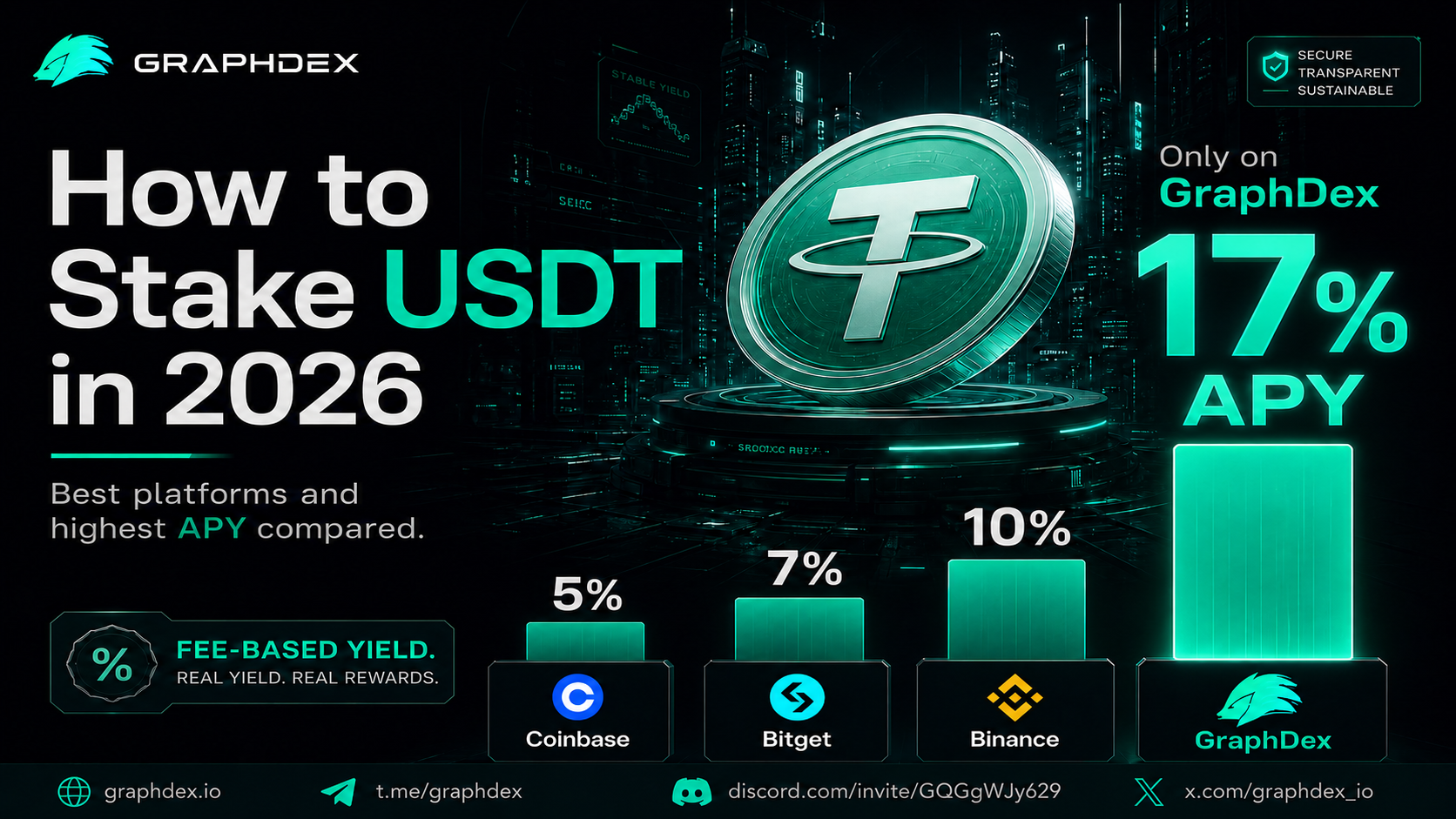
To stake USDT in 2026, deposit your USDT into a staking platform that pays yield from lending or platform fees. Rates range widely:
- Exchanges (Binance, Bybit): around 8-10% APY
- Mid-tier platforms (Bitget, Coinbase): around 4-7% APY
- GraphDex: up to 17% APY, generated from platform trading fees
Because USDT is pegged to the US dollar, you earn yield without exposure to crypto price volatility. The highest sustainable rates come from platforms generating yield from real revenue rather than temporary promotions.
Stake USDT at up to 17% APY on GraphDex
Key Takeaways
- USDT staking lets you earn yield on dollar-pegged stablecoins without price volatility risk.
- Most platforms pay 4-10% APY on USDT; GraphDex pays up to 17% from platform trading fees.
- USDT "staking" is technically lending/yield — you deposit and the platform generates returns.
- Always check the yield source, lock-up terms, and platform security before committing funds.
What Is USDT Staking?
USDT staking is the practice of depositing Tether (USDT) into a platform to earn yield. Unlike proof-of-stake cryptocurrencies that generate rewards through network validation, USDT staking technically refers to lending or depositing your stablecoins into platforms that use those funds for revenue-generating activities — lending to borrowers, providing liquidity, or funding platform operations.
The appeal is straightforward: USDT is pegged 1:1 to the US dollar. A $10,000 USDT deposit remains worth $10,000 regardless of crypto market conditions. You earn predictable, dollar-denominated returns without the stomach-churning drawdowns of volatile assets like Bitcoin or Ethereum.
This makes USDT staking ideal for conservative investors, anyone holding cash reserves in crypto, or traders who want their idle capital working between trades.
USDT Staking Rates Compared (2026)
| Platform | USDT APY | Type | Yield Source |
|---|---|---|---|
| GraphDex | Up to 17% | Platform | Trading fees |
| Bybit | High (variable) | Exchange | Lending |
| Binance | ~10% | Exchange | Lending |
| OKX | Variable | Exchange | Lending / pools |
| Bitget | 4-7.5% | Exchange | Lending + protection fund |
| Coinbase | ~5% | Exchange | Lending |
| Margex | 5% | Trading platform | Lending |
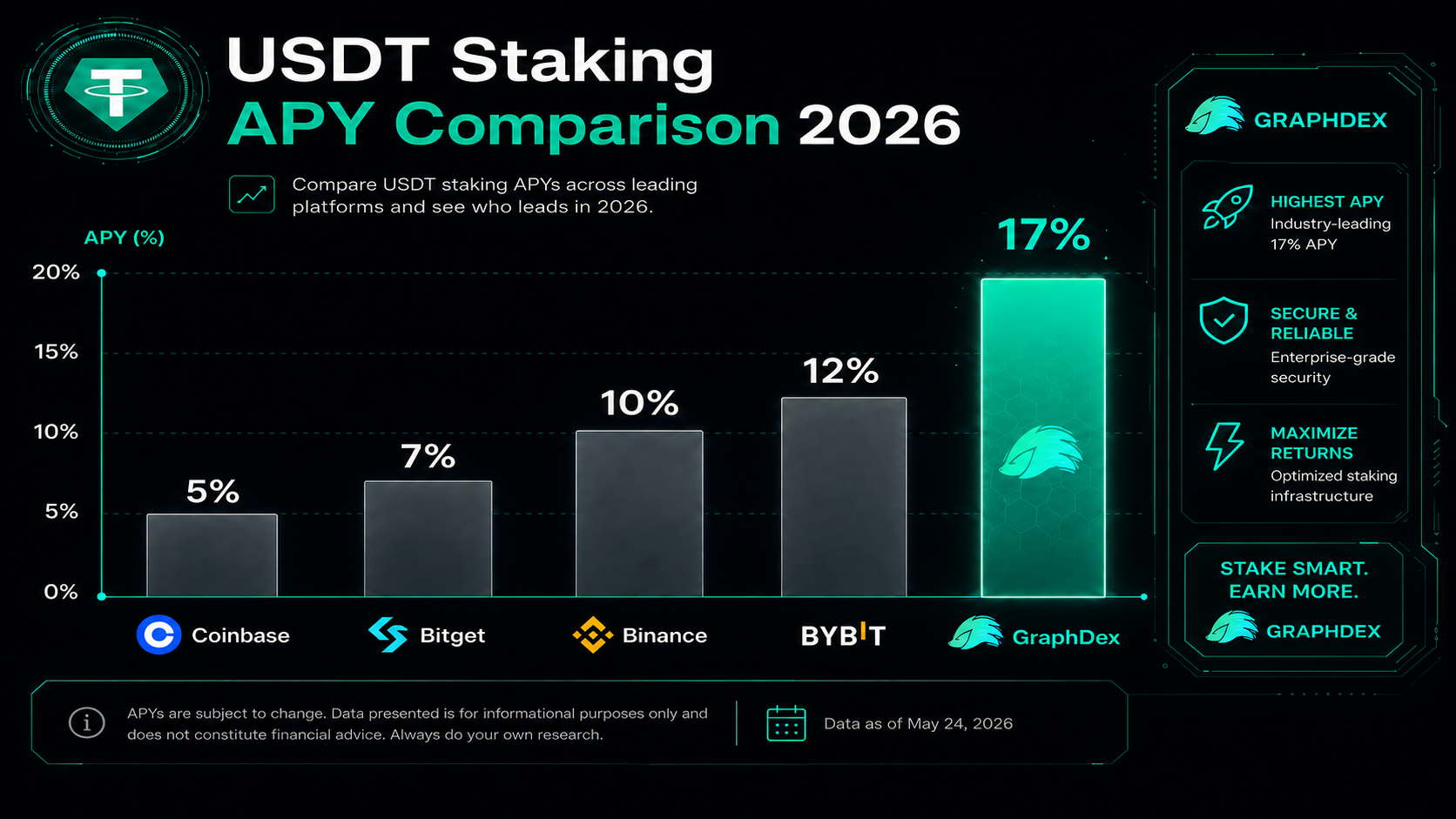
USDT staking rates are often the highest among stablecoins thanks to USDT's strong liquidity. Binance pays over 10% on USDT, while mid-tier platforms typically range from 4-7%. GraphDex's up to 17% stands out because its yield comes from a fundamentally different source — platform trading fees rather than lending markets or promotional rates.
Compare and stake USDT on GraphDex
Where Does USDT Staking Yield Come From?
This is the most important question to ask before staking USDT anywhere — and the one most guides skip.
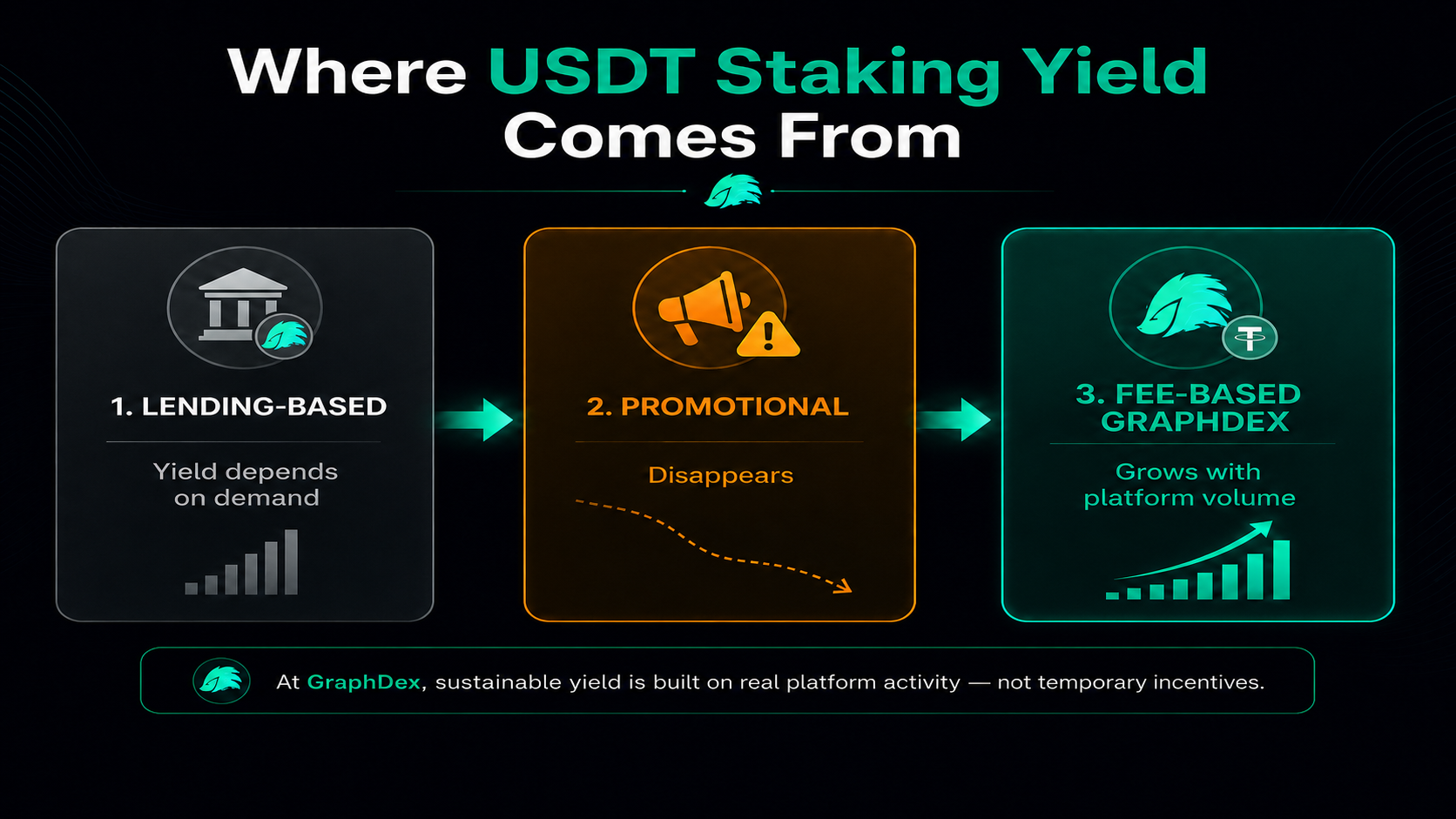
Lending-based yield (most exchanges) Platforms like Binance, Bybit, and Coinbase lend your USDT to borrowers — traders wanting leverage, institutions needing liquidity — and pay you a share of the interest. The yield depends on borrowing demand, which fluctuates. When demand is high, rates rise; when it falls, so do your returns.
Promotional yield (watch out) Some platforms advertise eye-catching rates — 38% or higher on certain pools — but these often have limited liquidity, short promotional windows, or hidden conditions. After reading the fine print, many users find real-world returns closer to 8%, or worse, their funds locked for months.
Fee-based yield (GraphDex) GraphDex generates USDT staking yield from platform trading fees and protocol revenue. Every trade on the terminal produces a fee; a defined share of that pool funds the staking yield. This is not lending demand and not a promotion — it is a share of real economic activity that scales with platform usage.
The distinction matters for sustainability. Lending yield rises and falls with borrowing demand. Promotional yield disappears when the promotion ends. Fee-based yield grows as more people trade on the platform.
How to Stake USDT on GraphDex: Step by Step
Step 1: Register Go to graphdex.io and sign in with Twitter, email, or Telegram via Privy. Your non-custodial wallet is created automatically — no seed phrase, no browser extension.
Step 2: Fund your wallet with USDT Send USDT to your wallet address from any exchange or wallet.
Step 3: Navigate to the Earn section Open the staking interface. You will see current APY rates and available lock periods for USDT.
Step 4: Choose your amount and term USDT supports flexible lock periods from 10 to 360 days, with deposits ranging from 50 to 600,000 USDT. Longer commitments earn the highest rates within the tier.
Step 5: Confirm Confirm the transaction from your wallet. Your USDT remains non-custodial — GraphDex never takes ownership. Yield accrues from platform fees.
Start staking USDT on GraphDex
USDT Staking Lock Periods and Deposit Ranges
On GraphDex, USDT staking offers flexible terms:
| Parameter | Range |
|---|---|
| APY | Up to 17% |
| Lock periods | 10, 20, 30, 90, 180, 360 days |
| Minimum deposit | 50 USDT |
| Maximum deposit | 600,000 USDT |
Shorter lock periods (10-30 days) offer liquidity and flexibility, while longer commitments (180-360 days) earn the highest rates. This lets you balance access to your funds against maximizing yield based on your needs.
USDT Staking vs Bank Savings
For most people, USDT staking is best understood in contrast to a traditional savings account.
A typical US savings account pays around 0.5% APY. A high-yield savings account might reach 4-5%. USDT staking on GraphDex pays up to 17% — several times higher.
The trade-offs:
- Bank savings are FDIC-insured (in the US) up to limits, fully regulated, and government-backed.
- USDT staking is not government-insured and carries platform and smart contract risk, but offers far higher yields and 24/7 access.
For capital you're comfortable holding in crypto, USDT staking offers dollar-denominated returns that traditional banking cannot match. For emergency funds you cannot risk, a bank remains appropriate. Many users split: emergency reserves in the bank, working capital earning yield in stablecoins.
Is USDT Staking Safe?
USDT staking carries real risks worth understanding:
Platform risk When you stake on a centralized exchange, that platform holds your USDT. If the platform fails or is hacked, your funds are at risk — as FTX demonstrated. GraphDex addresses this with non-custodial Privy architecture: your funds stay in your own wallet, and the platform cannot access them.
Smart contract risk Platforms and DeFi protocols run on code that can contain bugs. Look for platforms with security audits.
Yield sustainability risk Unusually high promotional rates can be unsustainable. Understand where the yield comes from — fee-based and lending-based yields are more durable than promotional rates that vanish.
Stablecoin peg risk While USDT is the most liquid stablecoin, all stablecoins carry a small risk of de-pegging from the dollar in extreme conditions. USDT's deep liquidity makes this risk low but not zero.
Lock-up risk Fixed-term staking locks your funds for the chosen period. Choose a term matching your liquidity needs.
How to Maximize Your USDT Staking Returns
Choose fee-based or sustainable yield Prioritize platforms where the yield source is transparent and durable. GraphDex's fee-based model scales with platform usage rather than depending on lending demand or promotions.
Match lock period to your needs Longer locks earn higher rates. If you won't need the capital, longer terms maximize yield. If you might, shorter flexible terms preserve access.
Compound your rewards Reinvesting your staking rewards rather than withdrawing them increases your effective annual yield through compounding.
Diversify across assets On GraphDex, USDT earns the highest stablecoin rate, but staking across USDT, USDC, and SOL diversifies your exposure while maintaining strong yields.
Keep records for taxes Staking rewards are generally taxable as income in most jurisdictions at the time you receive them. Track your rewards for tax reporting. This is general information, not tax advice — consult a professional in your country.
Maximize your USDT yield on GraphDex
USDT vs USDC Staking: Which Should You Stake?
USDT and USDC are the two largest stablecoins, and both are popular for staking. Here's how they compare.
USDT (Tether) holds about 60% of the stablecoin market by capitalization. Its deep liquidity often means USDT staking rates are among the highest available, because borrowing demand for USDT is strong. If you want maximum yield and are comfortable with USDT, it typically offers the best stablecoin rates.
USDC (USD Coin) is issued by Circle, a regulated firm holding 1:1 cash reserves audited monthly. Many users prefer USDC for its transparency and regulatory standing, accepting slightly lower yields in exchange for that assurance.
On GraphDex, both are supported with strong rates — USDT reaches the highest stablecoin tier, while USDC follows closely. Many stakers diversify across both: USDT for maximum yield, USDC for its regulatory transparency. Splitting between them balances yield optimization against issuer diversification.
The practical takeaway: if you already hold USDT, staking it on GraphDex captures the highest stablecoin rate. If you hold USDC or prefer Circle's regulated model, USDC staking on the same platform offers comparable, strong returns.
Stake USDT and USDC on GraphDex
Related Guides
- Best Solana Staking in 2026: Native, Liquid & Stablecoin Options Compared
- Best Stablecoin Staking Rates in 2026: Where to Earn the Highest APY
- Stablecoin Yield 2026: Best USDC/USDT APY (3–17%) Compared
Frequently Asked Questions
How much can you earn staking USDT in 2026? Most platforms pay 4-10% APY on USDT. Binance pays over 10%, mid-tier platforms 4-7%. GraphDex pays up to 17% because its yield comes from platform trading fees rather than lending markets or promotions.
Is staking USDT safe? USDT staking carries platform risk, smart contract risk, and small peg risk. Non-custodial platforms like GraphDex keep your funds in your own wallet, eliminating the custodial risk that affected platforms like FTX. Always check platform security and yield sustainability.
What is the best platform to stake USDT? For the highest yield, GraphDex pays up to 17% APY with non-custodial architecture. Binance and Bybit offer strong exchange-based rates around 8-10%. The best choice depends on whether you prioritize yield, regulation, or custody control.
How is GraphDex able to pay up to 17% on USDT when others pay 10%? GraphDex generates yield from platform trading fees rather than lending demand or promotions. As trading volume grows, the fee pool grows. This is a fundamentally different and more sustainable source than lending-based or promotional yields.
Can I unstake USDT anytime? It depends on the term you choose. GraphDex offers flexible lock periods from 10 to 360 days. Shorter periods provide quicker access; longer periods earn higher rates. Choose a term matching your liquidity needs.
Is USDT staking the same as SOL staking? No. SOL staking earns rewards from Solana network validation (5-8% typically). USDT staking earns yield from lending or platform fees. USDT offers price stability since it's pegged to the dollar, while SOL carries price volatility alongside its staking yield.
Do I pay tax on USDT staking rewards? In most jurisdictions, staking rewards are taxable as income when received. Tax treatment varies by country. Keep records of your rewards and consult a tax professional familiar with crypto in your jurisdiction. This is general information, not tax advice.
About This Guide
This guide is published by the GraphDex Research team — analysts and traders building the infrastructure for digital asset trading on Solana. Our content is based on live platform data, current market figures, and hands-on experience with the tools and platforms covered.
Sources & data: Staking rates, platform statistics, and competitor data reflect publicly available information as of 2026. APY rates are variable and not guaranteed; staking carries risk. This guide is educational and not financial advice.
GraphDex is the infrastructure for digital asset trading — trade, predict, and earn in one place. Learn more at graphdex.io.
Last reviewed: May 2026 · GraphDex Research
The infrastructure for digital asset trading. Trade, predict, stake, repeat. graphdex.io