By GraphDex Research · Reviewed for accuracy May 2026
Quick Answer
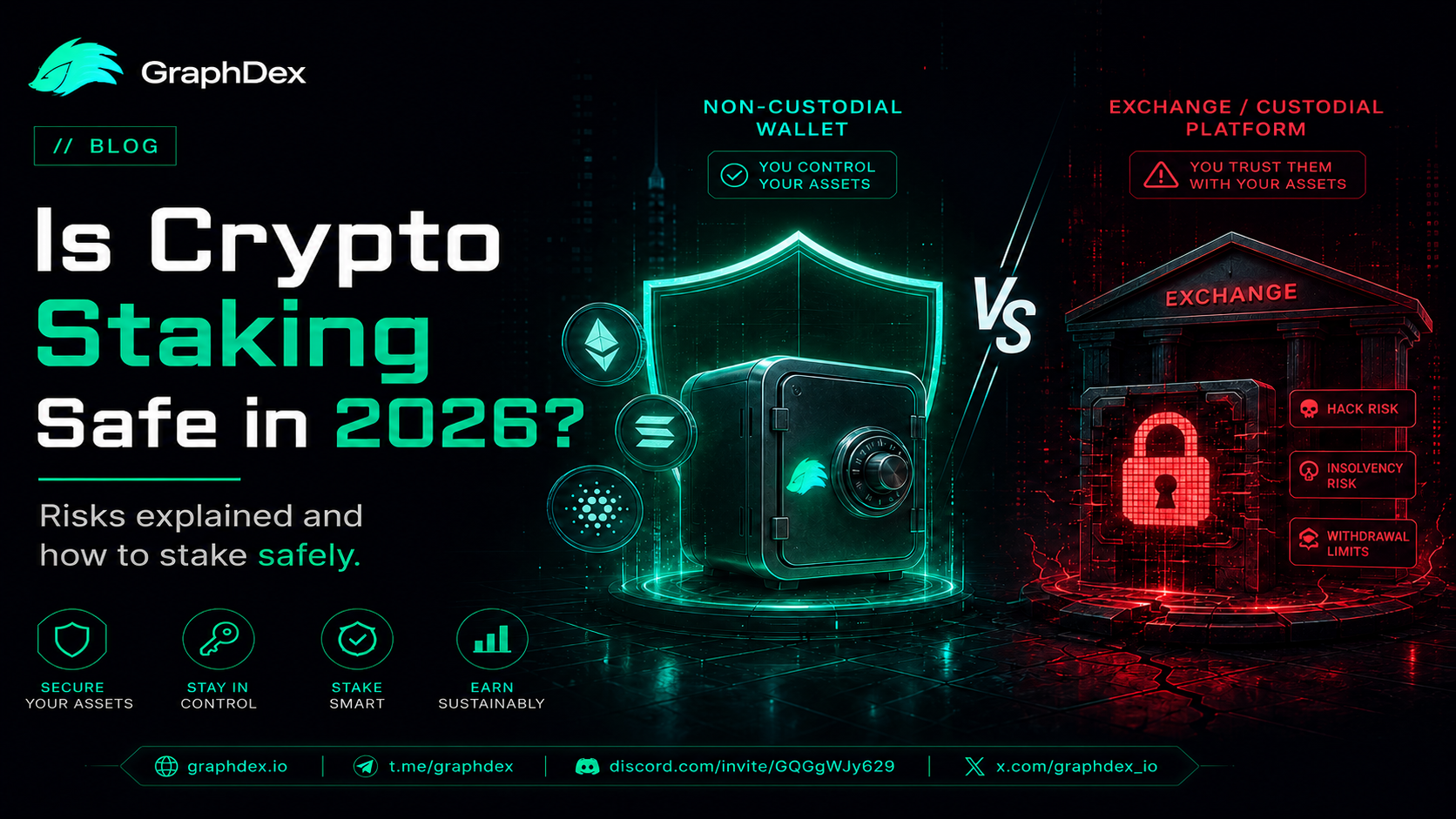
Crypto staking is reasonably safe when done correctly, but it is not risk-free. Safety depends on three factors:
- Custody — non-custodial staking (you hold the keys) is safer than custodial exchange staking (the platform holds your funds).
- Platform quality — audited, established platforms are safer than unknown ones offering suspicious rates.
- Asset type — stablecoin staking avoids price volatility; Proof-of-Stake token staking adds slashing and price risk.
The biggest historical losses came from custodial platforms failing (FTX, Celsius). Non-custodial staking like GraphDex eliminates that specific risk by keeping funds in your own wallet.
Stake safely with non-custodial GraphDex
Key Takeaways
- Crypto staking is reasonably safe when done right, but carries real risks worth understanding.
- The biggest historical losses came from custodial platforms failing — not from staking itself.
- Non-custodial staking (GraphDex via Privy) keeps funds in your wallet, eliminating custodial risk.
- Stablecoin staking avoids price volatility; verify platform audits and yield sources before staking.
Is Crypto Staking Safe? The Honest Answer
Crypto staking is reasonably safe when done correctly — but "safe" is relative, and the risks are real. The key insight most guides miss: the biggest staking losses in crypto history did not come from staking itself. They came from trusting the wrong custodian.
When FTX collapsed in 2022, users lost billions — not because staking failed, but because a centralized platform held their funds and misused them. The same pattern repeated with Celsius and others. The lesson: the danger usually isn't the staking mechanism, it's who controls your funds while they're staked.
This is why custody is the single most important safety factor. Non-custodial staking — where you keep control of your own keys — eliminates the exact risk that caused the largest losses. GraphDex uses non-custodial Privy architecture specifically for this reason: your funds never leave your wallet.
The Main Risks of Crypto Staking
Understanding each risk — and how serious it actually is — lets you stake intelligently.
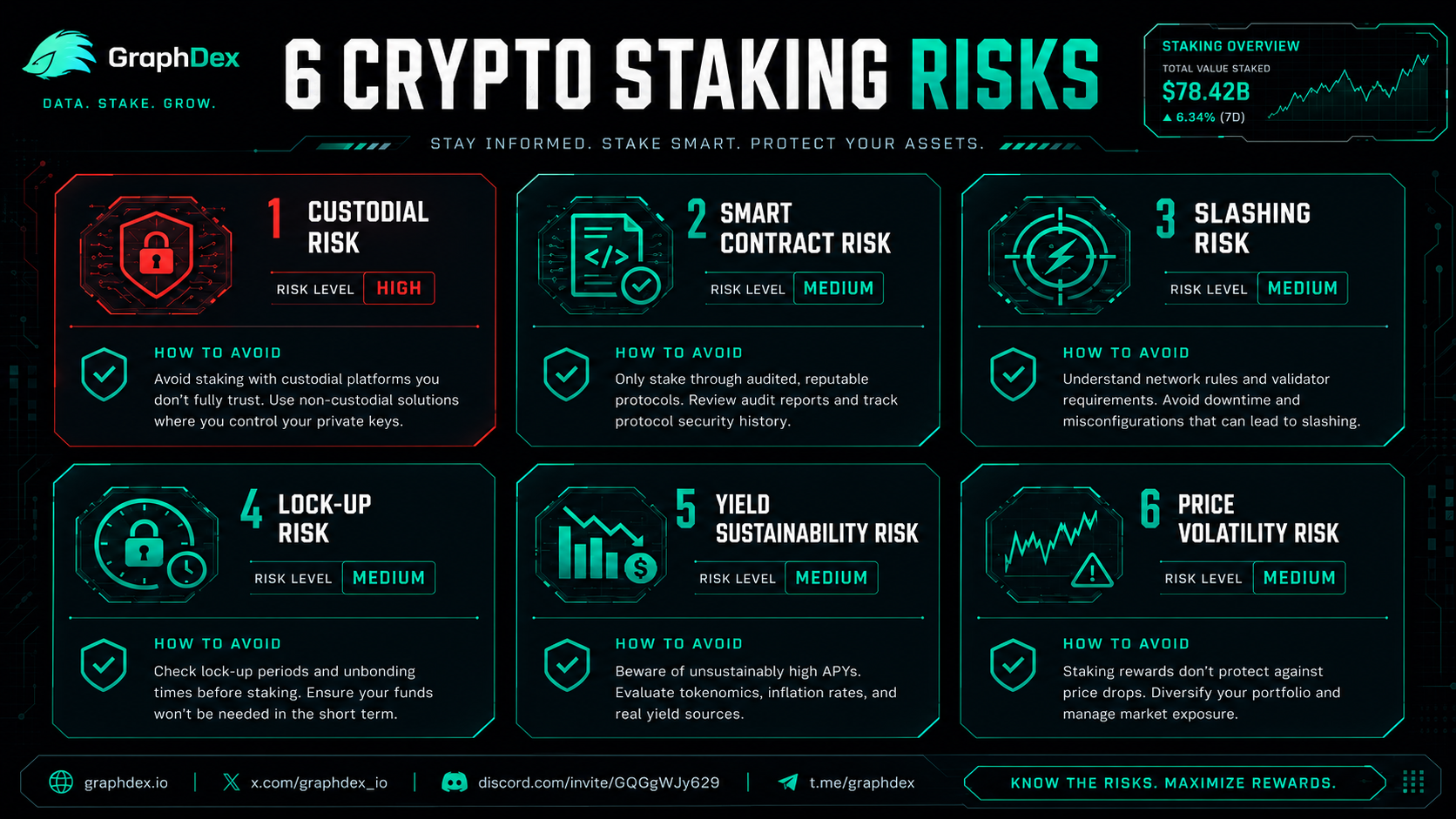
1. Custodial Risk (Highest Historical Impact)
When you stake on a centralized exchange, that platform holds your funds. If it's hacked, becomes insolvent, or misuses deposits, you can lose everything. This is the risk that caused the largest crypto losses in history.
How to avoid it: Use non-custodial platforms where you control your keys. On GraphDex, the Privy architecture means the platform cannot access, move, or freeze your funds — they stay in your wallet.
2. Smart Contract Risk
Staking platforms and DeFi protocols run on code. Bugs or exploits in that code can lead to losses, regardless of custody.
How to avoid it: Use platforms with security audits from reputable firms. Established protocols with long track records and large amounts staked have been more battle-tested.
3. Slashing Risk (Proof-of-Stake only)
On Proof-of-Stake networks, if your chosen validator misbehaves or has poor uptime, a portion of your stake can be "slashed" as a penalty.
How to avoid it: Choose validators with strong track records, high uptime, and slashing protection. This risk applies only to PoS network staking, not stablecoin yield staking.
4. Lock-Up / Liquidity Risk
Fixed-term staking locks your funds for a set period. Native PoS staking has unbonding periods. If you need funds urgently, you may not be able to access them.
How to avoid it: Match lock periods to your liquidity needs. Use flexible or shorter terms for funds you might need; longer terms only for capital you can commit.
5. Yield Sustainability Risk
Unusually high advertised rates — 30%, 40%, or more — are often unsustainable promotions or hide conditions. When the promotion ends or conditions aren't met, real returns can be far lower.
How to avoid it: Understand where the yield comes from. Fee-based yield (like GraphDex's, from trading fees) and established lending yields are more sustainable than promotional rates.
6. Price Volatility Risk (Proof-of-Stake tokens)
If you stake a volatile token like SOL, your yield is in that token — and the token's price can fall more than your yield gains.
How to avoid it: Stake stablecoins (USDT, USDC) for yield without price exposure. Stablecoin staking earns dollar-denominated returns regardless of crypto market conditions.
How Safe Is Stablecoin Staking Specifically?
Stablecoin staking is generally the safest form of staking, because it removes the volatility risk that affects Proof-of-Stake tokens.
When you stake USDC or USDT, your principal stays pegged to the dollar — a $10,000 deposit remains worth $10,000. You avoid the scenario where your staking yield is wiped out by the staked token's price falling.
The remaining risks for stablecoin staking are custodial risk (solved by non-custodial platforms), smart contract risk (mitigated by audits), and a small peg risk (low for USDC with its monthly-audited 1:1 reserves, and for USDT with its deep liquidity).
This is why risk-aware stakers often prefer stablecoin staking: it offers strong yields (up to 17% on GraphDex) with fewer risk dimensions than volatile-token staking.
Stake stablecoins safely on GraphDex
Custodial vs Non-Custodial Staking: The Critical Safety Distinction
This distinction matters more than any other for staking safety.
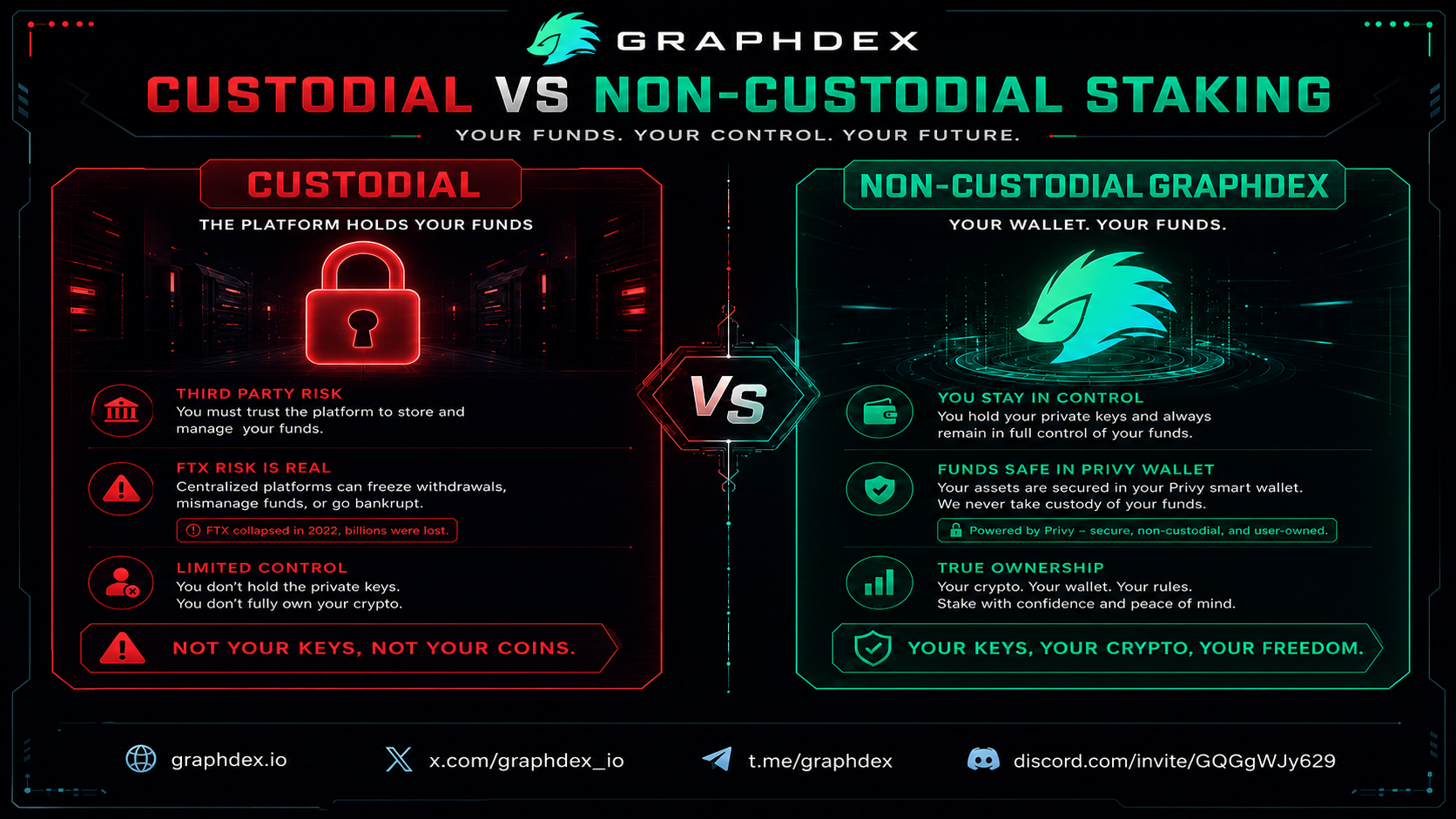
| Custodial Staking | Non-Custodial Staking | |
|---|---|---|
| Who holds your funds | The platform | You |
| Risk if platform fails | Lose funds | Funds safe in your wallet |
| Example | Exchange staking | GraphDex (Privy) |
| FTX-style risk | Yes | No |
| Convenience | High | High (with modern wallets) |
Custodial staking (on exchanges like Binance or Coinbase) is convenient, but you're trusting the platform with your funds. If it fails, you're an unsecured creditor — as FTX users learned.
Non-custodial staking keeps funds in your own wallet. The platform facilitates staking but cannot touch your assets. GraphDex uses Privy non-custodial architecture, so even if anything happened to the platform, your funds remain yours.
After FTX and Celsius, non-custodial architecture has become the baseline expectation for serious crypto participants. It directly eliminates the risk that caused the largest losses in crypto history.
How to Stake Crypto Safely: A Checklist
Follow these practices to minimize staking risk:
Use non-custodial platforms. Keep control of your own keys. This eliminates the custodial risk that caused the biggest historical losses.
Verify platform security. Look for audits from reputable firms, a track record, and transparency about how the platform operates.
Understand the yield source. Know whether yield comes from network rewards, lending, or fees. Be skeptical of unusually high promotional rates.
Choose stablecoins for lower risk. Stablecoin staking avoids the price volatility that affects Proof-of-Stake tokens.
Match lock terms to your needs. Don't lock funds you might need urgently. Use flexible terms for liquidity, fixed terms only for committed capital.
Choose reputable validators (PoS). For network staking, pick validators with high uptime and slashing protection.
Start small. Test a platform with a smaller amount before committing significant capital.
Never stake more than you can afford to lock or lose. Even safe staking carries some risk.
Why GraphDex Is Built for Safe Staking
GraphDex addresses the major staking risks structurally:
Non-custodial by design — Privy architecture means your funds stay in your wallet. The platform cannot access them, eliminating the custodial risk behind FTX-style losses.
No seed phrase vulnerability — Privy uses MPC and threshold encryption, so there's no single seed phrase to lose or have phished.
Stablecoin options — staking USDT and USDC at up to 17% APY offers high yield without price volatility risk.
Transparent fee-based yield — yield comes from platform trading fees, a sustainable source tied to real activity, not promotional rates that vanish.
Flexible lock terms — periods from 10 to 360 days let you match commitment to your liquidity needs.
This combination directly addresses custodial risk, yield sustainability risk, and price volatility risk — the risks that matter most.
Experience safe, non-custodial staking on GraphDex
Staking Safety: Common Myths Debunked
Several misconceptions cause people to either avoid staking unnecessarily or stake recklessly. Here are the most common myths.
Myth 1: "All staking is gambling." Staking is not gambling. With stablecoin staking on a non-custodial platform, your principal stays pegged to the dollar and you earn a defined yield. The risks are platform and smart contract risk — manageable and understandable — not the random outcome of a bet.
Myth 2: "Higher APY is always better." A higher advertised rate often signals higher risk or an unsustainable promotion. A steady 17% from a transparent fee-based source is safer than a flashy 40% with hidden conditions. Always weigh the rate against the yield source and platform safety.
Myth 3: "Non-custodial is too complicated." Modern non-custodial platforms have eliminated the complexity. On GraphDex, the Privy wallet is created automatically with no seed phrase — onboarding takes two minutes, as simple as any app, while you keep full control of your funds.
Myth 4: "If a big exchange offers it, it must be safe." FTX was one of the biggest exchanges in the world. Size is not safety. Custodial risk exists regardless of platform size — which is why non-custodial staking is structurally safer than trusting any custodian, large or small.
Myth 5: "Staking locks your money forever." Lock terms are your choice. Flexible and short-term options exist alongside longer commitments. On GraphDex, terms range from 10 to 360 days — you decide the balance between liquidity and yield.
Understanding these realities lets you stake with appropriate confidence: neither avoiding a sound strategy out of unfounded fear, nor chasing dangerous rates out of naivety.
Stake with confidence on GraphDex
Frequently Asked Questions
Is crypto staking safe in 2026? Crypto staking is reasonably safe when done correctly, but not risk-free. The biggest historical losses came from custodial platforms failing, not staking itself. Non-custodial staking (like GraphDex) keeps funds in your wallet, eliminating that risk. Stablecoin staking further avoids price volatility.
Can you lose money staking crypto? Yes. Risks include platform failure (custodial staking), slashing penalties (Proof-of-Stake), smart contract bugs, and price declines (for volatile tokens). Non-custodial stablecoin staking on audited platforms minimizes these risks but doesn't eliminate them entirely.
What is the safest way to stake crypto? Stake stablecoins (USDT/USDC) on a non-custodial, audited platform. This combination avoids price volatility, eliminates custodial risk, and reduces smart contract exposure. GraphDex offers non-custodial stablecoin staking up to 17% APY.
Is staking safer than holding crypto? Staking adds yield to holding but introduces additional risks (smart contract, lock-up, slashing for PoS). For stablecoins, non-custodial staking carries minimal extra risk over holding while adding significant yield. For volatile tokens, you have the same price risk as holding plus staking-specific risks.
Why did people lose money staking on FTX and Celsius? Those were custodial platforms that held user funds and misused or lost them — the failure was custodial, not the staking mechanism. Non-custodial staking, where you keep your own keys, eliminates this specific risk.
Is stablecoin staking safe? Stablecoin staking is generally the safest form of staking because it avoids price volatility. Your principal stays pegged to the dollar. The main remaining risks — custodial and smart contract — are mitigated by using non-custodial, audited platforms like GraphDex.
How do I know if a staking platform is safe? Check whether it's non-custodial (you hold keys), has security audits, has a track record, and is transparent about its yield source. Be skeptical of unusually high promotional rates. Start with a small amount to test before committing more.
About This Guide
This guide is published by the GraphDex Research team — analysts and traders building the infrastructure for digital asset trading on Solana. Our content is based on live platform data, current market figures, and hands-on experience with the platforms covered.
Sources & data: Risk information and platform details reflect publicly available information as of 2026. Staking carries risk and APY rates are variable and not guaranteed. This guide is educational and not financial advice.
GraphDex is the infrastructure for digital asset trading — trade, predict, and earn in one place. Learn more at graphdex.io.
Last reviewed: May 2026 · GraphDex Research
The infrastructure for digital asset trading. Trade, predict, stake, repeat. graphdex.io