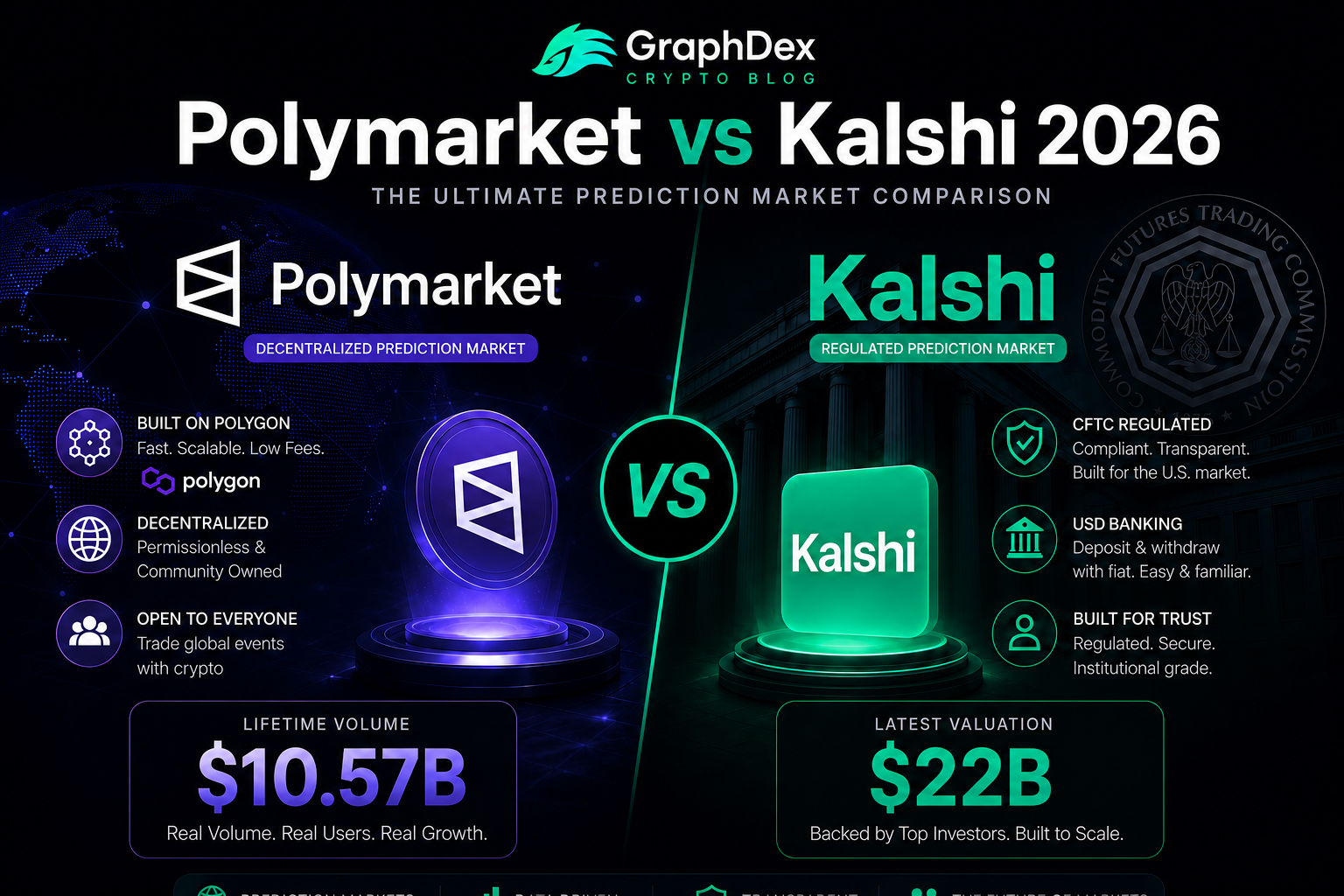
Quick Answer
Choose Kalshi if: you're a US user who wants federally regulated trading with traditional banking (Venmo, Visa, bank transfer) and full consumer protections.
Choose Polymarket if: you want the largest global volume, crypto-native settlement, the widest range of markets, and you're comfortable using a crypto wallet.
Both are excellent. The deciding factors are your location, whether you want crypto or traditional banking, and which markets you want to trade.
For Polymarket traders specifically, GraphDex adds copytrading and Solana DEX trading on top of Polymarket's markets in one terminal.
Trade Polymarket markets with copytrading on GraphDex
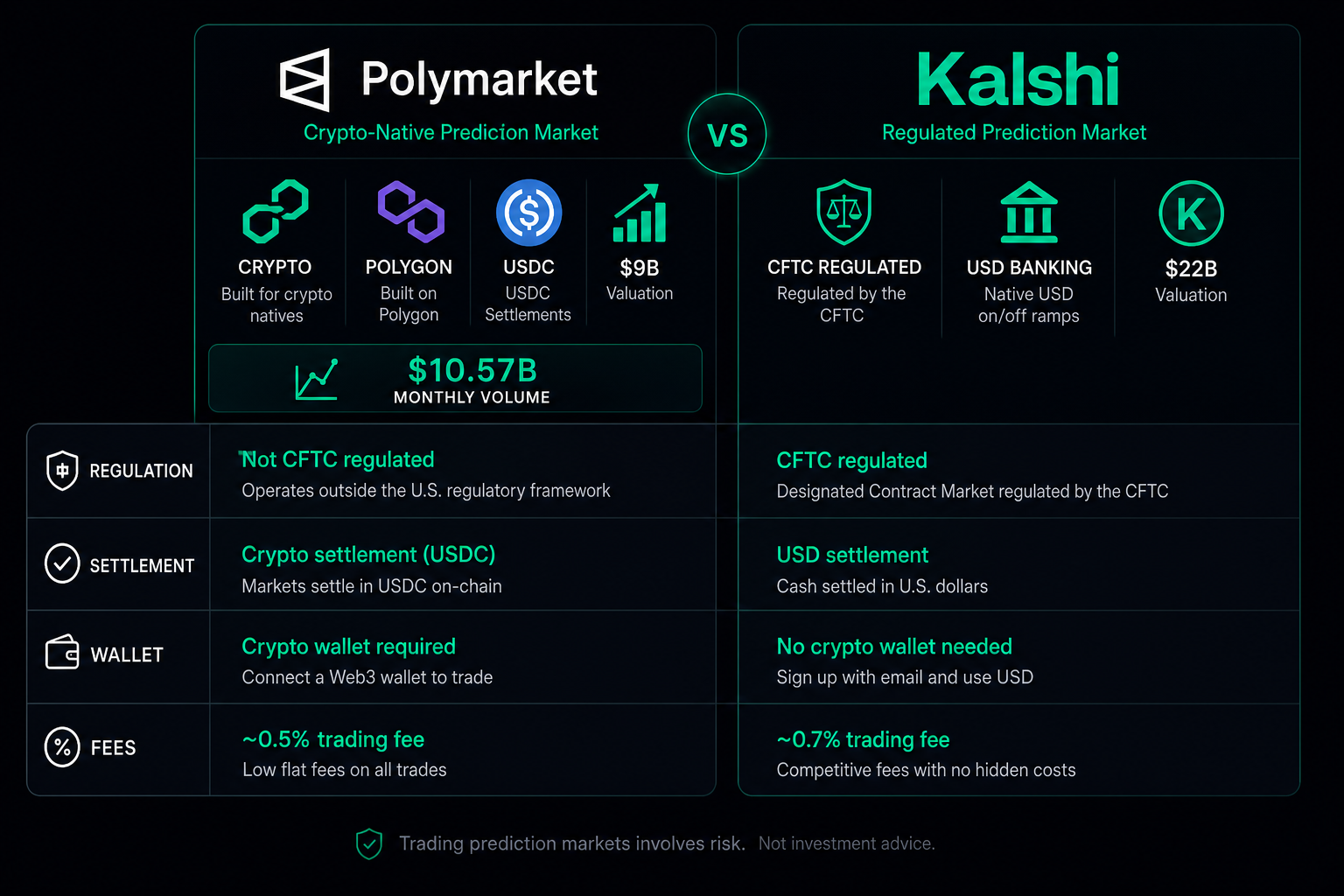
Polymarket vs Kalshi: At a Glance
| Feature | Polymarket | Kalshi |
|---|---|---|
| Regulation | Decentralized, crypto-native | CFTC-regulated (DCM) |
| Settlement | USDC on Polygon | USD, traditional banking |
| Valuation (2026) | ~$9 billion | ~$22 billion |
| Monthly volume | $10.57B (March 2026) | $8.5B (30-day) |
| Best for | Global, crypto-native traders | US users wanting legal clarity |
| Wallet required | Yes (crypto wallet) | No (bank/card) |
| Fees | Low taker fees, maker rebates | Maker/taker commissions vary |
| Markets | Politics, crypto, sports, world events | Politics, economics, weather, sports + |
| US availability | Returned as regulated platform | Available, most states |
Polymarket: The Global Volume Leader
Polymarket is the largest prediction market globally by trading volume. Launched in 2020 by Shayne Coplan, it gained global recognition during the 2024 US election when it processed over $3.5 billion in election volume and called the presidential race ahead of traditional media.
Polymarket is built on Polygon and settles in USDC. In October 2025, it was valued at $9 billion following a $2 billion investment from Intercontinental Exchange (the parent company of the New York Stock Exchange). In February 2026, it filed trademark applications for POLY and $POLY, linked to a potential native token launch.
Strengths:
- Largest global trading volume — $10.57 billion in March 2026
- Deepest order books — even multi-million dollar trades have minimal slippage
- Crypto-native, decentralized, on-chain settlement
- Widest range of crypto and global event markets
- Anticipated POLY token could add liquidity incentives
Weaknesses:
- Requires a crypto wallet and USDC
- Faced international bans (Portugal, Hungary in early 2026)
- More complex onboarding for non-crypto users
- Decentralized model means less traditional consumer protection
Polymarket is the choice for crypto-native traders who want the deepest liquidity and the widest market selection.
Kalshi: The Regulated US Leader
Kalshi is the first and most comprehensive CFTC-licensed event contract exchange in the United States. After winning its landmark federal lawsuit in 2024 to list political event contracts, Kalshi expanded rapidly into economics, weather, culture, and sports.
Kalshi's valuation surged from $2 billion in June 2025 to $22 billion in March 2026 — a 10x increase in nine months, making it the highest-valued prediction market platform. Robinhood generated roughly $25 million in Q3 revenue from prediction market activity through its Kalshi partnership.
Strengths:
- Full CFTC regulation — segregated, audited customer funds
- Traditional banking — Venmo, Visa, Mastercard, bank transfer
- Beginner-friendly, fintech-style interface
- Broadest range of regulated market categories
- No crypto wallet required
Weaknesses:
- US-focused — less accessible globally
- Faced state-level challenges (temporary ban in Massachusetts, January 2026)
- Maker/taker commissions apply (vary by market)
- Less crypto-native flexibility
Kalshi is the default choice for US users who want legal clarity, consumer protection, and the convenience of traditional banking.
Fees: Polymarket vs Kalshi
Fee structures differ significantly between the two platforms.
Polymarket historically charged no fees. In 2026, US users pay a small taker fee (around 0.01% on most contracts), scaling higher on short-duration crypto markets — up to around 1.56% when an outcome is near 50/50. Maker orders can earn rebates.
Kalshi applies maker and taker commissions that vary by market. The fee is calculated based on the contract price and trade size, generally designed to be competitive with other regulated venues.
For high-volume traders, Polymarket's maker rebates and historically low fees can offer an edge. For casual US traders who value regulatory protection, Kalshi's fee structure is straightforward and the regulatory wrapper justifies the cost.
Liquidity and Market Depth
Liquidity determines how easily you can enter and exit positions at fair prices.
Polymarket offers the deepest order books in the industry. With the anticipated POLY token launch, the platform has incentivized even more liquidity, ensuring multi-million dollar trades have minimal slippage. For large positions, Polymarket's depth is unmatched.
Kalshi processed over $8.5 billion in trading volume in a recent 30-day period — actually more than Polymarket's $2.7 billion in the same window by some on-chain measures, confirming Kalshi as a liquidity leader for regulated US markets. Liquidity is strong, especially in political and economic markets.
The takeaway: both have strong liquidity. Polymarket leads on the deepest crypto and global markets; Kalshi leads on regulated US political and economic contracts.
Market Selection
Kalshi offers thousands of contracts across 17 different sports, plus extensive coverage of economics (CPI, GDP, rate decisions), weather (hurricanes, temperature records), politics, and culture. Its regulated status lets it offer markets US users can trade legally.
Polymarket provides coverage across 14 sports plus deep crypto markets (Bitcoin price targets, ecosystem milestones), global conflict markets, political events worldwide, and emerging narratives. Its crypto-native model lets it list markets faster and cover global events.
If you want crypto price markets and global events, Polymarket has the edge. If you want regulated US economic and political contracts with the broadest sports coverage, Kalshi leads.
Regulation: The Key Difference
This is the single biggest distinction between the two platforms.
Kalshi is CFTC-regulated — a Designated Contract Market with segregated, audited customer funds. For US users, this means legal clarity and consumer protections similar to a regulated brokerage. Customer funds are protected, and the platform operates within a clear federal framework.
Polymarket operates as a crypto-native platform. It returned to the US as a regulated prediction market, but its decentralized, on-chain model is structurally different from Kalshi's centralized exchange. For some users, this means more flexibility and global access; for others, less traditional protection.
Both have faced regulatory friction: Kalshi was temporarily banned in Massachusetts (January 2026, subsequently challenged), and Polymarket faced a temporary restraining order in Nevada (February 2026) and bans in Portugal and Hungary. The prediction market regulatory landscape is still evolving.
Which Should You Choose?
Choose Kalshi if:
- You're a US resident wanting federally regulated trading
- You prefer traditional banking (Venmo, Visa, bank transfer)
- Consumer protection and legal clarity matter to you
- You want regulated economic and political contracts
- You're newer to trading and want a fintech-style interface
Choose Polymarket if:
- You want the largest global volume and deepest liquidity
- You're comfortable with a crypto wallet and USDC
- You want the widest range of crypto and global markets
- You trade large positions that need deep order books
- You want potential POLY token benefits
Use both if:
- You want maximum market coverage and the best price on each event — many serious traders maintain accounts on both.
Trade Polymarket markets on GraphDex
Beyond the Platforms: Using a Terminal
Whichever platform you choose, the native interface has limitations. Neither Polymarket nor Kalshi offers built-in copytrading to automatically follow winning traders.
This is where a terminal adds value. GraphDex integrates Polymarket prediction markets with copytrading — letting you follow top forecasters by PnL and win rate and mirror their positions automatically. It also combines prediction markets with Solana DEX trading in one interface, which neither native platform offers.
For crypto-native traders who already operate on Polygon and Solana, the terminal layer turns Polymarket from a standalone platform into part of an integrated trading workflow.
See how GraphDex adds copytrading to Polymarket
How to Get Started on Either Platform
Getting started on Polymarket:
- Set up a crypto wallet (or use GraphDex for an auto-created non-custodial wallet)
- Fund it with USDC on Polygon
- Browse markets and analyze prices
- Buy Yes or No shares on your chosen outcome
- Hold to resolution or sell early to lock in gains
Getting started on Kalshi:
- Create an account and verify your identity (KYC required)
- Deposit USD via bank transfer, Venmo, Visa, or Mastercard
- Browse the regulated market catalog
- Place orders on event contracts
- Hold or exit before resolution
The key onboarding difference reflects the core distinction: Polymarket is crypto-native (wallet + USDC), Kalshi is fintech-native (account + USD banking). GraphDex simplifies the Polymarket path by creating your wallet automatically with no seed phrase.
Polymarket and Kalshi Strategy Tips
Whichever platform you use, these principles apply:
Specialize in categories you understand. Your edge comes from knowing something the market hasn't priced. A crypto-focused trader has an advantage in Polymarket's crypto markets; a politics follower might prefer Kalshi's political contracts.
Compare prices across both. When the same event is listed on both platforms, prices can differ. Trading the better-priced side — or arbitraging the difference — is a legitimate strategy for traders with accounts on both.
Follow proven traders. Some forecasters consistently outperform. On Polymarket, GraphDex copytrading lets you follow them automatically. This is one of the fastest ways to learn what edge looks like in practice.
Manage liquidity risk. In thinner markets on either platform, wide spreads make entry and exit expensive. Stick to liquid markets unless you have strong conviction.
Use the early-exit option. Both platforms let you sell before resolution. Taking profit when a position has moved in your favor — rather than always holding to the end — is a valid risk management approach.
Trade smarter on Polymarket with GraphDex
The Bigger Picture: A $1 Trillion Industry
The Polymarket vs Kalshi rivalry is the headline event in a rapidly expanding sector. Together, the two platforms play a massive role in the roughly $10 to $13 billion traded through US prediction markets each month. Experts believe the industry's annual trading volume could reach $1 trillion by 2030.
This growth is attracting institutional capital (BitGo and Susquehanna launched institutional OTC access in March 2026), mainstream partnerships (Robinhood, DraftKings, Crypto.com, Gemini all entered the space), and a generational shift toward prediction markets as trusted information sources.
For traders, the competition is good news: deeper liquidity, lower fees, better interfaces, and more markets. Whether you choose Polymarket, Kalshi, or both, you're participating in one of the fastest-growing markets in finance.
Related Guides
- Prediction Market Copy Trading in 2026: The Complete Guide
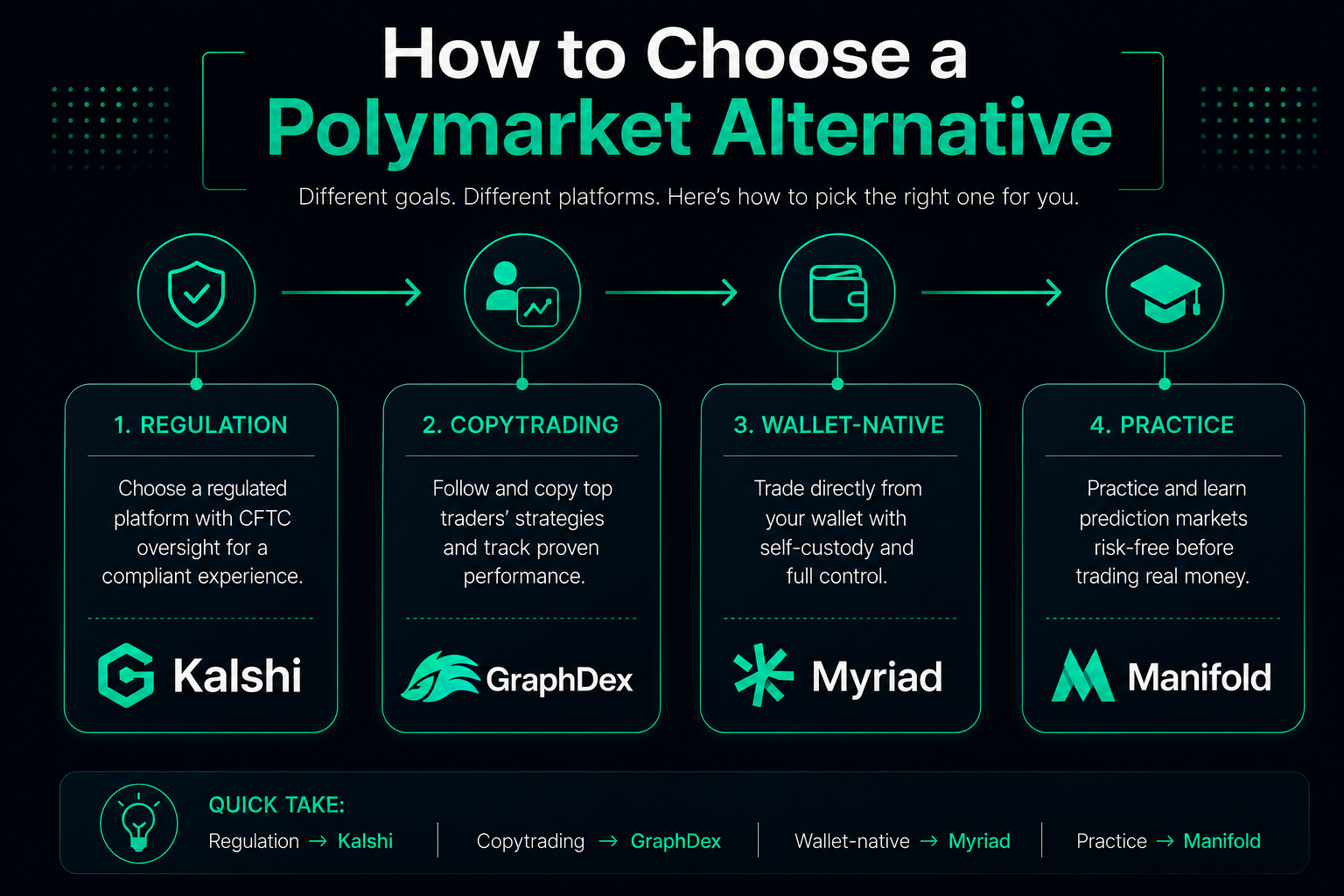
- Best Polymarket Alternatives 2026: Kalshi, GraphDex & 8 More Compared
- How to Make Money on Polymarket in 2026: 6 Proven Strategies
Frequently Asked Questions
Is Polymarket or Kalshi better? It depends on your needs. Kalshi is better for US users wanting federally regulated trading with traditional banking. Polymarket is better for crypto-native traders wanting the largest global volume and widest market selection. Both are leaders in the 2026 prediction market space.
Is Kalshi or Polymarket bigger? Kalshi has the higher valuation ($22 billion vs Polymarket's ~$9 billion in early 2026). Polymarket leads in global crypto-native trading volume ($10.57 billion in March 2026). Both process billions monthly.
Does Polymarket or Kalshi have lower fees? Polymarket historically charged no fees and now applies low taker fees with maker rebates. Kalshi applies maker/taker commissions that vary by market. For high-volume traders, Polymarket's structure can be cheaper; Kalshi's fees come with regulatory protection.
Is Polymarket legal in the US? Polymarket returned to the US as a regulated prediction market. Kalshi is the most clearly CFTC-regulated platform. Both have faced some state-level regulatory challenges, and the landscape continues to evolve.
Can I use both Polymarket and Kalshi? Yes. Many serious traders maintain accounts on both to access the widest market coverage and get the best price on each event. They serve overlapping but distinct market categories.
Do I need crypto for Polymarket? Yes. Polymarket settles in USDC on Polygon and requires a crypto wallet. Kalshi uses traditional USD banking. GraphDex creates a non-custodial wallet automatically for trading Polymarket markets.
Can I copytrade on Polymarket or Kalshi? Neither platform offers built-in copytrading. GraphDex adds copytrading on top of Polymarket markets — letting you follow top forecasters and mirror their positions automatically, which the native interfaces do not support.
The infrastructure for digital asset trading. Trade, predict, stake, repeat. graphdex.io