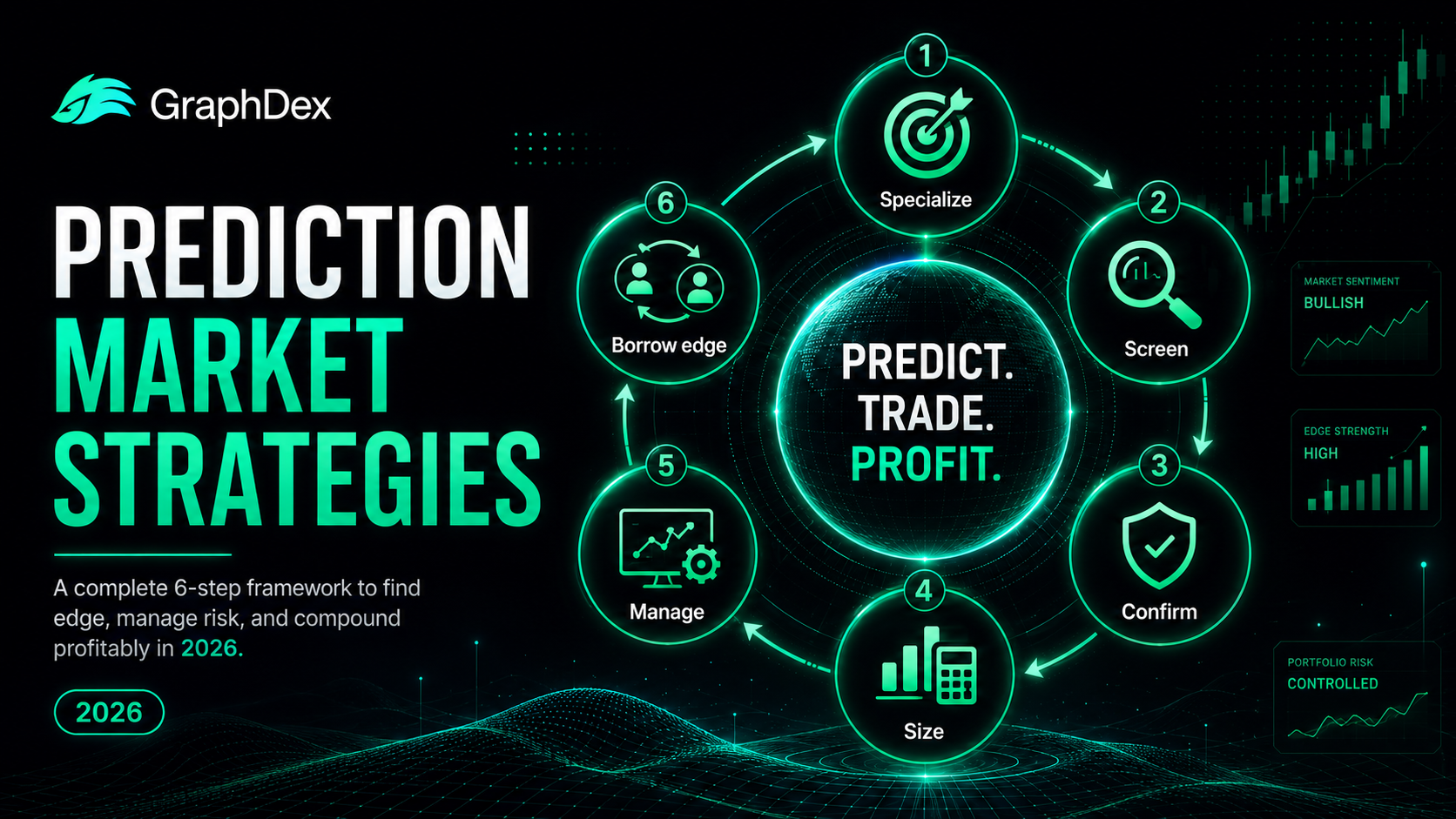
Quick Answer
The prediction market strategies that work in 2026:
- Trade only where you have edge — knowledge the market hasn't priced
- Find mispriced probability — gaps between your estimate and the market price
- Follow proven traders — copytrading the forecasters who consistently win
- Trade probability shifts — profit from price movement, not just outcomes
- Manage position size rigorously — survive variance to capture edge over time
- Use the early-exit advantage — take profit and cut losses before resolution
GraphDex supports these strategies with copytrading, whale tracking, and visual market screening.
Apply these strategies on GraphDex
The Core Principle: You Need an Edge
Before any specific strategy, understand the foundation: prediction market prices already reflect the collective knowledge of everyone trading. To profit consistently, you need an edge — you must know something, or analyze something, better than the market.
This is why "betting on what you hope happens" loses money. The market doesn't care about your hopes. It prices probability based on all available information. Your profit comes only from the gap between the market's estimate and the true probability — and you can only find that gap where you have genuine insight.
Every strategy below is a way to find, exploit, or borrow edge. Without edge, you're not trading — you're gambling.
Strategy 1: Specialize in What You Know
The single most reliable strategy is specialization. Trade markets where your knowledge exceeds the average participant's.
If you follow crypto closely, you understand catalysts, sentiment, and technical factors that casual traders miss — so crypto markets are where you have edge. If you're a sports analyst, sports markets. If you follow politics obsessively, political markets.
Why it works: In your area of expertise, you can spot mispriced probabilities the generalist market misses. The crypto specialist sees a Bitcoin market priced at 40% and knows, from genuine analysis, that it should be 60%.
How to apply it: Pick one or two categories. Go deep. Ignore markets outside your expertise no matter how tempting. A focused specialist consistently beats a scattered generalist.
Strategy 2: Find Mispriced Probability
The mechanical core of profitable prediction market trading is finding markets where the price doesn't match the true probability.
The process:
- Form your own probability estimate based on analysis
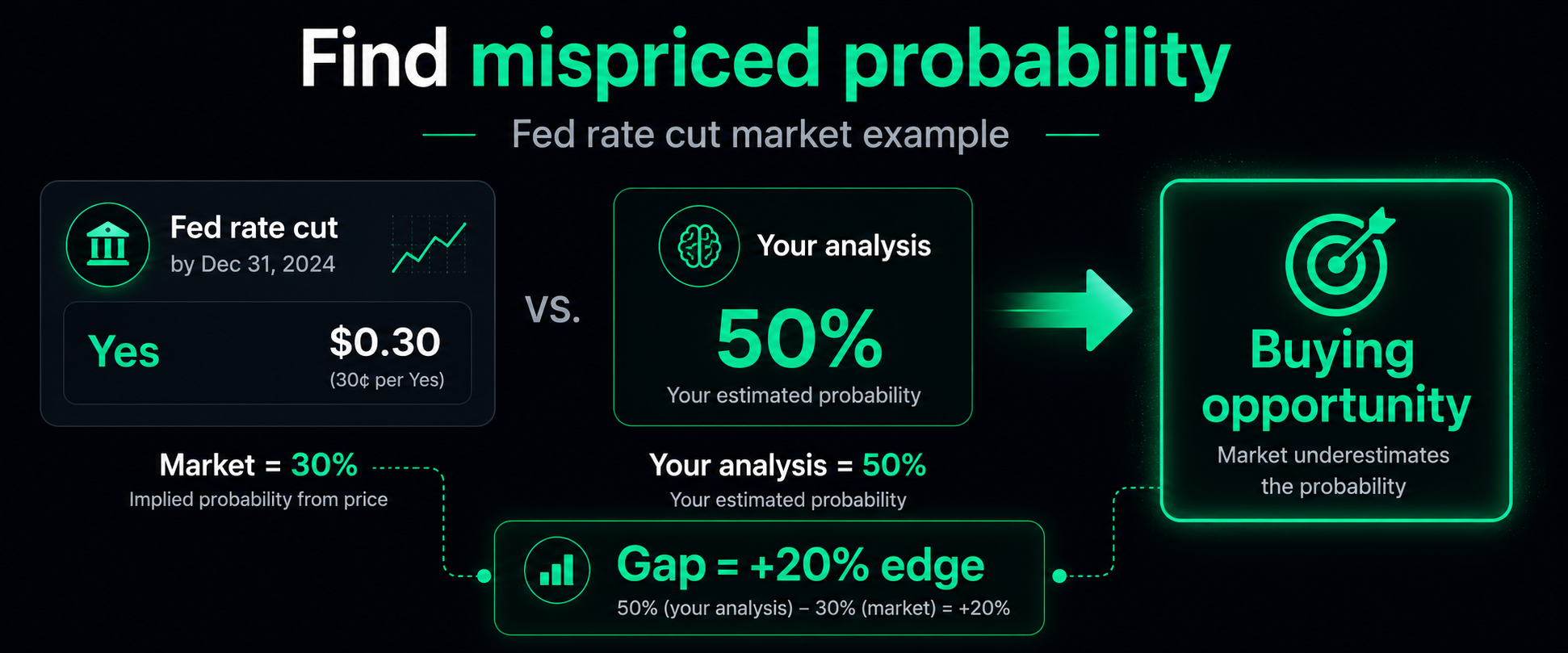
- Compare it to the market price (which is the market's probability estimate)
- If your estimate is meaningfully higher than the price, the Yes shares may be underpriced — a buying opportunity
- If meaningfully lower, the No shares may be underpriced
Example: A market asks "Will the Fed cut rates this quarter?" Yes shares trade at $0.30 (30% implied). Your analysis of recent economic data suggests the real probability is closer to 50%. The gap — 50% vs 30% — is your edge. You buy Yes at $0.30.
The skill is in forming accurate probability estimates. This requires genuine analysis, not gut feeling. The traders who profit are those whose estimates are consistently more accurate than the market's.
Strategy 3: Follow Proven Traders (Copytrading)
You don't have to generate all your own edge. You can borrow it from traders who have proven theirs.
Some prediction market traders consistently profit. Their track records — PnL, win rate, volume — are measurable and, on decentralized platforms, publicly verifiable. Copytrading lets you automatically mirror their positions.
Why it works: Following a trader with a proven, consistent track record means borrowing their edge. You don't need to be an expert forecaster yourself if you can identify and follow proven ones.
How to apply it: Use a terminal like GraphDex to rank forecasters by PnL, win rate, and volume. Select traders with long, consistent records — not one-time winners. Mirror their positions automatically within your own risk parameters.
This is one of the most accessible strategies for newer traders: instead of competing against experts, follow them.
Copytrade proven forecasters on GraphDex
Strategy 4: Trade Probability Shifts, Not Just Outcomes
A common mistake is treating every position as a hold-to-resolution bet. Profitable traders often trade the movement of probability, not the final outcome.
The approach: Buy when a market underprices an outcome. Sell when the price corrects toward fair value — without waiting for the event to resolve.
Example: You buy Yes shares at $0.40 because you believe the real probability is 60%. Over the next week, news emerges and the market price rises to $0.58. You can sell now, capturing most of the gain, rather than holding through resolution risk.
Why it works: Probability shifts happen constantly as new information arrives. Capturing these movements lets you profit repeatedly without exposure to the binary resolution. It also frees capital faster for new opportunities.
This is closer to active trading than betting — and it's how many professional prediction market traders actually operate.
Strategy 5: Manage Position Size Rigorously
Edge means nothing if variance wipes you out before it plays out. Position sizing is what separates traders who survive from those who don't.
Core rules:
- Never risk more on one market than you can afford to lose. Even 80%-probability outcomes fail 20% of the time.
- Size positions relative to your conviction and edge. Larger positions only where your edge is strongest and clearest.
- Diversify across markets. Spreading capital across several uncorrelated positions smooths variance.
- Avoid concentration in correlated markets. Five positions all dependent on the same event aren't diversification — they're one big bet.
Why it matters: Prediction markets are probabilistic. Even a perfect strategy loses individual bets. Position sizing ensures that no single loss — or losing streak — ends your trading. Survive the variance, and your edge compounds over time.
Strategy 6: Use the Early-Exit Advantage
Unlike fixed-odds betting, prediction markets let you sell before resolution. This is a strategic tool, not just an escape hatch.
Take profit early. When a position has moved significantly in your favor, taking the gain locks in profit and removes resolution risk. A bird in the hand.
Cut losses. When new information makes your thesis wrong, exiting at a loss is better than holding to a $0.00 resolution. Preserving capital lets you trade another day.
Reallocate capital. Selling a position that's reached fair value frees capital for new mispriced opportunities. Capital efficiency compounds returns.
Why it works: The early-exit option turns prediction markets from binary bets into dynamic positions you can manage as information evolves. Traders who use it well outperform those who simply hold everything to resolution.
Strategy 7: Use Whale and Momentum Signals
Combine your own analysis with market signals for stronger conviction.
Whale tracking: When a trader with a proven track record places a large bet, it's a signal worth investigating. Their move may reflect information you don't have.
Momentum screening: Tools like GraphDex's Bubbles visual screener show which markets have rising or falling probability across the board. A market turning sharply on strong volume signals something is happening.
Confluence: The strongest signals combine multiple inputs. Your own analysis, plus a proven whale positioning the same direction, plus momentum confirming — that confluence is high-conviction.
Use whale and momentum signals on GraphDex
Common Strategic Mistakes
Trading on hope, not analysis. Betting on what you want to happen rather than what's likely. The market doesn't reward optimism.
Trading outside your edge. Jumping into markets you don't understand because they look exciting. Stick to your specialties.
Over-sizing on conviction. Being so sure you bet too much, then getting wiped by the 20% that happens anyway.
Holding everything to resolution. Ignoring the early-exit option and exposing every position to full binary risk.
Chasing whales blindly. Following large trades without checking the trader's track record or whether the trade makes sense.
Ignoring liquidity. Trading thin markets where wide spreads erode your edge before the outcome even matters.
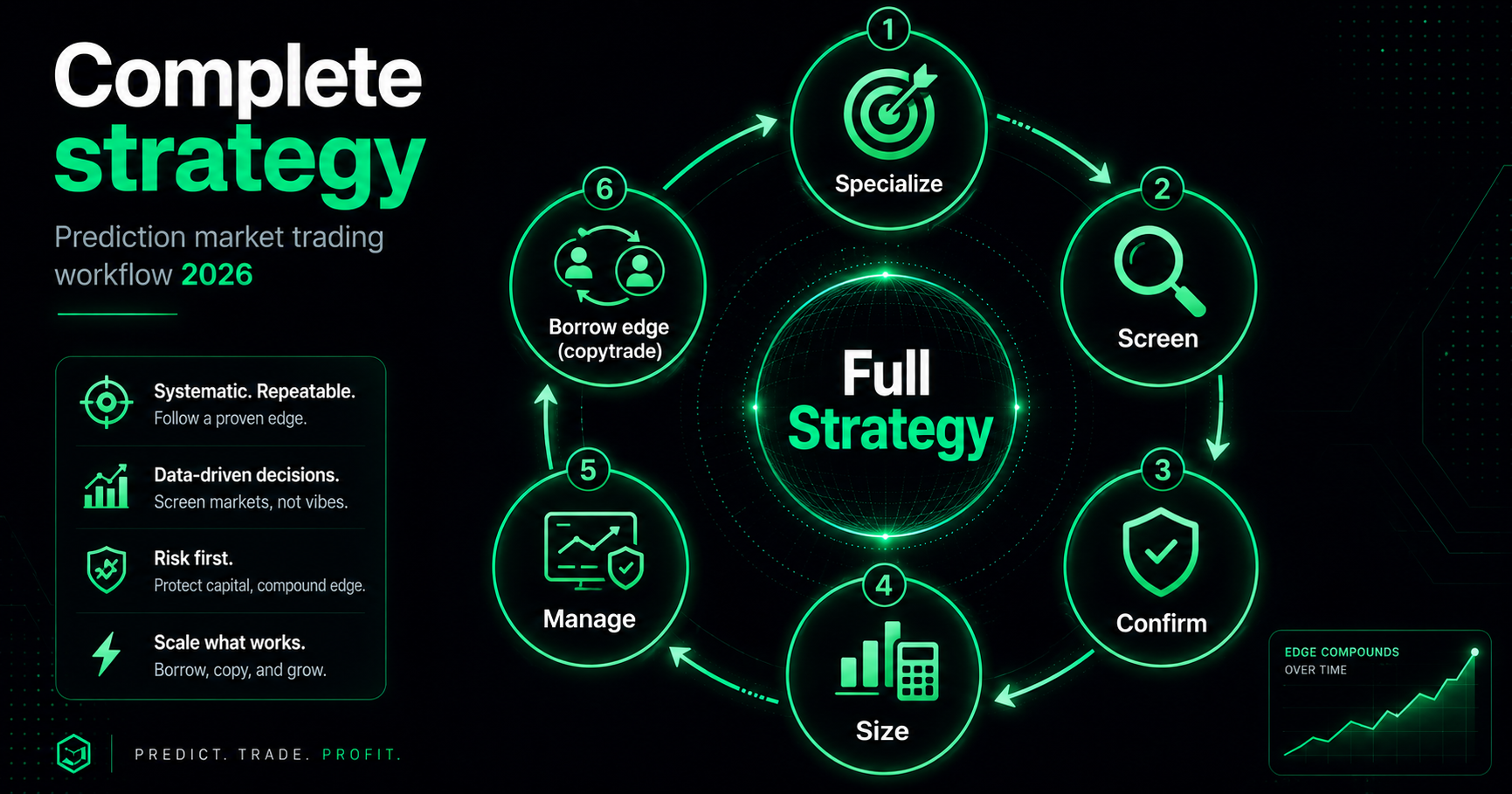
Putting It Together: A Complete Strategy
The strategies above combine into a coherent approach:
- Specialize in one or two categories where you have genuine knowledge
- Screen for mispriced markets using your analysis and momentum tools
- Confirm with whale signals and your own probability estimate
- Size positions according to conviction and edge, diversified across markets
- Manage actively — take profit on probability shifts, cut losses when wrong
- Borrow edge by copytrading proven forecasters in categories outside your expertise
GraphDex supports this complete workflow: the Bubbles screener for finding opportunities, whale tracking and copytrading for borrowing edge, and integrated execution for acting fast — all in one terminal.
The traders who profit consistently aren't lucky. They have edge, they manage risk, and they use the tools that let them act on signals faster than the market adjusts.
Build your prediction market strategy on GraphDex
Bankroll Management for Prediction Markets
Even the best strategy fails without disciplined bankroll management. This is the framework that lets your edge survive long enough to compound.
Define your total bankroll. Decide how much capital you're willing to allocate to prediction markets — money you can afford to lose entirely. This is your trading bankroll, separate from savings or essential funds.
Set a per-trade cap. A common guideline is risking no more than 2-5% of your bankroll on any single market, with the higher end reserved for your highest-conviction, strongest-edge positions. This ensures no single loss is catastrophic.
Scale with edge, not emotion. Bet bigger only where your analytical edge is clearest — not because you feel confident or want to recover a loss. Confidence and edge are different things.
Track your performance by category. Keep records of your results in each market category. Over time, this reveals where you genuinely have edge and where you're just guessing. Double down on the former, abandon the latter.
Avoid tilt. After a loss, the urge to immediately recover by betting bigger is the fastest way to ruin. Stick to your sizing rules regardless of recent results. Variance is normal; discipline is what separates winners.
Bankroll management isn't glamorous, but it's what turns a good strategy into consistent profit. The traders who last are the ones who never let a single position — or a bad streak — threaten their ability to keep trading.
Trade with discipline on GraphDex
Frequently Asked Questions
What is the best prediction market trading strategy? The most reliable strategy is specializing in categories where you have genuine knowledge, then finding markets where the price doesn't match the true probability. Combine this with rigorous position sizing and, where helpful, copytrading proven forecasters.
Can you actually make money on prediction markets? Yes, but only with genuine edge — knowing or analyzing something better than the market. Most casual participants don't profit consistently. Profitable traders specialize, find mispriced probability, manage risk, and often borrow edge through copytrading.
How do I find mispriced prediction markets? Form your own probability estimate through analysis, then compare it to the market price. When your estimate meaningfully differs from the price, there may be an edge. This requires genuine analysis in categories you understand well.
Should I hold prediction market positions to resolution? Not always. The early-exit option lets you take profit when a position moves in your favor or cut losses when your thesis is wrong. Trading probability shifts — rather than always holding to resolution — is how many professionals operate.
Is copytrading a good prediction market strategy? Yes, especially for newer traders. Copytrading lets you borrow edge from proven forecasters. Use a terminal like GraphDex to follow traders ranked by PnL and win rate, and mirror their positions automatically within your risk limits.
How much should I risk per prediction market trade? Never more than you can afford to lose on a single market. Size positions according to your conviction and edge, and diversify across uncorrelated markets. Even high-probability outcomes fail, so position sizing is what lets your edge compound over time.
What's the biggest mistake in prediction market trading? Trading on hope rather than analysis — betting on what you want to happen instead of what's likely. The market prices probability objectively; profit comes only from genuine edge, not optimism.
The infrastructure for digital asset trading. Trade, predict, stake, repeat. graphdex.io
Prediction Market Trading Strategies That Actually Work in 2026
Last updated: May 2026 | Reading time: 11 minutes
Most people approach prediction markets like gambling — betting on what they hope happens. Profitable traders do something different. This guide covers the prediction market trading strategies that actually work in 2026, from finding edge to managing risk to following smart money.
Quick Answer
The prediction market strategies that work in 2026:
- Trade only where you have edge — knowledge the market hasn't priced
- Find mispriced probability — gaps between your estimate and the market price
- Follow proven traders — copytrading the forecasters who consistently win
- Trade probability shifts — profit from price movement, not just outcomes
- Manage position size rigorously — survive variance to capture edge over time
- Use the early-exit advantage — take profit and cut losses before resolution
GraphDex supports these strategies with copytrading, whale tracking, and visual market screening.
Apply these strategies on GraphDex
The Core Principle: You Need an Edge
Before any specific strategy, understand the foundation: prediction market prices already reflect the collective knowledge of everyone trading. To profit consistently, you need an edge — you must know something, or analyze something, better than the market.
This is why "betting on what you hope happens" loses money. The market doesn't care about your hopes. It prices probability based on all available information. Your profit comes only from the gap between the market's estimate and the true probability — and you can only find that gap where you have genuine insight.
Every strategy below is a way to find, exploit, or borrow edge. Without edge, you're not trading — you're gambling.
Strategy 1: Specialize in What You Know
The single most reliable strategy is specialization. Trade markets where your knowledge exceeds the average participant's.
If you follow crypto closely, you understand catalysts, sentiment, and technical factors that casual traders miss — so crypto markets are where you have edge. If you're a sports analyst, sports markets. If you follow politics obsessively, political markets.
Why it works: In your area of expertise, you can spot mispriced probabilities the generalist market misses. The crypto specialist sees a Bitcoin market priced at 40% and knows, from genuine analysis, that it should be 60%.
How to apply it: Pick one or two categories. Go deep. Ignore markets outside your expertise no matter how tempting. A focused specialist consistently beats a scattered generalist.
Strategy 2: Find Mispriced Probability
The mechanical core of profitable prediction market trading is finding markets where the price doesn't match the true probability.
The process:
- Form your own probability estimate based on analysis
- Compare it to the market price (which is the market's probability estimate)
- If your estimate is meaningfully higher than the price, the Yes shares may be underpriced — a buying opportunity
- If meaningfully lower, the No shares may be underpriced
Example: A market asks "Will the Fed cut rates this quarter?" Yes shares trade at $0.30 (30% implied). Your analysis of recent economic data suggests the real probability is closer to 50%. The gap — 50% vs 30% — is your edge. You buy Yes at $0.30.
The skill is in forming accurate probability estimates. This requires genuine analysis, not gut feeling. The traders who profit are those whose estimates are consistently more accurate than the market's.
Strategy 3: Follow Proven Traders (Copytrading)
You don't have to generate all your own edge. You can borrow it from traders who have proven theirs.
Some prediction market traders consistently profit. Their track records — PnL, win rate, volume — are measurable and, on decentralized platforms, publicly verifiable. Copytrading lets you automatically mirror their positions.
Why it works: Following a trader with a proven, consistent track record means borrowing their edge. You don't need to be an expert forecaster yourself if you can identify and follow proven ones.
How to apply it: Use a terminal like GraphDex to rank forecasters by PnL, win rate, and volume. Select traders with long, consistent records — not one-time winners. Mirror their positions automatically within your own risk parameters.
This is one of the most accessible strategies for newer traders: instead of competing against experts, follow them.
Copytrade proven forecasters on GraphDex
Strategy 4: Trade Probability Shifts, Not Just Outcomes
A common mistake is treating every position as a hold-to-resolution bet. Profitable traders often trade the movement of probability, not the final outcome.
The approach: Buy when a market underprices an outcome. Sell when the price corrects toward fair value — without waiting for the event to resolve.
Example: You buy Yes shares at $0.40 because you believe the real probability is 60%. Over the next week, news emerges and the market price rises to $0.58. You can sell now, capturing most of the gain, rather than holding through resolution risk.
Why it works: Probability shifts happen constantly as new information arrives. Capturing these movements lets you profit repeatedly without exposure to the binary resolution. It also frees capital faster for new opportunities.
This is closer to active trading than betting — and it's how many professional prediction market traders actually operate.
Strategy 5: Manage Position Size Rigorously
Edge means nothing if variance wipes you out before it plays out. Position sizing is what separates traders who survive from those who don't.
Core rules:
- Never risk more on one market than you can afford to lose. Even 80%-probability outcomes fail 20% of the time.
- Size positions relative to your conviction and edge. Larger positions only where your edge is strongest and clearest.
- Diversify across markets. Spreading capital across several uncorrelated positions smooths variance.
- Avoid concentration in correlated markets. Five positions all dependent on the same event aren't diversification — they're one big bet.
Why it matters: Prediction markets are probabilistic. Even a perfect strategy loses individual bets. Position sizing ensures that no single loss — or losing streak — ends your trading. Survive the variance, and your edge compounds over time.
Strategy 6: Use the Early-Exit Advantage
Unlike fixed-odds betting, prediction markets let you sell before resolution. This is a strategic tool, not just an escape hatch.
Take profit early. When a position has moved significantly in your favor, taking the gain locks in profit and removes resolution risk. A bird in the hand.
Cut losses. When new information makes your thesis wrong, exiting at a loss is better than holding to a $0.00 resolution. Preserving capital lets you trade another day.
Reallocate capital. Selling a position that's reached fair value frees capital for new mispriced opportunities. Capital efficiency compounds returns.
Why it works: The early-exit option turns prediction markets from binary bets into dynamic positions you can manage as information evolves. Traders who use it well outperform those who simply hold everything to resolution.
Strategy 7: Use Whale and Momentum Signals
Combine your own analysis with market signals for stronger conviction.
Whale tracking: When a trader with a proven track record places a large bet, it's a signal worth investigating. Their move may reflect information you don't have.
Momentum screening: Tools like GraphDex's Bubbles visual screener show which markets have rising or falling probability across the board. A market turning sharply on strong volume signals something is happening.
Confluence: The strongest signals combine multiple inputs. Your own analysis, plus a proven whale positioning the same direction, plus momentum confirming — that confluence is high-conviction.
Use whale and momentum signals on GraphDex
Common Strategic Mistakes
Trading on hope, not analysis. Betting on what you want to happen rather than what's likely. The market doesn't reward optimism.
Trading outside your edge. Jumping into markets you don't understand because they look exciting. Stick to your specialties.
Over-sizing on conviction. Being so sure you bet too much, then getting wiped by the 20% that happens anyway.
Holding everything to resolution. Ignoring the early-exit option and exposing every position to full binary risk.
Chasing whales blindly. Following large trades without checking the trader's track record or whether the trade makes sense.
Ignoring liquidity. Trading thin markets where wide spreads erode your edge before the outcome even matters.
Putting It Together: A Complete Strategy
The strategies above combine into a coherent approach:
- Specialize in one or two categories where you have genuine knowledge
- Screen for mispriced markets using your analysis and momentum tools
- Confirm with whale signals and your own probability estimate
- Size positions according to conviction and edge, diversified across markets
- Manage actively — take profit on probability shifts, cut losses when wrong
- Borrow edge by copytrading proven forecasters in categories outside your expertise
GraphDex supports this complete workflow: the Bubbles screener for finding opportunities, whale tracking and copytrading for borrowing edge, and integrated execution for acting fast — all in one terminal.
The traders who profit consistently aren't lucky. They have edge, they manage risk, and they use the tools that let them act on signals faster than the market adjusts.
Build your prediction market strategy on GraphDex
Bankroll Management for Prediction Markets
Even the best strategy fails without disciplined bankroll management. This is the framework that lets your edge survive long enough to compound.
Define your total bankroll. Decide how much capital you're willing to allocate to prediction markets — money you can afford to lose entirely. This is your trading bankroll, separate from savings or essential funds.
Set a per-trade cap. A common guideline is risking no more than 2-5% of your bankroll on any single market, with the higher end reserved for your highest-conviction, strongest-edge positions. This ensures no single loss is catastrophic.
Scale with edge, not emotion. Bet bigger only where your analytical edge is clearest — not because you feel confident or want to recover a loss. Confidence and edge are different things.
Track your performance by category. Keep records of your results in each market category. Over time, this reveals where you genuinely have edge and where you're just guessing. Double down on the former, abandon the latter.
Avoid tilt. After a loss, the urge to immediately recover by betting bigger is the fastest way to ruin. Stick to your sizing rules regardless of recent results. Variance is normal; discipline is what separates winners.
Bankroll management isn't glamorous, but it's what turns a good strategy into consistent profit. The traders who last are the ones who never let a single position — or a bad streak — threaten their ability to keep trading.
Trade with discipline on GraphDex
Frequently Asked Questions
What is the best prediction market trading strategy? The most reliable strategy is specializing in categories where you have genuine knowledge, then finding markets where the price doesn't match the true probability. Combine this with rigorous position sizing and, where helpful, copytrading proven forecasters.
Can you actually make money on prediction markets? Yes, but only with genuine edge — knowing or analyzing something better than the market. Most casual participants don't profit consistently. Profitable traders specialize, find mispriced probability, manage risk, and often borrow edge through copytrading.
How do I find mispriced prediction markets? Form your own probability estimate through analysis, then compare it to the market price. When your estimate meaningfully differs from the price, there may be an edge. This requires genuine analysis in categories you understand well.
Should I hold prediction market positions to resolution? Not always. The early-exit option lets you take profit when a position moves in your favor or cut losses when your thesis is wrong. Trading probability shifts — rather than always holding to resolution — is how many professionals operate.
Is copytrading a good prediction market strategy? Yes, especially for newer traders. Copytrading lets you borrow edge from proven forecasters. Use a terminal like GraphDex to follow traders ranked by PnL and win rate, and mirror their positions automatically within your risk limits.
How much should I risk per prediction market trade? Never more than you can afford to lose on a single market. Size positions according to your conviction and edge, and diversify across uncorrelated markets. Even high-probability outcomes fail, so position sizing is what lets your edge compound over time.
What's the biggest mistake in prediction market trading? Trading on hope rather than analysis — betting on what you want to happen instead of what's likely. The market prices probability objectively; profit comes only from genuine edge, not optimism.
The infrastructure for digital asset trading. Trade, predict, stake, repeat. graphdex.io