Quick Answer
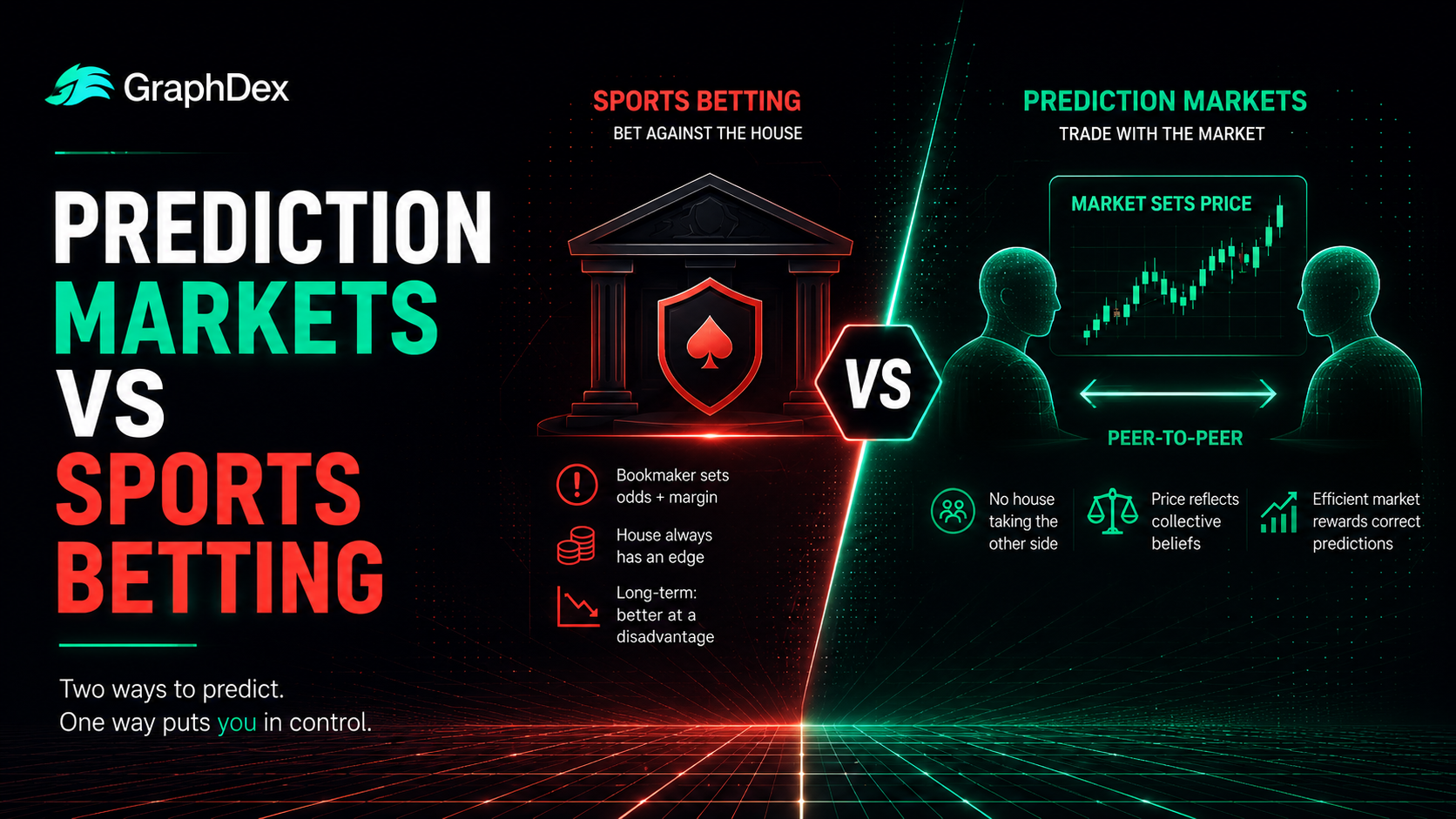
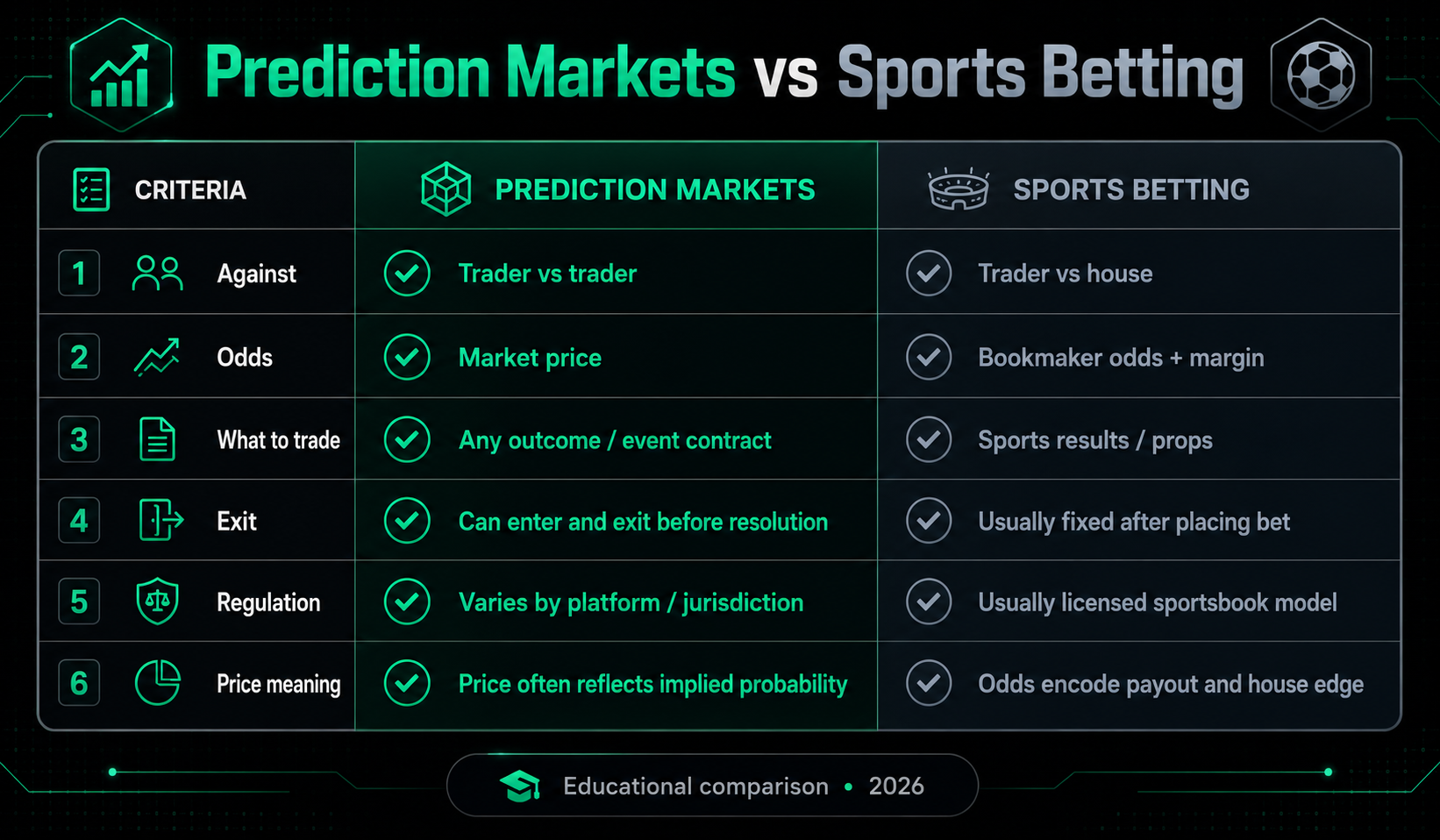
The core difference: in sports betting, you bet against a bookmaker who sets the odds with a built-in margin. In prediction markets, you trade with other people, and the collective trading sets the price — which reflects real probability.
| Sports Betting | Prediction Markets | |
|---|---|---|
| You trade against | The house | Other traders |
| Who sets the odds | Bookmaker | The market |
| What you can trade | Mostly sports | Politics, crypto, economics, weather, sports |
| Exit before resolution | Usually no | Yes — sell anytime |
| Regulation (US) | State by state | Federal (CFTC) |
| Price meaning | Odds + house margin | Real-time probability |
Prediction markets are peer-to-peer exchanges. Sports betting is betting against a house. This single structural difference drives everything else.
Trade prediction markets on GraphDex
The Fundamental Difference: Who You Trade Against
This is the distinction everything else flows from.
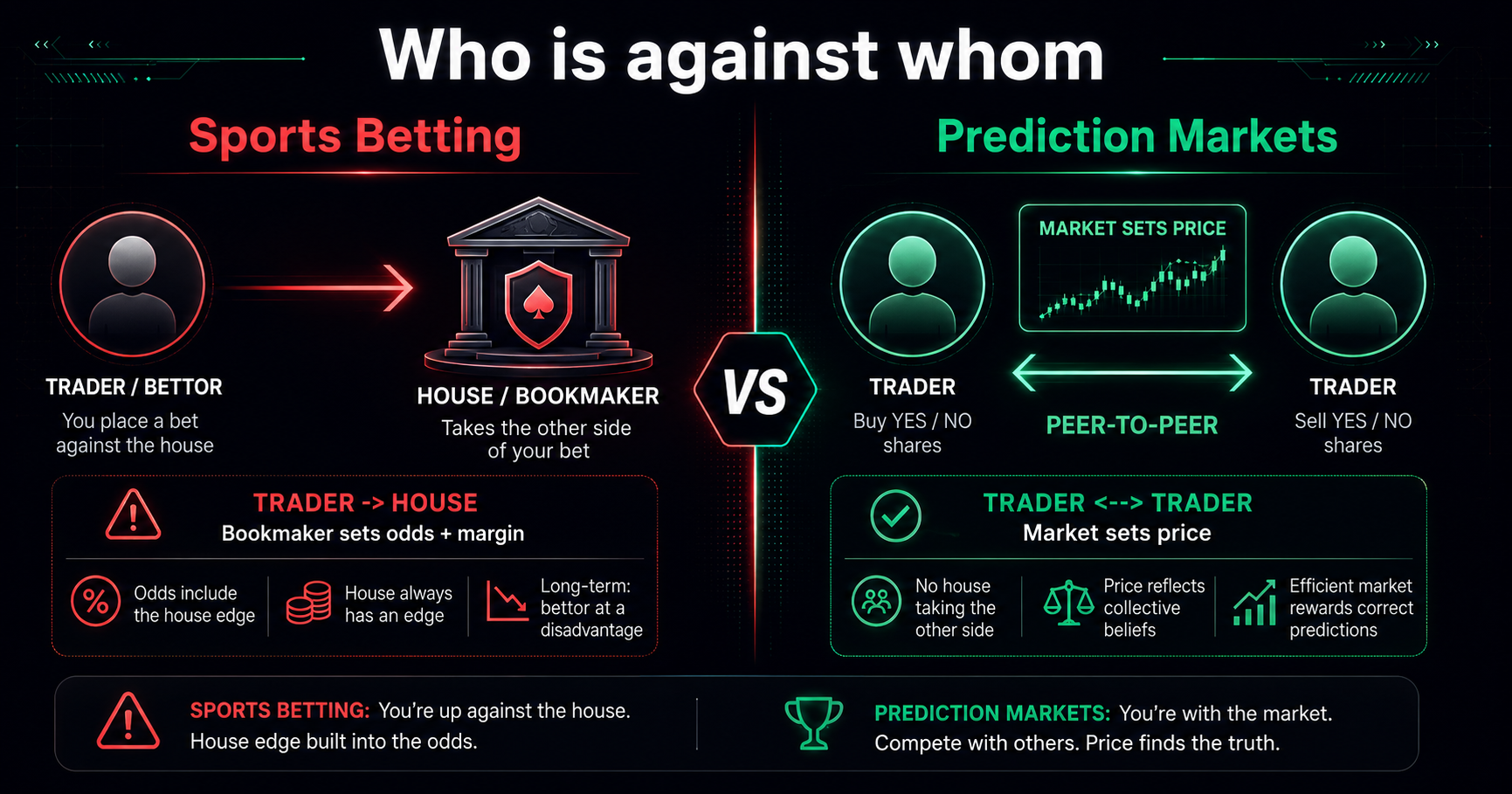
Sports betting is a bet against the house. The bookmaker sets the odds, builds in a margin (the "vig" or "juice"), and profits from the spread regardless of who wins. You're betting against the operator, and the operator structures the odds to ensure their long-term profit.
Prediction markets are peer-to-peer exchanges. There's no house setting odds. Prices are set by traders buying and selling — exactly like a stock exchange. When you buy a Yes share, someone else is selling it. The price reflects the collective probability estimate of everyone trading, not a bookmaker's margin.
Prediction platforms are peer-to-peer exchanges where contract prices are set by traders, reflecting real probability. Sportsbooks set their own odds and you bet against the house.
This is why prediction markets are often considered more accurate than sportsbook odds: the price isn't distorted by a house margin, and it updates continuously as traders with real information buy and sell.
Difference 2: What You Can Trade
Sports betting is, by definition, about sports — game outcomes, point spreads, player props, season futures. Some sportsbooks have expanded into novelty bets, but the core is sports.
Prediction markets cover almost any measurable future event. Politics (elections, policy decisions), economics (interest rates, inflation, GDP), crypto (Bitcoin price targets, ecosystem events), weather (hurricanes, temperatures), culture (awards, social trends) — and yes, sports too.
This breadth is a defining feature. On a prediction market, you can take a position on a Fed rate decision, a Bitcoin price target, and a championship game — all on the same platform, all with the same mechanics. Sports betting can't offer this range because it's structurally built around sports.
Difference 3: The Ability to Exit Early
Sports betting is typically all-or-nothing. You place a bet, and you wait for the outcome. Some sportsbooks offer "cash out" features, but they're at the bookmaker's discretion and pricing.
Prediction markets let you sell your position anytime before resolution, at the current market price. If your Yes shares rise from $0.40 to $0.70 before the event, you can sell and lock in the gain. If your thesis turns wrong, you can cut losses early.
This transforms the activity. Sports betting is a wager on an outcome. Prediction market trading is a position you actively manage as new information arrives — closer to trading stocks than placing a bet. You can trade the movement of probability itself, not just the final result.
Difference 4: Price Reflects Probability
Sports betting odds are set by the bookmaker to balance their book and guarantee margin. The odds reflect the bookmaker's risk management, not pure probability. The built-in vig means the implied probabilities of all outcomes add up to more than 100%.
Prediction markets prices are direct probability estimates. A Yes share at $0.64 means the market thinks there's a 64% chance. Because traders profit by being accurate, prices self-correct toward true probability. This is why media outlets increasingly cite prediction market odds alongside polls — the prices are genuine probability signals.
This accuracy is why prediction markets gained mainstream credibility. During the 2024 US election, Polymarket's odds were watched alongside traditional polling, and the platform processed over $3.5 billion in election volume — because people trusted the prices as information.
Difference 5: Regulation
Sports betting in the US is regulated state by state. Each state sets its own rules, licenses operators, and decides what's legal within its borders. This creates a patchwork — legal in some states, not others.
Prediction markets on regulated platforms are overseen federally by the CFTC (Commodity Futures Trading Commission). Kalshi is a CFTC-regulated Designated Contract Market. This federal framework treats event contracts as financial instruments, not gambling — a fundamentally different regulatory category.
This regulatory distinction matters. Prediction markets on CFTC-regulated platforms operate as financial exchanges, with the consumer protections and oversight that implies, rather than under state gambling laws.
Are Prediction Markets Just Gambling?
This is the most common question, and the answer is nuanced.
Structurally, prediction markets are financial instruments, not gambling. You're trading contracts whose prices reflect probability, on exchanges regulated as financial markets (in the case of CFTC-regulated platforms), with the ability to exit positions and the prices serving as genuine information signals.
The key differences from gambling:
- Peer-to-peer, not against a house — no built-in margin guaranteeing the operator profits from your loss
- Prices reflect real probability — not bookmaker-set odds
- You can exit anytime — manage positions dynamically
- Information value — prices are cited as forecasts by serious institutions
- Federal financial regulation — CFTC oversight, not state gambling law
That said, like any trading, prediction markets carry risk, and trading without edge will lose money over time — just as day-trading stocks without skill loses money. The distinction is that prediction markets are structured as markets, with the accuracy, flexibility, and regulation that implies.
Which Is Better for You?
Choose sports betting if:
- You only care about sports outcomes
- You prefer the simplicity of fixed odds
- You enjoy the sportsbook experience and promotions
Choose prediction markets if:
- You want to trade a wide range of events (politics, crypto, economics, sports)
- You want prices that reflect real probability, not house margins
- You want to exit positions before resolution
- You want to trade probability shifts, not just outcomes
- You prefer a financial-market structure over betting against a house
For traders who think analytically and want to apply knowledge across many domains, prediction markets offer more depth, flexibility, and better economics than sports betting.
How Prediction Markets and Crypto Trading Connect
For crypto-native traders, prediction markets are a natural extension of their existing activity. Crypto prediction markets — Bitcoin price targets, ecosystem events, regulatory outcomes — let you trade on the same narratives that drive your spot trading.
This is where a terminal like GraphDex adds value. It integrates Polymarket prediction markets with Solana DEX trading, so you can act on a narrative in both the spot market and the prediction market from one interface. A thesis about a crypto event can be expressed through token positions and prediction market positions simultaneously.
Add copytrading — following top forecasters automatically — and prediction markets become an integrated part of a crypto trading strategy rather than a separate gambling-adjacent activity.
Trade crypto prediction markets on GraphDex
The Bigger Picture: Why Prediction Markets Are Growing
Prediction markets are growing far faster than sports betting in 2026, and the structural differences explain why.
The sector traded over $64 billion in 2025, with US prediction markets processing $10-13 billion monthly and projections reaching $1 trillion annually by 2030. Institutional capital is entering (BitGo, Susquehanna, Intercontinental Exchange), mainstream platforms are integrating predictions (Robinhood, DraftKings, Crypto.com), and media treats prediction market odds as legitimate forecasts.
This growth reflects prediction markets' fundamental advantage: they're not just entertainment, they're information infrastructure. A prediction market price is a real-time, money-backed forecast of the future — useful to traders, analysts, journalists, and institutions in a way sportsbook odds never were.
Sports betting remains large and popular. But prediction markets are becoming something bigger: a new financial instrument class with applications far beyond entertainment.
How Sports Bettors Can Transition to Prediction Markets
Many sports bettors are discovering prediction markets and finding the transition natural. If you're coming from sports betting, here's how the skills transfer and where they differ.
What transfers: Your ability to assess probability, manage a bankroll, and avoid emotional decisions all apply directly. A sharp sports bettor who beats the closing line is already doing probability analysis — prediction markets reward exactly that skill, without the house margin working against you.
What's new: The peer-to-peer structure means you're competing against other traders, not a bookmaker. There's no margin to overcome, but also no soft lines to exploit — the market price is generally efficient. Your edge comes from genuine information or analysis, not from finding a slow bookmaker.
The early-exit adjustment: Sports bettors are used to holding to the final whistle. On prediction markets, learning to trade probability shifts — taking profit when your position moves in your favor before resolution — is a new skill that significantly improves results.
Broader markets: A sports bettor's analytical skills can extend beyond sports. The same probability assessment that works on a game can be applied to economics, politics, or crypto markets — opening far more opportunities than sports alone.
For sports bettors who think analytically, prediction markets offer better economics (no house edge), more markets, and the flexibility to manage positions. GraphDex makes the transition smoother for crypto-curious bettors by integrating prediction markets with crypto trading and adding copytrading to follow proven forecasters while you learn.
The Role of Terminals in Prediction Market Trading
Whether you come from sports betting or crypto, a terminal improves your prediction market results in ways the native platforms can't.
The native Polymarket and Kalshi interfaces handle basic trading well. But they don't let you follow winning traders automatically, don't surface whale activity, and don't integrate with your broader trading. A terminal like GraphDex adds these: copytrading to borrow edge from proven forecasters, the Bubbles screener to spot opportunities visually, and integration with Solana DEX trading for crypto-native traders.
This is the difference between treating prediction markets as occasional bets and treating them as a serious, managed part of your trading. The terminal provides the tools that turn probability assessment into a repeatable edge.
Trade prediction markets seriously on GraphDex
Frequently Asked Questions
What's the difference between prediction markets and sports betting? In sports betting, you bet against a bookmaker who sets odds with a built-in margin. In prediction markets, you trade with other people peer-to-peer, and prices reflect real probability. Prediction markets also cover far more than sports and let you exit positions before resolution.
Are prediction markets gambling? Structurally, prediction markets are financial instruments, not gambling. They're peer-to-peer exchanges where prices reflect probability, regulated federally by the CFTC (on regulated platforms) as financial markets rather than under state gambling law. Like all trading, they carry risk.
Are prediction markets more accurate than sportsbooks? Often, yes. Prediction market prices aren't distorted by a bookmaker's margin and update continuously as informed traders buy and sell. This is why media outlets cite prediction market odds as forecasts alongside polls.
Can I bet on sports through prediction markets? Yes. Prediction markets cover sports along with politics, crypto, economics, and more. The difference is you're trading peer-to-peer at probability-based prices, not against a bookmaker's odds, and you can exit before the game ends.
Is sports betting or prediction markets better? It depends on your goals. Sports betting suits those focused only on sports who prefer fixed odds. Prediction markets suit those who want to trade many event types, want prices reflecting real probability, and want to manage positions actively.
Why are prediction markets regulated differently? Regulated prediction markets like Kalshi are overseen federally by the CFTC as Designated Contract Markets, treating event contracts as financial instruments. Sports betting is regulated state by state under gambling law. This reflects the structural difference between trading financial contracts and betting against a house.
Can I trade crypto events on prediction markets? Yes. Prediction markets offer crypto markets — Bitcoin price targets, ecosystem events, regulatory outcomes. GraphDex integrates these with Solana DEX trading, letting crypto traders act on narratives in both spot and prediction markets from one terminal.
The infrastructure for digital asset trading. Trade, predict, stake, repeat. graphdex.io
Prediction Markets vs Sports Betting: What's the Difference in 2026?
Last updated: May 2026 | Reading time: 9 minutes
They look similar — you put money on an outcome and win if you're right. But prediction markets and sports betting are fundamentally different in structure, regulation, and economics. This guide explains the differences and why they matter for your money.
Quick Answer
The core difference: in sports betting, you bet against a bookmaker who sets the odds with a built-in margin. In prediction markets, you trade with other people, and the collective trading sets the price — which reflects real probability.
| Sports Betting | Prediction Markets | |
|---|---|---|
| You trade against | The house | Other traders |
| Who sets the odds | Bookmaker | The market |
| What you can trade | Mostly sports | Politics, crypto, economics, weather, sports |
| Exit before resolution | Usually no | Yes — sell anytime |
| Regulation (US) | State by state | Federal (CFTC) |
| Price meaning | Odds + house margin | Real-time probability |
Prediction markets are peer-to-peer exchanges. Sports betting is betting against a house. This single structural difference drives everything else.
Trade prediction markets on GraphDex
The Fundamental Difference: Who You Trade Against
This is the distinction everything else flows from.
Sports betting is a bet against the house. The bookmaker sets the odds, builds in a margin (the "vig" or "juice"), and profits from the spread regardless of who wins. You're betting against the operator, and the operator structures the odds to ensure their long-term profit.
Prediction markets are peer-to-peer exchanges. There's no house setting odds. Prices are set by traders buying and selling — exactly like a stock exchange. When you buy a Yes share, someone else is selling it. The price reflects the collective probability estimate of everyone trading, not a bookmaker's margin.
Prediction platforms are peer-to-peer exchanges where contract prices are set by traders, reflecting real probability. Sportsbooks set their own odds and you bet against the house.
This is why prediction markets are often considered more accurate than sportsbook odds: the price isn't distorted by a house margin, and it updates continuously as traders with real information buy and sell.
Difference 2: What You Can Trade
Sports betting is, by definition, about sports — game outcomes, point spreads, player props, season futures. Some sportsbooks have expanded into novelty bets, but the core is sports.
Prediction markets cover almost any measurable future event. Politics (elections, policy decisions), economics (interest rates, inflation, GDP), crypto (Bitcoin price targets, ecosystem events), weather (hurricanes, temperatures), culture (awards, social trends) — and yes, sports too.
This breadth is a defining feature. On a prediction market, you can take a position on a Fed rate decision, a Bitcoin price target, and a championship game — all on the same platform, all with the same mechanics. Sports betting can't offer this range because it's structurally built around sports.
Difference 3: The Ability to Exit Early
Sports betting is typically all-or-nothing. You place a bet, and you wait for the outcome. Some sportsbooks offer "cash out" features, but they're at the bookmaker's discretion and pricing.
Prediction markets let you sell your position anytime before resolution, at the current market price. If your Yes shares rise from $0.40 to $0.70 before the event, you can sell and lock in the gain. If your thesis turns wrong, you can cut losses early.
This transforms the activity. Sports betting is a wager on an outcome. Prediction market trading is a position you actively manage as new information arrives — closer to trading stocks than placing a bet. You can trade the movement of probability itself, not just the final result.
Difference 4: Price Reflects Probability
Sports betting odds are set by the bookmaker to balance their book and guarantee margin. The odds reflect the bookmaker's risk management, not pure probability. The built-in vig means the implied probabilities of all outcomes add up to more than 100%.
Prediction markets prices are direct probability estimates. A Yes share at $0.64 means the market thinks there's a 64% chance. Because traders profit by being accurate, prices self-correct toward true probability. This is why media outlets increasingly cite prediction market odds alongside polls — the prices are genuine probability signals.
This accuracy is why prediction markets gained mainstream credibility. During the 2024 US election, Polymarket's odds were watched alongside traditional polling, and the platform processed over $3.5 billion in election volume — because people trusted the prices as information.
Difference 5: Regulation
Sports betting in the US is regulated state by state. Each state sets its own rules, licenses operators, and decides what's legal within its borders. This creates a patchwork — legal in some states, not others.
Prediction markets on regulated platforms are overseen federally by the CFTC (Commodity Futures Trading Commission). Kalshi is a CFTC-regulated Designated Contract Market. This federal framework treats event contracts as financial instruments, not gambling — a fundamentally different regulatory category.
This regulatory distinction matters. Prediction markets on CFTC-regulated platforms operate as financial exchanges, with the consumer protections and oversight that implies, rather than under state gambling laws.
Are Prediction Markets Just Gambling?
This is the most common question, and the answer is nuanced.
Structurally, prediction markets are financial instruments, not gambling. You're trading contracts whose prices reflect probability, on exchanges regulated as financial markets (in the case of CFTC-regulated platforms), with the ability to exit positions and the prices serving as genuine information signals.
The key differences from gambling:
- Peer-to-peer, not against a house — no built-in margin guaranteeing the operator profits from your loss
- Prices reflect real probability — not bookmaker-set odds
- You can exit anytime — manage positions dynamically
- Information value — prices are cited as forecasts by serious institutions
- Federal financial regulation — CFTC oversight, not state gambling law
That said, like any trading, prediction markets carry risk, and trading without edge will lose money over time — just as day-trading stocks without skill loses money. The distinction is that prediction markets are structured as markets, with the accuracy, flexibility, and regulation that implies.
Which Is Better for You?
Choose sports betting if:
- You only care about sports outcomes
- You prefer the simplicity of fixed odds
- You enjoy the sportsbook experience and promotions
Choose prediction markets if:
- You want to trade a wide range of events (politics, crypto, economics, sports)
- You want prices that reflect real probability, not house margins
- You want to exit positions before resolution
- You want to trade probability shifts, not just outcomes
- You prefer a financial-market structure over betting against a house
For traders who think analytically and want to apply knowledge across many domains, prediction markets offer more depth, flexibility, and better economics than sports betting.
How Prediction Markets and Crypto Trading Connect
For crypto-native traders, prediction markets are a natural extension of their existing activity. Crypto prediction markets — Bitcoin price targets, ecosystem events, regulatory outcomes — let you trade on the same narratives that drive your spot trading.
This is where a terminal like GraphDex adds value. It integrates Polymarket prediction markets with Solana DEX trading, so you can act on a narrative in both the spot market and the prediction market from one interface. A thesis about a crypto event can be expressed through token positions and prediction market positions simultaneously.
Add copytrading — following top forecasters automatically — and prediction markets become an integrated part of a crypto trading strategy rather than a separate gambling-adjacent activity.
Trade crypto prediction markets on GraphDex
The Bigger Picture: Why Prediction Markets Are Growing
Prediction markets are growing far faster than sports betting in 2026, and the structural differences explain why.
The sector traded over $64 billion in 2025, with US prediction markets processing $10-13 billion monthly and projections reaching $1 trillion annually by 2030. Institutional capital is entering (BitGo, Susquehanna, Intercontinental Exchange), mainstream platforms are integrating predictions (Robinhood, DraftKings, Crypto.com), and media treats prediction market odds as legitimate forecasts.
This growth reflects prediction markets' fundamental advantage: they're not just entertainment, they're information infrastructure. A prediction market price is a real-time, money-backed forecast of the future — useful to traders, analysts, journalists, and institutions in a way sportsbook odds never were.
Sports betting remains large and popular. But prediction markets are becoming something bigger: a new financial instrument class with applications far beyond entertainment.
How Sports Bettors Can Transition to Prediction Markets
Many sports bettors are discovering prediction markets and finding the transition natural. If you're coming from sports betting, here's how the skills transfer and where they differ.
What transfers: Your ability to assess probability, manage a bankroll, and avoid emotional decisions all apply directly. A sharp sports bettor who beats the closing line is already doing probability analysis — prediction markets reward exactly that skill, without the house margin working against you.
What's new: The peer-to-peer structure means you're competing against other traders, not a bookmaker. There's no margin to overcome, but also no soft lines to exploit — the market price is generally efficient. Your edge comes from genuine information or analysis, not from finding a slow bookmaker.
The early-exit adjustment: Sports bettors are used to holding to the final whistle. On prediction markets, learning to trade probability shifts — taking profit when your position moves in your favor before resolution — is a new skill that significantly improves results.
Broader markets: A sports bettor's analytical skills can extend beyond sports. The same probability assessment that works on a game can be applied to economics, politics, or crypto markets — opening far more opportunities than sports alone.
For sports bettors who think analytically, prediction markets offer better economics (no house edge), more markets, and the flexibility to manage positions. GraphDex makes the transition smoother for crypto-curious bettors by integrating prediction markets with crypto trading and adding copytrading to follow proven forecasters while you learn.
The Role of Terminals in Prediction Market Trading
Whether you come from sports betting or crypto, a terminal improves your prediction market results in ways the native platforms can't.
The native Polymarket and Kalshi interfaces handle basic trading well. But they don't let you follow winning traders automatically, don't surface whale activity, and don't integrate with your broader trading. A terminal like GraphDex adds these: copytrading to borrow edge from proven forecasters, the Bubbles screener to spot opportunities visually, and integration with Solana DEX trading for crypto-native traders.
This is the difference between treating prediction markets as occasional bets and treating them as a serious, managed part of your trading. The terminal provides the tools that turn probability assessment into a repeatable edge.
Trade prediction markets seriously on GraphDex
Frequently Asked Questions
What's the difference between prediction markets and sports betting? In sports betting, you bet against a bookmaker who sets odds with a built-in margin. In prediction markets, you trade with other people peer-to-peer, and prices reflect real probability. Prediction markets also cover far more than sports and let you exit positions before resolution.
Are prediction markets gambling? Structurally, prediction markets are financial instruments, not gambling. They're peer-to-peer exchanges where prices reflect probability, regulated federally by the CFTC (on regulated platforms) as financial markets rather than under state gambling law. Like all trading, they carry risk.
Are prediction markets more accurate than sportsbooks? Often, yes. Prediction market prices aren't distorted by a bookmaker's margin and update continuously as informed traders buy and sell. This is why media outlets cite prediction market odds as forecasts alongside polls.
Can I bet on sports through prediction markets? Yes. Prediction markets cover sports along with politics, crypto, economics, and more. The difference is you're trading peer-to-peer at probability-based prices, not against a bookmaker's odds, and you can exit before the game ends.
Is sports betting or prediction markets better? It depends on your goals. Sports betting suits those focused only on sports who prefer fixed odds. Prediction markets suit those who want to trade many event types, want prices reflecting real probability, and want to manage positions actively.
Why are prediction markets regulated differently? Regulated prediction markets like Kalshi are overseen federally by the CFTC as Designated Contract Markets, treating event contracts as financial instruments. Sports betting is regulated state by state under gambling law. This reflects the structural difference between trading financial contracts and betting against a house.
Can I trade crypto events on prediction markets? Yes. Prediction markets offer crypto markets — Bitcoin price targets, ecosystem events, regulatory outcomes. GraphDex integrates these with Solana DEX trading, letting crypto traders act on narratives in both spot and prediction markets from one terminal.
The infrastructure for digital asset trading. Trade, predict, stake, repeat. graphdex.io