By GraphDex Research · Reviewed for accuracy May 2026
Quick Answer
Sports prediction markets let you trade on the outcomes of sporting events — with prices reflecting the crowd's real-time probability estimate. Key facts for 2026:
- Sports dominate volume: Roughly 56% of Polymarket volume and around 87% of Kalshi volume is now sports
- The World Cup effect: FIFA World Cup 2026 is driving record activity — Polymarket alone hosts thousands of World Cup markets
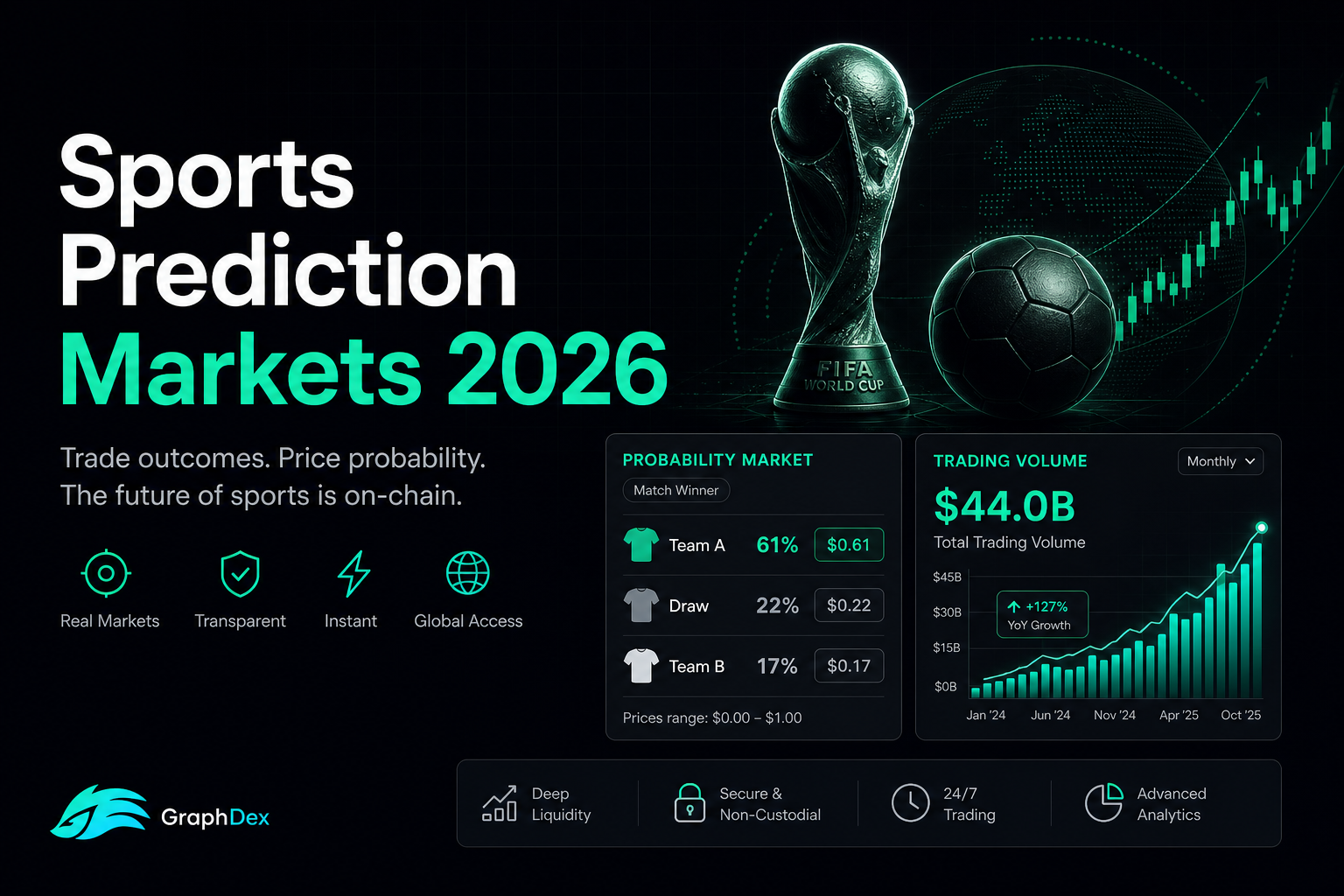
- Combined scale: Prediction markets processed around $44 billion in a single month in mid-2026
- How they differ from betting: You trade shares that rise and fall in price — you can exit before an event resolves, unlike a fixed sportsbook bet
- The edge: Successful traders use terminals for copytrading, whale tracking, and instant execution — 37% of bots are profitable vs 7-13% of manual traders
The honest truth: Sports prediction markets reward probability assessment and discipline, not fandom. The traders who win treat it like trading — using data, tools, and risk management, not gut feelings about their favorite team.
Trade prediction markets with copytrading on GraphDex
Key Takeaways
- Sports are now the dominant category in prediction markets — the majority of volume on major platforms.
- The FIFA World Cup 2026 is driving record activity across Polymarket, Kalshi, and new entrants.
- Prediction markets differ from sportsbooks — you trade tradeable shares and can exit before resolution.
- Winning traders use tools (copytrading, whale tracking, analytics), not fandom.
What Are Sports Prediction Markets?
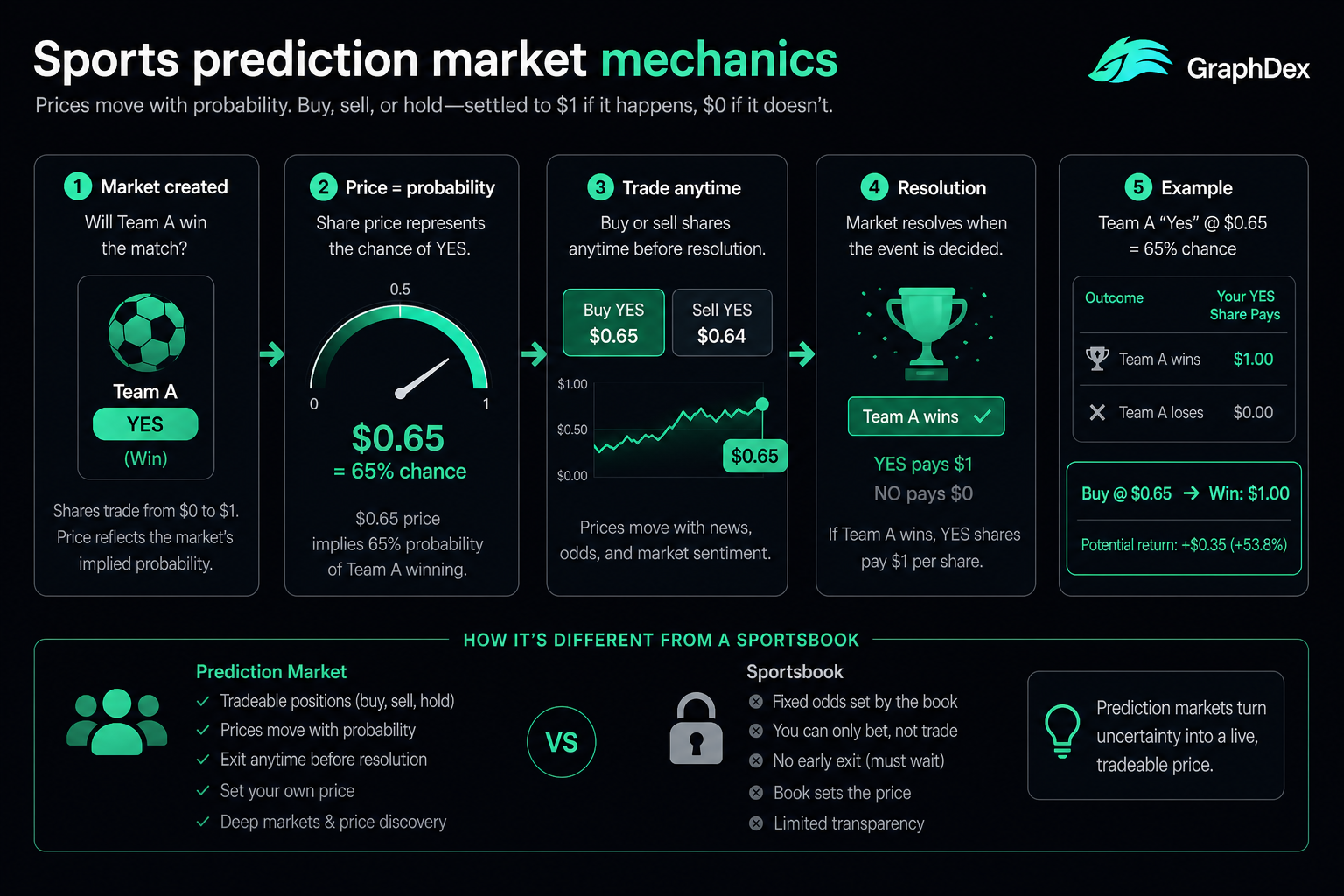
Sports prediction markets are venues where you trade on the outcomes of sporting events — who wins a match, a tournament, or a season; whether a total exceeds a threshold; whether a specific player achieves something. Unlike traditional betting, prices are set by the market (supply and demand from traders), and they move continuously as new information arrives.
The core mechanic: Each outcome trades as a share priced between $0 and $1 (or 0-100%), representing the market's estimated probability. If a team's "Yes" shares trade at $0.65, the market thinks there's a 65% chance they win. If you buy at $0.65 and they win, each share pays $1 — a profit. If they lose, the shares go to $0.
How they differ from a sportsbook:
Tradeable positions. Unlike a fixed bet, you can sell your position before the event resolves. If a team you backed jumps from 65% to 85% after a strong first half, you can sell for a profit without waiting for the final whistle.
Market-driven odds. Prices reflect the aggregate view of all traders, not a bookmaker's margin-loaded line. Many argue this produces more accurate probabilities.
Continuous price movement. Prices update in real time as events unfold, news breaks, and traders act — creating trading opportunities beyond simply picking winners.
No traditional "house." On decentralized platforms, you trade against other participants, not against a bookmaker setting odds to guarantee their profit.
This is why prediction markets attract traders, not just bettors — the ability to trade in and out, react to information, and profit from probability shifts makes them closer to financial markets than to gambling.
Why Sports Now Dominate Prediction Markets
The prediction market sector has exploded, and sports are the primary engine.
The scale in 2026:
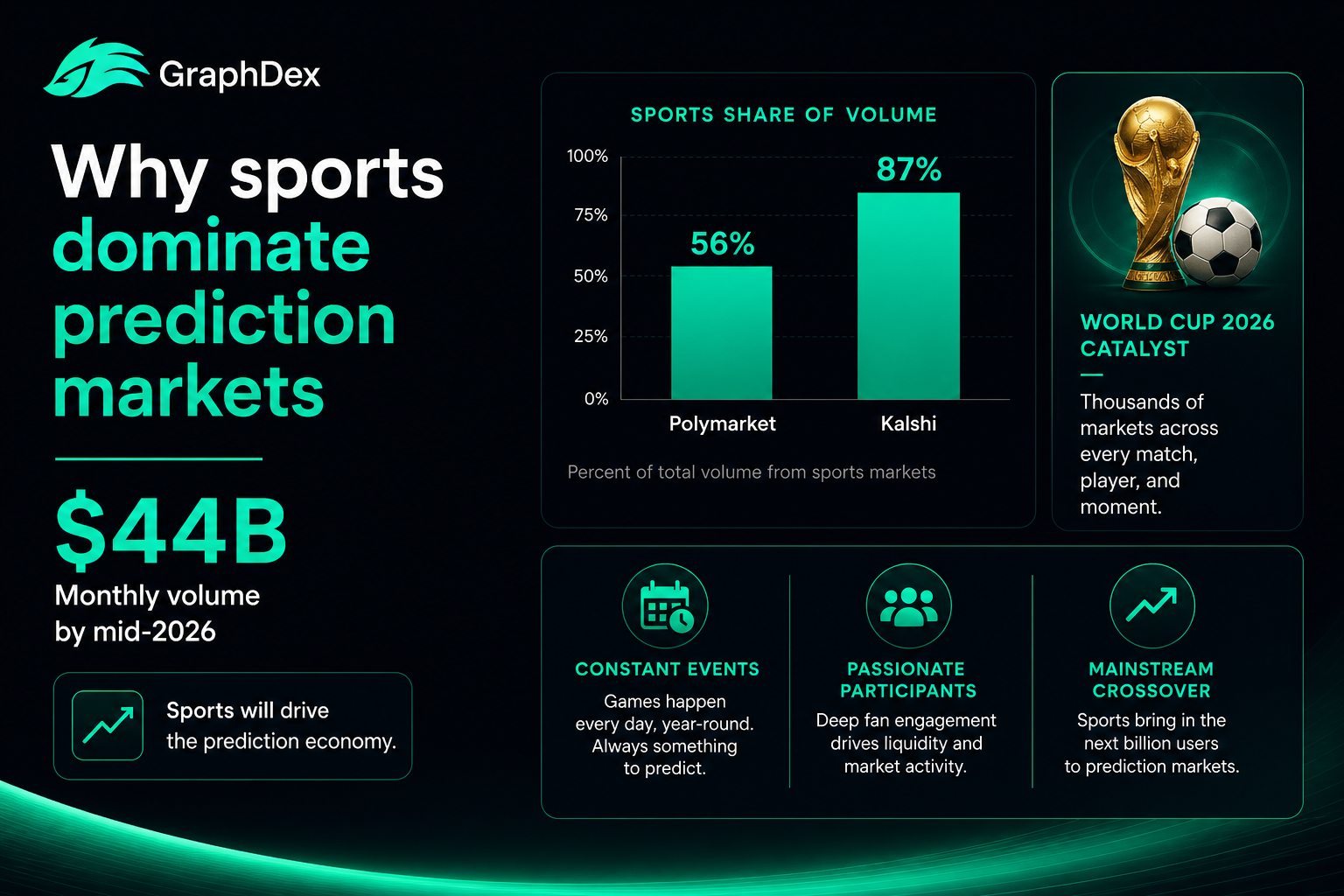
- Prediction markets processed roughly $44 billion in a single month in mid-2026
- Sports account for the majority of activity on the largest platforms
- On Polymarket, sports represent roughly 56% of volume
- On Kalshi, sports dominate even more heavily — around 87% of volume
Why sports drove the boom:
Constant events. Unlike elections (rare) or macroeconomic data (periodic), sports produce events daily — matches, games, and tournaments year-round. This creates continuous trading opportunities.
Passionate participants. Sports fans have strong opinions and existing engagement, making the leap to trading on outcomes natural.
The World Cup catalyst. The FIFA World Cup 2026 has been a massive driver. As one of the world's largest sporting events, it generates enormous interest, thousands of individual markets (match winners, group stages, top scorers, and more), and record trading volume. Polymarket alone hosts thousands of World Cup-related markets.
Mainstream crossover. Major platforms (Robinhood, Crypto.com, and others) added prediction markets, and sports were the natural entry point for mainstream users familiar with sports betting.
The result: Sports transformed prediction markets from a niche primarily focused on politics into a mainstream category with daily activity and massive volume. For traders, this means deep liquidity, constant opportunities, and a rapidly maturing tooling ecosystem.
How to Trade Sports Prediction Markets
Trading sports prediction markets well requires a different approach than casual betting.
Understand the Market Structure
Before trading, understand what you're trading:
- Binary markets: Will X happen? (Yes/No) — e.g., "Will Team A win the World Cup?"
- Categorical markets: Which of several outcomes? — e.g., "Which team wins Group B?"
- Scalar/threshold markets: Will a value exceed a threshold? — e.g., "Will total goals exceed 2.5?"
Each has different dynamics and risk profiles.
Develop a Probability Edge
Winning traders profit by identifying when market prices differ from true probabilities:
- If you assess a team's win probability at 70% but the market prices it at 60%, buying is +EV (positive expected value)
- This requires genuine analytical edge — statistical models, information advantages, or superior assessment
- Fandom is not an edge; disciplined probability assessment is
Use the Trade-and-Exit Advantage
Unlike sportsbook bets, you can trade in and out:
- Enter early when you spot mispriced probability
- Take profit when the price moves your way (before resolution)
- Cut losses if new information invalidates your thesis
- Trade momentum as probabilities shift during events
Manage Risk
Apply trading discipline, not gambling behavior:
- Position size appropriately (never risk more than you can afford to lose)
- Diversify across markets rather than concentrating on one event
- Have exit plans (profit targets and stop points)
- Avoid emotional trades on teams you support
Leverage Tools
This is where serious traders gain their edge — covered in detail below.
The Tools That Separate Winners from the Crowd
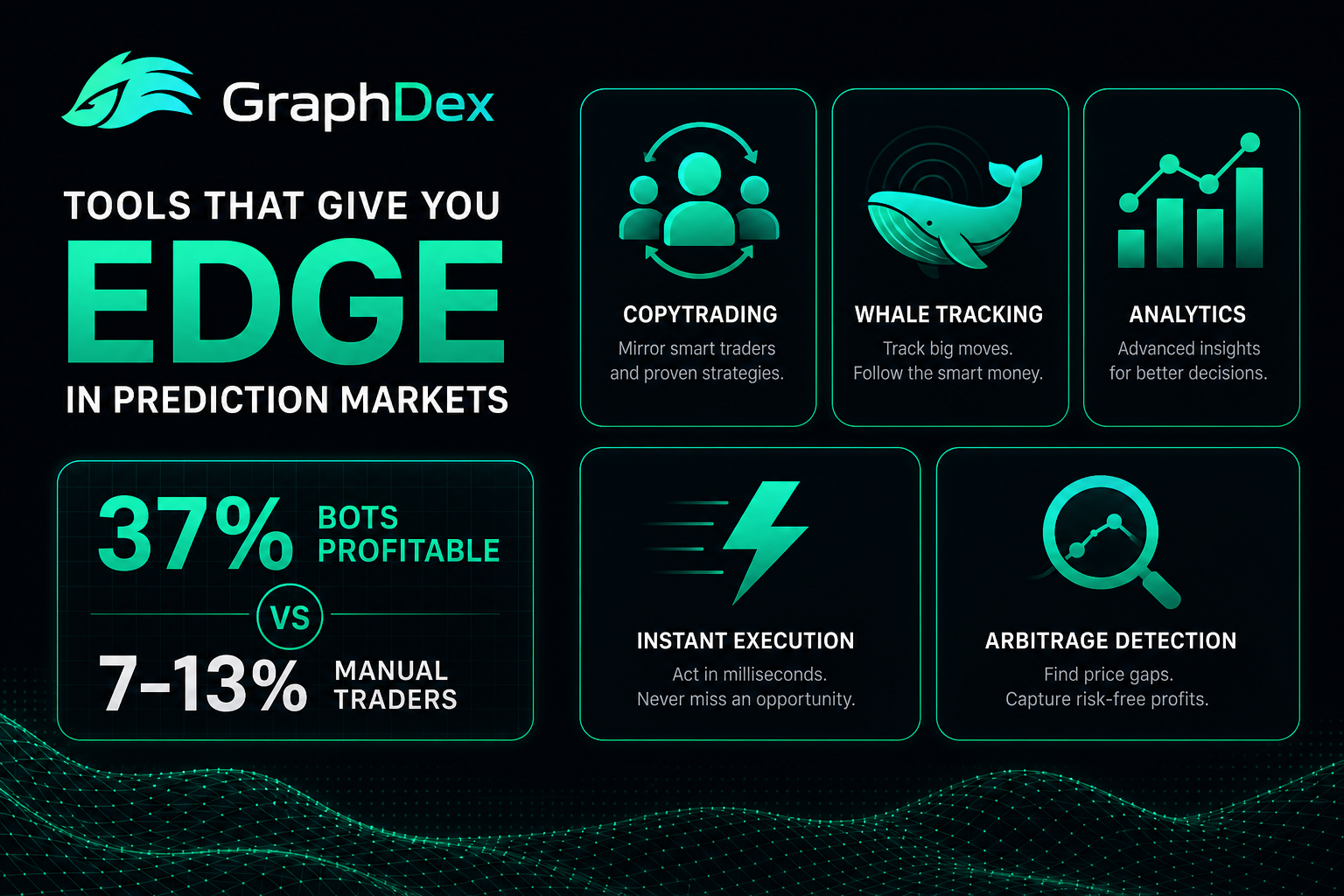
The single biggest factor in prediction market success isn't fandom or luck — it's tooling. Research found that 37% of bots on prediction markets are profitable versus only 7-13% of manual traders. The tooling gap is real and large.
Copytrading. Mirror successful sports predictors automatically. Rather than developing your own edge from scratch, you can copy traders with proven track records — while you learn. The best terminals let you copy multiple traders and set copy ratios.
Whale tracking. Large, informed traders often move before the crowd. Tracking whale wallet movements and significant probability shifts lets you spot developing opportunities early. Sharp money is worth watching.
Analytics and data. Historical performance, market depth, probability shift detection, and cross-market analysis inform better decisions than gut feeling.
Instant execution. Sports events move fast — a goal, an injury, a red card can shift probabilities in seconds. Tools that execute instantly capture opportunities that manual traders miss.
Arbitrage detection. Price differences between platforms (Polymarket vs Kalshi vs others) or between correlated markets create arbitrage opportunities. In 2026, spreads of 2-5% between platforms are not uncommon — tools that spot and execute these capture low-risk profit.
The consolidation advantage: Most traders juggle a base platform, a copytrading bot, an analytics tool, and a wallet. An integrated terminal (like GraphDex) consolidates copytrading, execution, and analytics — reducing the friction that fragments most traders' workflows.
Trade sports markets with integrated tools on GraphDex
The World Cup 2026 Opportunity
The FIFA World Cup 2026 represents the largest sports prediction market event in the sector's history.
Why it matters for traders:
Massive liquidity. The World Cup draws enormous trading volume, meaning deep markets where you can enter and exit positions cleanly — even large ones.
Thousands of markets. Beyond simple match winners, the tournament generates markets on group standings, top scorers, exact scores, tournament winners, and countless prop-style outcomes. This variety creates opportunities for traders with different edges.
Continuous action. With matches happening throughout the tournament, there's constant trading activity — new markets, resolving markets, and shifting probabilities.
Information edges. Team news, injuries, form, and tactical matchups all affect probabilities. Traders who process this information faster or better than the market can find edges.
The caution: High-profile events also attract sharp money and sophisticated traders. Casual traders betting on their favorite teams face experienced participants using data and tools. The World Cup is an opportunity, but it rewards preparation and discipline — not fandom.
The smart approach: Use tools (copytrading to follow proven traders, analytics to inform decisions, whale tracking to spot sharp money), apply risk management, and treat it as trading rather than betting on your heart.
Sports Prediction Markets vs Sports Betting
A common question: how do these differ from traditional sportsbooks?
| Feature | Sports Prediction Markets | Traditional Sportsbook |
|---|---|---|
| Odds set by | Market (traders) | Bookmaker |
| Can exit before event? | Yes (sell your position) | Usually no |
| Price movement | Continuous, tradeable | Fixed at bet time |
| "House" edge | Minimal (P2P on decentralized) | Built-in margin |
| Profit method | Buy low, sell high, or hold to resolution | Win the bet |
| Best for | Traders who value flexibility | Bettors who want simple fixed bets |
The key distinction: Sports betting is a fixed wager — you win or lose based on the outcome. Sports prediction markets are tradeable positions — you can profit from probability shifts, exit early, and treat it like trading. This flexibility is why prediction markets attract a trader mindset.
Important note on legality: Prediction market regulation varies by jurisdiction. In the US, platforms operate under CFTC oversight, but state-level rules and enforcement vary, and the regulatory landscape around sports markets specifically is actively evolving. Always verify the legal status in your location.
How GraphDex Approaches Sports Prediction Markets
GraphDex integrates prediction markets — including the world's first prediction-market copytrading — into a broader trading terminal, addressing the fragmentation that defines the space.
For sports prediction traders:
- Copytrading — mirror successful sports predictors automatically (world's first integrated prediction-market copytrading)
- Direct market access — trade prediction markets within the terminal
- Bubble Maps — visual analytics applied to prediction markets
- AI signals — opportunity discovery
- Whale/wallet tracking — follow sharp money
- Non-custodial — Privy wallet, sign in with Twitter, email, or Telegram
The integration advantage: Rather than juggling a prediction platform, a copytrading bot, an analytics tool, and a wallet, GraphDex consolidates them. And between prediction opportunities, the same capital can trade Solana tokens or earn up to 17% APY staking — no idle capital.
For sports prediction traders who want copytrading, analytics, and execution in one place — plus broader crypto trading — the integrated terminal removes the friction that fragments most traders' workflows.
Try integrated sports prediction trading on GraphDex
Common Mistakes in Sports Prediction Markets
For balance, what costs sports prediction traders:
1. Betting on your favorite team. Fandom clouds judgment. Trade probabilities, not loyalties.
2. Ignoring the exit option. The ability to sell before resolution is a key advantage — using it captures profits and cuts losses. Many treat markets like fixed bets and miss this.
3. No probability edge. Trading without a genuine analytical edge is gambling. Winning requires assessing probabilities better than the market.
4. Skipping tools. Manual traders lose to tool-equipped ones. 37% of bots profit vs 7-13% of humans — the gap is tooling.
5. Overconcentration. Putting everything on one match or tournament. Diversify across markets.
6. Emotional trading. Chasing losses, revenge trading after a bad call, FOMO into moving markets. Discipline wins.
7. Ignoring sharp money. Whales and informed traders often move first. Not tracking them means trading blind.
8. Poor risk management. No position sizing, no stop discipline. Risk management matters as much in prediction markets as in any trading.
Related Guides
- Prediction Market Copy Trading in 2026: The Complete Guide
- Best Polymarket Alternatives 2026: Kalshi, GraphDex & 8 More Compared
- How to Trade the FIFA World Cup 2026 on Prediction Markets
- Best Solana Trading Terminal in 2026: GraphDex vs Axiom vs GMGN vs Trojan vs BullX
Frequently Asked Questions
What are sports prediction markets? Sports prediction markets are venues where you trade on the outcomes of sporting events, with prices reflecting the crowd's real-time probability estimate. Each outcome trades as a share priced $0-$1 representing its probability. Unlike sportsbooks, you can sell your position before the event resolves — making them closer to financial trading than fixed betting. Sports now dominate prediction market volume in 2026.
How are prediction markets different from sports betting? Key differences: prediction market odds are set by traders (not a bookmaker), you can exit positions before events resolve (unlike fixed bets), prices move continuously and are tradeable, and decentralized platforms have minimal "house" edge. Sports betting is a fixed wager you win or lose; prediction markets are tradeable positions where you can profit from probability shifts and exit early.
Can you make money trading sports prediction markets? Yes, but it requires skill and tools, not fandom. Research found 37% of bots are profitable vs only 7-13% of manual traders — tooling provides real edge. Success requires a genuine probability edge (assessing outcomes better than the market), discipline, risk management, and tools (copytrading, whale tracking, analytics). Betting on favorite teams without edge loses money.
What's driving the sports prediction market boom in 2026? Several factors: constant sporting events (daily trading opportunities), passionate participants, mainstream platforms adding prediction markets, and especially the FIFA World Cup 2026 — a massive catalyst generating thousands of markets and record volume. Sports now account for the majority of volume on major platforms (roughly 56% on Polymarket, around 87% on Kalshi).
How do I trade the World Cup on prediction markets? Choose a platform or terminal, understand the market types (match winners, group standings, top scorers, tournament winner), develop or borrow a probability edge (via copytrading proven traders), use the trade-and-exit advantage (sell when probabilities move your way), apply risk management, and use tools (analytics, whale tracking). Treat it as trading, not betting on your heart — you'll face sharp money.
Are sports prediction markets legal? It varies by jurisdiction. In the US, prediction markets operate under CFTC oversight, but state-level rules and enforcement vary, and the regulatory landscape around sports markets specifically is actively evolving in 2026. Some jurisdictions permit them freely; others restrict them. Always verify the current legal status in your specific location before trading. This isn't legal advice.
What tools do I need for sports prediction markets? The key tools: copytrading (mirror successful traders), whale tracking (follow sharp money), analytics (data-driven decisions), instant execution (capture fast-moving opportunities), and arbitrage detection (spot cross-platform spreads). Integrated terminals like GraphDex consolidate these, reducing the need to juggle a base platform, copytrading bot, analytics tool, and wallet separately.
About This Guide
This guide is published by the GraphDex Research team — analysts and traders building the infrastructure for digital asset trading on Solana. Our content is based on direct experience, current market data, and 2026 prediction market developments.
Sources & data: Volume figures, platform statistics, and market data reflect publicly available information as of 2026 and may change. Prediction market trading carries risk including loss of capital, and legality varies by jurisdiction. This guide is educational and not financial or legal advice — always do your own research.
GraphDex is the infrastructure for digital asset trading — trade, predict, and earn in one place. Learn more at graphdex.io.
Last reviewed: May 2026 · GraphDex Research
The infrastructure for digital asset trading. Trade, predict, stake, repeat. graphdex.io