Quick Answer
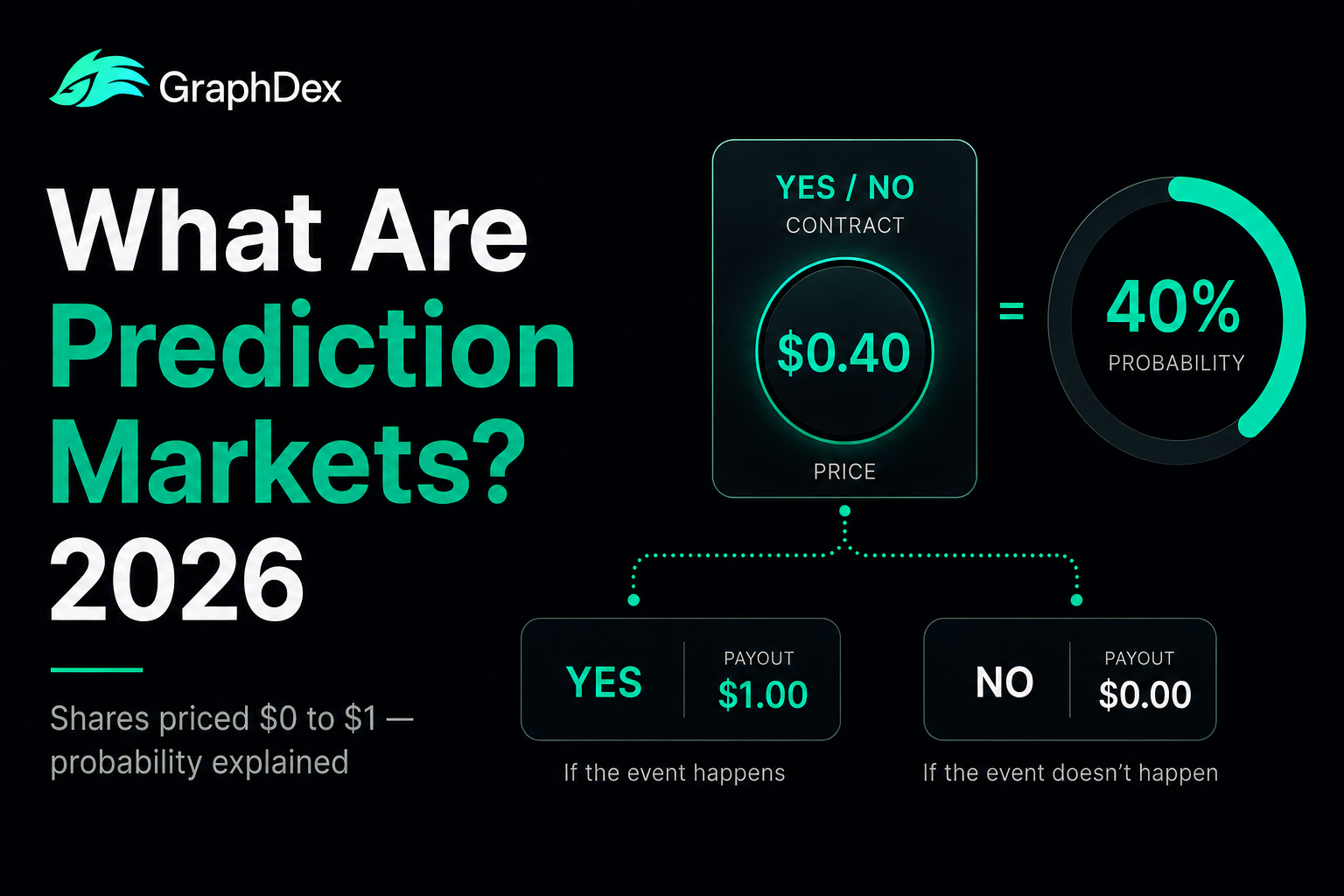
A prediction market is an exchange where you trade contracts tied to the outcome of a future event. Each contract is worth between $0.00 and $1.00, and the price represents the market's estimate of how likely the event is.
If a contract for "Will it happen?" trades at $0.64, the market is implying a 64% probability. If the event happens, the contract settles at $1.00. If it doesn't, it settles at $0.00. Your profit comes from buying contracts the market has mispriced.
The biggest platforms in 2026 are Polymarket (largest by global volume) and Kalshi (largest US-regulated). GraphDex lets you trade Polymarket markets with added copytrading and Solana DEX trading in one terminal.
Trade prediction markets on GraphDex
How Prediction Markets Work
Prediction markets turn questions about the future into tradeable contracts. Instead of betting against a bookmaker who sets the odds, you trade with other people, and the collective trading sets the price.
The Core Mechanic: Shares Priced 0 to 1
Every prediction market resolves to a binary outcome: Yes or No. You buy shares of the outcome you believe in.
- A Yes share pays $1.00 if the event happens, $0.00 if it doesn't
- A No share pays $1.00 if the event doesn't happen, $0.00 if it does
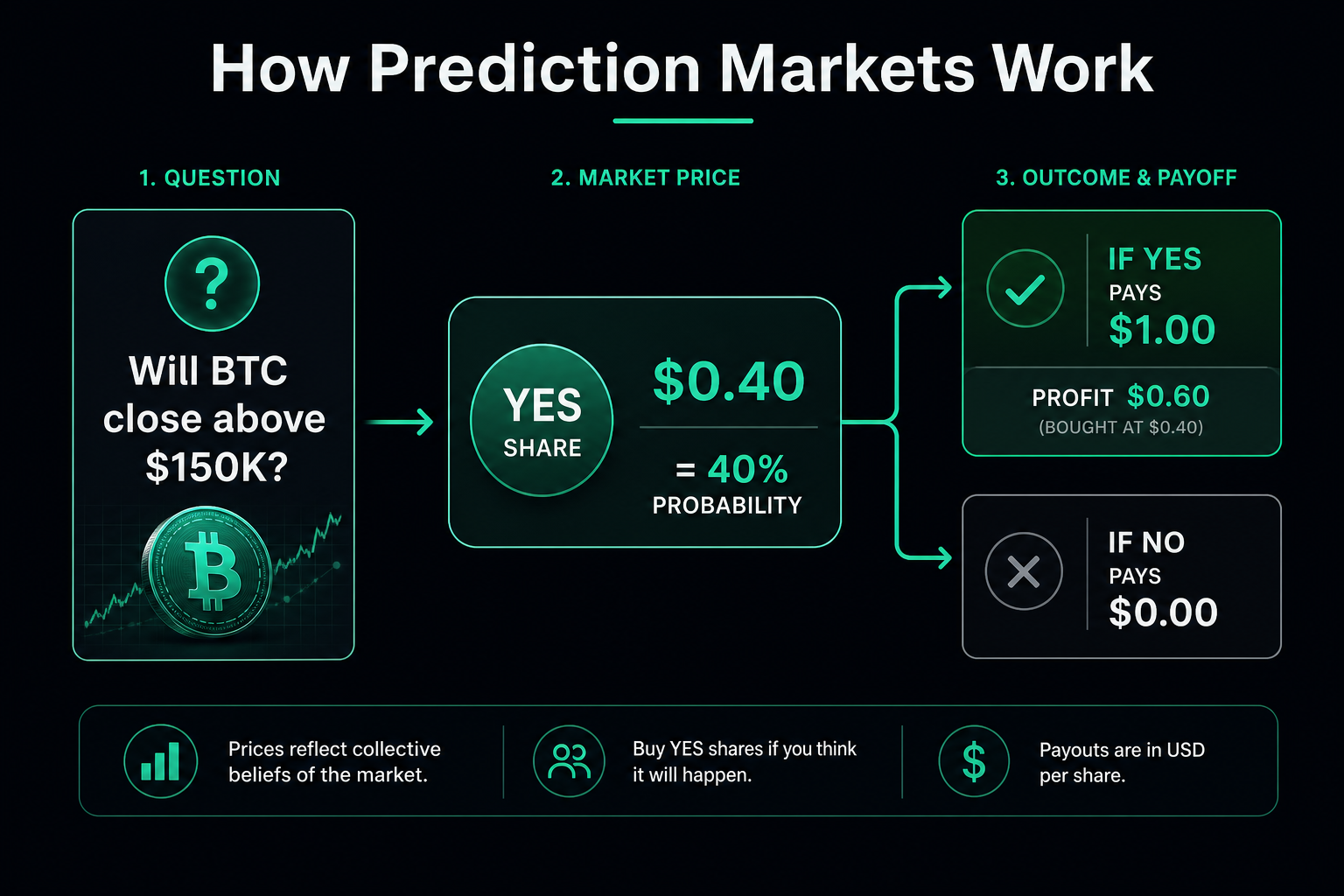
The price you pay reflects the implied probability. A Yes share at $0.30 means the market thinks there's a 30% chance. If you buy at $0.30 and the event happens, your share becomes worth $1.00 — a profit of $0.70 per share.
A Simple Example
Suppose there's a market: "Will Bitcoin close above $150,000 this year?"
- Yes shares trade at $0.40 (market implies 40% probability)
- You believe it's more likely — say 60%
- You buy 100 Yes shares for $40 total
- If Bitcoin closes above $150,000, your shares pay $100 — a $60 profit
- If it doesn't, you lose your $40
The skill is identifying markets where your estimate of probability differs from the market's price.
Why Prices Reflect Probability
Because traders profit by being right, prices tend toward accurate probabilities. If a Yes share is too cheap relative to the real likelihood, traders buy it, pushing the price up. This self-correcting mechanism is why prediction markets are often more accurate than polls or pundits — people backing their opinions with money tend to be more honest than people just talking.
Prediction Markets vs Sports Betting
A common confusion is whether prediction markets are just gambling. They are structurally different from sportsbooks.
| Sports Betting | Prediction Markets | |
|---|---|---|
| Who sets odds | The bookmaker (the house) | Traders, via supply and demand |
| Who you trade against | The house | Other traders (peer-to-peer) |
| What you can trade | Mostly sports | Politics, economics, crypto, weather, culture, sports |
| Can you exit early | Usually no | Yes — sell your position anytime |
| Regulation | State by state (US) | Federal (CFTC) for regulated platforms |
| Price meaning | Bookmaker's margin built in | Real-time probability estimate |
Prediction platforms are peer-to-peer exchanges where contract prices are set by traders, reflecting real probability. Sportsbooks set their own odds and you bet against the house. Prediction markets also cover far more than sports and, on regulated platforms, are regulated federally rather than state by state.
The ability to sell your position before resolution is a key difference. On a prediction market, if your contract rises from $0.40 to $0.70 before the event resolves, you can sell and lock in the profit — you don't have to wait for the outcome.
Why Prediction Markets Exploded in 2026
The 2024 US election was a watershed moment. Polymarket processed over $3.5 billion in election volume, Kalshi won its landmark CFTC lawsuit allowing political event contracts, and mainstream media started citing prediction market odds alongside traditional polls.
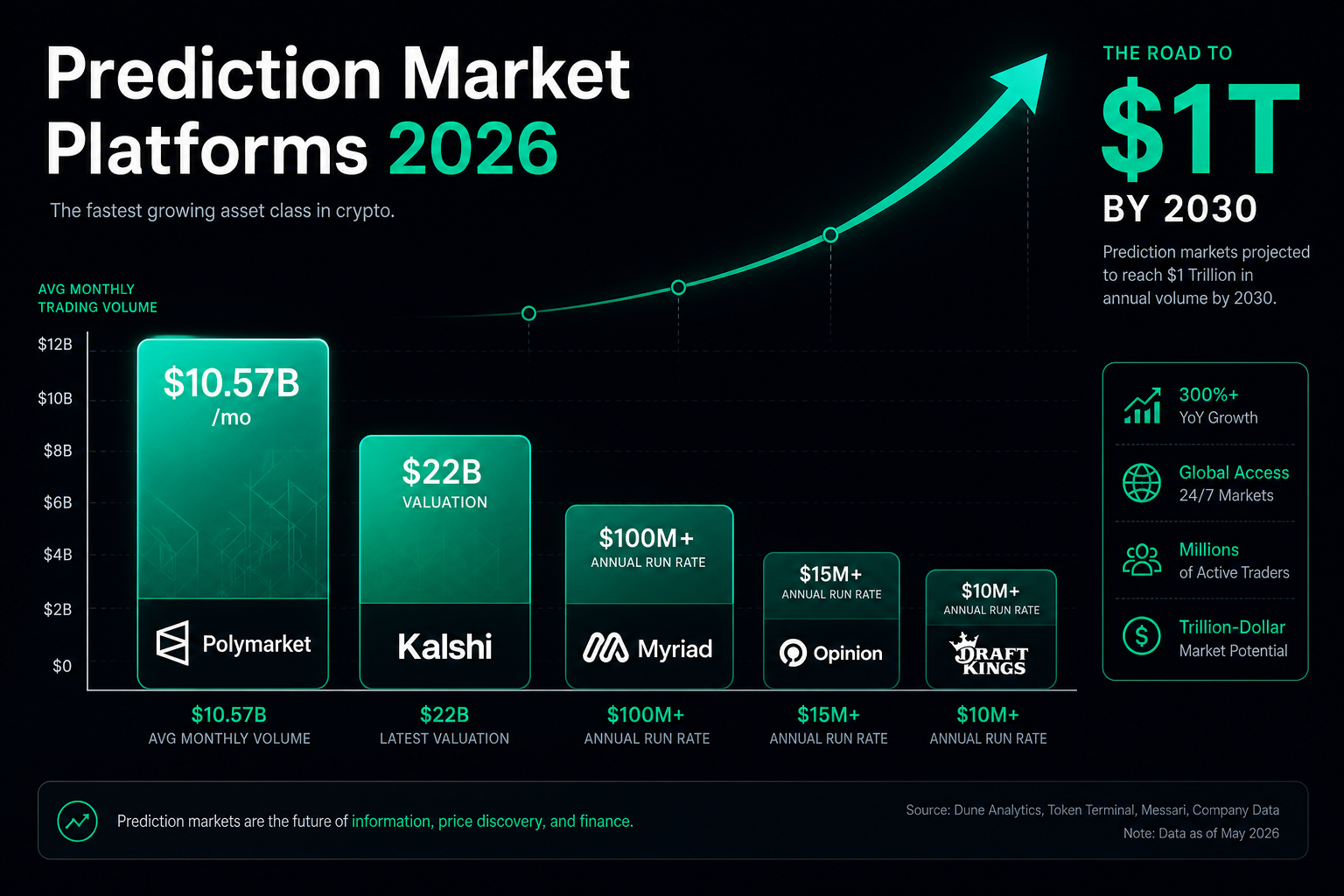
The numbers since have been staggering. By 2025, trading volumes surpassed $64 billion — a 300% year-over-year increase. By early 2026, US prediction markets alone were processing roughly $10-13 billion every month. Experts believe the industry's annual trading volume could reach $1 trillion by 2030.
Several forces drove this growth:
Mainstream legitimacy — when major media cite prediction market odds, the markets gain credibility as information sources, not just betting venues.
Regulatory clarity — Kalshi's CFTC victory established a legal framework for regulated prediction markets in the US.
Institutional entry — BitGo and Susquehanna launched institutional OTC access in March 2026, and Intercontinental Exchange invested $2 billion in Polymarket.
Generational shift — surveys show younger people increasingly trust prediction markets over traditional forecasting.
The Major Prediction Market Platforms in 2026
| Platform | Type | Best for |
|---|---|---|
| Polymarket | Decentralized (Polygon) | Largest global volume, crypto-native |
| Kalshi | CFTC-regulated | US users wanting legal clarity |
| Myriad | Wallet-native (BNB/Linea) | In-wallet predictions via Trust Wallet |
| Opinion | On-chain (BNB) | Backed by CZ's YZi Labs |
| DraftKings Predictions | CFTC-regulated | Sports-focused US traders |
| Manifold | Play-money | Risk-free forecasting practice |
Polymarket is the largest prediction market globally by trading volume, built on Polygon and settled in USDC. It recorded $10.57 billion in monthly volume in March 2026.
Kalshi is the first and most comprehensive CFTC-licensed event contract exchange in the US, valued at $22 billion in March 2026. It feels more like a fintech trading platform than a crypto app.
Myriad became the first wallet-native prediction market through Trust Wallet integration, surpassing $100 million in cumulative volume with over 400,000 active traders.
What Can You Trade on Prediction Markets?
Prediction markets cover far more than most people expect:
Politics — elections, policy decisions, geopolitical events, leadership changes
Crypto — Bitcoin and Ethereum price targets, token launches, ecosystem milestones
Economics — interest rate decisions, inflation data (CPI), GDP figures, jobs reports
Sports — game outcomes, championship winners, player props across many sports
Weather — number of hurricanes, temperature records, climate events
Culture — awards shows, entertainment outcomes, social trends
This breadth is what separates prediction markets from sports betting. You can take a position on almost any measurable future event.
Explore prediction markets on GraphDex
How to Start Trading Prediction Markets
Step 1: Choose your access point You can trade directly on a platform like Polymarket or Kalshi, or use a terminal like GraphDex that adds copytrading and integrates prediction markets with Solana DEX trading.
Step 2: Set up your wallet or account On Polymarket, you need a crypto wallet (funds settle in USDC on Polygon). On GraphDex, your non-custodial wallet is created automatically via Privy — no seed phrase, no extension. Kalshi uses traditional banking with USD deposits.
Step 3: Find a market Browse markets by category. Look for events you understand well — your edge comes from knowing something the market hasn't fully priced.
Step 4: Analyze the price The current price is the market's probability estimate. Ask yourself: do I think the real probability is higher or lower than this price? That gap is your potential edge.
Step 5: Take a position Buy Yes or No shares based on your analysis. Set a position size you're comfortable with.
Step 6: Manage or hold You can sell before resolution to lock in gains or cut losses, or hold until the event resolves and the contract settles at $1.00 or $0.00.
Prediction Market Strategies for Beginners
Trade what you know Your edge comes from knowledge. If you follow crypto closely, crypto markets are where you have an advantage. Don't trade markets where you have no informational edge.
Look for mispriced probability The goal is finding markets where the price doesn't match the real likelihood. This requires forming your own probability estimate, then comparing it to the market.
Follow the smart money Some traders consistently profit on prediction markets. Tools like GraphDex copytrading let you follow top forecasters by track record and mirror their positions — learning from proven performers.
Manage position size Never put more on a single market than you can afford to lose. Even high-probability outcomes fail sometimes.
Use the early-exit option Unlike sports betting, you can sell before resolution. If new information changes your view, or if your position has already gained significantly, taking profit early is a valid strategy.
Risks of Prediction Markets
Prediction markets carry real risks worth understanding:
You can lose your entire position — if your outcome doesn't happen, your shares are worth $0.00.
Markets can be illiquid — thin markets have wide spreads and can be hard to exit at a fair price.
Regulatory uncertainty — prediction markets face evolving regulation. Polymarket faced bans in Portugal and Hungary in early 2026, and some US states have imposed temporary restrictions.
Structural risks — a CertiK report cautioned that prediction markets face challenges including wash trading and hybrid security risks as the sector grows rapidly.
Resolution disputes — occasionally, how a market resolves can be ambiguous or contested.
Trade only what you can afford to lose, understand each market's resolution criteria before entering, and use platforms with strong track records.
Why Use a Terminal for Prediction Markets?
Trading directly on a prediction market platform works, but a terminal adds capabilities the native interfaces lack:
- Copytrading — follow and mirror top forecasters automatically
- Whale tracking — see where large, high-conviction money is flowing
- Visual screening — find opportunities across hundreds of markets at a glance
- Integrated execution — act on signals without switching interfaces
GraphDex integrates Polymarket prediction markets with copytrading, alongside Solana DEX trading, in one terminal. For crypto-native traders who treat prediction markets as part of a broader strategy, this consolidation is the advantage.
Start trading prediction markets with GraphDex
Frequently Asked Questions
What is a prediction market? A prediction market is an exchange where you trade contracts on the outcome of future events. Each contract is priced between $0.00 and $1.00, representing the probability the market assigns to that outcome. If you're right, the contract settles at $1.00; if wrong, $0.00.
Are prediction markets the same as gambling? No. Prediction markets are peer-to-peer exchanges where prices reflect real probability and you can exit positions before resolution. Sports betting is against a bookmaker who sets the odds with a built-in margin. Regulated prediction markets are overseen federally by the CFTC.
How do prediction markets make money? You profit by buying contracts the market has mispriced. If you buy a Yes share at $0.40 and the event happens, it pays $1.00 — a $0.60 profit per share. Your edge comes from estimating probability more accurately than the market.
What is the biggest prediction market in 2026? Polymarket is the largest by global trading volume, recording $10.57 billion in March 2026. Kalshi is the largest US-regulated platform, valued at $22 billion. Both are accessible to traders, with GraphDex adding copytrading on top of Polymarket markets.
Can you make a living trading prediction markets? Some traders profit consistently, but it requires genuine edge — knowing something the market hasn't priced. Most participants do not profit consistently. Treat it as skilled speculation, not guaranteed income, and only risk what you can afford to lose.
Do I need crypto to trade prediction markets? It depends on the platform. Polymarket settles in USDC on Polygon and requires a crypto wallet. Kalshi uses traditional USD banking. GraphDex creates a non-custodial wallet automatically — no seed phrase needed.
What's the difference between Polymarket and Kalshi? Polymarket is decentralized, crypto-native, and the largest by global volume. Kalshi is CFTC-regulated, uses traditional banking, and is the default for US users wanting legal clarity. Both are leaders in the 2026 prediction market space.
The infrastructure for digital asset trading. Trade, predict, stake, repeat. graphdex.io