By GraphDex Research · Reviewed for accuracy May 2026
Quick Answer
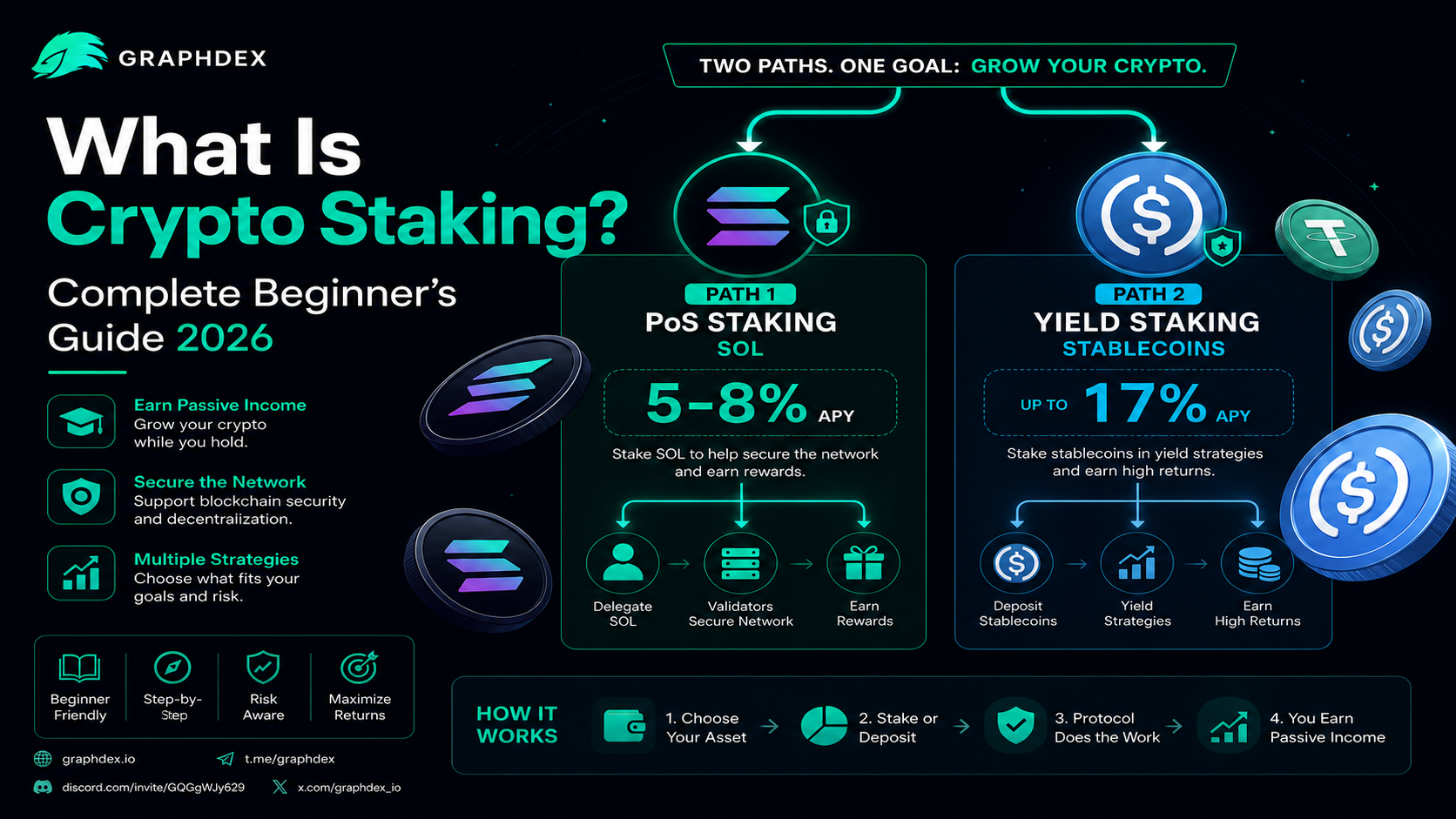
Crypto staking is the practice of locking up cryptocurrency to earn rewards — typically paid as a percentage yield (APY). There are two main forms:
- Proof-of-Stake staking — you help secure a blockchain (like Solana) by delegating your tokens, earning 5-8% APY from network rewards.
- Yield staking — you deposit assets (like stablecoins) into a platform that generates returns from lending or fees, earning anywhere from 4% to up to 17% APY.
In both cases, you earn passive income on assets you would otherwise hold idle. GraphDex offers staking up to 17% APY across SOL, USDT, USDC, and other assets.
Start earning up to 17% APY on GraphDex
Key Takeaways
- Crypto staking earns passive yield (APY) on cryptocurrency you would otherwise hold idle.
- Two types: Proof-of-Stake network staking (5-8% on SOL) and yield/platform staking (up to 17% on stablecoins).
- Yield comes from network rewards, lending demand, or platform fees — the source determines sustainability.
- GraphDex offers up to 17% APY from platform trading fees, with non-custodial Privy wallets.
What Is Crypto Staking?
Crypto staking is the process of committing your cryptocurrency to earn rewards. The term covers two distinct mechanisms that often get grouped together.
In its original sense, staking means participating in a Proof-of-Stake (PoS) blockchain. You lock up tokens to help validate transactions and secure the network, and in return you earn newly issued tokens as a reward. Solana, Ethereum, and most modern blockchains use this model.
In its broader, everyday sense, "staking" also refers to earning yield by depositing assets — especially stablecoins — into platforms that generate returns through lending or other revenue. This isn't network validation, but it's commonly called staking because the user experience is the same: deposit assets, earn yield.
Both let you put idle crypto to work. The difference lies in where the yield comes from and what risks apply.
How Does Crypto Staking Work?
The mechanics depend on which type of staking you're doing.
Proof-of-Stake Network Staking
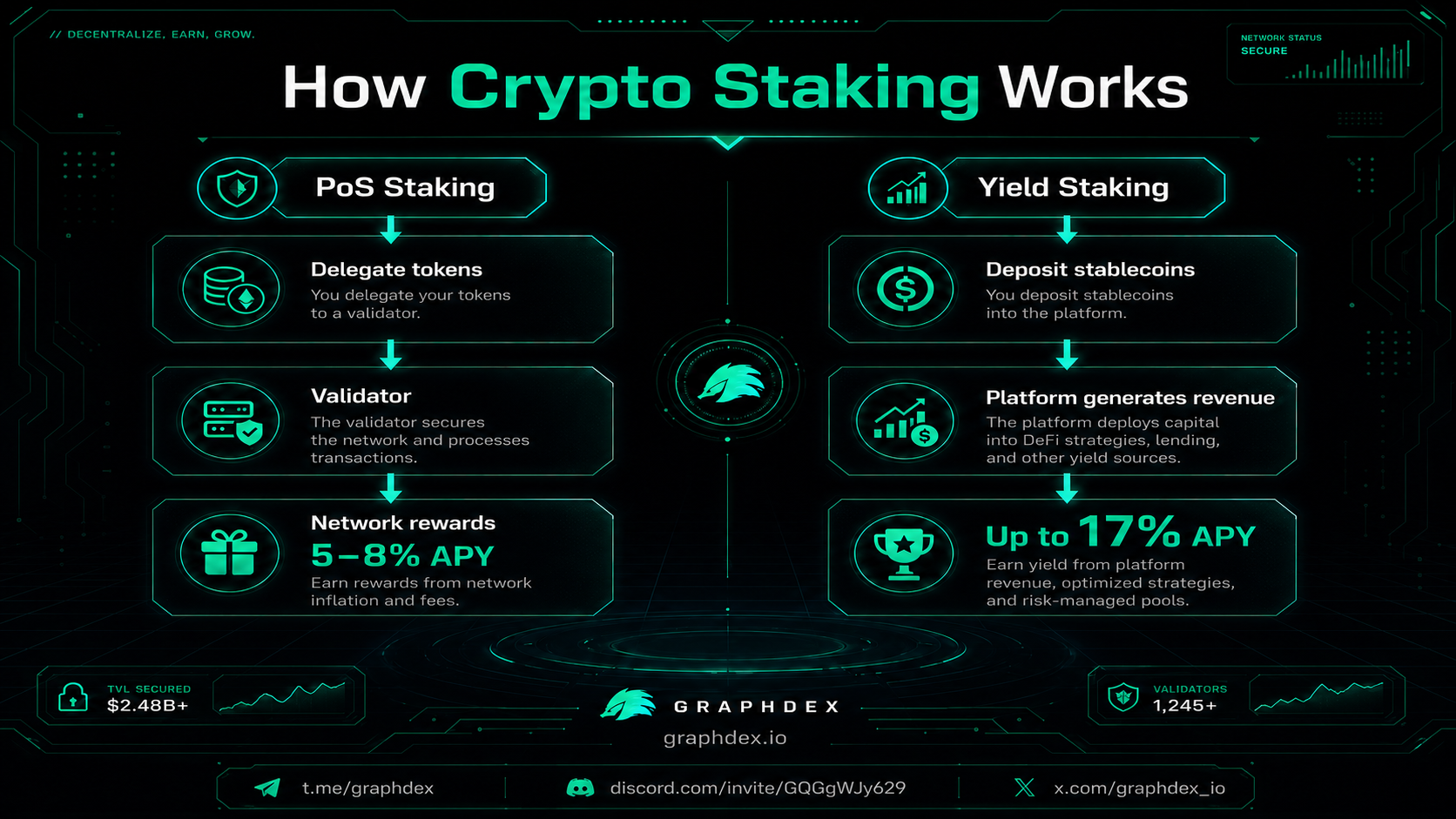
When you stake on a Proof-of-Stake blockchain like Solana:
- You hold a stakeable token (e.g., SOL)
- You delegate it to a validator — a node that processes transactions
- The validator uses your stake (combined with others') to secure the network
- The network issues rewards for honest validation
- You earn a share, typically 5-8% APY on Solana
Your tokens remain yours — you're delegating, not giving them away. Rewards accrue automatically, usually every epoch (a few days on Solana).
Yield / Platform Staking
When you stake stablecoins or tokens for yield:
- You deposit assets into a platform
- The platform deploys them — lending to borrowers, providing liquidity, or funding operations
- The platform generates revenue from that activity
- You earn a share as yield, from 4% to up to 17% depending on the source
This is how stablecoin staking works, since stablecoins aren't part of Proof-of-Stake consensus.
Types of Crypto Staking
There are several distinct ways to stake crypto in 2026:
Native staking Delegating tokens directly to a validator through your wallet. Most decentralized, suits long-term holders. Yields 5-8% on SOL.
Liquid staking Staking tokens and receiving a tradeable token (like jitoSOL) representing your position, which you can use in DeFi while still earning. Yields 6-8% on SOL.
Platform/yield staking Depositing assets (especially stablecoins) into a platform that generates yield from fees or lending. Yields up to 17% on GraphDex.
Exchange staking Staking through a centralized exchange (Binance, Coinbase). Convenient but custodial — the exchange holds your funds.
The right type depends on your goals: maximum decentralization (native), DeFi flexibility (liquid), highest yield (platform), or convenience (exchange).
Where Does Staking Yield Come From?
This is the most important question to ask before staking anything — and the one that separates sustainable yield from yield that disappears.
Network rewards (PoS staking) On Proof-of-Stake chains, yield comes from newly issued tokens the network creates to reward validators. As a chain reduces its issuance over time, these yields gradually decline.
Lending demand (most stablecoin platforms) Platforms lend your deposited assets to borrowers and pay you a share of the interest. Yield fluctuates with how much borrowers are willing to pay.
Platform fees (GraphDex) GraphDex generates staking yield from platform trading fees and protocol revenue. Every trade produces a fee; a share funds the staking yield. This scales with platform usage rather than depending on token issuance or borrowing demand.
Promotions (caution) Some platforms advertise very high rates that are temporary or have hidden conditions. Always verify whether a rate is structural or promotional.
Understanding the source matters: network rewards decline as issuance drops, lending yield swings with demand, but fee-based yield grows as a platform's usage grows. The most sustainable yields are tied to real, ongoing economic activity.
See how GraphDex generates yield from fees
How Much Can You Earn Staking Crypto?
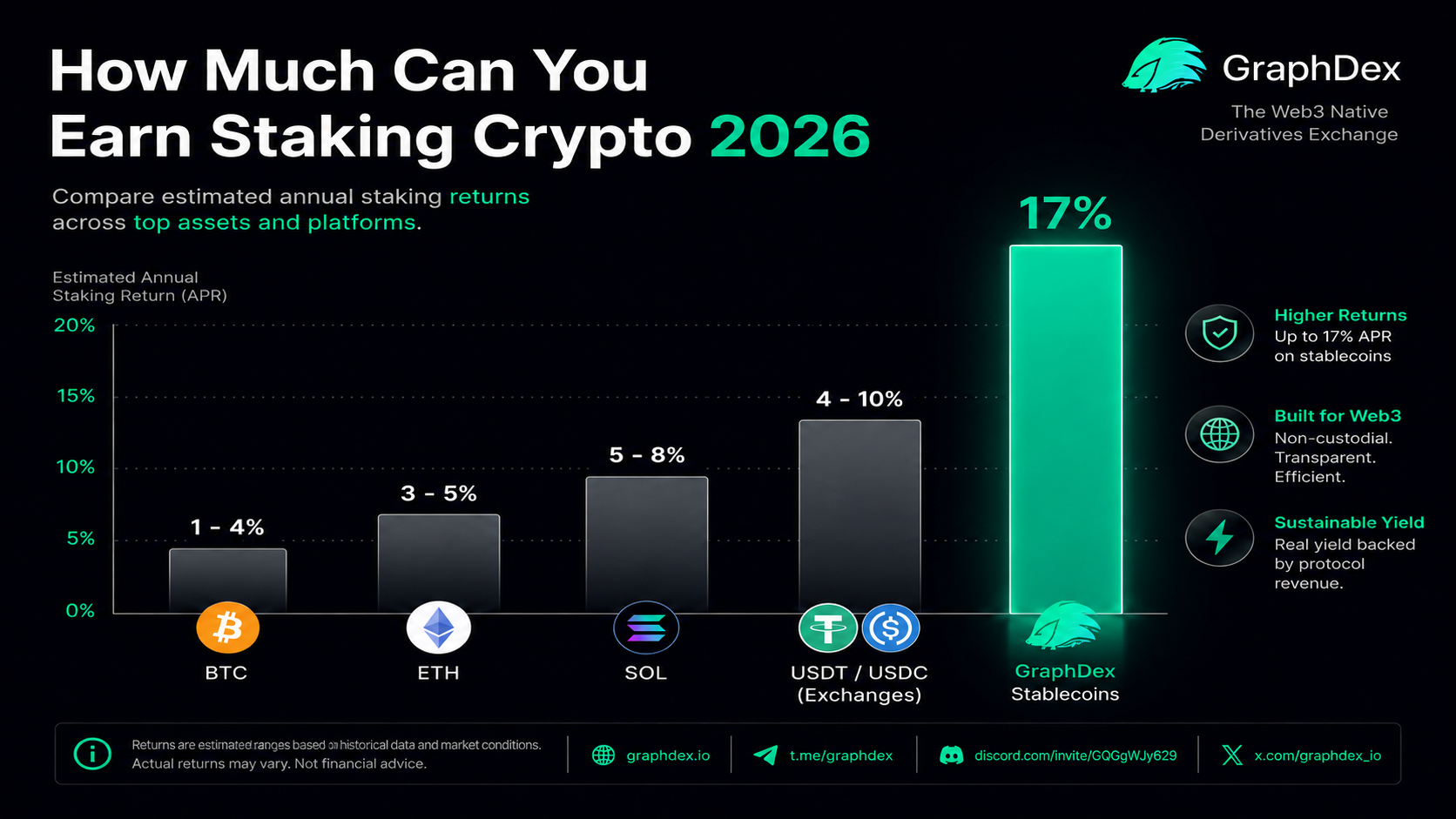
Staking returns vary widely by asset and method:
| Asset / Type | Typical APY |
|---|---|
| SOL (native) | 5-8% |
| SOL (liquid) | 6-8% |
| ETH (staking) | 3-5% |
| USDT / USDC (exchanges) | 4-10% |
| Stablecoins (GraphDex) | Up to 17% |
| BTC (wrapped/lending) | 1-4% |
Stablecoins generally offer the highest yields among low-volatility options, while major Proof-of-Stake tokens like SOL offer moderate yields plus potential price appreciation (or loss). On GraphDex, stablecoins reach up to 17% APY because the yield comes from platform fees rather than network issuance.
Your actual return also depends on lock period (longer often pays more), compounding frequency, and any platform fees.
How to Start Staking Crypto: Step by Step
Step 1: Choose what to stake Decide between Proof-of-Stake tokens (SOL for moderate yield plus price exposure) or stablecoins (USDT/USDC for stable, higher yield without volatility).
Step 2: Choose a platform Consider yield, custody model (non-custodial vs custodial), security, and lock terms. Non-custodial platforms keep your funds in your control.
Step 3: Set up your wallet On GraphDex, register with Twitter, email, or Telegram via Privy — your non-custodial wallet is created automatically with no seed phrase.
Step 4: Fund and stake Transfer your assets, choose your amount and lock period, and confirm. On GraphDex, lock periods range from 10 to 360 days.
Step 5: Earn and manage Rewards accrue automatically. Consider compounding (reinvesting rewards) to increase your effective annual yield.
Is Crypto Staking Safe?
Staking carries real risks that depend on the type and platform:
Custodial risk When you stake on a centralized exchange, it holds your funds. If the platform fails or is hacked, your assets are at risk — as FTX demonstrated. Non-custodial staking (like GraphDex via Privy) keeps funds in your own wallet, eliminating this risk.
Slashing risk (PoS staking) On Proof-of-Stake networks, if your validator misbehaves or has poor uptime, you can face penalties. Choose reputable validators with strong track records.
Smart contract risk Platforms and DeFi protocols run on code that can have bugs. Favor audited platforms.
Lock-up risk Fixed-term staking restricts access to your funds. Native staking has unbonding periods. Match the commitment to your liquidity needs.
Yield sustainability risk Unusually high promotional rates can be unsustainable. Understand where the yield comes from.
The safest approach: use non-custodial platforms, choose reputable validators, understand lock terms, and never stake funds you cannot afford to lock up.
Crypto Staking vs Traditional Savings
Staking is often compared to a savings account, since both earn yield on deposits:
| Bank Savings | Crypto Staking | |
|---|---|---|
| Typical yield | 0.5% (4-5% high-yield) | 5-17% |
| Insurance | FDIC (US, to limits) | None |
| Access | Business hours / delays | 24/7 |
| Volatility | None | None for stablecoins; PoS tokens vary |
A $10,000 bank deposit at 0.5% earns $50 a year. The same in stablecoin staking at up to 17% could earn up to $1,700. The trade-off is that staking is not government-insured and carries platform risk.
For PoS token staking (like SOL), you also gain or lose based on the token's price — the yield is on top of price movement. Stablecoin staking avoids this, offering pure dollar-denominated yield.
The Power of Compounding in Staking
One of the most underappreciated aspects of crypto staking is compounding — and it can significantly increase your long-term returns.
When you compound, you reinvest your staking rewards rather than withdrawing them. Those rewards then earn their own rewards, creating exponential rather than linear growth over time. The difference compounds, literally, the longer you stake.
Consider a simple example: $10,000 staked at 17% APY earns $1,700 in simple interest over a year. But if rewards compound — reinvested as they accrue — the effective annual yield rises higher, because each reward starts earning immediately. Over multiple years, compounded staking dramatically outpaces simple withdrawals.
Some platforms compound automatically; others require you to manually restake rewards. On efficient chains like Solana, where GraphDex operates, restaking costs a negligible fraction of a cent — so manual compounding is practical without fees eating into returns. On high-gas chains, frequent restaking can be uneconomical for smaller positions.
The practical takeaway: if you're staking for the long term and don't need the income immediately, compounding is one of the simplest ways to maximize returns. Combined with stablecoin staking's price stability, compounded stablecoin yield offers steady, predictable growth.
Start compounding your staking yield on GraphDex
Frequently Asked Questions
What is crypto staking in simple terms? Crypto staking means committing your cryptocurrency to earn rewards, paid as a yield (APY). You either help secure a Proof-of-Stake blockchain (earning network rewards) or deposit assets into a platform that generates yield from lending or fees. Either way, idle crypto earns passive income.
How does crypto staking work? In Proof-of-Stake staking, you delegate tokens to a validator that secures the network, earning a share of network rewards. In yield staking, you deposit assets into a platform that generates returns from lending or fees. Rewards accrue automatically over time.
How much can you earn from staking crypto? Returns range from 1-4% on Bitcoin lending to 5-8% on SOL to up to 17% on stablecoins via GraphDex. Stablecoins offer the highest low-volatility yields; Proof-of-Stake tokens offer moderate yields plus price exposure.
Is crypto staking safe? Staking carries custodial risk (on exchanges), slashing risk (PoS), smart contract risk, and lock-up risk. Non-custodial platforms like GraphDex keep funds in your wallet, eliminating custodial risk. Choose reputable platforms and never stake funds you cannot lock up.
What is the best crypto to stake in 2026? For stable, high yield without volatility, stablecoins (USDT/USDC) on GraphDex reach up to 17% APY. For yield plus potential price appreciation, SOL offers 5-8%. The best choice depends on whether you want stability or price exposure.
Can I lose money staking crypto? Yes. Risks include platform failure (custodial), slashing penalties (PoS), smart contract bugs, and — for PoS tokens — price declines. Stablecoin staking on non-custodial platforms minimizes these risks but doesn't eliminate them entirely.
What is the difference between staking and yield farming? Staking typically means locking assets for network rewards or platform yield with relatively predictable returns. Yield farming involves actively moving funds between DeFi protocols chasing higher, more variable returns, with higher complexity and risk. Staking is generally simpler and more passive.
About This Guide
This guide is published by the GraphDex Research team — analysts and traders building the infrastructure for digital asset trading on Solana. Our content is based on live platform data, current market figures, and hands-on experience with the platforms covered.
Sources & data: Staking rates and figures reflect publicly available information as of 2026. APY rates are variable and not guaranteed; staking carries risk. This guide is educational and not financial advice.
GraphDex is the infrastructure for digital asset trading — trade, predict, and earn in one place. Learn more at graphdex.io.
Last reviewed: May 2026 · GraphDex Research
The infrastructure for digital asset trading. Trade, predict, stake, repeat. graphdex.io