By GraphDex Research · Reviewed for accuracy May 2026
Quick Answer
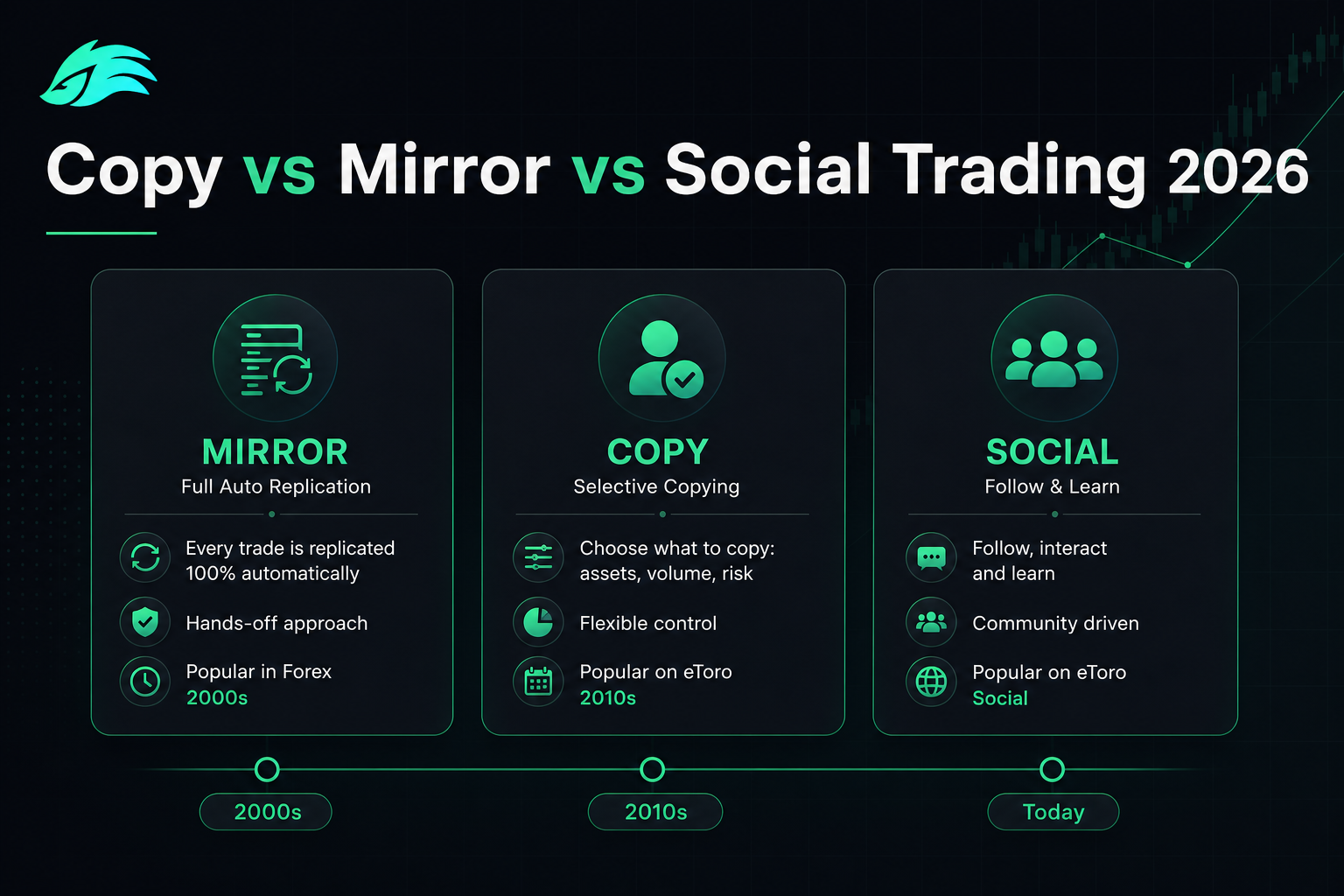
Copy trading, mirror trading, and social trading exist on a spectrum of automation and control:
- Mirror trading (most automated): Fully replicate a trader's strategy automatically — when they trade, you trade. Least control, most hands-off.
- Copy trading (selective): Copy individual trades, often selectively from a feed — you choose which to replicate. Balanced control and automation.
- Social trading (least automated): Follow and learn from top traders to inform your own decisions — without necessarily replicating. Most control, most involvement.
The key distinction: It's about how much you automate vs how much you decide. Mirror trading automates everything; social trading keeps you in the driver's seat; copy trading is in between.
On prediction markets: Platforms like Polymarket (via terminals such as GraphDex) often support all three — you can passively mirror, selectively copy, or simply follow and learn, with on-chain verified trader data informing your choice.
Explore prediction market copytrading on GraphDex
Key Takeaways
- Mirror, copy, and social trading exist on a spectrum from most automated to most hands-on.
- Mirror trading fully replicates a trader; copy trading is selective; social trading is follow/learn.
- The choice is about automation vs control — how much you delegate vs decide.
- Prediction market platforms often support all three modes.
What Are the Three Approaches?
While these terms overlap heavily in everyday use, they have distinct origins and mechanics. Understanding each clarifies which fits your goals.
Mirror Trading
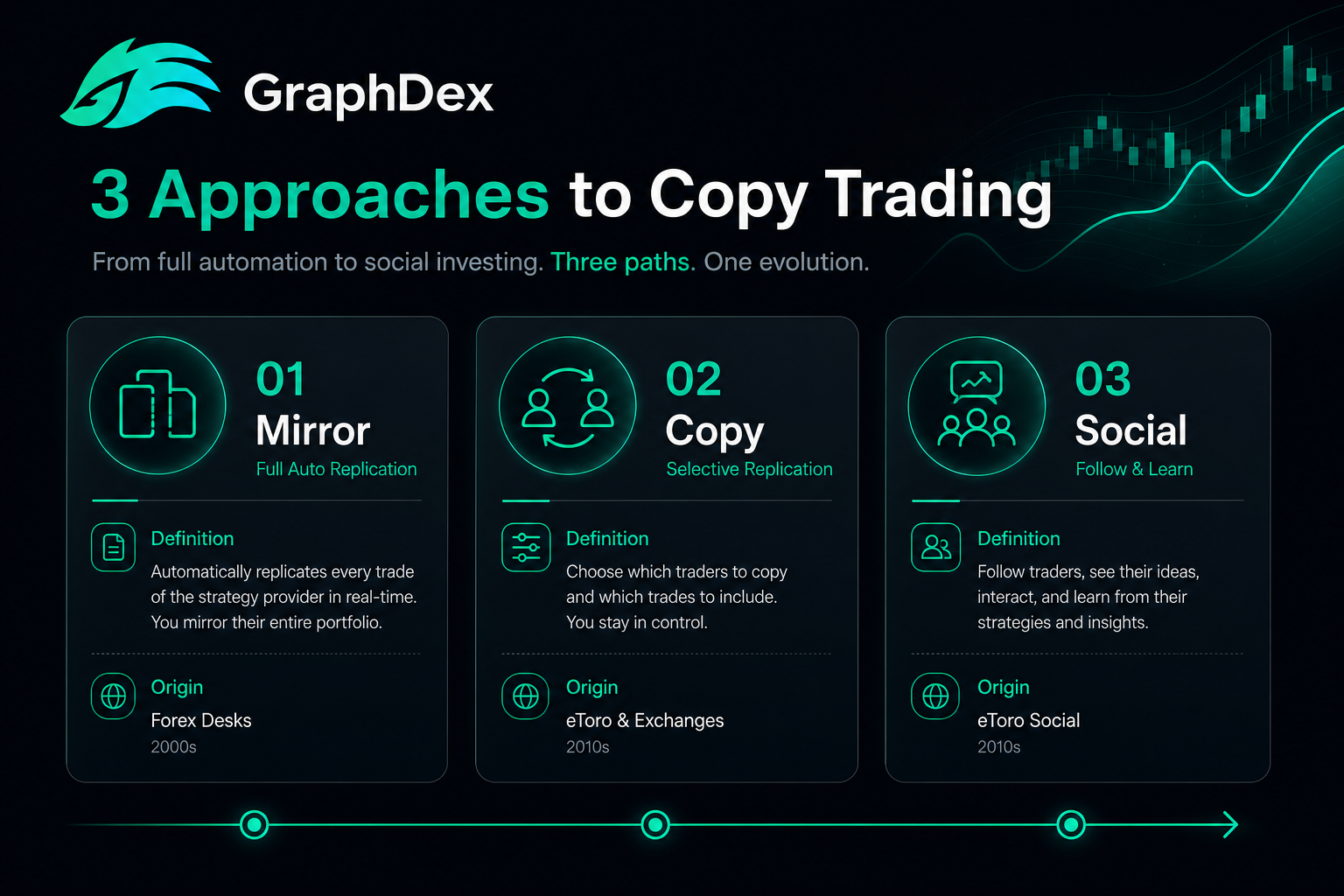
Definition: Automatically replicating — "mirroring" — a trader's entire strategy in your own account. When the source trader buys, your account buys; when they sell, your account sells. Full, automated replication.
Origin: The concept originated in the early 2000s on institutional forex desks, where brokerages let retail clients connect their accounts to professional trading strategies. It was the earliest form of automated strategy replication.
Control level: Lowest. You delegate all trade decisions to the trader you mirror. Once set up, it's hands-off.
Copy Trading
Definition: Replicating another trader's positions, often with more selectivity — you can copy individual trades from a feed, choosing which to replicate. Position size scales to your capital.
Origin: Popularized by platforms like eToro, which brought "CopyTrader" to mainstream retail investors in the 2010s. Crypto exchanges (Binance, Bybit, Bitget, OKX) later built their own copy trading systems.
Control level: Medium. You leverage a trader's expertise but can retain some choice over which trades to copy.
Social Trading
Definition: Using others' insights to inform your trading — following top traders, seeing their moves, reading discussions, and learning — without necessarily replicating their trades automatically. The most social, least automated.
Origin: eToro popularized "social trading" alongside CopyTrader, building a community network where traders share and discuss.
Control level: Highest. You stay in control of your decisions, using others' insights as input rather than delegating.
The Spectrum: Automation vs Control
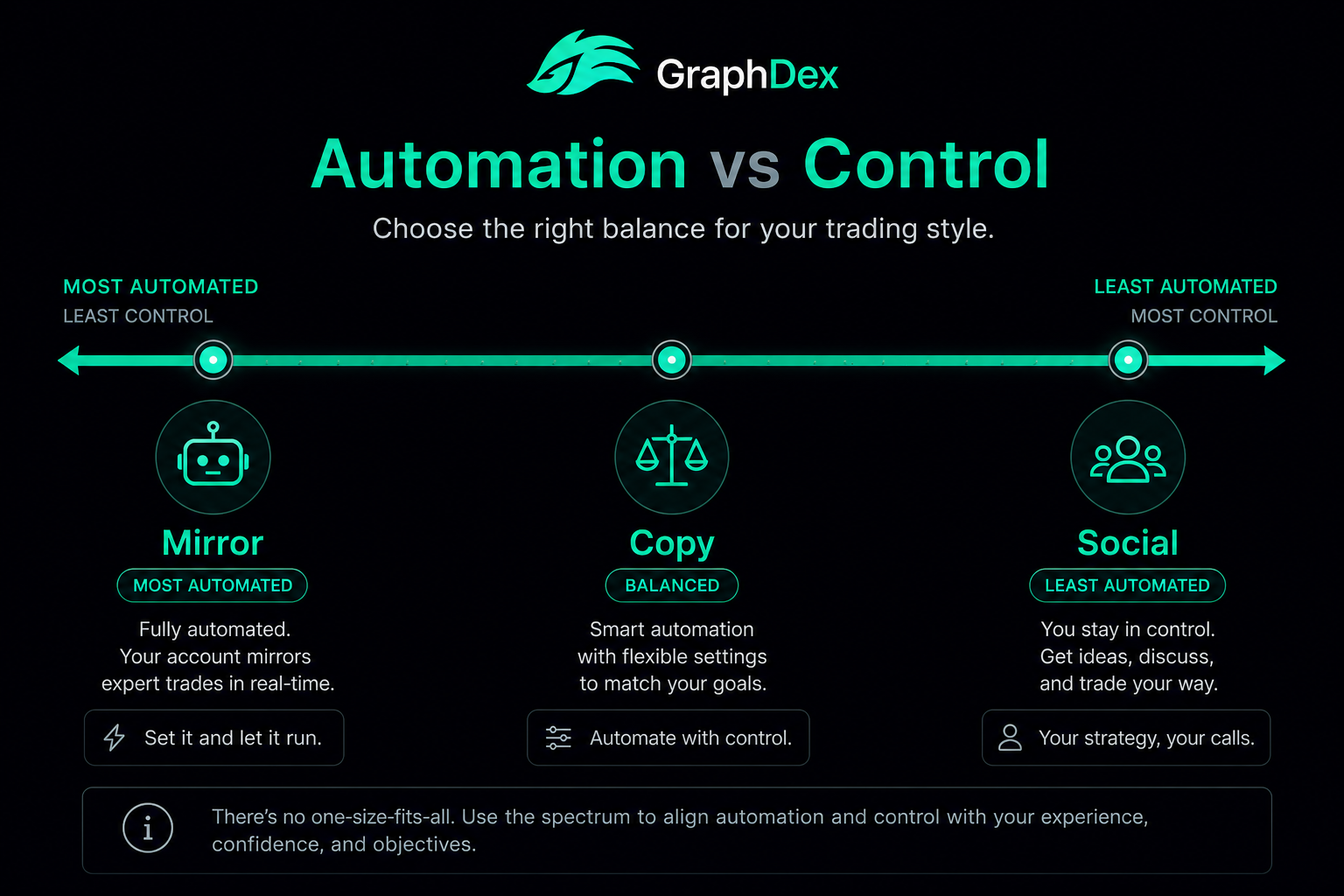
The clearest way to understand these approaches: they exist on a spectrum from most automated (least control) to least automated (most control).
Most automated → Least automated:
Mirror trading → Copy trading → Social trading
Most control ← Least control:
Social trading ← Copy trading ← Mirror trading
What this means:
- Choose mirror trading if you want maximum automation and are happy to fully delegate to a proven trader
- Choose copy trading if you want to leverage a trader but retain some selection over trades
- Choose social trading if you want to learn and make your own decisions, informed by others
The trade-off: Automation vs control is the core trade-off. More automation (mirror) means less effort but less control — you're fully trusting the trader. More control (social) means more involvement but more of your own decision-making. Copy trading balances the two.
Many platforms support all three: Modern prediction market platforms often let you passively mirror a trader's strategy (mirror trading), selectively copy individual trades from your feed (copy trading), or simply follow and learn from top traders without copying (social trading). You can choose the mode that fits your goals — and even use different modes for different traders.
Comparison Table
| Aspect | Mirror Trading | Copy Trading | Social Trading |
|---|---|---|---|
| Automation | Highest (full replication) | Medium (selective) | Lowest (follow/learn) |
| Control | Lowest | Medium | Highest |
| Your involvement | Hands-off | Some selection | Active decisions |
| Best for | Full delegation | Balanced approach | Learning, own decisions |
| Effort | Least (after setup) | Medium | Most |
| Origin | Forex desks (2000s) | eToro/exchanges (2010s) | eToro social (2010s) |
Which Approach Should You Choose?
Match the approach to your goals, experience, and preferences.
Choose mirror trading if you:
- Want maximum automation (hands-off after setup)
- Trust a proven trader and are happy to fully delegate
- Don't have time or desire to make trade-by-trade decisions
- Have selected a trader carefully (using verified data)
Choose copy trading if you:
- Want to leverage a trader's expertise but retain some choice
- Prefer to selectively copy trades rather than all of them
- Want a balance of automation and control
- Like to review trades before or as they're copied
Choose social trading if you:
- Want to learn from top traders and improve your own skills
- Prefer to make your own decisions, informed by others
- Value the educational aspect
- Want maximum control over your trades
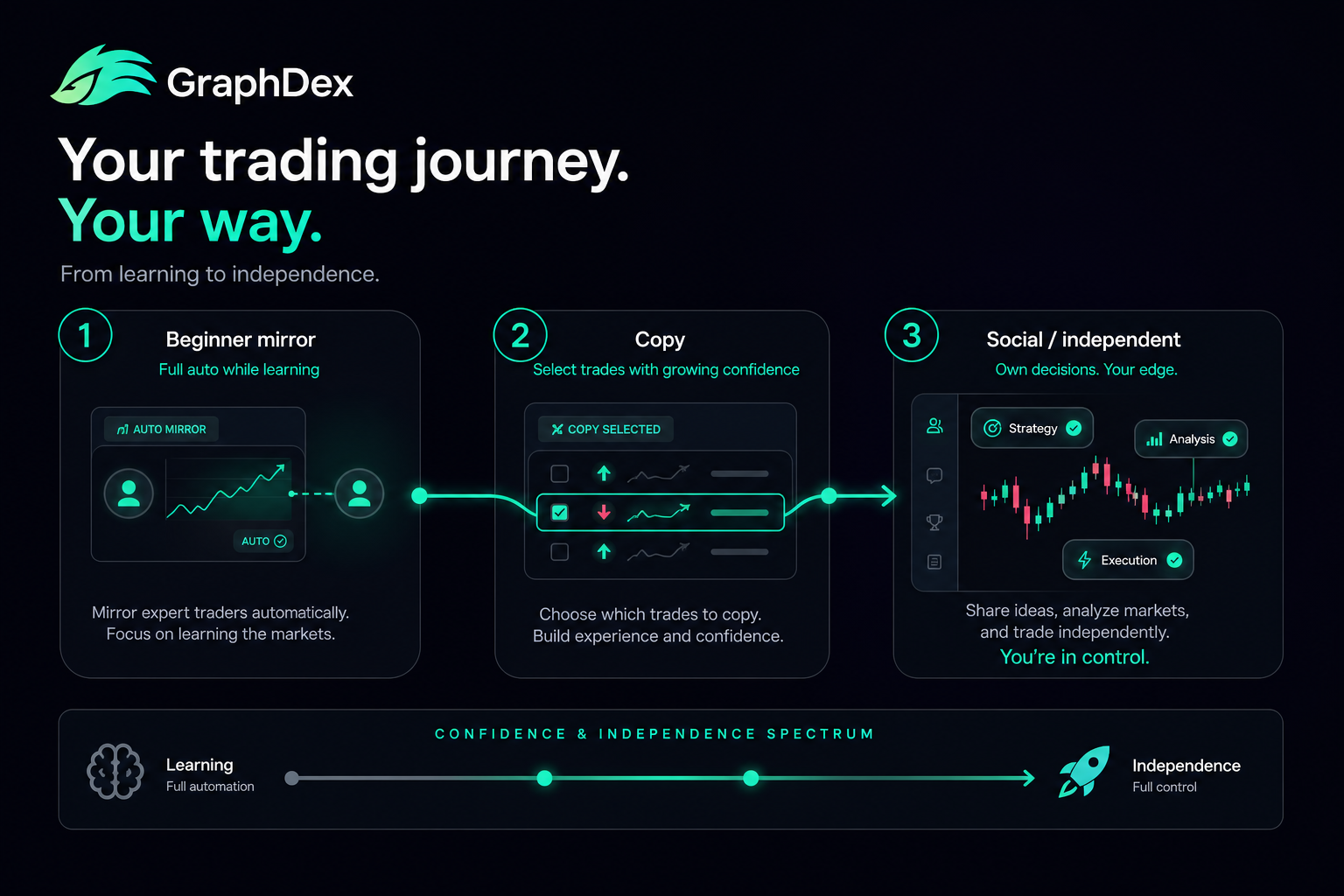
The progression path: Many traders progress along the spectrum. Beginners might start with mirror trading (full automation while they learn), move to copy trading (selecting trades as they gain confidence), and eventually social trading or independent trading (making their own decisions informed by what they've learned). There's no single "right" approach — it depends on your goals and stage.
How Do These Approaches Work on Prediction Markets?
Prediction markets like Polymarket add a unique dimension to all three approaches: on-chain verification.
Why prediction markets enhance these approaches:
Verified trader data. Because Polymarket is on-chain, the traders you mirror, copy, or follow have verifiable track records — real P&L, win rates, and drawdowns from blockchain data. This makes all three approaches more trustworthy than in traditional markets where performance can be faked.
Domain expertise. Top prediction market traders often specialize (politics, sports, crypto). Whether you mirror, copy, or follow them, you're leveraging genuine expertise.
Event-driven structure. Prediction markets trade binary/multi-outcome contracts resolving on real-world events. This structure suits all three approaches — mirror a specialist's positions, copy their best trades, or follow to learn their reasoning.
How platforms support all three: Terminals like GraphDex bring these approaches to Polymarket — you can passively mirror proven traders, selectively copy their trades, or follow and learn, all with on-chain verified data informing your choice. The mode is yours to pick.
The honest note: Regardless of approach, the same risks apply — you can lose money, copiers/mirrorers typically underperform the traders they follow, and past performance doesn't guarantee future results. The approach affects automation and control, not the underlying risk. Choose based on your goals, and apply good trader selection and risk management throughout.
Try mirror, copy, and social trading on GraphDex
How GraphDex Supports All Three Approaches
GraphDex offers the world's first integrated prediction-market copytrading, supporting the full spectrum of approaches on Polymarket.
What GraphDex offers:
- Mirror trading — passively replicate proven Polymarket traders automatically
- Copy trading — selectively copy individual trades
- Social trading — follow and learn from top traders
- On-chain verified data — evaluate traders on real, verifiable performance across all modes
- Non-custodial — your funds stay in your own wallet (Privy), sign in with Twitter, email, or Telegram
- Analytics — Bubble Maps, AI signals, and whale tracking to inform your choices
Plus the broader ecosystem:
- Direct Polymarket trading
- Solana DEX and memecoin trading
- Up to 17% APY staking on idle capital
- MEV protection
The value: GraphDex lets you choose your approach — full automation (mirror), selective control (copy), or learning (social) — all with on-chain verified trader data, in one non-custodial terminal. Whether you want hands-off delegation or active learning, GraphDex supports it, with the honest tools to do it well.
Remember: all approaches carry risk, copiers/mirrorers typically underperform the traders they follow, and no returns are guaranteed. GraphDex provides the infrastructure and verified data; your approach, selection, and risk management are yours.
Choose your approach on GraphDex
Related Guides
- Is Prediction Market Copy Trading Profitable in 2026? An Honest Analysis
- Prediction Market Copy Trading in 2026: The Complete Guide
- Best Solana Trading Terminal in 2026: GraphDex vs Axiom vs GMGN vs Trojan vs BullX
- Mirror Trading on Polymarket in 2026: How to Automatically Follow Top Traders
Frequently Asked Questions
What's the difference between copy trading and mirror trading? Mirror trading is the most automated — you fully replicate a trader's entire strategy (when they trade, you trade), hands-off after setup. Copy trading is more selective — you copy individual trades, often from a feed, retaining some choice over which to replicate. Mirror trading offers maximum automation with least control; copy trading balances automation and control. They exist on a spectrum.
What is social trading? Social trading means using others' insights to inform your trading — following top traders, seeing their moves, reading discussions, and learning — without necessarily replicating their trades automatically. It's the least automated and most hands-on of the three approaches, keeping you in control of your decisions while leveraging others' insights. eToro popularized the term in the 2010s.
Which is better: mirror, copy, or social trading? None is universally better — they suit different goals. Mirror trading suits those wanting maximum automation and full delegation. Copy trading suits those wanting to leverage a trader while retaining some choice. Social trading suits those wanting to learn and make their own decisions. The choice depends on how much you want to automate vs control, and your experience level.
Do these approaches work differently on prediction markets? The mechanics are similar, but prediction markets like Polymarket add on-chain verification — the traders you mirror, copy, or follow have verifiable track records from blockchain data, making all three approaches more trustworthy than in traditional markets. Prediction markets also feature domain-expert traders and event-driven contracts, which suit all three approaches well.
Can I use all three approaches? Yes — many platforms, including prediction market terminals like GraphDex, support all three. You can passively mirror some traders, selectively copy others, and follow yet others to learn — even using different modes for different traders. This flexibility lets you match your approach to each situation and your evolving goals and experience.
Which approach is best for beginners? Many beginners start with mirror trading (full automation while they learn the ropes), then progress to copy trading (selecting trades as they gain confidence), and eventually social trading or independent decisions (informed by what they've learned). However, even mirror trading requires careful trader selection. Beginners should start small, use verified data, diversify, and maintain realistic expectations regardless of approach.
Do any of these guarantee profit? No. Mirror, copy, and social trading all carry risk — you can lose money, and past performance doesn't guarantee future results. With mirror and copy trading, you also typically underperform the traders you follow (delays, worse fills). The approach affects automation and control, not the underlying risk. Apply good trader selection, diversification, and risk management regardless of which approach you choose.
About This Guide
This guide is published by the GraphDex Research team — analysts and traders building the infrastructure for digital asset trading on Solana. Our content is based on direct experience, current market data, and 2026 prediction market developments.
Sources & data: Definitions and mechanics reflect publicly available information as of 2026 and may change. All approaches carry substantial risk including loss of capital; copiers/mirrorers typically underperform the traders they follow, and past performance doesn't predict future results. Prediction market legality varies by jurisdiction. This guide is educational and not financial advice.
GraphDex is the infrastructure for digital asset trading — trade, predict, and earn in one place. Learn more at graphdex.io.
Last reviewed: May 2026 · GraphDex Research
The infrastructure for digital asset trading. Trade, predict, stake, repeat. graphdex.io