By GraphDex Research · Reviewed for accuracy July 2026
Quick Answer
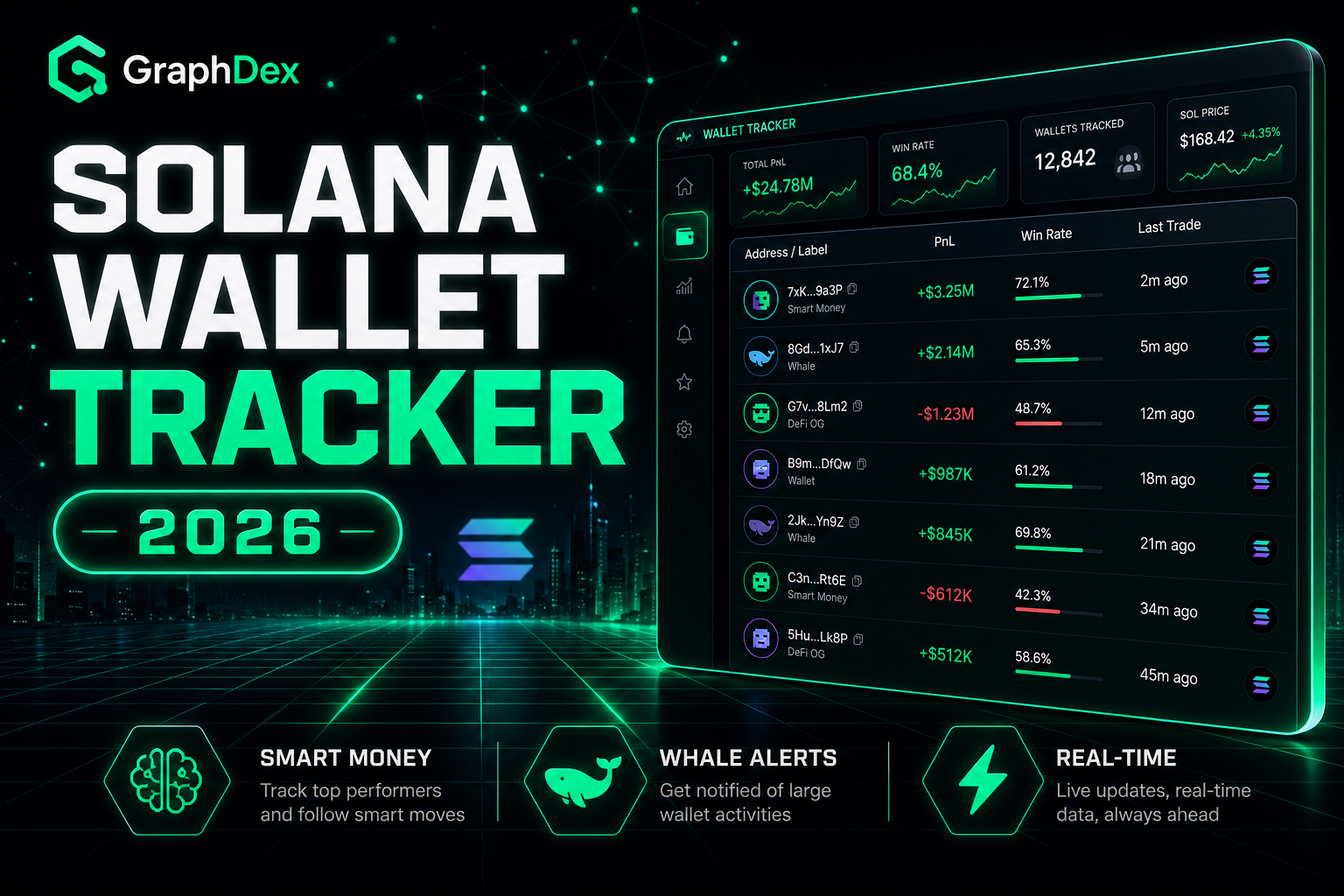
A Solana wallet tracker monitors specific wallet addresses in real time and alerts you when they trade. To follow smart money in 2026:
- Identify high-performance wallets — consistent PnL and win rate over months
- Build a categorized watchlist — smart money, whales, KOLs, project teams
- Set real-time alerts on significant trades
- Confirm signals with on-chain and social context before acting
- Execute fast — the edge decays as more people see the same move
Track smart money wallets on GraphDex
Key Takeaways
- A Solana wallet tracker monitors addresses in real time and alerts you when they trade.
- Smart money in 2026 includes institutional funds, AI agent treasuries, and ecosystem insiders.
- Every Solana transaction is public — wallet tracking analyzes legal, public on-chain data.
- GraphDex integrates tracking with execution, eliminating the tool-switching delay that costs the edge.
Why Wallet Tracking Is the Ultimate Solana Edge
In the high-velocity Solana network of 2026, the difference between a retail trader and a market maker is information latency. While most investors wait for social media hype, the real smart money — venture funds, institutional market makers, and elite algorithmic traders — has already finished accumulating.
The Solana blockchain is entirely public. Every transaction, every trade, every wallet balance can be seen by anyone. The problem is scale: Solana handles tens of millions of active wallets, making manual oversight impossible. A wallet tracker filters out the noise of millions of retail transactions and focuses exclusively on high-conviction movements.
By identifying and monitoring smart money addresses, you observe accumulation patterns before they reflect on the price chart. This is the closest thing to legal insider information in crypto — it is all public, you just need the tools to see it.
What Is Smart Money on Solana?
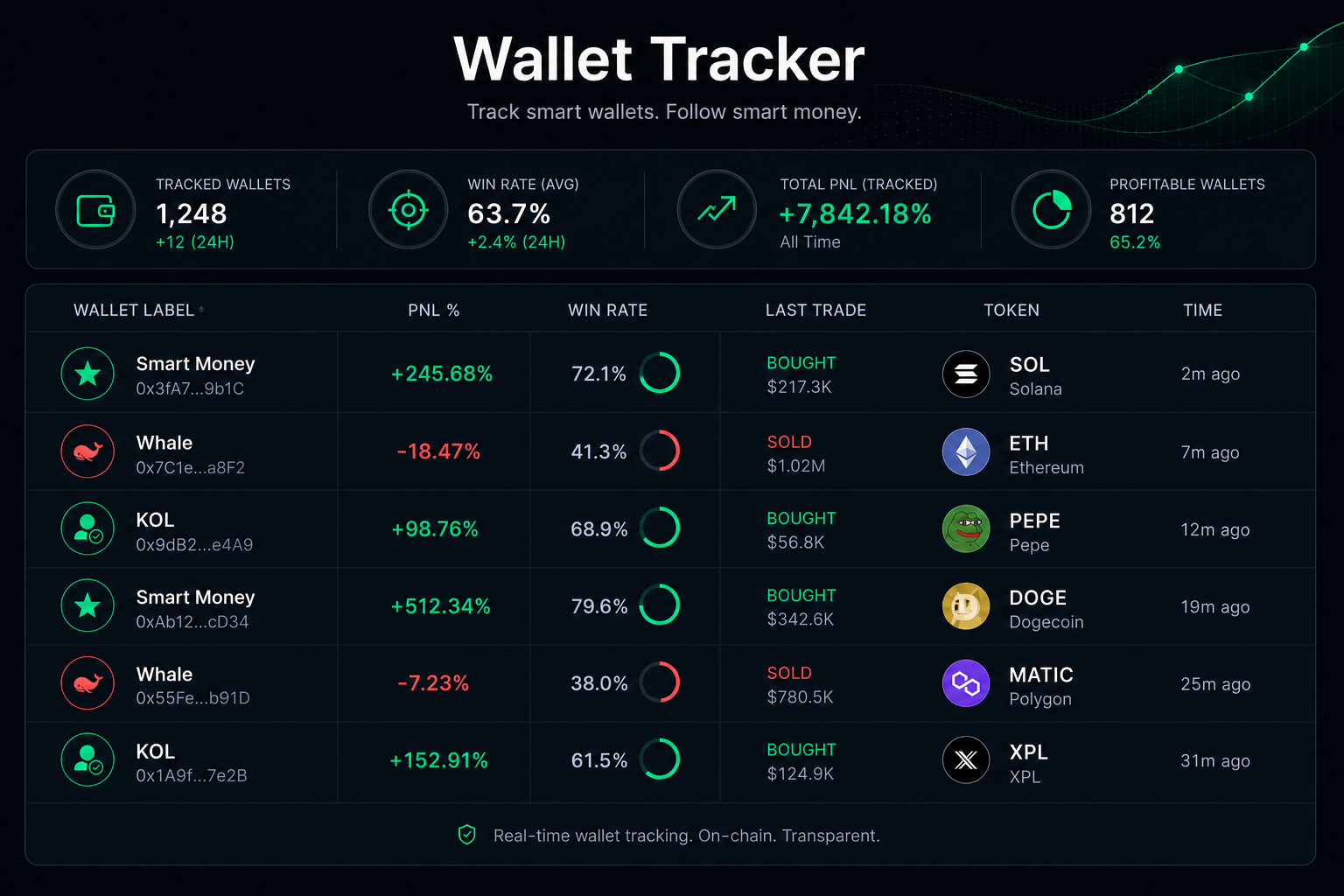
Smart money refers to wallet addresses that consistently demonstrate high profitability (PnL) and a high win rate over extended periods. In 2026, these are no longer just whales with large balances — they are sophisticated entities:
Institutional funds — wallets associated with established crypto funds and newer Solana-native funds that move significant capital with research behind it.
AI agent treasuries — autonomous Solana AI agents executing high-frequency arbitrage and liquidity strategies.
Ecosystem insiders — addresses that interact with new protocols weeks before public launch.
Elite individual traders — KOLs and independent traders with track records of early entries and profitable exits.
The goal of tracking is to focus exclusively on these high-conviction movements rather than the noise of retail activity.
The Types of Wallets Worth Tracking
A balanced Solana watchlist includes different categories, each providing different signals:
| Wallet Type | What it reveals |
|---|---|
| Smart money | Profitable entries and exits before price moves |
| Whales ($1M+) | Large positions that can move markets |
| KOL wallets | What influential traders actually do vs. what they post |
| Project teams | Insider behavior — are they dumping or holding? |
| Treasury wallets | How projects manage and deploy capital |
| Your own wallets | Monitor sends, receives, and approvals for security |
Whale wallets hold positions large enough to move markets — typically $1M+ on Solana. Track whale accumulation and distribution: consistent buying despite price drops indicates conviction, while gradual selling into strength suggests an exit.
Project team wallets reveal insider behavior. Teams selling tokens continuously while promoting publicly is a major red flag. Tracking team wallets for new projects verifies they are not dumping on retail.
How to Track Solana Wallets: Step by Step
Step 1: Find Wallets Worth Tracking
Start by identifying wallets with proven track records:
- Look at the early buyers of tokens that later ran successfully
- Find wallets with consistent profitability across multiple tokens over months
- Check entry timing — smart money enters in the first minutes to hours
- Verify exit behavior — profitable exits, not just early entries
Step 2: Build a Categorized Watchlist
Organize the wallets you track by category — smart money, whales, KOLs, teams. This lets you interpret alerts in context. A buy from a known smart money wallet means something different than a transfer from a project treasury.
Step 3: Set Real-Time Alerts
The goal is not to copy every move. The goal is to notice when a watched wallet starts doing something different. Set alerts on trades above a meaningful threshold so you are notified when tracked wallets make significant moves — not every dust transaction.
Step 4: Confirm Before Acting
A wallet alert is a signal, not a command. Before acting, confirm with context:
- Is the token's holder distribution healthy? (check Bubble Maps)
- Is there social momentum forming around it?
- Are other tracked wallets moving the same direction?
Step 5: Execute Fast
Smart money edges decay quickly. Once a known wallet's move is visible, thousands of trackers may see it simultaneously. The faster you can go from alert to execution, the more edge you retain.
Set up wallet tracking on GraphDex
Solana Wallet Tracker Tools Compared
| Tool | Strength | Limitation |
|---|---|---|
| GraphDex Tracker | Integrated with execution, social, Pulse feed | Solana-focused |
| Nansen | AI-powered labeling, free tier | Separate from execution |
| Arkham | 800,000+ labeled traders | Separate from execution |
| DEXTools | Discovery and tracking | Fragmented workflow |
| Step Finance | Comprehensive DeFi dashboard | Monitoring only |
Tools like Nansen and Arkham provide deep intelligence — Arkham maps over 800,000 labeled traders showing historical PnL and accumulation patterns. But they share one limitation: the tracking is separate from the execution. You see the signal in one tool, then switch to another to trade.
GraphDex integrates wallet tracking directly into the trading terminal. When a tracked wallet buys, you see the alert and can execute your own position in the same interface — without switching tools.
Why Integrated Tracking Beats Standalone Tools
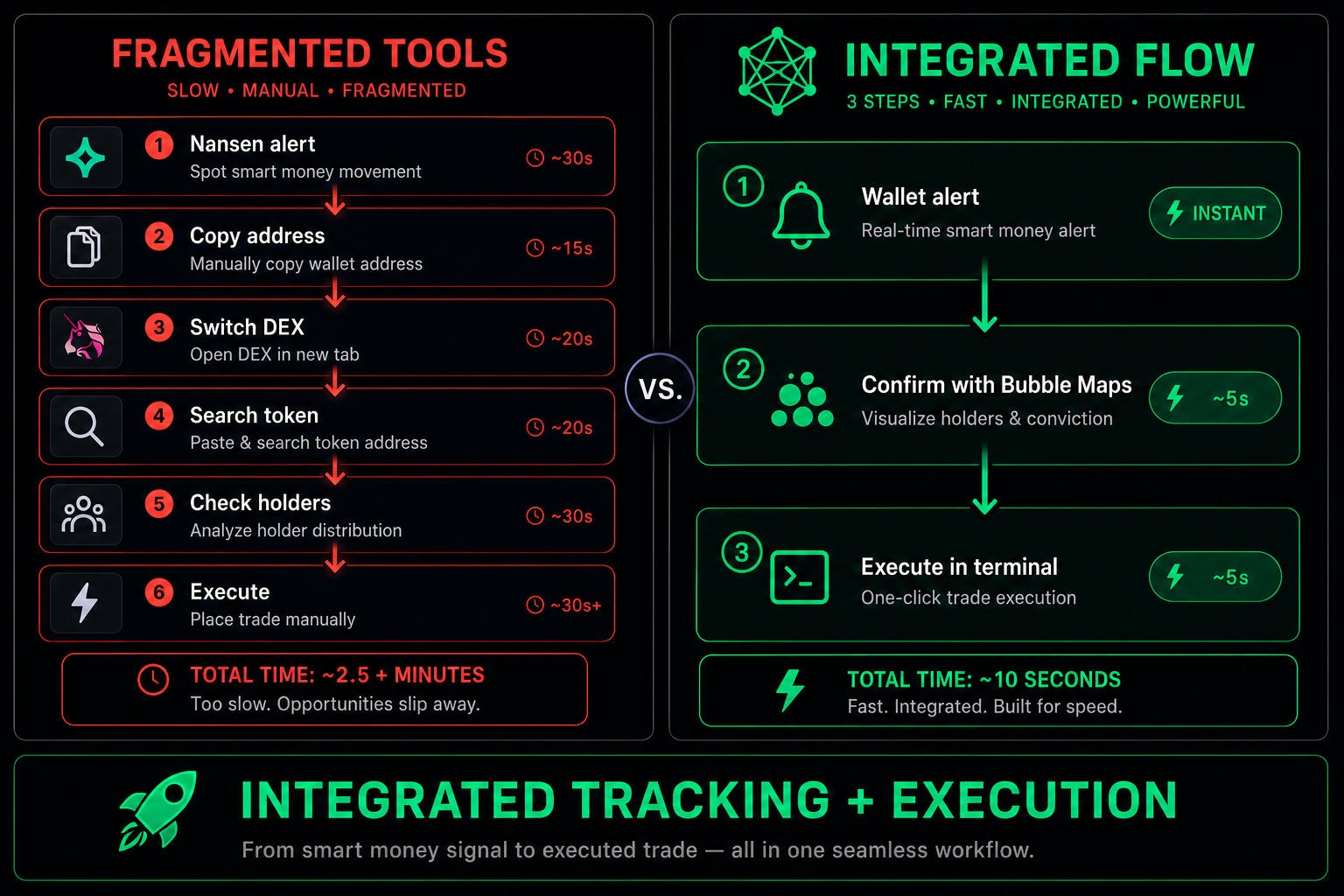
The fundamental problem with most wallet trackers is fragmentation. Fragmented workflows slow you down — and on Solana, slow means missed.
Consider the standard workflow with standalone tools:
- See an alert in Nansen or Arkham
- Copy the token address
- Switch to your DEX or terminal
- Search the token
- Check holder distribution in another tool
- Finally execute
Each step is delay. By the time you have completed six steps, the smart money move you spotted may have already played out.
GraphDex collapses this into one flow. The wallet tracker, the Pulse feed, social signals, Bubble Maps, and execution all live in one interface. See the alert, confirm the context, execute — without leaving the terminal.
Track and trade in one interface on GraphDex
Building an Effective Smart Money Workflow
The traders who profit from wallet tracking treat it as a disciplined process, not a copy-everything reaction.
Curate ruthlessly. A watchlist of 20 genuinely smart wallets beats a watchlist of 200 mediocre ones. Quality of signal matters more than quantity.
Categorize by behavior. Group wallets by what they do well — some excel at early memecoin entries, others at larger-cap accumulation. Interpret their moves accordingly.
Watch for behavior changes. The strongest signal is not a routine trade — it is when a wallet that normally does one thing suddenly does something different. A long-term holder starting to sell, or a cautious wallet suddenly accumulating aggressively.
Combine signals. A single wallet buying is weak signal. Multiple tracked wallets buying the same token simultaneously is strong signal. Confluence across your watchlist is where conviction comes from.
Respect the decay. Smart money alpha has a short shelf life. The information advantage exists only in the window before the broader market notices. Speed from signal to execution is the entire game.
Combining Wallet Tracking with the Full GraphDex Toolkit
Wallet tracking is most powerful when combined with the other signals available in the same terminal. On GraphDex, the wallet tracker does not operate in isolation — it works alongside the Pulse feed, social monitoring, and Bubble Maps to build complete conviction.
Wallet tracker + Pulse feed: When a tracked smart money wallet buys a token that simultaneously appears in the Pulse feed as a fresh launch, you have caught smart money entering at creation. This is the highest-conviction early signal available.
Wallet tracker + social signals: A smart money buy combined with organic social momentum building around the same token confirms the move is part of a forming narrative, not an isolated bet.
Wallet tracker + Bubble Maps: Before following a tracked wallet into a token, the Bubble Maps check confirms the holder structure is healthy. Smart money sometimes enters tokens that are still structurally risky.
Wallet tracker + copytrading: For prediction markets, GraphDex extends the same logic — follow top forecasters and mirror their positions automatically, the prediction-market equivalent of wallet tracking.
This integration is the core argument for an all-in-one terminal. Each signal is useful alone. Together, in one interface, they compound into conviction that fragmented tools cannot match.
Build complete conviction with GraphDex
Common Wallet Tracking Mistakes
Copying every move blindly Smart money makes losing trades too. Tracking reveals what they do; it does not guarantee the trade works. Confirm with context.
Tracking too many wallets A bloated watchlist generates noise, not signal. Curate ruthlessly.
Ignoring the decay By the time a famous wallet's move is widely visible, the edge is mostly gone. Speed matters.
Skipping verification A smart money buy into a token with concentrated holders can still be a trap. Always check holder distribution.
Using fragmented tools Every tool switch is delay. Integrated tracking and execution is the structural advantage.
Key Terms Defined
A Solana wallet tracker is a tool that monitors specific wallet addresses in real time and alerts you when they execute trades.
Smart money refers to wallet addresses — institutional funds, AI agents, and elite traders — with consistent high profitability over extended periods.
A whale is a wallet holding large positions (typically $1M+ on Solana) whose trades can move markets.
On-chain data is the publicly visible record of every transaction on the blockchain, which wallet trackers analyze to surface meaningful activity.
Related Guides
- Track Prediction Market Whales — follow smart money in prediction markets
- How to Find Memecoins Early — smart-money tracking as a discovery signal
- How to Spot a Rug Pull on Solana — pair wallet tracking with safety analysis
- Best Memecoin Trading Bots 2026 — tools with integrated wallet tracking
- What Is GraphDex? — the terminal with built-in smart-money tracking
Frequently Asked Questions
What is a Solana wallet tracker? A Solana wallet tracker monitors specific wallet addresses in real time and alerts you when they trade. It transforms public blockchain data into actionable intelligence by letting you follow smart money, whales, and KOLs. GraphDex includes wallet tracking integrated with execution.
How do I find smart money wallets on Solana? Look at the early buyers of tokens that later ran successfully, find wallets with consistent profitability across multiple tokens over months, and verify they have profitable exit behavior — not just early entries. Add them to a categorized watchlist.
Can I follow whales on Solana? Yes. Whale wallets hold $1M+ and their trades can move markets. Track their accumulation and distribution patterns — consistent buying despite price drops signals conviction, gradual selling into strength signals an exit.
Is wallet tracking legal? Yes. Every Solana transaction is public on the blockchain. Wallet tracking analyzes publicly available data. It is not insider information — it is public information that most people lack the tools to see efficiently.
What is the best Solana wallet tracker in 2026? Nansen and Arkham offer deep standalone analytics. GraphDex integrates wallet tracking directly with execution, the Pulse feed, social signals, and Bubble Maps — eliminating the tool-switching delay that costs you the edge.
How fast do I need to act on wallet signals? Smart money alpha decays quickly. Once a known wallet's move is visible, many trackers see it at once. The faster you go from alert to execution, the more edge you retain — which is why integrated tracking and trading matters.
Should I copy every trade a smart money wallet makes? No. The goal is to notice when a watched wallet does something different, then confirm with context before acting. Smart money makes losing trades too — tracking is a signal, not a command.
About This Guide
This guide is published by the GraphDex Research team — analysts and traders building the infrastructure for digital asset trading on Solana. Our content is based on live platform data, current market figures, and hands-on experience with the tools and platforms covered.
Sources & data: Market figures, platform statistics, and competitor data in this article reflect publicly available information as of 2026. Prediction market and trading data carry inherent risk; this guide is educational and not financial advice.
GraphDex is the infrastructure for digital asset trading — trade, predict, and earn in one place. Solana DEX trading, prediction markets with copytrading, AI signals, and non-custodial Privy wallets. Learn more at graphdex.io.
Last reviewed: July 2026 · GraphDex Research
The infrastructure for digital asset trading. Trade, predict, stake, repeat. graphdex.io