By GraphDex Research · Reviewed for accuracy May 2026
Quick Answer
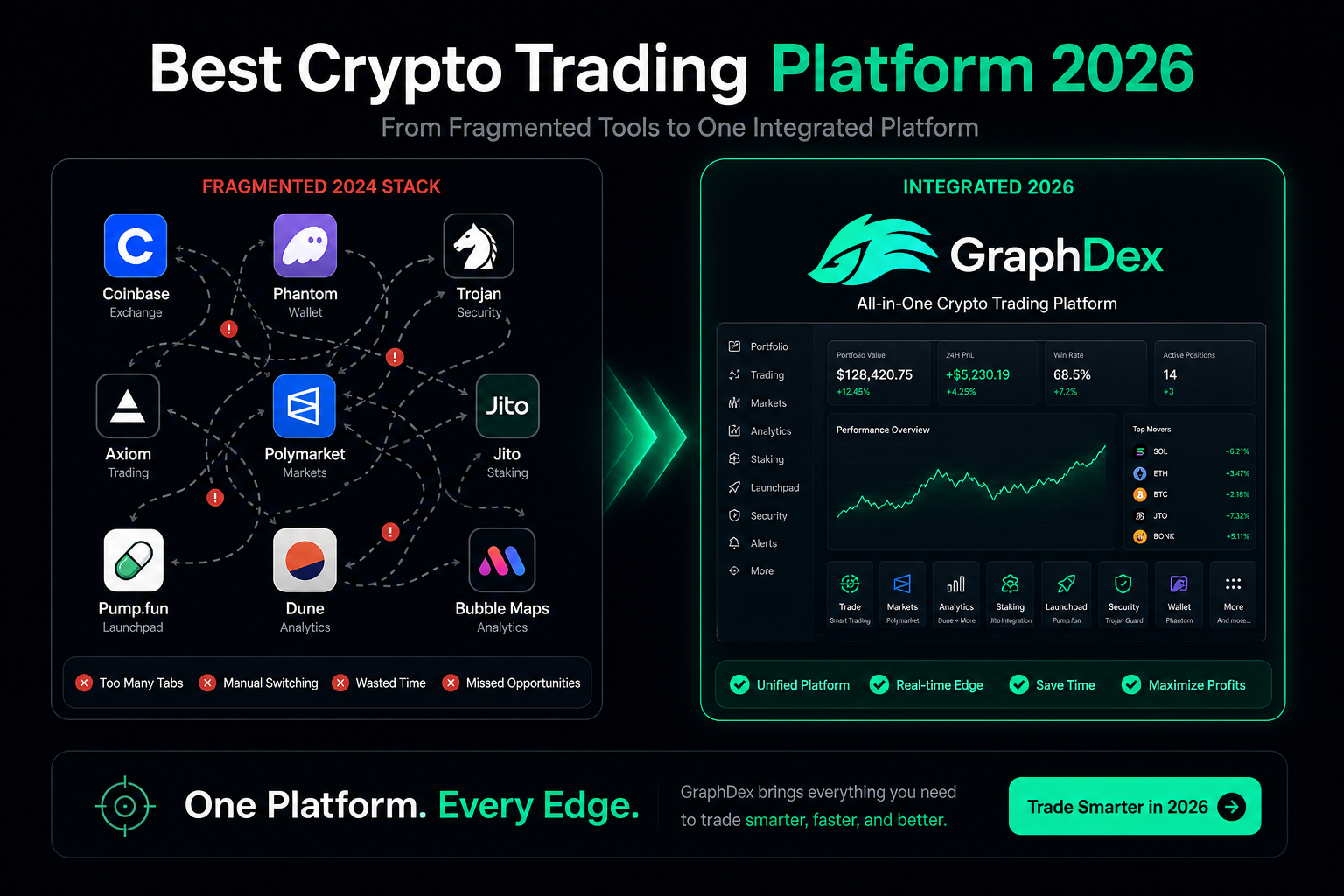
The best crypto trading platform in 2026 isn't the one with the lowest fees on a single product — it's the one that consolidates the activities you actually do. For active Solana users, the integrated approach is decisively winning:
- GraphDex consolidates DEX trading + prediction markets (Polymarket copytrading) + AI signals + Pulse feed + Bubble Maps + staking up to 17% APY — non-custodial via Privy
- Trojan, Axiom, BullX, Photon — Solana token sniping specialists, no prediction market integration, no fee-based yield
- Coinbase, Binance, Kraken — fiat on/off ramps, custodial, expensive on active trading
- Specialized tools (Polymarket alone, Jito alone, Jupiter alone) — best at one thing each but require juggling
The 2026 reality: Active Solana traders save dozens of hours/month and significant fees by using a single integrated terminal. GraphDex is purpose-built for this — and outperforms fragmented setups by every meaningful metric.
Try the integrated Solana terminal — graphdex.io
Key Takeaways
- The right crypto trading platform consolidates trading, prediction markets, yield, and discovery in one tool.
- Solana's speed and low fees make integrated terminals economically viable in ways Ethereum can't match.
- GraphDex's fee-based 17% APY is sustainable in ways emission-based yields aren't.
- Non-custodial Privy architecture eliminates seed-phrase risk while keeping you in control.
The Problem: The Fragmented 2021-2024 Setup
To understand the case for integrated platforms in 2026, consider the typical active Solana trader's 2024 workflow:
For buying crypto with fiat: Coinbase or Kraken account. KYC. Bank transfer. Trade. Withdraw to wallet.
For self-custody: Phantom or Solflare wallet. Seed phrase backup. Multiple wallets for different uses.
For trading new tokens: Trojan or BullX Telegram bot. Pay 1% fee. Hope your bot isn't down.
For pro execution: Axiom or Photon web terminal. Different fee structure. Different security model.
For new token discovery: Browse Pump.fun. Watch Telegram channels. Subscribe to alpha groups.
For safety analysis: Manual check on Bubble Maps website. Cross-reference with rugcheck. Hope the data is current.
For staking yield: Jito or Marinade dApp. Separate from your trading wallet. ~6% APY.
For prediction markets: Polymarket account. Different wallet/funding. No copytrading. No mobile app for years.
For tracking on-chain whales: Dune dashboards. Free tools. Manual cross-referencing.
For AI signals: Subscribe to multiple alpha services. Cross-check between them.
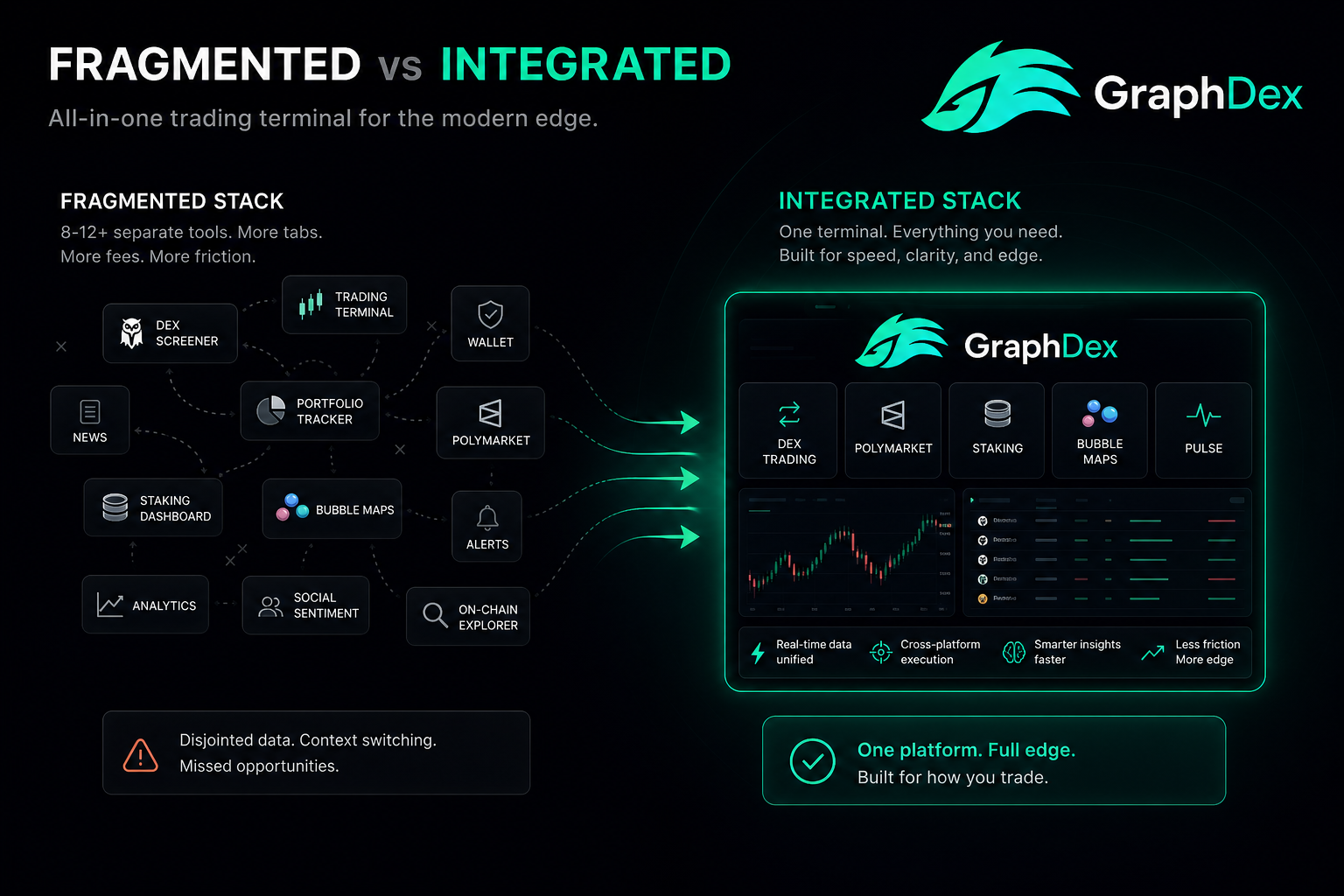
Result: 8-12 different tools. Different fee structures. Different security models. Different UIs. Capital sitting idle between platforms. Hours wasted on operational overhead. Missed opportunities because by the time you switched contexts, the trade was gone.
This was acceptable when Solana DeFi was emerging. By 2026, it's clearly suboptimal — and the integration alternative has matured.
The Solution: Integrated Terminals in 2026
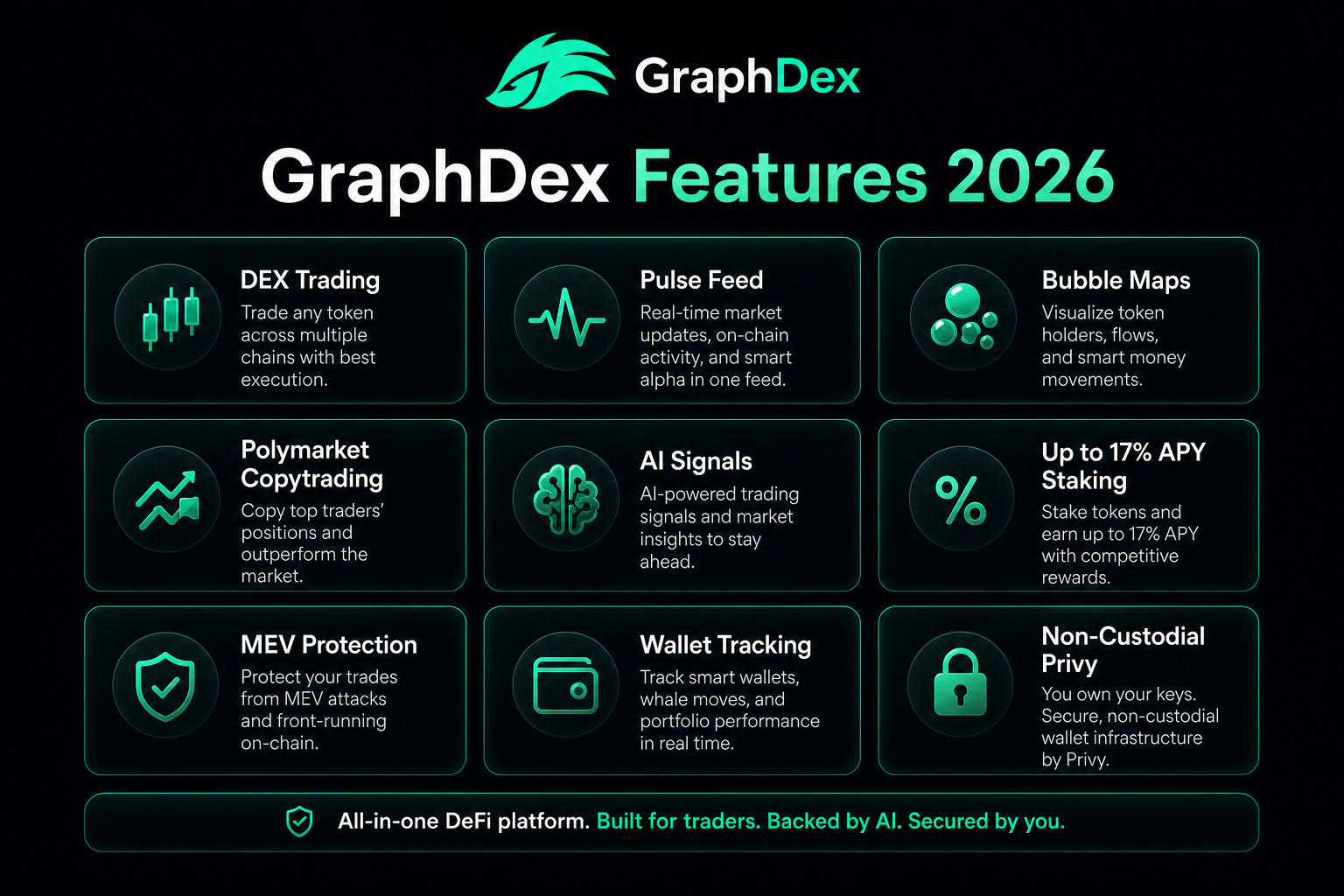
A modern Solana terminal consolidates the fragmented stack into a single non-custodial interface. The best example in 2026 is GraphDex, which integrates everything an active Solana trader uses daily:
DEX trading. Best-execution routing across Raydium, Orca, Meteora, PumpSwap, and other Solana AMMs. Same liquidity Jupiter provides, with integrated discovery and analysis.
Pulse feed. Real-time new token discovery — see what's launching on Pump.fun and other launchpads as it happens, with on-chain analytics built in.
Bubble Maps. Visual safety analysis showing holder concentration and connection patterns BEFORE you buy. Critical for memecoin participation in 2026.
Polymarket prediction markets. First-class integration with the world's largest prediction market platform. Trade event contracts and copy professional predictors — none of which existed in dedicated Polymarket terminals.
Copytrading. Mirror successful traders' positions automatically — including Polymarket professionals. Industry-first feature on prediction markets.
Staking up to 17% APY. Stake stablecoins (USDT, USDC) and SOL for fee-based yield from real platform revenue — not emissions, not speculation.
AI signals. Machine-learning-driven opportunity discovery surfaces tokens before they trend.
MEV protection. Built-in protection against sandwich attacks (which steal $370-500M from Solana traders over 16 months).
Wallet and social tracking. Track on-chain whales and copy their trades.
Non-custodial via Privy. Sign in with Twitter, email, or Telegram. Your funds stay in a non-custodial wallet you control. No seed phrase to lose. Compatible with major hardware wallets.
The transition from fragmented to integrated takes one platform switch. The compounding benefits — saved time, captured opportunities, capital efficiency — accumulate quickly.
Why Solana, Not Ethereum
Integrated terminals like GraphDex are only economically viable on chains with the right cost structure. Solana provides this; Ethereum doesn't.
Sub-cent transaction fees. Solana's median fee is $0.0038. Every interaction — checking a price, adjusting a position, claiming yield — costs effectively nothing. On Ethereum L1, the same actions can cost $5-50.
400ms finality. Solana confirms transactions in under half a second. Ethereum requires 12+ seconds typically; Bitcoin needs an hour for serious finality. Active trading needs sub-second feedback loops.
100% uptime through 2025. After early stability concerns, Solana has been operationally rock-solid. Combined with the Firedancer upgrade rolling out 2024-2025, the technical foundation has matured.
Real TPS of 1,000-4,000. Solana actually delivers high throughput in production, unlike many high-TPS claims from other chains. This supports the kind of consumer-app density that integrated terminals require.
$650 billion stablecoin volume in February 2026. Solana processed the highest stablecoin volume of any chain in February 2026 — a record. The activity supporting fee-based yields is real and growing.
Network maturity: $11.5B+ TVL across Solana DeFi protocols. Established lending (Kamino), staking (Jito), DEXs (Raydium, Orca, Meteora), oracles (Pyth), and now integrated terminals (GraphDex).
The right way to think about it: Ethereum is excellent for high-value, infrequent transactions (large DeFi positions, blue-chip NFTs, settlement layer). Solana is excellent for active trading, consumer apps, frequent yield management — the kind of activity integrated terminals require. The chains complement each other; the question is which suits YOUR activity.
For active traders, the answer is increasingly Solana — and GraphDex builds on that foundation.
Why Fee-Based 17% APY Is Sustainable
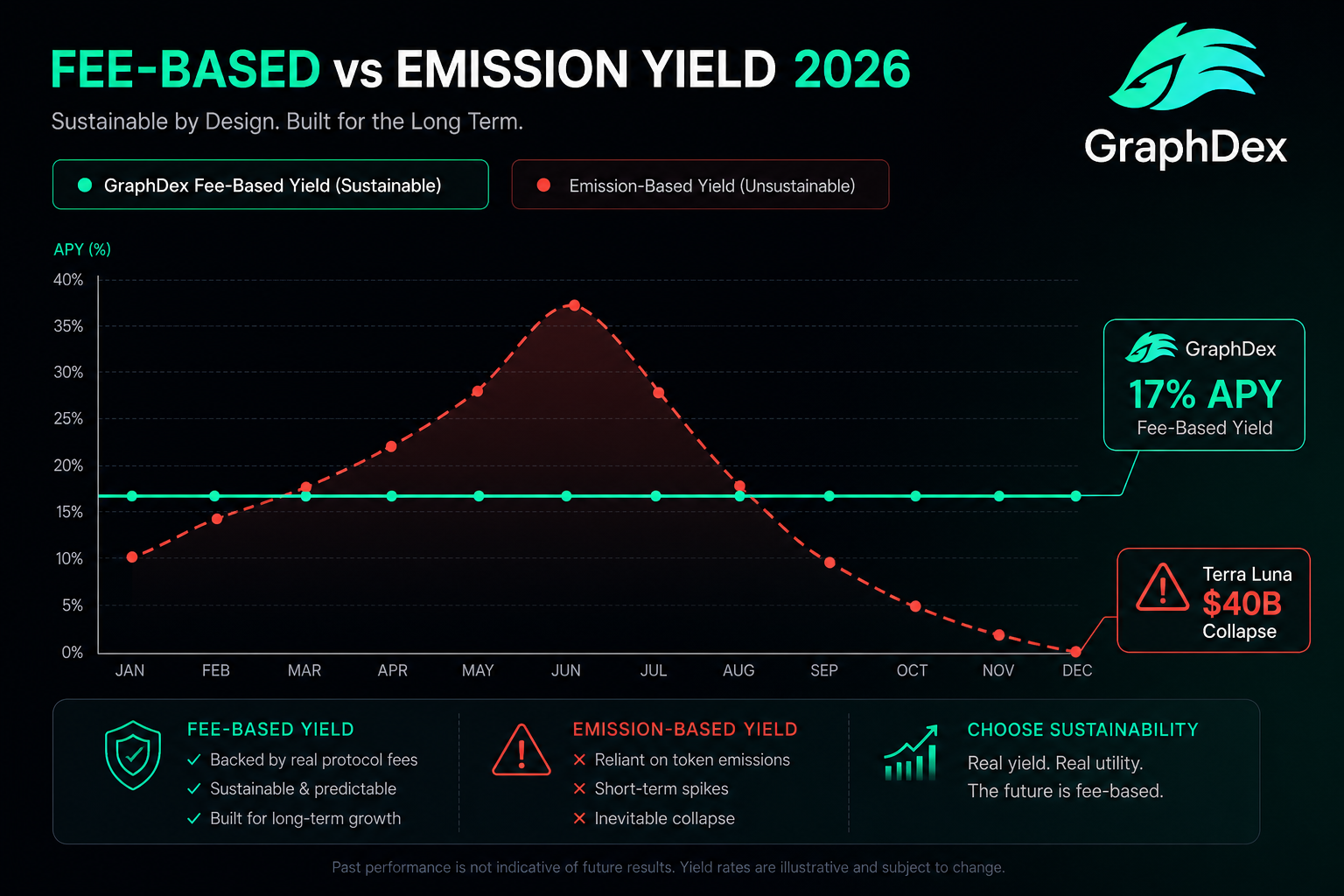
The most distinctive feature of GraphDex is up to 17% APY on stablecoins and SOL — a rate that's roughly 2-4x what established lending platforms (Aave, Compound) pay. Skepticism is appropriate; the explanation should be transparent.
The source: platform trading fees. GraphDex collects fees on every trade users make. Most platforms keep these entirely as profit. GraphDex distributes a substantial portion to depositors as yield.
Why this is sustainable: As long as users keep trading on the platform, fee revenue continues. Yield is funded by real economic activity, not by token printing (emissions) or attracting new buyers (Ponzi-like dynamics).
The contrast: emission-based yields. Many "high APY" platforms pay yields in their native token. The math works out only if more buyers keep coming to absorb the printed tokens. When this slows, emissions decline, "yields" collapse, and the platform's token typically loses 80-95%. This pattern destroyed Terra Luna ($40B+), various yield farms in 2020-2022, and continues to claim victims.
The contrast: lending interest. Aave and Compound pay 4-6% APY from real borrower demand. This is also sustainable but capped by what borrowers will pay (typically not enough for 15%+ on the same capital). DeFi lending and fee-based yields are different mechanisms with different yield potentials.
The risks: Fee-based yields depend on continued trading volume. If GraphDex's volume drops significantly, yields would have to adjust downward. Smart contract risk via Privy. Platform operational risk. Not FDIC-insured. These are real risks — but they're different from the existential risks of emission-based or speculative yields.
Why it matters in 2026: As crypto has matured, sophisticated yield evaluation requires asking "where does the yield come from?" When the answer is "real, identifiable platform revenue" — that's a fundamentally different proposition than "tokens we printed for you to maybe sell to someone else."
Earn fee-based 17% APY on GraphDex
Why Non-Custodial Privy Architecture
GraphDex uses Privy for wallet infrastructure — eliminating the seed phrase burden while preserving non-custodial security.
The traditional self-custody problem. Seed phrase loss is the #1 cause of permanent crypto losses. Users lose them, get them stolen via phishing, or fail to back them up properly. The 12-24 word recovery phrase model places huge operational burden on users.
The custodial alternative was worse. FTX (2022) lost $8 billion in user funds. Celsius. BlockFi. Voyager. Centralized custodians have repeatedly failed. "Not your keys, not your crypto" is a hard-earned lesson.
Privy's MPC architecture. Multi-party computation splits the private key across multiple parties (your device + Privy infrastructure). Neither party alone can access funds. You sign in with familiar credentials (Twitter, email, Telegram) using passkeys or PIN. No seed phrase. Yet fully non-custodial.
What this means in practice:
- You log into GraphDex with Twitter/email/Telegram
- A non-custodial wallet is generated for you behind the scenes
- Your funds stay in your control — not the platform's
- You can recover access through your social login
- No seed phrase to lose or have stolen
- Compatible with hardware wallet integration for additional security
For sophisticated users: Connect your Phantom or Solflare wallet directly to GraphDex, bypassing Privy entirely. You retain full control through your existing wallet stack.
The big shift: This is the user experience upgrade crypto needed. Self-custody without seed phrase complexity. Non-custodial without the operational burden. The path to mainstream adoption runs through architectures like Privy.
How GraphDex Compares to Specific Alternatives
Honest comparison to the major alternatives:
vs. Trojan / BullX / Bonkbot (Telegram bot competitors)
Where they win: Strong brand recognition. Established user bases. Telegram-native UX preferred by some users.
Where GraphDex wins: Non-custodial (Telegram bots are typically custodial). Built-in prediction market access (none have it). Fee-based 17% APY (none offer comparable yield). Bubble Maps integration for safety. Lower fees on most trades. AI signals.
Verdict: Telegram bots are excellent at one thing (memecoin sniping); GraphDex consolidates more activities into a more secure architecture.
vs. Axiom / Photon (Web terminal competitors)
Where they win: Strong technical UX for pure trading. Established pro-trader audiences.
Where GraphDex wins: Integrated prediction markets with copytrading. Fee-based yield (Axiom/Photon don't offer significant yield). Non-custodial Privy architecture (Axiom had reputational issues in 2026). Bubble Maps native integration. Comprehensive feature set beyond pure execution.
Verdict: Pure trading terminals are strong at execution but miss the integrated value proposition.
vs. GMGN / Padre / FOMO
Where they win: Each has specific specialties — GMGN for memecoin focus with MEV protection, Padre acquired Pump.fun integration with 35% cashback, FOMO for mobile-first.
Where GraphDex wins: Prediction market integration unique to GraphDex. Higher yield potential through fee-based model. Broader feature integration. Non-custodial security model.
Verdict: These are strong category specialists; GraphDex is the broader integrated platform.
vs. Polymarket (direct)
Where they win: Most established prediction market with $725M+ trading volume. Direct platform access. Full Polymarket feature set.
Where GraphDex wins: Copytrading on Polymarket (world's first — Polymarket doesn't offer this natively). Integrated with Solana DeFi and trading. Mobile-friendly access. Bubble Maps visualization of prediction markets.
Verdict: GraphDex doesn't replace Polymarket; it adds the integration layer Polymarket users have wanted.
vs. Coinbase / Binance / Kraken
Where they win: Fiat on/off ramps. Regulatory clarity (Coinbase, Kraken). Established custody. Comprehensive asset selection.
Where GraphDex wins: Non-custodial (your funds, not theirs). Sub-cent Solana fees vs CEX trading fees. DeFi integration (yield, prediction markets) not available on CEXs. Active Solana trading economics.
Verdict: Use exchanges for fiat on-ramp. Use GraphDex for active Solana trading and yield. Different platforms for different jobs.
vs. Direct DEXs (Jupiter, Uniswap)
Where they win: Pure swap aggregation excellence. Maximum execution quality on single trades.
Where GraphDex wins: Discovery and safety tools (Pulse, Bubble Maps) that DEXs lack. Prediction market integration. Yield earning. Comprehensive trader workflow.
Verdict: DEXs are infrastructure; terminals like GraphDex use that infrastructure as part of a broader trading experience.
The Realistic Setup for 2026 Active Solana Traders
For active Solana traders in 2026, the practical stack:
Step 1: Fiat on-ramp. Coinbase or Kraken (US) or Binance (international) for buying SOL/USDC with fiat.
Step 2: Move to non-custodial wallet. Phantom for chain-native ownership of SOL/USDC; or use Privy via GraphDex directly.
Step 3: Primary trading interface. GraphDex as the integrated terminal — trading, prediction markets, yield, discovery, safety.
Step 4: Hardware wallet for cold storage. Ledger Nano X or Trezor Safe 5 for longer-term holdings.
Step 5: Specialized tools as needed. Direct Aave/Kamino if you want pure lending exposure. Direct Jupiter for specific multi-DEX strategies. Direct Polymarket for specific event markets.
What you save: Hours per week of context switching. Capital efficiency from consolidated positions. Better opportunity capture via integrated discovery + execution. Fee savings vs juggling multiple bot subscriptions.
What you risk: Single-platform concentration. Smart contract risk via Privy. Newer platform vs decade-old alternatives. Mitigation: combine GraphDex with hardware wallet cold storage for amounts you're not actively trading.
Start trading on the integrated Solana terminal
The 2026 Direction
The crypto trading platform space is consolidating in three directions:
1. Fragmentation is over for active users. The "use 8 different tools for 8 different jobs" model is being replaced by integrated terminals that handle multiple activities natively.
2. Non-custodial is winning. FTX 2022, Celsius, BlockFi — the lesson stuck. Even mainstream-targeted platforms now offer non-custodial options. Privy, MPC, and seedless self-custody are mature.
3. Yield transparency matters more. "What's your APY?" used to win users. "Where does the yield come from?" is the new question. Fee-based yields, real revenue distribution, and transparent mechanics outperform emission-based "high APY" by every honest metric.
The platforms that combine all three — integrated, non-custodial, transparent yield — are the winners of the 2026-2030 phase. GraphDex is purpose-built for this convergence.
Frequently Asked Questions
What's the best crypto trading platform in 2026? For active Solana users: GraphDex offers the most integrated experience — DEX trading, prediction markets with copytrading, AI signals, Pulse feed for discovery, Bubble Maps for safety, and up to 17% APY staking, all non-custodial via Privy. For fiat on-ramp: Coinbase or Kraken. For specific Ethereum DeFi: Uniswap, Aave directly. Most active users combine 2-3 platforms based on activity.
Why is GraphDex's 17% APY sustainable when other "high APY" platforms collapsed? GraphDex's yield comes from real platform trading fees — verifiable revenue from real economic activity. Most "high APY" platforms that collapsed (Terra Luna and others) paid in newly printed tokens, requiring continuous new buyers. Fee-based yields are sustainable as long as trading volume continues; emission-based yields collapse predictably when emissions decline.
Is GraphDex safe? GraphDex uses non-custodial Privy architecture — your funds stay in a wallet you control, not the platform's. Yield comes from real platform fees, not unsustainable emissions. MEV protection guards against sandwich attacks. Smart contract risks exist as with any DeFi platform — diversify across platforms and never deploy more than you can afford to lose. Use hardware wallet integration for larger balances.
Why use a terminal instead of using Polymarket / Jupiter / Jito directly? Direct access to each platform is fine for occasional use. For active users, the time and fee costs of juggling 8+ tools add up significantly. Integrated terminals consolidate the workflow — trading, prediction markets, yield, discovery, and safety in one interface. The compounding time and capital efficiency benefits are significant for users active across multiple categories.
What's special about Solana for trading platforms? Sub-cent transaction fees (~$0.0038 median), 400ms finality, 100% uptime through 2025, and growing institutional adoption. Active trading workflows that cost dollars per interaction on Ethereum cost fractions of a cent on Solana. Integrated terminals like GraphDex are only economically viable on chains with this cost structure.
Can I use GraphDex without giving up self-custody? Yes. GraphDex's Privy architecture is non-custodial — your funds stay in a wallet you control. Sign in with Twitter, email, or Telegram; the wallet is generated for you without surrendering custody. For maximum control, connect your existing Phantom or Solflare wallet directly. Hardware wallet integration available for larger holdings.
How does GraphDex compare to Trojan or BullX for memecoin trading? GraphDex offers competitive execution with several differentiating features: built-in Bubble Maps safety analysis before buying, AI signals for discovery, integrated prediction market access, fee-based 17% APY on idle capital, and non-custodial architecture (Telegram bots are typically custodial). For pure memecoin sniping speed, dedicated bots have their use cases; for integrated workflow, GraphDex consolidates more value.
About This Guide
This guide is published by the GraphDex Research team — analysts and traders building the infrastructure for digital asset trading on Solana. Our content is based on direct experience, live platform comparisons, and 2026 market data. GraphDex is the platform we build and use.
Sources & data: Platform features, fees, and yields reflect current information as of 2026 and may change. All platforms compared have legitimate use cases for their respective users. This guide is educational and reflects honest assessment, not financial advice — always do your own research.
GraphDex is the infrastructure for digital asset trading — trade, predict, and earn in one place. Learn more at graphdex.io.
Last reviewed: May 2026 · GraphDex Research
The infrastructure for digital asset trading. Trade, predict, stake, repeat. graphdex.io