By GraphDex Research · Reviewed for accuracy May 2026
Quick Answer
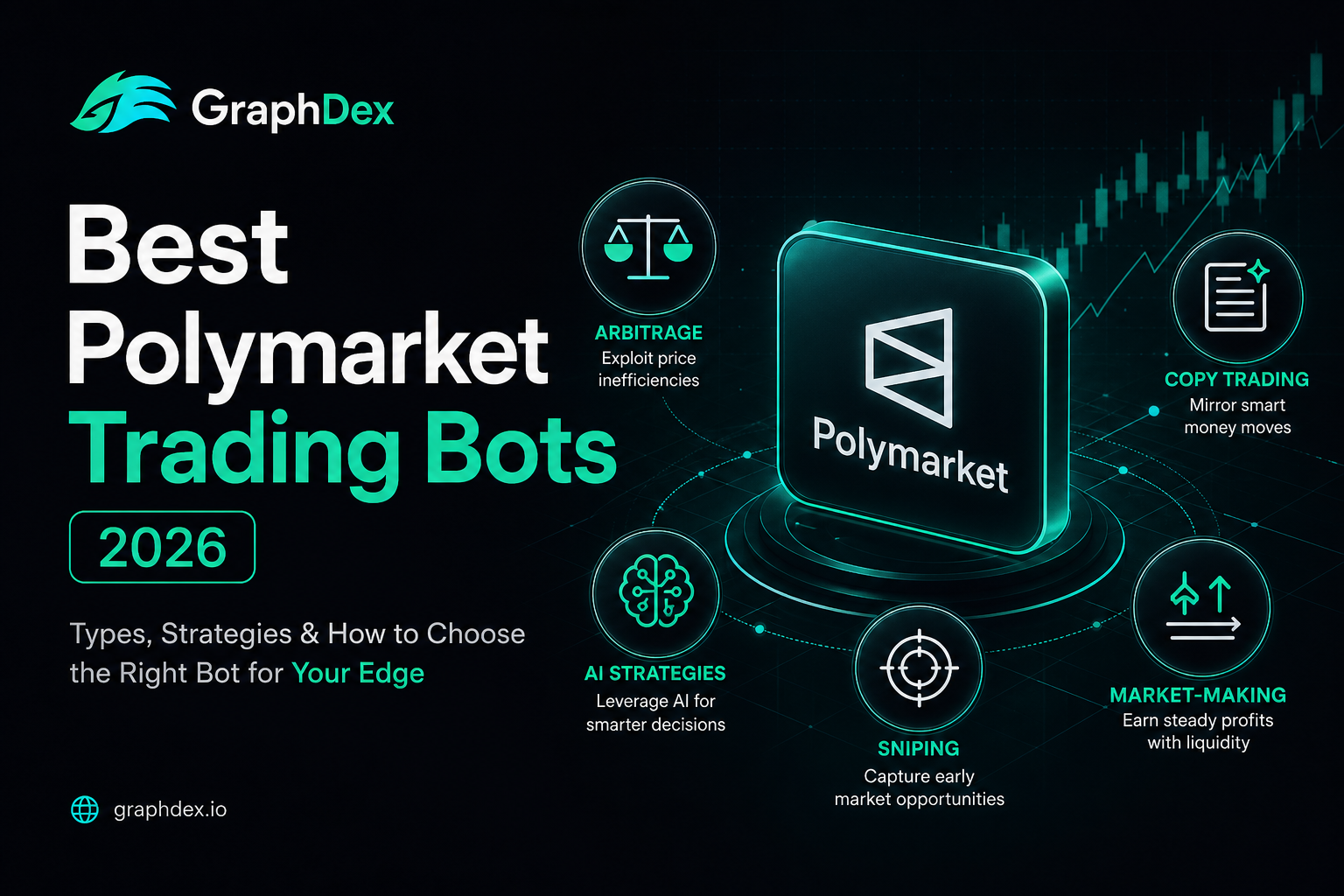
The best Polymarket trading bots in 2026, by strategy:
- Copy-trading: GraphDex, Olympus, PolyFollow — mirror winning traders
- Arbitrage: Cross-platform bots exploiting YES+NO ≠ $1.00 discrepancies
- AI / sentiment: Polysights (30+ metrics), news-driven agents
- Sniping: Telegram bots replicating specific wallets sub-second
- No-code: PredictEngine and similar AI bot builders
The most important rule: never hand over your private keys. Non-custodial platforms like GraphDex keep funds in your wallet. Match the bot type to your strategy and experience level.
Automate Polymarket copytrading safely on GraphDex
Key Takeaways
- Polymarket bots automate trading across strategies: arbitrage, copy-trading, AI sentiment, market-making.
- The industry processed over $44 billion in 2025; automation reacts faster than manual trading.
- Critical security rule: never give a bot your private keys — use non-custodial tools.
- Match the bot to your strategy and skill: copy bots for beginners, frameworks for developers.
Why Use a Polymarket Trading Bot?
Prediction markets operate 24/7. Events resolve at any hour, and price discrepancies between platforms appear and vanish in seconds. Manual trading simply can't capture every opportunity.
The numbers explain the rise of automation. The prediction market industry processed over $44 billion in trading volume in 2025. As markets mature and liquidity deepens, automation becomes essential for serious traders. Bots can monitor hundreds of markets simultaneously, execute trades before humans even notice the opportunity, and run strategies consistently without emotional interference.
The advantages of bots over manual trading:
- Speed — react in milliseconds to news and price moves
- Coverage — monitor hundreds of markets at once
- Consistency — execute strategies without emotional interference
- Availability — trade 24/7, even while you sleep
The trade-off is complexity and risk: bots require setup, carry security considerations, and can lose money fast if misconfigured. Matching the right bot type to your strategy and skill level is essential.
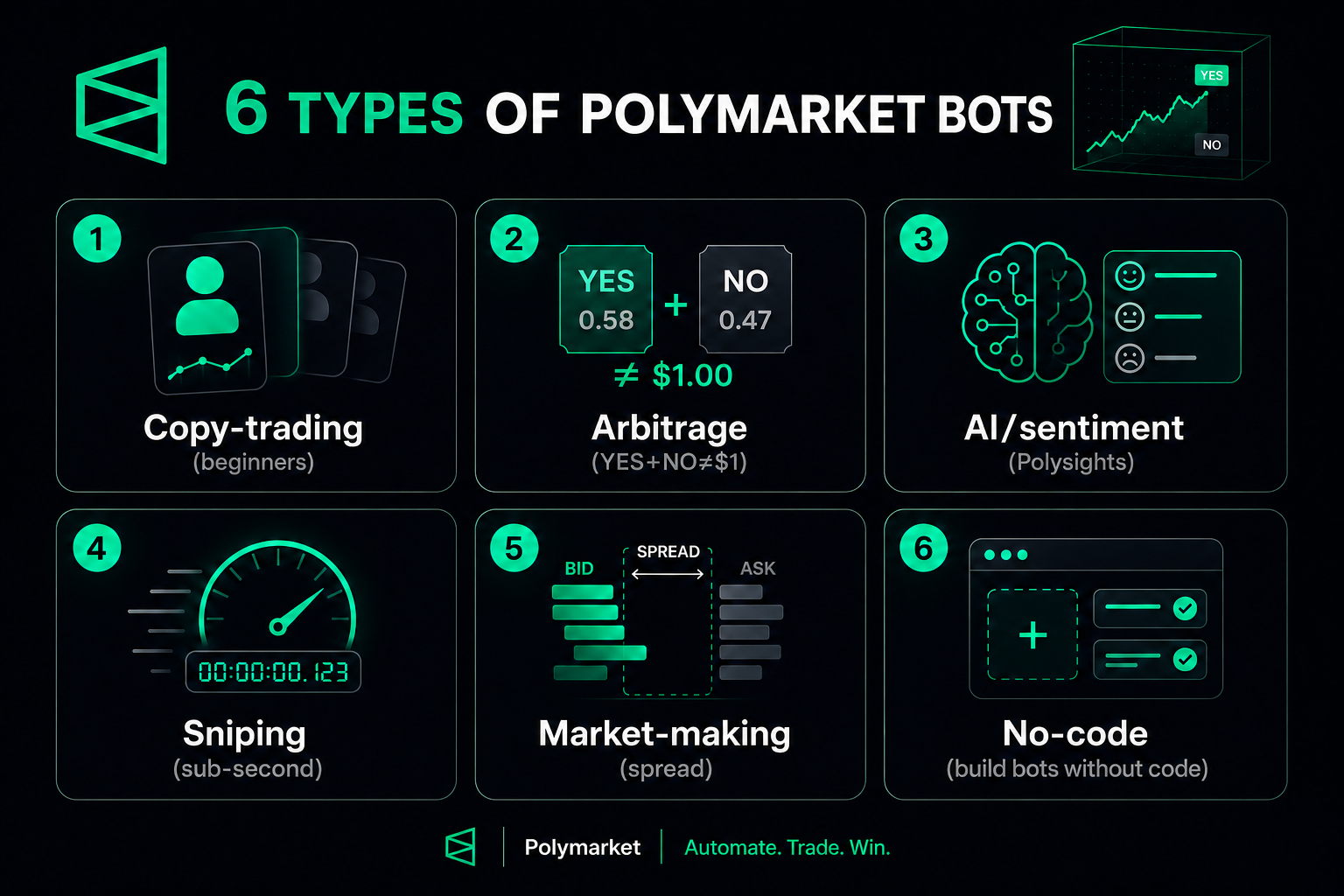
What Are the Types of Polymarket Trading Bots?
| Bot Type | What It Does | Best For |
|---|---|---|
| Copy-trading | Mirrors winning traders automatically | Beginners |
| Arbitrage | Exploits price discrepancies | Risk-averse, technical |
| AI / sentiment | Trades on news and data signals | Event traders |
| Sniping | Replicates specific wallets sub-second | Fast followers |
| Market-making | Provides liquidity for spread profit | Steady-return seekers |
| No-code builders | Create bots without programming | Non-developers |
1. Copy-Trading Bots (Best for Beginners)
Copy-trading bots automatically mirror the positions of winning Polymarket traders. They're the lowest-barrier way to automate, because you don't need your own strategy — you follow proven performers.
GraphDex offers copytrading integrated with a full Solana trading terminal. You follow forecasters ranked by PnL and win rate, mirror their positions within your risk parameters, and it's non-custodial via Privy — your funds stay in your wallet. Unlike standalone bots, copytrading sits alongside Solana DEX trading and staking.
Other copy-trading tools include Olympus (automated Polymarket copy-trading mirroring successful traders in real time), PolyFollow, and CopyShark.
Best for: Beginners who want to automate by following proven traders rather than building their own strategy.
Copytrade winning forecasters on GraphDex
2. Arbitrage Bots (Risk-Averse, Technical)
Arbitrage bots exploit price discrepancies. In prediction markets, the fundamental property is that YES + NO should equal $1.00. When they don't — or when the same event is priced differently on Polymarket and Kalshi — arbitrage opportunities exist.
These bots trade both sides to capture the discrepancy. Academic research documented over $40 million in arbitrage profits extracted from prediction markets between April 2024 and April 2025. While competition has compressed margins, opportunities still exist — especially during high-volatility events.
Cross-platform arbitrage bots (some written in Rust for maximum performance) detect opportunities across Polymarket, Kalshi, and sportsbooks.
Best for: Technical, risk-averse traders seeking lower-risk profit from price discrepancies. Requires speed and often coding setup.
3. AI and Sentiment Bots (Event Traders)
AI-powered bots analyze news, social sentiment, and market data to inform trades. Polysights represents the cutting edge, combining Vertex AI, Gemini, and Perplexity to extract signals, offering 30+ custom metrics, news integration, and AI-generated summaries for Polymarket analysis.
These tools ingest vast data — news, on-chain activity, social signals — to estimate probabilities and identify mispriced markets faster than humans can read and analyze.
Best for: Event-driven traders who want AI to surface signals and mispricing across many markets.
4. Sniping Bots (Fast Followers)
Sniping bots replicate specific wallets with sub-second speed. Telegram-based bots let users follow a chosen wallet address and copy its trades almost instantly — useful for following a specific sharp trader the moment they act.
The appeal is speed: in thin prediction markets, getting in right behind a sharp trader before the price moves preserves edge. The risk is following blindly — a fast copy of a bad trade is still a bad trade.
Best for: Traders who've identified specific wallets worth following and want instant replication.
5. Market-Making Bots (Steady Returns)
Market-making bots provide liquidity by placing buy and sell orders around the current price, profiting from the spread. They suit traders wanting steady, lower-variance returns rather than directional bets.
Best for: Liquidity providers seeking consistent spread-based returns, typically more advanced users.
6. No-Code Bot Builders (Non-Developers)
No-code platforms let you create automated bots without programming. Some use AI bot builders where you describe your strategy in plain English and the platform builds it. They support common strategy types — single-side trading, arbitrage, sports value betting — without writing code.
Best for: Non-developers who want custom automation without coding.
The Critical Security Rule: Never Hand Over Private Keys
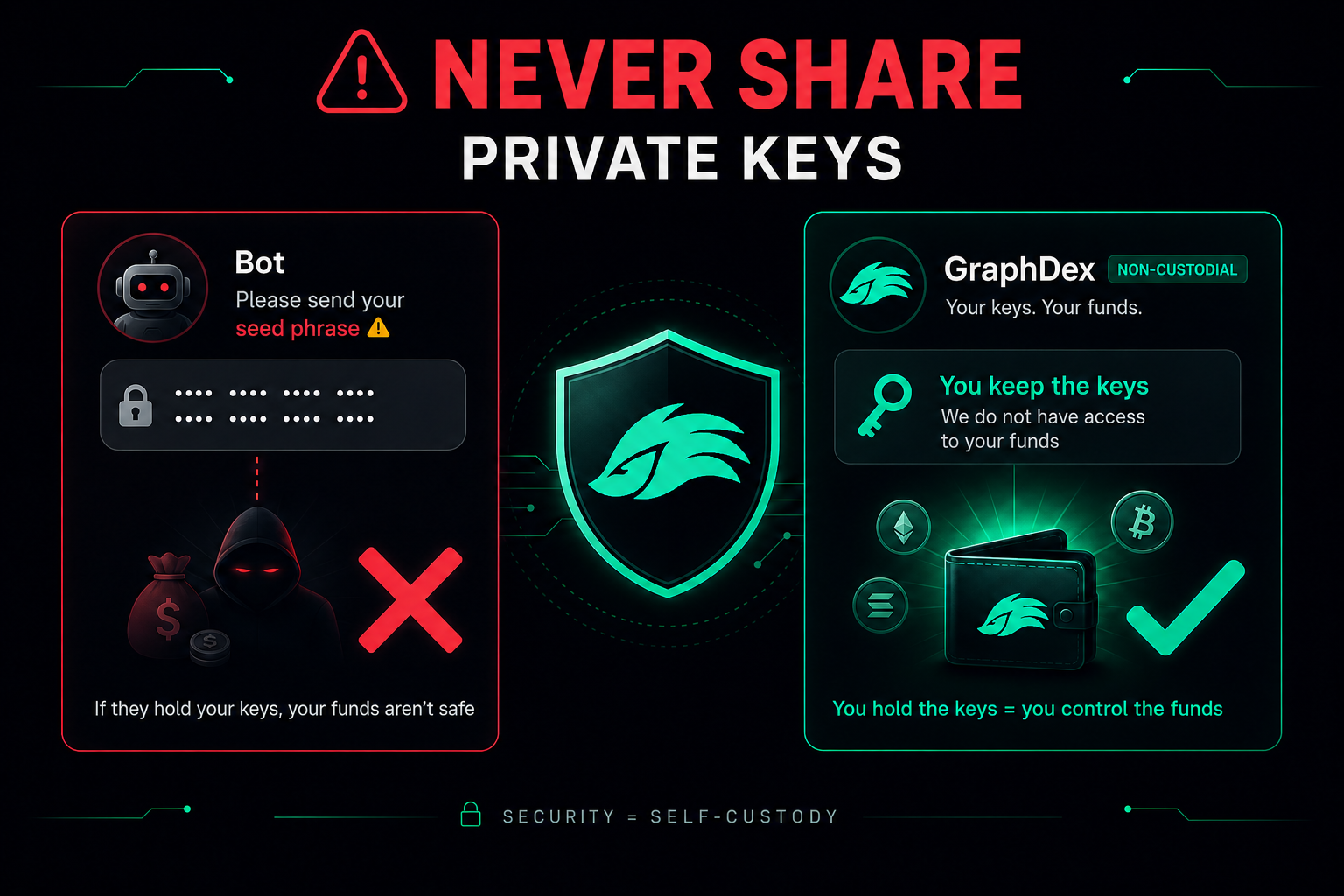
This is the single most important thing to understand about Polymarket bots: never use a bot that requires you to hand over your private keys.
Many bots ask for your private key or seed phrase to execute trades on your behalf. This is extremely dangerous — whoever holds your keys controls your funds entirely. A malicious or compromised bot can drain your wallet instantly. Industry reviewers explicitly warn against any bot that requires you to hand over your private keys.
Safer approaches:
- Non-custodial platforms like GraphDex keep funds in your own wallet — the platform executes trades without ever holding your keys
- API-based bots use authenticated API keys with limited permissions rather than full key access
- Read-only analytics (like whale trackers) that inform manual trades carry no custody risk
Before using any Polymarket bot, ask: does this require my private keys? If yes, walk away. The convenience is never worth the risk of total loss. GraphDex's non-custodial Privy architecture means you automate copytrading while your funds stay under your control.
Automate safely without surrendering keys on GraphDex
How Do You Choose the Right Polymarket Bot?
Match the bot to your experience:
- Beginners: copy-trading bots (GraphDex, Olympus) — lowest barrier, follow proven traders
- Developers: open-source frameworks — full control, requires setup
- Event traders: AI/sentiment bots — surface signals from news and data
- Liquidity providers: market-making bots — steady spread returns
- Risk-averse technical traders: arbitrage bots — exploit discrepancies
Key factors to evaluate:
- Security — non-custodial or limited API access; never full private keys
- Strategy fit — match the bot type to how you want to trade
- Cost — compare fees, subscriptions, and minimum deposits
- Reliability — documentation, active community, recent updates
- Custody — funds in your control, not the bot's
For most traders — especially beginners and crypto-natives — a non-custodial copytrading platform offers the best balance: automation, safety, and the ability to follow proven traders without coding or key risk.
Should You Use a Bot or an Integrated Terminal?
There's a distinction worth drawing: standalone bots versus integrated terminals.
Standalone bots do one job — arbitrage, sniping, market-making — often requiring technical setup and sometimes risky key access. They're powerful for specific strategies but fragment your workflow across multiple tools.
Integrated terminals like GraphDex build automation into a complete trading environment. GraphDex's copytrading automates following proven traders, but it sits within a non-custodial terminal that also handles Solana DEX trading, token discovery, and staking. You get automation plus a full workflow, without the key-handover risk of many standalone bots.
For traders who want focused, specialized automation (like pure arbitrage), a dedicated bot may fit. For those who want safe, accessible automation integrated with broader trading, a terminal like GraphDex is the more practical choice.
Get integrated automation on GraphDex
Frequently Asked Questions
What is the best Polymarket trading bot in 2026? It depends on your strategy. For copy-trading, GraphDex and Olympus let you mirror winning traders. For arbitrage, cross-platform bots exploit price discrepancies. For AI signals, Polysights offers 30+ metrics. For beginners, non-custodial copy-trading is the safest, lowest-barrier option.
Are trading bots allowed on Polymarket? Yes, automated trading is allowed on Polymarket. Polymarket provides the Gamma API for market discovery and the CLOB API for order book access, which bots use to automate. Many traders use bots for arbitrage, copy-trading, and market-making.
Are Polymarket trading bots safe? Bots carry risk. The biggest danger is bots requiring your private keys — never use these, as they can drain your wallet. Safer options are non-custodial platforms like GraphDex (funds stay in your wallet) and API-based bots with limited permissions. Always check the custody model.
Can Polymarket bots make money? They can, but it depends on strategy and execution. Arbitrage bots captured over $40 million in profits from 2024-2025, though margins have compressed. Copy-trading bots borrow proven traders' edge. Like all trading, profit isn't guaranteed, and poorly configured bots can lose money fast.
What's the safest Polymarket bot for beginners? Non-custodial copy-trading platforms like GraphDex. They let beginners automate by following proven traders ranked by PnL, without coding, and without handing over private keys. The non-custodial model keeps funds in your wallet, eliminating the biggest bot security risk.
Do I need coding skills to use a Polymarket bot? Not always. Copy-trading platforms like GraphDex and no-code bot builders require no coding. Developer frameworks and some arbitrage bots do require technical setup. Match the bot to your skill level — beginners should start with no-code copy-trading.
What is arbitrage on Polymarket? Arbitrage exploits price discrepancies — when YES + NO doesn't equal $1.00, or when the same event is priced differently across Polymarket and Kalshi. Arbitrage bots trade both sides to capture the difference. Over $40 million in such profits were documented from 2024-2025, though competition has compressed margins.
About This Guide
This guide is published by the GraphDex Research team — analysts and traders building the infrastructure for digital asset trading on Solana. Our content is based on live platform data, current market figures, and hands-on experience with the platforms covered.
Sources & data: Bot features, profits, and details reflect publicly available information as of 2026 and may change. Automated trading carries significant risk, including total loss from malicious bots. Never share private keys. This guide is educational and not financial advice.
GraphDex is the infrastructure for digital asset trading — trade, predict, and earn in one place. Learn more at graphdex.io.
Last reviewed: May 2026 · GraphDex Research
The infrastructure for digital asset trading. Trade, predict, stake, repeat. graphdex.io