By GraphDex Research · Reviewed for accuracy May 2026
Quick Answer
Day trading is opening and closing all positions within the same trading day to profit from intraday price movements — without holding any positions overnight. Key facts:
- Trade frequency: 1-20 trades per day
- Holding period: Minutes to hours (always closed before end of day)
- Profit per trade: Typically 1-5%
- Capital requirements: $5,000-$25,000+ for meaningful position sizes
- Best timeframes: 5-minute to 1-hour primary; daily for context
- Best on: Solana (sub-cent fees), L2s, or major derivatives platforms
- Reality check: 70-90% of day traders lose money in their first year
The honest truth: Day trading is more achievable than scalping but still extremely demanding. The successful 10-30% treat it as a business with strict systems, risk management, and emotional discipline.
Day trade Solana with integrated tools on GraphDex
Key Takeaways
- Day trading captures intraday volatility — closing all positions before day's end avoids overnight risk.
- 70-90% of new day traders lose money; the survivors typically take 2-5 years to become consistently profitable.
- Risk management (1-2% per trade max) matters more than market prediction.
- Solana's sub-cent fees make day trading economically viable at smaller capital sizes than Ethereum L1.
What Is Day Trading?
Day trading is a style where all positions are opened and closed within the same trading day. The defining rule: no overnight positions. Whatever you trade today, you exit before the day's market session ends.
Crypto's 24/7 nature means there isn't a literal "market close" like in stocks — but day traders typically define their "session" by their personal trading hours (e.g., 9 AM to 5 PM in their timezone).
A typical day trader's session:
- Reviews higher timeframes for context before session
- Identifies 3-10 potential setups for the day
- Executes 1-20 actual trades during the session
- Each trade held for minutes to several hours
- Closes all positions before logging off
- Reviews trades after session ends
Why day trade?
- Profit from intraday volatility without overnight exposure
- No worries about overnight news or weekend events
- More opportunities than swing trading
- Less intense than scalping (more manageable lifestyle)
- Can be combined with full-time work in some cases (if your market hours align)
Why NOT day trade:
- Studies consistently show 70-90% of retail day traders lose money
- Requires hours of focus during market hours
- Emotionally demanding — frequent losses common
- Tax complexity (many short-term gains, ordinary income rates)
- Mental fatigue accumulates quickly
Day Trading vs Other Styles
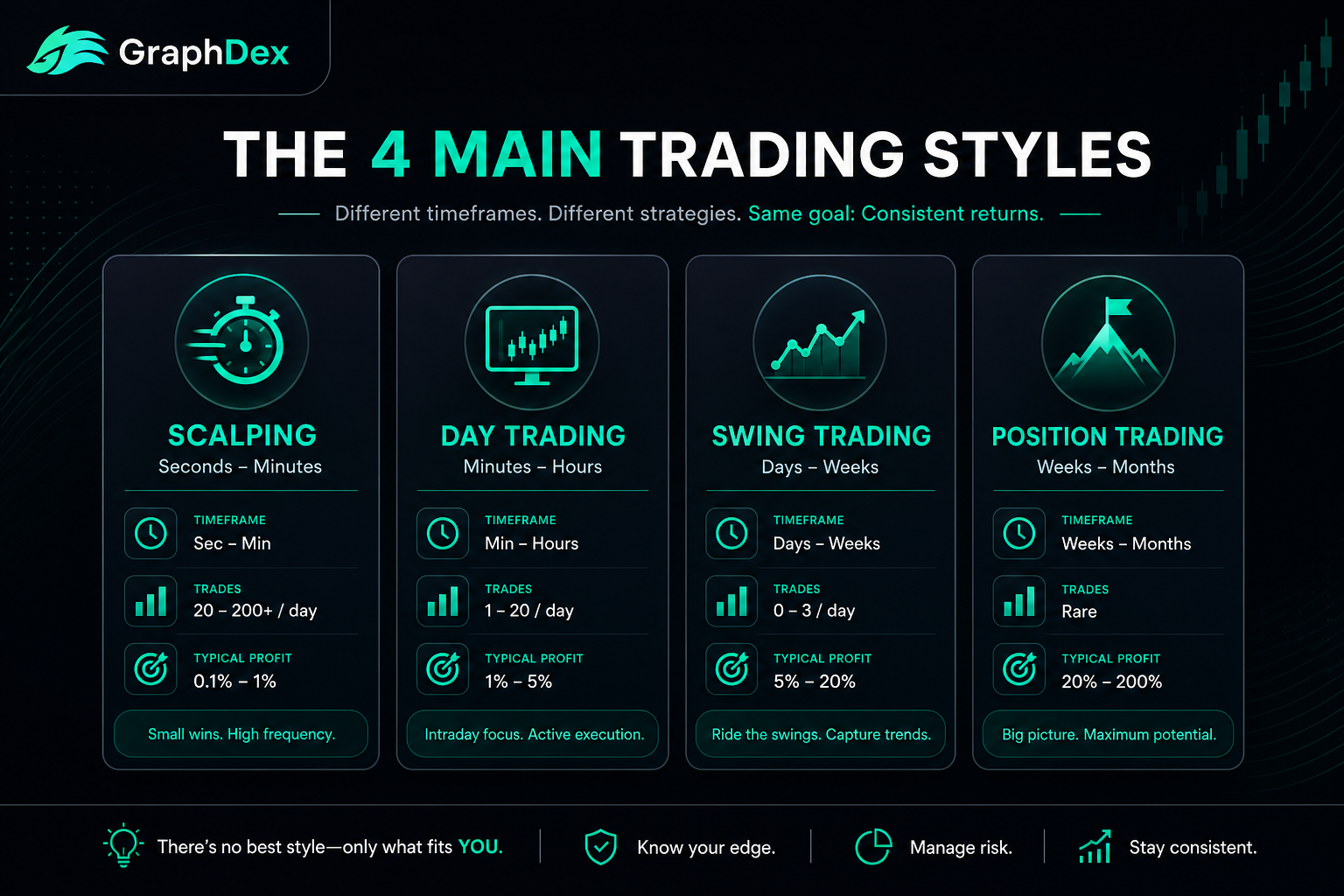
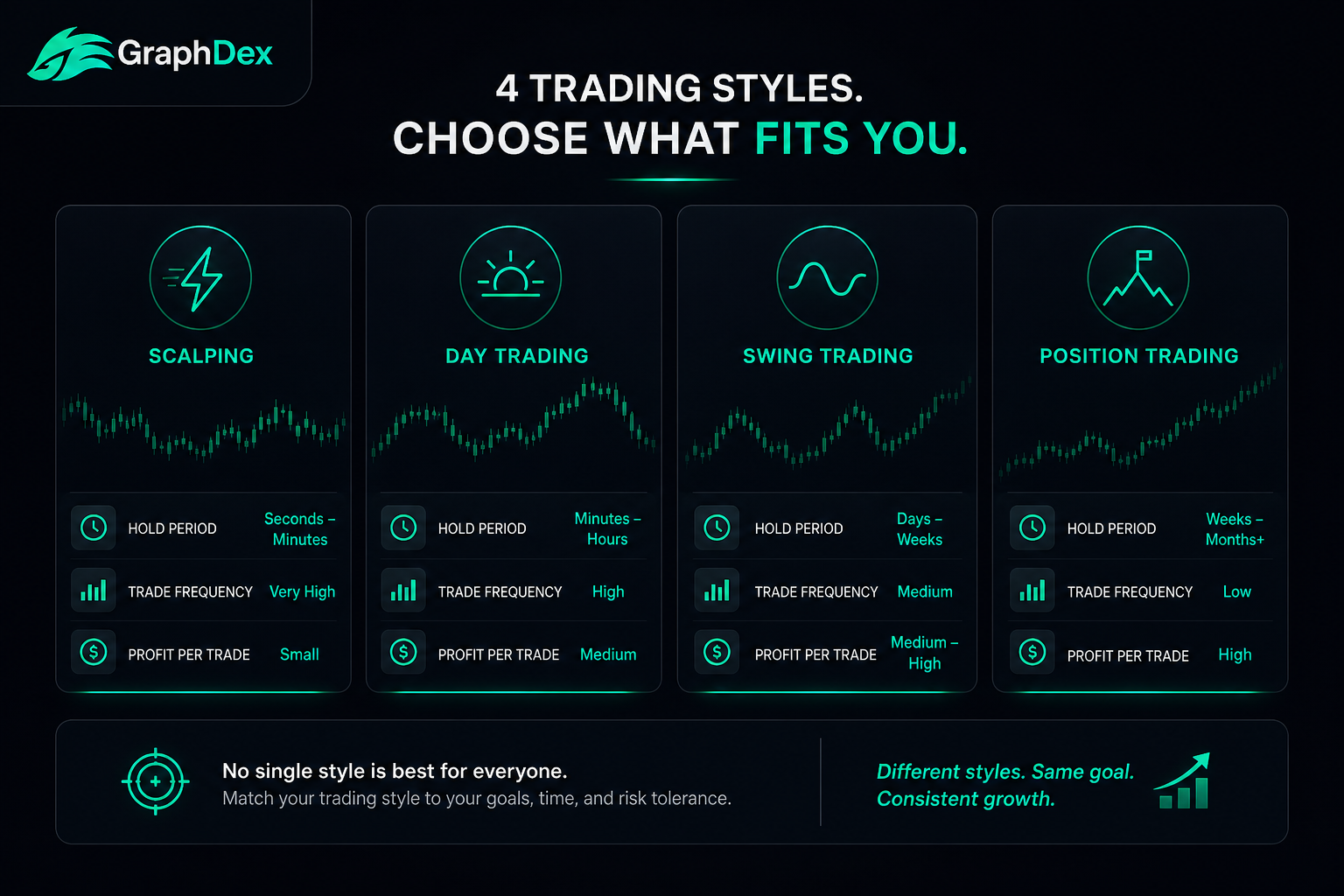
Understanding where day trading fits in the spectrum:
| Style | Hold Period | Trades/Day | Profit/Trade | Capital |
|---|---|---|---|---|
| Scalping | Seconds-minutes | 20-200+ | 0.1-1% | $5K+ |
| Day Trading | Minutes-hours | 1-20 | 1-5% | $5-25K |
| Swing Trading | Days-weeks | 0-3/day | 5-20% | $1K+ |
| Position Trading | Weeks-months | Rare | 20-200% | Any |
Day trading sits in the middle: More activity than swing trading, less intensity than scalping. It's often called the "default" active trading style because of this balance.
Best for traders who:
- Can dedicate 4-6 focused hours during market sessions
- Have $5,000-$25,000 in trading capital
- Want active trading but not extreme intensity
- Can avoid overnight position anxiety
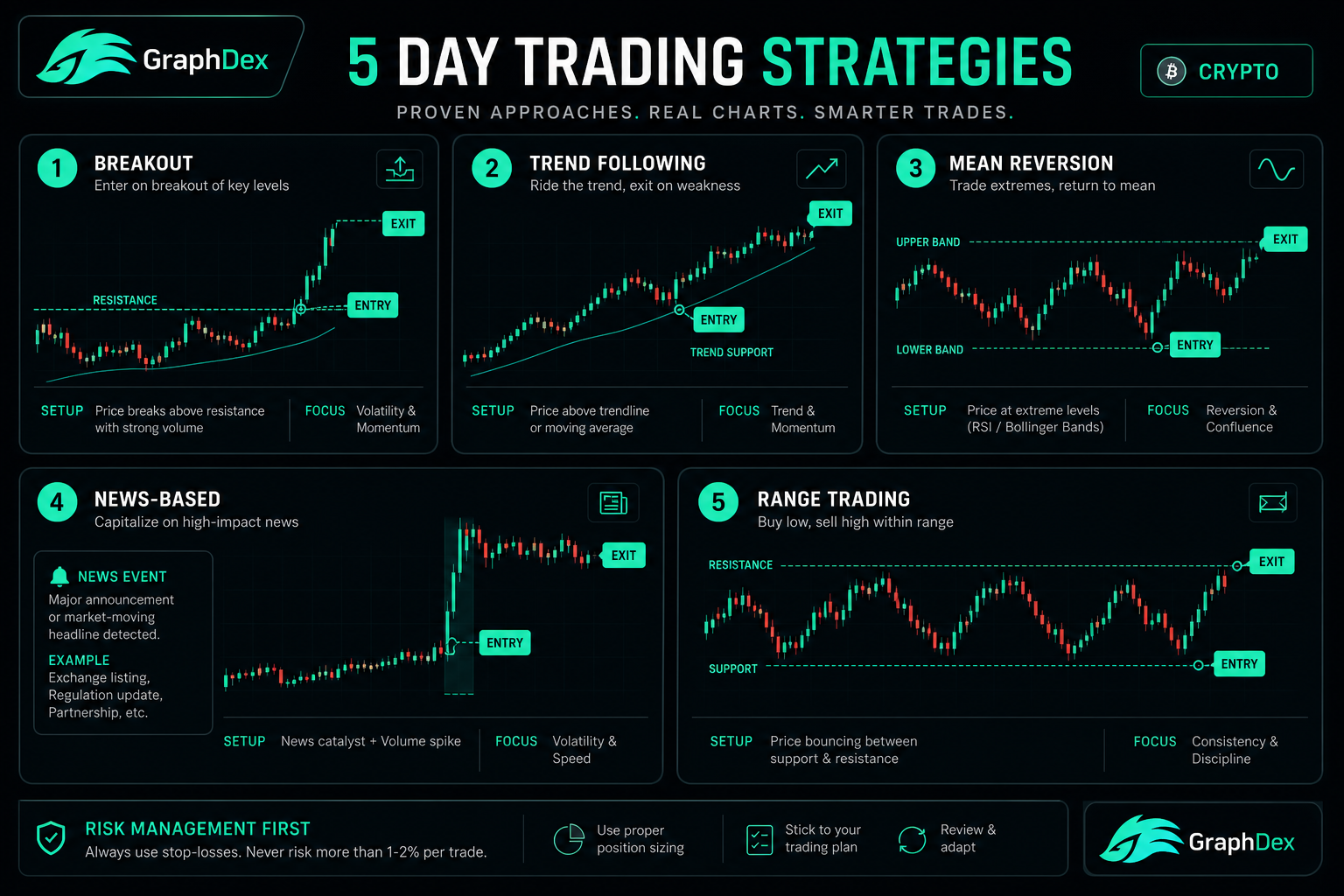
Which Day Trading Strategies Actually Work?
Several systematic approaches have proven track records in crypto markets.
Breakout Trading
The setup: Price compressed in a range or consolidation, often with declining volume. Volume expands as price breaks key resistance (or support for shorts).
The execution:
- Identify clear range with defined support/resistance
- Wait for breakout with volume confirmation (volume should be 1.5-2× recent average)
- Enter immediately after break, or on retest of broken level
- Stop loss: Just back inside the range
- Target: Range height projected from breakout
When it works: Periods of low volatility before major moves; around major news catalysts; after long consolidations.
Win rate: 50-65% for skilled practitioners. False breakouts are the main failure mode.
Trend Following
The setup: Clear directional trend on higher timeframe (4-hour or daily).
The execution:
- Confirm trend direction on higher timeframes
- Enter on pullbacks to key moving averages (20 EMA, 50 EMA) within the trend
- Stop loss: Below the recent swing low (or above swing high for shorts)
- Target: Next resistance/support level in trend direction
When it works: Strong trending markets (which crypto produces frequently).
Win rate: 55-70% in clear trends; much lower in choppy markets. The skill is identifying trending vs. choppy conditions.
Mean Reversion
The setup: Price extended significantly from a moving average (often 50 or 100 EMA on 4-hour or daily).
The execution:
- Enter against the extension when reversal signals appear (RSI extreme, candle patterns, divergence)
- Stop loss: Beyond the recent extreme
- Target: Return to the moving average
When it works: Range-bound markets, after exhaustion moves, during low-volatility periods.
Win rate: 50-65% with proper signal filtering. Fails in strong trending markets.
News-Based Trading
The setup: Known upcoming catalyst (economic release, major announcement, exchange listing).
The execution:
- Position before known events (or fade reactions after them)
- Enter immediately after news on momentum
- Tight stops because news moves can reverse violently
- Often exit within minutes to hours
When it works: Scheduled events with known timing; well-defined market expectations.
When it fails: Surprise outcomes; thin liquidity during after-hours releases; "buy rumor sell news" reactions.
Range Trading
The setup: Asset oscillating between clear support and resistance levels.
The execution:
- Buy near support with bullish confirmation
- Sell near resistance with bearish confirmation
- Stop loss: Beyond the range
- Target: Opposite end of range
When it works: Quiet markets between major directional moves; weekend low-volatility periods.
When it fails: When the range breaks. Discipline to recognize structural changes is critical.
How Do Day Traders Manage Risk?
This section matters more than any strategy. The single biggest predictor of day trading success isn't picking better setups — it's surviving long enough to develop edge.
The 1-2% Rule
Never risk more than 1-2% of your capital on a single trade. For a $10,000 account:
- Max risk per trade: $100-$200
- If your stop loss is 2% from entry, position size = $5,000-$10,000
- If your stop loss is 5% from entry, position size = $2,000-$4,000
Why this matters: A trader losing 10 trades in a row (which happens) loses 10-20% with proper sizing — recoverable. The same trader risking 10% per trade loses 65% — likely catastrophic.
Stop Losses Are Non-Negotiable
Every trade must have a pre-defined stop loss before entry. Reasons to never move stops against you:
The mathematics: Moving a 2% stop to 4% turns a controlled loss into a portfolio-damaging one. Three "moved stops" can wipe out months of profits.
The psychology: Once you move a stop once, the pattern repeats. Discipline once = discipline always.
The strategic logic: If your initial stop was correct, the market has invalidated your trade thesis. The trade is wrong — exit it.
Risk-Reward Ratios
Aim for minimum 2:1 reward-to-risk on every trade. Better trades target 3:1 or higher.
The math: A trader with 50% win rate and 2:1 R/R is profitable (1 win pays for 2 losses with profit left over). A trader with 70% win rate and 1:2 R/R is unprofitable (7 wins don't cover 3 losses at 2× each).
Practical application: Before every trade, calculate stop distance and target distance. If R/R isn't at least 2:1, skip the trade.
Daily Loss Limits
When you hit a maximum daily loss (typically 2-4% of capital), stop trading for the day. Reasons:
Tilt prevention: After losses, emotional state degrades. Continuing to trade while tilted compounds losses.
Statistical edge degrades: Studies show traders perform much worse after consecutive losses than after wins.
Capital preservation: A bad day shouldn't become a catastrophic day.
Maximum Daily Trade Count
Set a hard cap on trades per day (e.g., 5-10). Why:
Quality over quantity: The best setups are limited. Forcing more trades inevitably means taking lower-quality ones.
Mental fatigue: Each trade requires focus and decision-making capacity. Capacity is limited.
Discipline: A hard limit prevents revenge trading and impulse trading.
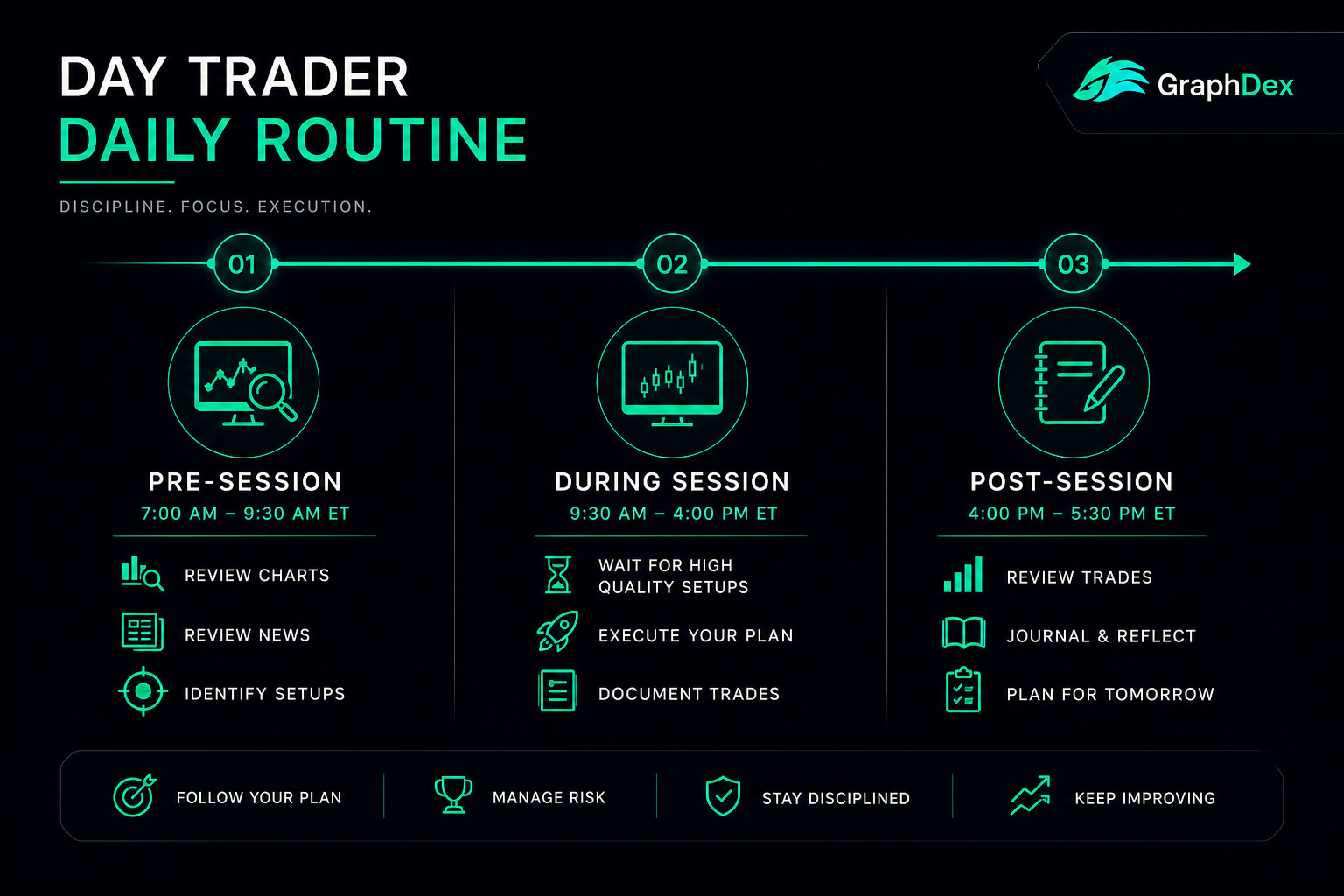
The Day Trader's Daily Routine
Successful day traders treat trading as a business with defined daily processes.
Pre-Session (30-60 minutes before)
- Review higher timeframe charts (daily, weekly) for major levels and trend
- Check overnight news, economic calendar, scheduled events
- Identify 3-10 potential setups based on technical analysis
- Set price alerts at key levels for these setups
- Define maximum daily loss limit
- Review yesterday's trades and lessons
During Session
- Wait for setups to come to you — don't chase
- Execute trades according to your plan, not impulse
- Document each trade as it happens (entry reasoning, plan, position size)
- Follow your daily trade limit
- Stop at your daily loss limit if hit
- Take breaks during low-volatility periods
Post-Session
- Close all positions
- Review every trade: setup, entry, management, exit, lessons
- Update trading journal
- Identify mistakes (even on winning trades)
- Plan for next session
- Disconnect — don't watch markets all night
This routine is what separates serious day traders from gamblers. Most failed day traders have no defined routine.
Common Day Trading Mistakes
For balance, the patterns that destroy day traders:
1. Overtrading. Taking too many trades to "make something happen." Best traders are highly selective.
2. Moving stop losses. The single most damaging habit in trading. Disciplined stops are non-negotiable.
3. Revenge trading. Doubling down after losses to "get even." Amplifies losses.
4. No daily loss limit. Letting bad days become catastrophic days.
5. Cutting winners short, letting losers run. The opposite of what works. Trust your plan.
6. Trading without context. Ignoring the higher timeframe trend. Fighting macro context loses.
7. Random risk sizing. Different position sizes per trade without methodology. Risk should be consistent.
8. No journaling. Cannot improve what you don't measure. Successful traders journal religiously.
9. Trading during major news without preparation. Surprise outcomes can wipe out positions instantly.
10. Pattern fitting. Seeing setups that aren't really there because you want to trade.
11. Confirmation bias. Looking only for evidence supporting your desired trade.
12. FOMO entries. Chasing pumps after most of the move is done. Top-buying.
How Much Capital Do You Need to Day Trade?
Realistic capital expectations:
$1,000-$3,000: Survival difficult. Position sizes too small for meaningful learning. Fees can eat profits. Best used for paper trading + tiny live trades for experience.
$5,000-$10,000: Meaningful starting capital. Can risk $50-200 per trade. Realistic to learn while taking proper risk per trade.
$10,000-$25,000: Comfortable range. Position sizing flexibility, fees less impactful, drawdowns recoverable.
$25,000-$100,000: Professional range. Can support multiple strategies, has room for significant drawdowns without ruin, can support full-time trading income.
$100,000+: Approaches professional levels. Different platform options, market impact considerations, professional tools.
For most retail day traders, $5,000-$25,000 is the practical range. Below this, fees and minimum position sizes hurt; above this, the principles don't change but flexibility increases.
Day trade with proper risk management on GraphDex
Why Day Trade on Solana?
Solana has become the dominant retail crypto day trading ecosystem in 2024-2026. Why:
Sub-cent fees mean day traders making 5-20 trades per day pay under $1 in fees — versus $25-1000 on Ethereum L1.
400ms finality enables faster reaction to setups than slower chains.
Deep liquidity on major pairs (SOL/USDC, BONK, WIF, others) supports day trading position sizes.
$650B+ stablecoin volume in February 2026 — record activity supporting tight spreads.
100% uptime through 2025 — no missed sessions due to network issues.
MEV protection available through platforms like GraphDex — critical because Solana sandwich attacks cost retail traders an estimated $370-500M over 16 months.
For active day traders, Solana is currently the optimal venue for crypto trading economics. Major derivatives platforms (Bybit, OKX) offer alternatives for leveraged trading.
Day trade Solana on GraphDex integrated terminal
Realistic Expectations for Day Trading
For honesty about outcomes:
Year 1: Likely losses for most. 70-90% of day traders lose money. Focus on system development and risk management — not profits.
Year 2: Possible breakeven with discipline. Many quit during this period.
Year 3+: Consistency possible for the survivors. Returns of 20-50% annually are achievable for skilled traders. 100%+ years happen occasionally but aren't sustainable expectations.
The 5-15% who succeed long-term share traits:
- Treat trading as a business
- Maintain strict risk management
- Journal every trade
- Continuously learn and adapt
- Don't depend on trading income initially
- Have realistic expectations (not "get rich quick")
What doesn't work:
- Random discretionary trading without systems
- High leverage from the start
- Following signal services blindly
- Trading while emotional
- Without a defined daily routine
- Treating trading as gambling
How GraphDex Supports Day Traders
For active Solana day traders:
- Sub-cent fees on every trade keeping fee impact minimal
- 400ms finality for fast execution
- Multi-timeframe charts for setup identification
- Volume integration confirming setups
- Bubble Maps for safety analysis (essential for memecoin day trading)
- Pulse feed surfacing intraday opportunities
- AI signals identifying high-probability setups
- MEV protection against sandwich attacks (critical for active trading)
- Wallet/social tracking following successful traders
- Fee-based 17% APY staking on idle capital between sessions
- Non-custodial Privy wallet — sign in with Twitter, email, or Telegram
The integrated approach means you can scan, analyze, execute, and protect — all in one platform. For day traders where context-switching costs both time and focus, consolidation is a real edge.
Frequently Asked Questions
What is day trading in crypto? Day trading is opening and closing all positions within the same trading day to profit from intraday price movements — without holding any positions overnight. Day traders typically hold positions for minutes to hours and make 1-20 trades daily. The defining rule: all positions are closed before the day ends.
Is day trading crypto profitable? Possible but difficult. 70-90% of retail day traders lose money in their first year. The 10-30% who succeed long-term typically take 2-5 years to develop consistent profitability. Realistic returns for skilled day traders: 20-50% annually. Claims of consistent 100%+ returns are usually outliers or misleading.
How much money do I need to day trade crypto? Realistic starting capital: $5,000-$10,000. Below $3,000, position sizes are too small for meaningful learning while accounting for fees. Most consistently profitable day traders operate with $10,000-$100,000. You can technically start with less, but the math becomes much harder.
What's the difference between day trading and scalping? Both close positions within the same day, but timeframes differ. Scalpers hold positions for seconds to minutes (often 30 seconds to 10 minutes) making 20-200+ trades daily. Day traders hold positions for minutes to hours making 1-20 trades daily. Day trading is more accessible; scalping requires faster execution and more focus.
Can I day trade crypto with a full-time job? Difficult but possible. Strategies: (1) Trade specific market hours that align with your schedule (e.g., evenings if you work day job); (2) Use higher timeframes that don't require constant monitoring; (3) Set alerts at key levels and check during breaks. However, most successful day traders eventually need full-time focus. Better part-time alternative: swing trading.
What's the best crypto for day trading? Major liquid assets are best: Bitcoin (BTC), Ethereum (ETH), Solana (SOL). These have deep liquidity, clean patterns, and reliable indicator signals. Major altcoins (BNB, XRP, etc.) work well too. Avoid low-cap memecoins for day trading unless you have specialized tools — they're more for shorter-term sniping than systematic day trading.
How do I avoid losing money day trading? Honest answer: most beginners can't. To improve odds: (1) Start with $5K+ capital; (2) Use low-fee venues like Solana; (3) Develop systematic setups; (4) Maintain 1-2% maximum risk per trade; (5) Always use stop losses; (6) Set daily loss limits; (7) Journal every trade; (8) Accept that year 1 is tuition. Even with all that, the majority still lose money.
About This Guide
This guide is published by the GraphDex Research team — analysts and traders building the infrastructure for digital asset trading on Solana. Our content is based on direct trading experience, current market data, and observation of successful day trading practices.
Sources & data: Trading style descriptions reflect typical day trading practices in 2026. Day trading carries substantial risk including total loss of capital. This guide is educational and not financial advice.
GraphDex is the infrastructure for digital asset trading — trade, predict, and earn in one place. Learn more at graphdex.io.
Last reviewed: May 2026 · GraphDex Research
The infrastructure for digital asset trading. Trade, predict, stake, repeat. graphdex.io