By GraphDex Research · Reviewed for accuracy May 2026
Quick Answer
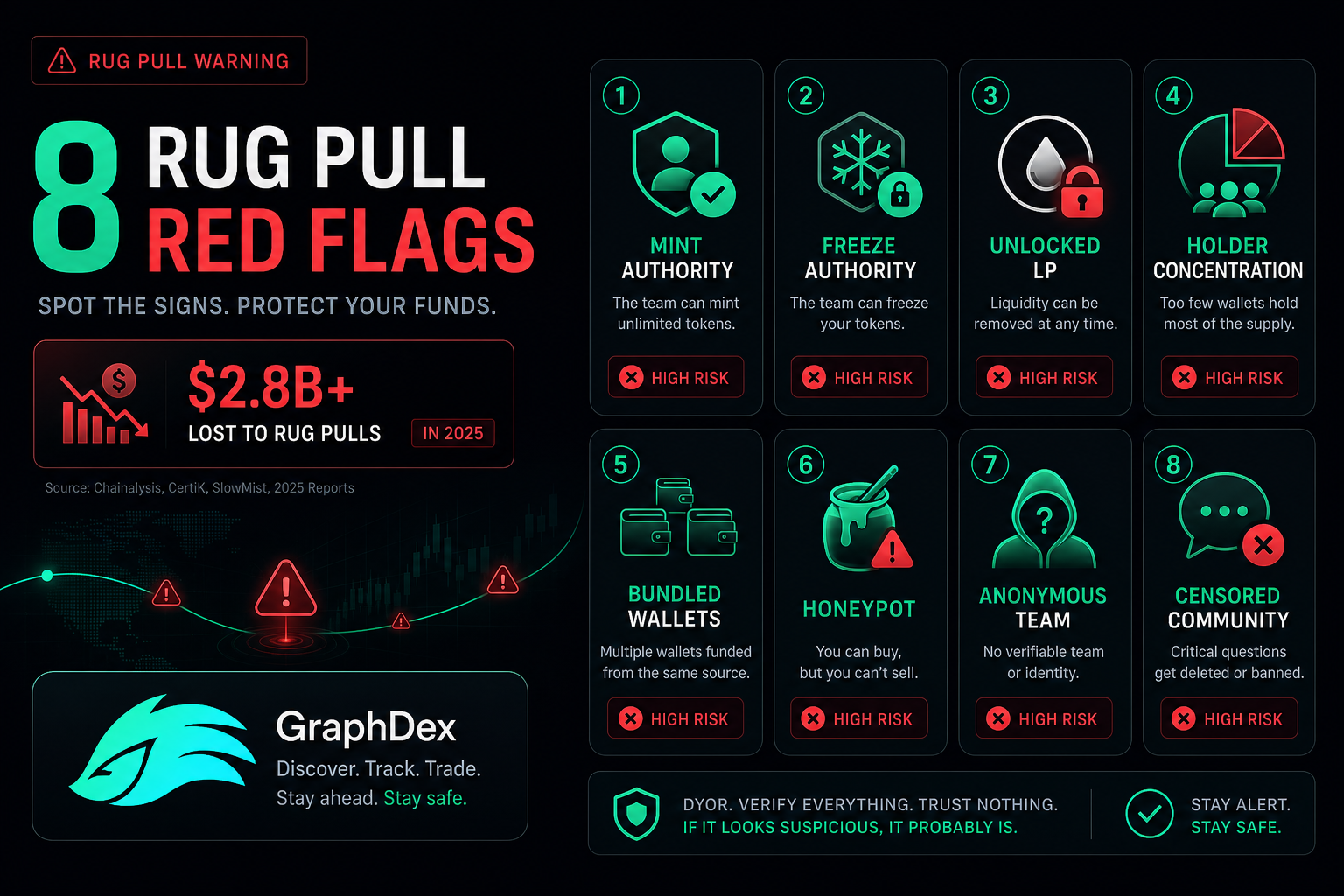
To avoid rug pulls on Solana, check these red flags before buying any token:
- Mint authority active — creator can print unlimited tokens (should be revoked)
- Freeze authority active — creator can freeze your ability to sell (should be revoked)
- Unlocked/unburned liquidity — creator can pull liquidity anytime
- Top holders concentrated — few wallets holding 30-40%+ can dump
- Bundled wallets — holdings split across wallets funded from one source
- Honeypot — you can buy but can't sell (only green candles, no red)
- Anonymous team with no track record
- Aggressive hype with banned questions
Tools like Bubble Maps visualize holder clusters to spot bundling instantly. Always check before buying, start small, and never invest more than you can afford to lose.
Spot risky tokens with GraphDex Bubble Maps
Key Takeaways
- Rug pulls cost over $2.8 billion in 2025; 5,000+ tokens launch daily, many designed to scam.
- Most rugs follow predictable patterns detectable through on-chain checks before you buy.
- Key checks: mint/freeze authority, liquidity locks, holder concentration, bundling, honeypots.
- Tools like Bubble Maps visualize wallet clusters to spot hidden bundling instantly.
What Is a Rug Pull?
A rug pull is a crypto scam where developers create a token, attract buyers to pump the price, then drain the liquidity or dump their holdings — leaving investors with worthless tokens. The perpetrators disappear with the funds, making recovery virtually impossible.
The scale is staggering. According to blockchain security firm Chainalysis, rug pulls accounted for over $2.8 billion in losses during 2025 alone. With 5,000+ new tokens launching daily across Solana, Ethereum, Base, and BSC, the hunting ground for scammers is vast — and Solana's speed and low fees, while great for legitimate trading, also make it efficient for malicious actors.
The term has evolved beyond simple liquidity removal. Modern rug pulls span a spectrum: slow-rugs with hidden token allocations, sophisticated honeypots using advanced token extensions, and bundled-wallet schemes designed to fake healthy distribution. The good news: most rug pulls follow predictable patterns, and by checking a few key on-chain signals before buying, you can avoid the vast majority.
Red Flag 1: Mint Authority Still Active
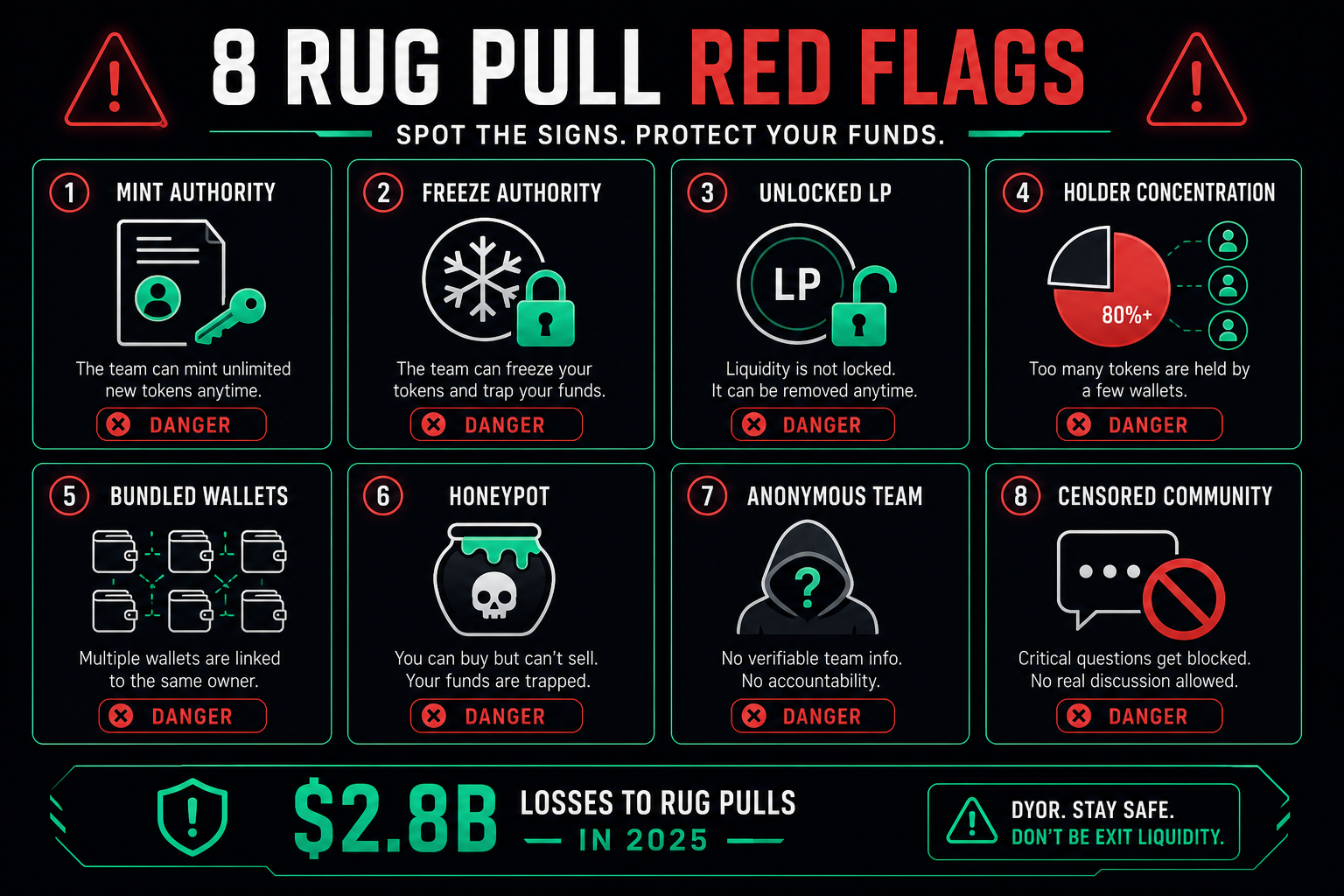
Every SPL token on Solana has a mint authority — the wallet permission that allows creating (minting) new tokens. This is the single most important check.
If the mint authority is still active, the creator can mint unlimited new tokens at any moment, instantly diluting every existing holder to near-zero. Legitimate projects typically revoke the mint authority (set it to null or a burn address), permanently fixing the supply.
What to check: Is mint authority revoked (null/burn address)? That's a positive sign — supply is fixed. Is it still pointing to an active wallet? Significant risk. Most rug checkers and token explorers display mint authority status clearly.
Red Flag 2: Freeze Authority Still Active
Freeze authority is another SPL token permission — it lets the holder freeze token accounts, preventing holders from transferring or selling.
This is used in honeypot scams: you can buy the token, but the creator freezes your account so you can never sell. Like mint authority, freeze authority should be revoked for any legitimate token. If it's still active, the creator can lock you out of selling at will.
What to check: Confirm freeze authority is revoked. An active freeze authority on a memecoin is a serious warning sign.
Red Flag 3: Unlocked or Unburned Liquidity
When a token's liquidity pool (LP) tokens aren't burned or locked, the creator can remove all liquidity at any time — pulling the rug literally. This is the classic rug pull mechanism.
On Raydium and other Solana DEXs, LP tokens should ideally be burned (sent to a dead address) — even more secure than locking. If LP tokens are unlocked and sitting in the creator's wallet, the rug can happen at any moment, leaving the token untradeable and worthless.
What to check: Look for the liquidity lock or burn status. Burned LP is best; locked LP (with a verifiable lock and duration) is acceptable. Unlocked LP in the creator's wallet is a major red flag.
Red Flag 4: Concentrated Top Holders
If a small number of wallets hold a disproportionate share of supply, those wallets can crash the price at any time by selling.
What to check: Look at the top 10 holders. If they collectively hold more than 30-40% of supply (excluding liquidity pools and known program addresses), that's a serious warning sign. A healthy token has supply distributed across many holders, so no single wallet can devastate the price.
But beware — sophisticated scammers split holdings across dozens of wallets to make distribution look healthy. That's where the next check becomes critical.
Red Flag 5: Bundled Wallets (Hidden Concentration)
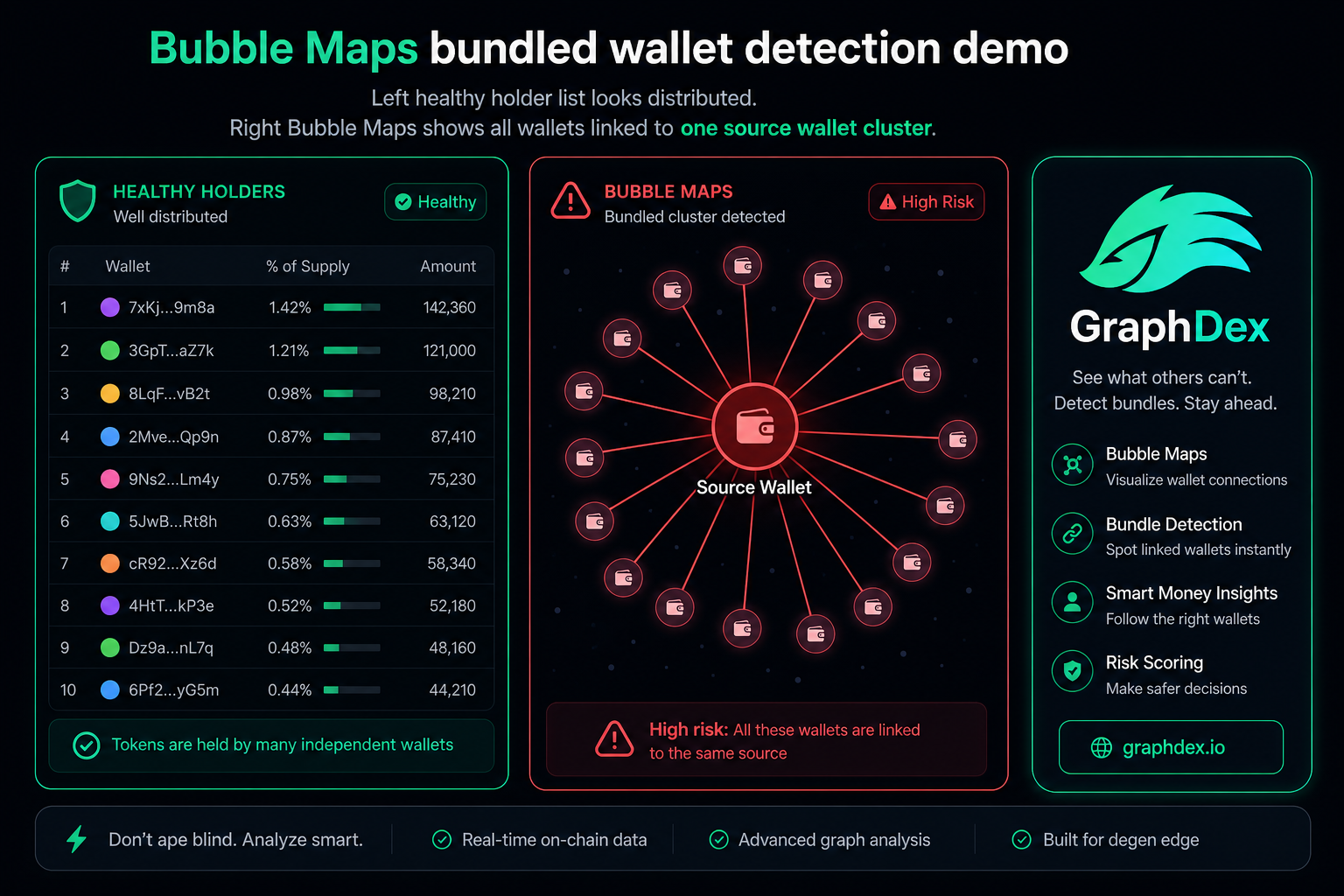
Sophisticated rug pullers distribute tokens across dozens of wallets to disguise concentration — making the holder distribution look healthy when it's actually controlled by one entity.
What to check: Look for whether multiple top holders were funded from the same source wallet. If 20 wallets each hold 2% but all were funded from one wallet, that's effectively one entity holding 40% — a bundled scheme.
This is where visual cluster analysis is invaluable. Tools like Bubble Maps display holders as connected bubbles, instantly revealing when seemingly separate wallets are linked to a common source. What looks like healthy distribution in a list becomes an obvious cluster in a visual map. This is one of the most powerful rug-detection techniques available.
Detect bundled wallets visually with GraphDex Bubble Maps
Red Flag 6: Honeypot (Can't Sell)
A honeypot lets you buy a token but prevents or heavily taxes selling — trapping your capital.
What to check: Before buying, simulate whether selling is possible using tools like GoPlus or Honeypot.is. Check buy vs sell tax, and watch for dynamic taxes that spike when you try to sell.
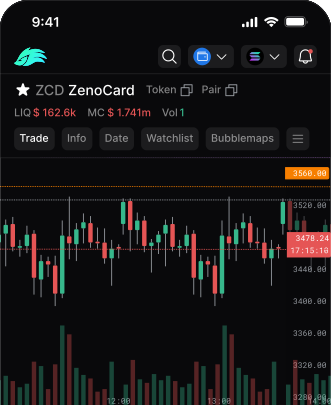
Pro tip: On a price chart, if you see only green (buy) candles with no red (sell) candles, that's a classic honeypot signature — people are buying but nobody can sell. This visual pattern is an immediate red flag.
Red Flag 7: Anonymous Team With No Track Record
While full doxxing (revealing real identities) isn't always expected in crypto, accountability is.
What to check: Does the team have a track record of building? Are they responsive to bugs and questions? Do they have past successful projects? If the developers are entirely anonymous with no history and no accountability, you're trusting them with your capital with zero recourse if they vanish.
A team that has built reputable projects before has reputational stake. Entirely anonymous creators with no track record have nothing to lose by rugging.
Red Flag 8: Manufactured Hype and Censored Communities
Rug pulls create artificial communities in Telegram and Discord — filled with bots and "hype men" who attack or ban anyone asking genuine questions.
What to check: Can you ask a difficult question in the community chat — about the contract, liquidity, or top holders — without being banned? If genuine questions get you attacked or removed, that's a major red flag. Legitimate projects welcome scrutiny; scams suppress it.
Also be skeptical of aggressive shilling with promises of "guaranteed returns" or "100x." Aggressive marketing without clear fundamentals is itself a warning sign.
What Tools Automate Rug Detection?
Manually checking all these signals on a Solana explorer is tedious and slow — and in fast-moving markets, you don't have time. Several tools automate it:
Visual holder analysis (Bubble Maps). Displays token holders as connected bubbles, instantly revealing bundled wallets and concentration that lists hide. This is one of the most effective rug-detection tools, turning a complex on-chain analysis into an at-a-glance visual.
Honeypot simulators (GoPlus, Honeypot.is). Simulate a sell before you buy, detecting honeypots and abnormal taxes.
Rug checkers (various). Automated tools that score tokens across many on-chain signals (mint authority, freeze authority, LP status, holder distribution) in seconds.
DEX analytics. Liquidity lock status, buy/sell patterns, and volume legitimacy on DEX tools.
GraphDex integrates Bubble Maps directly into its terminal, so when you discover a token via the Pulse feed, you can instantly visualize its holder distribution to spot bundling and concentration before buying. This integration — discovery plus instant safety analysis plus execution in one place — is far faster than switching between separate explorer, checker, and trading tools.
Check token safety with integrated Bubble Maps on GraphDex
What Should You Check Before Buying?
Before buying any Solana token, run through this checklist:
| Check | Safe Sign | Red Flag |
|---|---|---|
| Mint authority | Revoked (null/burn) | Still active |
| Freeze authority | Revoked | Still active |
| Liquidity | Burned or locked | Unlocked in creator wallet |
| Top 10 holders | Well distributed | 30-40%+ concentrated |
| Wallet bundling | No common funding source | Wallets funded from one source |
| Sell test | Sells work, normal tax | Honeypot or high sell tax |
| Team | Track record, responsive | Anonymous, no history |
| Community | Welcomes questions | Bans critical questions |
If a token fails multiple checks, walk away. There will always be other opportunities — capital preservation beats chasing every launch.
How Can You Stay Safe Overall?
Beyond the specific checks, follow these principles:
Never invest more than you can afford to lose — especially in newly launched tokens. Treat every memecoin as potentially going to zero.
Do your own research (DYOR) — check on-chain data, community channels, and creator history before committing.
Be skeptical of hype — if a token is aggressively shilled with guaranteed-return promises, that itself is a red flag.
Start small — if you trade a new token, start with a small position and scale only after confirming legitimacy.
Use multiple tools — no single tool catches everything. Combine visual holder analysis, honeypot checks, and rug scoring.
When in doubt, skip it — there will always be other opportunities. Missing a winner hurts less than getting rugged.
Use a dedicated wallet — trade new tokens from a separate, lightly-funded wallet rather than your main holdings, limiting damage from a malicious contract.
Related Guides
- What Is MEV on Solana in 2026? Sandwich Attacks Explained (and How to Avoid Them)
- Best Solana Trading Terminal in 2026: GraphDex vs Axiom vs GMGN vs Trojan vs BullX
- How to Find Memecoins Early on Solana (2026 Guide)
- What Is Bubbles on GraphDex? The Visual Way to Find Prediction Market Opportunities in 2026
Frequently Asked Questions
How do I check if a Solana token is a rug pull? Check these on-chain signals before buying: mint authority (should be revoked), freeze authority (should be revoked), liquidity (should be burned or locked), top holder concentration (under 30-40%), bundled wallets (no common funding source), and sell ability (not a honeypot). Tools like Bubble Maps visualize holder clusters to spot bundling instantly.
What is the biggest red flag for a Solana rug pull? Active mint authority is among the most critical — it lets the creator print unlimited tokens, diluting holders to near-zero instantly. Unlocked liquidity (creator can pull it anytime) and honeypots (you can't sell) are equally dangerous. Check all three before buying any token.
What are bundled wallets and why do they matter? Bundled wallets are when a scammer splits holdings across many wallets to disguise concentration — making distribution look healthy when one entity controls most supply. Detect them by checking if top holders were funded from the same source. Bubble Maps reveals this visually as connected clusters.
How much do rug pulls cost traders? According to Chainalysis, rug pulls accounted for over $2.8 billion in losses during 2025 alone. With 5,000+ tokens launching daily across chains, many designed as scams, rug detection is essential for capital preservation in 2026.
What is a honeypot token? A honeypot lets you buy a token but prevents or heavily taxes selling, trapping your capital. Detect it by simulating a sell with tools like GoPlus or Honeypot.is before buying. A classic visual sign: a price chart with only green (buy) candles and no red (sell) candles.
Can tools guarantee a token is safe? No. Tools like Bubble Maps and rug checkers flag the most common patterns and dramatically reduce risk, but new scam techniques emerge constantly, and no tool catches everything. Always combine tools with your own research, start small, and never invest more than you can afford to lose.
How does GraphDex help avoid rug pulls? GraphDex integrates Bubble Maps directly into its terminal, letting you visualize a token's holder distribution — spotting bundled wallets and concentration — the moment you discover it via the Pulse feed, before buying. Combining discovery, safety analysis, and execution in one place is faster than switching between separate tools.
About This Guide
This guide is published by the GraphDex Research team — analysts and traders building the infrastructure for digital asset trading on Solana. Our content is based on live platform data, current security research, and hands-on experience.
Sources & data: Loss figures, statistics, and detection methods reflect publicly available information as of 2026. No detection method is foolproof; scammers evolve tactics. This guide is educational and not financial advice — always do your own research and never invest more than you can afford to lose.
GraphDex is the infrastructure for digital asset trading — trade, predict, and earn in one place. Learn more at graphdex.io.
Last reviewed: May 2026 · GraphDex Research
The infrastructure for digital asset trading. Trade, predict, stake, repeat. graphdex.io