By GraphDex Research · Reviewed for accuracy May 2026
Quick Answer
Money market funds and stablecoin yields are competing approaches to dollar-denominated yield — each with distinct strengths:
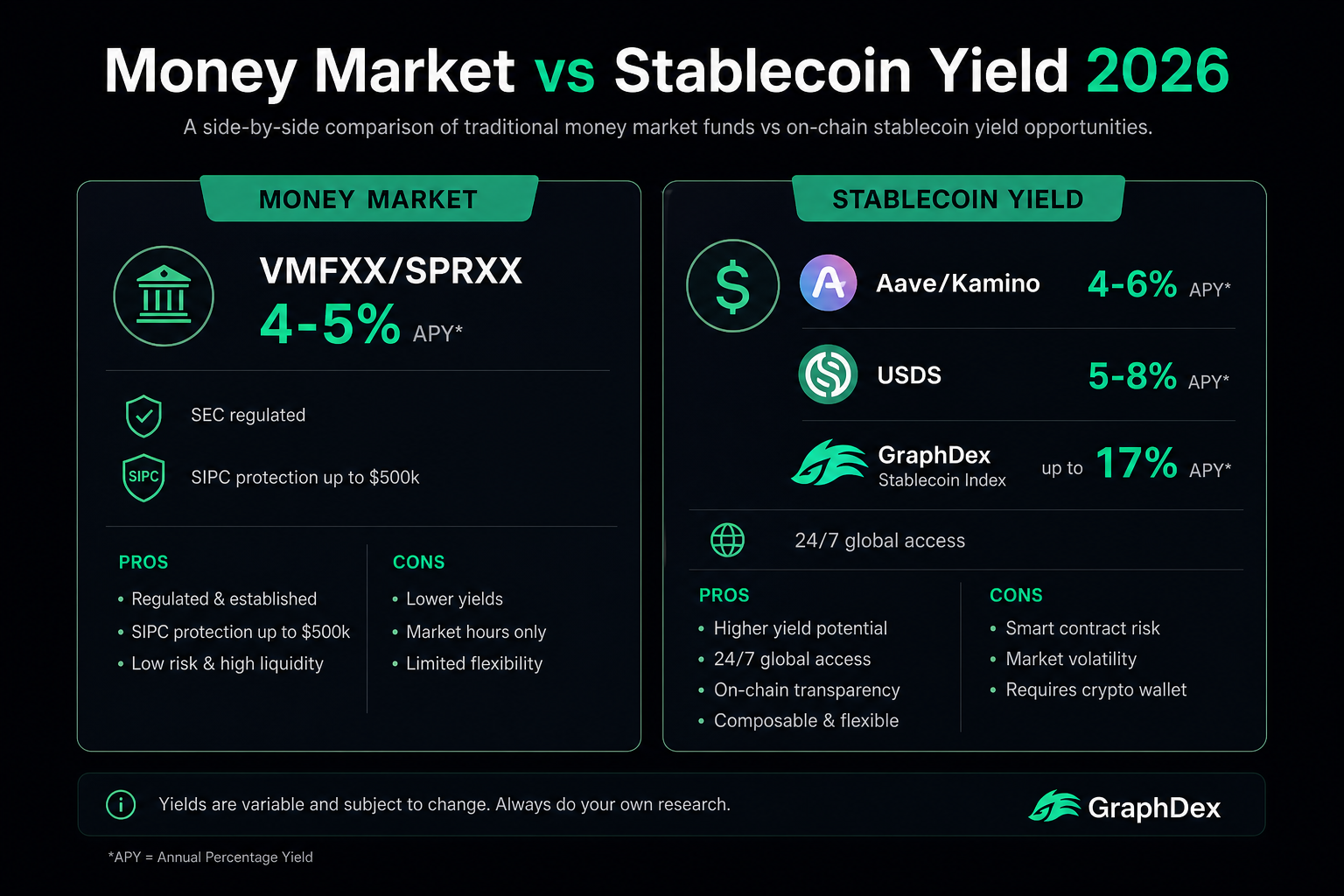
- Money market funds: 4-5% APY (SPRXX, VMFXX, similar), SEC-regulated, $250k SIPC, but business-hours access and US-residency requirements
- Stablecoin lending (Aave, Compound): 4-6% APY on USDC/USDT, 24/7, global, no minimums, but smart contract risk
- Yield-bearing stablecoins (USDS, USDe, USDY): 4-8%+ APY, passive (just hold)
- CeFi stablecoin yields (Bybit, Binance): 5-12% APY, custodial convenience
- Fee-based platform yields (GraphDex): Up to 17% APY from real platform trading fees, non-custodial
The rule: Money markets win on safety/regulation; stablecoin platforms win on yield, access, and global availability. Many sophisticated users combine both — money markets for tax-advantaged accounts, stablecoins for higher-yield active capital.
Compare with fee-based 17% APY on GraphDex
Key Takeaways
- Money market funds offer SEC-regulated stability at 4-5% APY; stablecoins offer 4-17% with different risks.
- Money markets are best for retirement accounts; stablecoins for global access and higher yields.
- The right choice depends on your priorities: insurance vs yield, regulation vs access, fiat vs crypto.
- A combined approach uses both: money markets in IRAs/401ks, stablecoins for active yield outside.
How Do Money Market Funds Work?
Money market funds are SEC-regulated mutual funds that invest in short-term, high-quality debt instruments — typically US Treasuries, commercial paper, certificates of deposit, and short-term corporate bonds. They aim to maintain a stable $1 share price while paying yield based on prevailing short-term interest rates.
How they work: When you deposit $10,000 in a money market fund, the fund invests in a diversified portfolio of safe, short-term debt. The interest earned, minus a small expense ratio (typically 0.1-0.5%), flows to fund holders as yield.
Major money market funds in 2026:
- Fidelity Government Money Market Fund (SPRXX): ~4.5% APY, broker-accessible
- Vanguard Federal Money Market Fund (VMFXX): ~4.5% APY, low expense ratio
- Schwab Value Advantage Money Fund (SWVXX): ~4.5% APY
- Bank money market accounts (Marcus, Ally, SoFi): 4-5% APY with FDIC insurance up to $250k
Regulatory framework: Money market funds are SEC-regulated under Rule 2a-7, with strict requirements about credit quality, maturity (most holdings under 60 days), and diversification. SIPC protection up to $500,000 for securities held in brokerage accounts.
Why this matters: Money market funds are how trillions of dollars sit "safely" earning yield outside the stock market. They're not exciting, but they're battle-tested.
How Do Stablecoin Yields Work?
Stablecoin yields are returns earned by depositing USDC, USDT, DAI, or other dollar-pegged tokens into yield-generating platforms — DeFi protocols, exchange "earn" products, or fee-based platforms.
How they work: You deposit stablecoins. Different mechanisms generate yield:
- Lending protocols (Aave, Kamino): Borrowers pay interest; you receive the interest
- Yield-bearing stablecoins (USDS, USDe): Built-in mechanisms generate yield (Treasury exposure, delta-hedged strategies)
- CeFi platforms (Bybit, Binance): Exchange operations generate yield distributed to depositors
- Fee-based platforms (GraphDex): Trading fees generate yield shared with depositors
Top stablecoin yield options:
- Aave USDC: 4-6% APY, established DeFi lending
- Compound USDC: 4-6% APY, similar to Aave
- USDS/DSR (Sky): 5-8% APY from protocol revenue + Treasury yields
- Bybit Easy Earn USDT: 5-10% APY, CeFi flexible
- GraphDex fee-based: Up to 17% APY from real platform trading fees
Regulatory framework: Variable and evolving. The 2025 GENIUS Act requires US stablecoin issuers to maintain 1:1 reserves; DeFi protocols are regulated under various crypto-specific rules. Less regulated than money market funds, but increasing.
Side-by-Side Comparison
The numbers tell the comparative story:
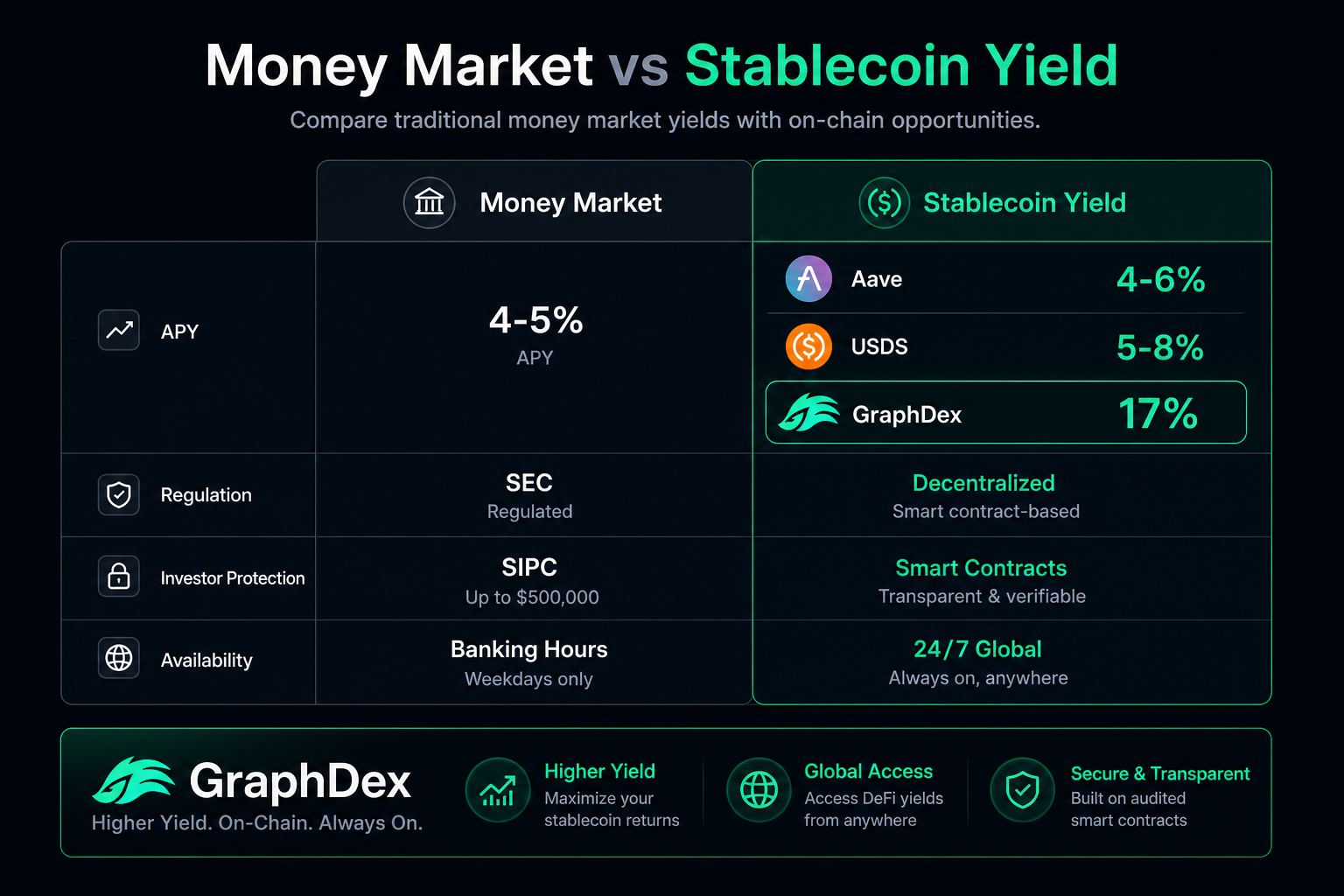
| Feature | Money Market Funds | Stablecoin Yields |
|---|---|---|
| Typical APY | 4-5% | 4-17% |
| Insurance/protection | SIPC (broker), FDIC (bank account) | None (mostly) |
| Liquidity | Same-day (business hours) | 24/7 instant |
| Geographic access | Mostly US-resident | Global |
| Minimum amount | Usually $1 (often $0 in brokerage) | Often no minimum |
| Tax treatment | Standard ordinary income | Ordinary income; complex DeFi cases |
| Regulation | Heavy (SEC Rule 2a-7) | Light-to-moderate (evolving) |
| Custodial | Yes (broker holds) | Both options available |
| Audit | Yes (regulated) | Varies (transparent for DeFi via blockchain) |
| Withdrawal flexibility | Daily, T+1 settlement | Instant for most |
Yield gap: Stablecoins typically pay 1-12 percentage points more than money markets — a meaningful difference on serious capital. $10,000 at 5% (money market) earns $500/year; at 12% (CeFi stablecoin) earns $1,200; at 17% (fee-based platform) earns $1,700.
Safety gap: Money markets have FDIC/SIPC protection (up to $250k/$500k). Stablecoins have no equivalent insurance — losses from depegs, hacks, or platform failures can be total.
When Are Money Market Funds the Better Choice?
Money market funds beat stablecoin yields in several specific scenarios.
Tax-advantaged accounts. 401(k)s, IRAs, HSAs, and similar tax-advantaged accounts often don't accommodate crypto easily. Money market funds slot directly into these structures, and the tax savings on yields can outweigh the lower nominal rate.
Emergency funds. For 3-6 months of expenses ($30K-50K for most households), the FDIC/SIPC insurance materially matters. The 4-5% yield is "good enough" for capital you must access if life goes wrong.
Conservative investors. Investors who genuinely lose sleep over investment risk should keep their stability portion in fully insured vehicles. Money markets fit; stablecoins don't.
Older investors (60+). Capital preservation matters more than yield maximization. Government-backed stability has real value over yield.
Regulatory comfort needs. Some investors, especially institutions and those in highly regulated industries (finance, legal, government), need the SEC-regulated path for compliance reasons.
US-focused, fiat-comfortable users. Money market funds work seamlessly within the US banking system. No wallets, no exchanges, no crypto tax complexity.
When Do Stablecoin Yields Win?
Stablecoins beat money markets in different scenarios.
Yield maximization. When the goal is maximum yield on a portion of capital you're willing to take risk with — stablecoins win by 2-12 percentage points. Real money over time.
Global access. Stablecoins work anywhere with internet and a wallet. Money market funds typically require US residence and brokerage access. For international users, stablecoins are the practical only option for dollar-denominated yield.
24/7 liquidity. Crypto markets never close. If you need to access funds at 2am Saturday, stablecoin platforms work; money market settlement waits until Monday.
Composability with broader crypto activity. If you're already in crypto for trading, holding stablecoins in yield platforms keeps capital working between trades. Money in money market funds is siloed from your crypto activity.
Higher-allocation diversification. Stablecoin yields offer a different risk profile than money markets. Holding both diversifies exposure beyond traditional fixed income.
Active capital deployment. If you're moving money between yield sources, opportunities, and trades — stablecoins enable strategies money markets can't (e.g., providing LP liquidity, lending against crypto collateral, earning fees while trading).
The Hybrid Approach (Most Sophisticated Users)
For users with $100K+ in deployable capital, combining both makes sense.
Sample hybrid allocation:
- 40-50% in money market funds: Emergency fund, IRA/401(k) cash positions, regulated capital
- 20-30% in DeFi lending (Aave, Compound): Higher-yield stable exposure with manageable risk
- 10-20% in yield-bearing stablecoins (USDS, USDe): Set-and-forget passive yield
- 10-20% in active yield platforms (GraphDex 17% APY): Maximum yield from real platform fees
- 5-10% in tokenized Treasuries (BUIDL, OUSG): Bridge between TradFi and crypto yield
Expected blended return: 6-9% APY versus 4.5% for pure money markets — meaningful compounding difference.
The discipline: Diversification across both regulated (money markets) and crypto-native (stablecoins) yields hedges against tail risks in either ecosystem. If crypto suffers a major systemic event, money market exposure protects you. If traditional finance has issues (bank failures, currency events), stablecoin exposure protects you.
Practical Decision Framework
For users choosing between money markets and stablecoin yields:
Choose money markets if:
- You're new to crypto and want maximum simplicity
- Your capital is in retirement accounts (IRA, 401k)
- Emergency fund or near-term cash needs
- Insurance/regulatory comfort is essential
- You're 60+ and prioritizing preservation
Choose stablecoins if:
- You're outside the US and need dollar-denominated yield
- You're already active in crypto and want capital to work
- Maximum yield matters more than regulatory comfort
- You're comfortable managing wallets and yield platforms
- Your time horizon is long enough to absorb potential setbacks
Choose both if:
- Your portfolio is $100K+
- You want diversification across yield sources
- You're comfortable with both regulated and crypto-native systems
- You can manage tax complexity from multiple income types
For active crypto users specifically, the realistic answer is "both" — money markets for tax-advantaged accounts and emergency funds, stablecoin platforms (Aave, Kamino, GraphDex) for higher-yield active capital.
Add fee-based 17% APY stablecoin yield to your stack on GraphDex
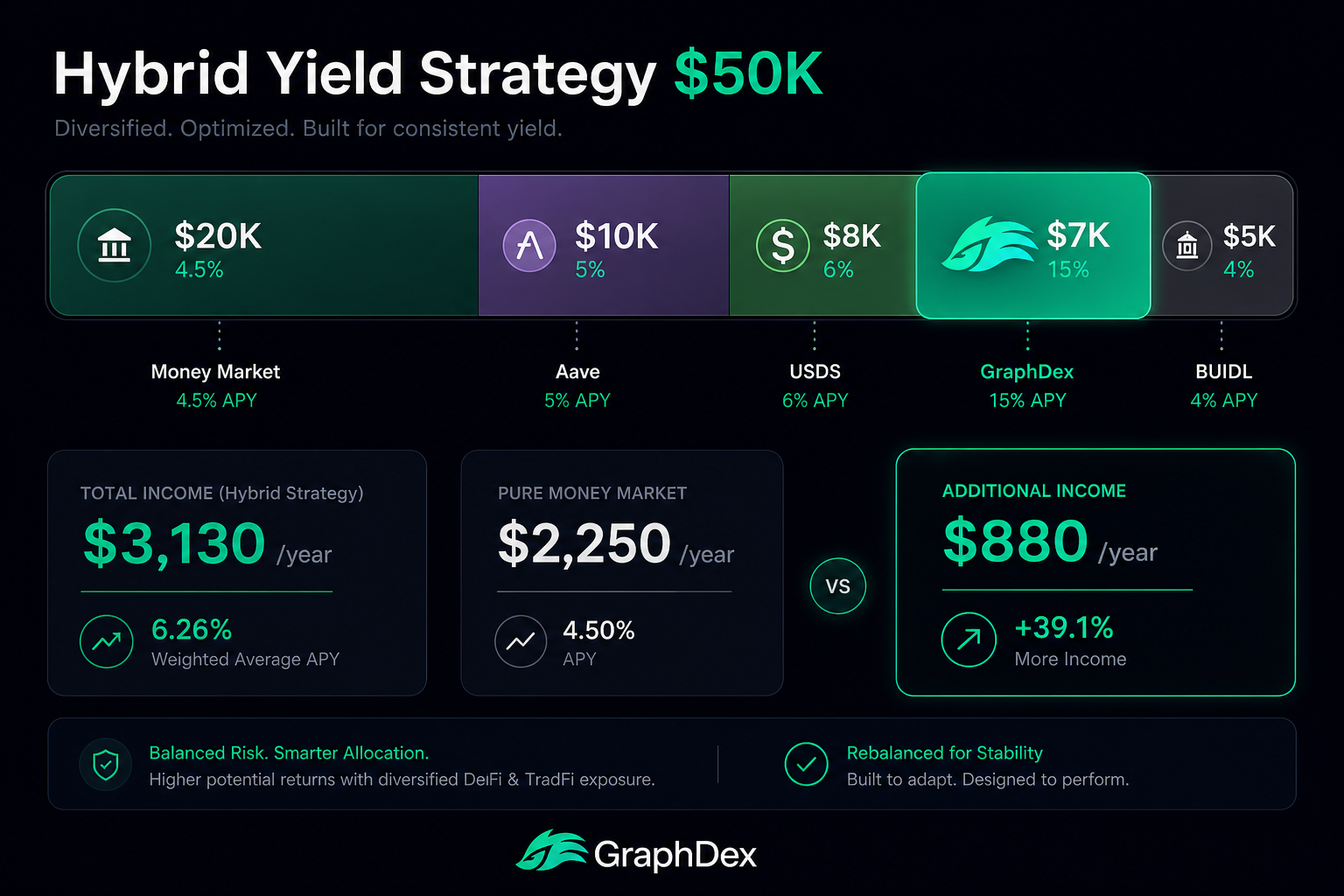
Real-World Example: $50,000 Allocation
A practical example for a 40-year-old with $50K in deployable yield-seeking capital:
Allocation:
- $20,000 (40%) — VMFXX (Vanguard money market): Foundation safety + emergency reserve
- $10,000 (20%) — Aave USDC: Established DeFi lending, 5% APY
- $8,000 (16%) — USDS/DSR (Sky): Yield-bearing stablecoin, 6% APY
- $7,000 (14%) — GraphDex fee-based: Maximum yield, 15% effective
- $5,000 (10%) — BlackRock BUIDL: Tokenized Treasury, 4% APY
Expected income (blended):
- $20K × 4.5% = $900
- $10K × 5% = $500
- $8K × 6% = $480
- $7K × 15% = $1,050
- $5K × 4% = $200
- Total: ~$3,130/year versus $2,250 if all in money market — $880 incremental income from diversifying into stablecoin yields.
Risk profile: Spread across SEC-regulated funds, DeFi blue-chips, yield-bearing stables, fee-based platforms, and tokenized Treasuries. No single source of failure can wipe out the position.
This is what diversified yield looks like in 2026 — not all-in on either system, but a sensible blend that captures both regulatory safety and crypto-yield premium.
Add fee-based 17% APY to your diversified yield on GraphDex
Frequently Asked Questions
Is stablecoin yield safer than money market funds? No — money markets have SEC regulation, SIPC protection up to $500k (broker), and decades of stability. Stablecoins lack equivalent insurance. However, established stablecoin yields (Aave, Compound, major CeFi) have weathered multiple market cycles and are practical for the right risk profile. Different risks, not strictly safer or riskier.
Can stablecoin yields fall below money market rates? Yes, particularly DeFi lending rates fluctuate with crypto borrowing demand. During quiet markets, USDC on Aave has paid 2-4% — below money market levels. The 5-17% range is current; rates change. Yield-bearing stablecoins and fee-based platforms tend to be more rate-stable than pure lending.
What's the catch with 17% APY on GraphDex? The yield comes from real platform trading fees (transparent, verifiable revenue source), not emissions or speculation. The risks are platform-specific operational risk and smart contract risk in the non-custodial Privy infrastructure. Unlike emission-based yields, it's sustainable as long as trading volume continues. Not FDIC-insured.
Are money market funds taxable? Yes — yields from money market funds are taxed as ordinary income, similar to most stablecoin yields. The exception is municipal money market funds, which can be tax-exempt at federal (and sometimes state) levels. Tax-advantaged accounts (IRA, 401k) shield gains until withdrawal.
Can I lose money in a money market fund? Money market funds aim to maintain $1 share price but aren't guaranteed. "Breaking the buck" has happened (Reserve Primary Fund in 2008). Bank money market accounts have FDIC insurance up to $250k; brokerage money market funds have SIPC up to $500k. Practical loss risk is very low but not zero.
How are stablecoin yields taxed? Generally as ordinary income at fair market value when received, in most jurisdictions. Some yields (lending interest) are simpler; others (LP fees, yield-bearing stablecoins with rebasing) are more complex. Keep records and consult a crypto-specialist tax professional.
Should I move my emergency fund to stablecoin yields? Generally no. Emergency funds need maximum safety and instant access during crises — exactly when crypto platforms might have issues. Keep emergency funds in FDIC-insured savings or money market accounts. Use stablecoin yields for capital you can afford to risk and would otherwise hold idle.
About This Guide
This guide is published by the GraphDex Research team — analysts and traders building the infrastructure for digital asset trading on Solana. Our content is based on live market rates, current platform yields, and publicly available information.
Sources & data: Yield rates and platform details reflect publicly available information as of 2026 and change with market conditions. Both money markets and stablecoin yields carry risk (low for money markets, moderate for stablecoins). This guide is educational and not financial or tax advice.
GraphDex is the infrastructure for digital asset trading — trade, predict, and earn in one place. Learn more at graphdex.io.
Last reviewed: May 2026 · GraphDex Research
The infrastructure for digital asset trading. Trade, predict, stake, repeat. graphdex.io