By GraphDex Research · Reviewed for accuracy May 2026
Quick Answer
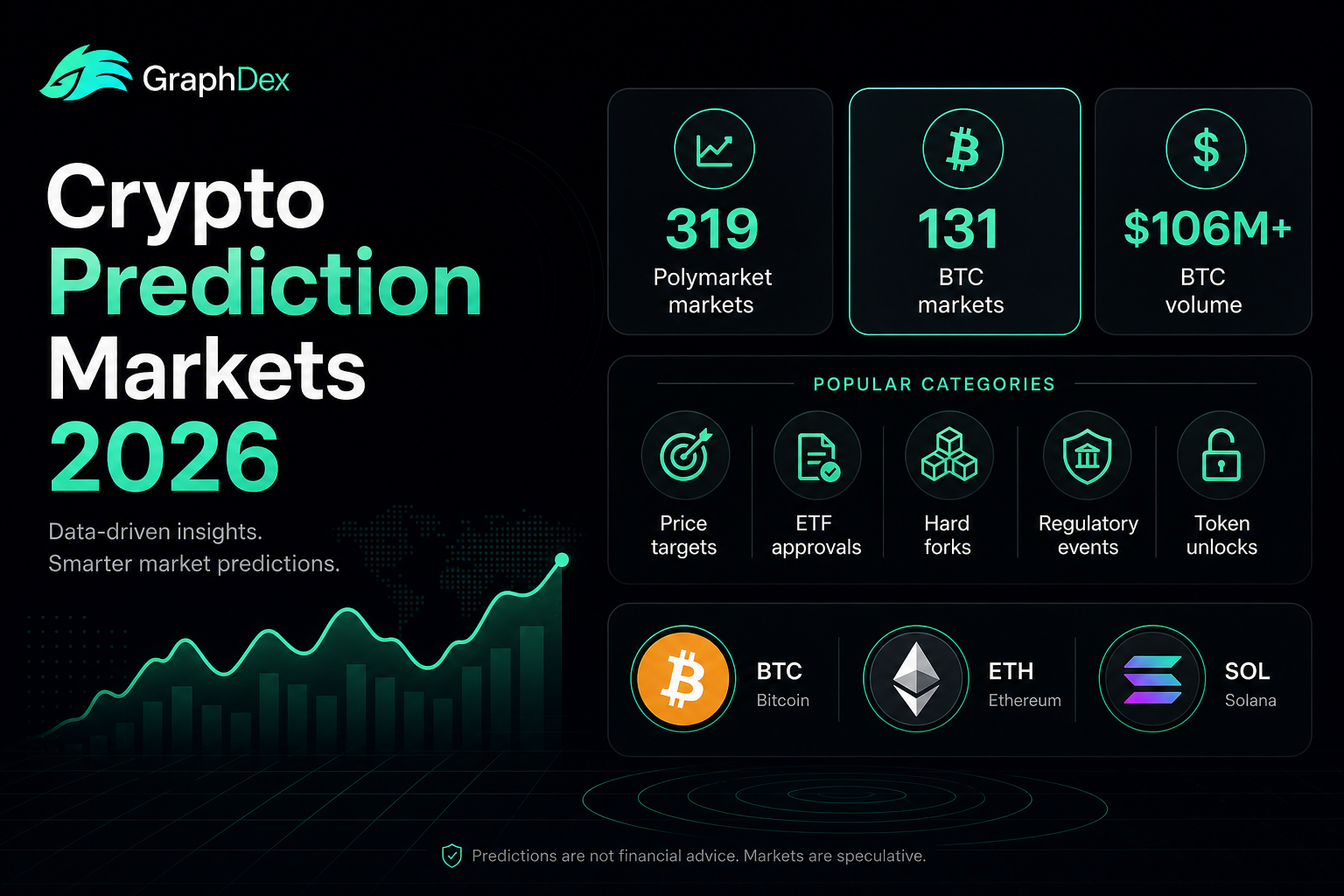
Crypto prediction markets let you trade contracts on cryptocurrency outcomes — prices, ETF approvals, protocol events, and more. Key facts in 2026:
- 319 crypto markets on Polymarket's Crypto category — the deepest crypto prediction coverage
- 131 Bitcoin markets alone, plus Ethereum, Solana, and altcoin markets
- $106M+ Bitcoin volume with weekly/monthly markets on price targets
- Beyond price: ETF approvals, hard forks, regulatory rulings, token unlocks, and more
- Polymarket POLY token planned: Founder Coplan signaled an airdrop later in 2026
For Solana traders especially, crypto prediction markets offer a way to monetize on-chain knowledge and catch narrative shifts in both spot and prediction markets.
Trade crypto prediction markets via GraphDex
Key Takeaways
- Polymarket hosts 319 crypto markets, with 131 on Bitcoin and major Ethereum/Solana coverage.
- Crypto markets cover price targets, ETF approvals, hard forks, regulatory events, and protocol decisions.
- Crypto-native traders have a natural edge — they already follow the news that moves these markets.
- Combining spot Solana trading with prediction markets captures narratives across both venues.
What Are Crypto Prediction Markets?
Crypto prediction markets are contracts on future cryptocurrency outcomes. Each is a yes/no question — "Will Bitcoin hit $150,000 by year-end?", "Will Ethereum be up on May 28?", "Will the SEC approve a Solana ETF in 2026?" — and you trade shares in YES or NO.
The price of each share reflects market-implied probability. A share priced at $0.40 in "When will Bitcoin hit $150k? — by Dec 31, 2026" implies traders collectively assess roughly 40% probability. Prices update continuously as news, data, and trader sentiment evolve. If you're right, each share pays $1.00; if wrong, $0.00.
This is fundamentally different from trading the underlying asset. Buying Bitcoin spot gives you exposure to its full price movement. Buying a crypto prediction market contract gives you a defined payoff based on a specific question — useful for catalysts, binary events, or trading a view without taking directional spot risk.
For crypto-native traders, prediction markets are a complementary edge. The news that moves these markets — ETF rumors, hard fork dates, regulatory decisions, protocol upgrades — is exactly what crypto traders already follow daily.
What You Can Trade: The Universe of Crypto Markets
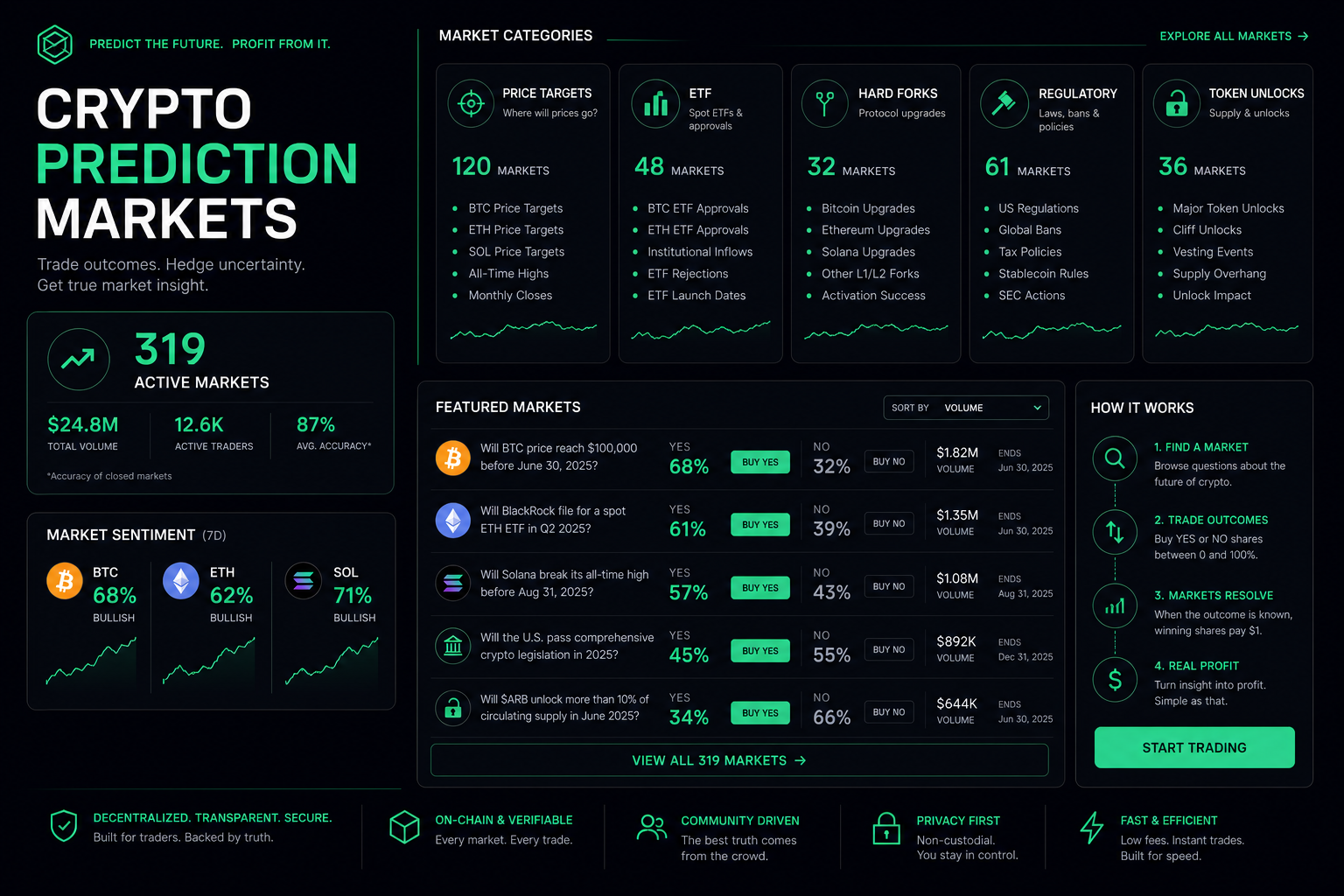
Polymarket's Crypto category alone hosts 319 markets in 2026. Coverage spans:
Price targets. "When will Bitcoin hit $150k?", "Bitcoin Up or Down on [date]?", "Ethereum price by end of Q3" — the most active category, with $106M+ in Bitcoin volume across 20+ active markets.
ETF approvals. Markets on Bitcoin, Ethereum, and altcoin (Solana, XRP, others) ETF approvals — high-stakes regulatory events that move spot markets dramatically.
Hard forks and upgrades. Ethereum protocol upgrades, Bitcoin softforks, major chain forks — events with on-chain timing that's analyzable.
Token unlocks and supply events. Polymarket and Kalshi list markets tied to token unlocks, halving cycles, and supply changes.
Regulatory rulings. Court decisions on cases like Ripple/SEC, CFTC actions, state regulatory moves — outcomes crypto Twitter dissects in real time.
Protocol decisions. Major governance votes, exchange listings, treasury moves.
Weekly and monthly markets. Short-horizon contracts that resolve quickly, useful for active traders who want frequent turnover.
The 131 Bitcoin markets reflect how deep the coverage is on the dominant asset. Ethereum and Solana also have significant coverage, especially around price, ETF, and protocol events.
Crypto Prediction Market Categories at a Glance
| Category | Examples | Liquidity |
|---|---|---|
| Price targets | "BTC to $150k?", "ETH up/down on date?" | High (esp. BTC) |
| ETF approvals | BTC, ETH, SOL ETF decisions | High |
| Hard forks | Ethereum upgrades, Bitcoin softforks | Moderate-High |
| Token unlocks | Major unlock event timing | Moderate |
| Regulatory | SEC rulings, court decisions | Variable |
| Protocol decisions | Governance, listings, treasury | Variable |
| Weekly/monthly | Short-horizon price markets | High |
Explore crypto prediction markets via GraphDex
Why Crypto Traders Have a Natural Edge
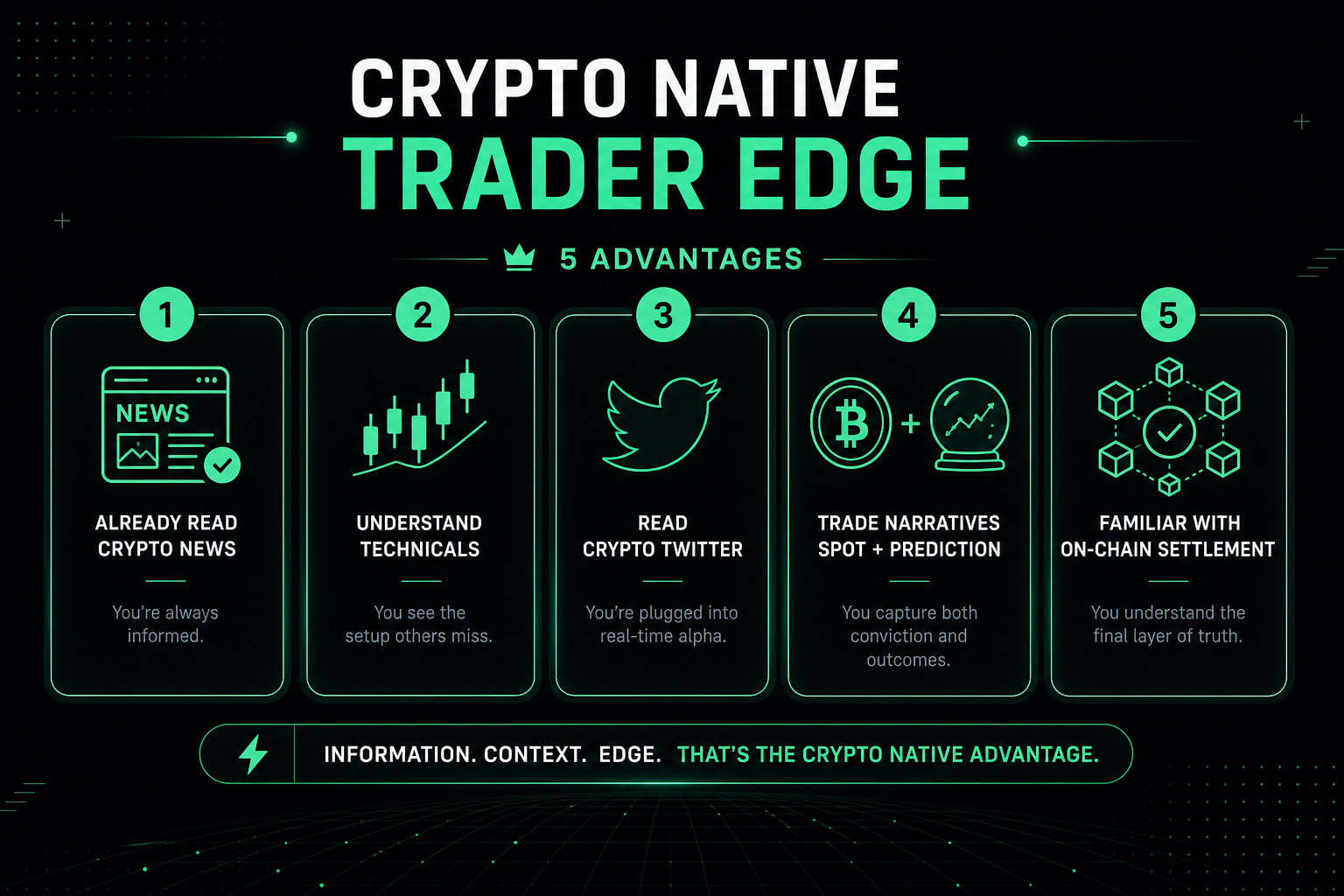
Crypto-native traders are uniquely positioned to profit from crypto prediction markets — for several reasons.
You already consume the news. ETF rumors, hard fork dates, regulatory developments, SEC announcements — crypto traders track this constantly. Prediction markets reward exactly this information speed and depth.
You understand the technicals. Protocol upgrades, supply mechanics, on-chain data — domains where non-crypto traders are at a disadvantage. A trader who reads an EIP closely can outprice the market on a hard fork question.
You read crypto Twitter natively. Sentiment, narratives, and breaking news flow through crypto Twitter faster than mainstream media. Traders embedded in that flow react minutes before the broader market.
You can trade narratives across spot and prediction markets. A bullish Bitcoin catalyst is tradeable in spot, futures, AND prediction markets. Skilled traders capture the narrative across all three for compounding edge.
You're familiar with on-chain settlement. Polymarket settles in USDC with self-custody — natural for crypto-native traders.
This information asymmetry is real. The largest profits on crypto prediction markets often go to wallets that connected an on-chain signal to a prediction market faster than the broader market priced it in.
Trading Bitcoin Prediction Markets
Bitcoin prediction markets are the most liquid crypto prediction segment, with 131 Polymarket markets and $106M+ in active volume.
Price target markets like "When will Bitcoin hit $150k?" with discrete date outcomes (by month, by year-end) let you trade a view on Bitcoin's trajectory without taking spot exposure. The market price implies probability — if "by December 31, 2026" is at 10%, the market is pricing roughly 10% probability.
Short-horizon markets like "Bitcoin Up or Down on May 28?" resolve daily or weekly, suiting traders who want fast turnover and trade based on near-term technicals or news.
ETF and regulatory markets carry binary catalyst risk — outcomes shift dramatically on SEC decisions or court rulings. Traders who closely follow regulatory dockets can find edge before broad-market participants.
For trading Bitcoin prediction markets effectively:
- Specialize in the timeframe (short-term vs long-term)
- Pair with spot analysis — your view on price should inform both
- Watch on-chain metrics (active addresses, exchange flows) and macro (Fed, inflation prints)
- Size positions conservatively — Bitcoin markets are liquid but volatile
Trading Ethereum and Solana Prediction Markets
Beyond Bitcoin, Ethereum and Solana prediction markets are increasingly active.
Ethereum markets cover price ("Ethereum price target for Q3?"), protocol upgrades (next hard fork timing), and ETF/regulatory events. As the second-largest crypto, ETH has deep liquidity in major markets. Major catalysts — staking changes, protocol upgrades, regulatory shifts — create tradeable opportunities.
Solana markets are especially relevant for our audience. Markets cover Solana price targets, ecosystem developments, and ETF prospects. Solana ETF speculation has been an active category in 2026 as institutional adoption questions become tradeable events.
For Solana-focused traders specifically, prediction markets are a natural extension of existing knowledge. You already track Solana validator metrics, ecosystem launches, and developer activity — that's directly tradeable on relevant prediction markets.
Altcoin events beyond the top three include token unlocks, exchange listings, and major project milestones. Liquidity is thinner for altcoin-specific markets, so position sizing matters more.
How GraphDex Helps Crypto Prediction Traders
For crypto traders pursuing prediction markets, GraphDex's integration is uniquely positioned:
Trade spot and predictions in one terminal. When you see a bullish Bitcoin catalyst, you can act in Solana DEX trading AND Polymarket from the same interface — capturing the narrative in both spot and prediction markets.
Copytrading. Follow proven Polymarket forecasters ranked by PnL and win rate, including those specialized in crypto markets. Mirror their positions automatically.
AI signals across both. GraphDex's signals span tokens and prediction markets — the same crypto narrative that drives a Solana token move often shows up in a prediction market simultaneously.
Whale tracking. See when large informed traders move on crypto prediction markets, often signaling something significant.
Staking on idle capital. Up to 17% APY on stablecoins between trades means your capital earns while you wait for catalysts.
For Solana traders, this integration captures something pure-prediction tools miss: the connection between spot trading, prediction markets, and earning. A trader who's bullish Solana can express that view across multiple venues from one terminal.
Trade crypto and prediction markets together on GraphDex
Risks of Crypto Prediction Markets
Crypto prediction markets carry specific risks worth understanding.
Volatility and binary outcomes. Unlike spot trading where you can scale out, prediction markets resolve to $1.00 or $0.00. A close miss on a price target pays nothing. Size positions accordingly.
Resolution disputes. Rare but real — markets occasionally face disputes over how to interpret resolution criteria (e.g., which oracle counts, what timestamps qualify). Read the market's resolution rules before trading.
Manipulation risk. Smaller crypto markets can be moved by single large positions. Stick to liquid markets where the consensus reflects many participants.
Regulatory uncertainty. Crypto prediction markets sit at the intersection of two regulated domains (crypto and event contracts). Legal status is evolving — check current rules.
Tax complexity. Crypto prediction market gains may be subject to crypto tax rules, event contract treatment, or both. The IRS has no formal guidance. Keep records and consult a tax professional.
Counterparty matching. Liquidity in niche markets can be thin — you may not be able to exit at fair prices when you want to.
For crypto-native traders, none of these are unfamiliar — they're the same kinds of risks crypto trading already involves. The key is sizing positions to handle adverse outcomes.
Frequently Asked Questions
Can you trade Bitcoin and Ethereum on prediction markets? Yes. Polymarket alone hosts 131 Bitcoin markets and significant Ethereum coverage, including price targets ("When will Bitcoin hit $150k?"), short-horizon markets ("Up or Down on [date]?"), and ETF/regulatory events. Bitcoin markets have $106M+ in active volume. You trade YES/NO contracts at market-implied probabilities.
What's the difference between trading crypto on prediction markets vs spot? Spot gives full price exposure; prediction markets give a defined payoff based on a specific question. Prediction markets are useful for catalysts (ETF decisions, hard forks), binary events, and trading a view without taking directional spot risk. Skilled traders use both — capturing narratives across venues.
Why do crypto traders have an edge on prediction markets? Crypto-native traders already follow the news that moves these markets (ETFs, forks, regulations), understand technicals (protocol upgrades, on-chain data), and consume crypto Twitter natively where signals flow first. This information asymmetry creates real opportunity for those embedded in the space.
Does Polymarket have Solana prediction markets? Yes. Polymarket lists Solana price target markets, ETF speculation, and ecosystem-related markets within its broader 319 crypto markets. For Solana traders specifically, these are a natural extension of existing knowledge — you already track Solana metrics that drive these markets.
Are crypto prediction markets legal? Federally, the CFTC allows event contracts including crypto on regulated platforms. Polymarket access varies by jurisdiction (US users face restrictions on Polymarket.com but Polymarket US (QCX) is on the CFTC DCM list). State-level enforcement adds complexity. This is educational, not legal advice — check current rules for your jurisdiction.
Will Polymarket launch a token? Polymarket founder Shayne Coplan has signaled plans for an airdrop later in 2026, with a potential POLY token. Such a token could find traction as in-house currency similar to BNB on Binance. As with any speculation, treat unconfirmed plans cautiously.
How can I trade crypto prediction markets profitably? Specialize in the crypto domain you know deeply (Bitcoin macro, Ethereum technicals, Solana ecosystem), compare market prices to your own probability estimates, manage risk conservatively given binary payoffs, and consider copytrading proven crypto forecasters via tools like GraphDex. Pair prediction trades with spot views for compounding edge.
About This Guide
This guide is published by the GraphDex Research team — analysts and traders building the infrastructure for digital asset trading on Solana. Our content is based on live platform data, current market figures, and hands-on experience with the platforms covered.
Sources & data: Volume figures, market counts, and platform details reflect publicly available information as of 2026 and may change. Crypto prediction market trading carries significant risk. This guide is educational and not financial advice — always do your own research.
GraphDex is the infrastructure for digital asset trading — trade, predict, and earn in one place. Learn more at graphdex.io.
Last reviewed: May 2026 · GraphDex Research
The infrastructure for digital asset trading. Trade, predict, stake, repeat. graphdex.io