By GraphDex Research · Reviewed for accuracy May 2026
Quick Answer
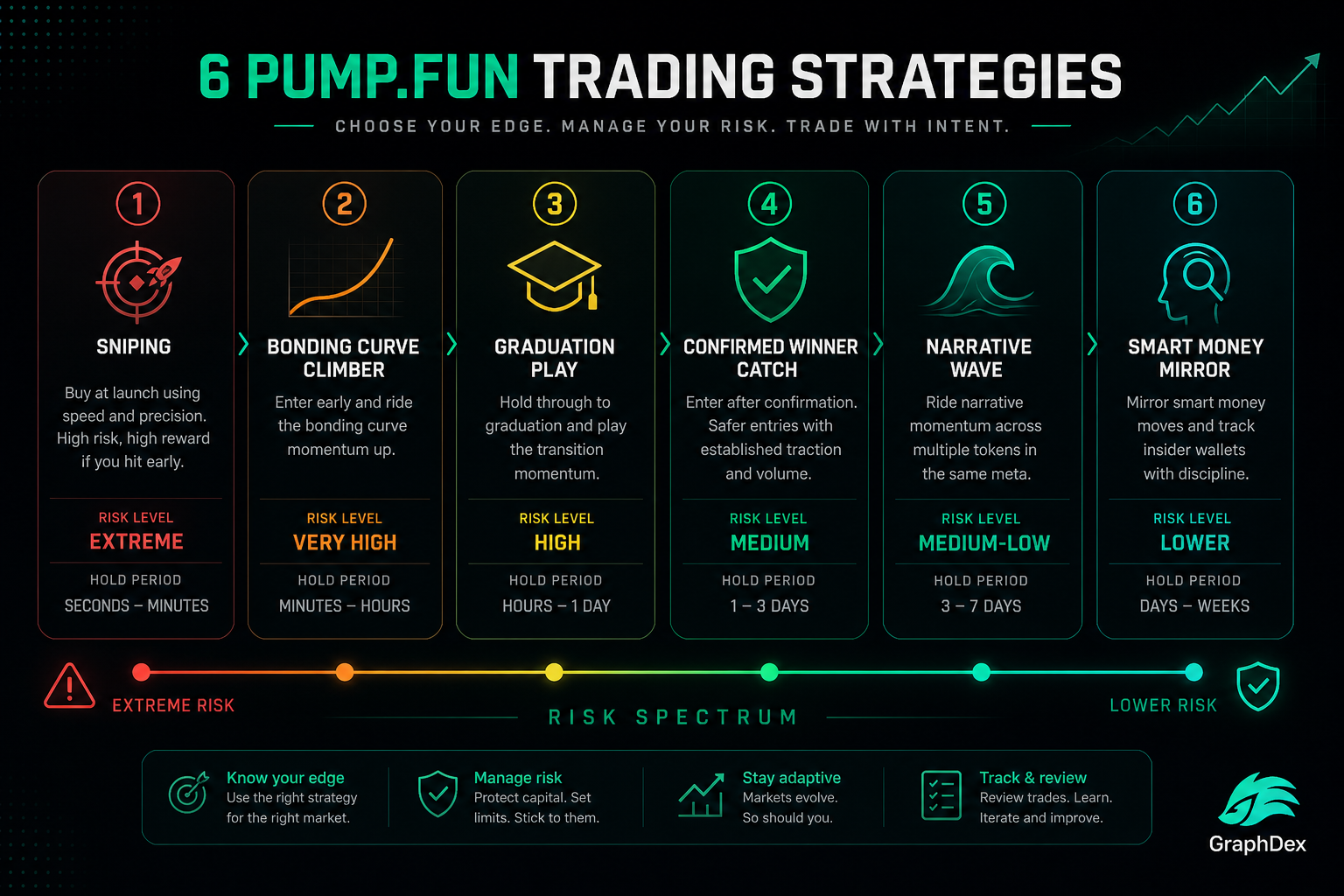
The six main strategies for trading Pump.fun tokens, ranked by risk-reward profile:
- The Sniping Strategy — Buy at launch; highest risk, highest reward (0.5% capital max per trade)
- The Bonding Curve Climber — Buy tokens climbing toward graduation
- The Graduation Play — Buy approaching ~$69K mcap graduation point
- The Confirmed Winner Catch — Buy post-graduation tokens on first pullback
- The Narrative Wave — Multiple tokens in trending themes simultaneously
- The Smart Money Mirror — Follow proven memecoin traders' entries
Critical facts about Pump.fun in 2026:
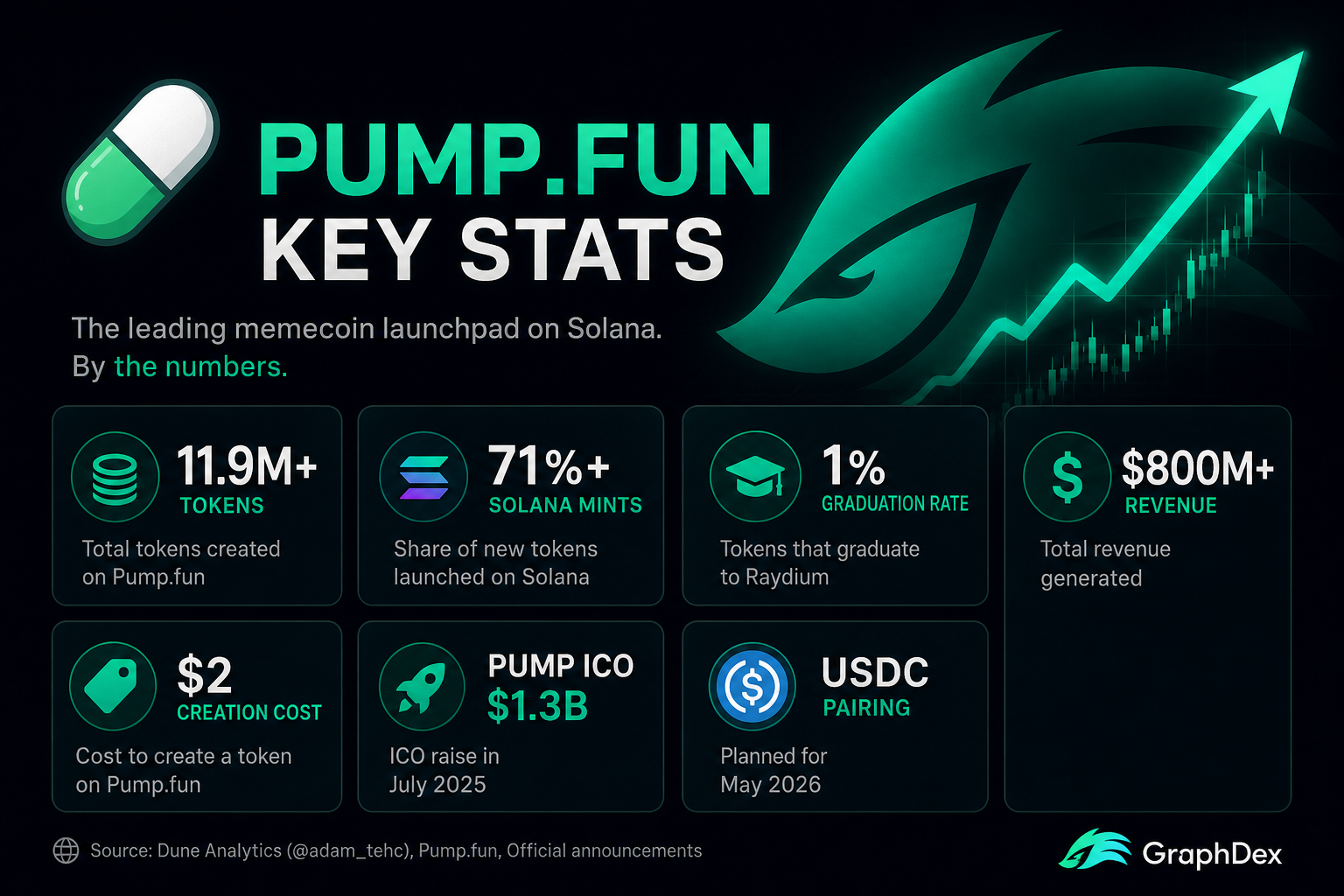
- 11.9M+ tokens launched since January 2024
- Only ~1% graduate from bonding curve to PumpSwap
- 71%+ of all Solana token mints come from Pump.fun
- PUMP token ICO in July 2025 raised $1.3B, peaked at $3.1B market cap
- USDC pairing enabled since May 2026 (expanding utility)
The honest truth: 80-95% of Pump.fun traders lose money. The few who profit use systematic approaches, on-chain analysis, and brutal risk management — not Twitter alpha or "diamond hands."
Trade Pump.fun tokens safely on GraphDex
Key Takeaways
- Pump.fun has unique mechanics (bonding curves, graduation) requiring specific strategies different from normal crypto trading.
- Only ~1% of Pump.fun tokens graduate — the bonding curve itself is a filtering mechanism.
- Best risk-adjusted Pump.fun strategy: confirmed winner catch (post-graduation pullbacks).
- All Pump.fun strategies require strict position sizing — assume 100% loss possible on every trade.
Understanding Pump.fun's Unique Mechanics
Pump.fun launched in January 2024 and immediately became the dominant launchpad for Solana memecoins. Its mechanics differ fundamentally from normal token launches, creating trading opportunities (and risks) unique to the platform.
The Bonding Curve Innovation
Most crypto tokens launch with separate liquidity pools requiring teams to provide initial liquidity. This creates barriers (capital required) and risks (rug pulls via liquidity removal).
Pump.fun's innovation: a mathematical bonding curve that provides automatic liquidity. The price increases automatically as more SOL flows in, decreases as SOL flows out — no external liquidity pool needed.
Why this matters:
- Anyone can launch with ~$2 (no liquidity capital required)
- Liquidity is mathematically guaranteed at all times (within the curve)
- Rug pulls via liquidity removal are impossible (until graduation)
- Price discovery happens through actual buying/selling, not arbitrary listing prices
This explains the explosion in launches: 11.9 million+ tokens since January 2024.
The Graduation Mechanic
Once a token reaches approximately $69,000 in market cap (in SOL terms), it "graduates" from the bonding curve to PumpSwap, Pump.fun's automated DEX (which acquired Raydium-style functionality after the Pump.fun acquisition of related infrastructure in October 2025).
At graduation:
- Pump.fun automatically creates a liquidity pool on PumpSwap
- The token migrates to normal DEX trading
- Standard mechanics apply (slippage, impermanent loss for LPs)
- The token becomes accessible to non-Pump.fun traders
Why this matters for trading:
- Graduation alone filters ~99% of tokens (the failures never reach it)
- Tokens approaching graduation often pump on anticipation
- Post-graduation tokens have new liquidity dynamics
- The graduation threshold creates predictable inflection points
The Numbers Behind Pump.fun
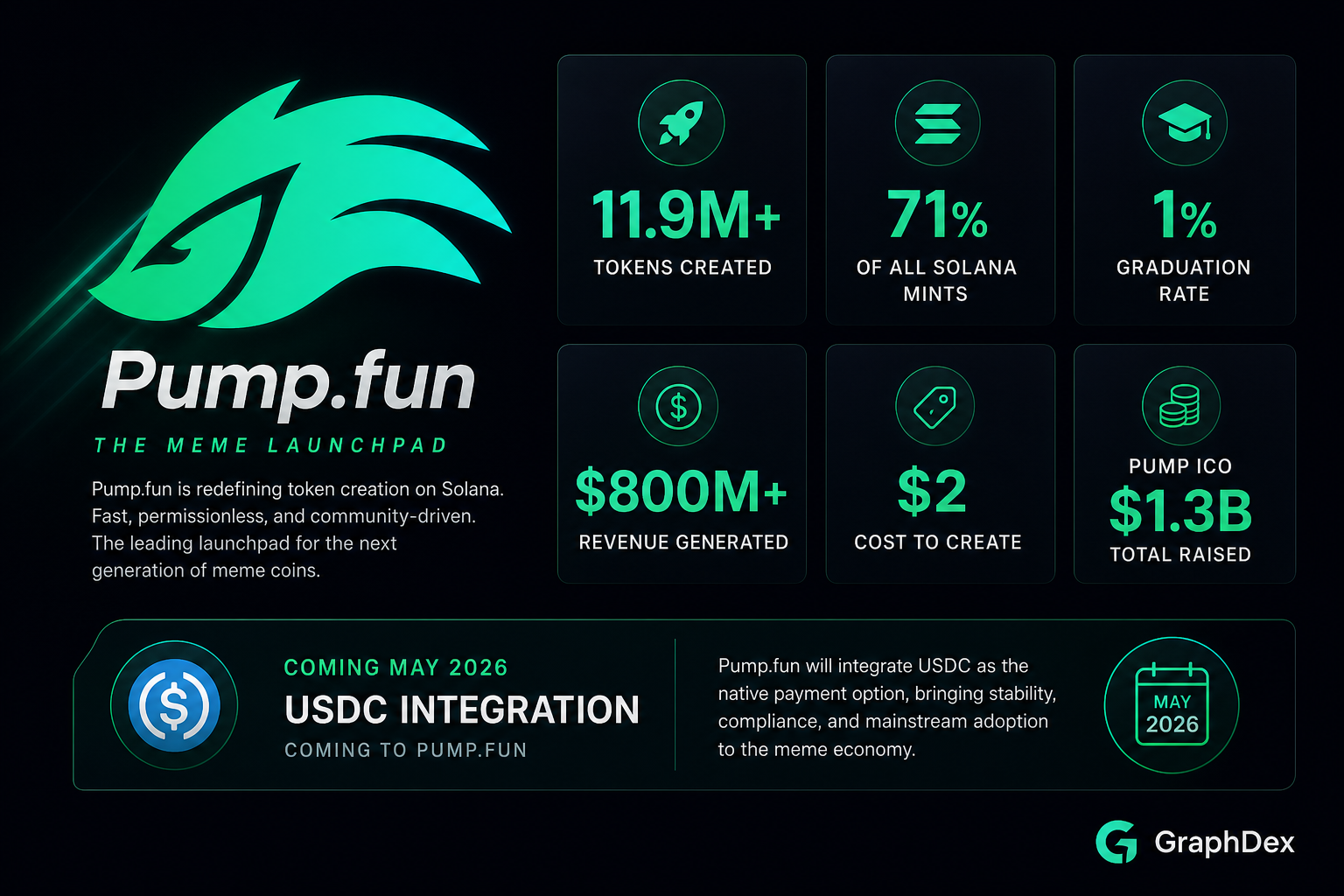
Volume: Up to 67% of total Solana DEX transactions during peak Pump.fun activity periods.
Tokens launched: 11.9 million+ since January 2024.
Tokens graduated: Approximately 1% of launches.
Revenue: $800+ million in protocol revenue (creation fees + trading fees).
Token creation cost: ~$2 (creates accessibility but also enables spam).
Fees: 1% on bonding curve trades, 0.25% on PumpSwap.
PUMP token: Launched ICO July 2025, raised $1.3B. Peaked at $3.1B market cap, then declined to ~$1.2B by mid-2026.
These mechanics shape every successful Pump.fun trading strategy.
Strategy 1: The Sniping Strategy
The fastest, highest-risk approach — buy tokens immediately at launch.
How It Works
The premise: Get into tokens before significant price discovery. If you're among the first 10-50 buyers and the token succeeds, your entry could be 100×-1000× the eventual price.
The execution:
- Monitor Pump.fun new launches in real time (Pulse feed in GraphDex)
- Identify launches with potential signals (creator reputation, immediate buy interest, initial design)
- Execute buy within seconds to minutes of launch
- Use fast execution tools to compete with bots
- Position sized very small due to extreme failure rate
Position Sizing
Per snipe: 0.1-0.5% of capital maximum. You'll execute many snipes; most will fail completely.
Total snipe allocation: 1-3% of trading capital across all active snipes combined.
Mental framing: Treat each snipe as a 90%+ probability of total loss. The 1-2% that work must dramatically outperform to compensate.
What to Look For
Signals favoring sniping a launch:
- Creator with previous successful token launches
- Immediate buy interest from known wallets
- Clean initial holder distribution (no obvious bundled buys)
- Reasonable token name and design (not obvious low-effort spam)
- Active social presence (Telegram, Twitter)
Red flags that abort the snipe:
- Initial bundled buys from creator-connected wallets
- Suspicious contract characteristics
- Immediate large sell from creator wallet
- No social presence
Reality Check
Sniping is essentially venture capital math applied to milliseconds. The successful sniper hits 1-2 monsters per month while losing 80-90% of position size on most attempts. Without algorithmic tools, retail snipers compete against bots with millisecond advantages — making manual sniping increasingly difficult.
GraphDex's Pulse feed surfaces new launches in real time with on-chain context, making informed sniping decisions possible at speeds approaching algorithmic competition.
Strategy 2: The Bonding Curve Climber
Trading tokens as they climb the bonding curve, before graduation.
How It Works
The premise: Identify tokens with momentum that's likely to continue climbing the curve. Profit from the bonding curve price increase before graduation (or capture the graduation pump).
The execution:
- Filter Pump.fun tokens by current market cap range (often $5K-$50K)
- Look for tokens with consistent buying volume and growing holder counts
- Verify safety metrics (holder distribution, no obvious manipulation)
- Enter with defined targets (often: take profits at $30K, $50K mcap milestones)
- Exit at predetermined levels or before graduation
Position Sizing
Per trade: 0.5-1% of capital.
Hold duration: Hours to days typically.
Win rate: 30-50% with proper selection. Most tokens stall or reverse before reaching graduation.
What to Look For
Bullish signals for climber trades:
- Sustained buying volume over hours
- Growing unique holder count
- Holder distribution not concentrated in connected wallets
- Active community engagement
- Creator hasn't dumped (verify on-chain)
Bearish signals to avoid:
- Volume drying up after initial pump
- Holders declining (people exiting)
- Creator dumping
- Bundle of bundled buys early
- Wash trading patterns (volume without holder growth)
Reality Check
The vast majority of tokens stall before graduation. The bonding curve is essentially a filter — climbing it requires sustained organic demand most tokens lack. This strategy works for the patient and selective, not for those chasing every climbing token.
Strategy 3: The Graduation Play
Buy tokens approaching graduation, capturing the graduation pump and immediate post-graduation momentum.
How It Works
The premise: Tokens approaching graduation often pump on anticipation (traders FOMO in before the migration). Post-graduation, the new PumpSwap liquidity attracts additional buyers. Catching this transition can produce reliable 2-5× returns on successful executions.
The execution:
- Monitor tokens approaching graduation threshold (~$60-69K mcap)
- Verify safety metrics carefully (graduation doesn't filter rugs)
- Enter in the $50-65K mcap range
- Hold through graduation
- Take profits at predefined targets post-graduation (often $150-300K mcap)
Position Sizing
Per trade: 0.5-1% of capital.
Hold duration: Hours to a few days.
Win rate: 50-65% with proper selection.
What to Look For
Bullish graduation signals:
- Approaching $50-69K mcap with sustained volume
- Active community discussion
- Holder distribution remains healthy as price climbs
- No major selling from early holders
- Creator hasn't dumped
Failure modes to recognize:
- Bonding curve stalls just before graduation (low conviction)
- Sudden major sells before graduation completes
- Bundled buyers begin coordinated exit
- "Sell the news" reaction at graduation
Post-Graduation Strategy
After graduation, the token competes with all Solana tokens for attention. Important considerations:
The first 24 hours post-graduation are often volatile. Many tokens pump significantly in the first hours, then have major pullbacks as initial momentum traders exit.
Take profits aggressively early. Many "graduation plays" produce their entire profit in first 24-48 hours. Holding longer is high-risk.
Reset analysis post-graduation. Normal swing trading principles apply to surviving graduated tokens — support/resistance, structure, etc.
Strategy 4: The Confirmed Winner Catch
The lowest-risk Pump.fun strategy — buy tokens that have already proven legitimate.
How It Works
The premise: Most graduated tokens still fail. But those that hold above their graduation price for 24-72 hours have demonstrated sustained organic interest. Buying on the first major pullback after this confirmation has favorable risk-reward.
The execution:
- Filter recently graduated tokens (last 1-7 days)
- Identify those holding above graduation levels (post-grad 50%+ above $69K mcap reference)
- Wait for natural pullback (often 20-40% retrace from local highs)
- Verify continued community engagement, holder growth, organic volume
- Enter on pullback with clear stop loss below recent support
- Standard targets and management
Position Sizing
Per trade: 1-2% of capital. Lowest-risk memecoin strategy allows larger positions.
Hold duration: Days to weeks.
Win rate: 50-65% (best of all memecoin strategies).
What to Look For
Confirmed winner characteristics:
- Token has been graduated for 24+ hours
- Holding above immediate post-graduation lows
- Healthy holder count growth continues
- Community engagement remains active
- Recognizable narrative or theme driving sustained interest
Pullback entry criteria:
- 20-40% retrace from local highs (provides better entry)
- Volume declines during pullback (selling exhausting)
- Holder count holds or grows during pullback (no panic selling)
- Bullish reversal patterns at established support
Why This Strategy Works Best
This is essentially normal swing trading applied to a filtered token set. The filtering (graduation + sustained trading) eliminates most catastrophic failures. Standard TA principles work better on these tokens than on pre-graduation memecoins.
For Pump.fun traders building consistent returns, this strategy typically produces the best long-term results.
Strategy 5: The Narrative Wave
Trade multiple tokens within emerging memecoin narratives or themes.
How It Works
The premise: When narratives emerge (dog coins, frog coins, AI agents, political memes, celebrity tokens), multiple tokens form around the theme. Capital flows across the entire narrative, lifting most tokens within it. Spreading across multiple narrative tokens captures the wave.
The execution:
- Identify emerging narratives (Twitter trends, news cycles, cultural moments)
- Identify 3-7 tokens within the narrative
- Allocate small amounts to each (0.2-0.5% per token)
- Exit collectively as narrative peaks (volume declining, new entrants slowing)
Position Sizing
Per token: 0.2-0.5% of capital.
Total narrative allocation: 2-5% of capital across all narrative positions.
Hold duration: Days to a few weeks.
Win rate: Variable — depends on narrative strength and timing.
Recognizing Emerging Narratives
Early signals:
- Sudden cultural moment driving multiple token creations
- News event triggering related tokens (political events, celebrity moments)
- Existing narrative gaining renewed momentum
- Influencer or media attention to specific theme
Established narrative signals:
- Multiple tokens within theme pumping simultaneously
- Cross-token volume growth
- Mainstream attention to the narrative
- Late-cycle: peak attention, declining new entrants
Exit Discipline
Critical: Most narratives have defined arcs — peak attention, then decline. Exit before attention shifts to the next narrative.
Typical narrative lifecycle:
- Days 1-3: Initial emergence
- Days 4-7: Mainstream awareness
- Days 7-14: Peak attention and prices
- Days 14+: Attention shifts; prices decline
Time-based exits often work better than price-based for narrative trades.
Strategy 6: The Smart Money Mirror
Follow proven successful memecoin traders' entries through wallet tracking.
How It Works
The premise: Some wallets consistently identify winning memecoins early. Following their entries (with verification) provides edge over random selection.
The execution:
- Identify 5-10 verified successful memecoin wallets
- Set real-time alerts when these wallets enter new positions
- Quickly analyze the token they entered (Bubble Maps, basic safety)
- Enter similarly if analysis supports
- Exit with discipline (don't follow them out — exit on your own targets)
Position Sizing
Per trade: 0.5-1% of capital.
Win rate: 35-55% — better than random but not magical.
Identifying Smart Money
Characteristics of profitable memecoin wallets:
- Track record across many trades (not just 1-2 lucky picks)
- Entries timed near token bottoms or early growth phases
- Exits timed near local tops (not riding tokens to zero)
- Diverse selection across narratives and timeframes
- No obvious self-promotion or pump signals
Tools for tracking: GraphDex's wallet tracking integrated with execution; Solscan for manual analysis; specialized memecoin tracking platforms.
Critical Caveats
Not all wallets you can see are smart money. Some are influencers' wallets where the influencer pumps their bags. Verify with multiple trades over time.
Don't blindly copy. Use smart money signals as one input, not as automatic buy signals. Verify the token meets your safety criteria.
Exit independently. Smart money may have different exit strategies than you. Use your own targets.
Mind delays. By the time you see their trade, they may have entered hours ago. The edge diminishes with time.
Comparing the Strategies
A practical comparison:
| Strategy | Risk Level | Position Size | Hold Period | Win Rate |
|---|---|---|---|---|
| Sniping | Extreme | 0.1-0.5% | Minutes-hours | 5-15% (but huge winners) |
| Bonding Curve | High | 0.5-1% | Hours-days | 30-50% |
| Graduation Play | High-Medium | 0.5-1% | Hours-days | 50-65% |
| Confirmed Winner | Medium | 1-2% | Days-weeks | 50-65% |
| Narrative Wave | Medium-High | 0.2-0.5% each | Days-weeks | Variable |
| Smart Money Mirror | Medium | 0.5-1% | Variable | 35-55% |
For most retail traders: Confirmed Winner Catch + Smart Money Mirror combination provides best risk-adjusted approach. Skip sniping unless you have specialized tools and accept the high failure rate.
Building a Pump.fun Trading System
Putting it together — your personal Pump.fun trading system:
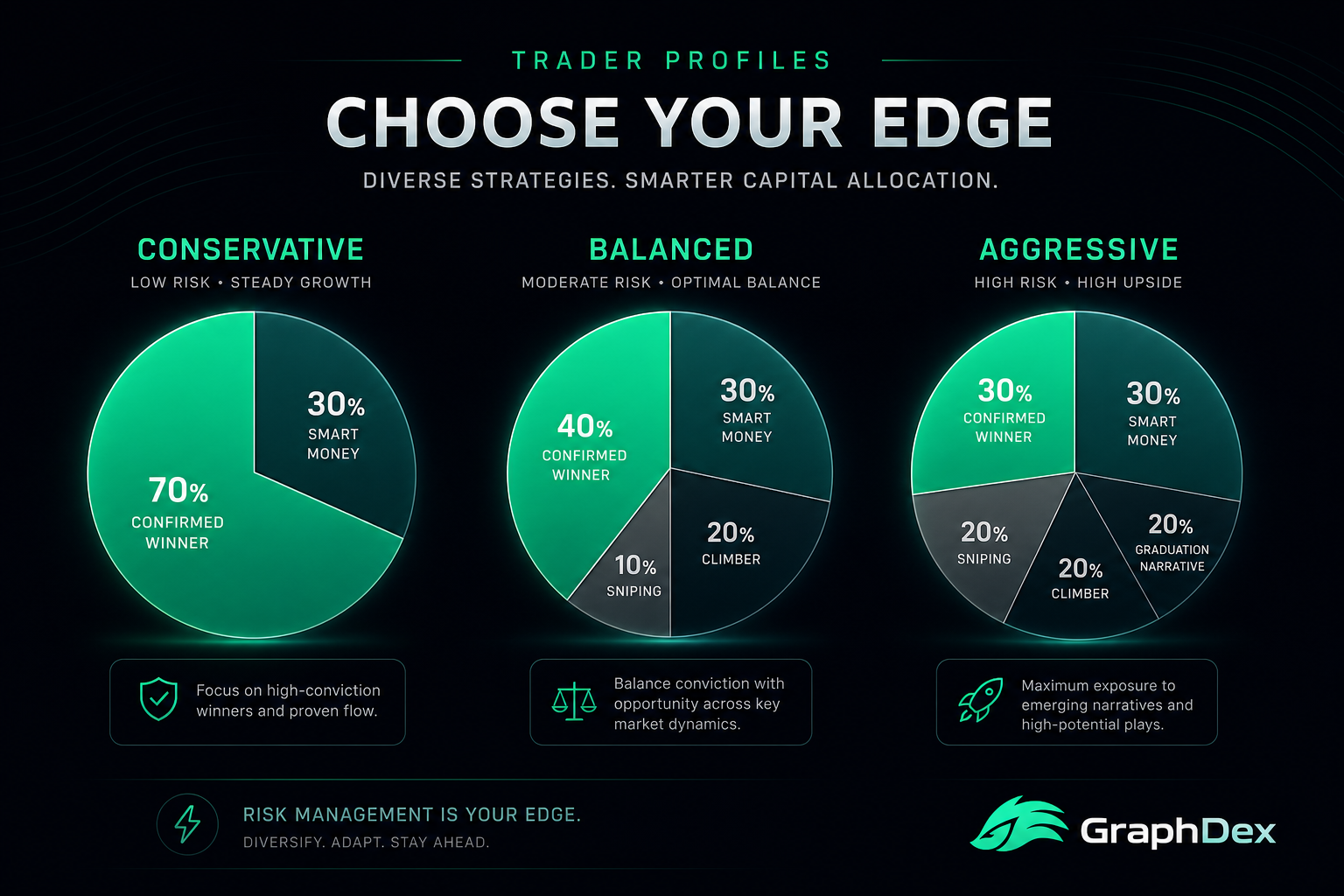
Step 1: Define Your Strategy Mix
Most traders benefit from 2-3 strategies rather than focusing on just one. Common mixes:
Conservative: 70% Confirmed Winner + 30% Smart Money Mirror
Balanced: 40% Confirmed Winner + 30% Graduation Play + 20% Smart Money + 10% Narrative
Aggressive: 30% Sniping + 30% Bonding Curve + 20% Graduation + 20% Narrative
Step 2: Set Aggregate Risk Limits
Total memecoin allocation: Maximum 10-15% of total trading capital across all Pump.fun positions combined.
Maximum simultaneous positions: 15-25 active positions.
Maximum positions in single narrative: 3-5.
Step 3: Define Entry and Exit Rules
For each strategy, define mechanical rules:
Entry triggers: What specifically must happen before you enter?
Position size: Exact percentage of capital per strategy.
Stop loss: Defined invalidation point for each trade type.
Profit targets: Predefined levels for partial and full exits.
Step 4: Use Proper Tools
The tools that make systematic Pump.fun trading possible:
- Pulse feed (GraphDex): Real-time new launches and trending tokens
- Bubble Maps: Holder concentration analysis before every entry
- Wallet tracking: Smart money monitoring
- AI signals: High-conviction setup identification
- MEV protection: Preventing sandwich attacks on illiquid trades
- Multi-DEX routing: Best execution across Pump.fun, PumpSwap, Raydium
- Sub-cent fees: Keep small position sizes economical
Step 5: Journal Religiously
Track every trade: entry, exit, reasoning, outcome, lessons. Patterns emerge over time showing which strategies work for you and which don't.
Build your Pump.fun trading system on GraphDex
How GraphDex Powers Pump.fun Trading
For active Pump.fun traders, GraphDex consolidates the essential tools:
- Pulse feed — real-time monitoring of all Pump.fun launches with on-chain context
- Bubble Maps — visual holder concentration analysis before every entry
- AI signals — high-conviction setup identification across Pump.fun
- Wallet/social tracking — smart money monitoring with alerts
- MEV protection — prevents sandwich attacks (critical for low-liquidity Pump.fun trades)
- Sub-cent fees — keeps small position sizes economical
- Multi-DEX routing — best execution across Pump.fun → PumpSwap → Raydium → Meteora
- Contract safety analysis — flags dangerous tokens automatically
- Non-custodial Privy — sign in with Twitter, email, or Telegram; no seed phrase
- Fee-based 17% APY staking — earn on idle SOL/USDC between Pump.fun trades
The integrated approach is particularly valuable for Pump.fun trading where speed and safety matter equally. Switching between five tools costs time and creates errors that pump.fun traders can't afford.
Trade Pump.fun with full integrated stack on GraphDex
Common Pump.fun Trading Mistakes
For balance, the patterns that destroy Pump.fun traders:
1. Treating it like stock trading. Pump.fun mechanics differ fundamentally. Standard approaches fail.
2. Position sizes too large. Treating Pump.fun trades like major crypto. One rug wipes out months.
3. FOMO into late-stage pumps. Buying tokens already 10× from launch when most of the move is done.
4. Ignoring on-chain analysis. Trading on price action alone. Bubble Maps reveal what charts can't.
5. Diamond-handing every position. Most Pump.fun tokens go to zero. Take profits.
6. Following influencer calls blindly. Many promotions are pump-and-dump schemes.
7. No exit strategy. Buying for "moon" without targets. Hold through inevitable reversals.
8. Trading every launch. Selectivity wins. Many small bets on quality > scattered bets on everything.
9. Ignoring MEV. Trading without MEV protection costs 5-20% per trade on illiquid Pump.fun tokens.
10. Adding to losers. "Averaging down" into rugs. Compounds losses.
11. No journal. Cannot improve without measurement.
12. Emotional state trading. Pump.fun volatility maximizes emotion. Mechanical systems essential.
Realistic Expectations for Pump.fun Trading
For honesty about outcomes:
Year 1: 80-95% lose money. Treat as tuition for understanding mechanics.
Year 2: Possible breakeven for the disciplined. Many quit.
Year 3+: Consistent profitability possible for the dedicated subset. Returns of 100-500% annually achievable but with extreme variance.
The 5-15% who succeed long-term share traits:
- Treat it as portfolio strategy, not individual token bets
- Use systematic rules across multiple strategies
- Rigorous on-chain analysis before every entry
- Disciplined exits at predefined targets
- Accept that 80%+ of trades will fail
- Recognize 1-2 moonshots per portfolio carry results
What doesn't work:
- Influencer-following without verification
- Single-strategy concentration
- High position sizes
- Hold-forever mentality
- Skipping safety analysis
Frequently Asked Questions
Can you make money trading Pump.fun tokens? Yes, but it's harder than people assume. 80-95% of retail Pump.fun traders lose money. The successful 5-15% use systematic approaches across multiple strategies, rigorous on-chain analysis, strict position sizing (0.5-1% per trade), and disciplined exits. Returns of 100-500% annually possible but with extreme variance and many losing periods.
What's the safest strategy for Pump.fun trading? "Confirmed Winner Catch" — buying recently graduated tokens (24-72 hours post-graduation) on their first major pullback. This filters out the ~99% that fail before graduation and the immediate post-graduation volatility. Combined with proper position sizing (1-2% max) and Bubble Maps holder analysis, it's the most accessible Pump.fun strategy for retail traders.
Should I snipe Pump.fun launches? Only with proper tools and acceptance of extreme failure rates. Sniping has the highest reward potential (occasional 100×-1000× returns) but the lowest win rate (5-15% wins). Without algorithmic tools, retail snipers compete against bots with millisecond advantages. Position sizing must be tiny (0.1-0.5% per snipe) due to high failure rate.
How do I find good Pump.fun tokens before they pump? Multiple approaches: (1) Pulse feed surfacing new launches with on-chain context; (2) Following smart money wallets entering early; (3) Identifying emerging narratives across multiple tokens; (4) Filtering for healthy holder distribution and active community engagement. No method is foolproof — most tokens still fail.
What is Pump.fun graduation? When a Pump.fun token reaches approximately $69,000 in market cap (in SOL terms), it "graduates" from the bonding curve to PumpSwap (Pump.fun's automatic DEX). At graduation: automatic liquidity pool created, standard DEX trading begins, token becomes accessible to non-Pump.fun traders. Only ~1% of Pump.fun launches graduate — graduation alone is a meaningful filter.
How much should I risk per Pump.fun trade? Maximum 0.5-1% of capital per trade for most strategies; 1-2% only for "confirmed winner" post-graduation trades. Total Pump.fun exposure: 10-15% of total trading capital across all positions. Mental framing: assume 100% loss possible on every trade. This sizing limits worst-case scenarios while allowing meaningful upside on winners.
Will Pump.fun continue to dominate Solana? Hard to predict but likely. Pump.fun has accounted for 71%+ of Solana token mints and up to 67% of total Solana DEX transactions. The PUMP token's ICO raised $1.3B in July 2025, suggesting continued institutional interest. The USDC pairing addition in May 2026 expanded utility. Competition exists (LetsBONK, others) but Pump.fun's network effects remain dominant in 2026.
About This Guide
This guide is published by the GraphDex Research team — analysts and traders building the infrastructure for digital asset trading on Solana. Our content is based on direct trading experience, on-chain data analysis of Pump.fun activity, and observation of successful trading practices in 2026.
Sources & data: Pump.fun statistics and market data reflect publicly available information as of 2026. Memecoin trading on Pump.fun carries extreme risk including total loss of capital — losses of 95%+ of trading positions are common. This guide is educational and not financial advice.
GraphDex is the infrastructure for digital asset trading — trade, predict, and earn in one place. Learn more at graphdex.io.
Last reviewed: May 2026 · GraphDex Research
The infrastructure for digital asset trading. Trade, predict, stake, repeat. graphdex.io