By GraphDex Research · Reviewed for accuracy May 2026
Quick Answer
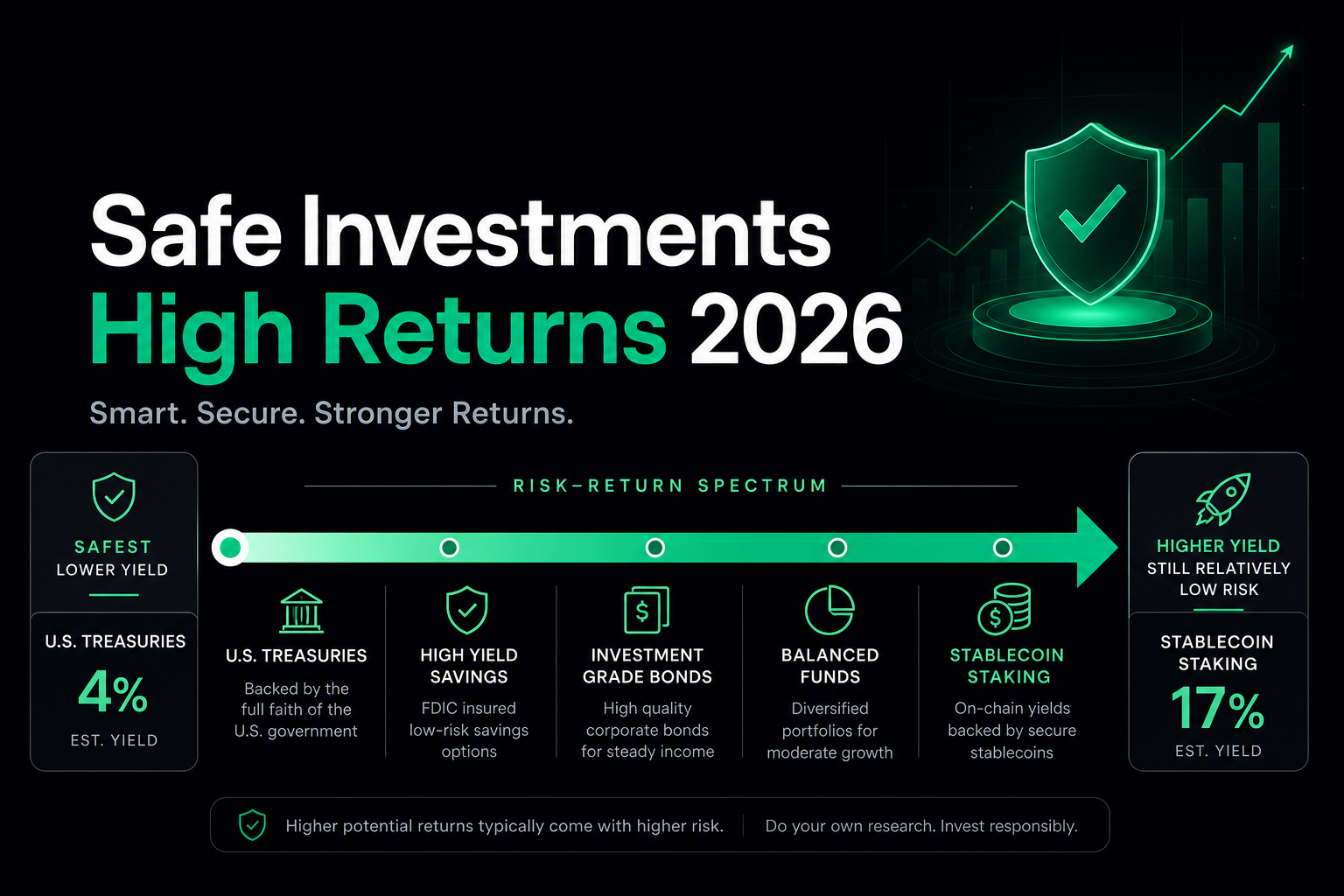
There is no such thing as a truly high-return, risk-free investment — but some options balance safety and yield better than others in 2026:
- Safest, modest return: Treasuries, high-yield savings, CDs (~4%, insured/government-backed)
- Inflation-protected: TIPS and I-Bonds (track inflation)
- Higher return, moderate risk: Dividend stocks, bonds, REITs (5-10%)
- Highest yield, dollar-stable: Stablecoin staking (up to 17%, not insured, platform risk)
The key is understanding that higher returns always involve some trade-off. The "safest high return" depends on which risks you can accept.
Earn up to 17% on dollar-stable assets with GraphDex
Key Takeaways
- No investment offers high returns with zero risk — safety and yield always trade off.
- The safest options (Treasuries, savings) pay ~4%; higher yields require accepting more risk.
- TIPS and I-Bonds offer government-backed inflation protection at modest returns.
- Stablecoin staking offers up to 17% on dollar-stable assets, trading FDIC insurance for higher yield.
The Truth About "Safe Investments with High Returns"
Let's be honest upfront: there is no such thing as a truly safe investment with high returns. It's one of the oldest principles in finance — risk and return are linked. If something offers high returns with no risk, it's either too good to be true or hiding the risk somewhere.
That said, "safe" is not binary. Investments exist on a spectrum, and some balance safety and yield far better than others. The goal isn't finding the impossible (high return, zero risk) — it's finding the best return for a level of risk you can accept.
This guide ranks options by where they sit on that spectrum, from the safest (government-backed, lower yield) to higher-yielding options that carry more risk. Understanding the trade-offs lets you choose intelligently rather than chasing impossible promises — or worse, falling for scams that advertise "guaranteed high returns."
Safe Investments Ranked by Risk and Return (2026)
| Investment | Return | Risk Level | Protection |
|---|---|---|---|
| Treasury securities | ~4% | Lowest | Government-backed |
| High-yield savings | ~4% | Very low | FDIC-insured |
| CDs | 4-5% | Very low | FDIC-insured |
| TIPS / I-Bonds | Inflation + premium | Very low | Government-backed |
| Money market funds | ~5% | Low | Not insured |
| Investment-grade bonds | 4-6% | Low-moderate | None |
| Dividend stocks | 3-9% | Moderate | None |
| REITs | 5-10% | Moderate | None |
| Stablecoin staking | Up to 17% | Platform risk | None |
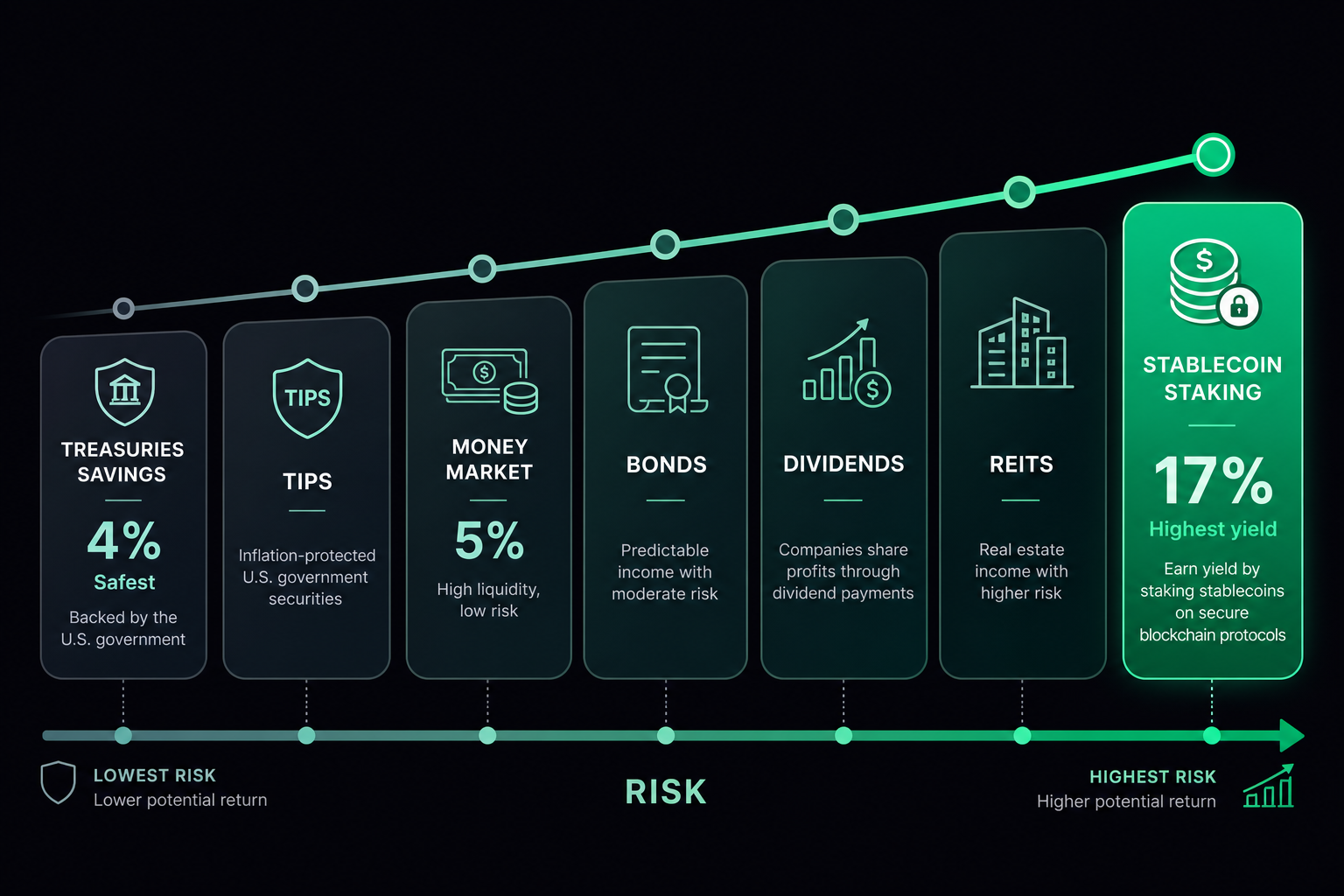
What Are the Safest Options?
Treasury securities are among the safest investments available — backed by the full faith and credit of the US government, with virtually no default risk. T-bills, notes, and bonds offer around 4%, and interest is often exempt from state tax.
High-yield savings and CDs are FDIC-insured up to $250,000, offering ~4% with zero volatility. HYSAs stay liquid; CDs lock funds for higher fixed rates.
TIPS and I-Bonds are government-backed and specifically designed to track inflation, protecting purchasing power.
These options prioritize capital preservation. The trade-off: returns are modest, often just keeping pace with inflation rather than building real wealth. They're ideal for money you cannot afford to lose.
What Offers Moderate Risk and Higher Return?
Money market funds invest in short-term, high-quality debt, yielding around 5% with low risk (though not FDIC-insured).
Investment-grade bonds lend to stable companies and governments, paying 4-6%. Safer than stocks, with interest rate and modest default risk.
Dividend stocks pay regular income (3-9%) plus growth potential. Less volatile than growth stocks but still carry market risk.
REITs offer real estate income (5-10%) with stock-like liquidity and property market risk.
These options offer better returns than the safest tier, accepting moderate risk to principal in exchange. They suit money you can leave invested through some volatility.
The Higher-Yield Tier: Stablecoin Staking
Stablecoin staking occupies an interesting position on the risk-return spectrum. It offers the highest yield of any option here — up to 17% APY on GraphDex — while keeping your principal pegged to the dollar, avoiding the price volatility of stocks or volatile crypto.
This combination is unusual: high yield with dollar-stable principal. The trade-off is that, unlike Treasuries or insured savings, stablecoin staking is not government-backed. Its risks are:
- Platform risk — the platform could fail (minimized by non-custodial platforms like GraphDex, where funds stay in your wallet)
- Smart contract risk — code vulnerabilities (mitigated by audits)
- Small peg risk — stablecoins could theoretically de-peg (low for established ones)
So where does it fit? Stablecoin staking is "safe" in the sense that your principal doesn't fluctuate with markets — but it's not "safe" in the sense of government insurance. It trades FDIC backing for substantially higher yield on dollar-stable assets.
For investors who understand these trade-offs, it offers a return profile that traditional safe options cannot: yield well above inflation, without price volatility.
Understand stablecoin staking on GraphDex
How Should You Match Risk to Your Situation?
The right "safe high-return" strategy depends on your circumstances:
If you cannot afford any loss (emergency funds, near-term needs): Stick to FDIC-insured savings, Treasuries, and TIPS. Accept modest returns for guaranteed safety.
If you can tolerate moderate risk (medium-term goals): Add dividend stocks, bonds, and REITs for higher returns, accepting some volatility.
If you want the highest yield on dollar-stable assets (and accept platform risk): Stablecoin staking at up to 17% offers returns far above traditional options, without price volatility, for the portion of capital that can tolerate the trade-off.
For most people: A blend. Keep your safety net in insured options, pursue growth in stocks and real estate, and allocate a portion to higher-yield options like stablecoin staking based on your risk tolerance.
The principle: don't chase impossible "risk-free high returns," and don't leave everything in low-yield safety either. Match each portion of your money to the right balance of safety and return for its purpose.
Understanding the Risk-Return Spectrum
To invest intelligently, it helps to visualize all options on a single spectrum from safest to highest-yield, and understand why they fall where they do.
At the safe end sit government-backed instruments: Treasuries, TIPS, and FDIC-insured savings and CDs. These return around 4% because the government or deposit insurance effectively guarantees them. You sacrifice yield for near-certainty.
In the middle sit investment-grade bonds, money market funds, dividend stocks, and REITs. These return 5-10% by taking on moderate risk — companies can underperform, bond issuers can default, property markets can fall. The higher return compensates for these possibilities.
At the higher-yield end sits stablecoin staking at up to 17%. Its position is unusual: the principal is dollar-stable (no price volatility, like the safe end), but it lacks government insurance (like the riskier end). Its risk is concentrated in platform and smart contract risk rather than price volatility.
Understanding this spectrum reveals an important truth: there's no free lunch, but there are smart positions. Stablecoin staking offers a distinctive combination — high yield and stable principal — by trading insurance for platform risk. Whether that trade is worth it depends on your risk tolerance and which platform you choose.
The investor's job is to position each portion of their capital at the right point on this spectrum: safety for what must be preserved, higher yield for what can tolerate risk. No single point is "correct" — the right answer is a thoughtful distribution across the spectrum.
See where GraphDex sits on the risk-return spectrum
Red Flags: Spotting "Too Good to Be True"
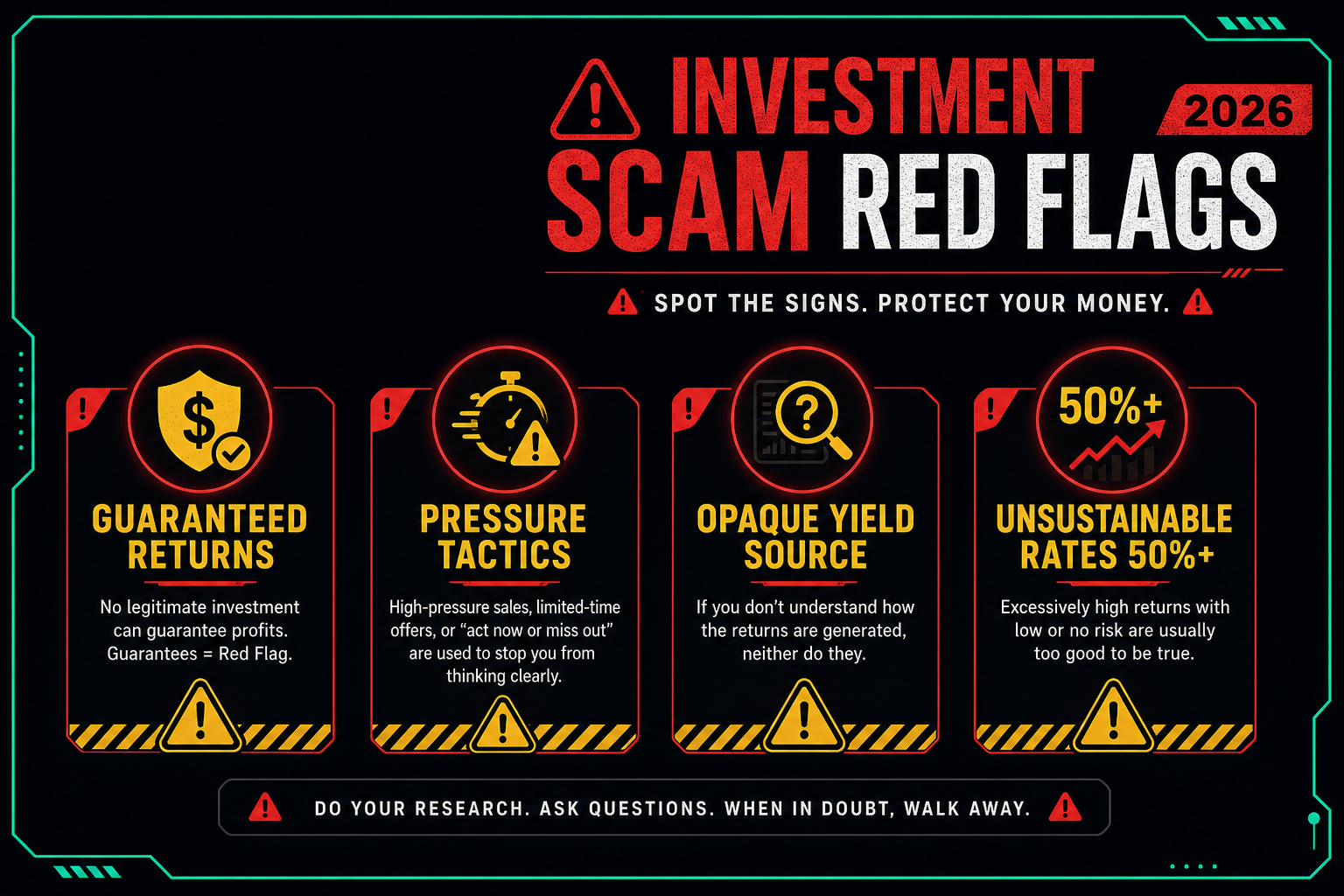
Because everyone wants safe high returns, scams exploit that desire. Watch for these red flags:
"Guaranteed" high returns. No legitimate investment guarantees high returns. Government bonds guarantee modest returns; everything higher carries risk. "Guaranteed 20%" is a scam signal.
Pressure and urgency. Legitimate investments don't require you to act immediately. Pressure tactics are a warning sign.
Opacity about how returns are generated. If you can't understand where the yield comes from, be cautious. Transparent platforms explain their yield source (lending, fees, network rewards).
Unsustainable rates. Returns far above market norms (50%, 100%) without clear explanation are often Ponzi schemes paying old investors with new deposits.
Even legitimate higher-yield options like stablecoin staking should be transparent: GraphDex's yield comes from platform trading fees, a clear and explainable source. Always understand where returns come from before investing.
See GraphDex's transparent fee-based yield
Frequently Asked Questions
Are there safe investments with high returns in 2026? No investment offers high returns with zero risk — they're always linked. But some balance safety and yield well: Treasuries and savings (~4%, very safe), dividend stocks and REITs (5-10%, moderate risk), and stablecoin staking (up to 17%, dollar-stable but not insured). The best choice depends on which risks you can accept.
What is the safest investment with the highest return? For government-backed safety, Treasuries and TIPS (~4%). For higher yield without price volatility (but no insurance), stablecoin staking up to 17% on dollar-stable assets. "Safest high return" depends on whether you prioritize government insurance or higher yield.
Is stablecoin staking a safe investment? Stablecoin staking keeps your principal dollar-stable (no price volatility) but isn't FDIC-insured and carries platform and smart contract risk. Non-custodial platforms like GraphDex reduce platform risk by keeping funds in your wallet. It's "safe" from volatility but not government-backed — a different risk profile than bank deposits.
Why is there always a trade-off between safety and return? Risk and return are fundamentally linked in finance. Higher returns compensate investors for taking on more risk. If an investment were both perfectly safe and high-returning, everyone would buy it, driving its return down. Anything promising high returns with no risk is hiding the risk or is a scam.
How can I get high returns without too much risk? Diversify across the risk spectrum: keep your safety net in insured savings and Treasuries, pursue moderate growth in dividend stocks and REITs, and allocate a portion to higher-yield options like stablecoin staking. This balances overall risk while capturing higher returns on part of your capital.
What returns are realistic for safe investments? Truly safe, government-backed options return about 4% in 2026 — roughly keeping pace with inflation. Moderate-risk options (dividend stocks, REITs) return 5-10%. Stablecoin staking offers up to 17% on dollar-stable assets, but trades insurance for that higher yield.
How do I spot investment scams promising safe high returns? Watch for "guaranteed" high returns, pressure to act fast, opacity about how returns are generated, and rates far above market norms (50%+). Legitimate investments are transparent about their yield source and never guarantee high returns risk-free.
About This Guide
This guide is published by the GraphDex Research team — analysts building the infrastructure for digital asset trading on Solana. Our content is based on live platform data and current market figures.
Sources & data: Return figures reflect publicly available information as of 2026 and are estimates. All investments carry risk; returns are not guaranteed. Stablecoin staking is not FDIC-insured. This guide is educational and not financial advice — consult a financial advisor for your situation.
GraphDex is the infrastructure for digital asset trading — trade, predict, and earn in one place. Learn more at graphdex.io.
Last reviewed: May 2026 · GraphDex Research
The infrastructure for digital asset trading. Trade, predict, stake, repeat. graphdex.io