By GraphDex Research · Reviewed for accuracy May 2026
Quick Answer
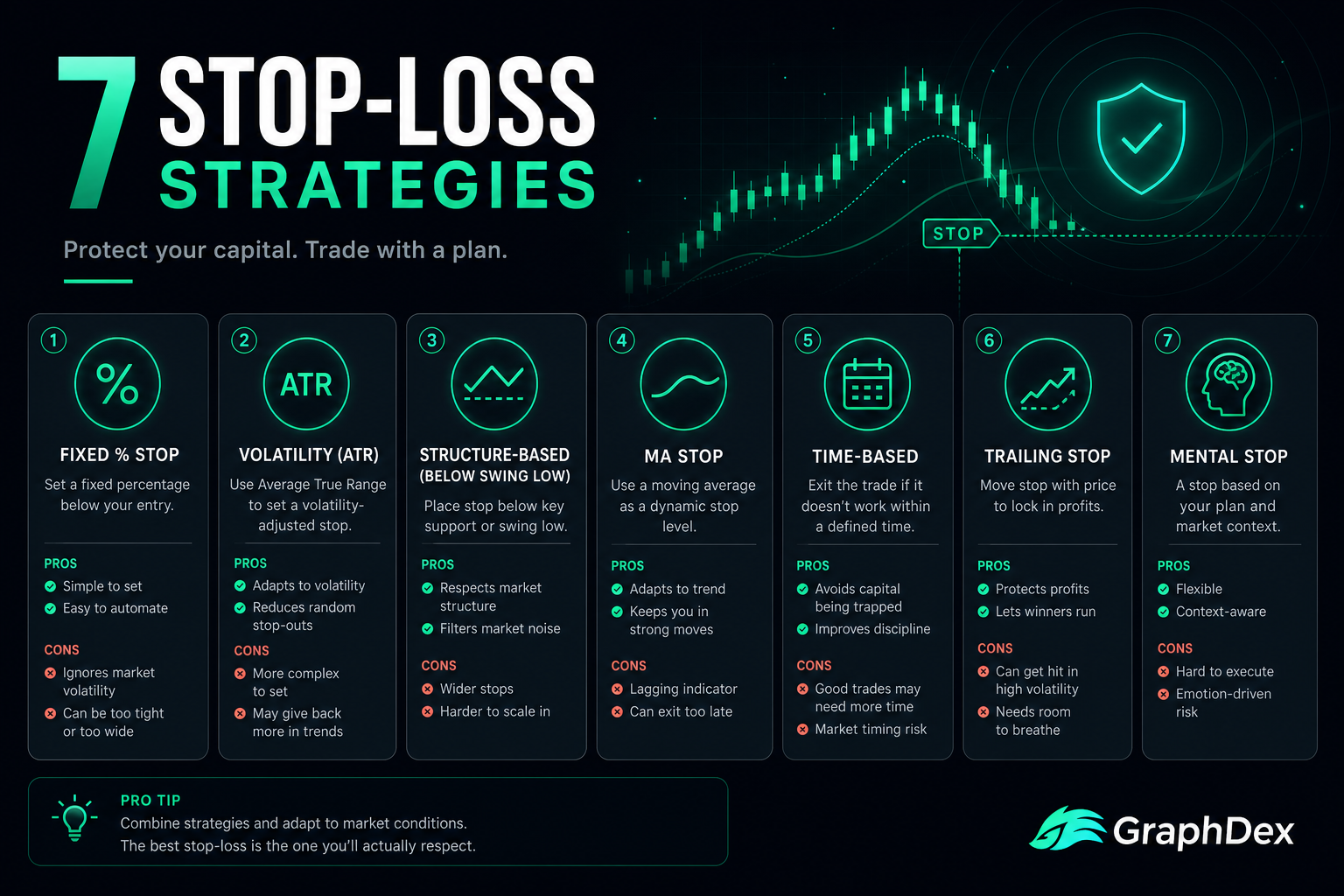
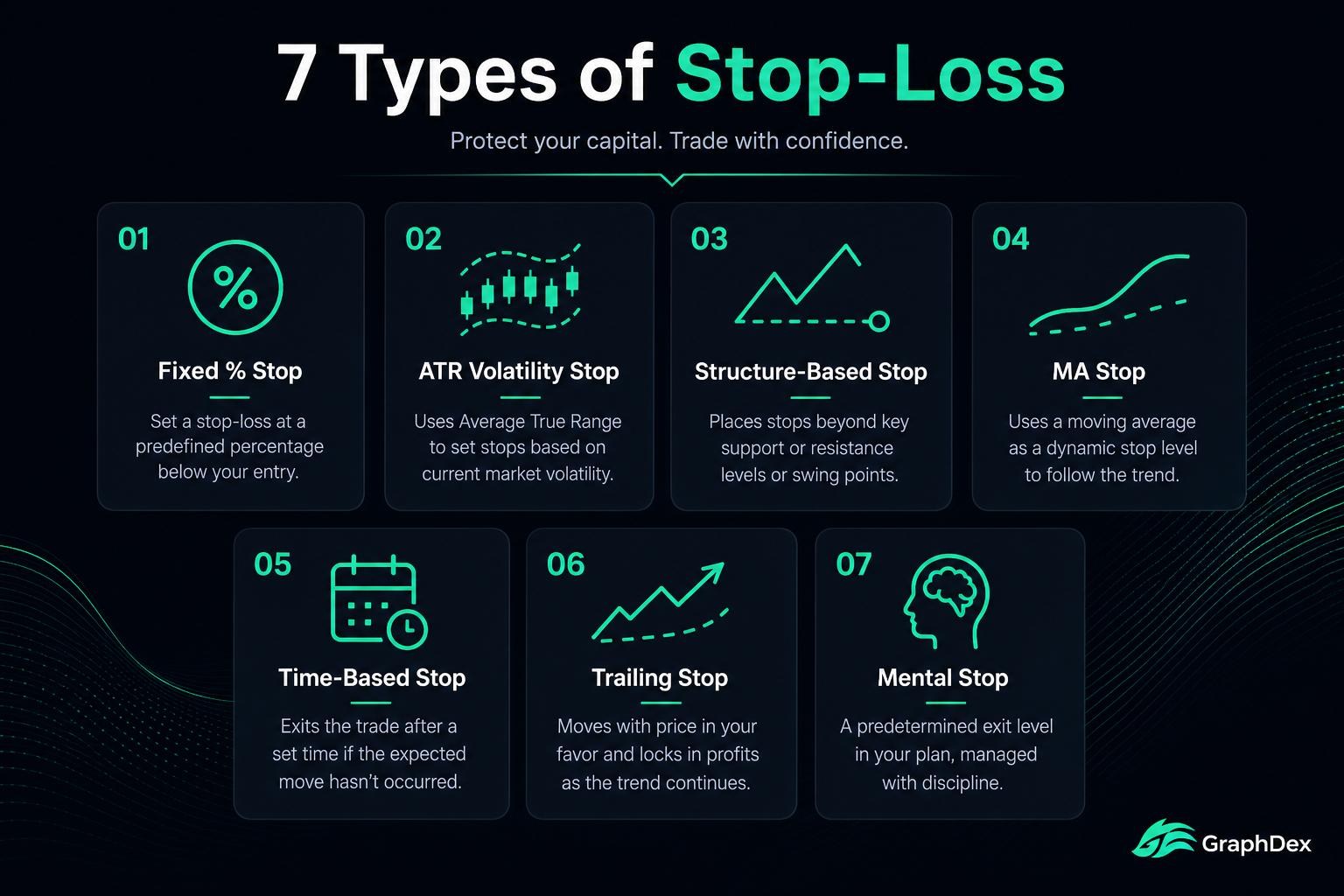
A stop loss is a pre-defined exit point that automatically closes your position if price moves against you by a specified amount. The seven main stop-loss strategies:
- Fixed percentage stop: Simple % distance from entry (e.g., 5% below)
- Volatility-based stop (ATR): Based on asset's typical movement range
- Structure-based stop: Below key support, swing low, or pattern invalidation
- Moving average stop: Below key MA (20 EMA, 50 EMA, 200 EMA)
- Time-based stop: Exit if position hasn't moved in defined timeframe
- Trailing stop: Stop that moves up as price moves favorably
- Mental stop: No order placed — discretionary exit (high discipline required)
The honest truth: The "best" stop strategy is the one you'll actually execute without moving it. Mechanical stops beat mental stops for almost all retail traders.
Trade with proper stop-loss discipline on GraphDex
Key Takeaways
- Every trade needs a pre-defined stop loss BEFORE entry — non-negotiable.
- Stop loss size depends on trading style and asset volatility (tight for scalping, wide for swing trading).
- Moving stops AGAINST you is the most damaging habit in trading.
- The best stops respect market structure, not arbitrary distances from entry.
Why Stop Losses Are Non-Negotiable
A stop loss is the single most important risk management tool. Yet most beginners either don't use them, use them incorrectly, or move them against themselves when losing.
What Stop Losses Actually Do
Function 1: Cap maximum loss. Limits how much any single trade can hurt your account. Without stops, a single trade can wipe out months of profits.
Function 2: Force decision-making before entry. Setting a stop requires defining "where am I wrong about this trade?" That clarity improves trade quality.
Function 3: Remove emotion at exit. Predetermined exit point eliminates the emotional decision to "wait a little longer."
Function 4: Enable position sizing. The stop distance determines position size (per the formula: Position Size = Risk Amount ÷ Stop Distance).
What Happens Without Stops
The progression of a stopless trader's blow-up:
- Trade goes against them
- Decide to "wait for a bounce"
- Bounce doesn't come; loss grows
- "It can't keep going down, I'll add more"
- Position size grows while losing
- Account approaches catastrophic loss
- Eventually forced out at worst possible point
This pattern destroys more trading accounts than any other single behavior.
The Mental Trap
Many traders think: "If I just don't set a stop, I can't be stopped out by noise."
This logic ignores reality:
- You eventually exit anyway — usually at much worse prices
- Decision-making degrades as losses grow
- The "noise" stop-out is far less damaging than the eventual capitulation
Setting stops is hard. Following them is harder. But surviving requires both.
Strategy 1: Fixed Percentage Stops
The simplest approach — set stop at a fixed % distance from entry.
How It Works
Example: Buy SOL at $200, set stop at $190 (5% below).
If price hits $190, position closes automatically with 5% loss.
When To Use
Beginners: Easy to calculate and implement. No technical analysis required.
Strategy testing: Consistent stop distances allow clean backtesting.
Highly volatile assets: Provides clear ceiling on losses without overthinking placement.
Common Settings by Style
- Scalping: 0.5-1% stops
- Day trading: 1-3% stops
- Swing trading: 5-10% stops
- Position trading: 10-20% stops
Pros and Cons
Pros:
- Simple to calculate
- Consistent risk per trade
- Easy to systematize
- No emotion in placement
Cons:
- Doesn't respect market structure (might stop at arbitrary level)
- May get hit by normal noise
- May be too wide for some setups, too tight for others
Best For
Beginners learning to trade with stops, systematic strategies, and as default when no clear structural level exists.
Strategy 2: Volatility-Based Stops (ATR)
Adjusts stop distance based on the asset's typical movement range.
What Is ATR?
ATR (Average True Range) measures average daily price movement over a defined period (typically 14 days). It quantifies "normal" volatility.
For example:
- BTC ATR might be $1,500 (price moves $1,500 daily on average)
- A small-cap memecoin ATR might be $0.05 (with the token at $0.10, that's 50% daily movement)
How To Use ATR for Stops
Standard formulas:
- Tight stop: 1.5× ATR below entry
- Standard stop: 2× ATR below entry
- Wide stop: 3× ATR below entry
Example with BTC:
- Current ATR: $1,500
- Entry: $100,000
- 2× ATR stop: $97,000 (3% below)
Why ATR Works
Adapts to market conditions. During high volatility, stops widen automatically. During low volatility, stops tighten. This prevents being stopped out by normal noise.
Asset-specific. A 5% stop on BTC is appropriate; the same 5% on a memecoin would be far too tight.
Mathematical rigor. Stops based on actual market behavior, not arbitrary percentages.
Pros and Cons
Pros:
- Respects each asset's normal movement
- Adapts to changing volatility
- Mathematically defensible
- Reduces noise-based stop-outs
Cons:
- Requires ATR calculation/indicator
- Doesn't respect support/resistance specifically
- More complex than fixed percentages
- ATR can shift quickly during news events
Best For
Intermediate traders, multi-asset trading where assets have very different volatility profiles, and systematic strategies.
Strategy 3: Structure-Based Stops
The professional standard — stops placed below market structure invalidation points.
How It Works
Instead of arbitrary distance, place stop at:
- Just below recent swing low (for long positions)
- Just above recent swing high (for shorts)
- Just below key support level
- Just below pattern invalidation point (e.g., below neckline after head-and-shoulders)
Example: Long Trade
Entry: SOL at $200 (bullish setup at support) Recent swing low: $192 Place stop at $190 (5% below entry, just below structural support)
If price drops to $190, the bullish thesis (support holding) is invalidated. Exit is appropriate.
Why Structure Beats Percentages
Aligned with market behavior. Markets respect levels. Stops below those levels respect the same logic.
Logical exit. When structure breaks, your trade thesis is broken. Time to exit regardless of arbitrary percentage.
Better win rates. Stops at logical levels avoid being hit by normal noise that doesn't invalidate the trade.
Common Structural Stop Levels
Below swing lows — most basic structural stop
Below pattern necklines — head-and-shoulders, triangles, etc.
Below key moving averages — 50 EMA or 200 EMA on appropriate timeframe
Below Fibonacci levels — 61.8% retracement, golden ratio
Below historical support — major price levels from past
Below volume profile nodes — high-volume historical zones
Pros and Cons
Pros:
- Respects market structure
- Higher win rates
- Logically defensible
- Adapts to specific setup
Cons:
- Requires identifying structure correctly
- Stop distance varies per trade (position sizing must adjust)
- Subjective elements in level identification
Best For
Intermediate to advanced traders, pattern-based strategies, swing and position trading.
Strategy 4: Moving Average Stops
A subcategory of structural stops using key moving averages.
Common MA Stop Levels
- 20 EMA: Short-term trend stop (day trading)
- 50 EMA: Medium-term trend stop (swing trading)
- 200 EMA: Major trend stop (position trading)
Implementation
Static MA stop: Set stop just below the MA at trade entry. Exit if price closes below.
Dynamic MA stop: Update stop daily/weekly to current MA value (effectively a moving stop).
Example
Swing trade on ETH:
- Daily 50 EMA at $3,400
- Entry at $3,500 (pullback to 50 EMA holding)
- Stop at $3,350 (just below 50 EMA)
Pros and Cons
Pros:
- Adapts with trend
- Major MAs are widely-watched levels
- Self-fulfilling support due to many traders watching
- Naturally tightens as trend extends
Cons:
- Can be wide initially
- MA-based stops can move favorably (giving false confidence)
- Different MAs work for different conditions
Best For
Trend-following strategies, traders who want adaptive stops, swing and position traders.
Strategy 5: Time-Based Stops
Less common but sometimes useful: exit if trade hasn't moved within defined timeframe.
How It Works
If you enter a position expecting movement within 24 hours and price hasn't moved (favorably or unfavorably) within that window, exit anyway.
Why Time Stops Exist
Capital efficiency: Capital tied up in non-moving positions can't capture other opportunities.
Setup invalidation: Many setups expire if movement doesn't occur within expected window.
Drift prevention: Prevents positions from drifting into different timeframes than intended.
Example
Day trade entered at 10 AM expecting breakout move within 2 hours. At 12 PM, no breakout occurred. Exit at current price regardless of P&L. Look for better setups.
Pros and Cons
Pros:
- Frees up capital
- Discipline mechanism
- Prevents unintended position drift
Cons:
- May exit before move develops
- Subjective time window selection
- Doesn't directly relate to risk
Best For
Scalping (very short timeframes), event-based trading where moves should be immediate.
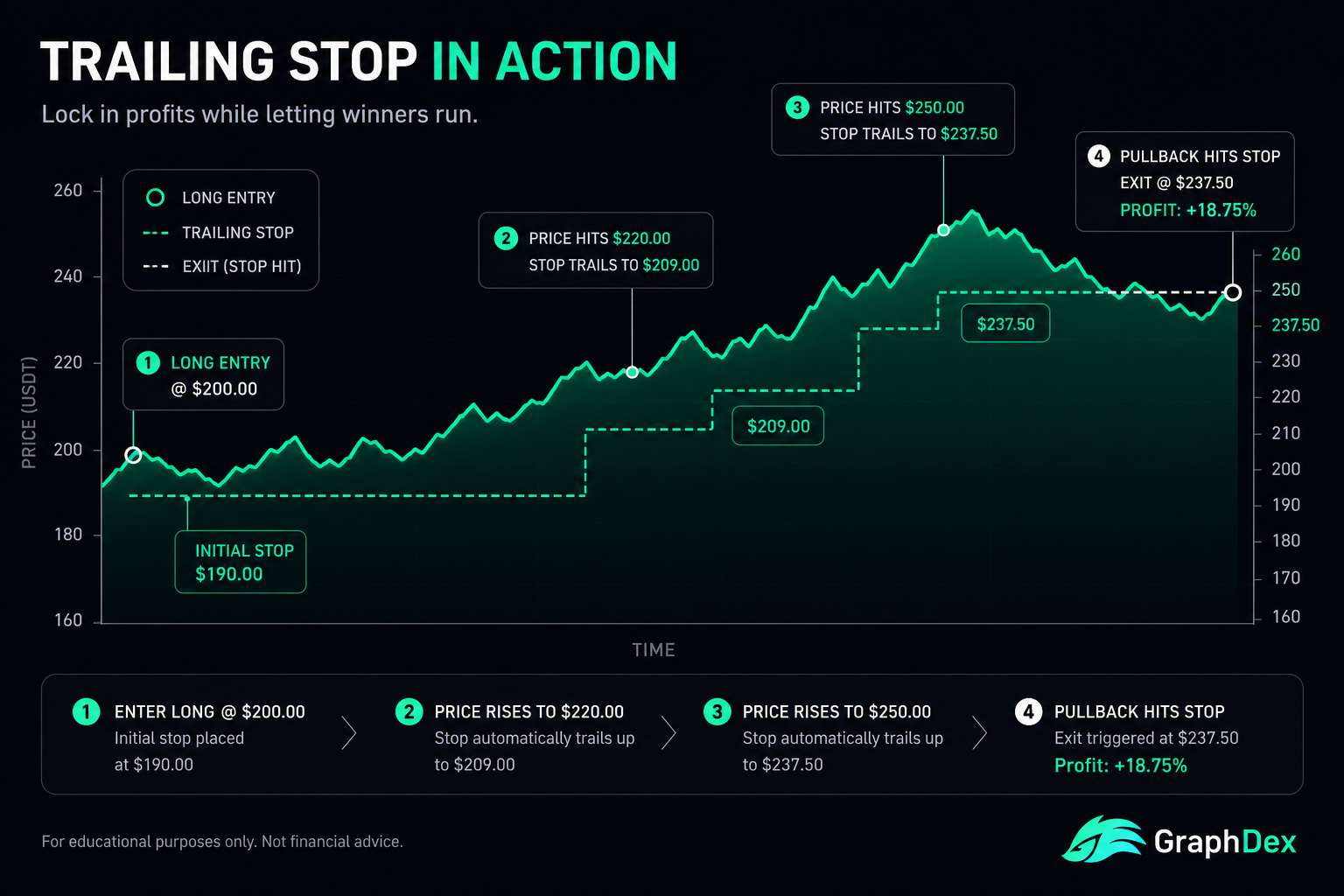
Strategy 6: Trailing Stops
A stop that moves up (for longs) as price moves favorably, locking in profits.
How It Works
Initial stop placed at entry. As price moves favorably, stop adjusts upward to maintain a defined distance.
Example:
- Entry: $200, initial stop: $190 (5% below)
- Price rises to $220 — stop trails to $209 (5% below current)
- Price rises to $250 — stop trails to $237.50
- Price drops to $237.50 — exit with substantial profit
Trailing Stop Types
Fixed percentage trail: Stop trails at X% below highest price reached.
ATR trail: Stop trails at 2× ATR below highest price.
Structure trail: Stop trails below most recent swing low as new swing lows form.
Why Trailing Stops Work
Capture trend extensions: Lets winners run beyond initial targets.
Lock in profits: Profits crystallize as trend continues.
Mathematical edge: Combined with high R/R, trailing stops can dramatically improve expected value.
Pros and Cons
Pros:
- Captures big moves
- Locks in profits progressively
- Removes "when to take profit" decision
- Higher expectancy in trending markets
Cons:
- Can stop out during normal volatility
- Doesn't work well in choppy markets
- May give back significant profits before triggering
Best For
Trend-following strategies, swing and position trading, traders who want to maximize big winners.
Strategy 7: Mental Stops
The riskiest approach: monitor positions manually rather than placing stop orders.
How Mental Stops Work
Decide stop level in advance, but don't place the order. Monitor price and manually exit if level is hit.
Why Anyone Uses Mental Stops
Avoid stop-hunting: Some claim placed stops get "hunted" by market makers and MEV bots.
Flexibility: Allows adjusting based on current market conditions.
Lower fees: No conditional order costs (minimal on Solana, more relevant on some platforms).
Why Mental Stops Usually Fail
Discipline required: Few retail traders can execute mental stops reliably under loss pressure.
Reaction time: Manual exit may be too slow during fast moves.
Emotional override: "Let me wait for a bounce" beats predefined plan when emotional.
Connectivity risk: Internet/platform issues can prevent manual exit during critical moments.
Sleep/distraction: Mental stops fail when you're not actively watching.
The Reality
Mental stops work for a small minority of professional traders with exceptional discipline. They fail for 99%+ of retail traders. Place orders.
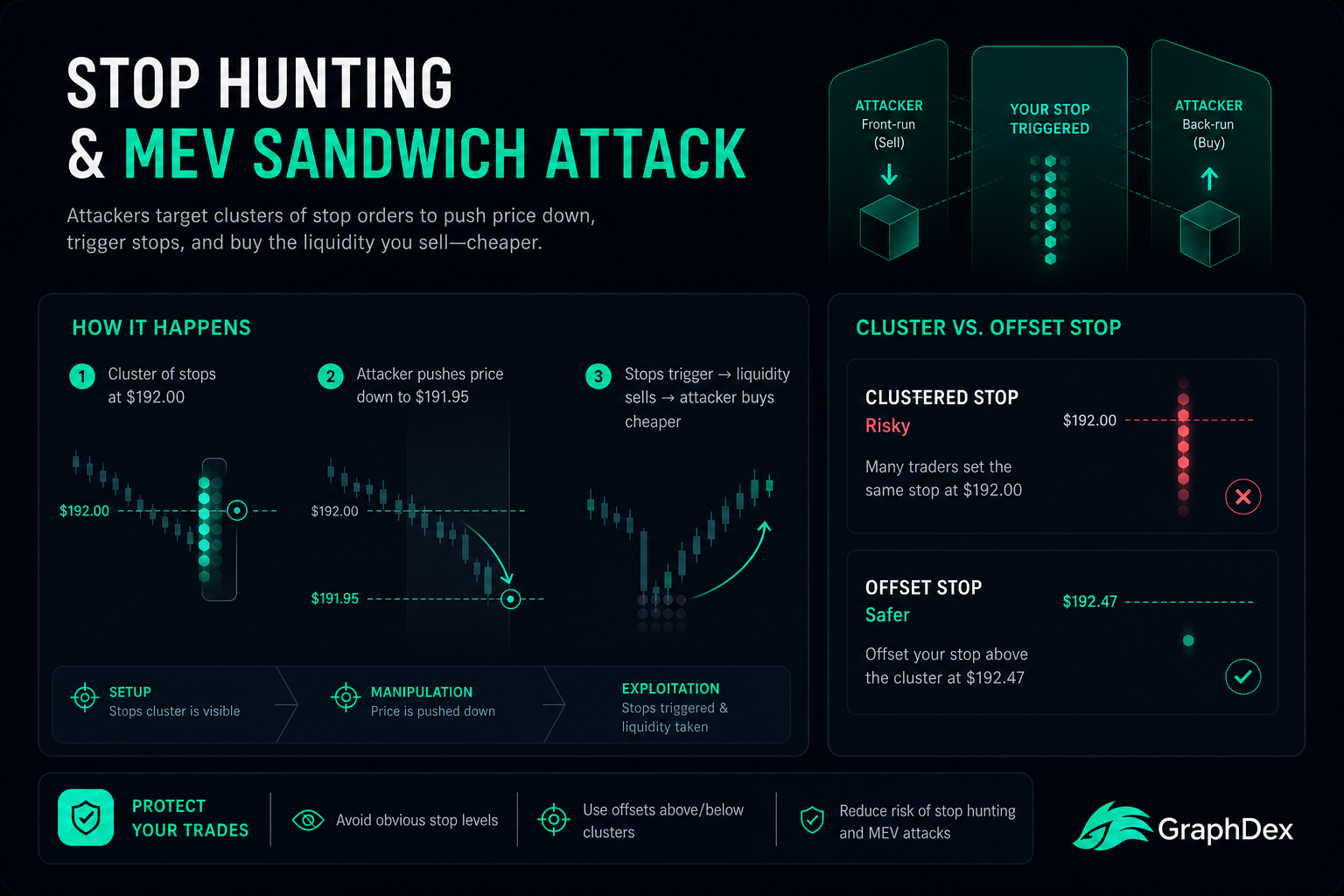
Avoiding Stop Hunts and MEV Sandwich Attacks
A critical consideration in 2026 crypto markets:
What Is Stop Hunting?
Coordinated selling (or buying) to push price through key stop-loss levels, triggering cascading exits, then reversing. Common at:
- Round numbers ($100, $1,000)
- Obvious technical levels
- Recent swing lows/highs
MEV Sandwich Attacks on Stops
On Ethereum and unprotected platforms, sandwich attacks can execute around large stop orders. The attacker:
- Sees pending stop-loss execution
- Front-runs by selling first (pushing price down)
- Stop-loss executes at worse price
- Attacker buys back at lower price
- Trader loses additional value to slippage
This cost Solana traders an estimated $370-500M over 16 months in 2024-2026.
How to Protect Against Both
1. Use MEV protection. Platforms like GraphDex include built-in MEV protection preventing sandwich attacks.
2. Don't place stops at obvious levels. Use $192.50 instead of $192.00. Use 4.7% instead of 5.0%. Random offsets help avoid clustered orders.
3. Use stop-limit orders where appropriate. These have a stop trigger and limit execution price, preventing excessive slippage.
4. Avoid placing stops just below visible swing lows. Many traders' stops cluster there. Move stop slightly lower if the wider distance still fits your risk profile.
5. Trade on high-liquidity pairs. Stop hunting and MEV are easier on illiquid tokens.
Common Stop-Loss Mistakes
For balance, the patterns that destroy stop discipline:
1. Moving stops against you. "Just a little more room." The death sentence of trading. Once you move a stop once, you'll do it again.
2. Stops too tight on volatile assets. Setting 1% stops on crypto where 5% intraday moves are normal. Guaranteed noise stop-outs.
3. Stops too wide on small-position trades. Risking 5% on a 50% stop = 2.5% account risk on one trade. Sizing fails.
4. No stop at all. "I'll watch carefully." Manual stops fail under pressure.
5. Stops at exact obvious levels. Round numbers and swing lows attract stop hunting.
6. Adjusting stops based on price movement, not structure. Stops should be based on invalidation, not current price.
7. Forgetting to set stops on automated systems. A bot without stops can blow up faster than human errors.
8. Stops in mental form only. Discipline rarely holds under loss pressure.
9. Single fixed stop strategy for all conditions. Trending markets and ranges require different stops.
10. Removing stops to "give the trade more room." This is the #1 way traders blow up.
Trade with built-in MEV protection and stops on GraphDex
Building Your Stop-Loss System
Putting it all together — your personal stop strategy should be:
Step 1: Identify trade type. Scalp, day trade, swing, or position trade? Each has different appropriate stop distances.
Step 2: Determine setup type. Trend-following, breakout, mean reversion? Each works best with different stop styles.
Step 3: Identify structural levels. Swing lows, support, MA levels, pattern invalidation.
Step 4: Apply ATR for volatility context. Ensure stop distance respects asset's typical movement.
Step 5: Combine into single stop. Often the best stop is "below key structure AND outside ATR noise zone."
Step 6: Place the order. Mental stops don't count.
Step 7: Don't move it. Unless moving it more favorably (trailing in profit direction), the stop stays.
Step 8: Document. Trade journal: entry, stop reasoning, what would invalidate trade.
This system feels rigid. That's the point — rigid systems don't bend under emotional pressure.
Set stops with MEV protection on GraphDex Solana terminal
How GraphDex Supports Stop-Loss Discipline
For Solana traders implementing proper stops:
- Built-in MEV protection preventing sandwich attacks on stop-loss executions (saves the $370-500M Solana traders lost to MEV)
- Sub-cent fees so stop-loss orders don't cost meaningfully to maintain
- Multi-timeframe charts for accurate structural stop placement
- Volume integration for stops aware of liquidity context
- Bubble Maps identifying tokens with manipulation risk requiring tighter risk control
- Pulse feed showing volatility context for new tokens
- AI signals confirming setups that justify stop discipline
- Non-custodial Privy wallet — your stops execute through your wallet, not a third party
- Fee-based 17% APY staking on cash reserves between trades
For risk-disciplined Solana traders, the integrated platform prevents the most common stop-loss failures — slippage from MEV, fee distortion, and manipulation on illiquid tokens.
Frequently Asked Questions
What is a stop loss in crypto trading? A stop loss is a pre-defined exit point that automatically closes your position if price moves against you by a specified amount. It caps the maximum loss on any single trade. Stop losses are essential risk management — surviving traders use them on every trade; blown-up traders don't.
How tight should my stop loss be? Depends on trading style and asset volatility. Scalping: 0.5-1% stops. Day trading: 1-3% stops. Swing trading: 5-10% stops. Position trading: 10-20% stops. Higher volatility assets need wider stops to avoid noise stop-outs. Best practice: combine percentage guidelines with structural placement (below swing lows, support, key MAs).
Should I use a stop loss or mental stop? Place actual stop orders for nearly all retail traders. Mental stops require exceptional discipline to execute properly under loss pressure — fewer than 1% of retail traders maintain mental stops successfully. Connectivity issues, distractions, and emotional override doom mental stops. The minor fee cost is worth the discipline.
What is a trailing stop loss? A stop loss that moves up (for long positions) as price moves favorably, locking in progressive profits while allowing winning trades to extend. Common forms: fixed percentage trail (5% below highest price), ATR trail (2× ATR below highest), structural trail (below most recent swing low). Best for trend-following strategies.
What is stop hunting? The practice of coordinated buying/selling to push price through obvious stop levels, triggering cascading stop executions for profit. Most common at round numbers, recent swing lows/highs, and obvious technical levels. Protection: avoid placing stops at exact obvious levels (use $192.50 instead of $192.00) and use platforms with MEV protection.
Can stop losses fail? Yes, in specific situations: (1) Major news gaps overnight where price opens far below stop level; (2) Exchange outages preventing execution; (3) Extreme liquidity events where market orders execute much worse than stop; (4) MEV sandwich attacks on Ethereum and unprotected platforms. Mitigation: stop-limit orders, MEV-protected platforms (GraphDex), trading on high-liquidity pairs.
What's the difference between stop-loss and stop-limit orders? A stop-loss order becomes a market order when triggered (guarantees execution but not price). A stop-limit order becomes a limit order when triggered (guarantees price but not execution). Stop-loss is better when you must exit at all costs; stop-limit is better when you want to control slippage but accept possible non-execution.
About This Guide
This guide is published by the GraphDex Research team — analysts and traders building the infrastructure for digital asset trading on Solana. Our content is based on direct trading experience and widely-accepted risk management principles.
Sources & data: Stop-loss strategies reflect standard professional trading practices. All trading carries substantial risk including total loss of capital. Proper stop-loss usage reduces but doesn't eliminate this risk. This guide is educational and not financial advice.
GraphDex is the infrastructure for digital asset trading — trade, predict, and earn in one place. Learn more at graphdex.io.
Last reviewed: May 2026 · GraphDex Research
The infrastructure for digital asset trading. Trade, predict, stake, repeat. graphdex.io