By GraphDex Research · Reviewed for accuracy May 2026
Quick Answer
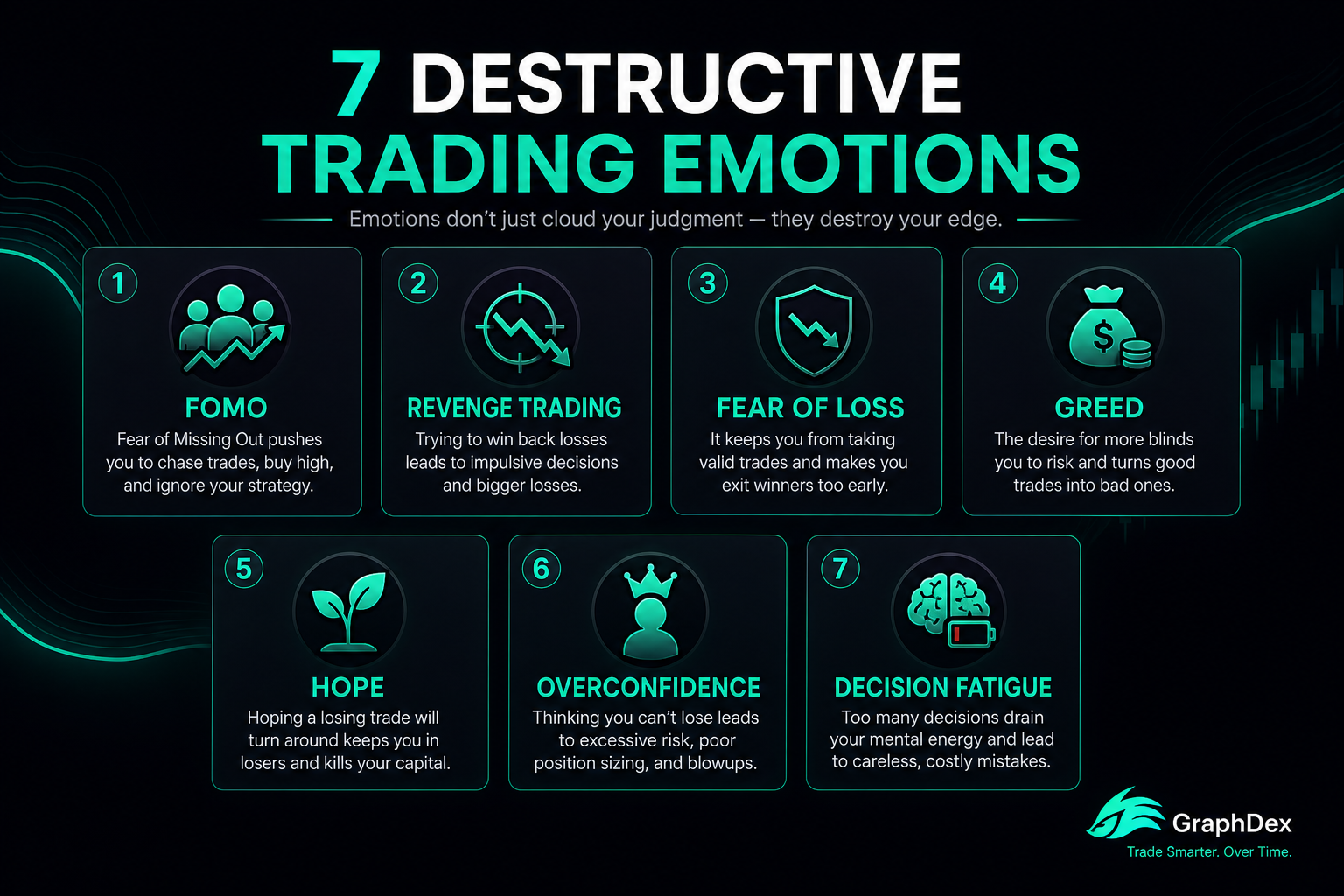
Trading psychology is the management of emotions and cognitive biases during trading. The seven most destructive trading emotions:
- FOMO (Fear of Missing Out): Chasing pumps after most of the move is done
- Revenge trading: Doubling down after losses to "get even"
- Fear of loss: Cutting winners short, refusing to take valid setups
- Greed: Holding losers hoping for recovery; oversizing positions
- Hope: The deadliest — refusing to exit losing trades because "it might come back"
- Overconfidence: Sizing too large after winning streaks
- Decision fatigue: Quality degrading from too many decisions
The honest truth: Trading psychology can't be "fixed" — only managed. Mechanical systems, journaling, and predefined rules protect against emotional decisions. The traders who succeed long-term aren't more emotionally controlled than others — they have systems that don't depend on emotional control.
Trade with systematic discipline on GraphDex
Key Takeaways
- Emotional decisions destroy more trading accounts than bad analysis or poor strategies.
- The same emotions appear in every trader — successful ones build systems that override them.
- The "Big 7" emotions: FOMO, revenge, fear, greed, hope, overconfidence, decision fatigue.
- Journaling, mechanical rules, and predefined exit plans neutralize emotional decisions.
Why Psychology Matters More Than Strategy
A truth most beginners refuse to believe: trading psychology determines success more than strategy.
The math:
- Two traders use identical strategies with 60% win rates and 2:1 R/R
- Trader A follows the system mechanically (every signal, every stop, every target)
- Trader B "uses judgment" — takes only the trades that "feel right"
- Trader B's emotional filter usually rejects winning setups and accepts losing ones
- After 100 trades, Trader A is profitable; Trader B is down
Why does this happen? Because emotional decisions are systematically biased AGAINST profitability:
- Fear makes us avoid trades right before they would have worked
- Greed makes us hold trades right before they reverse
- Confidence is highest after wins (right before losses are due)
- Doubt is highest after losses (right before reversals would have happened)
Studies of retail traders consistently show that emotional decision-making produces sub-random results — worse than if traders simply flipped coins to decide trades. Strategy without psychology is paper edge; psychology without strategy is random gambling.
The "Big 7" Trading Emotions
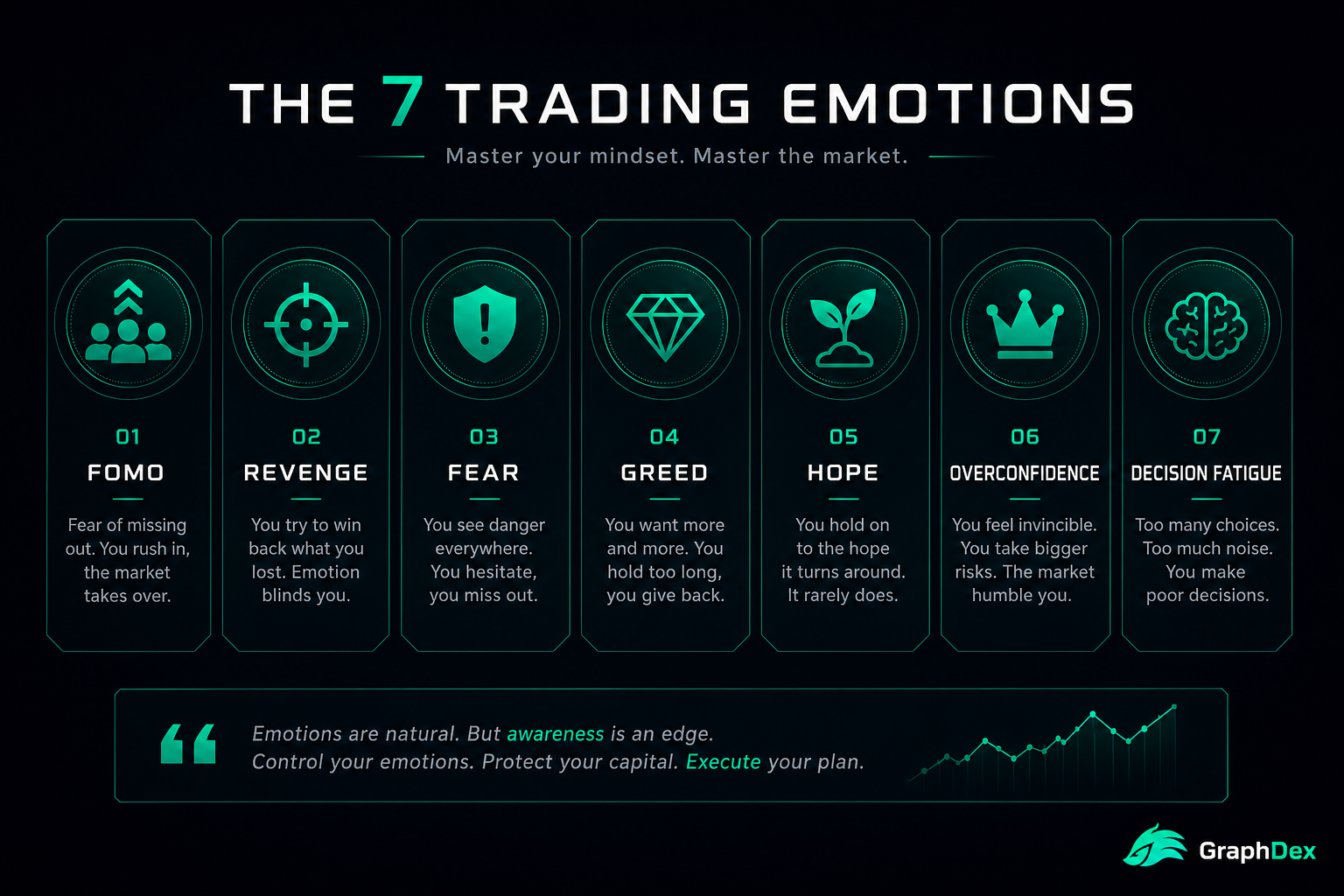
The destructive emotions that destroy traders. Recognizing them is the first step to managing them.
1. FOMO (Fear of Missing Out)
What it looks like: Seeing a token pumping 50% in a day. Feeling the urge to buy "before it's too late." Buying at the top. Watching the asset crash 30% over the next week.
Why it happens: Loss aversion (specifically, fear of missing potential gains) is one of the strongest cognitive biases. Social media amplifies FOMO dramatically — seeing others' wins triggers the urge to participate.
The mathematical reality: By the time you see a token "pumping," most of the move is already done. You're statistically buying near the top.
How to combat FOMO:
- Maintain a watchlist of pre-analyzed setups; trade only from the list
- Wait for pullbacks before entering pumps (most pumps have pullbacks within days)
- Recognize that missing trades is part of trading — there will always be more
- Don't follow Twitter/Telegram pump groups
- Use a daily new-trade limit (e.g., maximum 3 new entries per day)
The reframe: "Missing a trade costs nothing. Bad trades cost money."
2. Revenge Trading
What it looks like: Taking a loss. Immediately opening a larger position to "get back" the loss. Often in the same asset that just lost. Often without proper setup.
Why it happens: Loss aversion creates intense desire to "make it right." The emotional pain of losses demands immediate resolution.
The mathematical reality: Trades taken in emotional state systematically underperform. Revenge trades have ~30-40% win rates vs ~50-60% for systematic trades.
How to combat revenge trading:
- Mandatory break after any loss exceeding daily threshold (often 1-2% account loss)
- Hard daily loss limit that ends trading entirely
- Pre-defined "next trade only after X hours" rule after losses
- Trade journal entry required before re-entering after loss
- Recognize the emotional state — "I want my money back" is the warning sign
The reframe: "My account doesn't care which trade made the money back. The next trade should be evaluated on its own merits."
3. Fear of Loss
What it looks like: Closing winning trades too early because of "fear of giving back profits." Avoiding good setups because of "what if it doesn't work." Reducing position size too small. Paralysis at trade entry.
Why it happens: Loss aversion is twice as strong as gain seeking — losing $100 hurts about 2× as much as winning $100 feels good.
The mathematical reality: Cutting winners short destroys risk-reward ratios. A 60% win rate at 1:1 R/R is breakeven; the same win rate at 2:1 R/R is highly profitable. Fear-cut winners change which group you're in.
How to combat fear of loss:
- Predefined exit points (targets) before trade entry — no discretion at exit
- Take partial profits at first target, let runners go to ultimate target
- Move stop to breakeven after price moves 1× your risk in favor (eliminates fear of "giving back")
- Recognize that holding for targets is part of the system — not optional
- Trust your strategy's historical performance
The reframe: "Cutting winners short guarantees losses. Letting winners run is the math."
4. Greed
What it looks like: Position sizing too large because "this is a sure thing." Adding to winning positions chasing more gains. Refusing to take profits at targets because "it could go higher." Holding losers thinking "it'll come back."
Why it happens: Reward seeking, especially after wins. Confidence bias from recent positive outcomes.
The mathematical reality: Oversizing is the fastest path to ruin. Random variance ensures even great strategies have losing streaks; oversized positions during streaks blow accounts.
How to combat greed:
- Strict position sizing rules that don't bend (1-2% max regardless of conviction)
- Mechanical profit-taking at predefined targets
- Trailing stops to capture extended moves without manual decisions
- Recognize "this is the one" feeling as the warning sign
- Trade journal: review previous "sure thing" trades and outcomes
The reframe: "Position size based on risk, not confidence. Confidence is highest right before losses are due."
5. Hope (The Deadliest Emotion)
What it looks like: Trade goes against you. Decide to "wait for a bounce." Move stop further. "It'll come back." Loss grows from 5% to 15% to 40%. Eventually capitulate at much worse price.
Why it happens: Loss aversion combined with sunk cost fallacy. Once you've lost a certain amount, the brain frames "exiting" as "realizing" the loss — even though you're losing the money either way.
The mathematical reality: Holding losers turns small controlled losses into account-damaging ones. Recovery math is brutal — 50% drawdown requires 100% gain to recover.
How to combat hope:
- Stop loss orders that execute automatically (mental stops are exactly where hope kills traders)
- Pre-trade definition of "where am I wrong" — exit at that point regardless
- Recognition that "it might come back" is the universal symptom of doomed trades
- Daily review of any positions held longer than planned
- Hard rule: never move stops against you
The reframe: "The money is gone the moment the trade goes wrong. Exiting just makes it official."
6. Overconfidence
What it looks like: After winning streak, sizing positions larger. Taking more trades than usual. Skipping research. Believing "I've figured this out." Inevitable blow-up follows.
Why it happens: Recent success creates false confidence. The brain confuses recent variance with proven skill.
The mathematical reality: Winning streaks are partially random. A trader with 60% win rate will have 7-game winning streaks regularly. The streak doesn't mean strategy is "working better" — just variance.
How to combat overconfidence:
- Position sizing rules that don't bend regardless of recent results
- Maximum position size cap (absolute dollar amount, not just percentage)
- Recognition that winning streaks precede most losing streaks
- Trade journal: review post-winning-streak outcomes
- "Reset" after major wins — take a day off, return to standard sizing
The reframe: "The market doesn't care about my recent results. Each trade is independent."
7. Decision Fatigue
What it looks like: Quality of decisions degrades through the day. Late-day trades are worse than morning trades. Overtrading because "I haven't done anything yet today."
Why it happens: Mental energy depletes. Each decision uses willpower; willpower is limited daily.
The mathematical reality: Decision quality measurably degrades after 4-6 hours of intense focus. Late-day discretionary trades have lower win rates than systematic morning trades.
How to combat decision fatigue:
- Maximum daily trade count (5-10 trades for day traders)
- Time-boxed trading sessions with mandatory breaks
- Mechanical rules that don't require fresh decisions
- Recognition of mental state — tired = stop
- Daily energy management (sleep, exercise, breaks)
The reframe: "Mental energy is finite. Use it on highest-impact decisions, not constant minor ones."
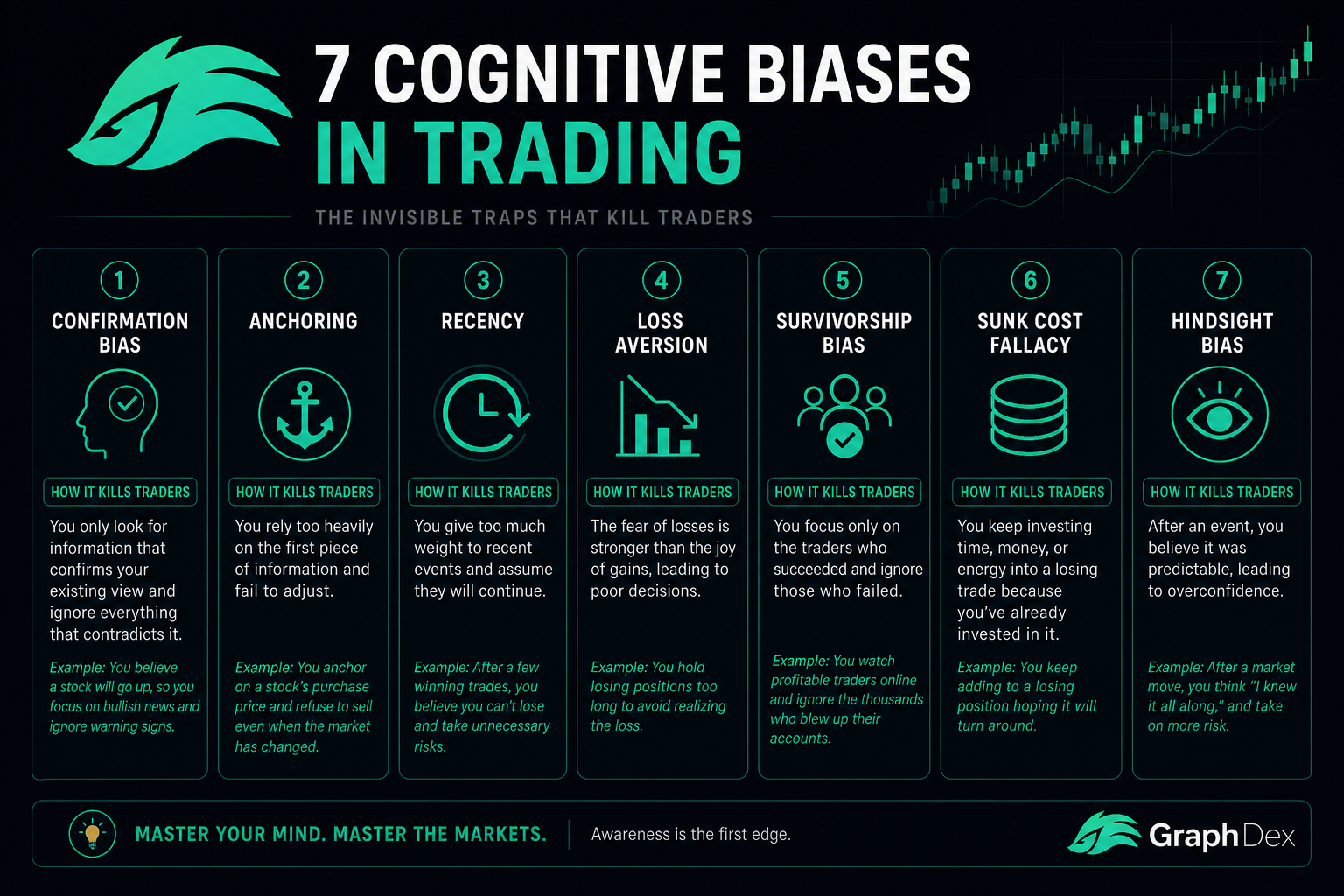
Cognitive Biases That Destroy Traders
Beyond emotions, specific cognitive biases systematically distort trading decisions.
Confirmation Bias
What it is: Seeking information that confirms existing beliefs; ignoring contradicting information.
In trading: You believe SOL is going up. You read bullish analysis and dismiss bearish data. You're surprised when SOL drops.
The fix: Actively look for evidence against your trade thesis. If you can't find any, the trade has hidden risk you're ignoring.
Anchoring Bias
What it is: Over-reliance on the first piece of information encountered.
In trading: You bought BTC at $100K. Now it's $80K. You keep thinking of $100K as "fair value" and refuse to sell or adjust analysis based on new information.
The fix: Reset analysis based on current price and current information. The past entry price is psychologically important but financially irrelevant.
Recency Bias
What it is: Overweighting recent events vs. longer-term patterns.
In trading: After three winning trades, you assume the strategy works perfectly. After three losing trades, you assume it's broken. Neither is necessarily true.
The fix: Evaluate strategies over 30+ trades, not 3-5. Variance dominates small samples.
Loss Aversion
What it is: Losses hurt about 2× as much as equivalent gains feel good.
In trading: Causes premature exits of winners (fear of giving back) and excessive holding of losers (hope they'll recover).
The fix: Mechanical exit rules that don't depend on emotional state. Predefined targets and stops.
Survivorship Bias
What it is: Focusing on success stories while ignoring failures.
In trading: Twitter/YouTube show traders posting massive wins. The 90% who blew up don't post about it.
The fix: Recognize that visible success is a tiny minority. Most successful traders don't post their P&L screenshots. Real edge is built through consistency, not stories.
Sunk Cost Fallacy
What it is: Continuing to invest in losing positions because you've already invested.
In trading: "I've held this position for 6 months, I can't sell now." The 6 months of holding are irrelevant — what matters is whether the position is currently a good investment.
The fix: Evaluate every position on current merits, not past investment.
Hindsight Bias
What it is: Believing past events were predictable after they happened.
In trading: "Of course BTC was going to crash; the signs were obvious." But you didn't see them when they were forming.
The fix: Review your historical analyses (journal) to see what you actually predicted vs. what happened.
Building Emotional Resilience
You can't eliminate emotions; you can build systems that protect you from them.
Strategy 1: Mechanical Rules
The single most important psychological tool: decisions made in advance.
Pre-trade rules:
- Maximum risk per trade (1-2%)
- Minimum risk-reward (2:1)
- Maximum daily loss (3-5%)
- Maximum daily trade count (5-10)
- Position sizes calculated from formulas, not feelings
Pre-entry rules:
- Stop loss MUST be set before entry
- Target MUST be defined before entry
- Trade journal entry MUST be made before entry
Once rules are set in calm states, follow them mechanically in heated states. Mechanical systems don't care about your emotions.
Strategy 2: Trade Journaling
The most powerful tool for psychological improvement.
What to journal:
- Entry reasoning (why this trade?)
- Plan (entry, stop, target, position size)
- Emotional state at entry
- What happened
- What you did differently from plan
- What you learned
Why journaling works:
- Forces deliberate decision-making (you must articulate reasoning)
- Reveals patterns (your emotional triggers, common mistakes)
- Provides feedback loop (which rules need adjusting)
- Builds discipline over time
Top traders journal religiously. The best traders I know have journals going back 5-10+ years. The worst traders never journal.
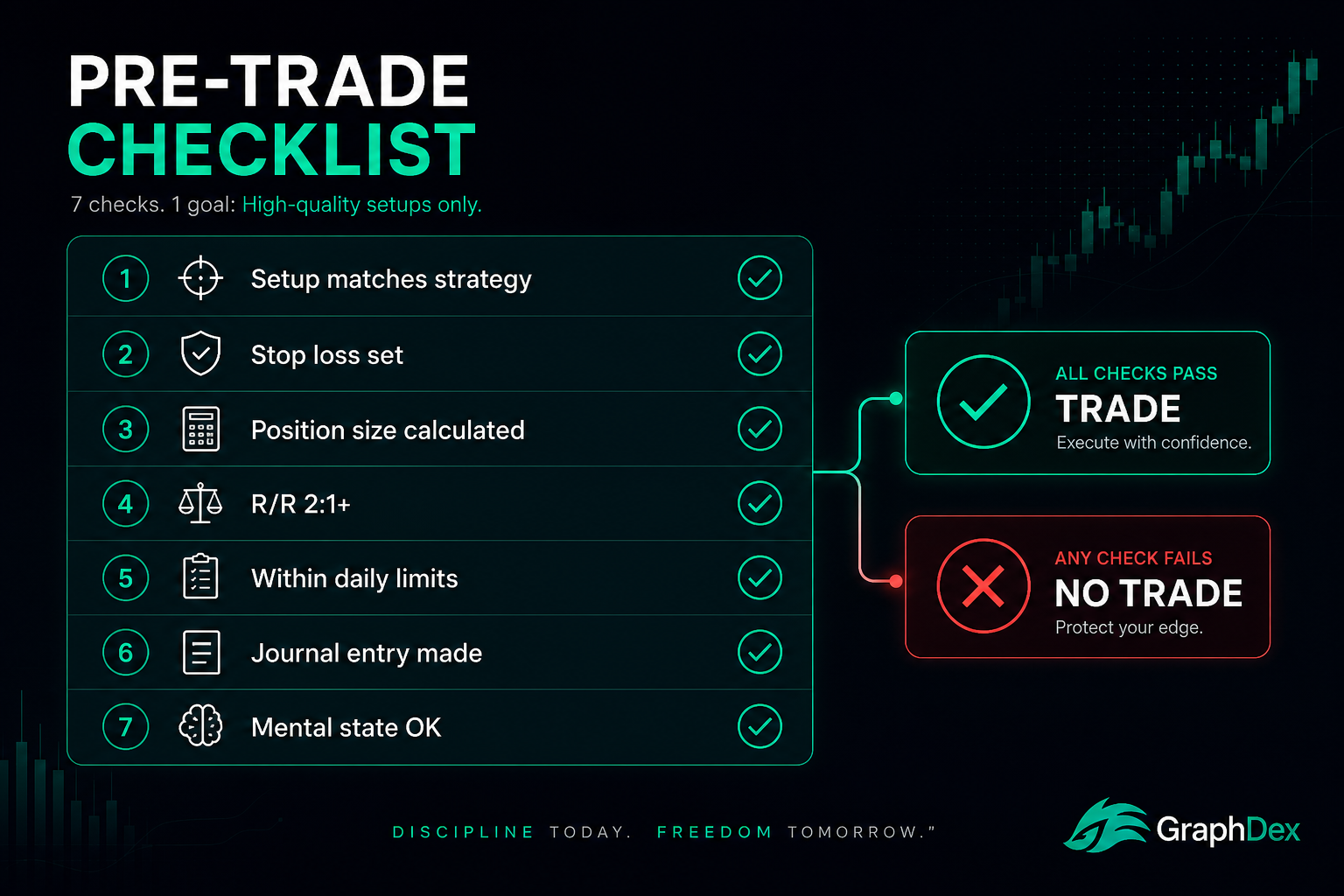
Strategy 3: Pre-Trade Checklists
Before any trade, mandatory checklist:
- Setup matches my defined strategy
- Stop loss level identified
- Position size calculated correctly
- Risk-reward ≥ 2:1
- Not exceeding daily trade count
- Not exceeding daily loss limit
- Trade journal entry written
- Emotional state acceptable for trading
If any item fails, no trade. Period. Checklists feel rigid; rigidity is the protection.
Strategy 4: Routine and Environment
Trading from chaotic environments produces chaotic decisions. Build supportive infrastructure:
- Dedicated trading space free from distractions
- Pre-session routine (review charts, news, mindset)
- Post-session routine (close positions, review journal, disengage)
- Sleep schedule that doesn't disrupt trading hours
- Exercise and physical health (directly affects decision quality)
- Diet that supports sustained mental focus
- Mental breaks between trades
Strategy 5: Accept the Game
The most overlooked psychological tool: realistic expectations.
- Losses are unavoidable. Even great traders lose 35-50% of trades.
- Streaks happen. A 7-loss streak doesn't mean strategy is broken.
- Patience is required. Some days have no good setups.
- Improvement takes years. Year 1 typically involves losses.
- Most traders fail. You're competing against the survivors.
Accepting these truths reduces emotional reactions to individual outcomes. The market isn't out to get you; it's just market.
Common Psychological Mistakes
For balance, the patterns that destroy psychological discipline:
1. Trading without rules. Discretionary trading "by feel" is gambling regardless of how good you think you are.
2. Bigger sizes after winning streaks. Confidence destroys traders consistently.
3. Smaller sizes after losing streaks. Reduces probability of recovering even with correct strategy.
4. Trading while emotional. Tilted state = degraded decisions. Take breaks.
5. Comparison to others. Twitter/YouTube success stories distort reality. Trade your system, not others'.
6. Trading for entertainment. If you're trading because it's exciting, you'll lose. Trading should be deliberate and often boring.
7. Not journaling. Cannot improve without measurement.
8. Skipping checklists. Discipline lapses in heated moments — checklists prevent them.
9. Trading after life stress. Personal stress carries into trading decisions.
10. Insufficient sleep. Cognitive performance directly tied to sleep. Tired traders make poor decisions.
11. Trading from mobile devices. Limited information visibility, easy distraction, impulsive entry.
12. Multi-tasking during trading. Trading demands focus. Other tasks = degraded decisions.
Trade with systematic discipline on GraphDex Solana terminal
How to Recover from Psychological Damage
If you've already developed bad habits (most traders have), recovery is possible.
Acknowledge the Damage
The first step: recognize you have psychological issues that are losing you money. Most retail traders blame strategies or markets — when the real issue is consistent emotional decisions.
Reduce Size Drastically
If your discipline is broken, reduce position sizes to where individual trades don't trigger emotional responses. For some, this means trading 0.1% of capital per trade for a few months while rebuilding discipline.
Rebuild Through Journaling
Start fresh journal. Document every trade — including emotional state, deviations from plan, mistakes. Review weekly. Patterns will emerge.
Take Breaks
Sometimes the right move is no trading for a week or month. Step away. Reset. Return with fresh perspective.
Consider Professional Help
Trading addiction is real. If you can't control yourself despite the methods above, consider speaking with a therapist or addiction counselor. The mental health framework for gambling addiction applies to compulsive trading.
Accept That Some Traders Shouldn't Trade
This is the hardest truth. Some personalities — particularly those with addiction susceptibility, impulsivity issues, or inability to tolerate losses — should not actively trade. Position trading or simple investing may suit them better. There's no shame in recognizing what doesn't work for you.
Build systematic trading discipline on GraphDex
How GraphDex Supports Trading Psychology
For active Solana traders implementing psychological discipline:
- Multi-timeframe charts enabling systematic analysis (not emotional reactions)
- Bubble Maps providing data-driven filters reducing FOMO buys of dangerous tokens
- Pulse feed showing context for new tokens, reducing impulse trades
- AI signals providing systematic confirmation for trades, reducing discretionary decisions
- MEV protection preventing the slippage that triggers revenge trading
- Sub-cent fees so risk calculations don't get distorted by transaction costs
- Fee-based 17% APY staking providing baseline returns during breaks from active trading
- Non-custodial Privy wallet — your funds, your decisions, your discipline
- Integrated workflow reducing context-switching that degrades decision quality
For psychologically-aware Solana traders, the integrated platform removes friction from systematic execution and provides data that supports rational decisions over emotional ones.
Frequently Asked Questions
Why is trading psychology so important? Because emotional decisions are systematically biased AGAINST profitability. Fear cuts winners short; greed holds losers too long; FOMO buys tops; revenge trading after losses compounds them. Studies show emotional trading produces sub-random results. Most traders fail not from bad analysis but from poor emotional discipline. Psychology determines whether your strategy gets executed properly.
What is FOMO in trading? FOMO (Fear of Missing Out) is the urge to chase pumping assets because you don't want to miss potential gains. It's one of the most destructive trading emotions. By the time you see a token "pumping," most of the move is usually done — you're buying near the top. Fight FOMO with pre-analyzed watchlists, daily trade limits, and the reframe: "missing trades costs nothing; bad trades cost money."
How do I stop revenge trading? Revenge trading happens when you take a loss, then immediately open a larger position to "get back" the money. Combat it with: (1) Mandatory break after any significant loss; (2) Hard daily loss limit that ends trading entirely; (3) Pre-defined waiting period after losses; (4) Trade journal entry required before re-entering. The mental reframe: "My account doesn't care which trade recovered the money."
Can I be successful trading without strong psychology? Almost certainly not. You can have the best strategy and still lose money with poor psychological discipline. Most successful long-term traders aren't more emotionally controlled than average people — they've built mechanical systems that don't depend on emotional control. Pre-defined rules, journaling, and checklists protect against emotional decisions.
How long does it take to develop trading psychology? Realistic timeline: 1-3 years of focused work for most traders. Some never develop adequate psychology and remain consistently unprofitable. Building psychology requires deliberate practice — journaling, reviewing trades, identifying personal patterns, implementing systematic rules. There are no shortcuts.
What's the hardest emotion to control in trading? For most traders, "hope" is the deadliest. Hope keeps you holding losing trades that should be exited. Hope makes you move stop losses to "give the trade more room." Hope turns 5% losses into 50% losses. Mechanical stop losses are the only reliable way to combat hope — once an order is placed, hope can't override it.
Should I use meditation or therapy for trading? Many successful traders use meditation, mindfulness, or therapy. Trading is psychologically demanding — mental health tools that work for life work for trading. If you're experiencing addiction-like patterns (trading despite consistent losses, hiding trading from family, severe emotional reactions to losses), professional help is appropriate.
About This Guide
This guide is published by the GraphDex Research team — analysts and traders building the infrastructure for digital asset trading on Solana. Our content is based on direct trading experience, behavioral finance research, and observation of common psychological patterns in retail trading.
Sources & data: Psychology principles reflect established behavioral finance research. Trading psychology improvement is essential for long-term success but doesn't guarantee profitability. This guide is educational and not financial or psychological advice. If you're experiencing addiction-like trading patterns, consider professional help.
GraphDex is the infrastructure for digital asset trading — trade, predict, and earn in one place. Learn more at graphdex.io.
Last reviewed: May 2026 · GraphDex Research
The infrastructure for digital asset trading. Trade, predict, stake, repeat. graphdex.io