By GraphDex Research · Reviewed for accuracy May 2026
Quick Answer
A stablecoin is a cryptocurrency designed to maintain a steady price — usually 1:1 with the US dollar — by being backed by reserves, collateral, or an algorithm. Key facts in 2026:
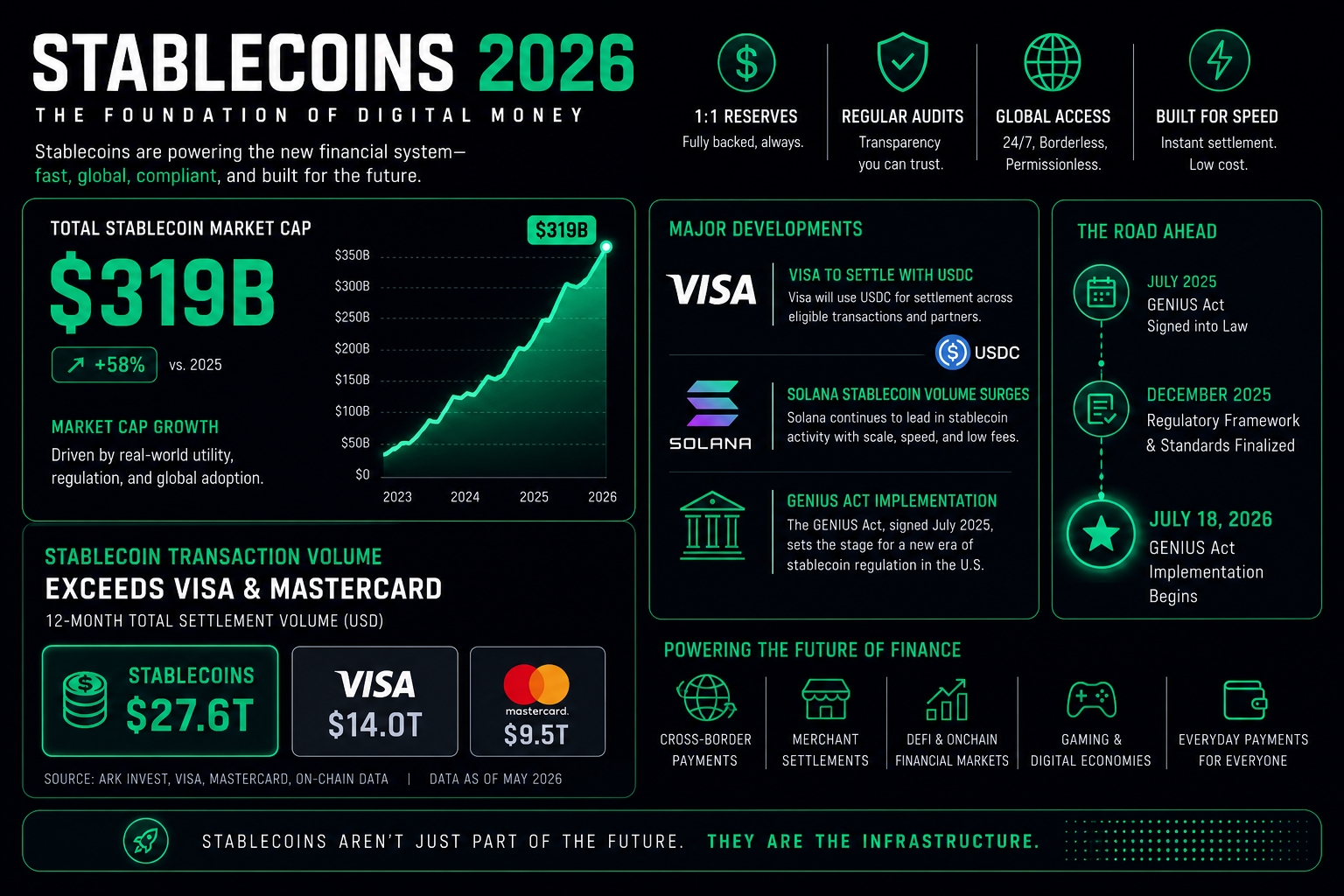
- Market size: $319 billion in circulation as of April 2026
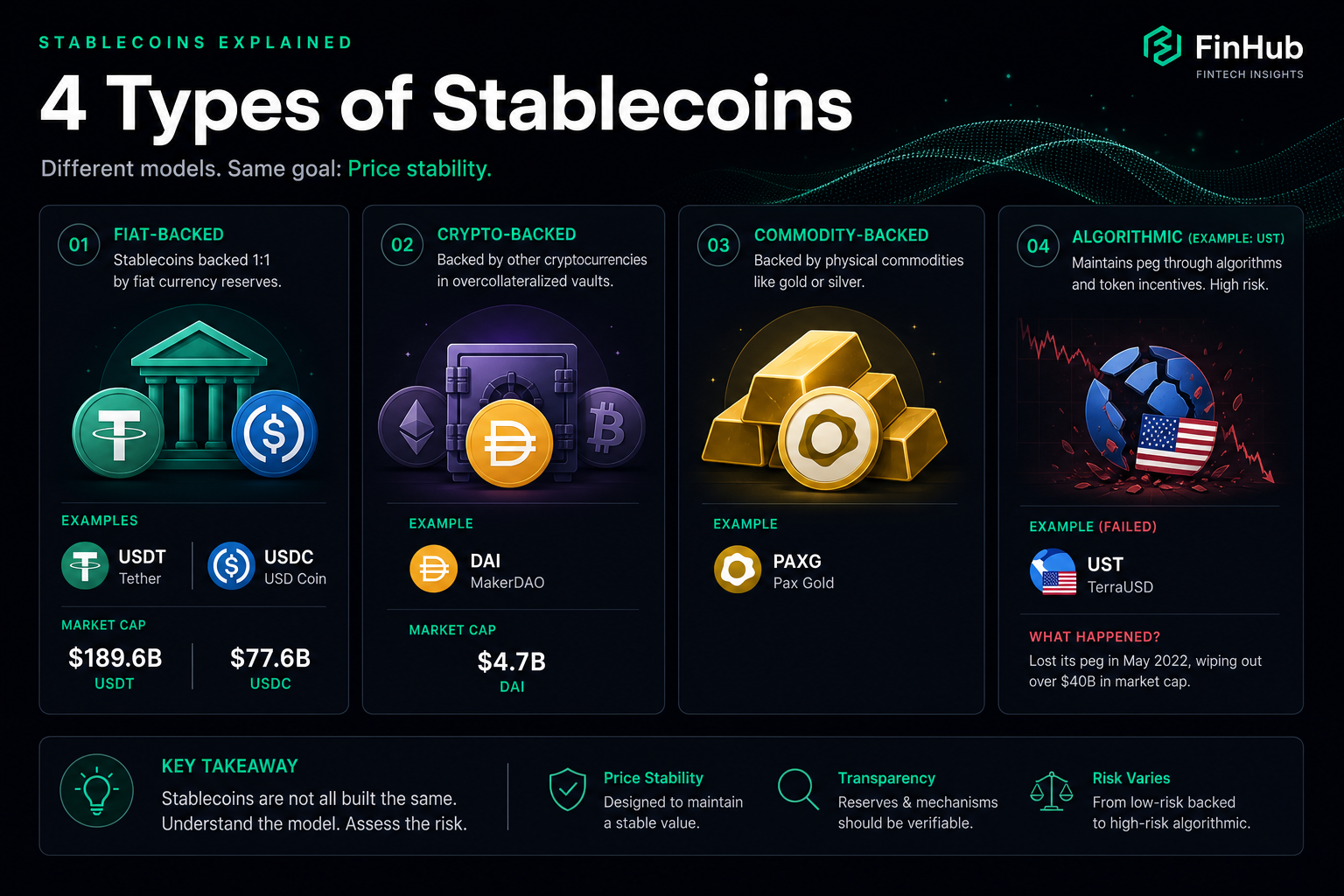
- Largest stablecoins: USDT ($189.6B), USDC ($77.6B), DAI ($4.7B)
- Three main types: Fiat-backed (USDT, USDC), crypto-backed (DAI), and algorithmic
- Use cases: Trading, payments, DeFi, savings, cross-border transfers
- Regulation: US GENIUS Act (signed July 2025, implementation rules due July 18, 2026); MiCA in Europe
- Major milestone: Visa began settling USDC on Solana in December 2025, 7 days a week
Stablecoins are crypto's "digital dollars" — and now they're a regulated financial instrument bridging crypto and traditional finance.
Earn up to 17% APY on stablecoins via GraphDex
Key Takeaways
- A stablecoin maintains a steady value (usually $1) through reserves, collateral, or algorithms.
- The market is $319B+ as of April 2026, with USDT ($189.6B) and USDC ($77.6B) dominant.
- The US GENIUS Act (2025) now requires 1:1 reserves and regular audits for issuers.
- Stablecoins enable 24/7 dollar-denominated transfers, DeFi yield, and payments.
What Is a Stablecoin?
A stablecoin is a cryptocurrency designed to hold a steady value — almost always pegged 1:1 with the US dollar. Unlike Bitcoin or Ethereum, whose prices can swing 5-15% in a day, stablecoins aim to keep one token worth one dollar at all times.
Think of a stablecoin as a digital dollar that moves on blockchain rails. You can send $1,000 worth of USDC across the world in seconds, for fractions of a cent in fees, 24/7 — without banks, wire fees, or business-hours delays. The blockchain provides the rails; the stablecoin provides the value stability.
Stablecoins have evolved from a niche crypto trading tool into legitimate financial infrastructure. As of April 2026, the stablecoin market exceeds $319 billion, with annual transaction volume already rivaling Visa and Mastercard combined according to research published by Visa. The shift accelerated in December 2025 when Visa began settling USDC transactions on Solana in the United States — seven days a week, including weekends and holidays. What started as a tool for traders has become foundational payment infrastructure.
For everyday users, stablecoins solve a real problem: they let you hold dollar-denominated value on a blockchain without being exposed to crypto's volatility. They're how billions of dollars in DeFi, payments, and trading operate today.
How Do Stablecoins Stay Stable?
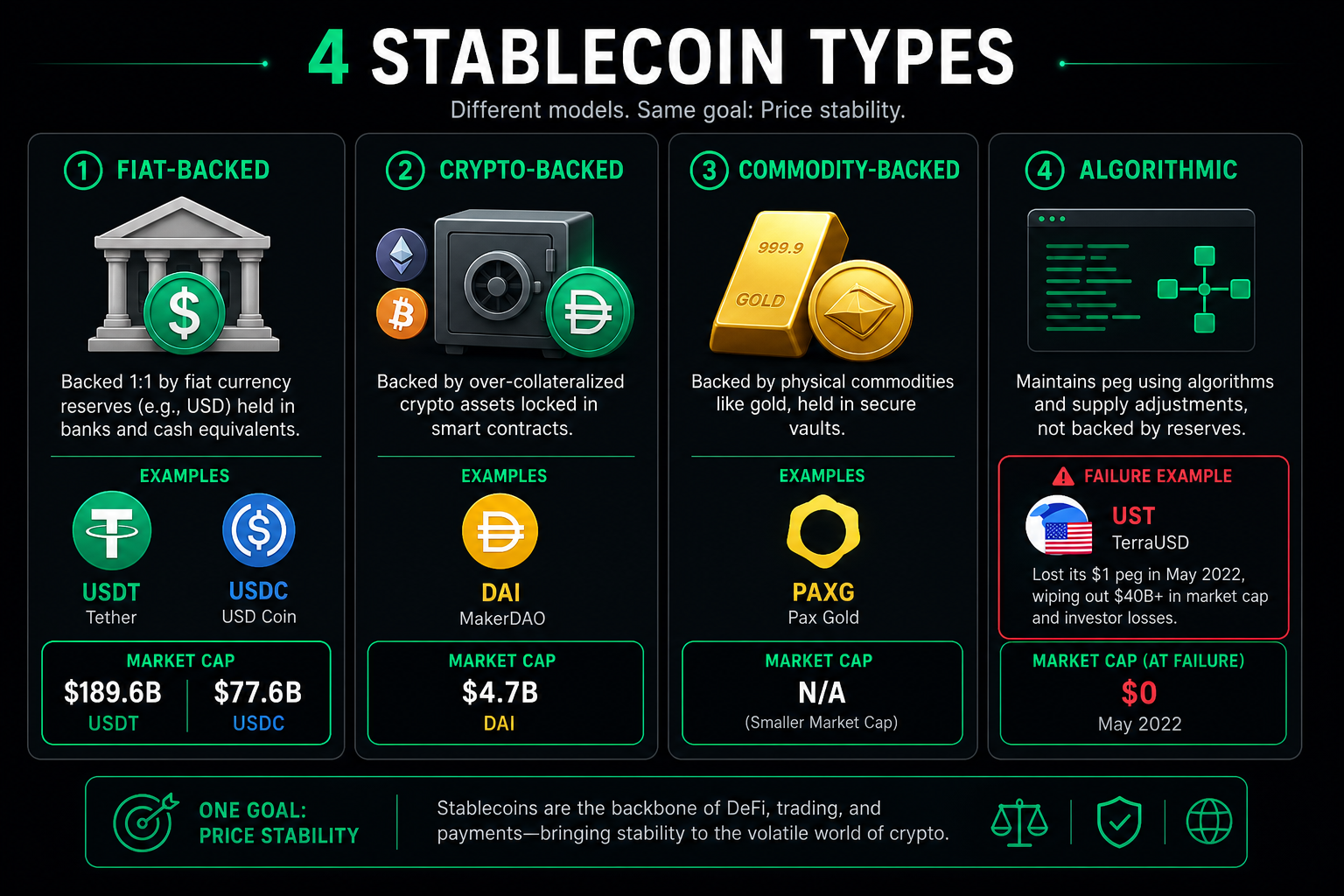
Stablecoins maintain their peg through one of three main mechanisms — and the choice matters because it determines how each one behaves under stress.
1. Fiat-backed (the largest category). The issuer holds $1 in reserves — cash and short-term Treasuries — for every stablecoin in circulation. USDT and USDC are the dominant examples. The selling point is simplicity: a regulated entity holds the dollars, mints tokens against them, and redeems on demand. Hold a USDC, and Circle is holding a matching dollar (or equivalent asset) in a bank or money-market fund.
2. Crypto-backed (decentralized alternative). Smart contracts hold crypto collateral (typically ETH or stablecoins) locked at a ratio above 1:1 — for example, $150 of ETH collateralizes $100 of stablecoin. DAI (issued by MakerDAO/Sky) is the largest example. The crypto-backed model removes the centralized issuer, but introduces volatility risk in the collateral.
3. Algorithmic. Code mints and burns supply automatically against a paired asset to maintain the peg, without holding traditional reserves. This category has had spectacular failures — Terra/Luna's UST collapsed in 2022, wiping out $40 billion. Modern designs are more cautious. Algorithmic stablecoins remain the highest-risk category.
A newer hybrid category, yield-bearing stablecoins (Ethena's USDe, Sky's USDS), use mixed strategies — often combining collateral with hedged positions or staking — to generate yield while maintaining a peg. These are more complex and carry additional risks worth understanding before use.
| Type | Mechanism | Examples | Trade-off |
|---|---|---|---|
| Fiat-backed | $1 in reserves per token | USDT, USDC, PYUSD | Centralized; issuer can freeze |
| Crypto-backed | Over-collateralized smart contracts | DAI, crvUSD | Decentralized; collateral volatility |
| Algorithmic | Supply mechanics, no reserves | (most have failed) | Highest risk; UST collapsed 2022 |
| Yield-bearing | Mixed strategies + collateral | USDe, USDS | Newer, additional complexity |
The Major Stablecoins in 2026
The stablecoin market is concentrated in a few major players. As of April 2026:
USDT (Tether) — $189.6B. The largest stablecoin by market cap, issued by Tether Limited. USDT has 60% market share (gradually shrinking under regulatory pressure), the broadest exchange listing, and is the default trading pair across most exchanges. It holds a more varied reserve structure with quarterly reports — historically attracting more scrutiny than competitors, but it has weathered multiple market stress events and held its peg.
USDC (USD Coin) — $77.6B. Issued by Circle, USDC prioritizes transparency and regulatory compliance with monthly audited attestations. Reserves are held in cash and US Treasuries (much in BlackRock's SEC-registered USDXX money market fund). USDC is the institutional choice and has surged 220% in circulating supply since late 2023, gaining ground on USDT. It briefly depegged to $0.88 in March 2023 when Silicon Valley Bank failed and Circle disclosed exposure, but recovered to $1 within days.
DAI / USDS — $4.7B. Originally DAI from MakerDAO, now transitioning to USDS under the Sky brand. Crypto-backed and decentralized, DAI/USDS is the standard option for users who want a stablecoin not controlled by a centralized issuer that could freeze addresses. Backed by crypto collateral locked in smart contracts.
PYUSD (PayPal USD). PayPal's stablecoin, increasingly used in the payments ecosystem and on Solana.
USDe (Ethena). A major yield-bearing stablecoin using delta-hedged strategies. Higher-yield but more complex risk profile than fully fiat-backed options.
Bank-issued stablecoins. Following the GENIUS Act, several US regional banks have applied for stablecoin charters. Expect more bank-issued options to enter the market.
For most users, USDC and USDT are the practical choices — they have the widest acceptance, deepest liquidity, and best track records. USDC for regulatory clarity and institutional comfort; USDT for liquidity and emerging-market presence.
What Stablecoins Are Used For
Stablecoins have grown far beyond crypto trading. Their main uses in 2026:
Trading. Most crypto trading pairs are denominated in USDT or USDC. When you buy SOL, ETH, or any altcoin, you typically sell a stablecoin to acquire it. Stablecoins provide the unit of account for the entire crypto market.
Payments. Stablecoins move dollar-denominated value globally in seconds for cents. Visa, PayPal, and Western Union (with planned USDPT) all build on stablecoin infrastructure. The Solana network alone cleared roughly $650 billion in stablecoin volume in February 2026 — the highest of any chain.
DeFi. Lending protocols (Aave, Kamino), DEXs, and staking platforms run primarily on stablecoin liquidity. Most yield opportunities in DeFi involve depositing or pairing stablecoins.
Savings and yield. Stablecoins enable dollar-denominated yields far higher than banks (3-15%+ vs 0.5%). DeFi lending, liquidity provision, and staking all generate yield on stablecoin deposits.
Cross-border transfers. Sending stablecoins across borders saves up to 90% on transaction fees versus wire transfers, settles in seconds, and works 24/7 — disrupting remittances and corporate payments.
Treasury management. Companies use stablecoins for fast settlement, treasury yield, and operational liquidity — particularly attractive for businesses with international exposure.
Inflation hedge in unstable economies. In countries with currency volatility, dollar-pegged stablecoins offer a way to hold value in a stable currency without a US bank account.
The use cases now extend well beyond crypto trading. Stablecoins have become a payment rail in their own right.
The 2026 Regulatory Landscape
Stablecoins have moved from a regulatory gray zone to a regulated financial instrument — and 2026 is the inflection point.
The US GENIUS Act, signed in July 2025 and with implementation rules due July 18, 2026, requires stablecoin issuers to:
- Back every token 1:1 with high-quality liquid assets
- Maintain 100% reserves at all times
- Undergo regular audits
- Operate under a licensed framework
This shifts stablecoins from "gray-zone product" to "licensed, audited financial instrument comparable to a money market fund." Banks and financial institutions can now act as stablecoin custodians and issue their own stablecoins, and several US regional banks have applied for stablecoin charters under the new law's bank-pathway provision.
Europe's MiCA framework provides similar regulatory clarity for stablecoin issuers operating in or for European users.
The practical implications for users:
- USDC, USDT, and other major issuers are now operating under stricter compliance requirements
- Some smaller or less-compliant stablecoins may exit US markets or restructure
- Bank-issued stablecoins are likely to gain market share over time
- The regulatory clarity reduces some risks (better audits, reserve requirements) while introducing others (issuers can freeze, comply with sanctions)
The question has shifted from "will stablecoins be regulated?" to "which ones survive regulation, and how does that change the market?"
The Risks of Stablecoins
Stablecoins solve volatility but introduce their own risks. Understanding them matters before holding significant amounts.
Reserve transparency. A stablecoin is only as reliable as what backs it. USDC's monthly audits and straightforward reserve composition give it strong credibility. USDT's quarterly reports and more varied reserves have historically attracted more scrutiny — though it's held its peg through multiple stress events. Before holding either at scale, understand what's actually behind the peg.
Depeg risk. Major stablecoins have held close to $1 even during stress, but the peg can drift temporarily. USDC traded at $0.88 briefly in March 2023 during the SVB failure before recovering. Algorithmic and less-collateralized stablecoins have failed entirely (UST). Stick to well-established options with transparent reserves.
Issuer freezing. Fiat-backed stablecoin issuers (Circle, Tether) can freeze tokens belonging to specific addresses for legal compliance — sanctions, court orders, or response to hacks. This is a feature for combating crime but a centralization risk. Decentralized stablecoins (DAI/USDS) don't have this capability.
Smart contract risk. Crypto-backed stablecoins depend on smart contract security. Bugs or exploits can affect the peg or drain collateral.
Regulatory changes. Rules vary by jurisdiction and continue evolving. Some smaller stablecoins may exit US markets; some bank-issued stablecoins are emerging.
Custody risk on exchanges. Holding stablecoins on a centralized exchange exposes you to the exchange's solvency (the FTX 2022 lesson applies to stablecoin holdings too).
For most users, the practical takeaway: USDC and USDT are the safest choices among major stablecoins for general use. Hold them in self-custody where possible. Understand the issuer's reserve structure before holding large amounts. Avoid algorithmic and yield-bearing stablecoins unless you specifically understand their risk profile.
Hold and earn on stablecoins non-custodially via GraphDex
Earning Yield on Stablecoins
One of stablecoins' most attractive features is the ability to earn meaningful yield — typically far higher than bank savings accounts (0.5%) while keeping dollar value stability.
Where stablecoin yields come from:
- Lending protocols (Aave, Compound, Kamino): Borrowers pay interest, distributed to lenders. Typically 2-8% APY on USDC/USDT
- Liquidity provision: Provide stablecoins to DEX pools and earn trading fees, plus potential rewards
- Liquid staking and structured products
- Fee-sharing platforms that return platform revenue to stablecoin depositors
Yields vary by platform, market conditions, and risk level. Higher yields generally reflect higher risk (smart contract risk, protocol risk, or strategy risk).
GraphDex offers up to 17% APY on stablecoins through a fee-based yield model — funded by platform trading fees rather than emissions or promotional rates. This sustainable structure is among the most competitive yields on stablecoins in 2026, in a non-custodial environment via Privy where your funds stay in your wallet. Combined with smart contract-powered DeFi access, prediction markets, and Solana DEX trading in one terminal, GraphDex consolidates stablecoin earning with broader crypto activity.
For users moving from a 0.5% bank account to dollar-denominated 17% yield, the gap is enormous over time — but always weigh yield against the underlying risks of any platform.
Earn up to 17% APY on stablecoins on GraphDex
Frequently Asked Questions
What is a stablecoin in simple terms? A stablecoin is a cryptocurrency designed to hold a steady value (usually $1) by being backed by reserves, collateral, or an algorithm. Unlike Bitcoin which can swing 10%+ in a day, stablecoins keep one token worth one dollar. They let you hold dollar value on a blockchain — useful for trading, payments, DeFi, and savings.
What's the difference between USDT and USDC? USDT (Tether, $189.6B) is the largest by market cap with the broadest exchange listing — the default trading pair across most exchanges. USDC (Circle, $77.6B) prioritizes transparency with monthly audited reserves and is the institutional preference. USDT has more liquidity; USDC has more regulatory clarity. Both are fiat-backed stablecoins.
Are stablecoins safe? Major stablecoins (USDC, USDT, DAI) have held their peg through multiple market stress events. USDC briefly depegged to $0.88 during the 2023 SVB crisis before recovering. The 2025 GENIUS Act now requires 1:1 reserves and regular audits for US issuers. Risks include depeg, issuer freezing, smart contract bugs, and regulatory changes. Stick to established options.
Is USDC better than USDT? USDC has more transparent monthly attestations, US regulatory compliance, and is preferred by institutions. USDT has larger market cap, broader exchange listings, deeper liquidity, and dominant presence in emerging markets. Neither is universally "better" — USDC for regulatory clarity, USDT for liquidity. Both are major safe choices among stablecoins.
Can stablecoins fail? Yes. Algorithmic stablecoin Terra/Luna's UST collapsed in May 2022, wiping out $40 billion. Smaller stablecoins have failed too. Major fiat-backed stablecoins (USDC, USDT) have weathered stress events but aren't risk-free. The GENIUS Act now imposes 1:1 reserve requirements that should reduce risk for compliant US issuers going forward.
How can I earn yield on stablecoins? Through DeFi lending (Aave, Compound, Kamino), liquidity provision on DEXs, staking platforms, and fee-sharing protocols. Yields range from 2-15%+ depending on risk and platform. GraphDex offers up to 17% APY through a sustainable fee-based model. Always weigh yields against underlying risks (smart contract, protocol, strategy).
What is the GENIUS Act? The GENIUS Act is US legislation signed in July 2025 (with implementation rules due July 18, 2026) that requires stablecoin issuers to back every token 1:1 with high-quality liquid assets, maintain 100% reserves, and undergo regular audits. It shifts stablecoins from a gray-zone product to a licensed, audited financial instrument and allows banks to issue stablecoins.
About This Guide
This guide is published by the GraphDex Research team — analysts and traders building the infrastructure for digital asset trading on Solana. Our content is based on live market data, current regulatory developments, and hands-on experience.
Sources & data: Market figures, regulatory details, and stablecoin statistics reflect publicly available information as of 2026 and may change. Stablecoins carry real risks including depeg and issuer failure. This guide is educational and not financial advice — always do your own research.
GraphDex is the infrastructure for digital asset trading — trade, predict, and earn in one place. Learn more at graphdex.io.
Last reviewed: May 2026 · GraphDex Research
The infrastructure for digital asset trading. Trade, predict, stake, repeat. graphdex.io