By GraphDex Research · Reviewed for accuracy May 2026
Quick Answer
AI x Crypto is the convergence of artificial intelligence and blockchain — combining autonomous AI agents with crypto rails (wallets, smart contracts, stablecoin payments) to enable financial activity without continuous human input. Key facts in 2026:
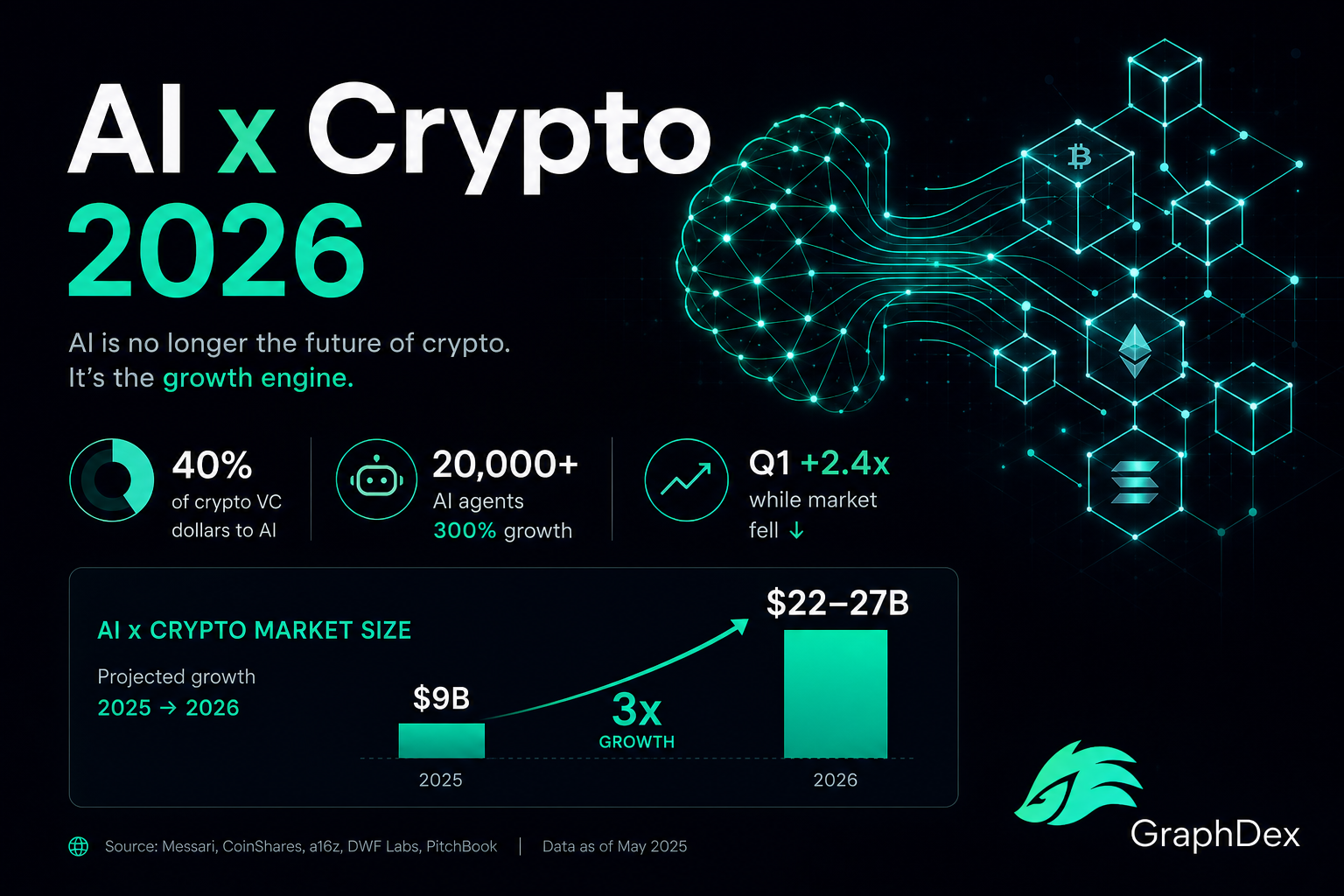
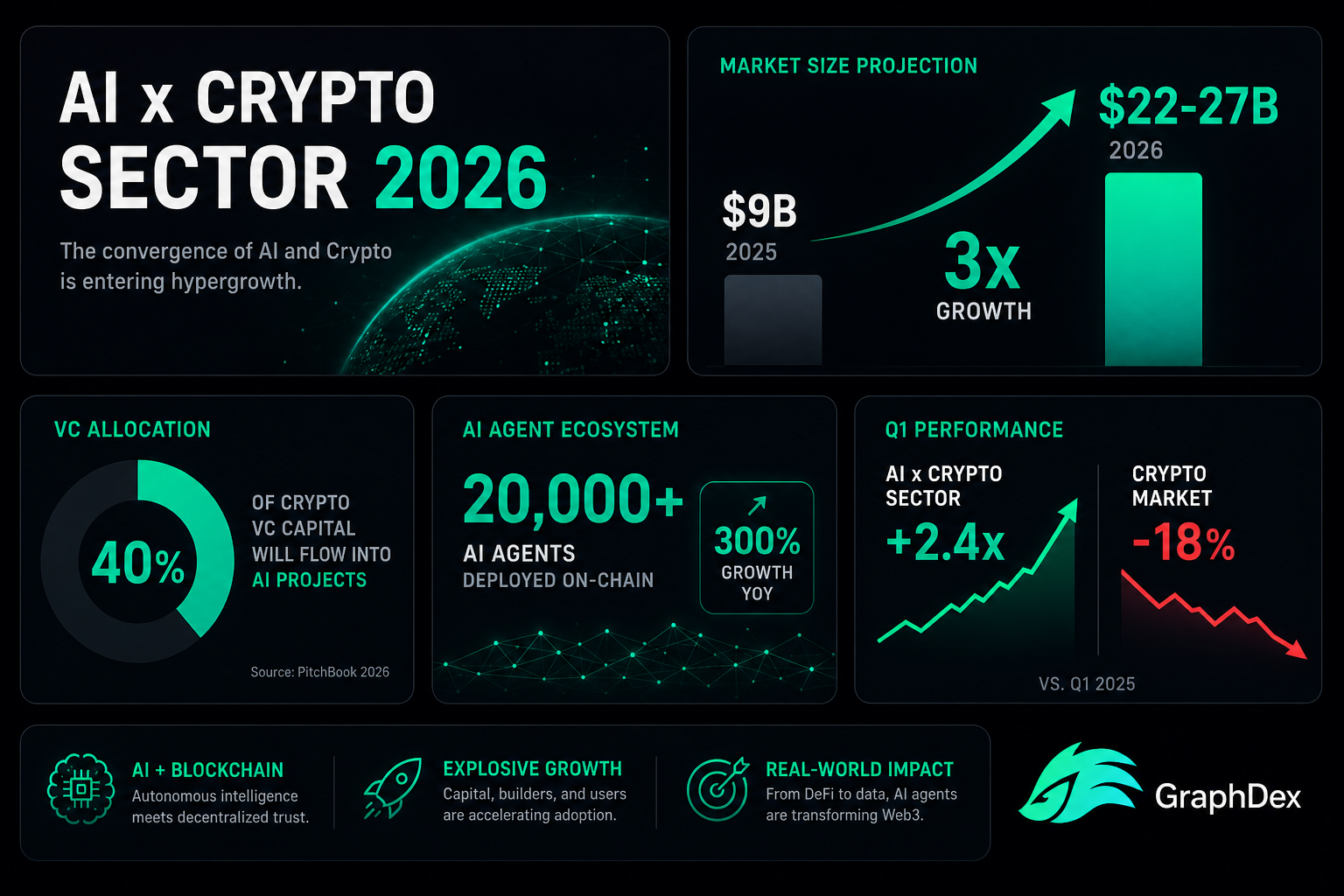
- Market size: AI crypto sector tripled to $22-27 billion (from $9B start of 2025)
- VC signal: 40% of crypto venture dollars in 2025 went to AI x crypto firms (vs 18% the prior year)
- Agent deployments: 20,000+ AI agents active on blockchains, up 300% in one quarter
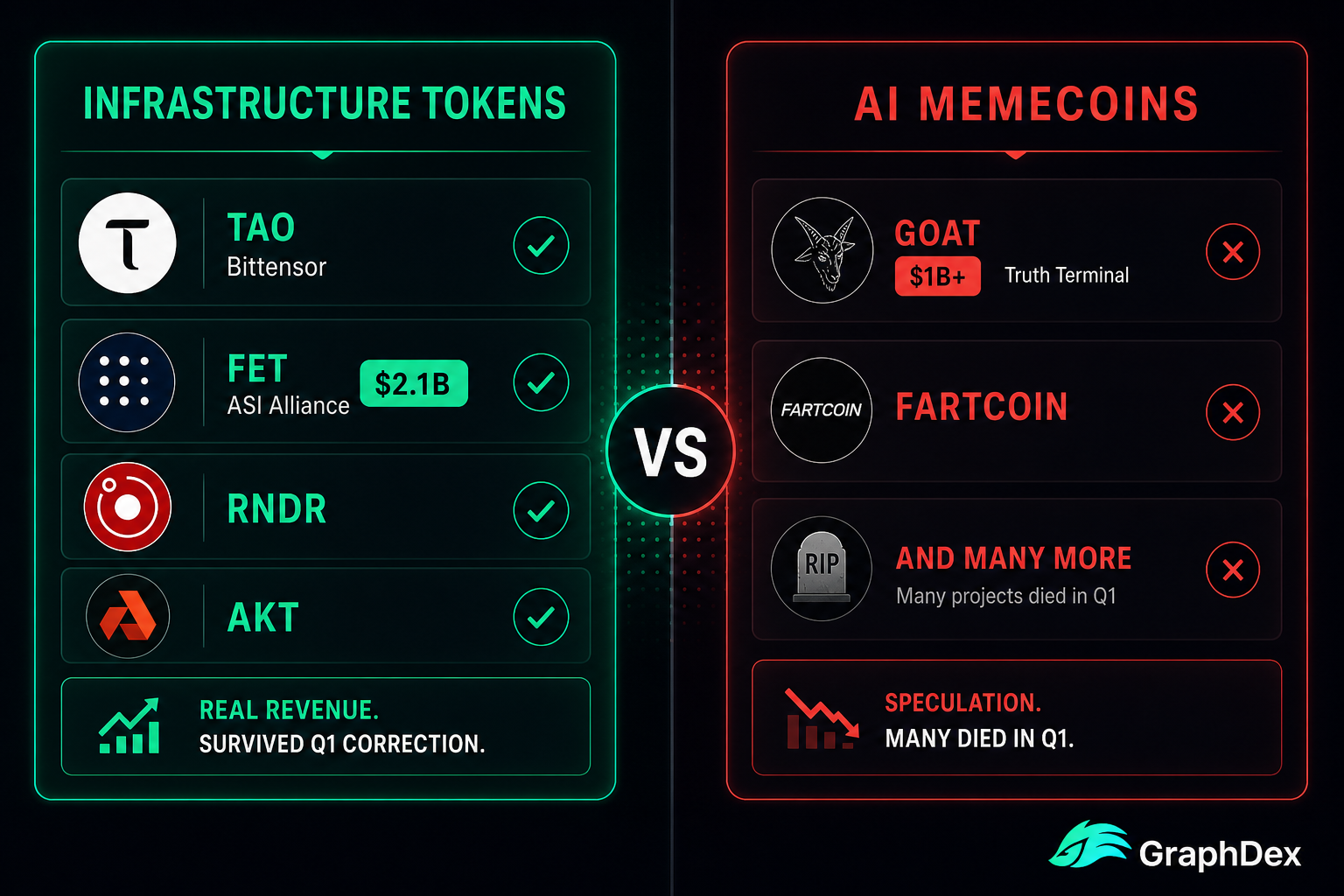
- Two major categories: Infrastructure tokens (FET, TAO, Bittensor) and AI memecoins (GOAT, FARTCOIN)
- Key infrastructure: Ethereum's EIP-7702 enables session-based AI agent permissions
- Real revenue: Unlike past narrative cycles, AI x crypto has measurable on-chain activity and revenue underneath
- Survived Q1 2026 correction: Sector held while broader crypto declined; zero-usage tokens collapsed while infrastructure survived
This isn't just narrative — it's becoming the dominant lens for capital allocation in crypto.
Trade on Solana with AI signals on GraphDex
Key Takeaways
- AI x Crypto combines autonomous AI agents with blockchain payments and smart contracts.
- The sector tripled in 2025-2026 to $22-27B; 40% of crypto VC dollars flow here.
- Two main categories: infrastructure tokens and AI memecoins (very different risk profiles).
- The Q1 2026 correction purged zero-usage tokens but infrastructure projects held — signaling maturation.
What Is AI x Crypto?
AI x Crypto (sometimes written "AI + Crypto" or "DeFAI") is the convergence of artificial intelligence and blockchain technology. The fundamental insight is that AI agents and crypto infrastructure naturally complement each other.
Why AI needs crypto. As AI systems become more capable, they need to transact — buying compute, paying for data, settling with other agents, accessing services. Traditional payment rails don't work for AI: machines don't have bank accounts, social security numbers, or legal identities. Crypto provides what AI needs — wallets without legal personhood, instant global settlement, programmable money, and trustless execution.
Why crypto needs AI. Crypto has historically been hard for humans — managing wallets, understanding gas, evaluating opportunities, executing across protocols and chains. AI agents abstract this away. They process real-time data, plan multi-step strategies, execute trades, manage DeFi positions, and handle the complexity humans struggle with.
The result: AI agents that hold crypto wallets, execute autonomous trades, manage DeFi positions, run 24/7 without supervision, and transact with other agents. This isn't theoretical — by 2026, over 20,000 AI agents are actively deployed across blockchain networks, generating measurable on-chain activity.
Unlike past "narrative cycles" (NFTs, memecoins, the metaverse) that were largely speculative, AI x crypto has real revenue underneath. The sector grew 2.4x in Q1 2026 while Bitcoin, DeFi, RWAs, and meme coins all declined — because the activity is real, not just price action.
Why 2026 Is the Breakthrough Year
Several structural shifts came together in 2026, transforming AI x crypto from speculative narrative to functional infrastructure.
1. EIP-7702 on Ethereum. Implemented in 2025, this upgrade allows a standard account to serve as a smart contract for a single transaction. The implication: a human user can grant temporary, highly restricted permission to an AI agent. The agent executes a specific trade, and the permission expires. Users retain private keys in secure hardware; agents get permission to transact but never access the underlying key material. This is foundational for safe AI agent operation.
2. Session keys and agentic wallets. Specialized wallets grant sub-agents time-limited authority for high-frequency micro-transactions. Combined with gas abstraction (wallets paying fees in alternative tokens), this enables thousands of agent transactions without per-transaction friction.
3. Payment protocols for AI agents. Coinbase's x402 protocol uses stablecoin micropayments for AI-to-AI commerce. Visa's Trusted Agent Protocol uses card rails for AI checkout. These compete to become the standard rails for AI agent commerce — and both signal serious institutional commitment.
4. Massive venture capital flow. 40 cents of every crypto venture dollar invested in 2025 went to firms simultaneously building AI products — more than double the 18 cents share recorded a year earlier. This level of capital allocation isn't typical of narrative cycles.
5. Real revenue. The sector held up through a broad crypto market drawdown specifically because the activity is real. AI agents are generating fees, infrastructure tokens have on-chain utility, and the underlying revenue isn't speculative.
6. ETF filings. ETF filings targeting AI-native crypto assets emerged in 2026, signaling traditional finance's recognition of the category as investable.
The combination of technical infrastructure (EIP-7702, session keys), payment rails (x402, Trusted Agent), capital (40% of crypto VC), and real revenue marks 2026 as the year AI x crypto stopped being speculative.
The Two Major Categories
AI x crypto isn't one thing — it's two distinct categories with very different risk profiles. Conflating them is the most common mistake.
Category 1: Infrastructure Tokens
These are tokens of protocols building the actual infrastructure for AI on crypto rails. They have functional products, generate revenue, and serve real use cases.
Major infrastructure projects:
Bittensor (TAO). A decentralized network for machine learning, where participants train models and share rewards. TAO market cap reached billions; the protocol has measurable activity and ecosystem growth.
Fetch.ai / ASI Alliance (FET). The Artificial Superintelligence Alliance, formed through the merger of Fetch.ai, SingularityNET, and Ocean Protocol. FET market cap around $2.1 billion. Targeting mainnet launch of ASI:Chain by late 2026. Holders can stake to contribute to open-source model training.
Virtuals Protocol. On Base, an ecosystem for deploying AI agents — analyzing wallet movements, executing strategies, acting as automated influencers or traders.
deBridge MCP. Cross-chain AI agent infrastructure that enables agents to quote routes, compare fees, and execute cross-chain swaps across 23+ blockchains using a 0-TVL intent-based architecture.
Render (RNDR), Akash (AKT). Decentralized compute networks for AI training and inference.
Coinbase x402 protocol. AI agent payment rail using stablecoin micropayments.
Infrastructure tokens carry standard crypto investment risks (volatility, regulatory) plus product/execution risk, but they have real products and use cases. The Q1 2026 sector correction was a "purge" — zero-usage tokens collapsed while infrastructure projects held.
Category 2: AI Memecoins
These are tokens whose value derives almost entirely from AI-themed narratives, viral culture, or AI agent personalities. They typically have no functional product and depend on attention and community.
Major AI memecoins:
GOAT (Goatseus Maximus). The flagship AI memecoin, propelled by Truth Terminal — an autonomous AI agent on X that promoted the token. Launched on Solana via Pump.fun, market cap reached over $1 billion. The agent reportedly accumulated holdings and refused to liquidate until specific research papers were published — demonstrating an autonomous system accumulating capital and influencing markets.
FARTCOIN. Emerged from the same AI agent lore ecosystem as GOAT, capitalizing on absurdist humor generated by language models. Significant volume on Pump.fun and Solana DEXs.
Truth Terminal-linked tokens. Various tokens tied to AI agent personalities operating on social media.
Agentic AI tokens. Interactive, "living" AI personalities deployed with tokens — a step beyond static-image memecoins, integrating LLM-powered characters with token economies.
AI memecoins are extremely high-risk speculation. They can produce extraordinary returns or go to zero overnight. The Q1 2026 correction wiped out many zero-usage AI memecoins while infrastructure survived — illustrating the gap between narrative and substance.
The critical distinction: Holding an AI memecoin is speculation on attention and community. Holding an AI infrastructure token is speculation on revenue and adoption. Both are crypto-risky, but very different.
What Are AI Agents and How Do They Work?
The most distinctive AI x crypto innovation is the autonomous AI agent. Understanding them clarifies why this category matters.
What they are. AI agents are autonomous programs that hold their own crypto wallets, execute trades, manage DeFi positions, and conduct transactions without continuous human input. Unlike traditional trading bots (which follow rigid if/then logic), AI agents use large language models to interpret context, plan multi-step strategies, and adapt execution dynamically.
Concrete example. A trading bot might execute "if SOL price drops 5%, buy 10 SOL." An AI agent might: evaluate that SOL price dropped 5%, check if it's broader market weakness or SOL-specific, consider current portfolio allocation, evaluate liquidity across Solana and Ethereum, identify that splitting the buy between Raydium and Orca produces less slippage, execute the trades with optimal routing, and handle the transactions — all without explicit instructions for each step.
How they hold assets. Through innovations like EIP-7702 and session keys, agents can hold and transact crypto without human approval for each action — but with bounded, time-limited permissions. The user grants the agent permission for specific activities; the agent operates within those limits.
What they do in practice:
- Automated trading. Continuously monitor markets and execute trades based on multiple signals
- DeFi position management. Manage lending positions, rebalance liquidity, optimize yield strategies
- Cross-chain operations. Bridge assets, evaluate liquidity across chains, route trades efficiently
- Copytrading and signal-following. Mirror successful traders' patterns while adjusting for risk
- Autonomous payments. Buy compute, data, or services from other agents
- Social and informational tasks. Operate accounts on X/Twitter, post analysis, run prediction market positions
The regulatory frontier. Financial regulations target human operators and corporate entities, but AI agents don't have legal identities. The SEC is evaluating agents acting as investment advisers. This is genuinely new regulatory territory — and the rules are being figured out as the technology deploys.
DeFAI: The DeFi + AI Convergence
A subset of AI x crypto specifically targets DeFi automation. Sometimes called DeFAI, this is where AI agents are most directly useful for traders.
The problem DeFAI solves. DeFi is powerful but punishing — you need to evaluate dozens of protocols, track rates, manage positions across chains, time entries and exits, and handle complex strategies. Most humans can't keep up; sophisticated DeFi has been limited to professional traders.
How DeFAI changes this. AI agents handle the complexity:
- Constantly monitoring lending rates across protocols and chains
- Rebalancing positions to capture best yields
- Managing risk parameters (loan-to-value, liquidation buffers)
- Executing multi-step strategies (deposit → borrow → reinvest → harvest)
- Bridging assets when opportunities are on other chains
- Handling gas, approvals, and protocol-specific quirks
The result. Sophisticated DeFi becomes accessible. Capital that would sit idle in basic positions can be deployed in active strategies that previously required full-time attention. As AI agents become more reliable, expect them to become the standard interface for serious DeFi participation.
This connects to GraphDex's approach for active traders. While GraphDex doesn't yet offer fully autonomous AI agents, its AI signals (surfacing news impact, mispricing, whale movements) provide the intelligence layer that human traders can act on. Copytrading offers similar automation — mirroring proven forecasters' decisions automatically. These bridge the gap between manual trading and fully autonomous agents.
Use AI signals and copytrading on GraphDex
How to Participate in AI x Crypto
For users wanting to participate in AI x crypto, several practical approaches:
1. Hold infrastructure tokens. Major AI infrastructure tokens (TAO, FET, RNDR, AKT) offer exposure to the underlying growth. Standard crypto investment caveats apply — never invest more than you can afford to lose, and treat altcoins as high-risk.
2. Avoid zero-usage AI memecoins unless you accept speculation. Most AI memecoins will go to zero. The Q1 2026 correction demonstrated this. If you trade them, treat positions as speculation, take profit aggressively, and never invest more than you can afford to lose entirely.
3. Use AI tools for trading. Even without holding AI tokens, AI tools are increasingly integrated into trading. GraphDex's AI signals analyze news impact and mispricing; AI-powered analytics platforms (Alphascope, Mention Matrix) provide intelligence for traders.
4. Try AI agent products. Several platforms let users deploy or interact with AI agents — Virtuals Protocol on Base, Fetch.ai agents for various tasks, and emerging Solana AI agent platforms.
5. Watch infrastructure development. Major protocols (x402, Trusted Agent Protocol, EIP-7702 ecosystem) are foundational. Following their adoption gives you a sense of where the agentic economy is heading.
6. Stay sober about the hype. AI x crypto has real substance, but it also has serious hype. Distinguish between revenue-generating infrastructure and pure narrative tokens. The 2026 correction was a useful filter.
The Risks of AI x Crypto
For balance, AI x crypto carries specific risks worth understanding.
Token speculation risk. Many AI tokens, especially AI memecoins, are driven by attention and hype. They can collapse rapidly. The Q1 2026 correction wiped out zero-usage tokens despite the broader sector growth.
Smart contract risk. AI agents operate via smart contracts; the underlying contracts can be exploited.
AI agent risk. Agents act autonomously within their granted permissions. Bugs, prompt injection, or unexpected behavior can cause losses. Session-key architectures (EIP-7702) limit damage but don't eliminate risk.
Regulatory uncertainty. AI agents acting as investment advisers, handling securities, or conducting unregistered financial activity face regulatory scrutiny that's still being figured out.
Concentration risk. Some infrastructure tokens have significant team/insider holdings, governance concerns, or are dependent on continued speculative interest.
Hype vs reality gap. AI x crypto's strong narrative attracts capital that doesn't fully evaluate substance. The Q1 2026 correction was healthy — purging projects without real revenue — but the pattern will likely repeat.
Execution risk for agents. AI agents executing complex multi-protocol strategies have many failure points. A wrong signal, bridge failure, or unexpected market move can cascade.
The honest takeaway: AI x crypto has real substance and growing adoption. But the volatility, regulatory uncertainty, and quality variance across projects mean it's high-risk. Stick to substantive infrastructure projects you understand, avoid pure speculation, and treat any allocation as money you can afford to lose.
How GraphDex Connects to AI x Crypto
GraphDex isn't an AI agent platform per se, but it integrates AI in several ways that benefit active Solana traders.
AI signals. GraphDex's AI surfaces news impact, mispricing, and trading opportunities across Solana tokens and Polymarket prediction markets — providing the intelligence layer that informs trading decisions.
Copytrading. A halfway point between manual trading and autonomous agents — automatically mirror proven Polymarket forecasters' positions based on PnL ranking. The intelligence is human; the execution is automated.
Bubble Maps and Pulse feed. Safety and discovery infrastructure powered by data analysis — helping traders identify good opportunities and avoid rugs.
Built for the AI agent future. As AI agent infrastructure matures (EIP-7702, session keys, payment protocols), terminals like GraphDex are natural deployment points — combining trading, prediction markets, staking, and discovery in one non-custodial environment that future AI agents could operate within.
For users participating in AI x crypto specifically, GraphDex offers AI-powered tools for active Solana trading without requiring you to understand or operate autonomous agents directly. As the agentic economy develops, expect terminals to integrate more agent capabilities natively.
Trade with AI signals on Solana via GraphDex
Frequently Asked Questions
What is AI x crypto in simple terms? AI x crypto is the combination of artificial intelligence and blockchain technology. AI agents hold crypto wallets, execute trades, and operate autonomously using blockchain payments and smart contracts. The convergence works because AI needs payment rails (which crypto provides) and crypto needs intuitive interfaces (which AI provides). Sector market cap reached $22-27B in 2026.
What's the difference between AI agents and trading bots? Trading bots follow rigid if/then logic (e.g., "buy if price drops 5%"). AI agents use language models to evaluate context, plan multi-step strategies, and adapt dynamically. An agent might decide to buy AND choose the optimal venue, AND route across chains, AND time the trade — all without explicit instructions for each step. AI agents hold their own wallets via session-key architectures.
What are the best AI crypto tokens in 2026?
Top infrastructure tokens include Bittensor (TAO), Fetch.ai
(FET, part of ASI Alliance,
$2.1B mcap), Render (RNDR), and Akash (AKT). Top AI
memecoins include GOAT ($1B+ at peak, propelled by Truth Terminal) and FARTCOIN.
Infrastructure tokens have real products; AI memecoins are
largely speculation. This is not investment advice.
Are AI memecoins like GOAT real investments? AI memecoins are extremely high-risk speculation. GOAT and FARTCOIN reached significant market caps driven by AI agent narratives (Truth Terminal), but most AI memecoins go to zero. The Q1 2026 correction wiped out zero-usage AI tokens while infrastructure projects held. Treat any AI memecoin position as speculation, not investment.
What is DeFAI? DeFAI (Decentralized Finance + AI) is the application of AI agents to DeFi — autonomous strategy execution, position management, yield optimization, cross-chain operations. Agents handle the complexity that has historically limited DeFi to professional traders. By 2026, this is moving from concept to deployed reality with thousands of active agents.
How do AI agents hold crypto? Through innovations like Ethereum's EIP-7702, users grant AI agents temporary, restricted permissions to execute specific transactions without exposing private keys. The user's private keys stay in secure hardware; the agent gets session-based authority that expires. This makes safe AI agent operation possible — they can transact but never access the underlying key material.
Will AI agents replace human traders? For many activities, yes — AI agents already outperform humans in 24/7 market monitoring, multi-chain DeFi position management, and rapid execution. But human traders still have advantages in narrative interpretation, novel situation handling, and strategic decisions. The realistic 2026 model is human + AI: humans setting strategy and risk parameters, AI executing and managing. Tools like GraphDex's copytrading represent this hybrid approach.
About This Guide
This guide is published by the GraphDex Research team — analysts and traders building the infrastructure for digital asset trading on Solana. Our content is based on live AI x crypto data, current market figures, and publicly available analysis.
Sources & data: Market figures, project details, and trends reflect publicly available information as of 2026 and change continuously. AI x crypto carries significant risks including extreme volatility and regulatory uncertainty. This guide is educational and not financial advice — always do your own research and never invest more than you can afford to lose.
GraphDex is the infrastructure for digital asset trading — trade, predict, and earn in one place. Learn more at graphdex.io.
Last reviewed: May 2026 · GraphDex Research
The infrastructure for digital asset trading. Trade, predict, stake, repeat. graphdex.io