By GraphDex Research · Reviewed for accuracy May 2026
Quick Answer
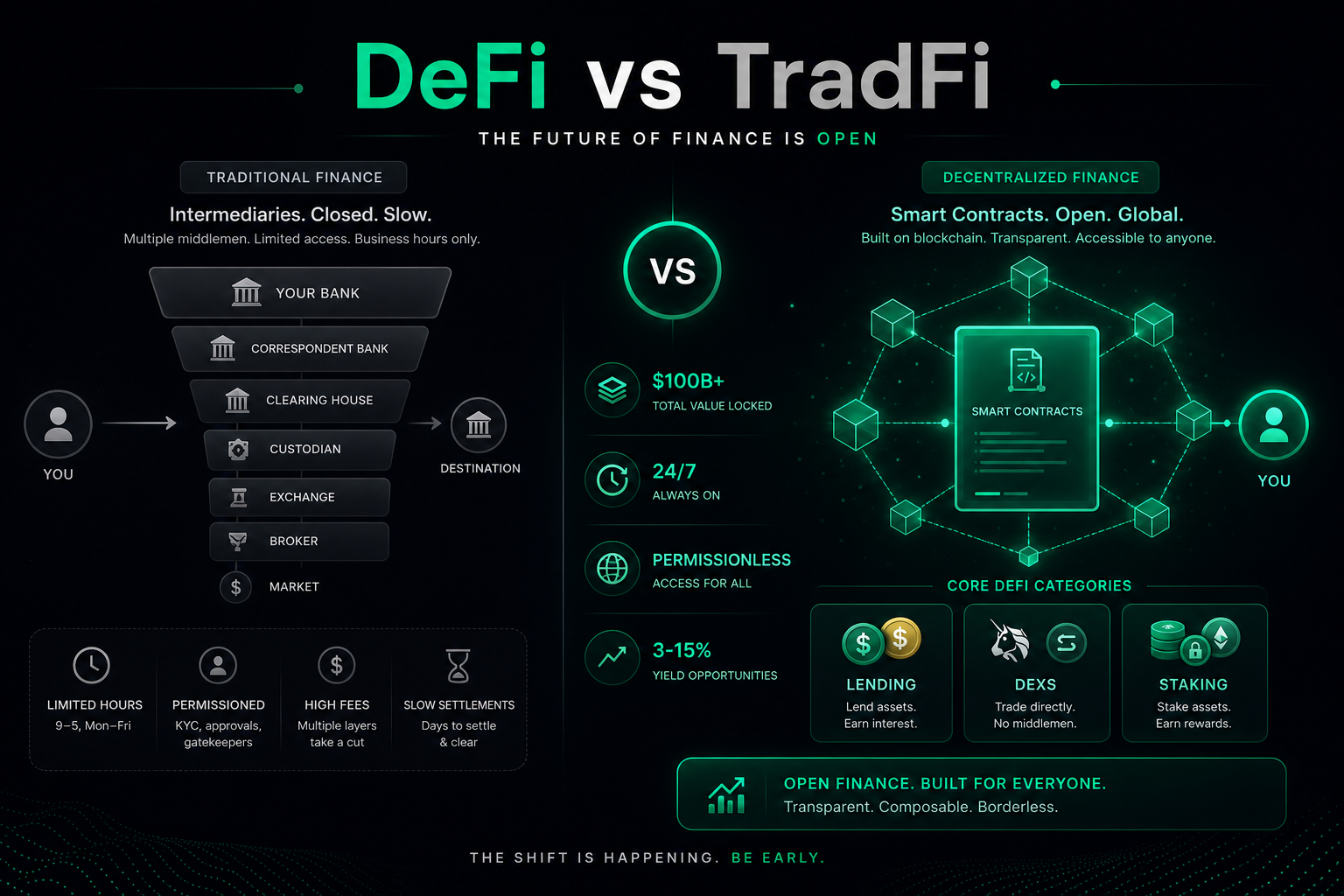
DeFi (Decentralized Finance) is a financial ecosystem built on blockchain that replaces banks, brokers, and other intermediaries with smart contracts. Key facts in 2026:
- What it does: Lending, borrowing, trading, staking, savings, derivatives — without banks or middlemen
- How it works: Smart contracts on blockchains (Ethereum, Solana, others) execute financial agreements automatically
- Scale: Over $100 billion in total value locked (TVL) across hundreds of protocols
- Top categories: Liquid staking, lending, DEXs, restaking, and stablecoin/CDP protocols
- Access: Permissionless — anyone with a crypto wallet and internet can use it 24/7
DeFi offers higher yields and self-custody, but carries real risks: smart contract bugs, hacks, impermanent loss, and volatility.
Trade and earn in Solana DeFi via GraphDex
Key Takeaways
- DeFi recreates traditional finance using smart contracts instead of banks and brokers.
- The ecosystem manages over $100 billion TVL across lending, DEXs, staking, and more.
- DeFi offers 3-15% yields and self-custody, but carries real smart contract and market risks.
- It's permissionless and global — anyone with a wallet can participate, 24/7.
What Is DeFi?
DeFi — short for Decentralized Finance — is a collection of financial applications built on blockchain networks that recreate traditional financial services without banks, brokers, or other centralized intermediaries.
In traditional finance, banks and institutions act as intermediaries: they custody your money, decide who gets loans, set interest rates, and process transactions. DeFi replaces these institutional intermediaries with smart contracts — self-executing code on a blockchain that enforces the terms of an agreement automatically when conditions are met.
The simple version: instead of a bank holding your money and a banker deciding your loan, smart contracts hold your collateral, calculate interest, and execute liquidations — all without human intervention or institutional approval. You interact directly with the protocol from your own wallet, retaining control of your funds.
DeFi runs across multiple blockchains. Ethereum pioneered programmable smart contracts and remains the largest DeFi ecosystem with around 68% of TVL. Solana has emerged as a major DeFi hub with its low fees and fast finality. Other significant chains include BNB Chain, Base, Arbitrum, and Polygon. The ecosystem now manages over $100 billion in total value locked across hundreds of protocols.
How DeFi Works
DeFi's mechanics are elegant once you understand the core building block: the smart contract.
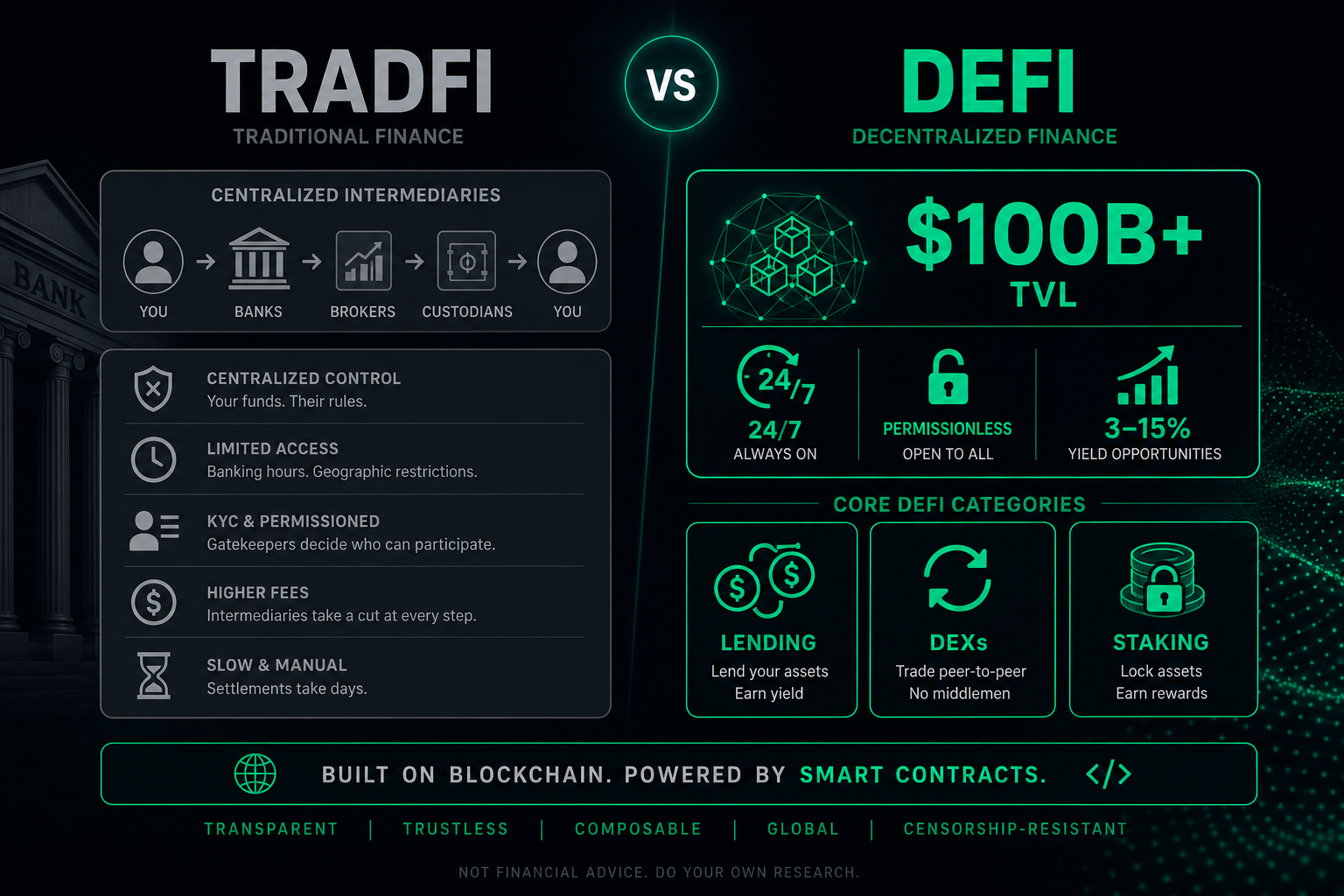
Smart contracts are self-executing programs stored on a blockchain that automatically enforce agreement terms when predefined conditions are met. In DeFi, smart contracts replace the institutional counterparty. A lending protocol's smart contract holds collateral, calculates interest rates, and executes liquidations — without human intervention. Ethereum introduced programmable smart contracts at scale; today they run across dozens of blockchain networks supporting DeFi activity.
The user experience is direct: you connect a crypto wallet (like Phantom on Solana or MetaMask on Ethereum) to a DeFi protocol's interface, choose an action — lend, borrow, swap, stake — and confirm the transaction. The smart contract executes automatically. There's no account to create, no KYC, no approval process. Your wallet is your account.
The transparency is built into the design. Because everything runs on a public blockchain, every transaction, every reserve, every smart contract is verifiable by anyone. You can audit a protocol's code and reserves yourself, rather than trusting an institution's word.
The trade-off is responsibility. With no intermediary to call when something goes wrong, you bear full responsibility for security, mistakes, and risk. There's no FDIC insurance, no fraud protection, no customer service to reverse a wrong transaction.
The Major DeFi Categories
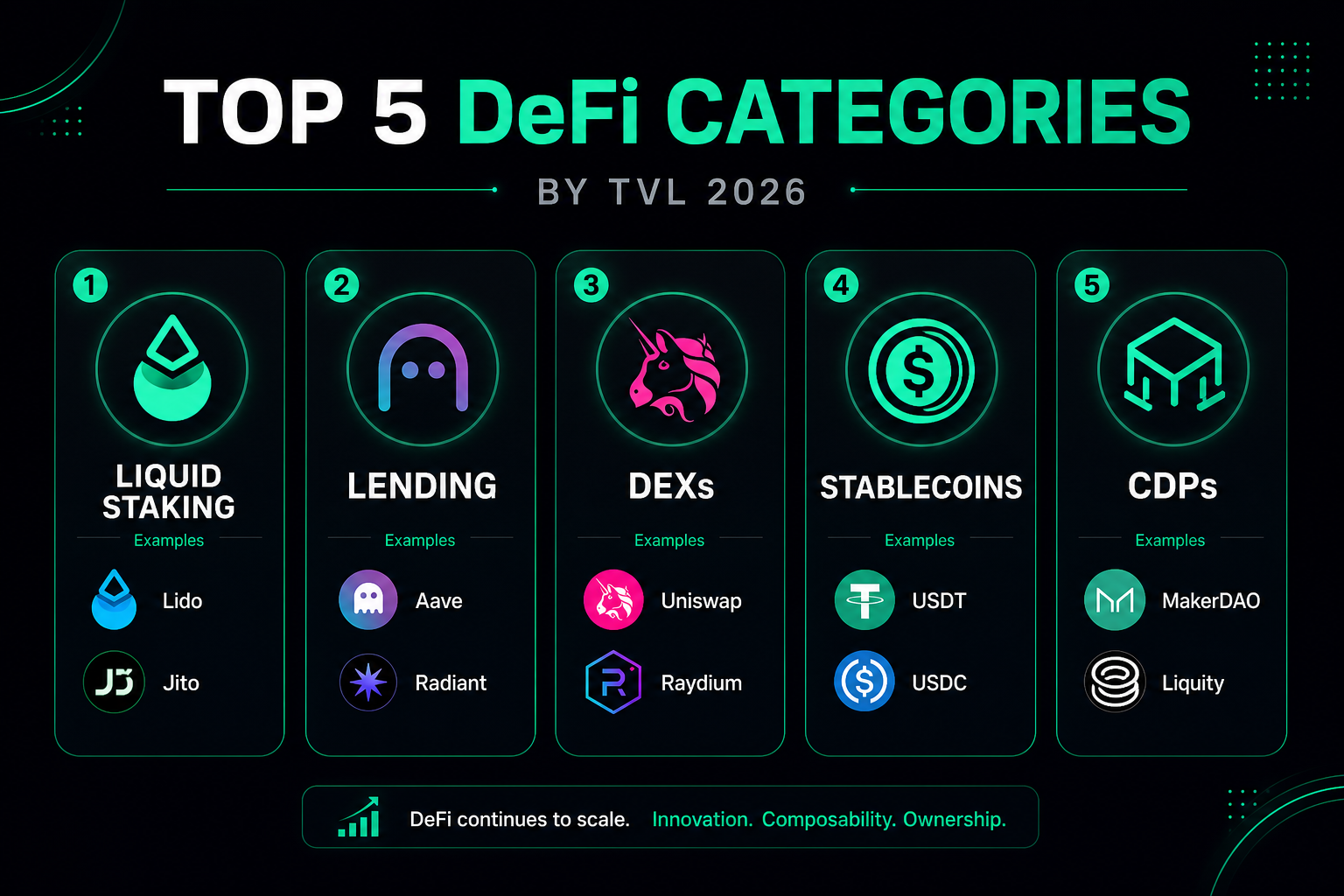
DeFi has matured into several major categories, each replacing a specific traditional finance function. Understanding them helps you navigate the ecosystem.
| Category | What It Does | Examples |
|---|---|---|
| DEXs (Decentralized Exchanges) | Swap tokens directly from your wallet | Uniswap, Raydium, Orca |
| Lending & Borrowing | Lend crypto to earn interest, or borrow against collateral | Aave, Compound, Kamino |
| Liquid Staking | Stake tokens while keeping liquid claim | Lido, Jito, Marinade |
| Restaking | Re-stake already-staked tokens for additional yield | EigenLayer |
| Stablecoins & CDPs | Algorithmic dollar tokens; collateralized debt | MakerDAO/DAI, Curve crvUSD |
DEXs (Decentralized Exchanges) let you swap tokens directly from your wallet without an order book. They use liquidity pools and automated market makers (AMMs) to price trades algorithmically. Solana DEXs include Raydium, Orca, and Meteora; Ethereum's dominant DEX is Uniswap.
Lending & Borrowing protocols replace banks: you deposit crypto to earn interest (typically 2-8% on stablecoins) while borrowers can take loans against collateral they post. Aave is the largest lending protocol; on Solana, Kamino and similar protocols lead the segment.
Liquid Staking — the largest DeFi category by TVL in 2026 — lets you stake tokens (earning network rewards) while receiving a tradeable derivative token representing your stake. You earn staking yield while keeping your capital liquid. Lido dominates Ethereum; Jito and Marinade lead on Solana.
Restaking is a newer category where already-staked tokens are restaked to secure additional protocols (oracles, bridges, new networks), multiplying yields. EigenLayer pioneered this.
Stablecoins and CDPs create dollar-pegged tokens (USDC, USDT, DAI) and the collateralized-debt protocols backing them. They're the unit of account for most DeFi activity.
DeFi vs Traditional Finance
The contrast between DeFi and TradFi makes the value proposition clearer.
| Feature | DeFi | Traditional Finance |
|---|---|---|
| Intermediaries | Smart contracts | Banks, brokers, custodians |
| Access | Permissionless, 24/7 | Requires accounts, KYC, business hours |
| Custody | You hold your keys | Bank holds your money |
| Yields on stablecoins | 3-15% | 0.5% (savings accounts) |
| Transparency | Fully on-chain, auditable | Limited |
| Insurance | None (FDIC equivalent absent) | FDIC up to $250k |
| Geographic restrictions | Generally none | National regulations |
| Speed | Seconds to minutes | Days for some operations |
The advantages of DeFi are real: higher yields, self-custody, permissionless access, transparency, and global availability. The trade-offs are equally real: no insurance, full personal responsibility, smart contract risk, and the technical complexity of managing your own wallet.
DeFi isn't a wholesale replacement for traditional finance — it's an alternative system with different strengths and trade-offs. Many users treat the two as complementary, using DeFi for higher yields and self-custody on a portion of their assets while keeping insured deposits in traditional banking.
The Real Risks of DeFi
DeFi's openness brings genuine risks. Understanding them is essential before participating.
Smart contract risk. Smart contracts are code, and code can have bugs. Even well-audited protocols have been exploited. Major hacks have drained hundreds of millions from DeFi protocols. Using established, audited protocols reduces but doesn't eliminate this risk.
Liquidation risk. When you borrow against crypto collateral, a drop in the collateral's price can trigger automatic liquidation — your collateral is sold to cover the loan, often at a loss. Volatile markets amplify this risk.
Impermanent loss. If you provide liquidity to a pool, divergence between the two tokens' prices leaves you with less value than if you'd held them. Volatile pairs can have impermanent loss exceeding the fees earned.
Rug pulls and scams. Anyone can create a token or protocol. Scams targeting new and inexperienced users are common, especially in memecoin and yield-farming spaces.
Phishing and security errors. A single compromised seed phrase or approval to a malicious contract can drain your wallet. There's no customer service to reverse transactions or recover funds.
Regulatory uncertainty. DeFi exists in a evolving regulatory landscape. Rules vary by jurisdiction and change frequently — check current regulations for your situation.
Volatility. Crypto prices can move dramatically. Even stablecoins have had depegging incidents (Terra/Luna collapsed in 2022, erasing $40B+).
The honest takeaway: DeFi offers significant opportunities, but it requires self-education and accepting full responsibility. The investors who succeed in DeFi treat it with respect: starting small, using audited protocols, never investing more than they can afford to lose, and continuing to learn.
Getting Started With DeFi
For beginners wanting to explore DeFi, a sensible path:
Step 1: Get a non-custodial wallet. For Solana, Phantom or Solflare; for Ethereum, MetaMask. These are wallets you control — never share your seed phrase with anyone.
Step 2: Fund your wallet. Buy crypto on a centralized exchange (Coinbase, Kraken, Binance) and withdraw to your wallet. Start with small amounts you can afford to lose entirely while learning.
Step 3: Start with a simple use case. Swap one token for another on a major DEX (Uniswap on Ethereum, Raydium or Orca on Solana). This teaches you wallet mechanics without significant risk.
Step 4: Try lending or liquid staking. Once comfortable with swaps, deposit stablecoins to a major lending protocol (Aave) or stake SOL with a liquid staking protocol (Jito, Marinade) to earn yield. Keep amounts small initially.
Step 5: Learn before adding complexity. Yield farming, liquidity provision, leverage, derivatives — these add powerful tools but also significant risk. Don't use what you don't understand.
Step 6: Diversify and manage risk. Don't put everything in one protocol. Use established, audited platforms. Keep a portion in cold storage or major exchanges. Never share seed phrases.
The biggest mistake new DeFi users make is rushing in with too much capital before understanding the mechanics. Start small, learn the tools, and scale as you gain confidence.
Start your DeFi journey safely on GraphDex
How GraphDex Fits Into DeFi
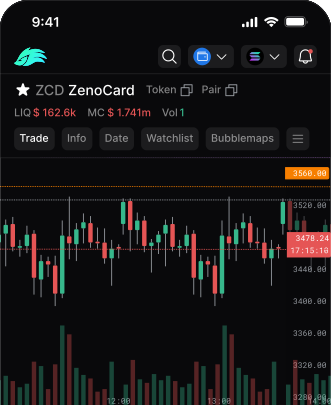
For Solana-focused DeFi users, GraphDex consolidates several DeFi activities into one terminal:
- DEX trading with smart routing across Solana's AMMs (Raydium, Orca, Meteora) and MEV protection
- Staking up to 17% APY on stablecoins and SOL — among the most competitive yields in DeFi
- Token discovery via the Pulse feed for finding new opportunities early
- Safety tools including Bubble Maps to spot rug risk before trading
- Prediction market access via Polymarket integration
- Non-custodial via Privy architecture — your funds stay in your wallet, no seed phrase
This consolidation matters because DeFi power users often juggle multiple platforms — one for DEX trading, another for staking, another for analytics. Having these in one non-custodial terminal preserves the time and capital efficiency that fragmentation otherwise wastes.
For Solana-native traders, GraphDex represents an integrated way to participate in DeFi: trade, stake, predict, and earn in one place. For broader DeFi exposure (Ethereum, restaking, advanced strategies), you'll still want dedicated tools — but for the active Solana trading and earning that drives much of 2026 DeFi, integration wins.
Get started with integrated Solana DeFi on GraphDex
Frequently Asked Questions
What is DeFi in simple terms? DeFi (Decentralized Finance) is financial services — lending, trading, saving, earning interest — built on blockchain with smart contracts replacing banks and brokers. You interact directly from your crypto wallet, retain custody of funds, and access 24/7 without account creation or KYC. The ecosystem manages over $100 billion TVL in 2026.
Is DeFi safe? DeFi carries real risks: smart contract bugs, hacks, liquidations, impermanent loss, scams, and volatility. There's no FDIC insurance. However, using established and audited protocols, starting small, and never investing more than you can afford to lose, makes participation manageable. Education and caution matter more than in traditional finance.
How does DeFi make money? DeFi yields come from real protocol activity: lenders earn interest from borrowers (2-8% on stablecoins), liquidity providers earn trading fees, stakers earn network rewards (often 5-15%), and protocols may distribute tokens. Yields are higher than banks (0.5%) but reflect higher risk, not free money.
What's the difference between DeFi and CeFi? CeFi (Centralized Finance) uses centralized companies (Coinbase, Binance) that hold your funds and process transactions. DeFi uses smart contracts on public blockchains with you holding your own keys. CeFi offers customer service and easier UX; DeFi offers self-custody, higher yields, and permissionless access. Each has trade-offs.
Do I need to know how to code to use DeFi? No. Most DeFi protocols have user-friendly interfaces. You connect a wallet, select an action, and confirm. Some technical literacy helps — understanding wallets, gas fees, slippage, and basic security — but coding isn't required. Start with simple actions like swaps before exploring complex strategies.
What is TVL in DeFi? TVL (Total Value Locked) is the total value of crypto deposited in DeFi protocols' smart contracts — whether lending, staking, providing liquidity, or other uses. It's the primary metric for measuring a protocol's or sector's size. The DeFi ecosystem holds over $100 billion in TVL in 2026; high TVL signals user trust and liquidity.
Which is better, Ethereum or Solana for DeFi? Ethereum has the largest DeFi ecosystem (~68% of TVL), the deepest liquidity, and the most mature protocols. Solana has lower fees, faster transactions, and growing activity especially in active trading, memecoins, and recent DeFi protocols. Many users use both — Ethereum for large positions and blue-chip DeFi, Solana for active trading and lower-fee operations.
About This Guide
This guide is published by the GraphDex Research team — analysts and traders building the infrastructure for digital asset trading on Solana. Our content is based on live DeFi data, current market figures, and hands-on experience.
Sources & data: TVL figures, yields, and protocol details reflect publicly available information as of 2026 and change frequently. DeFi carries significant risk of loss. This guide is educational and not financial advice — always do your own research and never invest more than you can afford to lose.
GraphDex is the infrastructure for digital asset trading — trade, predict, and earn in one place. Learn more at graphdex.io.
Last reviewed: May 2026 · GraphDex Research
The infrastructure for digital asset trading. Trade, predict, stake, repeat. graphdex.io