By GraphDex Research · Reviewed for accuracy May 2026
Quick Answer
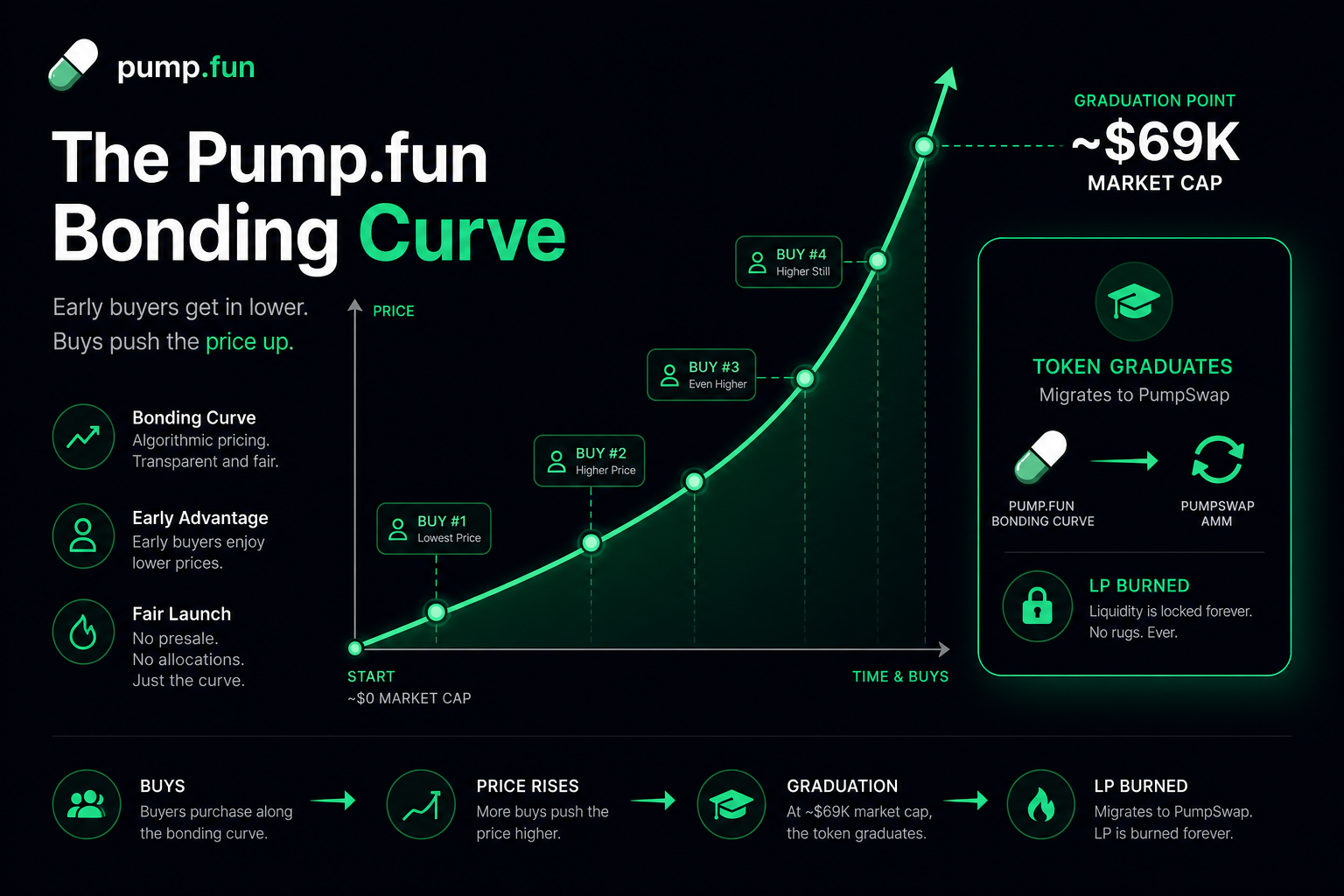
Pump.fun is a Solana memecoin launchpad that lets anyone create a token in minutes with no coding, using a bonding curve for fair launches. How it works:
- Create: Anyone launches a token in ~60 seconds for about $2 — no presale, no team allocation
- Bonding curve: The price rises automatically as people buy; early buyers pay less
- Graduation: When a token hits ~$69,000 market cap, liquidity migrates to PumpSwap (a DEX) and LP tokens are burned
- Fees: ~1% on bonding curve trades, lower after graduation
- PUMP token: Launched via a $1.3B ICO in July 2025, with a buyback-and-burn model
Reality check: only about 1% of tokens graduate. Most fail or are dumped by creators. Trade carefully.
Discover and trade new Solana tokens on GraphDex
Key Takeaways
- Pump.fun lets anyone launch a Solana memecoin in ~60 seconds for ~$2, with no coding or presale.
- A bonding curve sets the price automatically; tokens "graduate" to PumpSwap at ~$69K market cap.
- Only about 1% of tokens graduate — most fail, and creators can still dump their holdings.
- The PUMP token launched via a $1.3B ICO in July 2025 with a buyback-and-burn model.
What Is Pump.fun?
Pump.fun is a permissionless memecoin launchpad built on Solana. Launched in January 2024, it lets anyone create a fully functional token in under sixty seconds for about $2 in fees — no coding, no liquidity bootstrapping, no presale, no team allocation.
It has become the epicenter of Solana's memecoin ecosystem. Since launch, Pump.fun has powered over 11.9 million tokens and generated $800M+ in revenue, becoming a major driver of Solana network activity. Its core value is accessibility and fairness: every launch is a "fair launch" on a bonding curve, giving all users equal early access and aiming to prevent predatory presales and insider allocations.
The platform functions as both a token launchpad and a trading environment. You can create a coin by simply providing a name, symbol, description, and image — the platform automatically generates the smart contract and deploys it on Solana. Built on Solana's low fees and high speed, it enables affordable, rapid token creation and trading.
The appeal and the danger are two sides of the same coin: the same accessibility that lets a creative meme become a viral token also floods the ecosystem with thousands of low-quality and scam tokens daily.
How the Bonding Curve Works
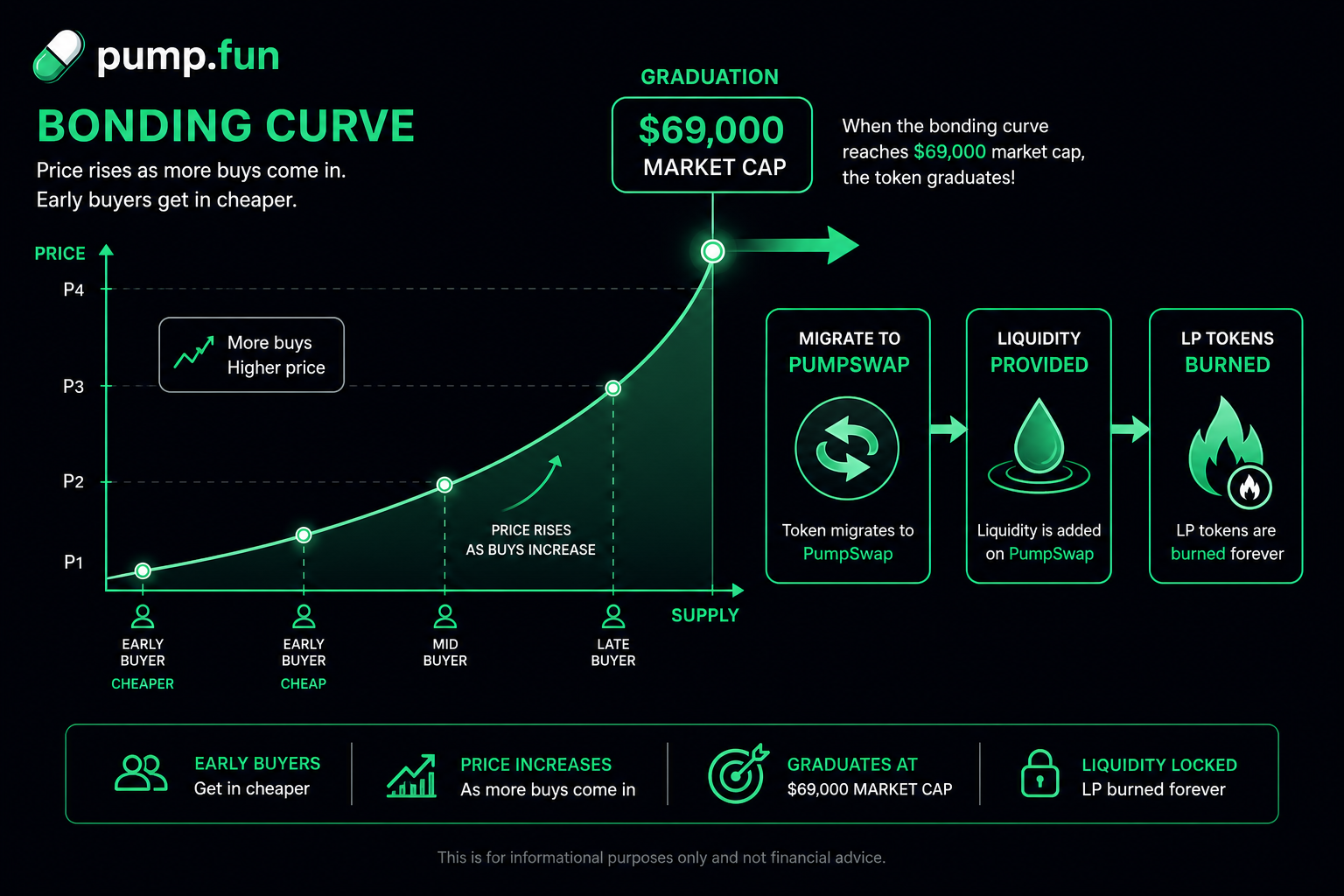
The bonding curve is Pump.fun's key innovation — understanding it is essential to trading there.
When a coin is created, its price follows a mathematical curve that increases as people buy. There's no traditional liquidity pool to seed — instead, the curve automates liquidity provision and price discovery:
- Early buyers pay less. The first purchases happen at the bottom of the curve.
- Each buy raises the price. As more SOL flows in, the price climbs along the curve.
- Each sell lowers the price. The curve works both ways.
- No liquidity setup needed. The curve provides built-in liquidity, so tokens are instantly tradable from creation.
This creates a transparent, automated pricing mechanism. The rising price as people buy is easily read as a signal of growing community consensus, which further drives participation — a self-reinforcing dynamic that can fuel rapid pumps (and equally rapid dumps).
Importantly, on a fair-launch bonding curve, the creator must buy in like everyone else — there are no pre-allocated tokens handed to the team for free. This is the "fairness" Pump.fun emphasizes, though as we'll see, it doesn't eliminate all risk.
What Is "Graduation"?
"Graduation" is a key Pump.fun concept. When a token's market cap reaches a set threshold — around $69,000 — its liquidity automatically migrates from the bonding curve to PumpSwap, Pump.fun's decentralized exchange.
At graduation:
- Liquidity moves to a PumpSwap pool (the "canonical pool"), ensuring continuous tradeability
- LP tokens are burned, which prevents the classic liquidity-pull rug for graduated tokens
- The token becomes tradeable like any standard Solana DEX token
Graduation matters because it signals a token reached enough buying momentum to "make it" beyond the launchpad. But here's the critical reality: only about 1% of tokens graduate. The vast majority never reach the threshold — they stall on the bonding curve, get dumped, or fade to zero.
This 1% graduation rate is the single most important statistic for traders to internalize. The overwhelming majority of Pump.fun tokens fail, which is why disciplined risk management and profit-taking matter enormously.
Pump.fun Fees Explained
Pump.fun uses a fee-based revenue model rather than token allocations. The fee structure:
Bonding curve phase: Approximately 1% (historically 1.25% cited in some analyses) on trades while the token is on the bonding curve. This fee is collected in SOL (or USDC for USDC-paired tokens).
After graduation (PumpSwap): Lower fees — around 0.25%, of which a portion goes to the liquidity pool and a smaller portion to Pump.fun.
Creator fee: Since May 13, 2025, on every trade the creator receives a portion of the total fees (the "Creator fee"), incentivizing creators to drive volume.
Token creation: Roughly $2 (around 0.02 SOL) to launch.
A notable 2026 update: as of May 21, 2026, token creators can use USDC as the paired token instead of SOL, with slightly different fees. This broadened the platform beyond SOL-only pairing.
The fee model means Pump.fun earns from activity rather than dumping a pre-mined token supply — aligning platform revenue with usage.
The PUMP Token
In July 2025, Pump.fun launched its native token, PUMP, via a major ICO. Key facts:
- ICO: Raised approximately $1.3 billion in July 2025, with tokens fully unlocked
- Supply: 1 trillion total tokens
- Utility: Platform incentives, potential governance, and ecosystem support
- Buyback-and-burn: A significant portion of platform fees buys back and burns PUMP, linking platform usage to token scarcity
The token's price history has been rocky. PUMP peaked at roughly $3.1 billion market cap in September 2025 before declining to around $1.2 billion. It has traded below its $0.004 ICO price, meaning public sale participants have been underwater. The team's ongoing buyback program (reportedly funded by $1M+ daily revenue) hasn't reversed the downtrend but may be establishing a price floor.
Upcoming catalysts include a planned PUMP incentive program (rewarding traders with PUMP for activity), potential expansion to EVM-compatible chains, and a $3 million Pump Fund hackathon in 2026. As with any token, treat these as speculation — this is not investment advice.
How to Trade on Pump.fun: Step by Step
For those wanting to trade Pump.fun tokens, the general process:
Step 1: Get a Solana wallet with some SOL for trades and fees.
Step 2: Find a token — browse Pump.fun directly, or use a token discovery tool that surfaces new launches in real time (catching tokens early matters on the bonding curve).
Step 3: Check safety first — before buying, verify the token isn't an obvious scam. Check holder distribution, whether the creator holds a large share, and bundling. (More on this below.)
Step 4: Buy — enter your SOL amount, set slippage, and confirm. Early buys on the curve get lower prices.
Step 5: Set a profit plan — decide in advance what price or multiple you'll sell at. The curve can dump as fast as it pumps.
Step 6: Sell — most experienced traders take profit aggressively rather than holding for graduation, since only ~1% graduate. Partial profit-taking on the way up is statistically sounder than holding for the rare graduation.
The recurring theme among experienced Pump.fun traders: take profit, don't get greedy, and assume most tokens will fail.
The Risks of Pump.fun
Pump.fun is, statistically, one of the most brutal corners of crypto. The risks are severe and worth stating plainly.
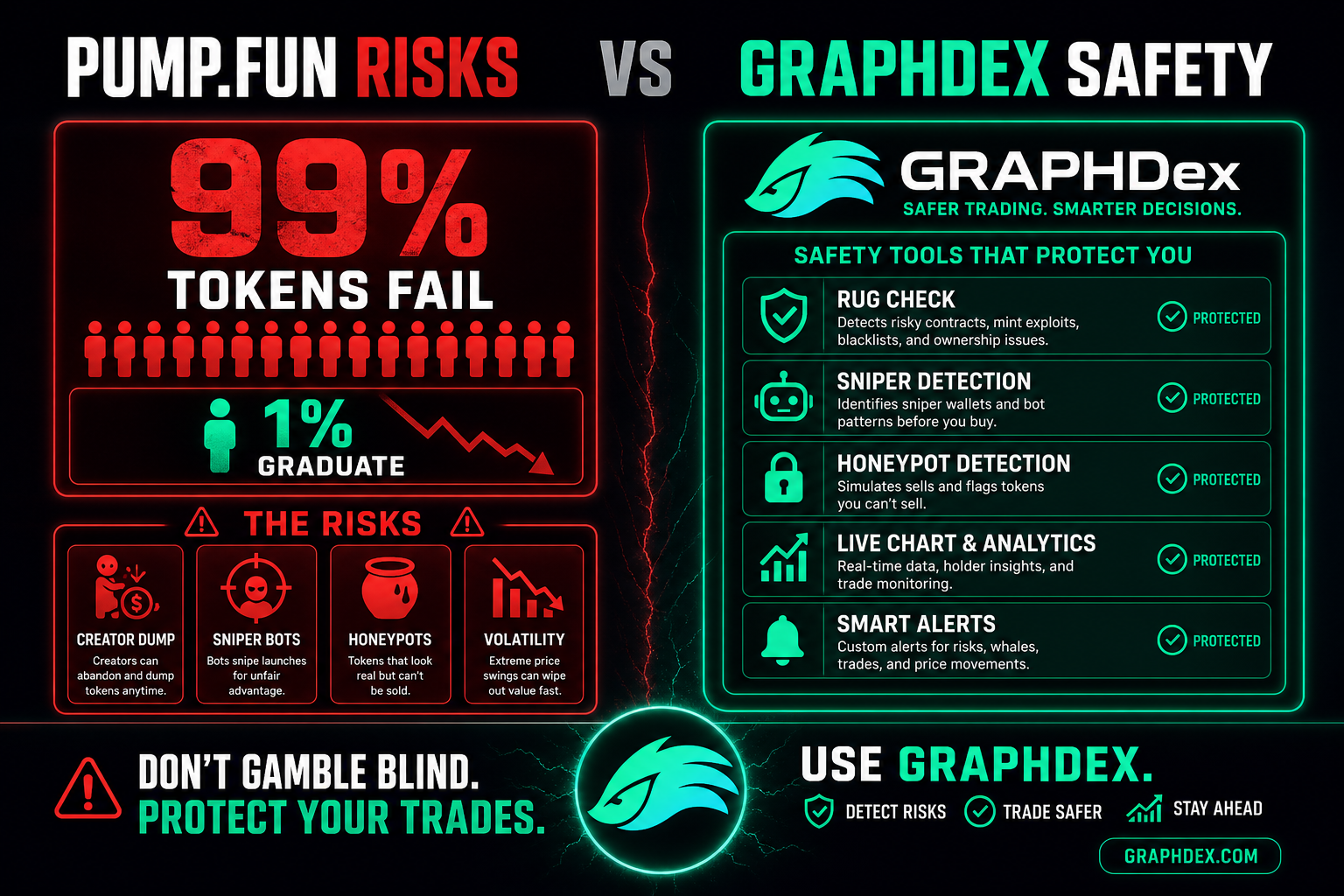
~99% of tokens fail. Only about 1% graduate. The vast majority go to zero. For every story of turning $50 into $50,000, there are thousands of quiet losses.
Creators can still dump. While the bonding curve and LP burning prevent classic liquidity-pull rugs for graduated tokens, creators can still dump their own holdings immediately after launch, crashing the price. Fair launch doesn't mean fair behavior.
Sniper bots compete with you. Bots (running through tools like Photon, BullX, and others) snipe new launches in the first seconds, often getting better entry prices than manual traders.
Honeypots and scams. Despite the fair-launch model, the flood of tokens includes honeypots, bundled-wallet schemes, and pump-and-dumps. The transparency tools (top-holder percentages) display risk but don't prevent the behavior.
Extreme volatility. The bonding curve can pump and dump within minutes. Positions can lose most of their value in seconds.
Emotional/addictive dynamics. The gamified, fast-paced environment encourages impulsive, emotional trading — a recipe for losses.
The honest takeaway: Pump.fun can be profitable for disciplined traders who manage risk ruthlessly, but it destroys the capital of most who treat it like a lottery. Never invest more than you can afford to lose entirely.
Check token safety before trading with GraphDex Bubble Maps
How GraphDex Helps with Pump.fun Trading
For traders navigating Pump.fun, the right tools dramatically improve safety and speed:
Token discovery (Pulse feed). GraphDex's Pulse feed surfaces new tokens in real time as they're created — catching launches early, when bonding-curve entry prices are lowest.
Safety analysis (Bubble Maps). Before buying, GraphDex's Bubble Maps visualize holder distribution, instantly revealing bundled wallets and creator concentration — the warning signs that a token will dump. This addresses the "creators can dump" and "bundling" risks directly.
MEV protection. Sniping new Pump.fun launches exposes you to sandwich bots. GraphDex's built-in MEV protection reduces this risk.
Integrated execution. Discover, check safety, and trade in one non-custodial interface — faster than switching between Pump.fun, a rug checker, and a separate trading tool.
Because GraphDex combines these with copytrading, AI signals, and staking up to 17% APY, you can trade Pump.fun tokens within a complete environment that prioritizes both speed and safety. In a space where 99% of tokens fail, having integrated safety analysis isn't a luxury — it's how you avoid the worst losses.
Trade Pump.fun tokens safer on GraphDex
Frequently Asked Questions
What is Pump.fun? Pump.fun is a Solana memecoin launchpad, launched in January 2024, that lets anyone create a token in ~60 seconds for about $2 with no coding. It uses a bonding curve for fair-launch price discovery, with tokens "graduating" to the PumpSwap DEX at ~$69K market cap. It has powered 11.9M+ tokens and $800M+ in revenue.
How does the Pump.fun bonding curve work? When a token launches, its price follows a mathematical curve that rises as people buy and falls as they sell. Early buyers pay less; each purchase raises the price. The curve provides built-in liquidity, so tokens are instantly tradable with no liquidity pool to seed. At ~$69K market cap, liquidity migrates to PumpSwap.
What does it mean when a token "graduates" on Pump.fun? Graduation is when a token reaches ~$69K market cap and its liquidity migrates from the bonding curve to PumpSwap (a DEX), with LP tokens burned. This signals enough momentum to trade beyond the launchpad. Critically, only about 1% of tokens graduate — most never reach the threshold.
What are Pump.fun's fees? Roughly 1% on bonding curve trades (collected in SOL or, since May 2026, USDC), dropping to around 0.25% after graduation on PumpSwap. Creators earn a portion of fees on their tokens (since May 2025). Creating a token costs about $2 (0.02 SOL).
Is the PUMP token a good investment? PUMP launched via a $1.3B ICO in July 2025, peaked at ~$3.1B market cap in September 2025, then declined to ~$1.2B, trading below its ICO price. A buyback-and-burn program funds purchases from platform revenue. This is not investment advice — PUMP is volatile and speculative; do your own research.
Is Pump.fun safe? Pump.fun's bonding curve prevents some rug types (LP is burned at graduation), but it's statistically brutal — about 99% of tokens fail, creators can dump holdings, sniper bots compete with you, and scams are common. It can be profitable for disciplined traders managing risk, but most lose. Never invest more than you can afford to lose.
How can I trade Pump.fun tokens safely? Check token safety before buying (holder distribution, creator concentration, bundling — tools like GraphDex Bubble Maps help), set a profit plan in advance, take profit aggressively rather than holding for the rare graduation, use MEV protection, and start small. Treat most tokens as likely to fail.
About This Guide
This guide is published by the GraphDex Research team — analysts and traders building the infrastructure for digital asset trading on Solana. Our content is based on live platform data, current market figures, and hands-on experience with the platforms covered.
Sources & data: Platform statistics, fees, and token figures reflect publicly available information as of 2026 and may change. Memecoin trading carries extreme risk of total loss. This guide is educational and not financial advice — always do your own research and never invest more than you can afford to lose.
GraphDex is the infrastructure for digital asset trading — trade, predict, and earn in one place. Learn more at graphdex.io.
Last reviewed: May 2026 · GraphDex Research
The infrastructure for digital asset trading. Trade, predict, stake, repeat. graphdex.io