By GraphDex Research · Reviewed for accuracy May 2026
Quick Answer
Solana is a high-performance Layer 1 blockchain designed for speed, scale, and low costs. Key facts in 2026:
- Founders: Anatoly Yakovenko (CEO) and Raj Gokal (COO); whitepaper 2017, mainnet March 2020
- Speed: ~400ms block times, sub-second finality, real-world TPS of 1,000-4,000+ (theoretical max 65,000)
- Fees: Under $0.001 per transaction
- Native token: SOL — ~600M supply, ~65% staked, 7-8% staking APY, ~1,400 active validators
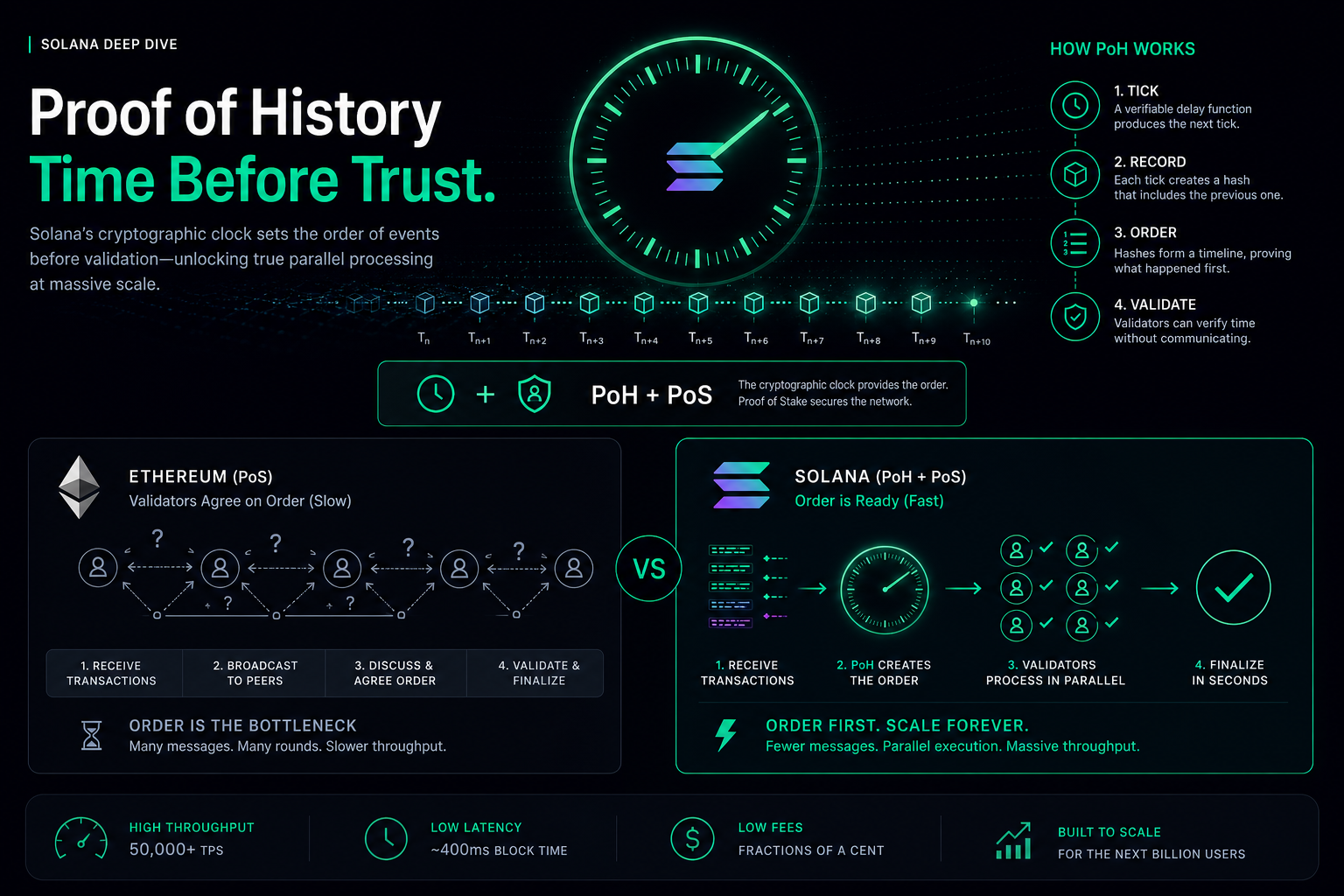
- Innovation: Proof of History — a cryptographic clock that orders transactions before consensus, enabling massive parallel processing
- 2026 upgrades: Firedancer (live since December 2025, targeting 1M+ TPS) and Alpenglow (consensus overhaul, finality to ~150ms)
Solana powers DEXs, memecoins, prediction markets, and the most active on-chain trading. It's the chain for fast, cheap, high-velocity activity.
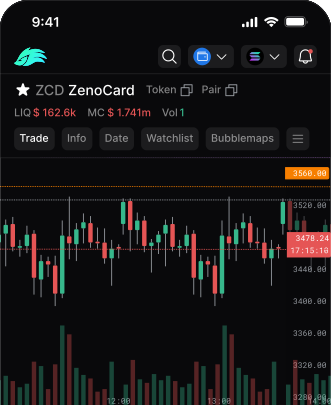
Trade on Solana with a complete terminal on GraphDex
Key Takeaways
- Solana is a high-speed Layer 1 blockchain with ~400ms blocks and fees under $0.001.
- Proof of History plus Proof of Stake enables real-world throughput far beyond Ethereum L1.
- 2026 upgrades (Firedancer, Alpenglow) target 1M+ TPS and sub-200ms finality.
- Solana leads stablecoin volume ($650B+ in February 2026) and active on-chain trading.
What Is Solana?
Solana is a Layer 1 blockchain that prioritizes speed, low fees, and scale. Where Bitcoin focused on decentralized money and Ethereum on programmable smart contracts, Solana set out to solve a different problem: building a blockchain fast and cheap enough to support real-world applications, from active DeFi trading to consumer-grade apps.
Solana's story began with a 2017 whitepaper from Anatoly Yakovenko, whose research at Qualcomm focused on network synchronization — work that later inspired Proof of History. Raj Gokal joined as co-founder and COO. Greg Fitzgerald became the lead engineer behind Solana's early architecture. The team's goal was clear: overcome Ethereum's scaling limits and create a blockchain execution layer fast enough to handle institutional-grade activity.
After three years of research and development, Solana's mainnet launched in March 2020. The 2021 cycle brought rapid adoption as DeFi and NFTs grew. The 2022 FTX crash hurt market confidence (Sam Bankman-Fried had been a high-profile Solana booster). But from 2023 through 2026, Solana steadily strengthened — fixing reliability issues, attracting institutional partners, and shipping major upgrades. By 2026, Solana has emerged as one of the most active blockchains by transaction volume and on-chain economic activity.
Solana at a Glance: Key Stats in 2026
| Metric | Value |
|---|---|
| Mainnet launch | March 2020 |
| Co-founders | Anatoly Yakovenko, Raj Gokal |
| Consensus | Proof of History + Proof of Stake |
| Native token | SOL |
| Total SOL supply | ~600 million (inflationary, ~4.7% annual rate) |
| SOL staked | ~65% of circulating supply |
| Staking yield | 7-8% APY |
| Active validators | ~1,400 |
| Block time | ~400ms |
| Real-world TPS | 1,000-4,000 (peaks 6,000+) |
| Theoretical max TPS | 65,000 |
| Average transaction fee | Under $0.001 |
| Stablecoin volume (Feb 2026) | $650 billion (highest of any chain) |
| Daily transactions | 70 million+ |
| Daily active wallets | 2.2 million+ |
The combination of sub-second blocks, near-zero fees, and high real-world throughput makes Solana the leading chain for active trading, memecoins, payments, and time-sensitive applications.
How Solana Works: Proof of History Explained
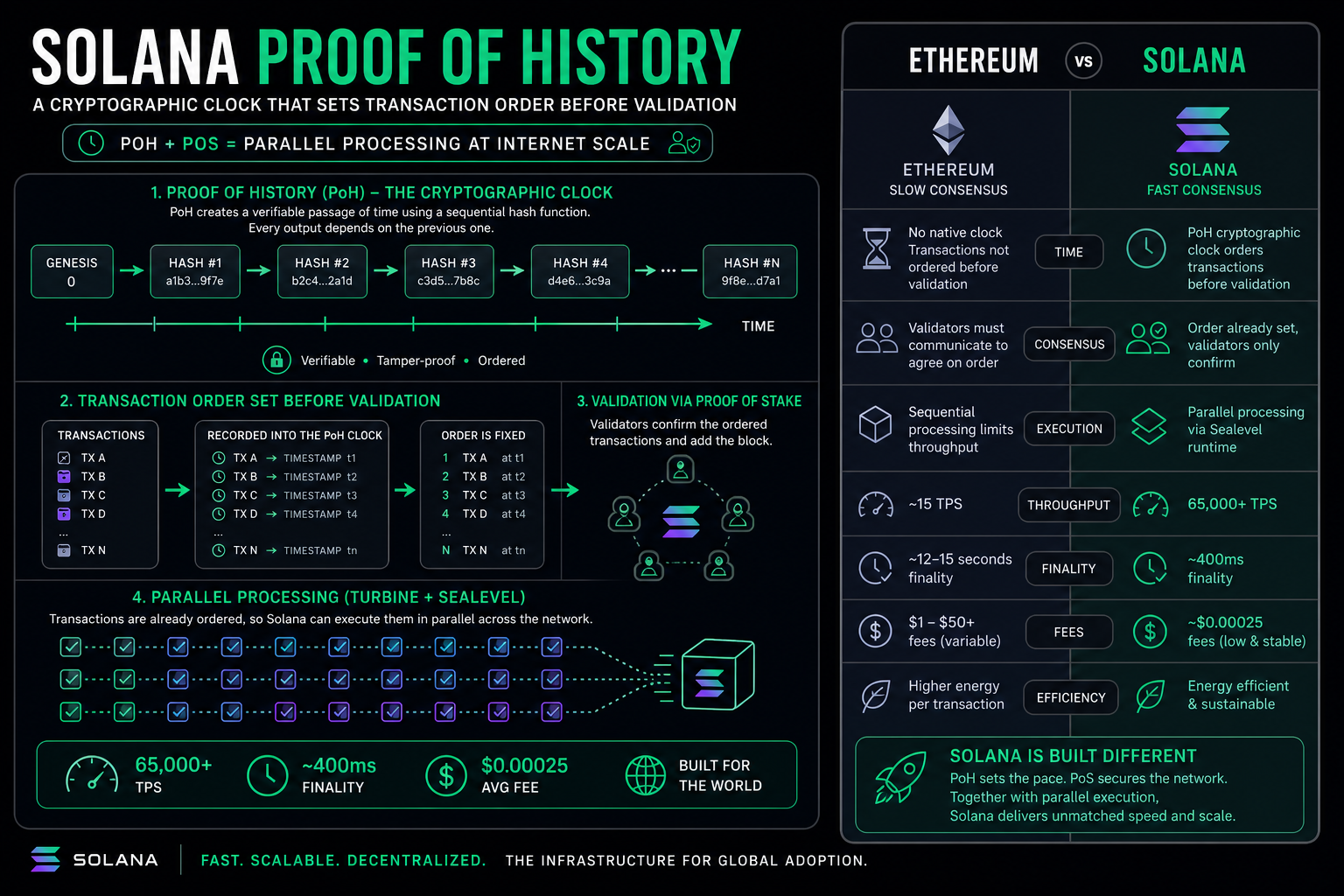
Solana's core technical innovation is Proof of History (PoH) — a cryptographic clock that timestamps transactions in order before validators process them.
Here's why this matters. Most blockchains spend significant resources on validators agreeing about the order of transactions. Bitcoin and Ethereum use slow, coordination-heavy processes for this. Solana removes the problem by establishing time itself as a verifiable, ordered sequence — using a cryptographic function that proves how much time has passed and in what order events occurred.
Think of PoH as a built-in timekeeper. Each transaction is timestamped into a global, verifiable sequence before validators process anything. Because the ordering is already established, validators can focus on processing — not coordinating. The result: massive parallel processing of transactions that other chains process sequentially.
PoH works alongside Proof of Stake (PoS) for security. Validators stake SOL to participate in consensus and earn rewards. The combination of PoH for ordering plus PoS for validation gives Solana its speed (block times of ~400ms) and finality (sub-second to ~2.5 seconds) without sacrificing decentralization to the same degree as some pure-speed alternatives.
This is why Solana can handle thousands of TPS sustained while Ethereum L1 handles 15-20 — the architecture eliminates the coordination overhead that limits older chains.
SOL: The Native Token
SOL is Solana's native cryptocurrency, used for transaction fees, staking, and governance. Key tokenomics:
- Total supply: ~600 million SOL (inflationary)
- Inflation rate: ~4.7% annually, decreasing over time toward a long-term target
- Staked supply: ~65% of circulating SOL is staked, securing the network
- Staking yield: 7-8% APY for delegators
- Use cases: Transaction fees, validator staking, governance, and as the unit of account across most Solana DeFi
SOL holders can stake their tokens with validators to earn yield while contributing to network security. Liquid staking protocols (Jito, Marinade) let stakers maintain liquidity — they receive derivative tokens (JitoSOL, mSOL) representing their staked SOL, usable elsewhere in DeFi.
The high staked percentage (~65%) signals strong holder commitment — and significantly reduces effective circulating supply available for trading. Combined with growing demand from DeFi, payments, and institutional activity, this dynamic shapes SOL's market behavior.
The 2026 Upgrades: Firedancer and Alpenglow
Two major upgrades are reshaping Solana's performance trajectory in 2026.
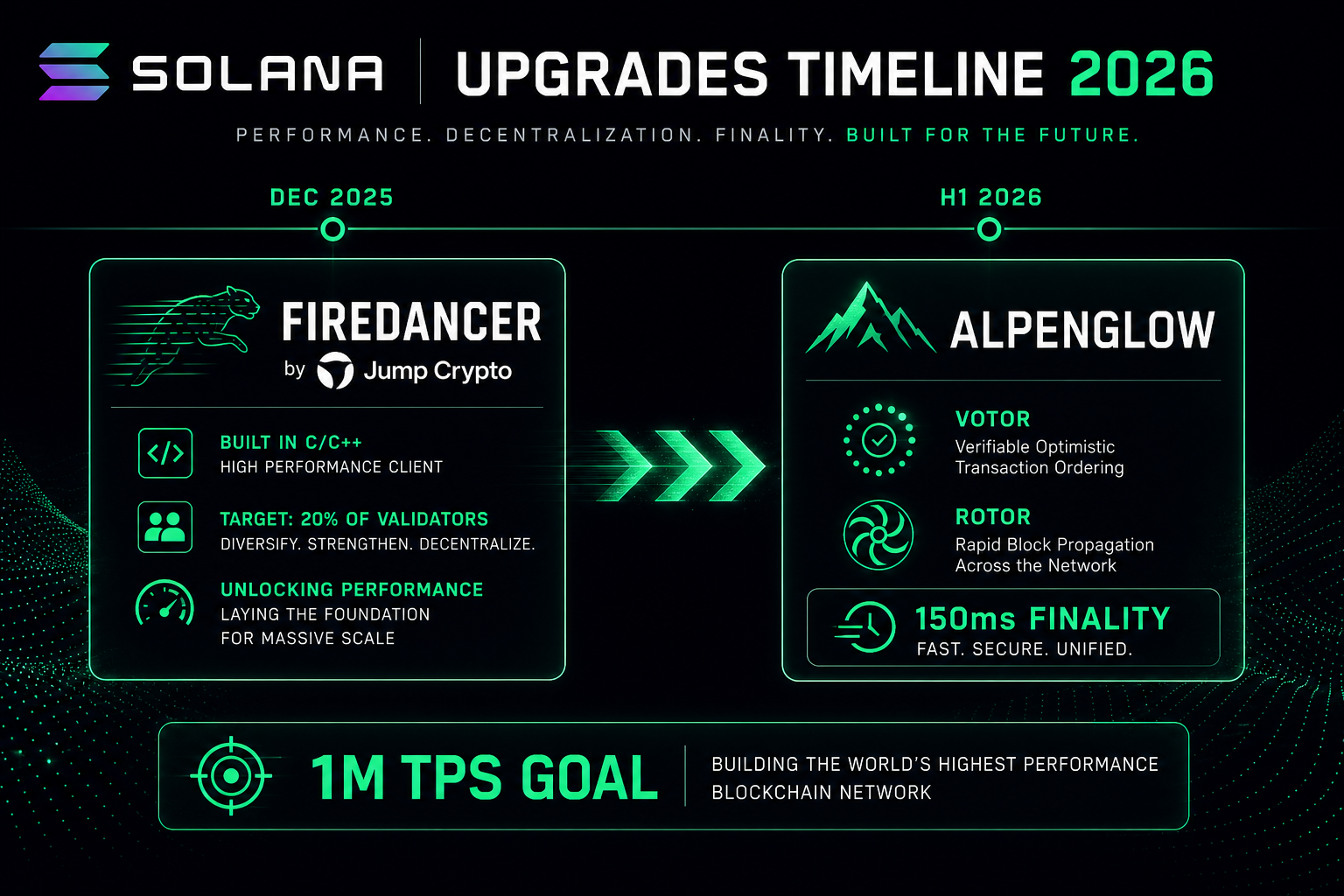
Firedancer is a completely new validator client built from scratch by Jump Crypto in C and C++ — independent from Solana's existing Agave client (written in Rust). It launched on Solana mainnet in December 2025, ending the network's reliance on a single codebase. As of early 2026, Firedancer runs on 20%+ of active validators, with adoption growing.
The "Frankendancer" hybrid client (combining Firedancer's networking with Agave's runtime) demonstrated over 600,000 TPS in live conditions, and full Firedancer targets over 1 million TPS on commodity hardware. The honest reality: this won't deliver 1M TPS to every user tomorrow, but it lays the infrastructure foundation for Solana to scale toward that ceiling as validators adopt and the protocol matures.
Beyond raw speed, Firedancer brings client diversity — meaning a bug crashing Agave wouldn't necessarily affect Firedancer, and vice versa. This addresses Solana's historical reliability concerns. Current uptime now reaches about 99.98%.
Alpenglow is the next major upgrade — a consensus-layer overhaul projected for the first half of 2026. Its core innovations are Votor (off-chain vote aggregation by validators, replacing multi-round serial voting) and Rotor (allowing high-stake validators to route blocks directly, minimizing latency). The target: shrinking block finality from the current 400-800ms to approximately 150ms.
At 150ms finality, Solana's on-chain settlements approach the responsiveness of high-frequency trading systems — enabling use cases (institutional order books, real-time gaming, micropayments, AI agent coordination) that were impractical before.
What Solana Is Used For in 2026
Solana hosts a wide range of applications, but the most active categories are:
DeFi and DEXs. Solana leads weekly DEX volume in 2026 ($11.49B in April 2026, ahead of Ethereum's $7.62B). Major Solana DEXs include Raydium, Orca, and Meteora, all powered by AMMs and liquidity pools. DeFi TVL on Solana reached ~$8-23 billion (peak 2025).
Memecoins and launchpads. Pump.fun is the central hub — over 11.9 million tokens launched since January 2024. Solana's low fees and speed make memecoin trading economically viable in a way Ethereum L1 isn't.
Payments and stablecoins. Solana cleared roughly $650 billion in stablecoin transaction volume in February 2026 — the highest monthly figure of any blockchain. USDC leads the flow, with PYUSD, USDG, USD1, and Western Union's planned USDPT building on Solana payment rails. Visa has piloted stablecoin settlements on Solana.
NFTs and gaming. Solana hosts a major NFT ecosystem and growing crypto gaming sector, benefiting from low transaction costs that make in-game economies viable.
DePIN (Decentralized Physical Infrastructure Networks). Solana has become a leading chain for DePIN projects — networks for wireless, storage, mapping, and other physical infrastructure.
Trading terminals and tools. A rich ecosystem of trading terminals, bots, and analytics tools has emerged on Solana — including GraphDex, which integrates Solana DEX trading with prediction markets, copytrading, and staking up to 17% APY in one terminal.
Solana's Strengths and Risks
Strengths:
- Speed and fees: sub-second finality, fees under $0.001 — ideal for active trading and high-frequency use
- High real-world throughput: consistently far above Ethereum L1
- Improved reliability: uptime around 99.98% in 2026 with Firedancer client diversity
- Active ecosystem: leading DEX volume, stablecoin payments, memecoins, and DePIN
- Strong staking economics: 7-8% APY with ~65% participation
Risks:
- More centralized than Ethereum: ~1,400 validators versus Ethereum's 900,000+, though this trade-off enables performance
- Historical reliability concerns: Solana faced outages in 2021-2022, addressed by recent upgrades but remembered by some
- Regulatory uncertainty: like all cryptos, Solana operates in an evolving regulatory landscape
- Token volatility: SOL's price has historically been more volatile than Bitcoin or Ethereum
- Smart contract risk: the $285 million Drift exploit in 2025 reminded users that protocol-level risk is real on any chain
For most active traders, Solana's strengths (speed, fees, active ecosystem) outweigh the risks — which is why it's become the home of high-velocity on-chain activity. For users prioritizing maximum decentralization and security track record, Ethereum may still fit better.
Trade Solana with safety tools on GraphDex
How GraphDex Works on Solana
GraphDex is built natively for Solana, leveraging the chain's speed and low fees to deliver a complete trading environment:
- DEX trading across Solana's AMMs (Raydium, Orca, Meteora) with smart routing and MEV protection
- Pulse feed surfacing new Solana tokens in real time as they're created
- Bubble Maps for safety analysis — spotting bundled wallets and concentration on Solana tokens
- Staking up to 17% APY on SOL and stablecoins — among the most competitive yields on Solana
- Prediction market integration via Polymarket, alongside Solana trading
- Non-custodial via Privy architecture — no seed phrase, your funds stay in your wallet
The result: a Solana-native terminal that consolidates trading, discovery, safety, prediction markets, and earning — built for the fast, active trading Solana's architecture enables. For Solana users, this integration captures more value than juggling separate tools.
Trade Solana natively on GraphDex
Frequently Asked Questions
What is Solana in simple terms? Solana is a fast, low-cost blockchain designed to process thousands of transactions per second with fees under $0.001 and sub-second confirmation. It uses Proof of History (a cryptographic clock that orders transactions) plus Proof of Stake (validators staking SOL) to achieve this performance. Solana powers DEXs, memecoins, payments, and high-velocity DeFi.
Who created Solana? Solana was founded by Anatoly Yakovenko (CEO), whose research on network synchronization inspired Proof of History, alongside Raj Gokal (COO) and Greg Fitzgerald (lead engineer). The whitepaper was published in 2017, and mainnet launched in March 2020.
What is SOL used for? SOL is the native token of the Solana blockchain. It pays transaction fees (under $0.001 typically), is staked by validators to secure the network (earning 7-8% APY), and serves as the unit of account across Solana DeFi. SOL is also used in governance and as collateral in various protocols.
Is Solana faster than Ethereum? Yes. Solana processes 1,000-4,000+ TPS in real-world conditions (with theoretical max of 65,000) versus Ethereum L1's 15-20 TPS. Solana's block time is ~400ms versus Ethereum's ~12 seconds. Ethereum's L2s reach higher throughput but require bridging and fragment liquidity. Solana's speed is its core competitive advantage.
What is Proof of History? Proof of History is Solana's innovation — a cryptographic clock that timestamps transactions in a verifiable order before validators process them. By establishing transaction order upfront, validators avoid spending resources coordinating sequence and can process transactions in parallel. This enables Solana's high throughput.
What is Firedancer? Firedancer is a new validator client for Solana, built by Jump Crypto in C/C++ — independent from the existing Agave client (Rust). Live on mainnet since December 2025, it targets over 1 million TPS and brings client diversity that improves network resilience. As of early 2026, Firedancer runs on 20%+ of active validators.
Is Solana safe to use? Solana is generally safe and stable in 2026, with uptime around 99.98% after the Firedancer rollout and a mature ecosystem. However, smart contract risks exist on any chain (the $285M Drift exploit in 2025 is one example), and SOL is more volatile than Bitcoin or Ethereum. For active trading, Solana is one of the most reliable performance chains; always use audited protocols and never invest more than you can afford to lose.
About This Guide
This guide is published by the GraphDex Research team — analysts and traders building the infrastructure for digital asset trading on Solana. Our content is based on live network data, current market figures, and publicly available statistics.
Sources & data: Network metrics, TVL figures, and upgrade timelines reflect publicly available data as of 2026 and change continuously. SOL and Solana-based activity carry risk. This guide is educational and not financial advice — always do your own research.
GraphDex is the infrastructure for digital asset trading — trade, predict, and earn in one place. Learn more at graphdex.io.
Last reviewed: May 2026 · GraphDex Research
The infrastructure for digital asset trading. Trade, predict, stake, repeat. graphdex.io