By GraphDex Research · Reviewed for accuracy May 2026
Quick Answer
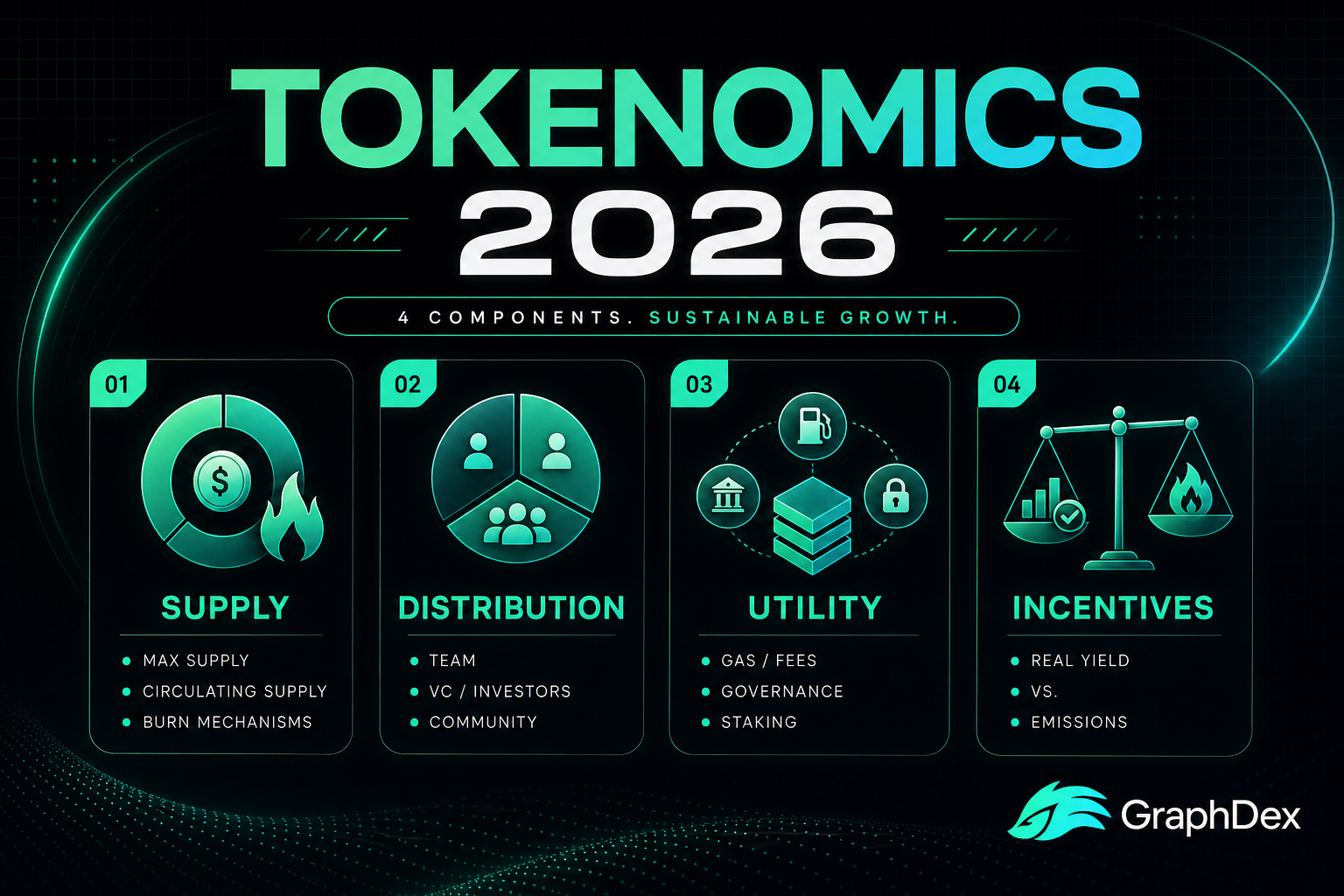
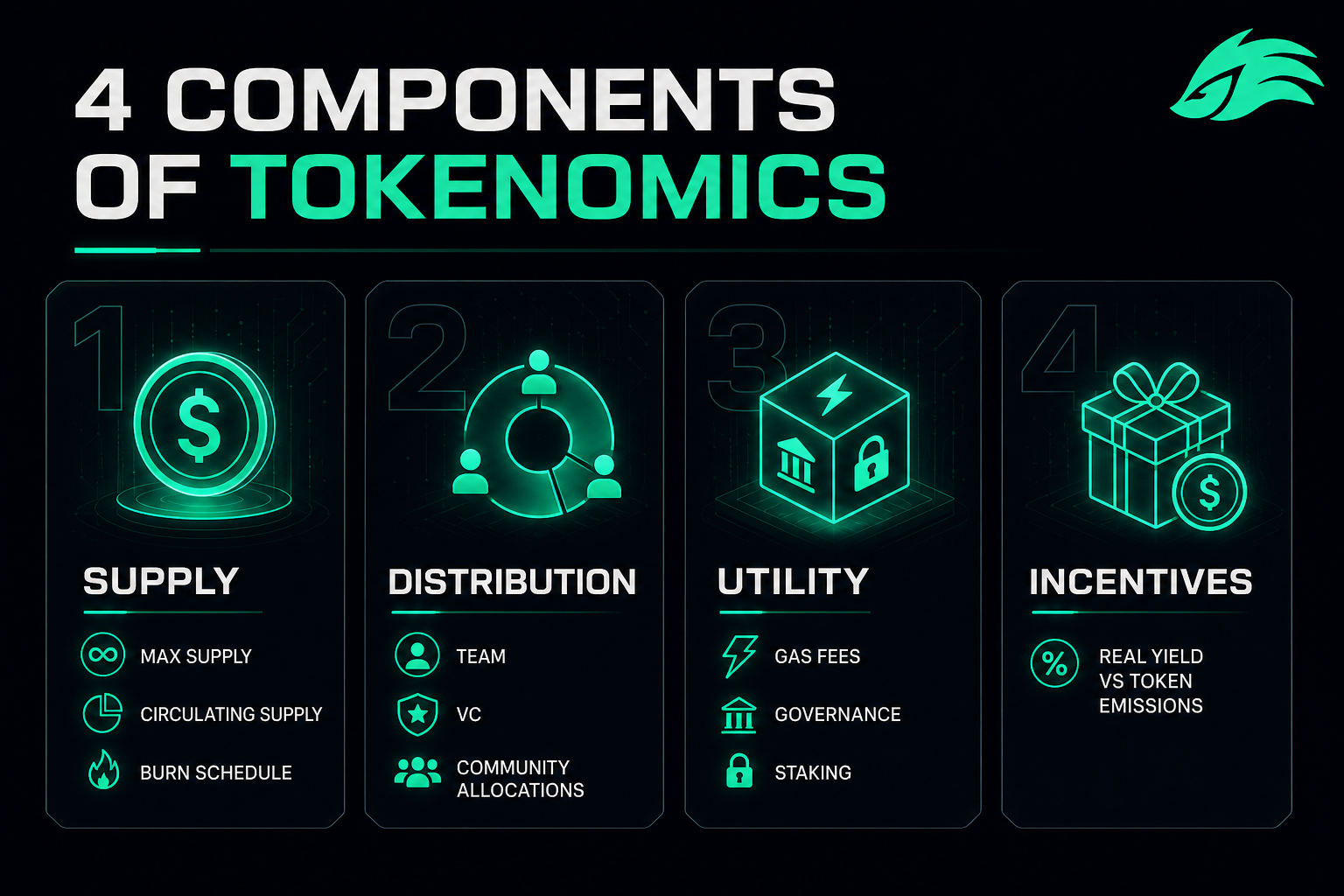
Tokenomics is the economic design of a cryptocurrency — how tokens are created, distributed, used, and managed within an ecosystem. It determines whether a token appreciates, holds value, or collapses. Key components:
- Supply: Total supply, circulating supply, max supply, inflation/burn schedule
- Distribution: Who got what tokens, vesting schedules, founder/VC allocations
- Utility: What the token actually does (governance, fees, staking, payments)
- Incentives: Mechanics encouraging holding, staking, productive use vs dumping
The rule: Good tokenomics = sustainable value creation. Bad tokenomics = value extraction or collapse. The biggest red flags: low circulating supply relative to total (future dilution), team allocations >40%, no real utility, and hyperinflationary emissions.
Trade with sound-tokenomics protocols on GraphDex
Key Takeaways
- Tokenomics is the economic system governing a token's supply, distribution, utility, and incentives.
- The four components determine whether a token appreciates, stabilizes, or collapses.
- Red flags: low circulating-to-total supply ratio, large team/VC allocations, no real utility.
- Bitcoin's fixed 21M supply and Ethereum's EIP-1559 burning are examples of strong tokenomics.
What Is Tokenomics?
Tokenomics — a combination of "token" and "economics" — is the economic design and principles behind a cryptocurrency or blockchain token. It encompasses how a token is created, distributed, used, and managed within a blockchain ecosystem.
The simple framing: Tokenomics is the rulebook coded into the blockchain that determines how a token's economy works. Just as a country needs economic policies (managing money supply, inflation, taxation), a crypto project needs tokenomics — and the quality of that design determines the project's survival.
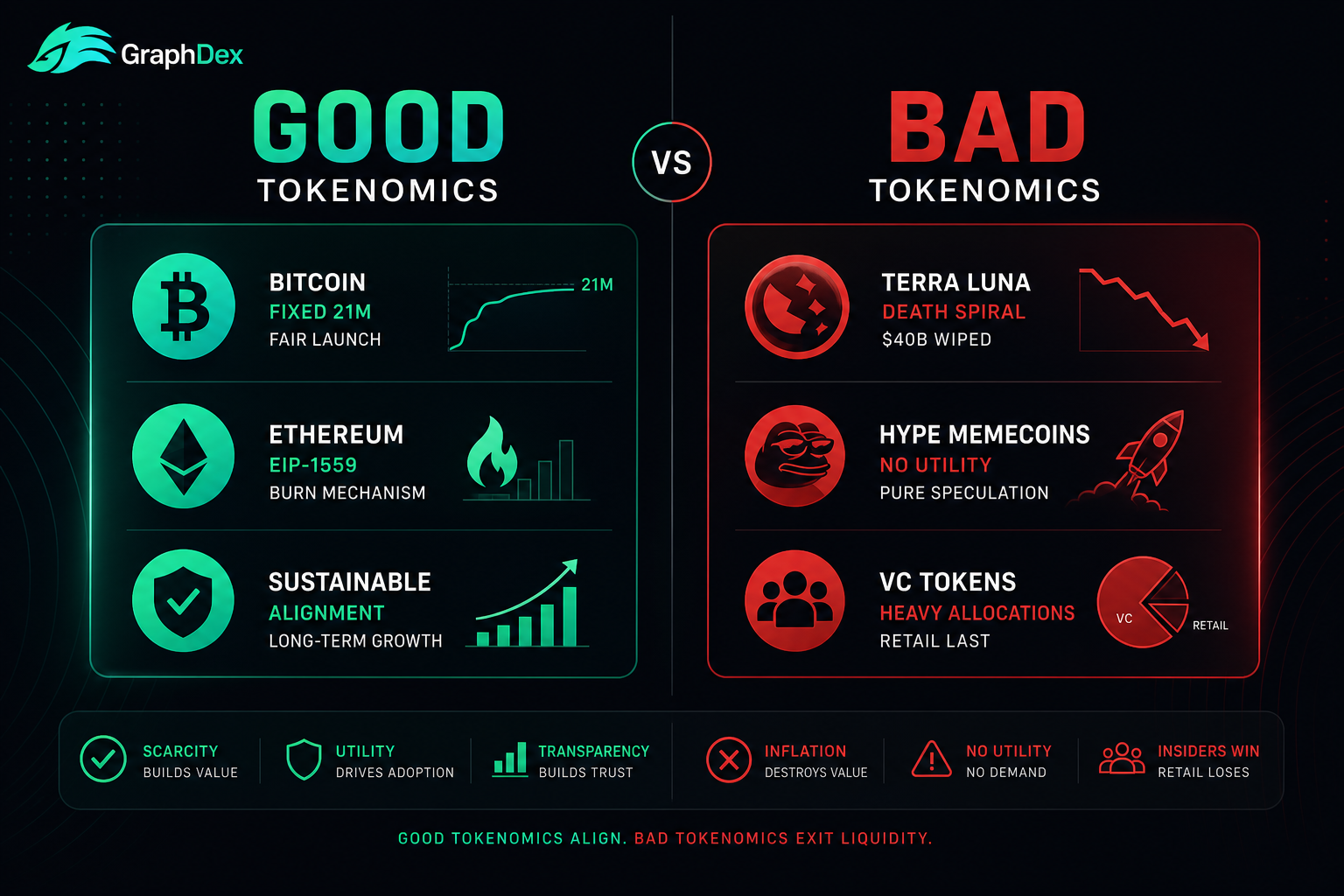
Why this matters: Many projects with great technology have failed because of bad tokenomics. Many projects with mediocre technology have succeeded because of good tokenomics. The difference between Bitcoin's success (fixed supply creating digital scarcity) and Terra Luna's collapse (death-spiral mechanism in the design) was tokenomics.
The investor's perspective: Understanding tokenomics is your due diligence. Without it, you're guessing whether a token will hold value. As one observer put it: "If you don't understand tokenomics, you're just gambling." The shift from 2017 ("buy anything with blockchain in the name") to 2021 ("buy anything with high APY") to 2026 ("understand tokenomics") reflects how the crypto market has matured.
The four core components of tokenomics — supply, distribution, utility, and incentives — work together to determine whether a token has sustainable value or extracts value from late buyers. Understanding each is essential to evaluating any crypto project.
The Four Core Components
1. Supply
The most fundamental tokenomic question: how many tokens will ever exist, and how does supply change over time?
Key supply metrics:
- Max supply: The maximum tokens that will ever exist (Bitcoin: 21 million; many others have caps)
- Total supply: Tokens currently minted (whether circulating or locked)
- Circulating supply: Tokens actively in the market (excluding locked/vested)
- Inflation rate: How quickly new tokens are issued (Solana: ~4.7% annually, decreasing)
- Burn mechanisms: Tokens permanently removed from supply (Ethereum's EIP-1559)
Why this matters: Supply directly affects scarcity and price dynamics. A fixed supply (Bitcoin) creates scarcity. Constant inflation dilutes existing holders. Burning (Ethereum, BNB) reduces supply, potentially appreciating remaining tokens.
Critical check: circulating supply vs total supply. If only 20% of tokens are circulating, the remaining 80% will eventually enter the market (through vesting unlocks). This dilutes existing holders. Always calculate: circulating supply ÷ total supply. If under 25% is circulating, factor heavy future dilution into your valuation.
2. Distribution
Who gets the tokens, in what proportions, and when?
Key distribution questions:
- Founders/team allocation: What percentage? When does it vest?
- VCs/early investors: How much? With what unlock schedule?
- Community: Airdrop, fair launch, public sale, ecosystem fund?
- Treasury: How much controlled by the protocol/DAO?
- Liquidity: Reserved for DEX liquidity, market making?
Why this matters: Distribution affects centralization, market manipulation risk, and long-term sell pressure. Heavy founder/VC allocations (>40% combined) mean significant tokens will hit the market on unlock, creating sell pressure.
Healthy distribution patterns: Wide community distribution, modest team allocation (10-25% typically), long vesting (2-4+ years), transparent unlock schedules. Treasury managed by DAO rather than founders.
Red flag patterns: Team holding 40%+, short vesting (6-12 months), opaque or undisclosed allocations, founder wallets that can mint unlimited tokens, large allocations to anonymous parties.
3. Utility
What can you actually do with the token? Real utility is the foundation of sustainable demand.
Common utilities:
- Gas/transaction fees: Pay for network usage (ETH, SOL)
- Governance: Vote on protocol decisions (UNI, AAVE, MKR)
- Staking: Earn rewards and secure the network (ETH, SOL staking)
- Collateral: Use as collateral in DeFi (ETH, BTC, stablecoins)
- Payment for services: Pay for storage (FIL), bandwidth (HNT), AI (TAO)
- Access: Holding required for app/community access
- Discount: Reduced fees when paying with native token (BNB)
Why this matters: Tokens with strong utility have organic demand from real use cases. Tokens without utility depend entirely on speculation — "we'll add utility in Phase 3" tokens typically collapse when speculation wanes.
The test: Can you explain how this token gains value beyond "other people buying it"? If not, you're speculating, not investing. Speculation can pump price temporarily, but without utility, eventually goes to zero.
4. Incentives
The mechanics that encourage productive use and discourage extractive behavior.
Common incentive structures:
- Staking rewards: Lock tokens to earn yield, reducing circulating supply
- Burn mechanisms: Deflationary pressure on supply
- Fee distribution: Real revenue distributed to holders/stakers
- Liquidity mining: Rewards for providing protocol liquidity
- Vote-escrow (ve-tokens): Lock tokens for longer = more voting power
- Slashing: Penalties for misbehavior, aligning operator incentives
Why this matters: Incentives shape behavior. Tokens with weak holder incentives experience constant sell pressure. Tokens with strong incentives (real yield, governance value, utility-driven demand) build long-term holder bases.
The pattern: Sustainable incentives come from real economic activity (trading fees, protocol revenue, network usage). Unsustainable incentives come from token emissions printed to attract liquidity — these create high APYs that eventually collapse.
Real Tokenomics Examples
The theory is clearer through examples — both good and bad.
Bitcoin (BTC): The Tokenomics Template
Supply: Fixed 21 million max supply. Block rewards halve every ~4 years (halving events), creating predictable, decreasing inflation.
Distribution: Fair launch in 2009 — no premine, no founder allocation, no ICO. Distribution happened through mining.
Utility: Store of value, peer-to-peer payments, settlement layer for Bitcoin DeFi (Lightning, Stacks).
Incentives: Mining secures the network and earns BTC; the difficulty adjustment self-balances the issuance rate.
Result: Bitcoin's tokenomics created digital scarcity that has driven a trillion-dollar market cap. The simplicity is the strength — no team unlocks, no surprise inflation, just programmed scarcity.
Ethereum (ETH): Evolving Tokenomics
Supply: No max supply. Inflationary through staking rewards, but EIP-1559 burns a portion of transaction fees, making ETH potentially deflationary during high-usage periods.
Distribution: ICO in 2014, then fair issuance through mining (until 2022) and staking. Foundation holds some, but significant supply is distributed.
Utility: Gas for transactions, staking, collateral for DeFi, store of value, payment for many on-chain services.
Incentives: Staking (5-7% APY) reduces circulating supply. Burns offset inflation.
Result: Strong utility-driven demand. ETH market cap follows network usage closely — a sign of healthy tokenomics.
Solana (SOL): Performance + Inflation
Supply: ~600M total supply, ~4.7% annual inflation rate (decreasing toward long-term target).
Distribution: Mix of team, foundation, VCs, and public sale at launch. Significant amounts staked (~65% of circulating supply).
Utility: Gas for transactions (cents), staking (7-8% APY), DeFi collateral.
Incentives: Validator and staker rewards align security incentives.
Result: Strong utility from Solana's high activity (memecoins, DEXs, NFTs). Inflation has been offset by demand growth in 2024-2026.
Cautionary Examples
Terra Luna (UST): Algorithmic stablecoin with reflexive design — when UST de-pegged, the mechanism printed unlimited LUNA, creating hyperinflation. Result: $40+ billion erased in May 2022. Death-spiral built into the design.
Many memecoins: No utility, founder dumps after launch, often hyperinflationary, designed to extract value from late buyers. Most go to zero.
Some VC tokens: 60%+ allocated to VCs with short vesting. Tokens collapse on vesting cliffs as VCs sell. Recognizable by very high "fully diluted valuation" (FDV) relative to circulating market cap.
How to Evaluate a Project's Tokenomics
A practical checklist when reviewing any token:
Supply checks:
- What's the max supply? Is it capped or unlimited?
- Circulating supply ÷ total supply: under 25% is a warning (future dilution)
- Inflation rate: how fast are new tokens issued?
- Burn mechanisms: anything reducing supply?
Distribution checks:
- Team/founders allocation: under 25%? Vested 2-4 years?
- VC allocation: how much, and what's the unlock schedule?
- Community/airdrop: significant share to actual users?
- Treasury: DAO-controlled or founder-controlled?
Utility checks:
- What does the token actually do?
- Can you explain value beyond "other people buying it"?
- Is utility live, or "coming in Phase 3"?
- Is there real demand from real users for the utility?
Incentive checks:
- What encourages holding vs selling?
- Real yield from revenue, or emission-based "yield" from token printing?
- Vesting and unlock schedules: any cliff that creates massive sell pressure?
The red flags summary:
- Low circulating/total ratio (heavy future dilution)
- Team/VC allocation >40% combined
- No real utility ("trust us, utility is coming")
- Short or unclear vesting
- Hyperinflationary mechanics
- Founder wallets that can mint unlimited tokens
- Bad community structure (whales control governance)
If a project fails multiple checks, walk away. There will always be other opportunities.
Trade sound-tokenomics protocols on GraphDex
Tokenomics in 2026: What's Changed
The space has matured significantly. Patterns visible in 2026:
Move toward real revenue. Projects increasingly emphasize protocol revenue distribution to holders rather than emission-based yields. The "fees, not emissions" framing reflects market learning from 2020-2022 collapses.
Vote-escrow models. Lock tokens for longer = more voting power and rewards (pioneered by Curve, adopted broadly). Aligns long-term incentives.
Buyback-and-burn programs. Funded by real protocol revenue. Solana's Pump.fun does this with platform fees; Ondo and others have similar mechanics.
Fairer launches. Increased aversion to high team/VC allocations. Community drops and earned distribution gain favor over pure private sales.
Sophisticated valuation. Investors look at fully diluted valuation (FDV) vs market cap, real revenue, holder concentration, and on-chain holder behavior — not just price action.
Regulatory clarity. Frameworks like MiCA (Europe) and GENIUS Act (US, for stablecoins) clarify which tokens are securities. This affects which tokens can be offered in which jurisdictions.
The honest assessment: tokenomics quality varies enormously across crypto. Established protocols (Bitcoin, Ethereum, major DeFi tokens) have track-records of sound tokenomics. New launches are highly variable. Reading tokenomics is one of the most valuable skills for crypto participation.
How GraphDex Approaches Token Economics
GraphDex's approach to platform yield illustrates good tokenomics principles in action.
Yield from real revenue, not emissions. GraphDex's up to 17% APY on stablecoins comes from platform trading fees — real protocol revenue from users actually trading. This is fundamentally different from emission-based yields where you're "paid" in newly printed tokens that will eventually need a buyer.
Sustainable design. Because yield is funded by ongoing platform activity, it can persist indefinitely rather than depending on declining emissions or speculative token interest.
Aligned incentives. Users earning yield benefit from platform success; platform success drives more trading; more trading drives more yield. The economic flywheel doesn't depend on attracting new buyers of an emissions token.
Non-custodial via Privy. Your funds stay in your wallet, no platform-issued token to manage, no governance overhead. Simple value capture from real fees.
This isn't to say GraphDex's structure is the only model — emission-based tokens with strong utility (ETH, SOL) can also have excellent tokenomics. But fee-based platform yield offers a particularly transparent example of where value comes from.
Earn fee-based yield up to 17% APY on GraphDex
Frequently Asked Questions
What is tokenomics in simple terms? Tokenomics is the economic design of a cryptocurrency — how tokens are created (supply), distributed (who gets them), used (utility), and managed (incentives). Good tokenomics builds sustainable value (Bitcoin, Ethereum). Bad tokenomics extracts value or collapses (Terra Luna). Understanding tokenomics is essential due diligence before holding any token.
What are the most important tokenomics metrics? The critical ones: max supply (fixed or unlimited?), circulating-to-total supply ratio (under 25% means heavy future dilution), team/VC allocation (over 40% combined is concerning), token utility (real or "coming later"), and inflation/burn mechanics. Always check fully diluted valuation (FDV) versus circulating market cap.
Why is Bitcoin's tokenomics considered ideal? Bitcoin has fixed 21M max supply (digital scarcity), fair launch (no premine), no team allocation, predictable halving schedule (decreasing inflation), and clear utility as store of value and payment. The simplicity is the strength — no surprises, no team unlocks, no governance changing the rules.
What makes tokenomics "bad"? Common red flags: low circulating supply with heavy future dilution, large team/VC allocations with short vesting, no real utility, hyperinflationary emissions, founder wallets that can mint unlimited tokens, opaque or undisclosed distribution, and reflexive designs (like Terra Luna's death spiral). Most "rugpull" memecoins fail multiple checks.
How do I read tokenomics in a white paper? Find: max/total/circulating supply, full distribution breakdown (team, VC, community, treasury), vesting schedules with dates, all utility descriptions, inflation and burn mechanics, and any unlock cliffs. Calculate circulating ÷ total ratio. Verify the team allocation isn't excessive. Confirm utility is live or imminent, not vague future promises.
What's the difference between coin and token? A coin is native to its own blockchain (BTC, ETH, SOL). A token is built on another blockchain's infrastructure (USDC and most memecoins are tokens on Ethereum, Solana, etc.). Tokenomics applies to both, but coins typically have additional economic considerations around mining/validation that pure tokens don't.
Can good tokenomics overcome bad technology? Sometimes, but rarely long-term. Tokenomics drives short-to-medium-term price action through demand and supply dynamics. But long-term value requires the protocol/network to actually be useful. Great tokenomics on a useless product creates a temporary speculative pump that eventually fades. The best tokens have both strong tokenomics and real utility.
About This Guide
This guide is published by the GraphDex Research team — analysts and traders building the infrastructure for digital asset trading on Solana. Our content is based on token economics analysis, current market data, and publicly available information.
Sources & data: Tokenomics figures and project details reflect publicly available information as of 2026 and change continuously. Tokens carry investment risk including total loss. This guide is educational and not financial advice — always do your own research on tokenomics before any token investment.
GraphDex is the infrastructure for digital asset trading — trade, predict, and earn in one place. Learn more at graphdex.io.
Last reviewed: May 2026 · GraphDex Research
The infrastructure for digital asset trading. Trade, predict, stake, repeat. graphdex.io