By GraphDex Research · Reviewed for accuracy May 2026
Quick Answer
Prediction markets occupy a contested legal space in 2026. The key facts:
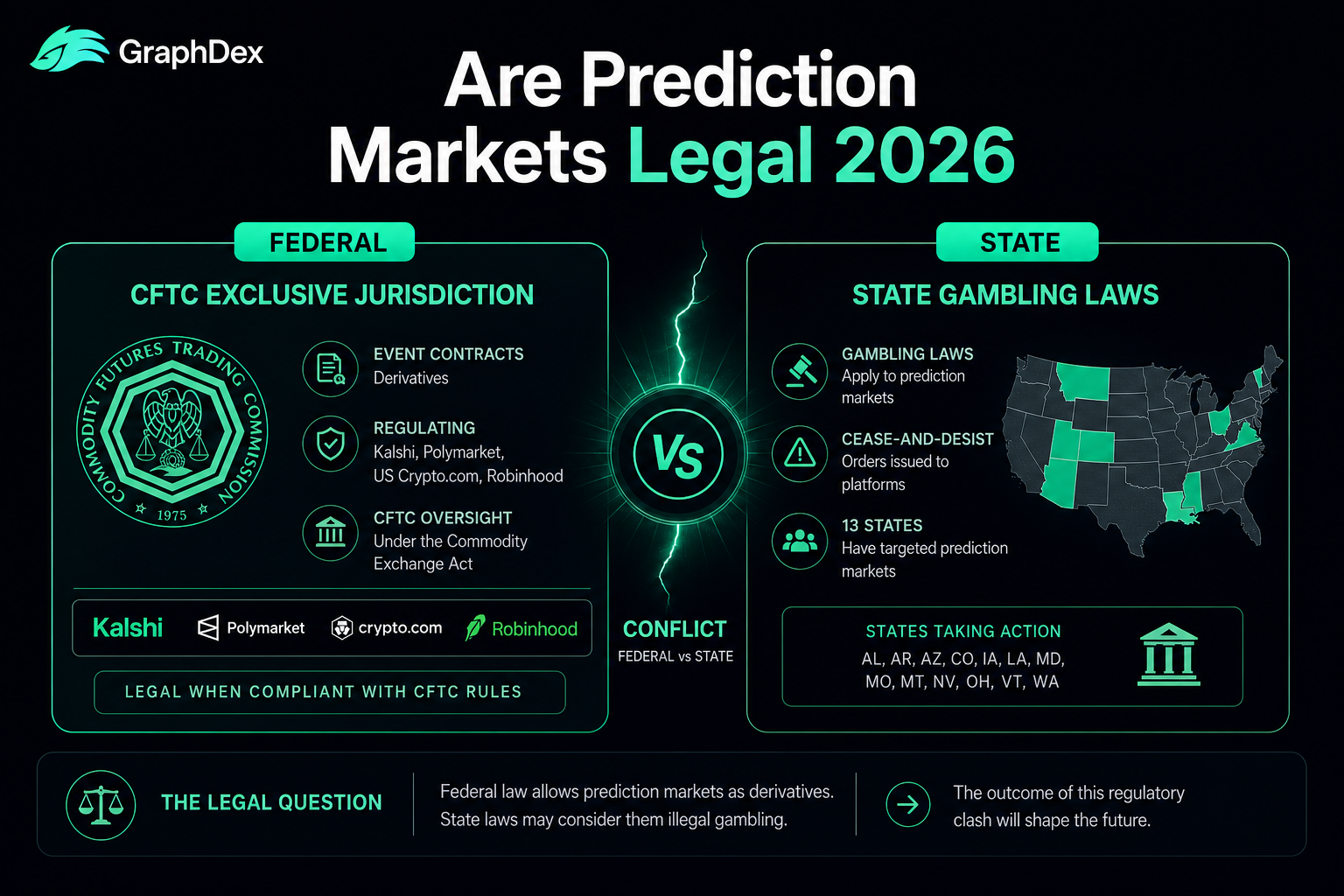
- Federally: The CFTC regulates event contracts and claims exclusive jurisdiction. Several platforms (Kalshi, Crypto.com, Polymarket US, Robinhood) are CFTC-registered.
- State conflict: A growing number of states argue some contracts (especially sports) are gambling and have pushed back. The CFTC has sued multiple states to block enforcement.
- Polymarket access: Polymarket US (QCX LLC) is on the CFTC's designated contract market list, but different access paths (Polymarket US vs Polymarket.com) carry different legal status.
The law is evolving rapidly through ongoing litigation. This guide is educational, not legal advice — always check current rules for your jurisdiction.
Trade prediction markets via GraphDex
Key Takeaways
- The CFTC claims exclusive federal jurisdiction over event contracts; several platforms are CFTC-registered.
- A growing number of states argue some contracts are gambling, creating an ongoing federal-state conflict.
- Courts have largely sided with federal jurisdiction, but some states continue enforcement.
- The law is changing fast through litigation — this guide is educational, not legal advice.
The Short Answer: It's Complicated and Evolving
Are prediction markets legal? The honest answer in 2026 is: it depends on the platform, the contract type, and your state — and it's changing rapidly through litigation.
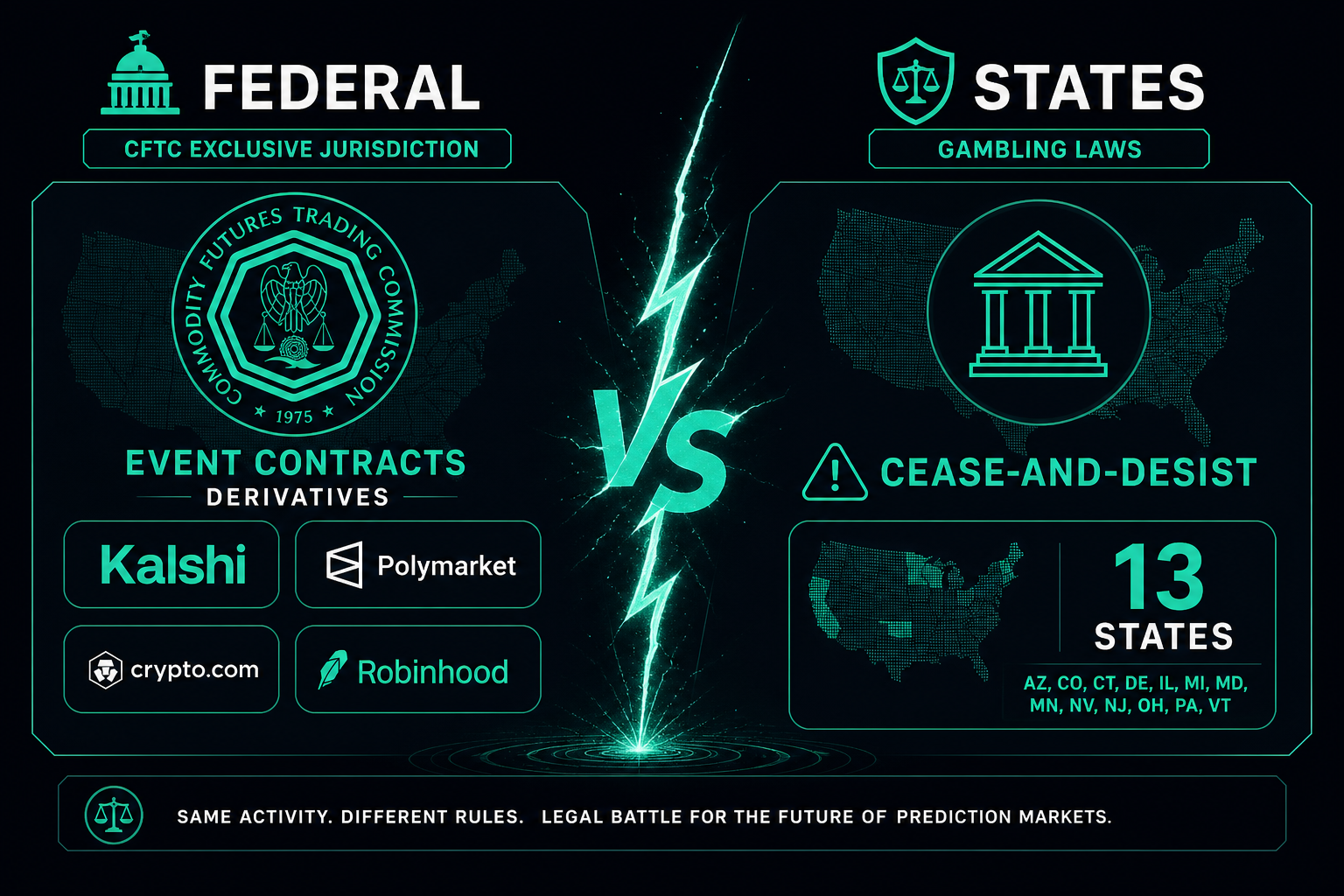
At the federal level, prediction markets have found a regulatory foothold. The Commodity Futures Trading Commission (CFTC) regulates event contracts as derivatives and claims exclusive jurisdiction over them under the Commodity Exchange Act. Several platforms operate as CFTC-registered Designated Contract Markets (DCMs).
But the picture is contested. A growing number of states argue that some event contracts — particularly sports-related ones — function like gambling and fall under state authority. This has triggered a wave of litigation between the CFTC (defending federal jurisdiction) and states (asserting their gambling laws). The result is a fast-moving legal landscape where the answer can shift with each court ruling.
Because this is genuinely complex and changing, the rest of this guide explains the key pieces — but always verify the current status for your specific situation.
How the CFTC Regulates Prediction Markets
The foundation of prediction market legality in the US is the CFTC. Under the Commodity Exchange Act, the CFTC has exclusive jurisdiction over futures, options, and swaps traded on federally regulated exchanges.
The landscape shifted significantly in early 2025. With a change in CFTC leadership in January 2025, the agency adopted a more permissive stance toward event contracts. Then-Acting Chair Caroline Pham characterized prior interpretations as "a sinkhole of legal uncertainty and an inappropriate constraint." Following this, Kalshi and other platforms began offering sports-related markets in January 2025.
As of the recent regulatory filings, at least eight CFTC-regulated DCMs have collectively self-certified more than 3,000 event contracts. CFTC-registered platforms include Kalshi, Crypto.com (via CDNA), Polymarket US, PredictIt, and Robinhood Derivatives. Operating as a CFTC-regulated DCM is the clearest path to legal prediction markets in the US.
CFTC-Registered Prediction Market Platforms
| Platform | Status | Notable |
|---|---|---|
| Kalshi | CFTC-regulated DCM | Largest US-regulated; ~87% sports volume |
| Polymarket US (QCX) | On CFTC DCM list | Verify access path (US vs .com) |
| Crypto.com (CDNA) | CFTC-regulated | Derivatives exchange |
| Robinhood Derivatives | CFTC-registered | Mainstream brokerage access |
| PredictIt | Limited (research) | Academic/research constraints |
What Is the Federal-State Conflict?
The central legal battle in 2026 is between federal CFTC authority and state gambling regulators.
The federal argument: The CFTC and platforms argue the Commodity Exchange Act gives the CFTC exclusive jurisdiction over event contracts traded on federally regulated exchanges, preempting state law. Platforms have sued states to defend this — Polymarket sued Massachusetts in February 2026 arguing only the CFTC can regulate prediction markets.
The state argument: A number of states argue that some event contracts, especially sports-related ones, are wagers rather than swaps, and may only be offered by state-licensed firms. They've issued cease-and-desist letters and pursued enforcement.
Where courts have landed: Rulings have been mixed but often favored federal jurisdiction. The Third Circuit's April 2026 decision affirmed a preliminary injunction barring New Jersey from enforcing gambling laws against Kalshi's sports contracts. In Tennessee, a court granted Kalshi a preliminary injunction, holding sports event contracts are likely swaps. However, some states have had partial success — a federal court recognized state gaming authority can coexist with CFTC regulation in one Maryland case, and Nevada secured a temporary ban.
This conflict is actively being litigated, with the CFTC suing multiple states (including Arizona, Connecticut, Illinois, and Minnesota) to block enforcement.
How Does the Law Differ by State?
The state-level picture changes frequently. As of 2026, a significant number of states have active enforcement postures, litigation, or both. Some examples of the dynamics:
- Nevada issued a cease-and-desist to Kalshi; a federal court ruled for Nevada, and the Ninth Circuit cleared the way for a temporary ban.
- Maryland continues enforcement after a court declined to block it, finding state gaming authority can coexist with CFTC regulation.
- Tennessee enforcement was blocked by a preliminary injunction favoring Kalshi.
- Minnesota passed a prediction market law set to take effect August 1, 2026; the CFTC sued in May 2026 to block it.
- Arizona enforcement was blocked by a federal preliminary injunction while litigation continues.
The takeaway: your state's status can differ from your neighbor's, and it can change with each ruling. Anyone considering prediction market trading should check the current status in their specific state rather than relying on general statements.
Polymarket vs Kalshi: Different Legal Paths
The two largest prediction markets have taken different routes, with different legal implications.
Kalshi is a CFTC-regulated Designated Contract Market — the most established legal path. It operates with federal regulation, traditional banking, and has been the platform most actively defending federal jurisdiction in court. For US users wanting the clearest regulated option, Kalshi is the standard reference. Notably, roughly 87% of Kalshi's $39.7 billion in trailing-year volume was on sports.
Polymarket historically operated as a crypto-native platform on Polygon, and US users were restricted following a 2022 CFTC settlement. However, Polymarket US (QCX LLC) now appears on the CFTC's DCM list. Crucially, different access paths carry different status — Polymarket US versus Polymarket.com are not the same, and users should verify which they're using before trading.
This distinction matters: being on a regulated platform via a compliant access path is very different from accessing a restricted route. Always confirm the specific platform and access method.
See how GraphDex integrates Polymarket
Do You Pay Taxes on Prediction Markets?
Tax treatment of prediction market winnings adds another layer of uncertainty in 2026.
The IRS has issued no formal guidance on how to classify prediction market gains, and platforms handle reporting differently — Kalshi, for example, does not issue 1099-B forms for event contract trades. This leaves traders to determine their own reporting obligations.
Generally, prediction market gains are likely taxable as income or capital gains depending on classification, but without formal IRS guidance, the precise treatment is unsettled. Anyone trading prediction markets should keep detailed records of their trades and consult a tax professional familiar with derivatives and crypto. This is general information, not tax advice.
What Does This Mean for Traders?
Given the complexity, here's a practical framing:
If you're in the US: The clearest legal path is a CFTC-regulated platform like Kalshi, but check your state's current status — some states actively restrict sports or other contracts. The federal-state conflict means your access can depend on where you live and what you trade.
If you're outside the US: Different jurisdictions have their own rules. Polymarket and other platforms serve global users, but local regulations vary widely. Check your country's stance.
For all traders: The law is evolving fast. What's permitted today may change with the next court ruling or regulation. Stay informed, use compliant platforms and access paths, keep records for taxes, and consult professionals for your specific situation.
GraphDex operates as a terminal that integrates Polymarket prediction markets — users remain responsible for ensuring their own compliance with applicable laws in their jurisdiction.
Learn how GraphDex integrates prediction markets
Prediction Markets vs Gambling: The Legal Distinction
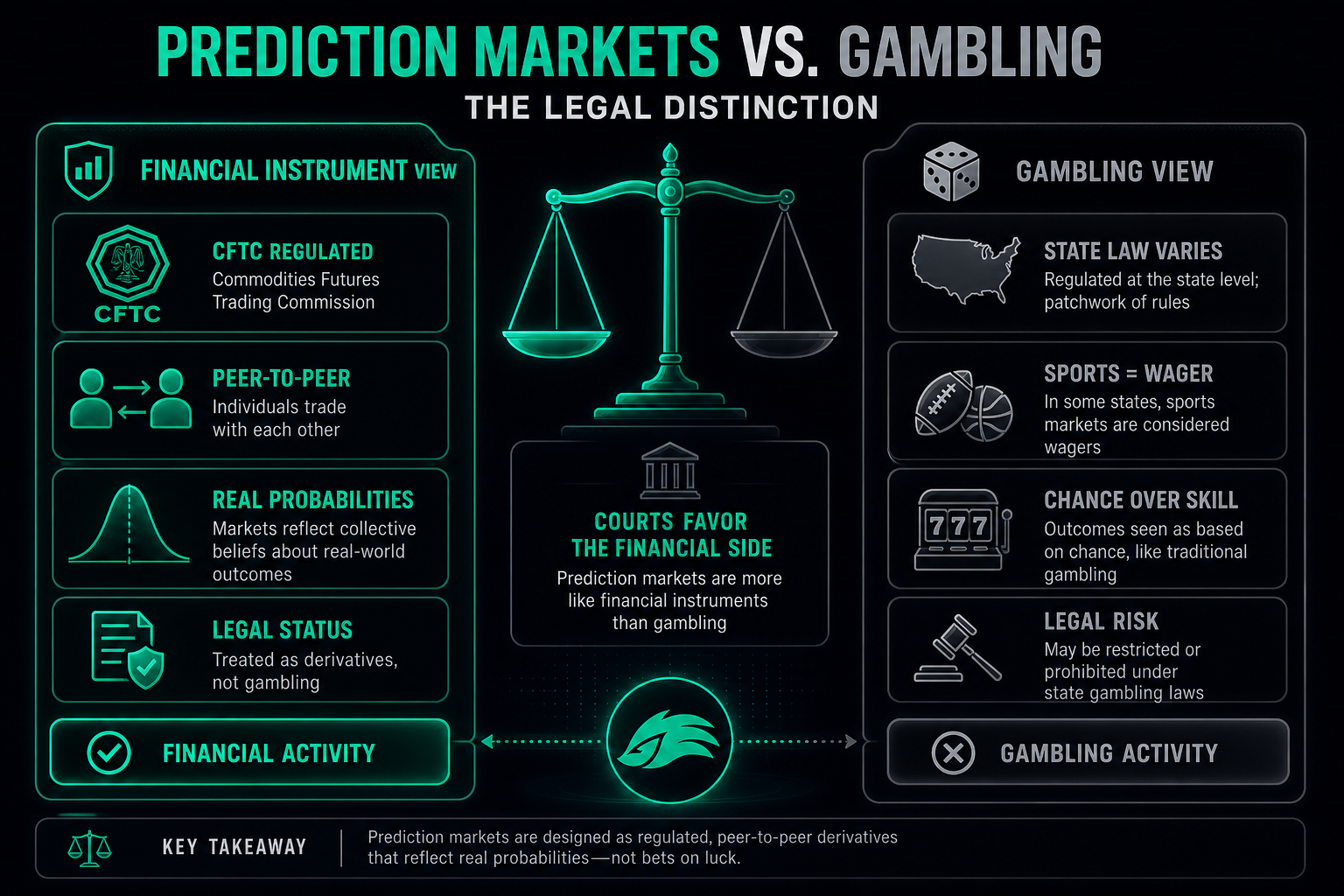
A core part of the legal debate is whether prediction markets are gambling or financial instruments — and the distinction matters legally.
The financial-instrument view (CFTC, platforms): Event contracts are derivatives — peer-to-peer financial instruments where you trade against other participants, not a house. Prices reflect real probabilities, and the contracts serve risk-management and information-aggregation functions like other derivatives. This view places them under federal CFTC jurisdiction.
The gambling view (some states): Some contracts, especially sports-related, function like wagers and should fall under state gambling regulation.
Courts have frequently leaned toward the financial-instrument view for CFTC-regulated contracts — the Tennessee court, for instance, held sports event contracts are likely swaps. This distinction isn't just academic: it determines which regulator has authority and whether a platform can operate in a given state.
For traders, the practical point is that regulated prediction markets are structured as financial instruments under federal oversight, distinct from traditional gambling — though the legal debate over specific contract types continues.
Frequently Asked Questions
Are prediction markets legal in the US in 2026? It's complicated and evolving. Federally, the CFTC regulates event contracts and several platforms (Kalshi, Crypto.com, Polymarket US, Robinhood) are CFTC-registered. But a growing number of states challenge some contracts as gambling, creating ongoing litigation. Legality can depend on the platform, contract type, and your state. This is educational, not legal advice.
Is Polymarket legal in the US? US users were restricted following a 2022 CFTC settlement, but Polymarket US (QCX LLC) now appears on the CFTC's DCM list. Different access paths (Polymarket US vs Polymarket.com) carry different legal status — verify which you're using. Always check current rules for your jurisdiction.
Is Kalshi legal? Kalshi is a CFTC-regulated Designated Contract Market — the most established legal path for US prediction markets. However, some states have challenged its sports contracts, with mixed court results. Courts have often favored Kalshi's federal regulation, but a few states continue enforcement. Check your state's status.
Why are states fighting prediction markets? Some states argue certain event contracts, especially sports-related ones, function like gambling and should fall under state gambling law rather than federal CFTC jurisdiction. The CFTC and platforms argue federal law preempts state authority. This federal-state conflict is being actively litigated in 2026.
Do I pay taxes on prediction market winnings? Likely yes, but the treatment is unsettled. The IRS has issued no formal guidance, and platforms report differently (Kalshi doesn't issue 1099-B forms for event contracts). Keep detailed records and consult a tax professional familiar with derivatives. This is general information, not tax advice.
Are prediction markets the same as gambling? Legally, regulated event contracts are treated as derivatives — financial instruments under CFTC jurisdiction, where you trade peer-to-peer, not against a house. Some states argue certain contracts function like gambling. Courts have often favored the financial-instrument view for CFTC-regulated contracts, but the debate over specific types continues.
Can the legal status change? Yes — rapidly. The landscape shifts with each court ruling, regulatory action, and new state law. What's permitted today may change. Stay informed, use compliant platforms, and verify the current status in your jurisdiction before trading.
About This Guide
This guide is published by the GraphDex Research team — analysts and traders building the infrastructure for digital asset trading on Solana. Our content is based on publicly available information and current developments.
Sources & data: Legal developments and platform statuses reflect publicly available information as of 2026 and change frequently through ongoing litigation. This guide is educational and not legal or financial advice — prediction market legality varies by jurisdiction and is evolving. Always consult a qualified attorney and verify current rules for your specific situation before trading.
GraphDex is the infrastructure for digital asset trading — trade, predict, and earn in one place. Learn more at graphdex.io.
Last reviewed: May 2026 · GraphDex Research
The infrastructure for digital asset trading. Trade, predict, stake, repeat. graphdex.io