By GraphDex Research · Reviewed for accuracy May 2026
Quick Answer
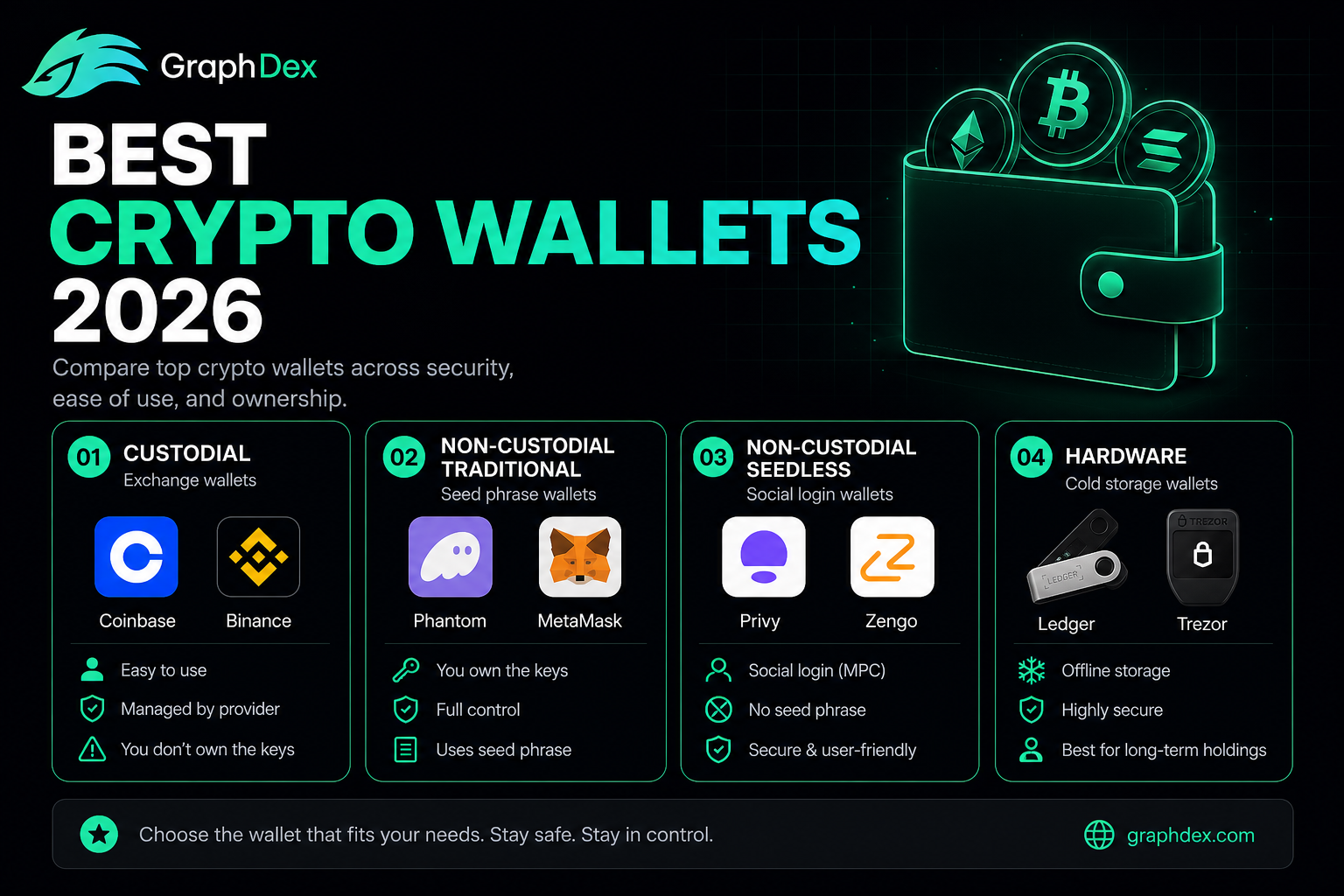
The best crypto wallet depends on your primary chain, technical comfort, and balance size. Top picks for 2026:
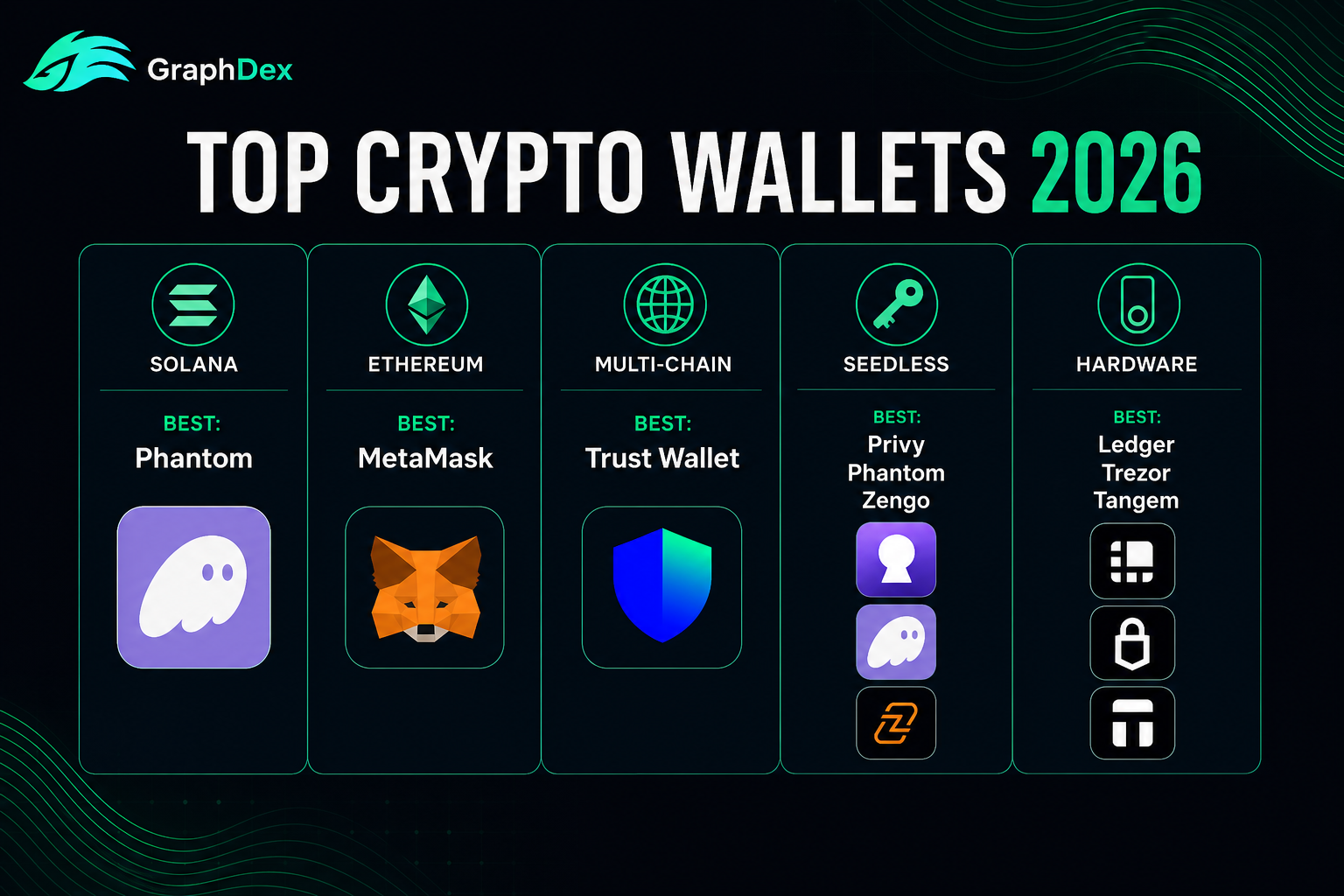
- Best for Solana: Phantom — leading Solana UX, seedless login option, NFT-friendly
- Best for Ethereum/EVM: MetaMask — dominant DeFi wallet, hardware integration
- Best multi-chain: Trust Wallet — 100+ blockchains, 10M+ assets in one app
- Best seedless (no seed phrase): Privy-based wallets (used by GraphDex), Phantom's seedless option, Zengo MPC
- Best hardware cold storage: Ledger Nano X, Trezor Model T — for serious holdings
- Best multi-chain mobile security: Tangem (card-format hardware-backed)
- Best for beginners switching to self-custody: Coinbase Wallet — Coinbase-familiar UX
The rule: not your keys, not your crypto. Move funds off exchanges into wallets you control.
Trade Solana with built-in non-custodial wallet on GraphDex
Key Takeaways
- Crypto wallets are how you control your funds — exchanges hold yours, wallets put you in charge.
- Phantom leads Solana; MetaMask leads Ethereum/EVM; Trust Wallet leads multi-chain.
- Seedless wallets (Privy, MPC, Phantom social login) eliminate seed phrase risk without surrendering control.
- For amounts over a few thousand dollars, hardware wallets (Ledger, Trezor) substantially reduce risk.
Custodial vs Non-Custodial: The Critical Distinction
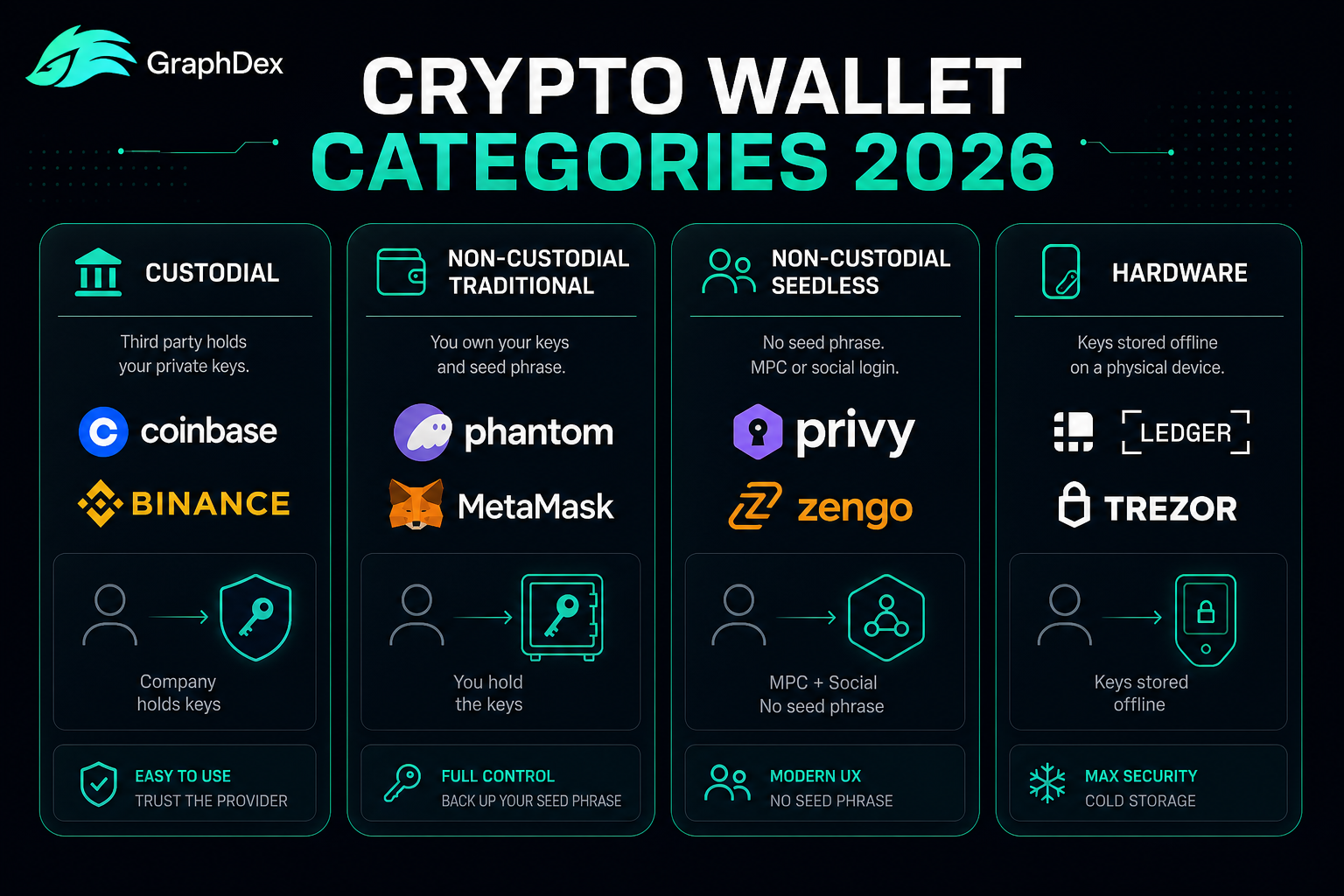
Before comparing wallets, the most consequential distinction in crypto: who controls the private keys?
Custodial wallets (Coinbase account, Binance account) hold your keys for you. You log in with email/password. The exchange can help you recover access, but can also freeze your funds, restrict withdrawals, or fail entirely (FTX 2022). Convenient; trust-dependent.
Non-custodial wallets (Phantom, MetaMask, Trust, hardware wallets) put you in control. You hold your private keys via seed phrase or seedless methods (MPC, social login). No company can freeze you. The flip side: lose your seed phrase, lose your funds — no recovery, no support.
The 2026 trend toward seedless non-custodial: New wallet architectures (MPC like Privy, social login like Phantom's Google/Apple option) combine self-custody with easier recovery, eliminating the seed phrase burden without surrendering control. This is the big UX shift of 2025-2026.
What's the Best Solana Wallet in 2026?
Phantom is the dominant Solana wallet — and the friendliest entry point to Solana for beginners.
Strengths:
- Best-in-class Solana UX with mobile app and browser extension
- Now supports Ethereum, Bitcoin, and Sui beyond Solana
- Seedless login via Google/Apple secured by 4-digit PIN
- NFT-friendly interface with built-in marketplace integration
- Scam-aware transaction signing — warns about suspicious approvals
- Strong staking integration with major Solana validators
Weaknesses:
- No browser extension means less convenient desktop dApp use compared to MetaMask
- No in-app hardware wallet connection for stronger signing isolation
- Only one Secret Recovery Phrase active at a time
- Built-in swaps don't cover every chain or asset
Best for: Anyone whose primary activity is on Solana — memecoins, NFTs, DeFi, staking. The default Solana wallet choice.
Which Wallet Is Best for Ethereum and EVM Chains?
MetaMask has been the dominant Ethereum wallet since 2016 and remains the standard for EVM chains.
Strengths:
- Seamless dApp connectivity across Ethereum, Arbitrum, Base, Optimism, Polygon, BNB Chain, and 200+ EVM chains
- Hardware wallet integration (Ledger, Trezor) for secure signing
- Built-in MetaMask Earn (Aave integration for stablecoin yield)
- Token swaps through aggregated liquidity sources
- Customizable network additions for any EVM chain
- Largest developer ecosystem support
Weaknesses:
- EVM-focused (limited Solana support)
- UX friction for total beginners
- No native Bitcoin support
- Occasional fee miscalculations on complex transactions
Best for: Anyone primarily using Ethereum, L2s, or EVM chains. Essential for DeFi power users and NFT collectors on Ethereum.
What's the Best Multi-Chain Crypto Wallet?
Trust Wallet supports over 10 million assets across 100+ blockchains — the broadest coverage in one app.
Strengths:
- Massive chain coverage including all major and most minor chains
- Mobile-first design with polished UX
- Integrated dApp browser
- Native staking for 12+ tokens
- Multi-chain swaps within one interface
- Acquired by Binance (2018), strong resourcing
Weaknesses:
- Mobile-only (no browser extension)
- Binance-related concerns for some users
- Less depth per chain than chain-specific wallets
Best for: Users who want one app covering everything — Ethereum, Solana, Bitcoin, Cosmos, and dozens of other chains in a single interface.
Which Seedless Non-Custodial Wallets Are Best?
For users who want self-custody without the seed phrase burden, several seedless options have matured in 2026.
Privy-Based Wallets
Privy provides MPC-style non-custodial wallet infrastructure that lets apps issue wallets without seed phrases. Users sign in with familiar credentials (Twitter, email, Telegram) while keys are split across the user's device and Privy's infrastructure. GraphDex uses Privy — sign in with Twitter/email/Telegram, get a non-custodial wallet generated for you, no seed phrase to lose.
Zengo
The pioneering MPC mobile wallet. Splits keys across your device and Zengo's servers using multi-party computation — neither party alone can access funds. Biometric recovery, no seed phrase. Strong UX with built-in scam protection.
Phantom Seedless
Phantom's Google/Apple login option uses similar architecture — sign in with social credentials secured by a 4-digit PIN. Maintains non-custodial security while eliminating seed phrase risk.
Coinbase Smart Wallet
Coinbase's account abstraction-based wallet on Base. Email signup, passkey authentication, gasless transactions for first-time users. Among the smoothest onboarding flows in 2026.
When seedless wallets make sense:
- New crypto users intimidated by seed phrases
- Users who lost funds previously due to seed phrase mishandling
- Users wanting self-custody without operational burden
- Apps wanting to onboard non-crypto-native users
The trade-off is dependency on the wallet provider's infrastructure. For modest balances and active use, the UX benefits often outweigh this. For very large balances, hardware wallets remain the gold standard.
What Are the Best Hardware Wallets for Cold Storage?
For holdings over a few thousand dollars or longer-term storage, hardware wallets substantially reduce risk by keeping keys offline.
Ledger Nano X / Nano S Plus
Ledger is the dominant hardware wallet brand globally. Nano X has Bluetooth and a larger screen; Nano S Plus is the cost-effective USB version (Bluetooth-free, no iOS support).
Strengths: Broad coin support (5,500+ assets), strong audit history, Ledger Live companion app, integration with major software wallets.
Considerations: The 2020 customer database breach left lasting concerns for some users (though seed phrases were never exposed). The closed-source firmware approach is debated in the community.
Trezor Model T / Safe 5
Trezor is the original hardware wallet (launched 2014). Model T has a color touchscreen; Safe 5 is the latest model with enhanced security elements.
Strengths: Open-source firmware, strong privacy reputation, Shamir backup option for advanced security setups.
Considerations: Smaller asset support than Ledger (still covers all major chains), some firmware updates have created occasional UX friction.
Tangem
Tangem offers card-format hardware wallets — your private key sits in a secure element on a credit-card-sized device. No batteries, no charging, no extra hardware needed beyond your phone (NFC connection).
Strengths: Best mobile hardware experience, no battery dependency, simple UX, multi-card backup options.
Considerations: Smaller asset ecosystem than Ledger/Trezor for very obscure coins.
For most users, Ledger Nano X for ~$150 or Trezor Model T for ~$200 covers the hardware wallet need with broad support and reliability.
Best Wallet for Specific Use Cases
Different needs favor different wallets:
| Use Case | Best Wallet |
|---|---|
| Active Solana trader | Phantom + GraphDex terminal |
| Ethereum DeFi power user | MetaMask + hardware wallet |
| Multi-chain casual user | Trust Wallet |
| First wallet for total beginner | Phantom (Solana) or Coinbase Wallet |
| Seedless self-custody | Privy-based apps, Phantom seedless, Zengo |
| Long-term cold storage | Ledger Nano X or Trezor Safe 5 |
| Mobile hardware security | Tangem |
| Desktop power user | Exodus, Rabby |
| Bitcoin-first holder | Sparrow, Blockchain.com |
| NFT-focused | Phantom (Solana), MetaMask (Ethereum) |
| Best privacy | Hardware wallets + Tor browser, with operational discipline |
For most users, the practical setup ends up being: a primary software wallet (Phantom or MetaMask) for active use + a hardware wallet for storage of larger amounts + specific app integrations as needed.
How to Choose: A Decision Framework
For users picking their first or main wallet:
Step 1: Identify your primary chain. If you're using Solana, Phantom. Ethereum/EVM, MetaMask. Multi-chain, Trust Wallet.
Step 2: Estimate your balance. Under $1,000: any reputable software wallet is fine. $1,000-$10,000: software wallet for active use, consider hardware for larger amounts. Over $10,000: hardware wallet (Ledger, Trezor) for the bulk of holdings.
Step 3: Consider seedless preferences. New to crypto and worried about seed phrases? Phantom's seedless option, Privy-based apps, or Zengo offer modern alternatives.
Step 4: Plan your wallet stack. Most active users have multiple wallets:
- Vault wallet: Hardware wallet for storage, rarely connects to anything
- Active wallet: Software wallet for daily DeFi/trading
- Burner wallet: Dedicated, lightly funded wallet for risky activity (new dApps, memecoin trading)
Step 5: Practice with small amounts. Send a small test amount before transferring significant funds. Verify the wallet works as expected. Practice receiving, sending, and using basic DeFi.
Get a built-in non-custodial wallet via GraphDex
Trade with non-custodial Privy wallet on GraphDex
Critical Security Best Practices
Whatever wallet you choose, security practices matter more than the choice itself.
Never share your seed phrase. No legitimate service will ever ask. Anyone asking is trying to steal your funds.
Never store seed phrases digitally. No photos, cloud, password managers, email, or text files. Physical paper or metal in secure locations.
Use hardware wallets for significant balances. The cost of hardware ($100-200) is minimal compared to the protection for larger holdings.
Verify every transaction signing. Read what you're approving. Phishing attacks often disguise malicious transactions as routine actions.
Bookmark trusted sites. Always navigate to wallets and dApps manually. Don't click wallet popups from social media DMs.
Use a dedicated wallet for risky activity. Don't use your main wallet for new dApps, memecoin trading, or anything you don't trust completely.
Revoke old approvals. Use tools like revoke.cash periodically to revoke unused contract approvals.
Keep software updated. Wallet apps patch vulnerabilities — update promptly.
Test recovery. Practice recovering your wallet on a new device using your seed phrase (or MPC backup). Discover problems before you actually need recovery.
Frequently Asked Questions
What's the best crypto wallet in 2026? There's no single best — the right wallet depends on your primary chain, balance size, and use case. For Solana: Phantom. For Ethereum/EVM: MetaMask. For multi-chain: Trust Wallet. For seedless self-custody: Phantom's social login or Privy-based apps. For large balance cold storage: Ledger Nano X or Trezor.
Is Phantom or MetaMask better? Phantom is better if your primary chain is Solana — best Solana UX, seedless option, NFT-friendly. MetaMask is better for Ethereum and EVM chains — most DeFi protocols integrate with it natively. Both are non-custodial and free; many active users have both for their respective chains.
Are seedless wallets safe? Modern seedless wallets (Privy MPC, Phantom social login, Zengo MPC) use multi-party computation to maintain non-custodial security without a single seed phrase. Neither the user alone nor the wallet provider alone can access funds. They're safe for the typical user and address the #1 cause of self-custody losses (lost seed phrases). For very large balances, hardware wallets are still the gold standard.
Do I need a hardware wallet? For holdings over a few thousand dollars or anything you're holding more than a few months — yes, strongly recommended. Hardware wallets keep keys offline, dramatically reducing exploit risk. The $100-200 cost is minimal versus the protection. For amounts under $1,000 or active trading balances, software wallets are practical.
What happens if I lose my hardware wallet? Your funds are recoverable as long as you have your seed phrase. The hardware wallet generates and stores the keys, but the seed phrase backup lets you recover the same wallet on a new device (any brand of hardware wallet, or even a software wallet temporarily). Lose both the device AND the seed phrase, and funds are gone permanently.
Can I use multiple wallets? Yes, and most active users do. Common setup: hardware wallet for cold storage of larger amounts, software wallet (Phantom or MetaMask) for active use, dedicated "burner wallet" for risky activity. Each wallet has its own seed phrase. Just keep careful records of what's where.
Are exchange accounts crypto wallets? Technically yes — exchange accounts are custodial wallets where the exchange holds keys for you. Practically, most crypto educators recommend keeping funds you're not actively trading in non-custodial wallets you control. The FTX 2022 collapse and other exchange failures showed why exchange custody concentrates risk.
About This Guide
This guide is published by the GraphDex Research team — analysts and traders building the infrastructure for digital asset trading on Solana. Our content is based on direct experience with these wallets, current public information, and 2026 market data.
Sources & data: Wallet features and details reflect publicly available information as of 2026 and may change. Wallet security depends significantly on user practices. This guide is educational and not financial advice — always do your own research.
GraphDex is the infrastructure for digital asset trading — trade, predict, and earn in one place. Learn more at graphdex.io.
Last reviewed: May 2026 · GraphDex Research
The infrastructure for digital asset trading. Trade, predict, stake, repeat. graphdex.io