By GraphDex Research · Reviewed for accuracy May 2026
Quick Answer
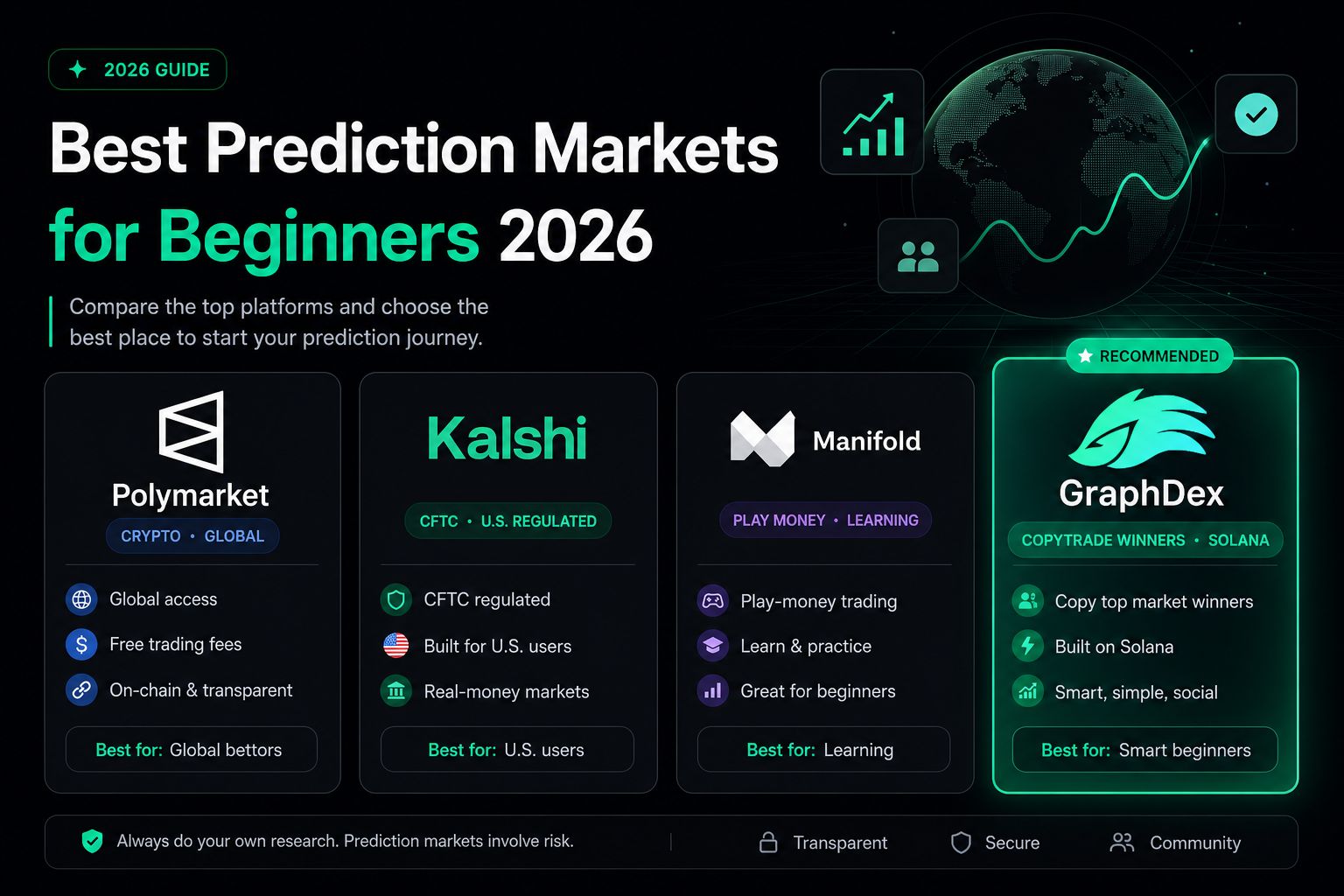
The best prediction markets for beginners in 2026, by use case:
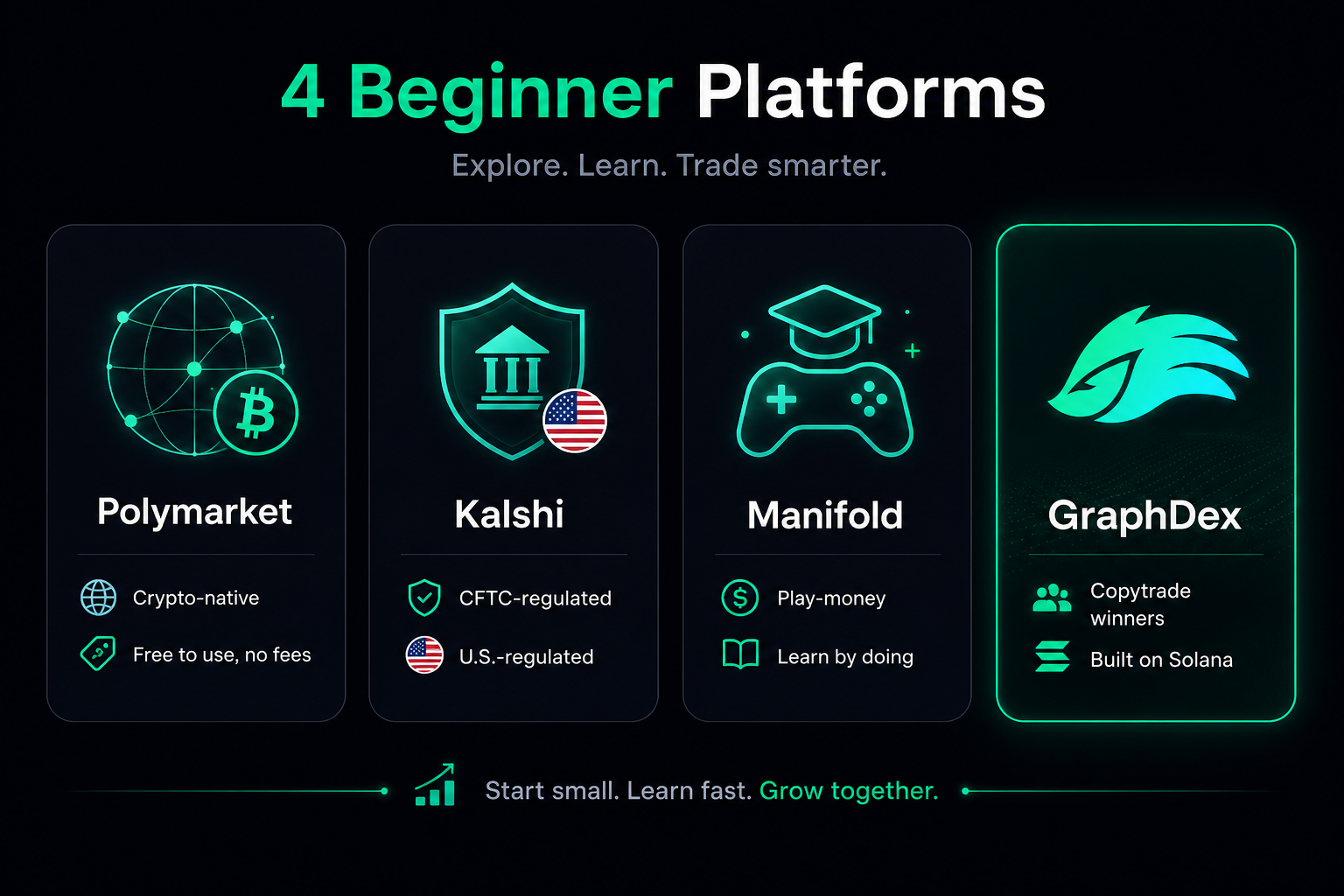
- Polymarket — the largest by global volume, free trading fees, USDC; best for crypto-native beginners and global users
- Kalshi — CFTC-regulated, traditional banking, US-friendly; best for US users wanting regulatory clarity
- Manifold — play-money markets; best for risk-free learning before real trading
- GraphDex (terminal) — copytrade Polymarket forecasters with Solana trading integrated; best for beginners who want to learn by following proven winners
For most beginners, the smartest path is to learn on play-money Manifold, then trade small on Polymarket or Kalshi while copytrading proven forecasters via GraphDex to learn from their decisions.
Start by copytrading on GraphDex
Key Takeaways
- Polymarket is the largest by global volume with free trading fees; Kalshi is the US-regulated option.
- Manifold offers play-money markets — risk-free learning before real trading.
- Beginners benefit most from starting small, specializing in markets they understand, and managing risk.
- Copytrading proven forecasters via GraphDex is one of the lowest-barrier ways to learn and profit.
Best Prediction Markets for Beginners: At a Glance
| Platform | Type | Best For | Fees | Custody |
|---|---|---|---|---|
| Polymarket | Crypto, global | Crypto-native beginners | No trading fees | USDC self-custody |
| Kalshi | CFTC-regulated, US | US users wanting regulation | Variable | Custodial |
| Manifold | Play-money | Risk-free learning | Free | N/A (play-money) |
| GraphDex | Terminal | Copytrade beginners | Standard | Non-custodial |
What Is a Prediction Market?
A prediction market is an exchange where you trade contracts on future event outcomes. Each contract is a simple yes/no question — "Will Trump win in 2028?", "Will inflation exceed 3% in Q2?" — and you buy shares in YES or NO.
The price of each share reflects the market's collective probability assessment. A share trading at $0.65 implies the market thinks there's a 65% chance the event happens. If you're right, each share pays $1.00; if wrong, $0.00. The price is the probability.
This makes prediction markets fundamentally different from gambling. You're not betting against a house with built-in margin — you're trading peer-to-peer against other participants. Prices reflect real probabilities aggregated from many traders' information, and skilled forecasters genuinely profit over time because the structure rewards accuracy.
For beginners, the key insight is: it's a market, not a casino. Prediction markets reward the patient, the analytical, and the risk-aware — not the lucky.
1. Polymarket — The Largest Global Platform
Polymarket is the largest prediction market by global volume, processing billions of dollars across thousands of markets covering politics, economics, crypto, sports, and pop culture.
For beginners, several features stand out: it charges no trading fees, settles in USDC (a transparent stablecoin), and is self-custodial — you control your funds. The interface is mature, with active markets across virtually any topic you care about. Liquidity is deep on major markets, making it easy to enter and exit positions.
The main consideration is access. US users face restrictions on Polymarket due to CFTC regulations, though Polymarket US (QCX LLC) operates as a CFTC-regulated DCM. Different access paths carry different legal status — verify the specific platform and your jurisdiction's rules before trading.
Best for: Crypto-native beginners and global users wanting the largest, most liquid prediction market.
2. Kalshi — The Regulated US Option
Kalshi is the largest CFTC-regulated prediction market in the US, providing a fully compliant US trading experience. It uses traditional banking (no crypto required) and is the established choice for US users wanting regulatory clarity.
For beginners, Kalshi's regulated structure offers reassurance: it operates as a Designated Contract Market under the CFTC, with the consumer protections that brings. Markets cover politics, economics, sports, and other domains. Roughly 87% of Kalshi's recent trailing volume was on sports — a major focus area.
The trade-off versus Polymarket is access route, not capability — Kalshi offers strong markets for US users where Polymarket access is restricted. Some states have challenged Kalshi's sports contracts; check current status in your state.
Best for: US users wanting CFTC-regulated prediction markets with traditional banking.
3. Manifold — Risk-Free Learning
Manifold is a play-money prediction market — you trade with virtual currency, not real money. This makes it ideal for beginners who want to learn how prediction markets work without financial risk.
You can practice making forecasts, see how the market moves with information, and develop a sense for pricing without losing money on early mistakes. Many traders use Manifold to learn the mechanics before moving to real-money platforms.
The limitation is that without real stakes, the wisdom-of-crowds effect is weaker — prices may not reflect actual probabilities as accurately as real-money markets. Use Manifold as a learning tool, not as the source of truth on probabilities.
Best for: Complete beginners who want to learn the mechanics with zero financial risk.
4. GraphDex — Copytrade and Integrated Trading
GraphDex is a terminal that integrates Polymarket prediction markets with full Solana DEX trading and staking. For beginners specifically, two features matter most: copytrading and integrated workflow.
Copytrading lets you automatically mirror proven forecasters ranked by PnL and win rate. Rather than developing your own edge from scratch — which can take 6-12 months — you borrow the edge of traders with verified track records. For a beginner, copytrading is one of the highest-leverage ways to participate while learning.
Integrated workflow means prediction markets, Solana token trading, AI signals, and staking up to 17% APY coexist in one non-custodial interface. As your activity grows, you don't need separate tools.
GraphDex uses non-custodial Privy architecture with no seed phrase — sign in with Twitter, email, or Telegram. Onboarding is friction-free.
Best for: Beginners who want to learn by copytrading proven winners, plus broader crypto trading integrated.
Start by copytrading proven forecasters on GraphDex
How to Start as a Beginner: A Practical Path
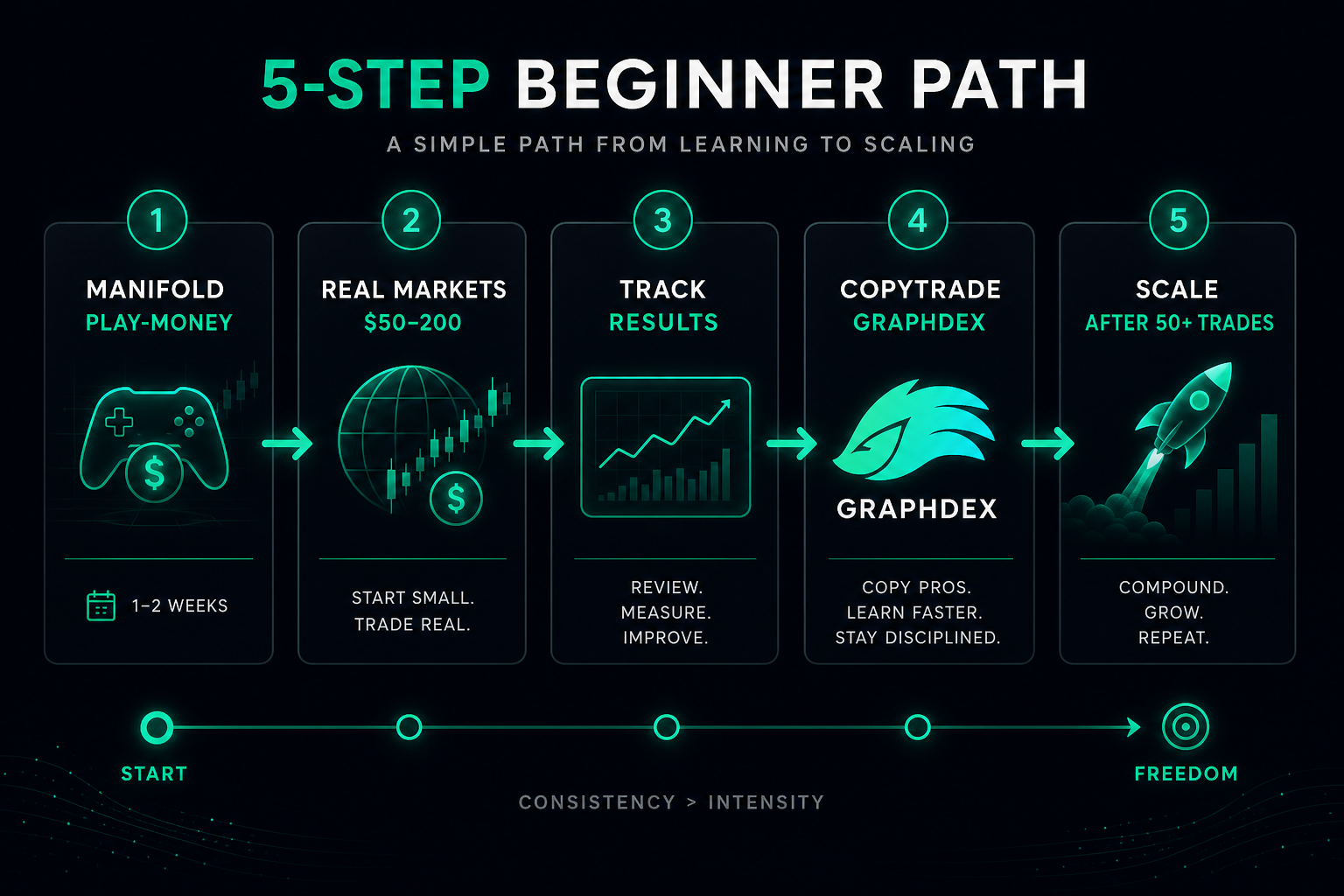
For beginners, the smartest path balances learning, low risk, and exposure to real markets.
Step 1: Learn the mechanics on play-money (1-2 weeks). Use Manifold to understand how markets work: how prices reflect probabilities, how news moves prices, how to enter and exit positions. Zero risk while you build intuition.
Step 2: Start small on real markets ($50-200). Move to Polymarket or Kalshi (depending on your jurisdiction) with a small starter amount you can afford to lose. Focus on markets you genuinely understand — a sport you follow closely, a political race in your region, an economic indicator you have background on.
Step 3: Track your results honestly. Keep a record of trades, your reasoning, and the outcome. Most beginners lose on their first 10-20 trades; this is learning. Positive expectancy typically comes after 50-100 trades over 6-12 months.
Step 4: Consider copytrading. If developing your own edge is slow, copytrading proven forecasters via GraphDex lets you participate in profitable strategies while learning from their decisions. Following 2-3 traders with consistent track records diversifies risk.
Step 5: Scale only as you prove your system. Don't increase position sizes based on a few wins — increase only when you have 50+ trades showing positive expectancy. The traders who turn small amounts into significant profits do hundreds of disciplined trades, not a few lucky calls.
Common Beginner Mistakes to Avoid
The pattern of beginner losses is consistent — these mistakes destroy most starters' bankrolls.
Treating prediction markets like a casino. Casual bettors who pick a side based on gut feel tend to lose. The market is informed, and your gut without analysis is no edge.
Betting too big too soon. Concentrated bets on a few markets means one bad call ends your run. Spread small positions across many markets to learn while limiting damage.
Betting on emotion or hope. Wanting an outcome doesn't make it likely. The market reflects collective probability — your personal preference doesn't change odds.
Ignoring fees and platform costs. Some platforms have trading fees; some are free. On real money, fees compound. Know your costs.
Not having an exit plan. You can sell before resolution to lock gains or cut losses. Plan exits before you enter, not in panic afterward.
Skipping the learning phase. Jumping into real money before understanding mechanics costs more than the play-money phase saves. Use Manifold or paper-trade first.
Chasing losses. After a loss, doubling down to "make it back" is the fastest path to ruin. Stick to position-sizing discipline regardless of recent results.
Avoid beginner mistakes with copytrading on GraphDex
What to Trade as a Beginner
Some market types are more beginner-friendly than others.
Good for beginners:
- Elections in regions you know — fundamentals are analyzable, news is public
- Economic indicators with clear data releases (Fed decisions, CPI prints)
- Sports outcomes in sports you follow closely
- Major events with deep liquidity, where mispricing is rarer but markets are stable
Avoid as a beginner:
- Low-liquidity markets with thin order books — easy to enter, hard to exit at fair prices
- Highly subjective resolution markets — interpretation disputes can ruin clear trades
- Long-dated speculative markets without close ties to verifiable information
- Markets dominated by clearly informed insiders — you'll be the liquidity
The principle: trade where you have or can develop genuine information edge. If you can't articulate why your view differs from the market price, you're guessing rather than trading.
Frequently Asked Questions
What is the best prediction market for beginners in 2026? It depends on your situation. Polymarket is the largest with free trading and global access. Kalshi is the regulated US option. Manifold offers risk-free play-money learning. GraphDex lets beginners copytrade proven forecasters with Solana trading integrated. Many beginners use Manifold to learn, then real markets via GraphDex.
Is Polymarket safe for beginners? Polymarket is self-custodial (you control funds), uses USDC, and charges no trading fees — strong fundamentals. The main risks are losing money on trades (manage with small positions) and access restrictions for US users. Beginners should start small, specialize in markets they understand, and consider copytrading proven traders.
How much money do I need to start? You can start with $50-200 to learn on real markets, or zero on Manifold's play-money platform. Most beginners lose on early trades while learning — start with what you can afford to lose. Scale only after 50+ trades show consistent positive expectancy, typically over 6-12 months.
Is prediction market trading gambling? Legally, regulated event contracts are derivatives — peer-to-peer financial instruments, not gambling against a house. Prices reflect real probabilities, and skill genuinely profits over time. That said, treating it like a casino (betting on emotion, not analysis) leads to losses. Approach it as informed trading, not gambling.
Can I lose all my money on prediction markets? You can lose what you stake on any individual trade. With disciplined position sizing — small positions across many markets, never risking more than you can afford to lose — you limit downside while learning. Most beginners who lose big violated position-sizing rules.
What's the easiest way to profit as a beginner? Copytrading proven forecasters via GraphDex is one of the lowest-barrier ways — you mirror traders ranked by consistent PnL, borrowing their edge while you learn. Combined with starting small and specializing in markets you understand, this gives beginners a realistic path to participate in profits while building skill.
Where can I learn more about prediction markets? Start with Manifold for hands-on play-money practice. Read about market mechanics (how prices reflect probabilities). Follow proven traders' moves on Polymarket via tools like GraphDex to learn from their decisions. Track your own trades and reasoning to develop intuition through deliberate practice.
About This Guide
This guide is published by the GraphDex Research team — analysts and traders building the infrastructure for digital asset trading on Solana. Our content is based on live platform data, current market figures, and hands-on experience with the platforms covered.
Sources & data: Platform features and figures reflect publicly available information as of 2026 and may change. Prediction market trading carries risk of loss. This guide is educational and not financial advice — always do your own research and start with what you can afford to lose.
GraphDex is the infrastructure for digital asset trading — trade, predict, and earn in one place. Learn more at graphdex.io.
Last reviewed: May 2026 · GraphDex Research
The infrastructure for digital asset trading. Trade, predict, stake, repeat. graphdex.io