By GraphDex Research · Reviewed for accuracy May 2026
Quick Answer
Prediction markets significantly outperformed traditional polls in the 2024 US presidential election. Key facts:
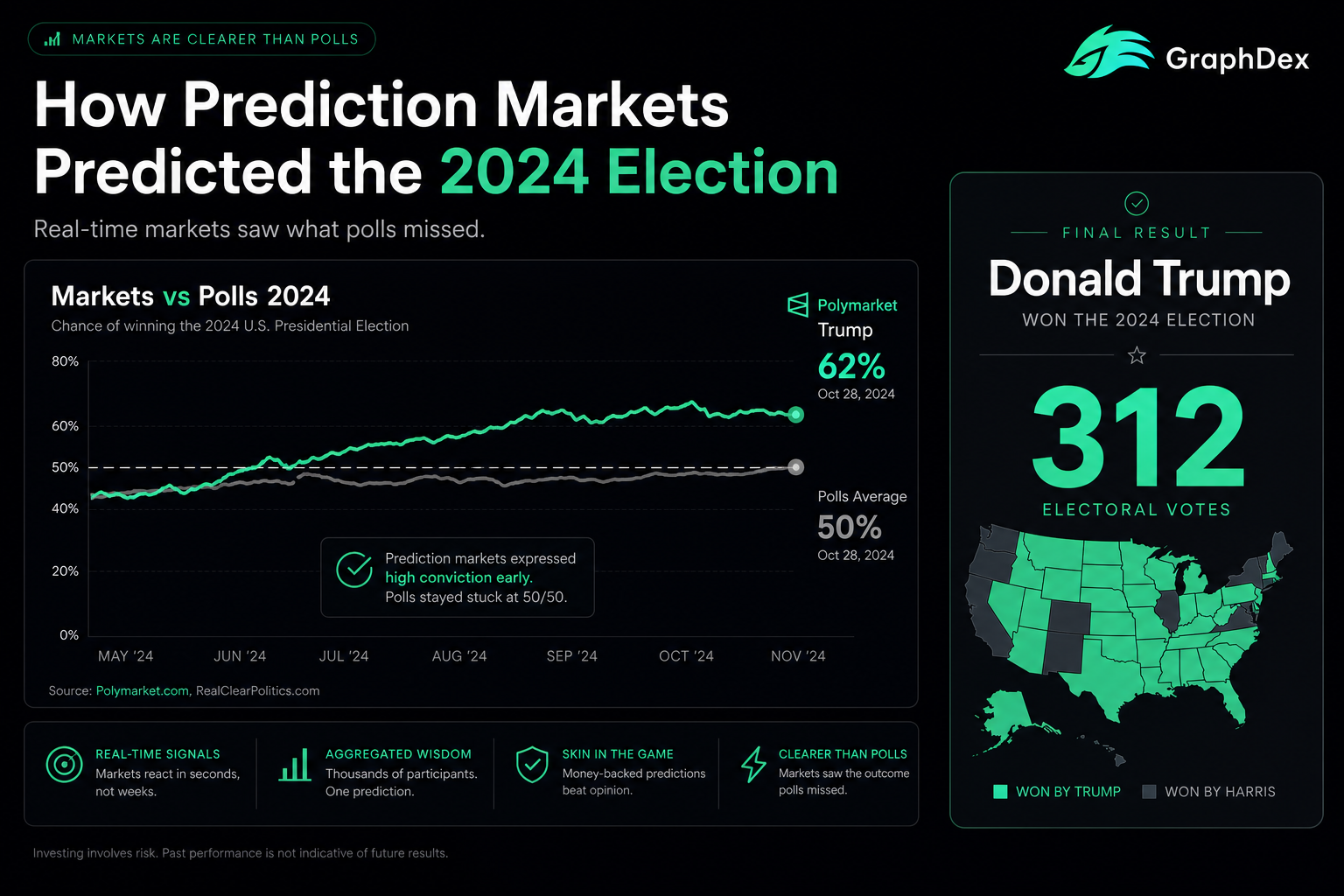
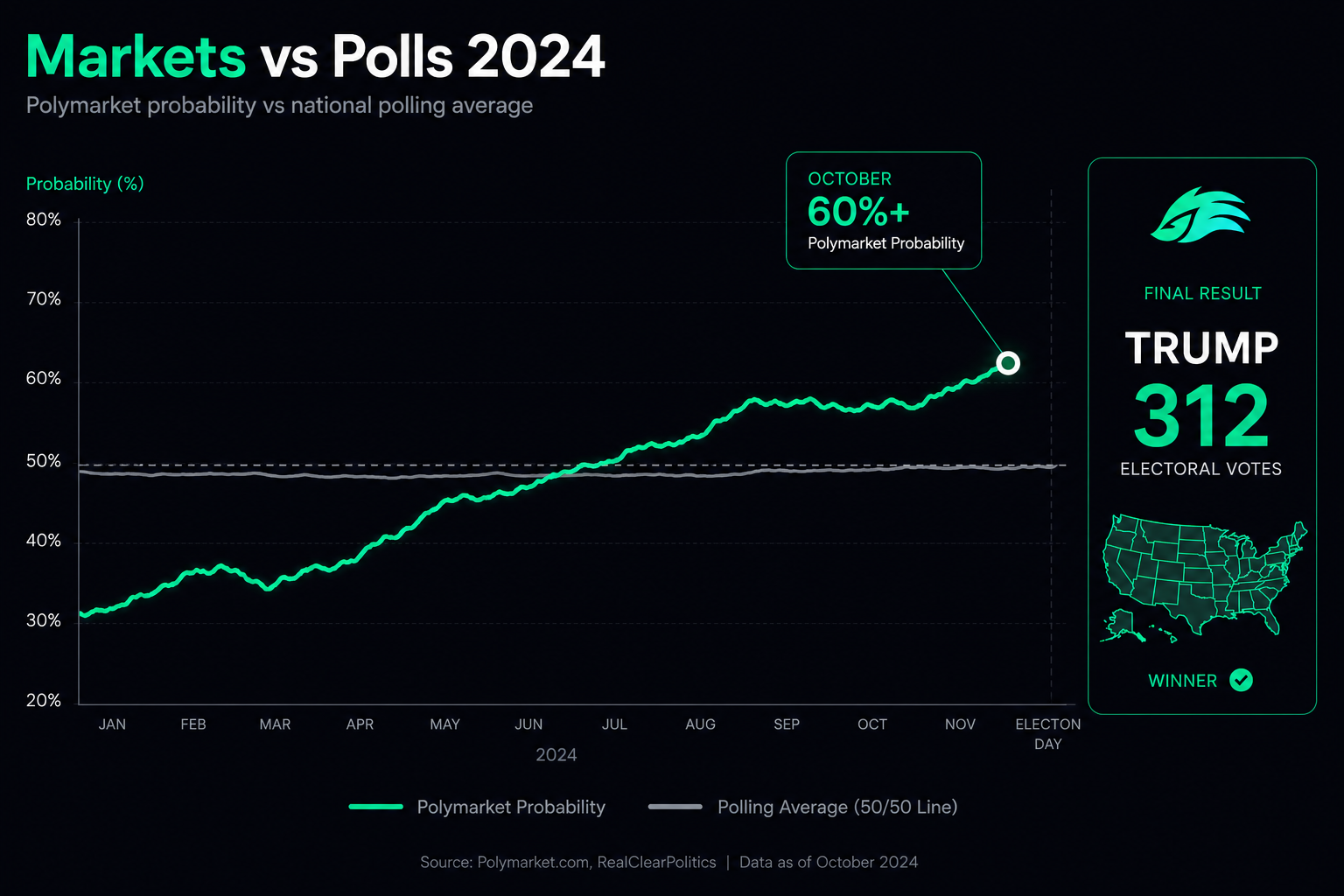
- Polymarket held Trump above 60% for most of October 2024, while national polls showed a near-50/50 race
- Trump won with 312 electoral votes — a decisive victory consistent with the market's directional call
- Major outlets cited markets: CNN, The New York Times, and The Economist tracked Polymarket alongside polls
- Academic study (March 2026): A formal analysis on arXiv supported markets' predictive superiority over traditional polling
Markets win because traders risk real capital — financial accountability rewards accuracy and punishes wishful thinking. For the 2026 midterms, markets are already running.
Trade and follow election markets via GraphDex
Key Takeaways
- Polymarket called Trump's 2024 victory more confidently and earlier than national polls.
- Markets work because real money creates accountability — wrong bets cost money, sharpening accuracy.
- Major media (CNN, NYT, The Economist) cited Polymarket alongside polls in 2024.
- For 2026 midterms and beyond, prediction markets are increasingly treated as primary forecasting tools.
The 2024 Election: Markets vs Polls
The 2024 US presidential election was the most high-profile test of prediction markets to date — and they passed it impressively.
Throughout October 2024, Polymarket held Trump above 60% to win. Meanwhile, national polls consistently showed a near-50/50 race, with most poll averages keeping the candidates within a percentage point or two of each other. The market's directional call was emphatic where polls were noncommittal.
When the votes were counted, Trump won with 312 electoral votes — a decisive victory. The market's confident call proved closer to reality than the polls' coin-flip framing. This wasn't a one-night surprise: Polymarket's elevated Trump probability held for weeks, suggesting traders were processing information polls weren't capturing.
The market's track record across the cycle was telling. In January 2023 — two years before the election — Polymarket priced Trump at roughly 40% and DeSantis at 30%. By January 2024, after primary wins, Trump was above 80%. Markets updated continuously as information arrived, while polls reported periodic snapshots.
Why Markets Beat Polls: Three Structural Advantages
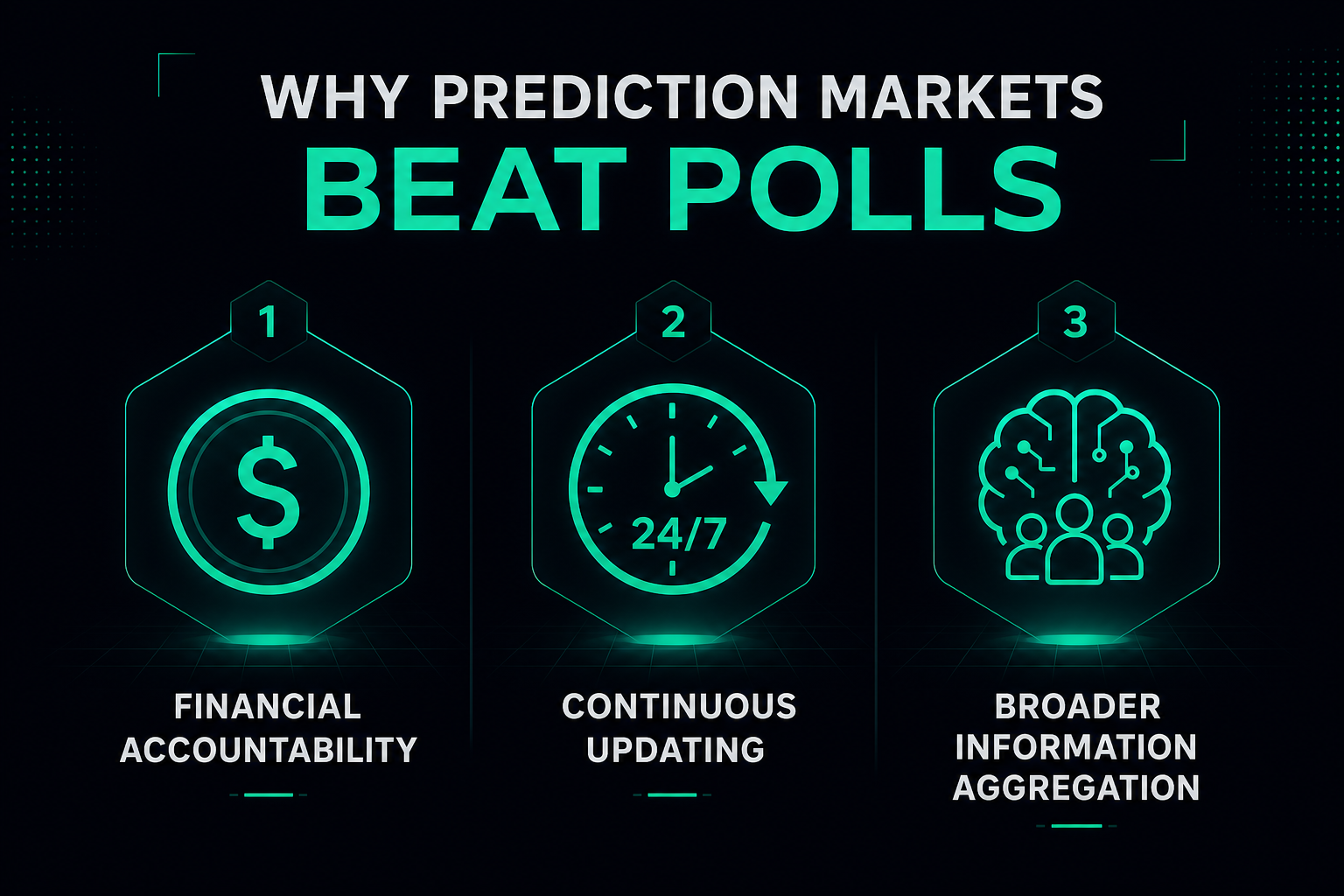
Three structural features explain why prediction markets often outperform traditional polling.
Financial accountability. Traders risk real money. A trader who's wrong loses money. This incentive structure rewards accuracy and punishes wishful thinking — especially in liquid markets. Polls have no such mechanism; respondents face no cost for inaccurate answers.
Continuous updating. Markets run 24/7, with prices updating as traders react to breaking news, new polls, debates, endorsements, court rulings, and live vote counts. Polls are periodic snapshots that miss developments between releases.
Broader information aggregation. Markets aggregate more than polling data alone. Participants weigh base rates, partisan lean, historical precedent (the long-running Republican lean of West Virginia, the Democratic lean of New York), ground-level reporting, and direct knowledge that pollsters can't capture. Real capital backs each piece of information.
This is the wisdom-of-crowds effect, hardened by financial stakes. A formal academic analysis published on arXiv in March 2026 supported these advantages, suggesting prediction markets could be employed to predict presidential elections in a superior manner to traditional polling methods that have been in place for almost a century.
How Election Markets Actually Work
Prediction market election odds aren't betting odds in the traditional sense — they're probability prices. Understanding the mechanics matters.
Each contract is a simple yes/no question tied to a verifiable election outcome. A candidate trading at $0.62 has roughly a 62% market-implied probability of winning. You buy shares at the current price, and if the outcome happens, each share pays $1.00. If it doesn't, the share pays $0.00.
The math is direct: price equals implied probability. This is fundamentally different from sportsbook fixed odds (expressed as +150 or 3/2), where odds include a house margin. Prediction market prices reflect the market's actual aggregate assessment, with no built-in house edge taking a cut.
Markets resolve based on official, trusted sources. For complete clarity, each market specifies the exact criteria and sources used to determine the winner. Polymarket charges no trading fees and uses USDC for deposits and withdrawals — though access varies by jurisdiction.
Where Prediction Markets Have Limits
For balance, it's worth understanding where prediction markets don't outperform — or where they have specific weaknesses.
Low-liquidity markets are less reliable. The wisdom-of-crowds and financial-accountability effects need participation. A market with $1 million in volume aggregates information well; one with $5,000 in volume is just a few people's guess.
Markets can be manipulated. Large players can move thinly-traded markets to influence perceptions. The 2024 cycle saw concerns about this, prompting research on hardening markets ahead of 2026 elections.
Markets reflect probabilities, not certainties. A 70% market is wrong 30% of the time, by design. Confusing "high probability" with "guaranteed" is a misreading.
Polls and markets are complementary, not substitutes. Polymarket itself notes that markets and traditional forecasts are complementary tools. Markets aggregate the broadest information; polls capture specific demographic and methodological signals. The best forecasters watch both.
Access is restricted. US users face restrictions on Polymarket; Kalshi is the CFTC-regulated US alternative. Legal status is evolving — check current rules for your jurisdiction.
What Markets Are Saying About 2026
For the 2026 midterms and beyond, prediction markets are already pricing major outcomes. Polymarket lists markets including "Balance of Power: 2026 Midterms" and races at the House, Senate, and state level. These markets let traders take positions as new information emerges over the life of the market — short-horizon weekly markets to long-dated contracts covering outcomes months or years away.
Markets are now treated as primary forecasting tools by political strategists, financial institutions, and journalists. After 2024's performance, the question has shifted from "are markets accurate enough to trust?" to "how should we read them alongside polls?"
For 2026, expect markets to:
- Reflect breaking news within minutes (debates, court rulings, polling shifts)
- Aggregate signals polls miss (ground-level reporting, base rates, money flows)
- Be hardened against manipulation following lessons from 2024
- Be widely cited by major media as a forecasting indicator
For traders, this is an opportunity. Election markets are liquid, fundamentally analyzable, and rich with information edge. The 2024 cycle produced documented wallets that turned modest capital into significant profit by reading information faster than the market.
Trade 2026 election markets via GraphDex
How to Trade Election Markets in 2026
For traders considering election markets, a practical framing:
Specialize in markets you understand. A market is a probability puzzle. Focus on races, regions, or topics where you have an information edge — local knowledge, deep historical context, or fast information processing.
Compare market prices to your own probability estimates. The market price is the consensus. Your edge is where you confidently disagree. If the market prices a candidate at 40% and your analysis says 55%, that's a tradable gap.
Use multiple platforms when possible. Polymarket and Kalshi often price the same events differently — cross-platform arbitrage exists. CFTC-regulated platforms apply for US users; check current legal status.
Read both markets and polls. They're complementary. Markets aggregate information including polls; polls provide methodological detail markets don't. Skilled forecasters synthesize both.
Consider copytrading proven forecasters. Rather than developing your own edge from scratch, follow traders ranked by PnL who consistently called past races. Platforms like GraphDex let you copytrade ranked forecasters automatically.
Manage risk. Election markets can be volatile around news. Size positions according to edge, diversify across races, and use the early-exit option to lock in gains or cut losses before resolution.
Why GraphDex Helps with Election Trading
For traders pursuing election markets, several features matter:
- Copytrading — follow proven Polymarket forecasters ranked by PnL and win rate; mirror their positions on election markets automatically
- Whale tracking — see when large informed traders move on a race
- AI signals — surface news impact and probability shifts faster than manual monitoring
- Bubble Maps — visual screener showing volume and momentum across markets including elections
- Integrated execution — act on signals immediately without switching tools
Election markets are a domain where information speed and edge matter intensely. Pairing prediction market trading with GraphDex's tracking, copytrading, and execution — plus Solana DEX trading and staking up to 17% APY on the same capital — gives you a complete environment for serious election trading.
Start trading election markets smarter on GraphDex
Frequently Asked Questions
Did prediction markets correctly predict the 2024 US election? Yes — Polymarket held Trump above 60% for most of October 2024 while polls showed a near-50/50 race. Trump won with 312 electoral votes, validating the market's confident directional call. A March 2026 academic study on arXiv supported markets' superior predictive performance over traditional polling.
Why are prediction markets often more accurate than polls? Three structural advantages: financial accountability (traders lose money when wrong), continuous updating (markets run 24/7 vs periodic polls), and broader information aggregation (markets weigh polls, base rates, and direct knowledge polls can't capture). Real capital sharpens accuracy.
Can I trust prediction markets for the 2026 midterms? Markets are now treated as primary forecasting tools by strategists, institutions, and journalists. They're highly informative — but not certainties. A 70% market is wrong 30% of the time by design. Read markets alongside polls; they're complementary, not substitutes.
How do election prediction markets work? Each contract is a yes/no question on an outcome. A share trading at $0.62 implies a 62% probability. Buy shares at the current price; if the outcome happens, each share pays $1.00 (zero if not). Prices reflect aggregate market belief and update continuously as information arrives.
Are prediction markets gambling? Legally, regulated event contracts are treated as financial derivatives by the CFTC, not gambling — you trade peer-to-peer against other participants, not against a house. Some states dispute this for certain contracts. Markets reflect real probabilities, unlike sportsbook odds that include house margin.
Can US users trade on Polymarket? US users face restrictions on Polymarket due to CFTC regulations, though Polymarket US (QCX LLC) operates as a CFTC DCM. Kalshi is the established CFTC-regulated US option for election markets. Legal status varies by state and is evolving — verify current rules before trading.
How can I trade election markets profitably? Specialize in markets you understand, compare market prices to your own probability estimates, manage risk according to your edge, and consider copytrading proven forecasters via platforms like GraphDex. Treat market prices as starting points for analysis, not endpoints — your edge is where you confidently disagree.
About This Guide
This guide is published by the GraphDex Research team — analysts and traders building the infrastructure for digital asset trading on Solana. Our content is based on live platform data, current market figures, and publicly available analysis.
Sources & data: Election data, market figures, and academic findings reflect publicly available information as of 2026. Prediction market trading carries risk; markets reflect probabilities, not certainties. This guide is educational and not financial or political advice — always do your own research.
GraphDex is the infrastructure for digital asset trading — trade, predict, and earn in one place. Learn more at graphdex.io.
Last reviewed: May 2026 · GraphDex Research
The infrastructure for digital asset trading. Trade, predict, stake, repeat. graphdex.io