By GraphDex Research · Reviewed for accuracy May 2026
Quick Answer
Trading Solana memecoins successfully requires a different approach than trading major crypto:
- Use on-chain analysis (Bubble Maps, holder concentration) more than technical analysis
- Position sizing far smaller than major crypto trades (0.5-1% per trade)
- Faster execution with sub-cent fees and MEV protection
- Multiple small bets rather than concentrated positions (most go to zero)
- Strict exit discipline — taking profits at predefined targets, not "for the moon"
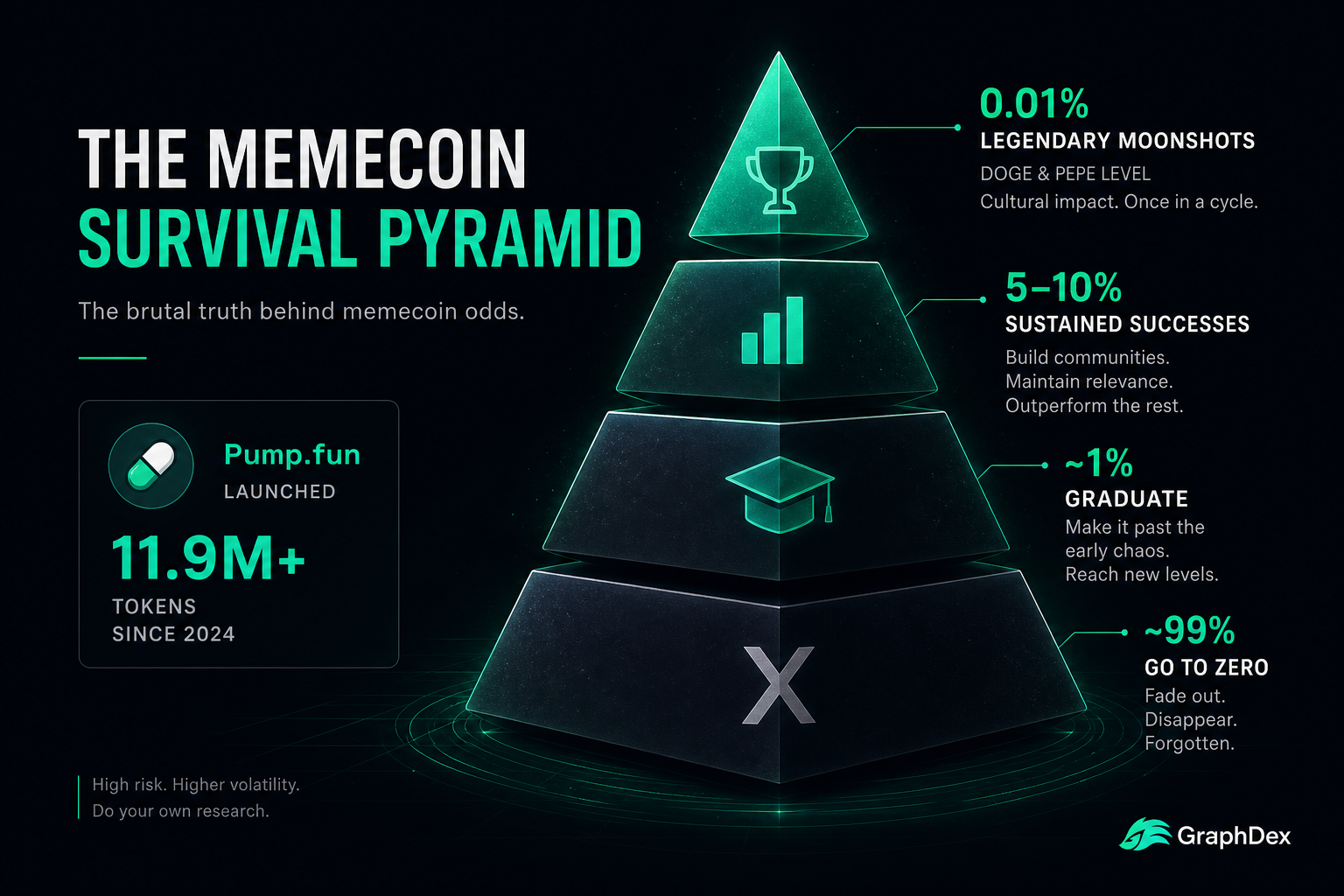
- Accept 99% of memecoins go to zero — survival depends on the 1% that don't
The honest truth: Most memecoin traders lose money. The few who profit treat it as a portfolio approach (many small bets, accepting most will fail) rather than picking single "winners." This guide explains how they actually do it.
Trade Solana memecoins with safety tools on GraphDex
Key Takeaways
- Memecoin trading is portfolio-based — many small positions, accepting most will fail.
- On-chain analysis (holder distribution, liquidity locks) matters more than charts.
- Pump.fun's bonding curve and graduation mechanics create predictable inflection points.
- Position sizing must be tighter than major crypto — assume 100% loss possible on every trade.
What Makes Memecoin Trading Different
Memecoins are crypto tokens whose value comes primarily from internet culture, community, and viral momentum rather than utility or fundamentals. Trading them requires a fundamentally different mindset than trading Bitcoin, Ethereum, or major altcoins.
The Brutal Numbers
By 2026, the Solana memecoin ecosystem has matured into a unique market:
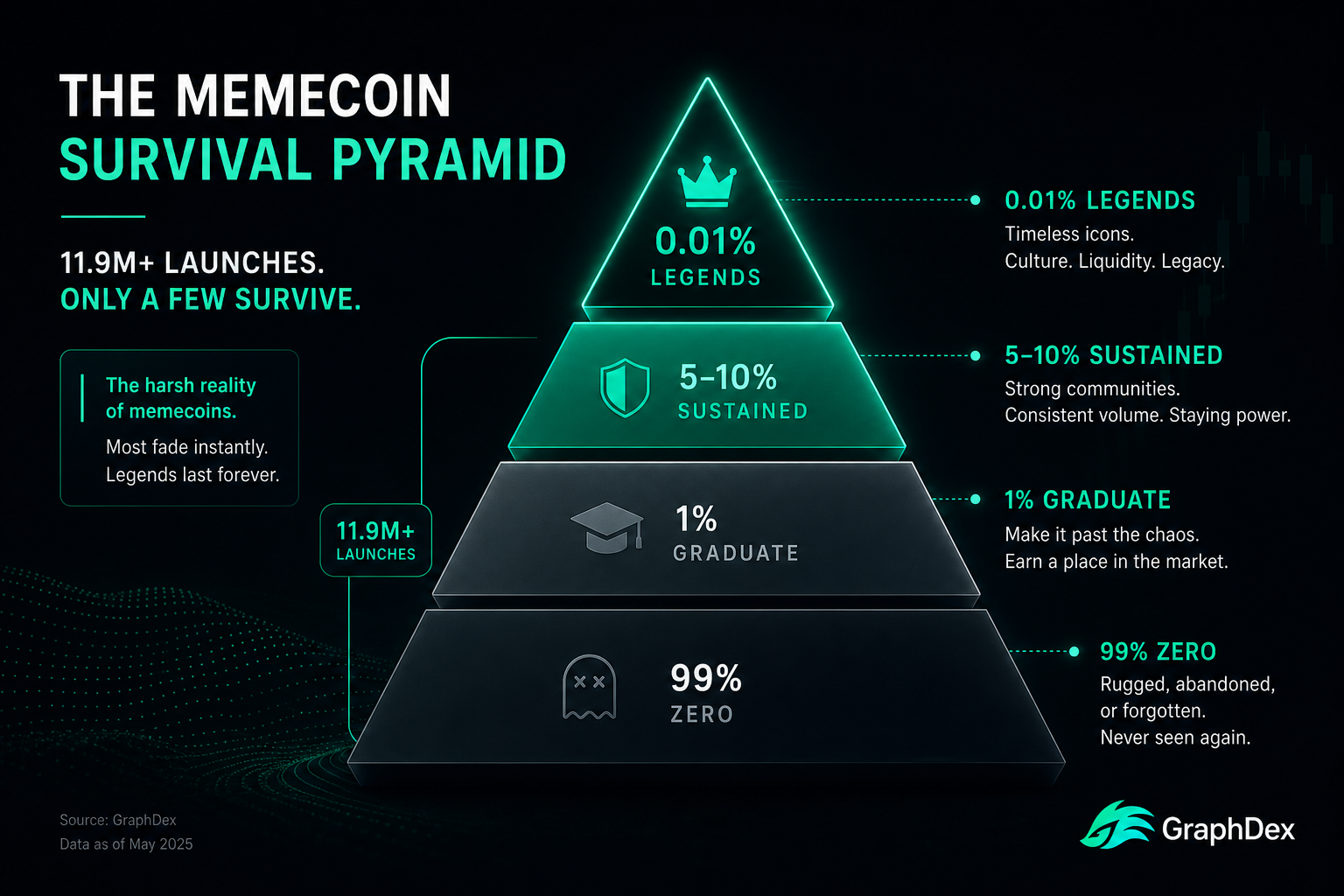
- Pump.fun has launched 11.9 million+ tokens since January 2024
- Only ~1% successfully "graduate" from the bonding curve to a DEX
- ~99% of tokens go to zero — either through abandonment, rug pulls, or organic decline
- The successful 1% can produce 100×-1000× returns for early entrants
- $2.8 billion in losses to rug pulls in 2025 alone (Chainalysis data)
- Up to 67% of total Solana DEX transactions at peak Pump.fun activity
These numbers shape everything about how successful memecoin trading works.
Why Traditional TA Doesn't Quite Work
Standard technical analysis works less reliably on memecoins because:
Low liquidity: Single large traders can move prices substantially. A "perfect" pattern can be manufactured by one whale.
Short lifespans: Many memecoins go from launch to peak to zero within hours or days. Patterns don't have time to develop.
Manipulation potential: Wash trading, coordinated buying, and "bundle buys" can fake volume and price action.
Social-driven price action: Twitter trends, Telegram pumps, and viral moments override technical signals.
Different volatility: Daily moves of 50-200% are normal. Standard stops get destroyed by noise.
This doesn't mean TA is useless — it means it must be combined with on-chain analysis and modified for memecoin reality.
The Portfolio Approach
Successful memecoin traders use a portfolio mindset:
- 10-30 small positions over a week or month
- Each position 0.5-1% of trading capital
- Expect 80-90% to fail
- The 10-20% that work must pay for the failures
- 1-2 "moonshots" carry the entire portfolio
This is essentially venture capital math applied to memecoins. Trying to identify the one perfect memecoin is harder than spreading across many.
The Pump.fun Lifecycle: Critical Understanding
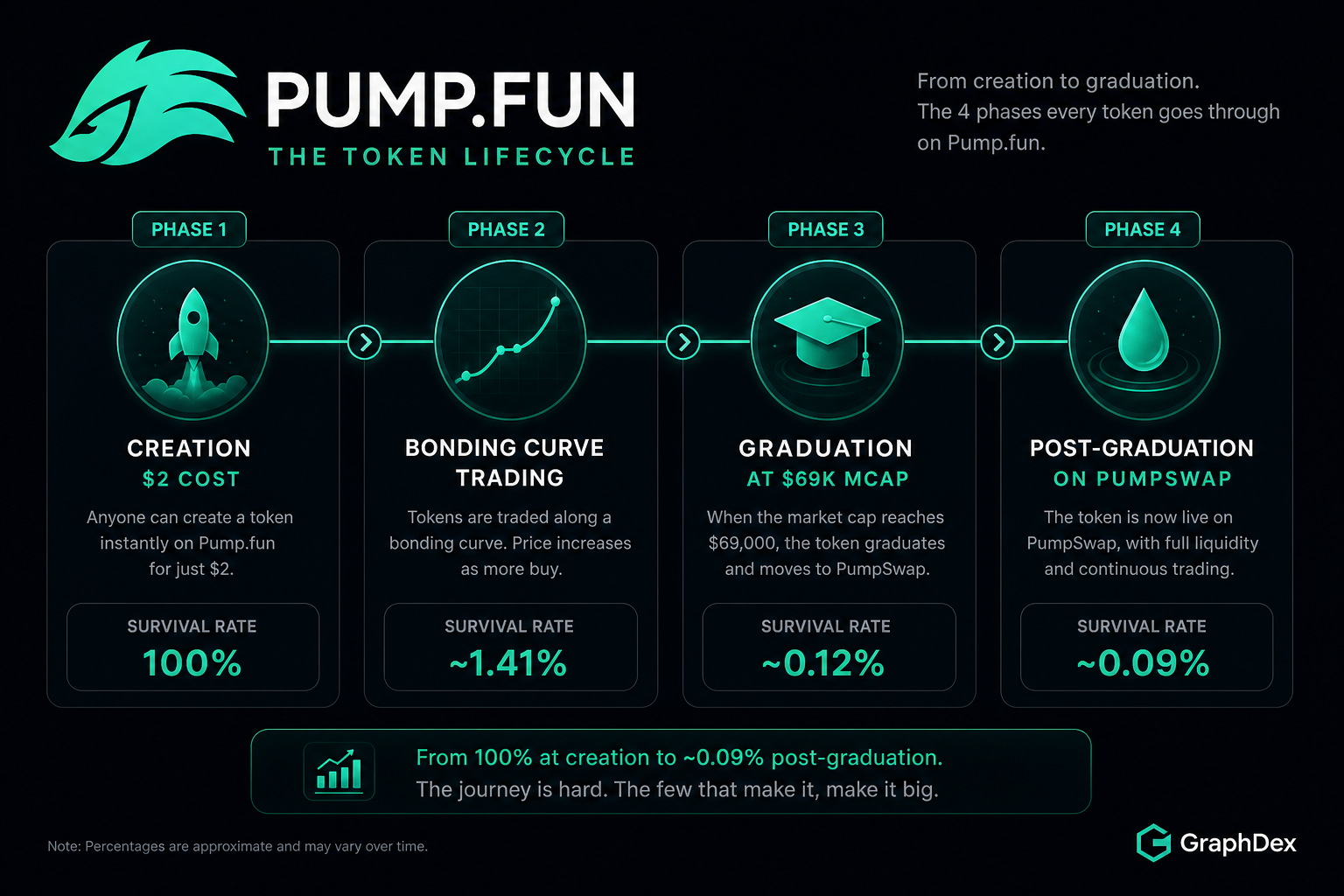
To trade Solana memecoins, you must understand Pump.fun mechanics.
Phase 1: Token Creation
Anyone can launch a token on Pump.fun for ~$2. The creator chooses name, ticker, image, and description. The token is immediately available for trading.
Implications: Anyone can create scam tokens. Always verify the official version of any token you've heard about — fake versions appear within minutes of any trend.
Phase 2: Bonding Curve Trading
Initially, tokens trade against a mathematical bonding curve, not on a normal DEX. As more SOL flows in, price rises along the curve. As SOL flows out, price falls.
Critical features:
- Liquidity is automatic (no separate LP needed initially)
- Price discovery is mathematical, not market-driven
- Volume on the curve reflects actual demand
- Most tokens trade only on the curve, never graduating
Phase 3: Graduation
When a token's market cap reaches approximately $69,000 in SOL, it "graduates" from the bonding curve to PumpSwap (formerly Raydium). At graduation:
- Pump.fun automatically creates a liquidity pool
- The token migrates to a normal DEX environment
- Standard trading mechanics apply (impermanent loss, normal liquidity)
- The token becomes available to non-Pump.fun traders
Critical inflection point: ~99% of tokens never graduate. Graduation alone is a meaningful signal that the token has organic demand.
Phase 4: Post-Graduation
After graduation, the token competes with all other Solana tokens. Most graduated tokens still go to zero — graduation alone doesn't guarantee success.
Successful post-graduation patterns:
- Continued community building
- Real utility additions (or convincing narrative)
- Exchange listings (CEXs)
- Cultural moments that drive sustained attention
Why This Matters for Trading
Different strategies suit different phases:
Sniping (early curve): Buy tokens immediately at launch. Extreme risk; extreme reward potential.
Curve trading: Trade tokens climbing the curve, betting on graduation.
Graduation play: Buy around graduation, betting on continued momentum.
Post-graduation: Treat like normal small-cap trading.
On-Chain Analysis: The Memecoin Edge
Where TA falls short, on-chain analysis provides the real edge for memecoin trading.
Holder Concentration Analysis
The most important metric. Tools like Bubble Maps visualize holder distribution.
Red flags:
- Top 10 holders own >50% of supply (extreme concentration)
- Multiple wallets with similar early purchase timing (likely bundled buys)
- Few wallets controlling most supply with no apparent reason
- Top holders connected through earlier transactions (sybil patterns)
Green flags:
- Top 10 holders own <30% combined
- Broad distribution across many wallets
- Top holders are known good actors (verified bundlers, DEXs, etc.)
- Diverse early purchase timing
Bubble Maps (built into GraphDex) makes this analysis visual — you literally see which wallets are connected to each other.
Liquidity Verification
Before buying any memecoin, verify:
Liquidity amount: Insufficient liquidity = inability to exit at acceptable prices. Generally need $20,000+ in liquidity for safe trading.
Liquidity lock status: Locked liquidity prevents creators from pulling it (rug pulling). Unlocked liquidity is a major risk.
Lock duration: How long is liquidity locked? Short locks (days) provide little protection.
Lock platform: Reputable locks (Streamflow, Team.Finance) verifiable; "self-locks" are essentially no locks.
Smart Money Tracking
Some wallets consistently profit from memecoins. Following them provides edge.
How to identify smart money:
- Wallets that frequently buy tokens that later moon
- Wallets with high win rates on memecoin trades
- Wallets that don't simply dump on retail (signs of long-term thinking)
How to use it:
- Set alerts when known smart money wallets enter new tokens
- Don't blindly copy — use as signal to investigate
- Recognize that smart money exits matter as much as entries
GraphDex's wallet tracking feature consolidates this — see what successful traders are doing in real time.
Volume vs Holders Analysis
Real growth: increasing holders AND increasing volume.
Fake growth: increasing volume with stable or decreasing unique holders (wash trading).
Healthy memecoin growth shows both volume and holder growth in roughly proportional ways.
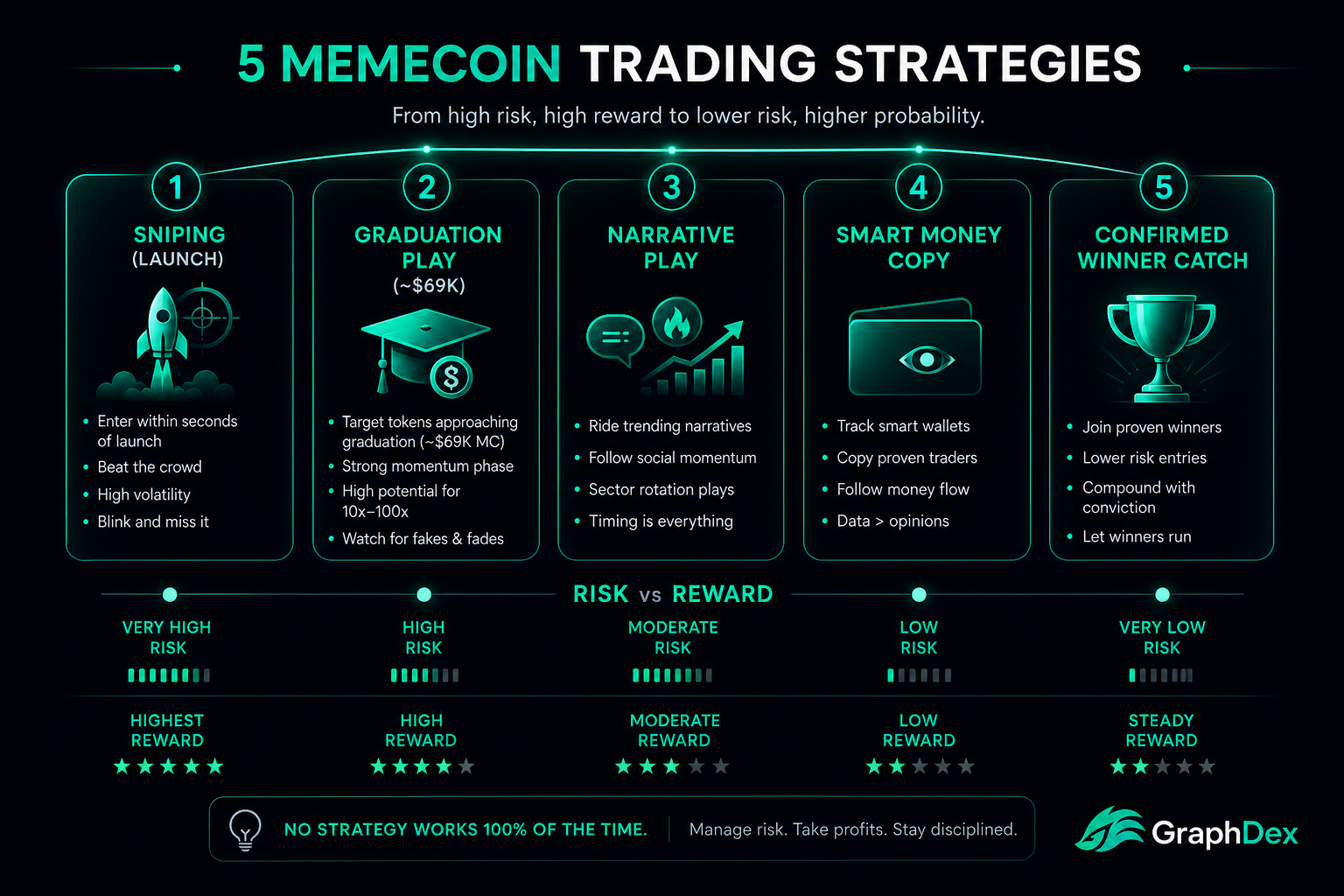
Memecoin Trading Strategies
The major systematic approaches that work in 2026:
Strategy 1: The Sniping Approach
Buy tokens at or near launch, before significant price discovery.
The setup:
- New token launches on Pump.fun (or similar launchpads)
- You enter within first 1-10 minutes
- Aim to catch tokens before they significantly run
The execution:
- Fast execution tool (GraphDex, dedicated bots)
- Pre-funded wallet with SOL ready
- Quick analysis of new token (creator, initial holders, basic safety)
- Small position size due to extreme risk
Risk profile:
- Highest risk-reward ratio in trading
- Most "snipes" lose 50-100% within hours
- Successful snipes can produce 10×-100× returns
- Bot competition makes manual sniping difficult
Position sizing: 0.1-0.5% of capital per snipe maximum. You'll do many; most will fail.
Strategy 2: The Graduation Play
Buy tokens approaching Pump.fun graduation (~$60-69K market cap).
The setup:
- Token climbing bonding curve with sustained volume
- Approaching graduation threshold ($69K mcap)
- Holder distribution acceptable
- Genuine community engagement visible
The execution:
- Enter before graduation as momentum builds
- Hold through graduation transition (often pumps further)
- Exit at predefined targets after graduation
Risk profile:
- Medium-high risk
- ~50-70% of graduated tokens see continued price action for some period
- Less competition than pure sniping
- More time for analysis
Position sizing: 0.5-1% of capital per trade.
Strategy 3: The Narrative Play
Identify emerging memecoin narratives and trade across multiple tokens in the theme.
The setup:
- Emerging cultural trend, meme, or narrative
- Multiple tokens forming around the theme
- Early stage of attention cycle
- Identifiable end state (peak attention, then decline)
The execution:
- Buy multiple tokens within the narrative
- Some will moon more than others
- Take profits as narrative peaks
- Exit before attention shifts
Examples of past narratives: Dog coins, frog coins, AI agents, political memes, celebrity tokens, cat coins.
Risk profile: Medium-high risk; narrative timing is crucial.
Position sizing: Spread 2-5% across multiple tokens in the narrative.
Strategy 4: The Smart Money Copy
Follow known successful memecoin traders' moves.
The setup:
- Track 5-10 verified successful memecoin traders
- Wait for them to enter new positions
- Verify entry through on-chain data
- Enter similarly (within first 5-30 minutes of their entry typically)
The execution:
- Real-time alerts on tracked wallets
- Quick analysis of why they likely entered
- Position size based on your conviction, not theirs
Risk profile: Medium risk if done properly. Lower risk than sniping; higher than graduation plays.
Position sizing: 0.5-1% per trade.
Strategy 5: The Confirmed Winner Catch
Buy tokens that have already proven legitimate (graduated + sustained price action) on pullbacks.
The setup:
- Token has graduated and held above bonding curve for 24+ hours
- Active community engagement
- Pullback presents better entry than initial graduation
- Clear technical structure (support levels emerging)
The execution:
- Apply normal swing trading principles
- Use support levels and structure
- Stop loss below key support
- Targets at major resistance
Risk profile: Lower-risk memecoin strategy. Many graduated tokens still go to zero, but the proven-winner subset has better odds.
Position sizing: 1-2% per trade. Closest to normal crypto position sizing.
Critical Safety Protocols
Memecoin trading without safety protocols is gambling regardless of edge.
The Pre-Trade Checklist
Before any memecoin entry:
1. Holder distribution check (Bubble Maps). Top 10 < 50% combined? If higher, skip.
2. Liquidity check. $20K+ liquidity? Locked? Verified lock?
3. Contract verification. Standard SPL token? No mint function? No blacklist?
4. Initial holder analysis. Bundled buys? Sybil patterns? Real distribution?
5. Social verification. Real community vs. just hype? Engagement vs. follower count?
6. Position sizing. Position size matches risk model? 0.5-1% maximum?
7. Exit plan defined. Stop loss set? Targets identified?
If any of the above raises serious concerns, skip the trade. There will always be more memecoins.
Position Sizing for Memecoins
Due to the high rug pull and total loss risk, position sizes must be smaller than normal crypto:
Per-trade limits:
- Sniping/launches: 0.1-0.5% of capital
- Standard memecoin trades: 0.5-1% of capital
- Confirmed graduated tokens: 1-2% of capital
Aggregate limits:
- Total memecoin exposure: 5-15% of total trading capital maximum
- Maximum 10-20 active memecoin positions
- Avoid clustering all positions in same narrative
This limits worst-case scenarios. If all your memecoins blow up simultaneously (which has happened during major market events), you've lost 5-15% of capital, not your entire account.
MEV Protection
Solana memecoin trading attracts MEV bots. Sandwich attacks on illiquid tokens can cost 5-20% per trade in slippage.
Protection methods:
- Use platforms with built-in MEV protection (GraphDex)
- Avoid obvious "round number" position sizes
- Use private mempool services where available
- Set strict slippage limits
The estimated $370-500M Solana traders lost to MEV in 2024-2026 came predominantly from unprotected memecoin trades.
Rug Pull Recognition
Common rug pull patterns:
Pattern 1: Slow rug. Creator gradually sells over hours/days as price climbs. Volume from creator's wallet visible in on-chain data.
Pattern 2: Liquidity pull. Creator removes liquidity, causing instant price collapse. Locked liquidity prevents this.
Pattern 3: Mint function activation. Creator mints unlimited tokens and dumps. Modern Pump.fun tokens generally don't allow this, but verify.
Pattern 4: Honeypot. Token can be bought but not sold. Test with small purchase + immediate sell attempt before larger entry.
Pattern 5: Social media disappearance. Creator deletes Twitter/Telegram. Often precedes liquidity pull.
GraphDex's Bubble Maps and contract analysis tools surface most of these patterns before you enter.
Exit Strategies for Memecoins
Equally important to good entries: knowing when to leave.
Take-Profit Levels
Memecoin moves are extreme. Profit targets should be aggressive:
Conservative: Exit 50% at 2× (100% gain), let 50% ride with trailing stop.
Standard: Exit 25% at 2×, 25% at 5×, 25% at 10×, let 25% run for moonshot.
Aggressive: Hold positions hoping for 100×+ — but only after taking initial cost back.
The "free roll" approach: Exit your original investment when up 2-3×. The remaining position is "house money" — letting it run carries no real downside.
When to Cut Losses
Standard rules:
Major resistance fails: Token fails to break expected level, exit.
Holder dump: Large holders sell, suggests insiders losing confidence.
Narrative shifts: The cultural moment driving the token fades.
Time-based: Position hasn't moved in defined timeframe; capital better used elsewhere.
Drawdown threshold: Down 50% from entry, exit and reassess.
The Psychological Trap
Memecoins create extreme psychological pressure:
The "diamond hands" trap: Holding too long because "this is the next DOGE." Most aren't. Take profits at targets.
The "buy more" trap: Adding to losing positions hoping for recovery. Compounds losses.
The "I'll exit when it doubles" trap: Setting impossible targets. Take profits at realistic targets.
The successful memecoin traders aren't the ones who held positions to 1000×. They're the ones who took disciplined profits at 5-20× consistently while losing on most positions.
Trade Solana memecoins with full safety stack on GraphDex
How GraphDex Powers Memecoin Trading
For Solana memecoin traders specifically, GraphDex consolidates critical tools:
- Bubble Maps for holder concentration analysis (the #1 safety filter)
- Pulse feed showing new launches and trending tokens in real time
- AI signals identifying high-conviction opportunities
- MEV protection preventing sandwich attacks on illiquid trades
- Wallet/social tracking following successful memecoin traders
- Sub-cent fees so small position sizes remain economical
- Multi-DEX routing across Pump.fun, PumpSwap, Raydium, Meteora for best execution
- Contract safety checks flagging dangerous tokens automatically
- Fee-based 17% APY staking on cash reserves between memecoin trades
- Non-custodial Privy wallet — sign in with Twitter, email, or Telegram
The integrated approach means you don't switch between five tools for safety analysis, execution, tracking, and protection. Everything happens in one workflow — critical when memecoin trades require speed and discipline simultaneously.
Trade Solana memecoins safely with Bubble Maps + MEV protection on GraphDex
Common Memecoin Trading Mistakes
For balance, the patterns that destroy memecoin traders:
1. FOMO into peaks. Buying tokens already up 1000% in a day. You're statistically buying the top.
2. Skipping on-chain analysis. Trading on hype without checking holders, liquidity, contract. Recipe for rugs.
3. Position sizing too large. Treating memecoins like major crypto. One rug pull wipes out months.
4. No exit plan. Buying for "moon" without defined targets. Holding through inevitable reversals.
5. Adding to losers. "Averaging down" into rugs. Compounds losses.
6. Following influencer calls blindly. Most paid promotions are pump-and-dumps. Verify everything independently.
7. Concentration in one narrative. All positions in dog coins, or all in AI tokens. Single shifts wipe everything.
8. Ignoring MEV. Trading without MEV protection costs 5-20% per trade on illiquid tokens.
9. Trading every launch. Selectivity wins. Many small bets on quality > many small bets on everything.
10. Diamond hands. Refusing to take profits at obvious targets, hoping for impossible moons.
11. No journaling. Cannot improve without measurement. Successful memecoin traders track every trade.
12. Emotional state trading. Memecoin volatility triggers maximum emotion. Trading while emotional guarantees losses.
Realistic Expectations for Memecoin Trading
For honesty about outcomes:
Year 1: Almost certainly losses. 80-95% of memecoin traders lose money. Treat as tuition for understanding the ecosystem.
Year 2: Possible breakeven or small profits for the disciplined. Many quit.
Year 3+: Consistency possible for the dedicated subset. Returns of 100-500% annually achievable for skilled memecoin traders — but with significant variance.
The 5-15% who succeed long-term share traits:
- Treat it as portfolio strategy, not single-token bets
- Strict position sizing (0.5-1% per trade)
- Rigorous on-chain analysis before every entry
- Disciplined exits at predefined targets
- Acceptance that most trades will fail
- Recognition that 1-2 moonshots per portfolio carry the whole strategy
What doesn't work:
- Influencer-following without verification
- Diamond-handing every position
- Single-token concentration
- Skipping safety analysis
- High leverage (avoid leverage entirely on memecoins)
Frequently Asked Questions
Can you make money trading Solana memecoins? Yes, but it's harder than people assume. 80-95% of retail memecoin traders lose money. The successful 5-15% use portfolio approaches (many small bets), strict on-chain analysis, disciplined exits, and accept that most trades will fail. Returns of 100-500% annually are achievable for skilled traders but come with massive variance — including months of losses.
What's the safest way to trade Solana memecoins? There's no fully "safe" way — but lower-risk approaches: (1) Wait for graduation + 24-48 hour stabilization before entering; (2) Use Bubble Maps for holder concentration analysis; (3) Verify liquidity is locked; (4) Position sizes 0.5-1% maximum; (5) Use MEV-protected platforms; (6) Take partial profits at 2-3× to recover original investment.
How do I avoid rug pulls in Solana memecoins? Five-step verification before every memecoin trade: (1) Check holder distribution on Bubble Maps (top 10 holders should own <50%); (2) Verify liquidity is locked and amount sufficient ($20K+); (3) Check contract for malicious functions (no mint, no blacklist); (4) Analyze initial holder patterns (avoid bundled buys); (5) Verify project social presence is genuine.
What's the best time to enter Solana memecoins? Different strategies favor different entry points: Sniping (immediately at launch, highest risk), Curve climbing (during organic growth, before graduation, medium risk), Graduation play (around $50-69K mcap, medium risk), Post-graduation pullback (24+ hours after graduation on first major pullback, lowest risk). Match entry timing to your risk tolerance and capital size.
Should I use leverage on Solana memecoins? No. Memecoin volatility (30-50% daily moves common) makes leverage essentially guaranteed liquidation. Most major exchanges don't even offer leverage on small-cap memecoins. Stick to spot trading with appropriate position sizing. The volatility itself provides enough exposure — adding leverage just accelerates losses.
How much money do I need for memecoin trading? You can technically start with $100-500, but realistic capital for systematic memecoin trading: $1,000-5,000. Position sizes need to be 0.5-1% of total capital, meaning small accounts have positions too small to be meaningful. With $5,000, position sizes are $25-50 each — viable for portfolio approach across 10-20 positions.
What's the difference between Pump.fun graduation and PumpSwap? Pump.fun tokens initially trade on a bonding curve (mathematical price discovery within Pump.fun). When market cap reaches ~$69K, the token "graduates" to PumpSwap (Pump.fun's automatic DEX, formerly graduating to Raydium). At graduation, normal DEX trading mechanics apply — liquidity pools, impermanent loss, etc. Only ~1% of Pump.fun tokens graduate; graduation is a meaningful filter.
About This Guide
This guide is published by the GraphDex Research team — analysts and traders building the infrastructure for digital asset trading on Solana. Our content is based on direct trading experience, on-chain data analysis, and observation of successful memecoin trading practices in 2026.
Sources & data: Pump.fun statistics, Solana ecosystem data, and trading patterns reflect publicly available information as of 2026. Memecoin trading carries extreme risk including total loss of capital — losses of 95%+ of trading positions are common. This guide is educational and not financial advice.
GraphDex is the infrastructure for digital asset trading — trade, predict, and earn in one place. Learn more at graphdex.io.
Last reviewed: May 2026 · GraphDex Research
The infrastructure for digital asset trading. Trade, predict, stake, repeat. graphdex.io