By GraphDex Research · Reviewed for accuracy May 2026
Quick Answer
Trading the FIFA World Cup 2026 on prediction markets involves five steps:
- Choose your platform or terminal — Polymarket (crypto-native, thousands of World Cup markets), Kalshi (regulated US, sports-focused), or a terminal like GraphDex that adds copytrading and analytics
- Understand the market types — tournament winner, group standings, match winners, top scorer, exact scores, and prop-style markets
- Develop or borrow an edge — analyze matchups yourself, or copytrade proven predictors
- Trade with the exit advantage — buy mispriced probabilities, sell when they move your way (before matches resolve)
- Manage risk — position size, diversify across markets, avoid betting on your favorite team
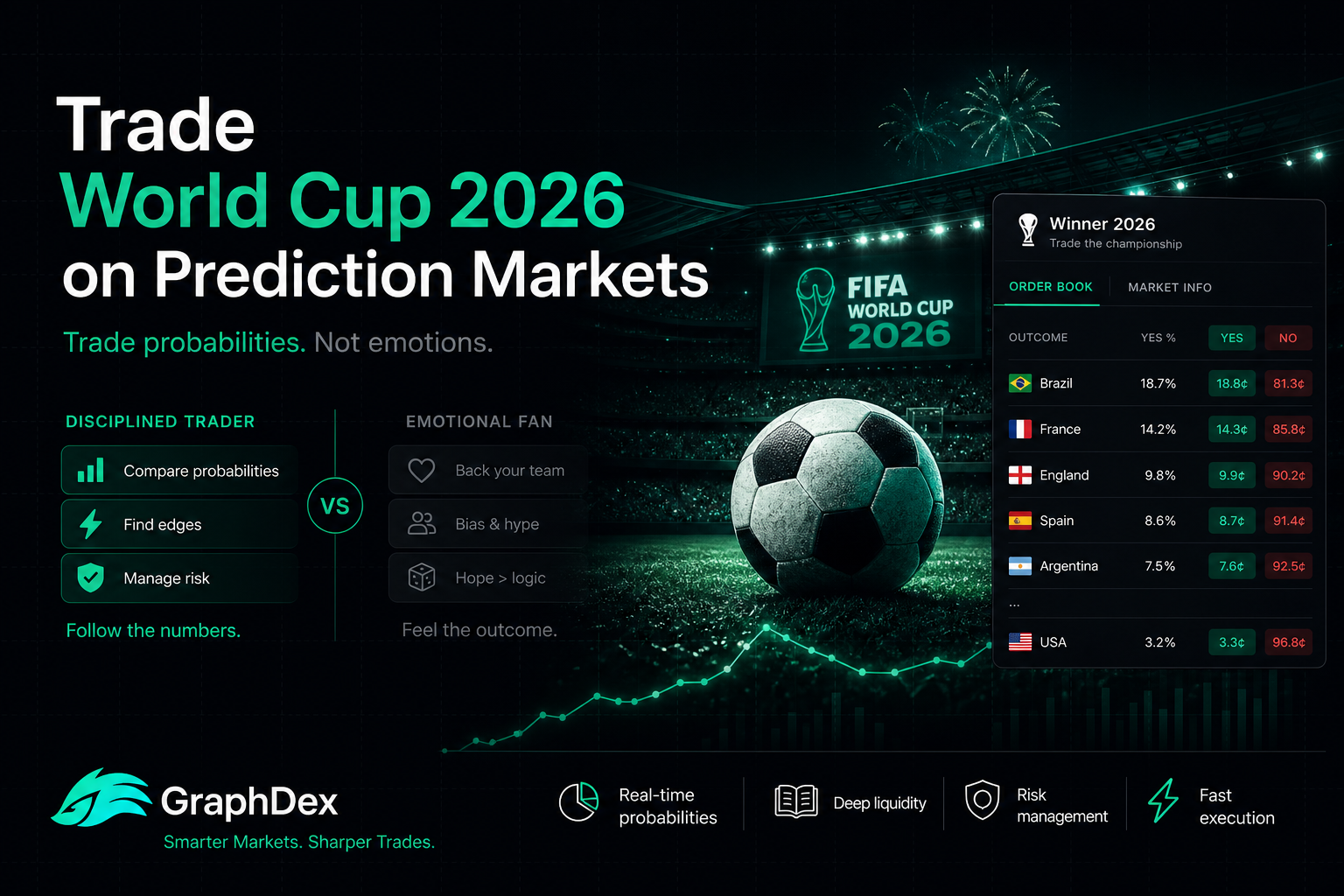
The key insight: The World Cup draws massive liquidity and thousands of markets, but also sharp money. Winning requires trading probabilities with discipline and tools — not backing your heart. Use copytrading, analytics, and the trade-and-exit advantage that prediction markets offer over fixed betting.
Trade the World Cup with copytrading on GraphDex
Key Takeaways
- The FIFA World Cup 2026 is the largest sports prediction market event ever — thousands of markets, record volume.
- Market types range from tournament winner to individual match outcomes and player props.
- Prediction markets let you trade in and out — a key advantage over fixed sportsbook bets.
- Winning requires discipline and tools (copytrading, analytics), not fandom.
Why the World Cup Is a Prediction Market Event Like No Other
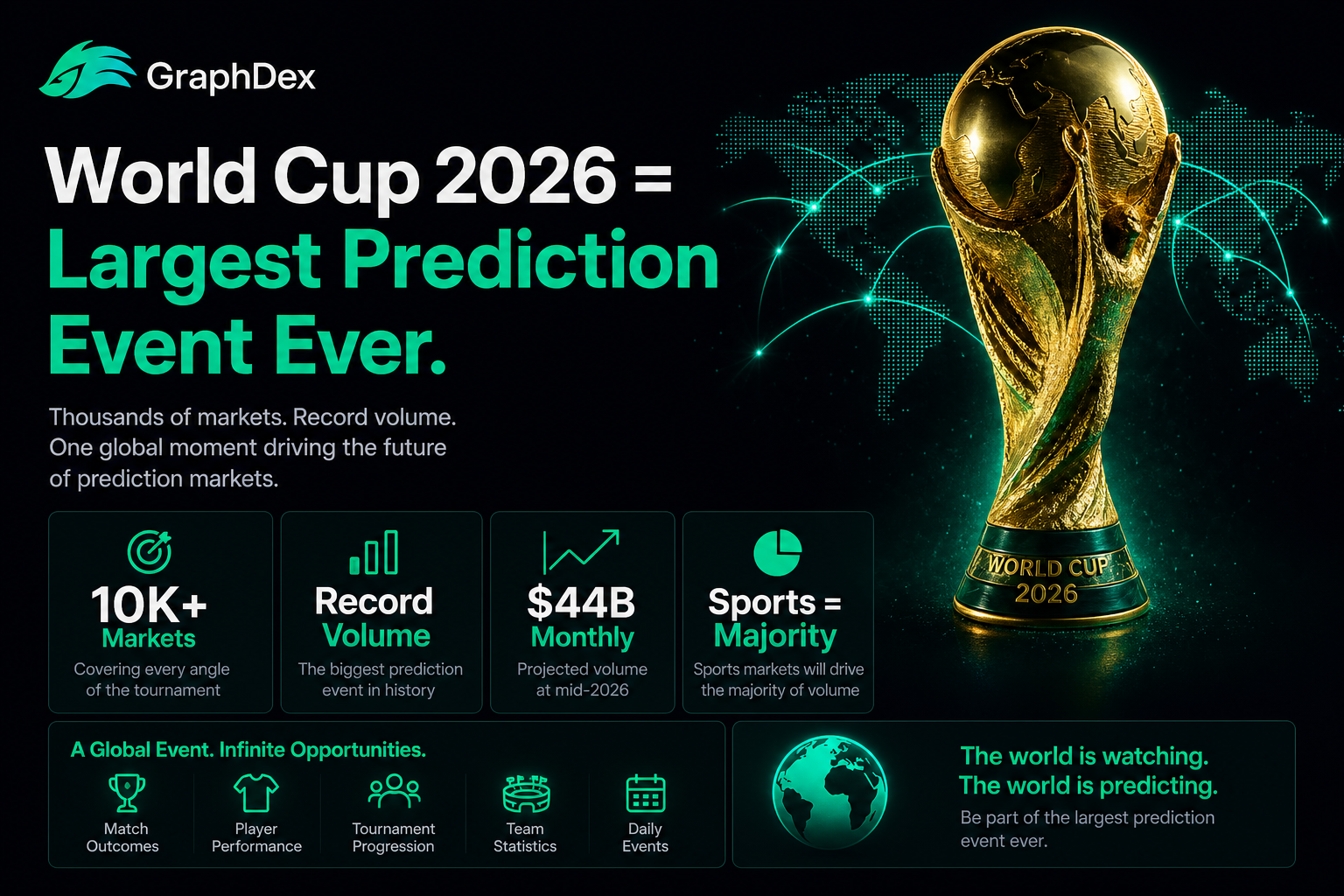
The FIFA World Cup 2026 has become the single biggest catalyst in prediction market history. Understanding why helps you approach it strategically.
The scale:
- The World Cup generates thousands of individual markets — far more than any other single event
- It drives record trading volume, with prediction markets processing around $44 billion in a single month in mid-2026, heavily driven by sports
- Sports have grown to the majority of volume on major platforms, and the World Cup is the crown jewel
Why it's ideal for trading:
Massive liquidity. The enormous interest means deep markets — you can enter and exit positions cleanly, even large ones, without moving prices dramatically.
Market variety. Beyond simple match winners, the tournament generates markets on group standings, knockout progression, top scorers, exact scores, and countless prop-style outcomes. Different edges suit different markets.
Continuous action. With matches throughout the tournament, there's constant activity — new markets opening, others resolving, and probabilities shifting with every result.
Information richness. Team form, injuries, tactical matchups, weather, and momentum all affect probabilities — creating opportunities for traders who process information well.
The caution: Big events attract sharp, sophisticated traders. You're not just competing against casual fans — you're facing data-driven traders using tools. This makes preparation and discipline essential.
World Cup Market Types Explained
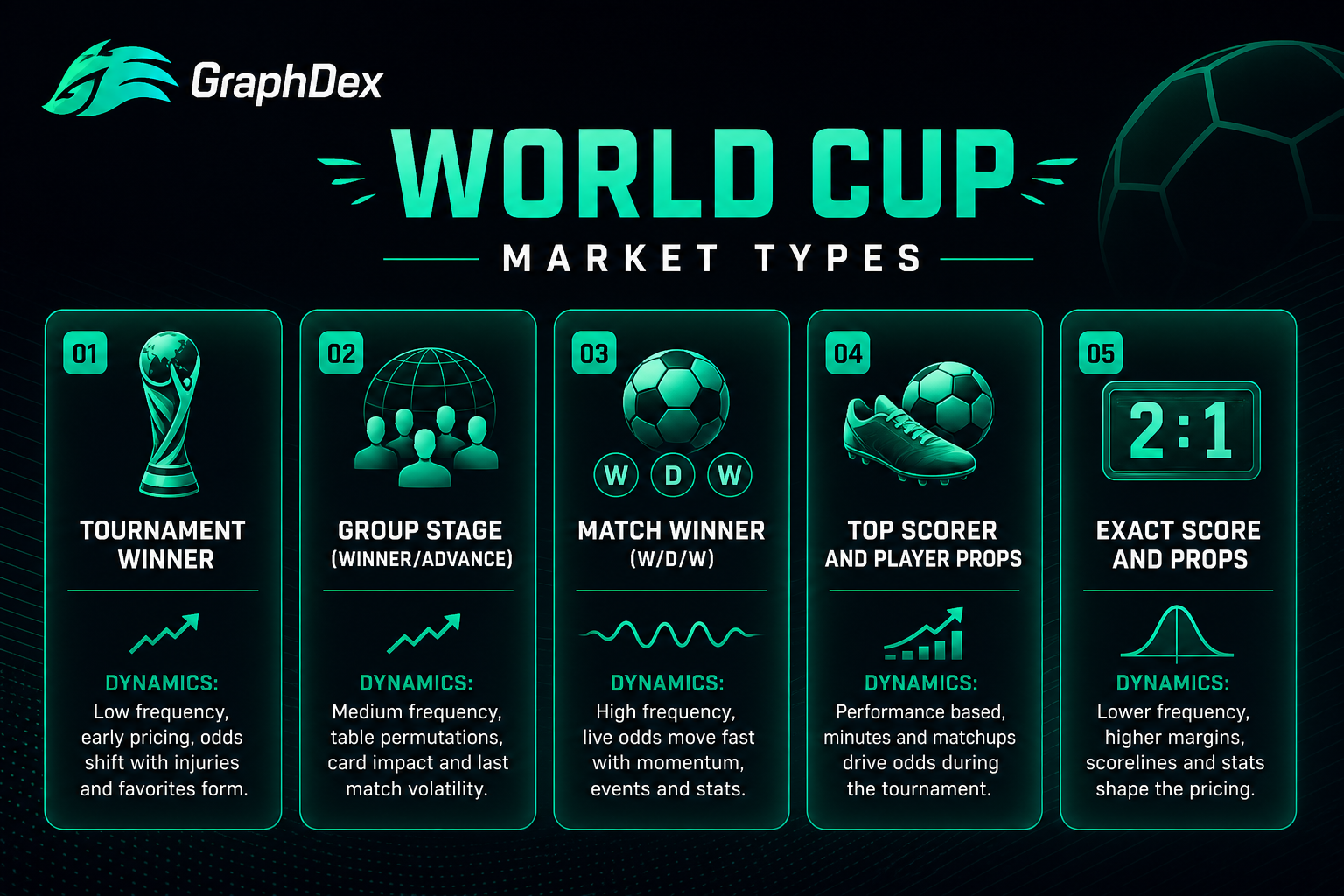
The World Cup offers diverse market types, each with different dynamics.
Tournament Winner
The headline market — which team wins the whole thing.
- Dynamics: Long-running, prices shift throughout the tournament as teams progress or exit
- Opportunity: Early positions on undervalued teams; trading momentum as favorites emerge
- Risk: Long capital lockup if held to resolution
Group Stage Markets
Outcomes within the group stage.
- Types: Group winner, teams to advance, group standings
- Dynamics: Resolve earlier than tournament markets, faster turnover
- Opportunity: Assessing group dynamics better than the market
Match Winner Markets
Individual match outcomes.
- Types: Win/draw/win (three-way), or two-way markets
- Dynamics: Fast resolution, high activity, prices shift during matches
- Opportunity: In-match trading as probabilities swing with events
Top Scorer & Player Markets
Individual player achievements.
- Types: Tournament top scorer, player to score, assists
- Dynamics: Build over the tournament, affected by team progression
- Opportunity: Identifying undervalued players or those on deep-running teams
Exact Score & Prop Markets
Specific outcomes within matches.
- Types: Exact scorelines, total goals, both teams to score
- Dynamics: Higher variance, lower probability, higher payouts
- Opportunity: Statistical edges on specific outcomes
The strategic view: Different market types suit different edges. Match winners reward tactical analysis; top scorer markets reward identifying deep-running teams; prop markets reward statistical modeling. Diversifying across types spreads risk and creates more opportunities.
How to Trade the World Cup Step by Step
A practical framework for trading the tournament.
Step 1: Choose Your Platform or Terminal
- Polymarket: Crypto-native, thousands of World Cup markets, deep liquidity, global access
- Kalshi: Regulated US exchange, sports-focused
- A terminal (GraphDex): Adds copytrading, analytics, and whale tracking on top — the tools that give traders an edge
Step 2: Understand What You're Trading
Before any trade, know the market type, how it resolves, and its dynamics. A tournament-winner position behaves very differently from an in-match trade.
Step 3: Develop or Borrow an Edge
- Develop your own: Analyze matchups, form, injuries, and tactics to assess probabilities better than the market
- Borrow via copytrading: Mirror proven sports predictors automatically — leverage others' edge while you learn
Step 4: Use the Trade-and-Exit Advantage
Unlike a fixed sportsbook bet, you can trade in and out:
- Enter when you spot mispriced probability
- Take profit when the price moves your way — before the match resolves
- Cut losses if new information (injury, red card) invalidates your thesis
- Trade momentum as probabilities shift
Step 5: Manage Risk
- Position size appropriately — never risk more than you can afford to lose
- Diversify across markets rather than concentrating on one outcome
- Set profit targets and exit points
- Critically: don't bet on your favorite team out of loyalty
The Discipline Difference: Trading vs Fandom
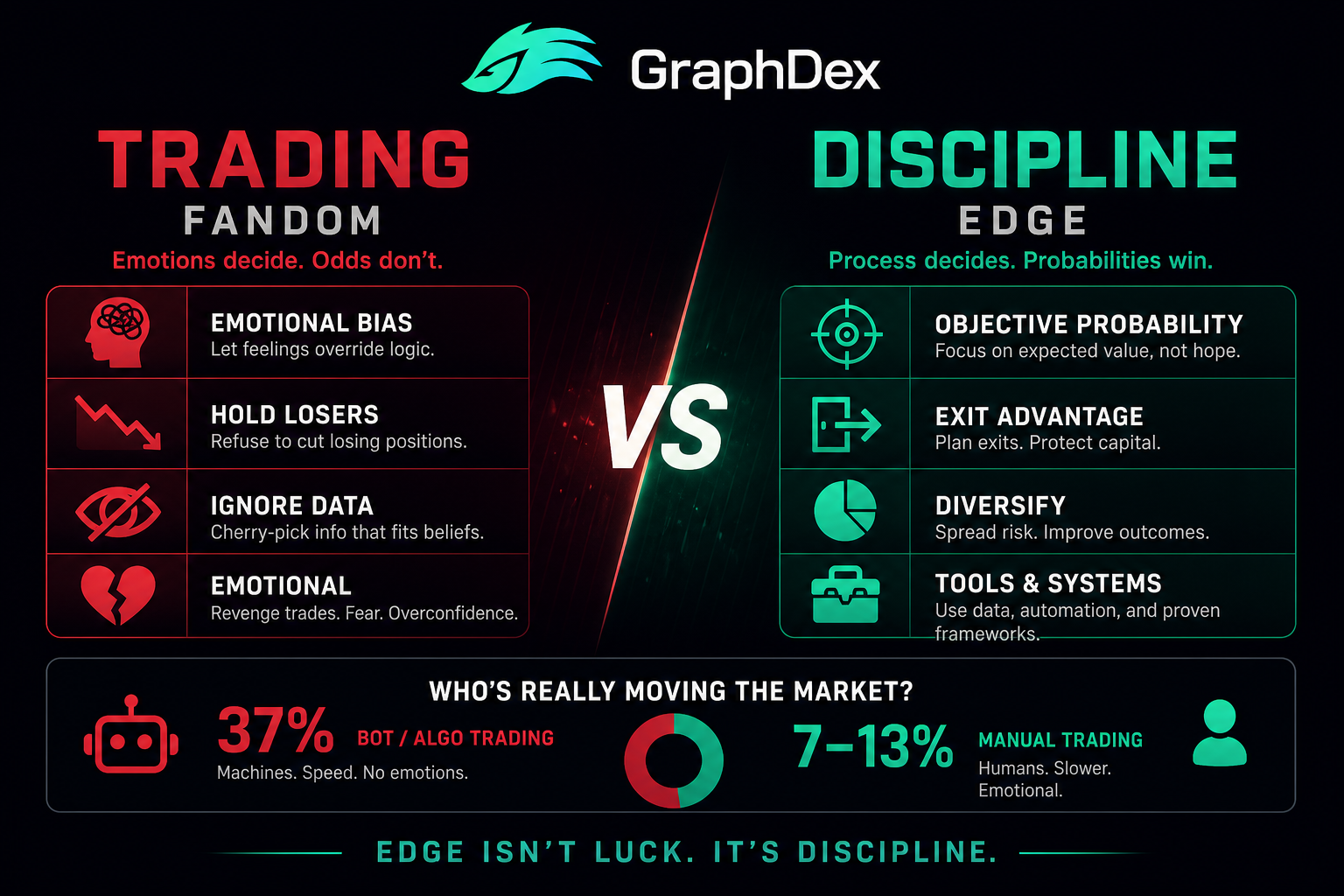
The single biggest mistake in World Cup prediction trading is letting fandom drive decisions.
Why fandom loses:
- You overvalue teams you support (biased probability assessment)
- You hold losing positions hoping your team turns it around (no discipline)
- You ignore data that contradicts your hopes (confirmation bias)
- You're trading emotionally against data-driven traders
Why discipline wins:
- You assess probabilities objectively, spotting genuine mispricing
- You use the exit advantage to take profits and cut losses
- You diversify rather than concentrating on emotional picks
- You leverage tools (copytrading, analytics) rather than gut feeling
The reframe: You're not a fan placing a bet — you're a trader capturing mispriced probabilities. Your favorite team's match is a market to assess objectively, not a loyalty test. The traders who profit from the World Cup treat it as trading; those who treat it as fandom fund the profitable ones.
The tool advantage: Research found 37% of bots are profitable vs only 7-13% of manual traders. Tools enforce discipline — copytrading follows proven strategies rather than emotions, analytics inform decisions with data, and whale tracking shows where sharp money goes. Discipline plus tools is how you compete.
Trade the World Cup with disciplined tools on GraphDex
How GraphDex Helps You Trade the World Cup
GraphDex integrates prediction-market tools into a broader terminal, giving World Cup traders the edge that separates winners from the crowd.
For World Cup traders:
- Copytrading — mirror successful sports predictors automatically (world's first integrated prediction-market copytrading), borrowing proven edge for the tournament
- Analytics — Bubble Maps visualization and AI signals applied to prediction markets
- Whale/wallet tracking — follow sharp money across World Cup markets
- Integrated execution — trade within the terminal
- Non-custodial — Privy wallet, sign in with Twitter, email, or Telegram
Plus the broader ecosystem:
- Solana DEX trading in the same terminal
- Up to 17% APY staking on idle capital between tournament opportunities
- MEV protection and more
The value: The World Cup rewards discipline and tools over fandom. GraphDex provides the copytrading (borrow proven edge), analytics (data-driven decisions), and whale tracking (follow sharp money) that give traders a structural advantage — all in one non-custodial terminal that also handles your broader crypto activity.
For the biggest sports prediction event in history, the right tools make the difference between trading with an edge and betting with your heart.
Try GraphDex for World Cup trading
Common World Cup Trading Mistakes
For balance, what costs World Cup traders:
1. Betting on your home team. The classic mistake. Loyalty clouds probability assessment. Trade objectively.
2. Ignoring the exit option. Treating markets like fixed bets and missing the chance to take profits or cut losses before matches resolve.
3. No edge. Trading without genuine probability assessment or borrowed edge (copytrading). That's gambling.
4. Overconcentration. Putting everything on one team or match. Diversify across markets.
5. Chasing losses. Revenge trading after a bad call. Discipline over emotion.
6. Ignoring sharp money. Not tracking whales who often move before the crowd on major events.
7. FOMO into moving markets. Chasing a team after its price has already surged. You're buying the top.
8. No risk management. No position sizing, no exit plan. Risk discipline matters as much here as in any trading.
Related Guides
- Sports Prediction Markets in 2026: Complete Guide to Trading the World Cup & Beyond
- Prediction Market Copy Trading in 2026: The Complete Guide
- Best Polymarket Alternatives 2026: Kalshi, GraphDex & 8 More Compared
Frequently Asked Questions
How do I trade the World Cup on prediction markets? Five steps: (1) Choose a platform (Polymarket, Kalshi) or terminal (GraphDex for copytrading and analytics); (2) Understand the market types (tournament winner, group stages, match winners, top scorer, props); (3) Develop or borrow an edge (analyze yourself or copytrade proven predictors); (4) Use the trade-and-exit advantage (buy mispriced probabilities, sell when they move your way); (5) Manage risk and avoid betting on your favorite team.
What World Cup markets can I trade? Many types: tournament winner (which team wins it all), group stage markets (group winner, teams to advance), match winners (individual game outcomes), top scorer and player markets, and exact score/prop markets (scorelines, total goals, both teams to score). Different market types suit different edges — match winners reward tactical analysis, top scorer markets reward identifying deep-running teams.
Is trading the World Cup on prediction markets different from betting? Yes. Prediction markets let you trade positions in and out — you can sell before a match resolves, take profits when probabilities move your way, and cut losses if news changes things. Traditional sportsbook bets are fixed wagers you win or lose. Prediction markets are tradeable positions, making them closer to financial trading than fixed betting.
Can I make money trading the World Cup? Possibly, with discipline and tools — not fandom. The World Cup draws sharp, data-driven traders, so you're not just competing against casual fans. Success requires a genuine probability edge (or borrowing one via copytrading), the discipline to trade objectively (not back your favorite team), and tools. Research found 37% of bots are profitable vs 7-13% of manual traders.
Where can I trade the World Cup 2026? Polymarket (crypto-native, thousands of World Cup markets, deep liquidity, global) and Kalshi (regulated US exchange, sports-focused) are the main platforms. Terminals like GraphDex add copytrading, analytics, and whale tracking on top of the base platforms. Availability and legality vary by jurisdiction — always verify the legal status in your location.
Should I bet on my favorite team in the World Cup? Not out of loyalty. Fandom is the biggest mistake in World Cup prediction trading — it biases your probability assessment, makes you hold losing positions, and has you trading emotionally against data-driven traders. Assess your favorite team's markets objectively, like any other. If the probability is genuinely mispriced, trade it; if you're just being a fan, you'll fund the disciplined traders.
What's the best way to trade the World Cup as a beginner? Start with copytrading — mirror proven sports predictors automatically, borrowing their edge while you learn, rather than trying to develop your own edge immediately. Use the trade-and-exit advantage, diversify across a few markets, position size small, and focus on discipline over fandom. Terminals like GraphDex make copytrading accessible for beginners.
About This Guide
This guide is published by the GraphDex Research team — analysts and traders building the infrastructure for digital asset trading on Solana. Our content is based on direct experience, current market data, and 2026 prediction market developments.
Sources & data: Volume figures and market data reflect publicly available information as of 2026 and may change. Prediction market trading carries risk including loss of capital, and legality varies by jurisdiction. This guide is educational and not financial or legal advice — always do your own research and verify legal status in your location.
GraphDex is the infrastructure for digital asset trading — trade, predict, and earn in one place. Learn more at graphdex.io.
Last reviewed: May 2026 · GraphDex Research
The infrastructure for digital asset trading. Trade, predict, stake, repeat. graphdex.io