By GraphDex Research · Reviewed for accuracy May 2026
Quick Answer
For active trading, Solana and Ethereum suit different needs:
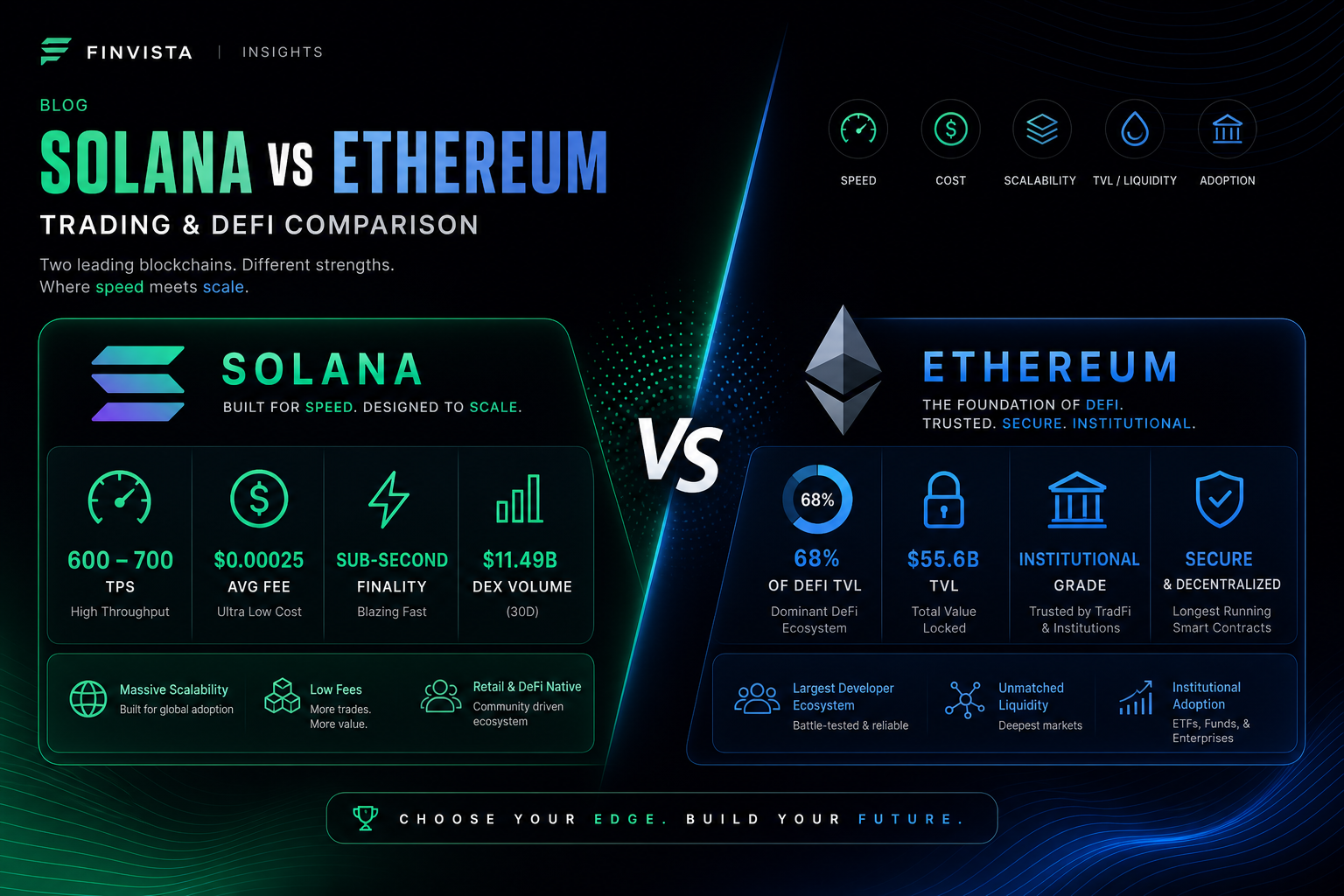
- Solana — sub-second finality, ~$0.00025 fees, 600-700 real TPS. Best for high-frequency trading, memecoins, and cost-sensitive activity. Leads weekly DEX volume ($11.49B vs Ethereum's $7.62B in April 2026).
- Ethereum — deepest DeFi liquidity ($55.6B TVL, ~68% of the market), institutional infrastructure, broadest asset coverage. Best for large positions, blue-chip DeFi, and regulated products. L2s (Base, Arbitrum) cut fees to $0.01-0.10.
For fast, cheap, high-frequency trading — especially memecoins and retail DeFi — Solana's economics win. For deep liquidity and institutional-grade products, Ethereum leads. Many traders use both.
Trade Solana with a complete terminal on GraphDex
Key Takeaways
-
Solana leads on speed (
600-700 real TPS, sub-second) and fees ($0.00025) — ideal for active trading. - Ethereum leads on DeFi liquidity ($55.6B TVL, ~68% market share) and institutional adoption.
- In April 2026, Solana's weekly DEX volume ($11.49B) topped Ethereum's ($7.62B).
- The choice depends on your strategy: fast cheap trading (Solana) vs deep liquidity (Ethereum).
Solana vs Ethereum: At a Glance
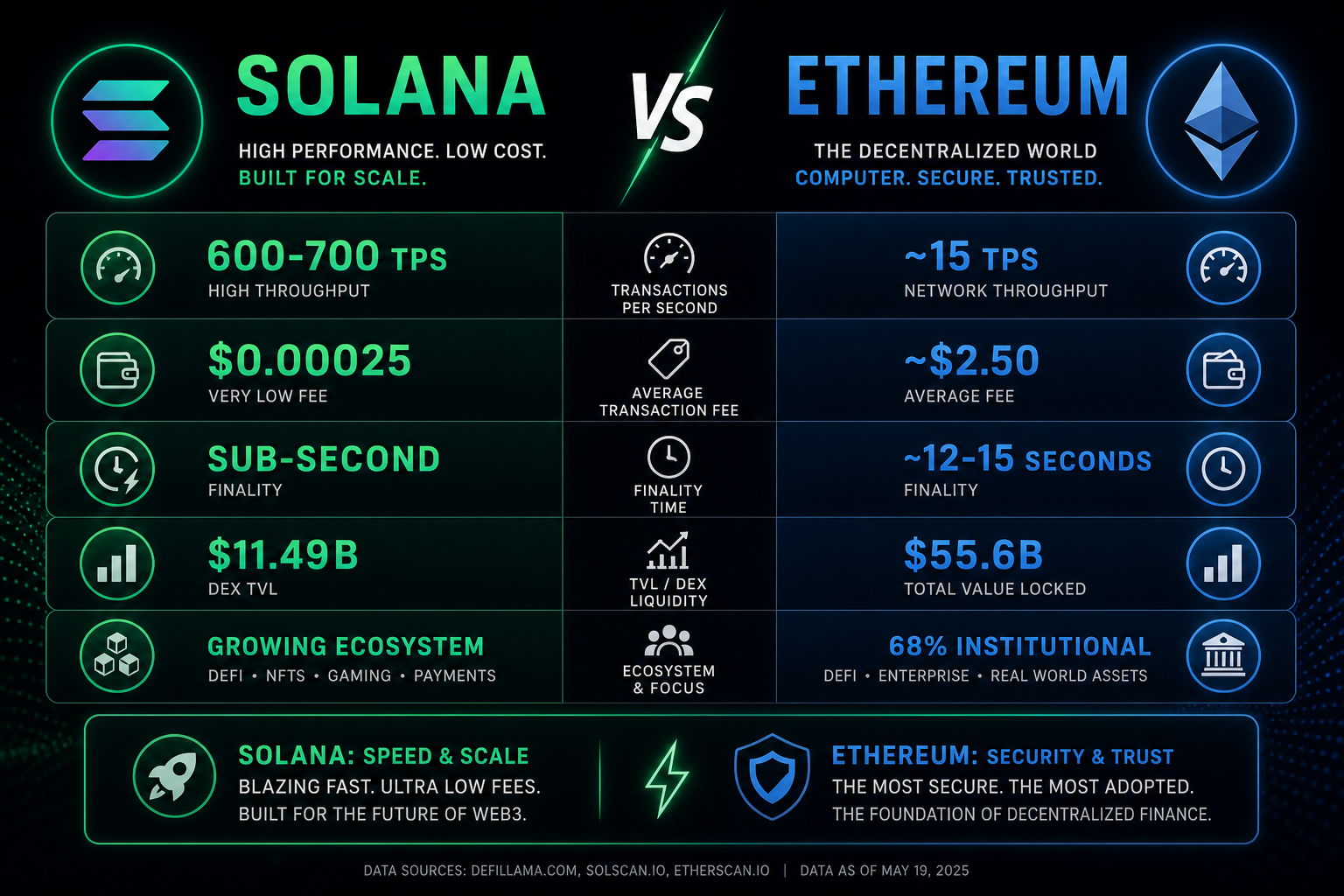
| Metric | Solana | Ethereum |
|---|---|---|
| Real-world TPS | 600-700 (up to 65,000 theoretical) | 15-20 L1 (L2s much higher) |
| Avg transaction fee | ~$0.00025 | $0.50-3 L1 ($0.01-0.10 on L2) |
| Finality | Sub-second (~2.5s) | Slower L1; L2 varies |
| DeFi TVL | ~$8 billion | ~$55.6 billion (~68% of market) |
| Weekly DEX volume (Apr 2026) | $11.49 billion | $7.62 billion |
| Validators | ~800-1,500 | 900,000+ |
| Best for | Fast, cheap, high-frequency trading | Deep liquidity, institutional DeFi |
Which Is Faster for Trading?
For traders, speed directly affects execution — and Solana leads decisively here.
Solana was engineered for raw speed, combining Proof of History with Proof of Stake. Under real-world 2026 conditions, it consistently delivers 600-700 TPS on average (with theoretical capacity up to 65,000 TPS) and sub-second to ~2.5-second finality. For a trader, this means near-instant trade execution with no extra steps.
Ethereum's mainnet handles a modest 15-20 TPS at L1, prioritizing decentralization and security. Its Layer 2 ecosystem (Arbitrum, Optimism, Base, zkSync) pushes aggregate throughput far higher — well above 100,000 TPS combined — but using L2s requires bridging assets between chains, adding friction Solana doesn't have.
Verdict for traders: Solana wins on single-chain simplicity and felt speed. For high-frequency trading, sniping new tokens, and time-sensitive execution, Solana's architecture gives a genuine advantage. Ethereum's L2s offer high aggregate capacity but at the cost of bridging complexity and fragmented liquidity.
How Do Trading Fees Compare?
Fees compound for active traders, and this is where the gap is starkest.
Solana's average transaction fee is roughly $0.00025 — a fraction of a cent. Even during congestion, fees rarely exceed $0.01 for standard transactions. For a trader making dozens or hundreds of trades, this is transformative: fees are effectively negligible.
Ethereum mainnet is significantly more expensive: simple transfers average $0.50-3.00, while complex DeFi interactions can spike to $15-30 during peak demand. Layer 2 networks (Base, Arbitrum) bring this down to $0.01-0.10 — much better, but still generally higher than Solana, and with the added step of bridging to L2.
Verdict for traders: Solana wins decisively on fees. For high-frequency trading, micro-positions, and cost-sensitive strategies, Solana's economics are purpose-built. On Ethereum L1, fees alone can make small or frequent trades uneconomical; L2s help but add complexity.
Which Has Better Liquidity?
Liquidity determines how easily you can enter and exit positions at fair prices — and here Ethereum leads.
Ethereum holds approximately $55.6 billion in DeFi TVL, capturing roughly 68% of the global DeFi market, plus around 70% of on-chain stablecoin supply. This makes it the default custody and settlement venue, with the deepest liquidity for large trades and the broadest asset coverage.
Solana holds approximately $8 billion in DeFi TVL — smaller, but growing rapidly (Solana's dApp ecosystem reportedly grows around 300% annually). Notably, Solana's trading activity is intense relative to its TVL: in April 2026, Solana's weekly DEX volume of $11.49 billion actually led Ethereum's $7.62 billion, showing high velocity and active trading.
Verdict for traders: Ethereum wins on raw liquidity depth, especially for large positions where slippage matters. Solana wins on trading velocity and activity — its volume-to-TVL ratio reflects an active, fast-moving trading culture. For large blue-chip DeFi positions, Ethereum's depth; for active high-turnover trading, Solana's velocity.
Ecosystem and Use Cases
The two chains have diverged into different specialties — and your trading type points to one.
Ethereum dominates:
- Institutional DeFi and high-value trades (BlackRock, Franklin Templeton, JPMorgan build here)
- Blue-chip NFTs and curated marketplaces
- Regulated financial products and compliant infrastructure
- Deepest liquidity pools and mature risk tools
- Largest developer ecosystem (~31,869 developers, 4,000+ dApps)
Solana dominates:
- Retail DeFi activity and high-frequency trading
- Memecoins and launchpads (Pump.fun ecosystem)
- Gaming and consumer apps
- The DePIN sector
- Frequently handles over 50% of global DEX volume
These reflect two legitimate architectural philosophies: Ethereum as an ultra-secure settlement layer with performance via L2s, and Solana as a monolithic high-performance chain betting most users want a single fast environment. As one analysis put it, they're no longer fighting for the same throne — they've diverged into different bets on what blockchain infrastructure should be.
Trade the active Solana ecosystem on GraphDex
Decentralization and Security
For balance, this is where Ethereum has a clear edge — and it matters for some traders.
Ethereum operates with 900,000+ validators, offering high decentralization and client diversity, and maintains its reputation as the most stable, battle-tested smart-contract platform. For traders holding large positions or valuing maximum security, this matters.
Solana operates with roughly 800-1,500 validators — far fewer, offering higher performance at the cost of greater centralization. Historically, Solana faced reliability concerns (network outages), but its reliability has reached institutional standards in 2026 with the full rollout of the Firedancer client.
Verdict for traders: Ethereum wins on decentralization and its longer security track record. Solana has substantially improved reliability with Firedancer but remains more centralized by validator count. For most active traders, both are sufficiently secure; for those prioritizing maximum decentralization, Ethereum leads.
Which Should You Choose for Trading?
There's no universal winner — the right chain depends on your trading style.
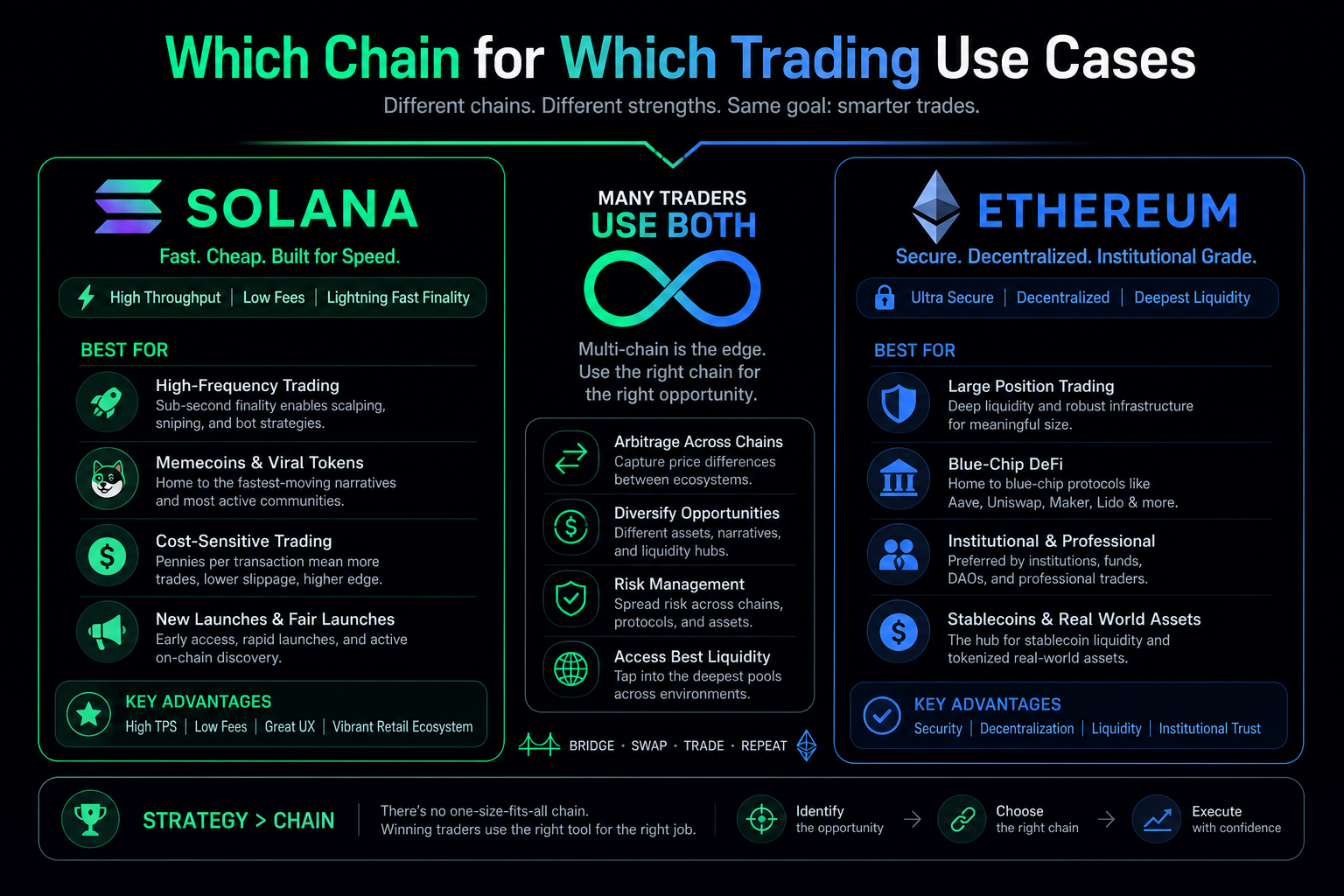
Choose Solana for trading when:
- You trade frequently and need low fees (high-frequency, scalping)
- You trade memecoins and new launches (Pump.fun ecosystem)
- You want sub-second execution for time-sensitive trades
- You value single-chain simplicity over bridging
- Cost-sensitivity matters (micro-positions, many trades)
Choose Ethereum for trading when:
- You deploy large DeFi liquidity positions where depth matters
- You trade blue-chip DeFi or need institutional-grade infrastructure
- You prioritize maximum decentralization and security track record
- You trade assets primarily available on Ethereum
- Fee sensitivity is low relative to position size
The deciding question: Is your trading high-frequency and cost-sensitive (Solana), or large-position and liquidity-dependent (Ethereum)? Many active traders use both — Solana for fast, cheap, high-turnover trading and memecoins; Ethereum for large positions and blue-chip DeFi. A multi-chain approach often gives the best balance.
Why Solana Suits Active Traders
For the specific profile of an active trader — making many trades, chasing new tokens, valuing speed — Solana's design is hard to beat.
The combination of near-zero fees and sub-second finality means you can trade frequently without fees eroding returns, react to opportunities in real time, and snipe new launches where milliseconds matter. The Pump.fun ecosystem, memecoin culture, and 50%+ share of global DEX volume all live on Solana precisely because the economics suit fast, active trading.
This is why the Solana trading tool ecosystem — terminals, bots, and platforms — is so rich. Active traders gravitate to Solana, and tools have followed. GraphDex is built for exactly this: a Solana-focused terminal combining DEX trading (with MEV protection), token discovery via the Pulse feed, Bubble Maps for safety, copytrading, prediction markets, and staking up to 17% APY — everything an active Solana trader needs in one non-custodial interface.
For traders whose strategy fits Solana's strengths — speed, low fees, high turnover, new tokens — having a complete Solana terminal consolidates the workflow. For those who also trade Ethereum, a multi-chain approach with Solana for active trading remains common.
Get a complete Solana trading terminal on GraphDex
Frequently Asked Questions
Is Solana or Ethereum better for trading? It depends on your style. Solana is better for high-frequency, cost-sensitive trading and memecoins, with ~$0.00025 fees and sub-second finality. Ethereum is better for large positions needing deep liquidity ($55.6B TVL) and institutional-grade DeFi. Many traders use both — Solana for active trading, Ethereum for large blue-chip positions.
Why are Solana fees so much lower than Ethereum? Solana's architecture (Proof of History plus parallel processing) handles high throughput efficiently, keeping average fees around $0.00025. Ethereum L1 prioritizes decentralization and security with lower base throughput, resulting in $0.50-3 fees (higher during congestion). Ethereum L2s cut fees to $0.01-0.10 but require bridging.
Which has more liquidity, Solana or Ethereum? Ethereum has far more DeFi liquidity — approximately $55.6 billion TVL versus Solana's ~$8 billion, capturing ~68% of the DeFi market. However, Solana's trading velocity is high: in April 2026, its weekly DEX volume ($11.49B) actually led Ethereum's ($7.62B), reflecting an active trading culture despite lower TVL.
Is Solana fast enough for serious trading? Yes. Solana delivers 600-700 real-world TPS with sub-second to ~2.5s finality — near-instant for traders. Its reliability reached institutional standards in 2026 with the Firedancer client rollout. For high-frequency and time-sensitive trading, Solana's speed is a genuine advantage over Ethereum L1.
Is Ethereum more secure than Solana? Ethereum has a longer security track record and far more validators (900,000+ vs Solana's ~800-1,500), offering greater decentralization. Solana has substantially improved reliability with Firedancer in 2026 but remains more centralized by validator count. For most traders both are sufficiently secure; Ethereum leads on decentralization.
Should I trade on both Solana and Ethereum? Many active traders do. A multi-chain approach uses Solana for fast, cheap, high-frequency trading and memecoins, and Ethereum for large positions, blue-chip DeFi, and deep liquidity. This balances speed and liquidity. Your primary chain should match your dominant trading style.
What's the best tool for trading on Solana? Active Solana traders use terminals that combine DEX trading, token discovery, safety analysis, and MEV protection. GraphDex integrates these plus copytrading, prediction markets, and staking up to 17% APY in one non-custodial terminal — built for the fast, active trading Solana's economics enable.
About This Guide
This guide is published by the GraphDex Research team — analysts and traders building the infrastructure for digital asset trading on Solana. Our content is based on live network data, current market figures, and publicly available statistics.
Sources & data: Network metrics, fees, and TVL figures reflect publicly available data (DefiLlama, L2Beat, and others) as of 2026 and change continuously. This guide is educational and not financial advice — always do your own research.
GraphDex is the infrastructure for digital asset trading — trade, predict, and earn in one place. Learn more at graphdex.io.
Last reviewed: May 2026 · GraphDex Research
The infrastructure for digital asset trading. Trade, predict, stake, repeat. graphdex.io