By GraphDex Research · Reviewed for accuracy May 2026
Quick Answer
A crypto wallet is software (or hardware) that lets you store, send, and receive cryptocurrency by managing the private keys that prove ownership. The critical distinction:
- Custodial wallet — a company (typically an exchange) holds the keys for you; you log in with email/password
- Non-custodial wallet — you hold the keys yourself, usually via a seed phrase; no company can freeze or reset
The rule: if you don't control the private keys, you don't fully control the crypto. Non-custodial swap volumes rose more than 340% year-over-year in early 2026 as users shifted toward self-custody. New "seedless" non-custodial options (MPC, social login) reduce the seed phrase risk without surrendering control.
Get a non-custodial seedless wallet via Privy on GraphDex
Key Takeaways
- A crypto wallet manages the private keys that prove ownership of your funds.
- Custodial wallets (exchanges) hold keys for you; non-custodial wallets put you in full control.
- The trade-off: custodial offers convenience and recovery; non-custodial offers true ownership.
- New seedless wallets (MPC, social login) combine non-custodial control with easier UX.
What Is a Crypto Wallet?
A crypto wallet is the software or hardware tool that lets you store, send, and receive cryptocurrency. The key insight is that wallets don't actually hold your coins — the coins exist on the blockchain itself. What a wallet holds are the private keys that prove you own and can move those coins.
Think of it like a bank: your money isn't physically in your debit card. The card just authorizes transactions against your bank account. Similarly, your wallet authorizes transactions against blockchain addresses by signing them with your private keys. Whoever has the private keys controls the funds — full stop.
This is why crypto security fundamentally comes down to one question: who controls the private keys? That answer determines whether you have a custodial or non-custodial wallet, and it has profound implications for security, control, and what can go wrong.
Wallets come in several forms: mobile apps (Phantom, Trust Wallet), browser extensions (MetaMask), hardware devices (Ledger, Trezor), and increasingly cloud-based seedless options (Privy, Zengo). The form factor matters for convenience and security, but the deeper question — who holds the keys — matters more.
Custodial vs Non-Custodial: The Critical Difference
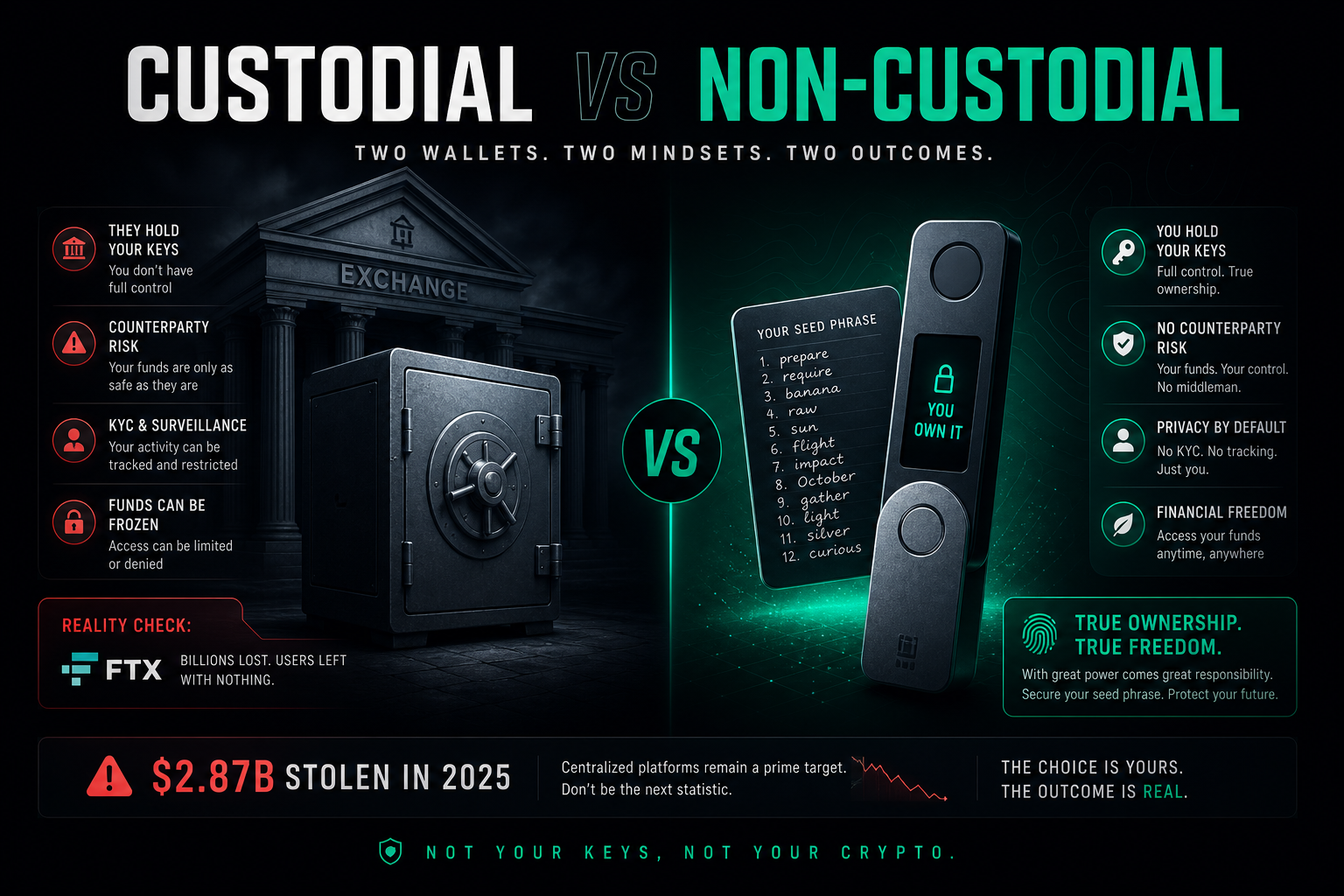
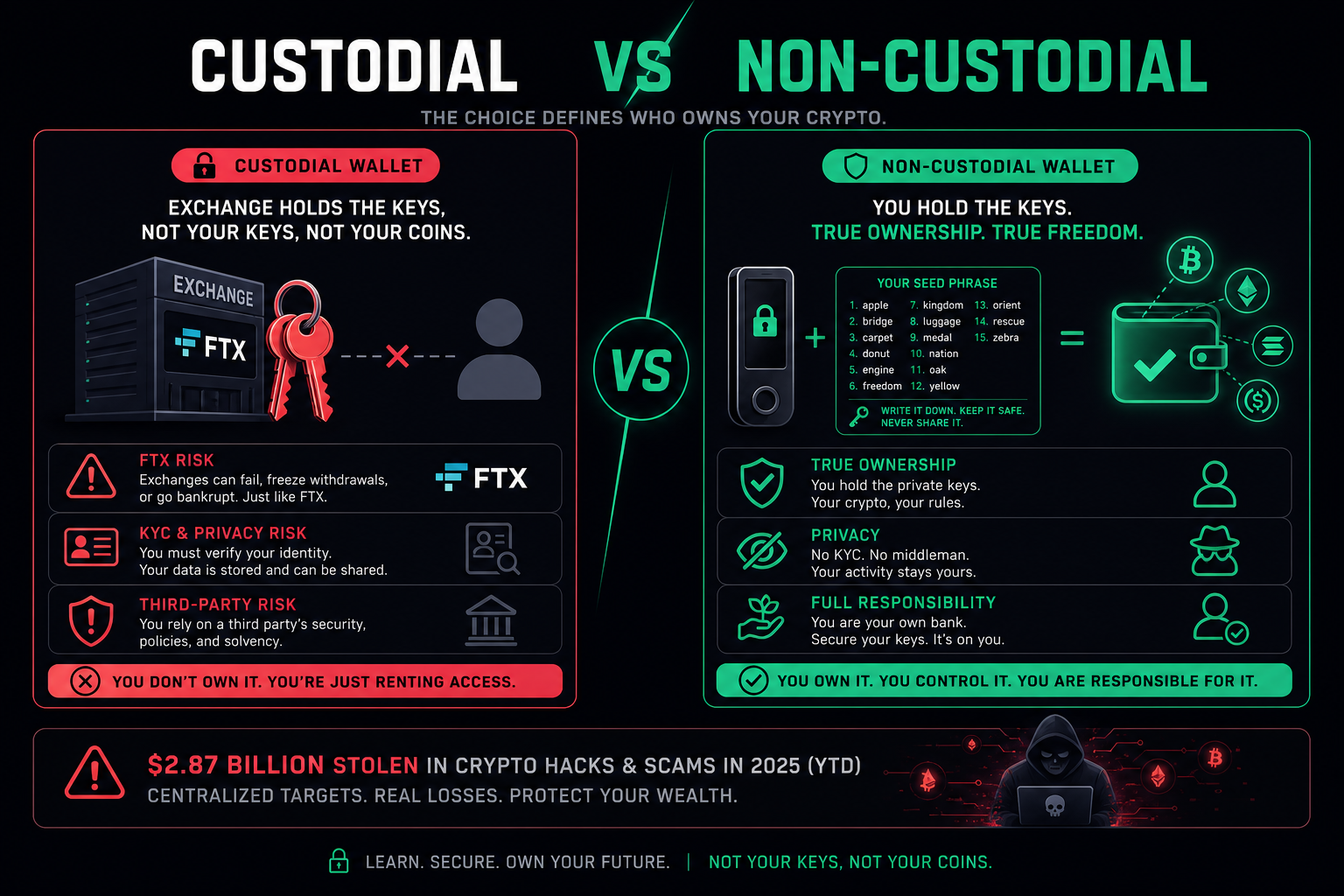
Here's the rule that clears up most confusion: if you don't control the private keys, you don't fully control the crypto.
Custodial wallets are wallets where a service (typically a centralized exchange like Coinbase or Binance) holds the keys for you. You log in with email, password, and 2FA. The exchange can help you recover access if you forget something, freeze withdrawals during emergencies, comply with regulators, and apply KYC checks. Your funds depend on the provider staying solvent, secure, and willing to process withdrawals.
Non-custodial wallets put you in full control. You hold the keys yourself — traditionally through a 12-24 word seed phrase that recovers your wallet, or through newer methods like MPC (multi-party computation) that split keys across devices. No company can freeze your wallet or reset your password. The flip side: if you lose your seed phrase (and there's no MPC backup), you lose access permanently. You are the support desk.
| Feature | Custodial | Non-Custodial |
|---|---|---|
| Who holds keys | Service/exchange | You |
| Recovery | Email + identity check | Seed phrase (or MPC backup) |
| KYC required | Usually yes | Usually no |
| Counterparty risk | Yes (FTX-style failures) | No |
| Customer support | Yes | None (you're on your own) |
| Best for | Beginners, traders on exchanges | DeFi users, long-term holders |
| Example | Coinbase, Binance accounts | Phantom, MetaMask, Ledger |
The 2022 FTX collapse remains the defining lesson here: when a custodian fails, users couldn't take their private keys and walk away — billions were lost. Mt. Gox in 2014 taught the same lesson to an earlier generation. In 2025 alone, approximately $2.87 billion in crypto was stolen across nearly 150 exchange and platform hacks. The pattern is clear: keeping funds on exchanges concentrates risk.
Hot vs Cold Wallets
Beyond custody, wallets are also categorized by connectivity:
Hot wallets are connected to the internet — mobile apps, browser extensions, web wallets. They're convenient for everyday use and frequent trading. But internet connectivity means greater attack surface: phishing, malicious software, and social engineering all target hot wallets. Examples: Phantom, MetaMask, Trust Wallet.
Cold wallets keep keys offline — hardware devices that connect only when signing transactions, paper wallets, or air-gapped computers. They're far more secure for storing large amounts because attackers can't reach offline keys, but less convenient for frequent activity. Examples: Ledger Nano, Trezor.
A common strategy is to use both: a hot wallet for active trading and small balances, a cold wallet (typically a hardware wallet) for long-term storage of significant funds. The hot wallet is your "checking account"; the cold wallet is your "vault."
What Is a Seed Phrase?
The seed phrase is the most important security concept in non-custodial wallets — understanding it determines whether you keep your funds or lose them.
When you create a non-custodial wallet, the software generates a 12-24 word phrase (using the BIP-39 standard) that mathematically encodes your private keys. From this phrase, the wallet can regenerate all your addresses and unlock your funds on any compatible device. It's both your backup and your ultimate password.
The critical rules:
- Never share it. Anyone with the phrase has full control of your funds — instantly.
- Never store it digitally. No photos, no cloud backups, no password managers, no emails. Screenshots are particularly dangerous.
- Write it on paper or metal. Physical, offline storage in a secure location only you know.
- Make backups. Lose the phrase and your device, and your funds are gone forever — no recovery, no exceptions.
Thanks to BIP-32 and BIP-39 standardization, a single seed phrase can recover near-infinite blockchain addresses and works across compatible wallets — you can switch between providers by importing your seed phrase elsewhere.
The seed phrase is the strength and the weakness of traditional non-custodial wallets. It gives you sovereign control, but the burden of protecting it is unforgiving. This is why a new generation of wallets has emerged to address this risk.
The Rise of Seedless Non-Custodial Wallets
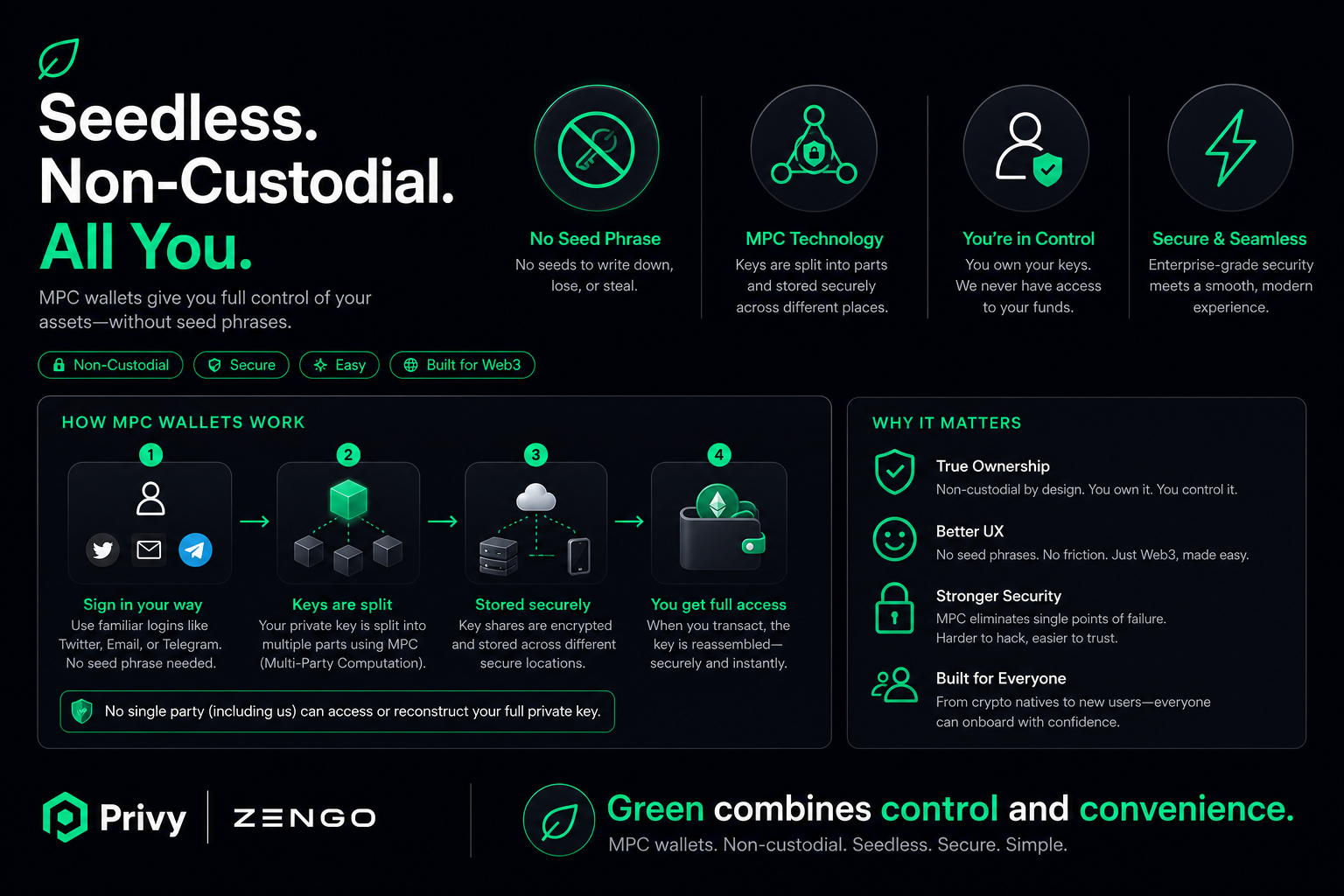
A new wave of wallets in 2025-2026 combines non-custodial control with easier UX by eliminating or reducing seed phrase risk. The two main approaches:
MPC (Multi-Party Computation) wallets split your private key across multiple parties (typically your device and a service's servers) so that no single party can access funds alone. You retain full self-custody, but recovery doesn't require remembering a seed phrase — biometrics, device access, and the service together regenerate the key when needed. Zengo, Privy, and Cobo's MPC wallets are leading examples.
Social login wallets let you sign in with familiar credentials (Google, Apple, email, Twitter, Telegram) while maintaining non-custodial architecture under the hood. The credentials authenticate you to your wallet, but you still hold the keys. Phantom offers Google/Apple seedless login secured by a 4-digit PIN. Privy enables sign-in via Twitter, email, or Telegram while keeping wallets non-custodial.
This category resolves the central trade-off: traditional non-custodial wallets give you control but punish mistakes; custodial wallets are easy but give up control. Seedless non-custodial wallets give you control without the punishing seed phrase burden — which is why they're seeing rapid adoption.
GraphDex uses non-custodial Privy architecture — you sign in with Twitter, email, or Telegram, the wallet is generated for you with MPC-style security, and you retain full self-custody. No seed phrase to lose; no company holding your funds. This is the modern model.
Get a seedless non-custodial wallet on GraphDex
Wallets on Solana vs Other Chains
Different blockchains use different wallet ecosystems, though the core concepts are universal.
Solana wallets: Phantom is the most popular Solana wallet (also supports Ethereum and other chains), with a mobile app and browser extension. Solflare is another major Solana-focused option. Both are non-custodial.
Ethereum wallets: MetaMask is the dominant non-custodial wallet for Ethereum and EVM-compatible chains.
Multi-chain wallets: Wallets like Trust Wallet, IronWallet, and Rabby support many chains in one app.
Hardware wallets: Ledger and Trezor support Bitcoin, Ethereum, Solana, and dozens of other chains — they're chain-agnostic.
For Solana users specifically, Phantom is the most common starting point for self-custody. For trading via terminals like GraphDex, the integrated Privy architecture means you don't necessarily need a separate wallet at all — sign in with social credentials, and a non-custodial wallet is generated for you.
How to Choose a Crypto Wallet
The right wallet depends on your use case, technical comfort, and balance size.
For beginners just starting: A reputable custodial exchange (Coinbase, Kraken) for buying crypto + a non-custodial mobile wallet (Phantom on Solana, MetaMask on Ethereum) for using DeFi. Keep small amounts in non-custodial while learning; move to self-custody as you gain confidence.
For active traders: Non-custodial trading terminals with built-in wallet management (like GraphDex with Privy) consolidate trading and custody in one interface. You get DEX trading, prediction markets, staking, and a non-custodial wallet without managing seed phrases manually.
For long-term holders: Hardware wallets (Ledger, Trezor) for cold storage of significant holdings. Combine with a hot non-custodial wallet for occasional movements. Treat the hardware wallet as your vault.
For privacy-focused users: No-KYC non-custodial wallets like IronWallet that don't require identity verification. Note that regulatory pressure on self-hosted wallets is growing globally (MiCA in Europe, GENIUS Act in the US).
For DeFi power users: Non-custodial is essentially required — you can't connect a custodial exchange account directly to most DeFi protocols. Phantom, MetaMask, or a wallet via a terminal like GraphDex.
Many users combine multiple wallets: a small hot wallet for daily use, a hardware wallet for storage, and an exchange account for fiat on/off ramps. This diversifies risk and matches each tool to its strength.
Wallet Security Best Practices
Whichever wallet you choose, security practices matter:
Never share your seed phrase. No legitimate service will ever ask for it. Anyone asking is trying to steal your funds.
Never store seed phrases digitally. No photos, cloud, email, or text files. Physical paper or metal in a secure location.
Use hardware wallets for significant funds. Hot wallets are fine for active balances; cold storage protects large holdings.
Beware phishing. Always verify URLs before connecting wallets. Bookmark trusted sites. Don't click wallet popups from unknown sources.
Use a dedicated wallet for risky activity. A separate, lightly-funded wallet for memecoin trading or new dApp testing limits damage from a malicious contract.
Keep software updated. Wallet apps patch vulnerabilities — update promptly.
Enable available security features. PINs, biometrics, transaction signing confirmations all add layers of protection.
Test small amounts first. When using a new wallet or address, send a small test amount before transferring large balances.
Trade safely with non-custodial architecture on GraphDex
Frequently Asked Questions
What is a crypto wallet in simple terms? A crypto wallet is software or hardware that manages the private keys needed to send and receive cryptocurrency. The coins themselves live on the blockchain — the wallet just authorizes transactions by signing them with your keys. Whoever has the private keys controls the funds.
What's the difference between custodial and non-custodial wallets? Custodial wallets (typically exchanges) hold your keys for you — convenient but you trust the provider with full control. Non-custodial wallets put you in charge of your keys via a seed phrase or MPC — true ownership but full responsibility. The core rule: if you don't control the keys, you don't fully control the crypto.
What is a seed phrase and why is it so important? A seed phrase is a 12-24 word string that mathematically encodes your wallet's private keys. It's both your backup (recover your wallet on any compatible device) and your ultimate password. Anyone with it has full control of your funds. Never share, never store digitally, write it on paper or metal in a safe location.
Is a non-custodial wallet safer than a custodial one? Non-custodial wallets eliminate counterparty risk (no FTX-style failure can lose your funds), but shift responsibility entirely to you — lose your seed phrase and funds are gone forever. Custodial wallets reduce personal responsibility but add counterparty risk. Neither is universally "safer" — they fail differently. Many users use both.
What are seedless wallets? Seedless non-custodial wallets (MPC wallets like Zengo and Privy, or social login wallets like Phantom's Google/Apple option) combine self-custody with easier recovery. Instead of a seed phrase, multi-party computation or social credentials authenticate you while keeping wallets non-custodial. They reduce the seed phrase risk without surrendering control.
Can I use the same wallet on Ethereum and Solana? Some wallets support both (Phantom, Trust Wallet, hardware wallets like Ledger). Others are chain-specific (MetaMask is primarily EVM, while Phantom focuses on Solana). Wallet addresses are chain-specific even if your wallet supports multiple chains — make sure you're sending to the right network.
What happens if I lose my crypto wallet? If you have your seed phrase (or MPC backup credentials), you can recover the wallet on a new device. If you lose both the device and the seed phrase, your funds are permanently inaccessible — no customer service can recover them in true non-custodial setups. This is why seedless non-custodial wallets (with MPC backups via your accounts) are increasingly popular for less burdensome recovery.
About This Guide
This guide is published by the GraphDex Research team — analysts and traders building the infrastructure for digital asset trading on Solana. Our content is based on current wallet ecosystem data, security research, and hands-on experience.
Sources & data: Wallet features, statistics, and security details reflect publicly available information as of 2026 and may change. Crypto self-custody carries real risks — lost seed phrases cannot be recovered. This guide is educational and not financial advice; always do your own research.
GraphDex is the infrastructure for digital asset trading — trade, predict, and earn in one place. Learn more at graphdex.io.
Last reviewed: May 2026 · GraphDex Research
The infrastructure for digital asset trading. Trade, predict, stake, repeat. graphdex.io