Quick Answer
A DEX (decentralized exchange) is a crypto trading platform that runs on smart contracts instead of a company's servers. You trade directly from your own wallet — the exchange never holds your funds.
In 2026, DEXs operate as the fully matured, essential liquidity infrastructure for the entire on-chain economy, facilitating billions of dollars in daily trading volume without relying on corporate intermediaries.
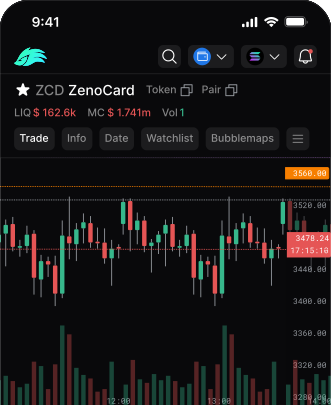
Trade on Solana DEX with GraphDex — graphdex.io
Key Takeaways
- A DEX executes swaps via smart contracts; you keep custody and sign every trade from your wallet.
- Solana's speed and low fees made it the dominant chain for on-chain DEX volume in 2026.
- MEV, slippage, and rug risk still apply — terminals add routing, analytics, and protection layers.
- GraphDex aggregates Solana DEX access with analytics and execution in one non-custodial UI.
DEX vs CEX: The Core Difference
| CEX (Centralized Exchange) | DEX (Decentralized Exchange) | |
|---|---|---|
| Custody | Exchange holds your funds | You hold your funds |
| Account required | Yes — KYC, email, ID | No — wallet only |
| Who controls keys | The exchange | You |
| Risk of hack | Exchange can be hacked | Only your wallet |
| Token availability | Listed tokens only | Any on-chain token |
| Trading hours | 24/7 (but can halt) | 24/7 always on |
| FTX-style collapse possible | Yes | No |
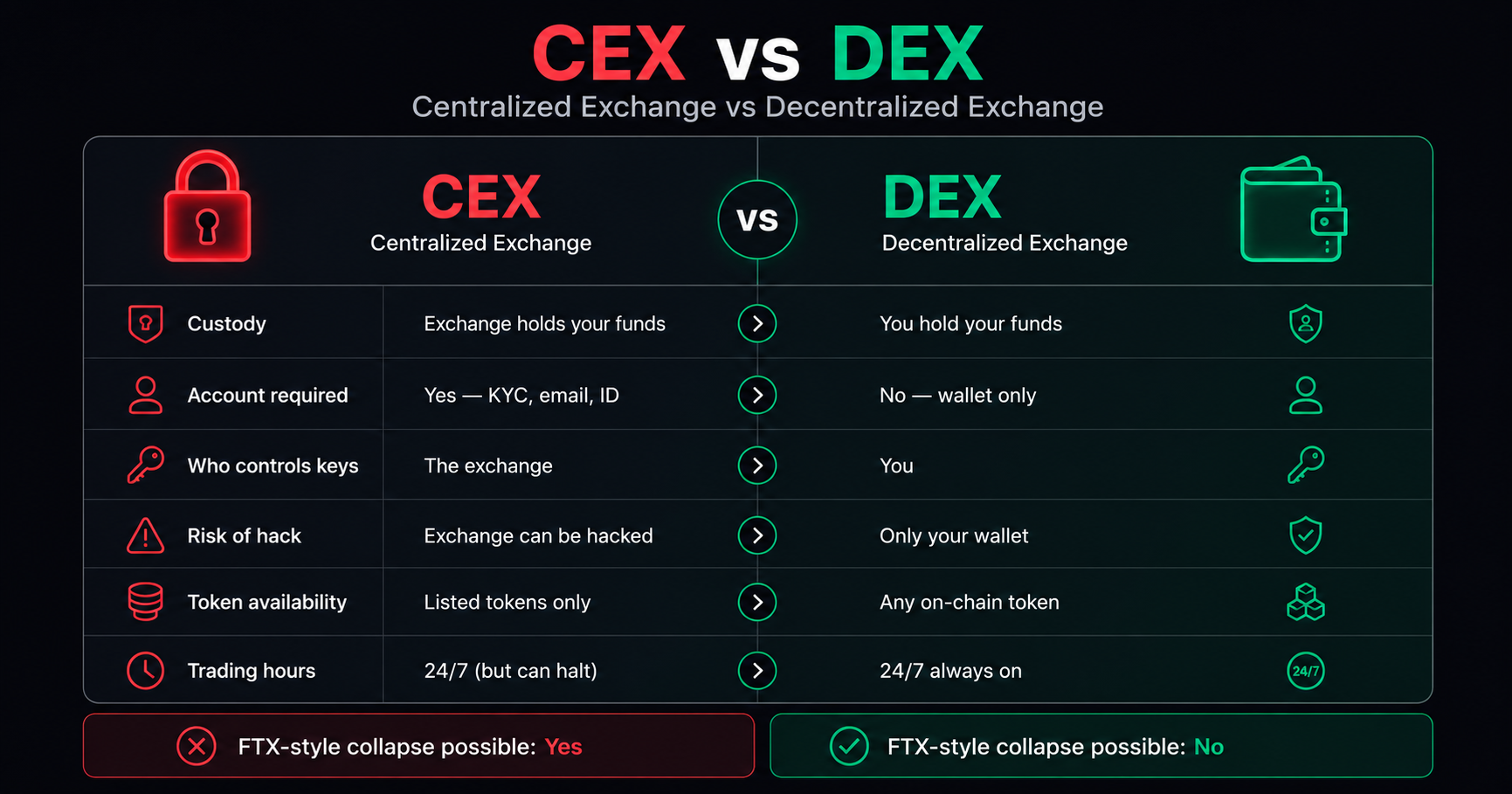
The FTX collapse in 2022 made this distinction matter in practice, not just in theory. Eight billion dollars in customer funds disappeared because users trusted a centralized exchange with their assets. A DEX makes this structurally impossible — the exchange never holds your funds, so it cannot lose them.
How a DEX Works: The Technical Explanation (Made Simple)
Automated Market Makers (AMM)
Most DEXs — including the ones GraphDex routes through on Solana — use an Automated Market Maker model.
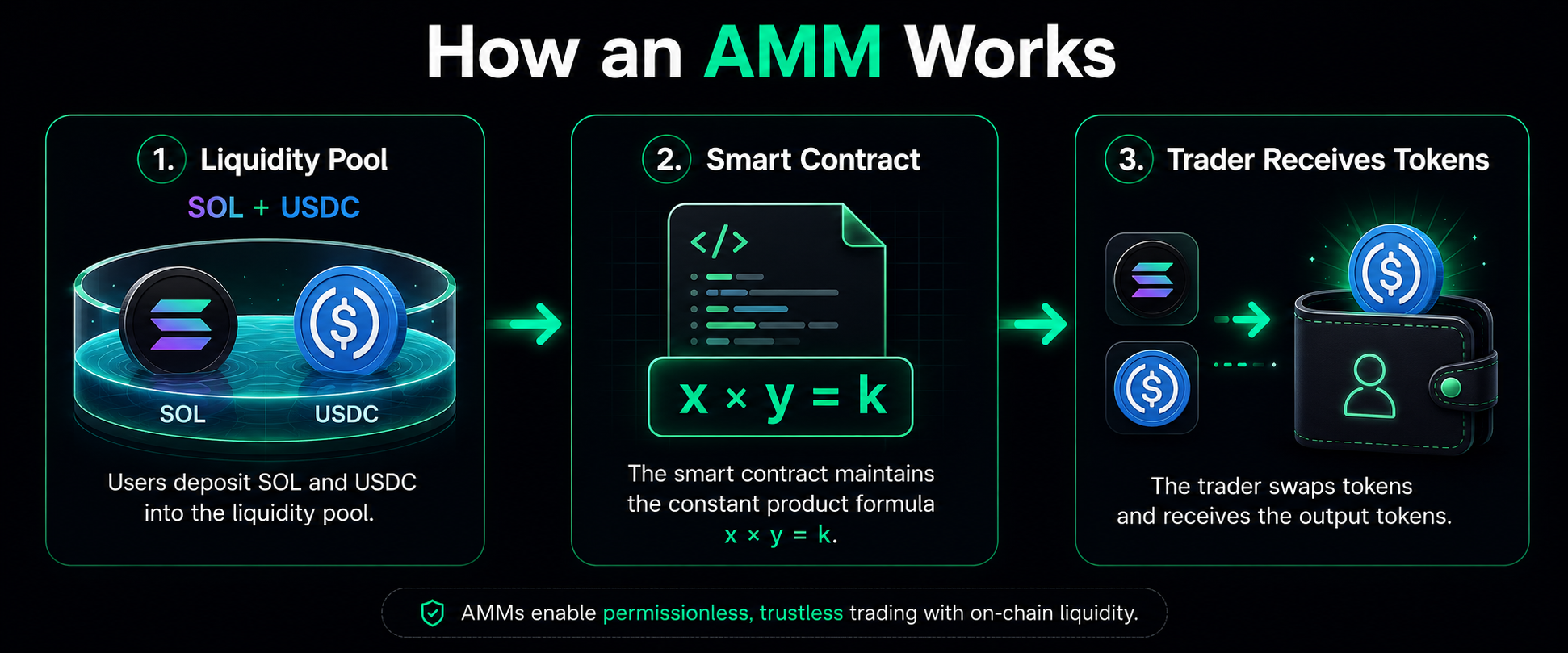
Instead of matching buyers and sellers like a traditional exchange, an AMM uses liquidity pools: pairs of tokens locked in smart contracts. When you swap Token A for Token B, you are trading against the pool, not against another person.
Liquidity providers deposit token pairs into a pool. Traders swap against that pool, and the price adjusts automatically based on pool balances — using a formula such as x × y = k. AMMs enable 24/7 trading without needing a direct counterparty.
In plain terms:
- Liquidity providers deposit SOL + USDC into a pool
- You swap SOL → USDC by trading against that pool
- The smart contract calculates the price automatically
- Your wallet receives USDC. No human involved.
Order Book DEXs
Order book DEXs work more like traditional exchanges: users place bids and offers, and trades clear based on supply and demand. In an on-chain order book, orders and trades are recorded directly on the blockchain — highly transparent, but potentially slower and more expensive.
Solana's speed (sub-second finality, near-zero fees) makes on-chain order books viable in a way that Ethereum never could. This is one reason Solana became the dominant DEX chain in 2026.
DEX Aggregators
A DEX aggregator routes your trade across multiple DEXs simultaneously to find the best price. Instead of swapping on one pool, it splits your order across several pools to minimize slippage and maximize output.
GraphDex routes through Solana's DEX infrastructure to ensure best execution on every trade — automatically, without you needing to compare pools manually.
Access all Solana DEX pairs on GraphDex — graphdex.io
Why Solana Became the Dominant DEX Chain in 2026
Solana's performance characteristics transformed the DEX landscape:
Sub-second finality Solana transactions confirm in 400 milliseconds. On Ethereum mainnet, confirmation takes 12-15 seconds. For memecoin trading where price moves in seconds, this gap is decisive.
Near-zero fees Solana transaction fees average $0.0002. Ethereum mainnet fees regularly exceed $5-50 during congestion. The overwhelming majority of decentralized trading volume no longer occurs on the Ethereum mainnet due to prohibitive gas fees. Instead, liquidity and user activity have migrated to Layer 2 rollup networks and high-performance chains like Solana.
Token launch ecosystem Pump.fun held 57.5% of Solana launchpad market share in March 2026. Thousands of new tokens launch on Solana every day. The DEX volume follows the launches — and the launches are on Solana.
Total DEX volume Solana processed $123 billion in DEX volume in the 30 days ending early 2026 — nearly double Ethereum's volume in the same period.
The Main DEXs on Solana in 2026
| DEX | Type | Best for |
|---|---|---|
| Raydium | AMM + Order book | High-volume pairs, new token launches |
| Jupiter | Aggregator | Best price routing across all Solana DEXs |
| Orca | AMM (Whirlpool) | Concentrated liquidity, tighter spreads |
| Meteora | Dynamic AMM | Yield-optimized liquidity |
| Pump.fun AMM | Bonding curve | New memecoins at launch |
GraphDex aggregates liquidity across all major Solana DEXs. You access every pair through one interface without manually connecting to each protocol.
What Is Slippage on a DEX?
Slippage is the difference between the price you expected and the price you received. It happens when:
- Low liquidity — thin pools move significantly when you trade against them
- Large order size — your trade is large relative to the pool
- High volatility — price moves between when you submit and when the transaction confirms
How to manage slippage:
- Set a slippage tolerance in your trading settings (typically 0.5-2% for liquid pairs, up to 5-15% for low-liquidity memecoins)
- Use a DEX aggregator that splits orders across multiple pools
- Check liquidity depth before entering large positions
GraphDex shows slippage estimates before you confirm any trade and routes automatically through the deepest liquidity.
What Is MEV and Why Does It Affect DEX Traders?
MEV (Maximal Extractable Value) is profit extracted by validators or bots who reorder, insert, or censor transactions in a block. The most common form affecting retail DEX traders is sandwich attacks:
- Bot sees your pending swap transaction
- Bot places a buy order before your transaction (front-run)
- Your transaction executes at a higher price
- Bot sells immediately after (back-run)
- Bot profits from the price difference
GraphDex routes through MEV-protected infrastructure on Solana to block sandwich attacks before they reach the mempool. This is one reason using a terminal with MEV protection matters — not just raw execution speed.
DEX Risks Every Trader Should Know
Key DEX risks include: no safety net — mistakes and lost keys are usually irreversible; smart contract risk — bugs or exploits can lead to losses; impermanent loss for liquidity providers when token prices diverge; scam tokens and fake contract addresses; and variable network fees during congestion.
Practical risk management:
Verify contract addresses Scam tokens copy the name and ticker of legitimate projects with different contract addresses. Always verify the contract address from official sources before buying.
Check holder distribution Tokens where a small number of wallets hold most of the supply are vulnerable to coordinated dumps. GraphDex integrates Bubble Maps for visual on-chain holder analysis directly in the terminal.
Check developer wallet history Developers who have previously deployed tokens that were abandoned or rug-pulled are statistically likely to repeat. GraphDex surfaces developer wallet migration rates alongside new token discoveries.
Start with small positions On low-liquidity tokens especially, test with a small amount before committing significant capital. The entry is cheap. The exit might not be.
How to Trade on a Solana DEX in 2026
The fastest path from zero to executing a Solana DEX trade:
Step 1: Get a wallet GraphDex uses Privy wallet infrastructure — your wallet is created automatically at registration. No seed phrase setup, no browser extension required. Alternatively, connect an existing Phantom, Solflare, or Backpack wallet.
Step 2: Fund with SOL Send SOL from any exchange to your wallet address. Keep at least 0.01 SOL for transaction fees — Solana fees are paid in SOL regardless of which token you are trading.
Step 3: Find your token Use GraphDex's Pulse feed to discover new tokens in real time, or search any token by name, ticker, or contract address. The terminal shows liquidity depth, holder concentration, and price data before you trade.
Step 4: Set your parameters Set your slippage tolerance, enable MEV protection, and confirm the transaction. GraphDex routes automatically through the best available liquidity.
Step 5: Trade Your transaction executes on-chain. Your wallet receives the tokens. GraphDex never holds your funds at any point.
Start trading on Solana DEX — graphdex.io
Why Use a DEX Terminal Instead of the Native DEX Interface?
Native DEX interfaces like Raydium or Jupiter cover one protocol each. A DEX terminal like GraphDex adds:
- Real-time token discovery — Pulse feed shows new launches before aggregators index them
- Wallet tracking — follow smart money positions in real time
- Social signal monitoring — catch narrative formation before price reacts
- Bubble Maps integration — on-chain visual analysis without switching tabs
- AI signal analysis — multiple data streams correlated simultaneously
- MEV protection — built-in sandwich attack prevention
- Non-custodial Privy architecture — no seed phrase, no extension required
The seven tools most active Solana traders use separately — consolidated into one interface. Every tab switch is a delay. On Solana, delay costs money.
DEX Trading Strategies for Solana in 2026
Understanding how DEXs work is step one. Using them profitably requires strategy.
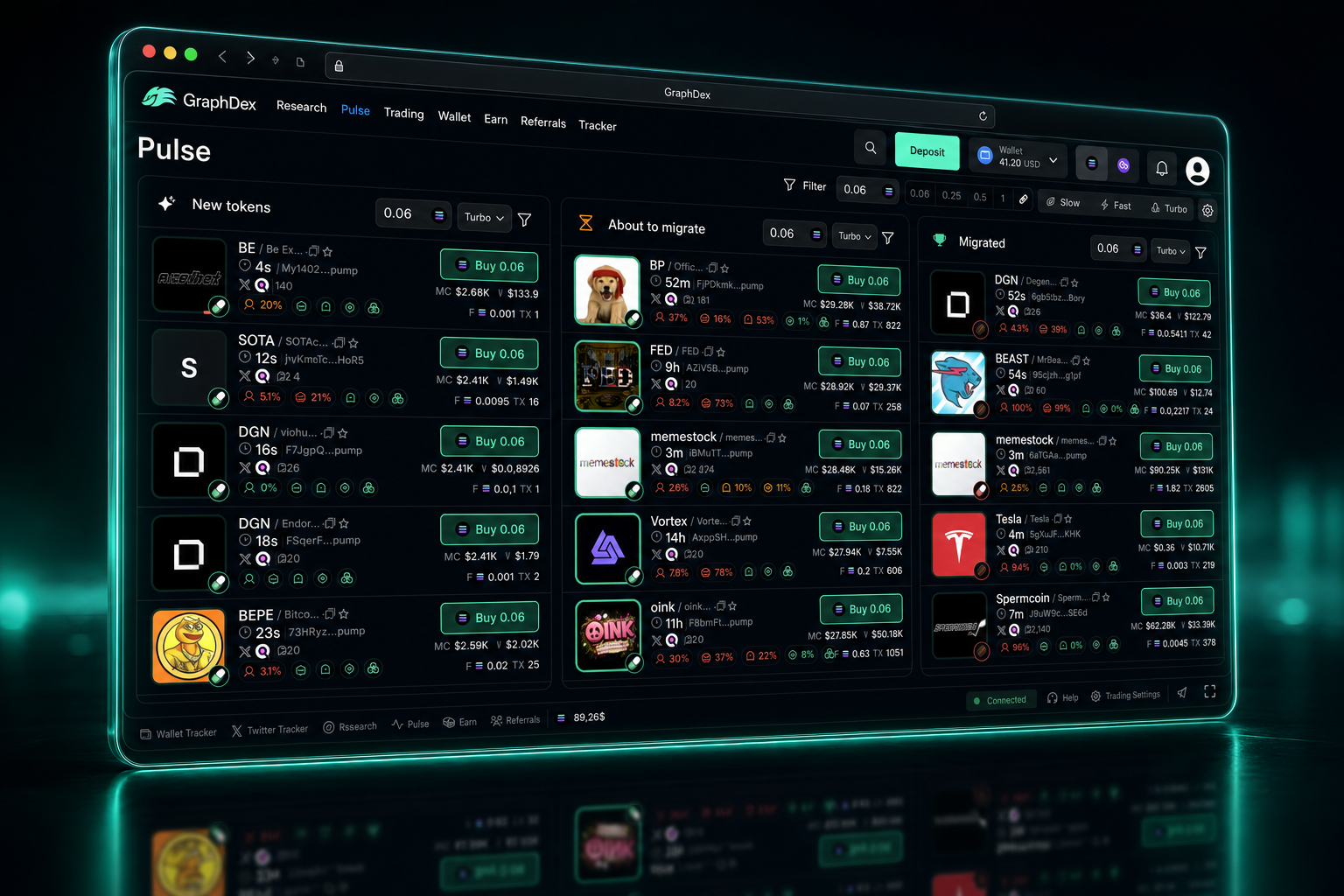
Early token discovery The most consistent edge on Solana DEXs comes from finding tokens early — in the first minutes of a token existence, before price discovery starts. GraphDex Pulse feed surfaces tokens the moment liquidity is added on-chain, before any aggregator indexes them. Combined with wallet tracking to confirm smart money participation, early discovery is the primary strategy for active Solana traders.
Narrative trading Solana memecoin markets run on narratives — AI agents, specific sector plays, viral moments. When a narrative starts forming in social signals and wallet movements simultaneously, the tokens connected to it tend to move together. GraphDex AI signal layer surfaces these correlations before they become obvious in price.
Liquidity analysis before entry Not all DEX pairs have sufficient liquidity to absorb your position without significant slippage. Always check liquidity depth before entering. A token with 50,000 USD in liquidity will move dramatically on a 5,000 USD buy — fine for a snipe, bad for a larger position. GraphDex shows liquidity data alongside every token discovery.
Exit planning before entry The most common mistake on Solana DEXs is entering without planning the exit. Set take-profit levels before you buy. In fast-moving markets, having these decisions made in advance is the difference between executing and hesitating.
Trade smarter on Solana DEX with GraphDex
Frequently Asked Questions
What is a DEX in crypto? A DEX (decentralized exchange) is a crypto trading platform that runs on smart contracts. You trade directly from your own wallet with no account required and no exchange holding your funds. Major Solana DEXs include Raydium, Jupiter, and Orca.
Is a DEX safer than a Coinbase or Binance? A DEX eliminates the risk of exchange collapse — the exchange never holds your funds, so it cannot lose them. However, DEXs introduce different risks: smart contract bugs, scam tokens, and user error. Neither is categorically safer; the risks are different in kind.
What is the best DEX on Solana in 2026? Jupiter is the best starting point for Solana DEX trading because it aggregates liquidity across all major Solana protocols and automatically finds the best price. For active traders who want real-time token discovery, wallet tracking, and AI signals alongside DEX execution, GraphDex integrates Jupiter and other Solana DEX routing in one terminal.
Do I need KYC to use a DEX? No. DEXs are permissionless. You only need a crypto wallet. GraphDex registration requires no identity verification — connect with Twitter, email, or Telegram via Privy.
What is slippage on a DEX? Slippage is the difference between the expected price and the executed price. It occurs due to low liquidity or price movement between submission and confirmation. Set slippage tolerance in your trading settings and use a DEX aggregator to minimize it.
What is impermanent loss? Impermanent loss affects liquidity providers, not traders. It occurs when the price ratio of a token pair changes after you deposit into a liquidity pool — you end up with less value than if you had held the tokens. Relevant only if you provide liquidity, not if you are trading.
What is the difference between a DEX and a DEX aggregator? A DEX (like Raydium) is a single liquidity protocol. A DEX aggregator (like Jupiter, or the routing layer in GraphDex) splits your trade across multiple DEX protocols to find the best price and minimize slippage.
The infrastructure for digital asset trading. Trade, predict, stake, repeat. graphdex.io