By GraphDex Research · Reviewed for accuracy May 2026
Quick Answer
An automated market maker (AMM) is an algorithm that prices and executes trades against a liquidity pool, replacing the traditional order book. How it works:
- Instead of matching buyers and sellers, you trade against pooled tokens in a smart contract
- A mathematical formula (commonly x × y = k) sets prices based on the pool's reserve ratio
- Each trade changes the reserves, so the price moves — this creates price impact (slippage)
- Liquidity providers fund the pools and earn trading fees
- Arbitrage keeps AMM prices aligned with the broader market
AMMs underpin most on-chain trading on Solana (Raydium, Orca), Ethereum (Uniswap), and other chains — enabling permissionless, 24/7 trading with no intermediaries.
Trade Solana AMMs with smart routing on GraphDex
Key Takeaways
- An AMM is the pricing algorithm that executes trades against a liquidity pool instead of an order book.
- The constant product formula (x × y = k) sets prices based on the pool's reserve ratio.
- Each trade shifts reserves and moves the price, creating price impact that grows with trade size.
- AMMs power most DeFi trading; leading ones include Uniswap, Raydium, Orca, and Curve.
What Is an Automated Market Maker?
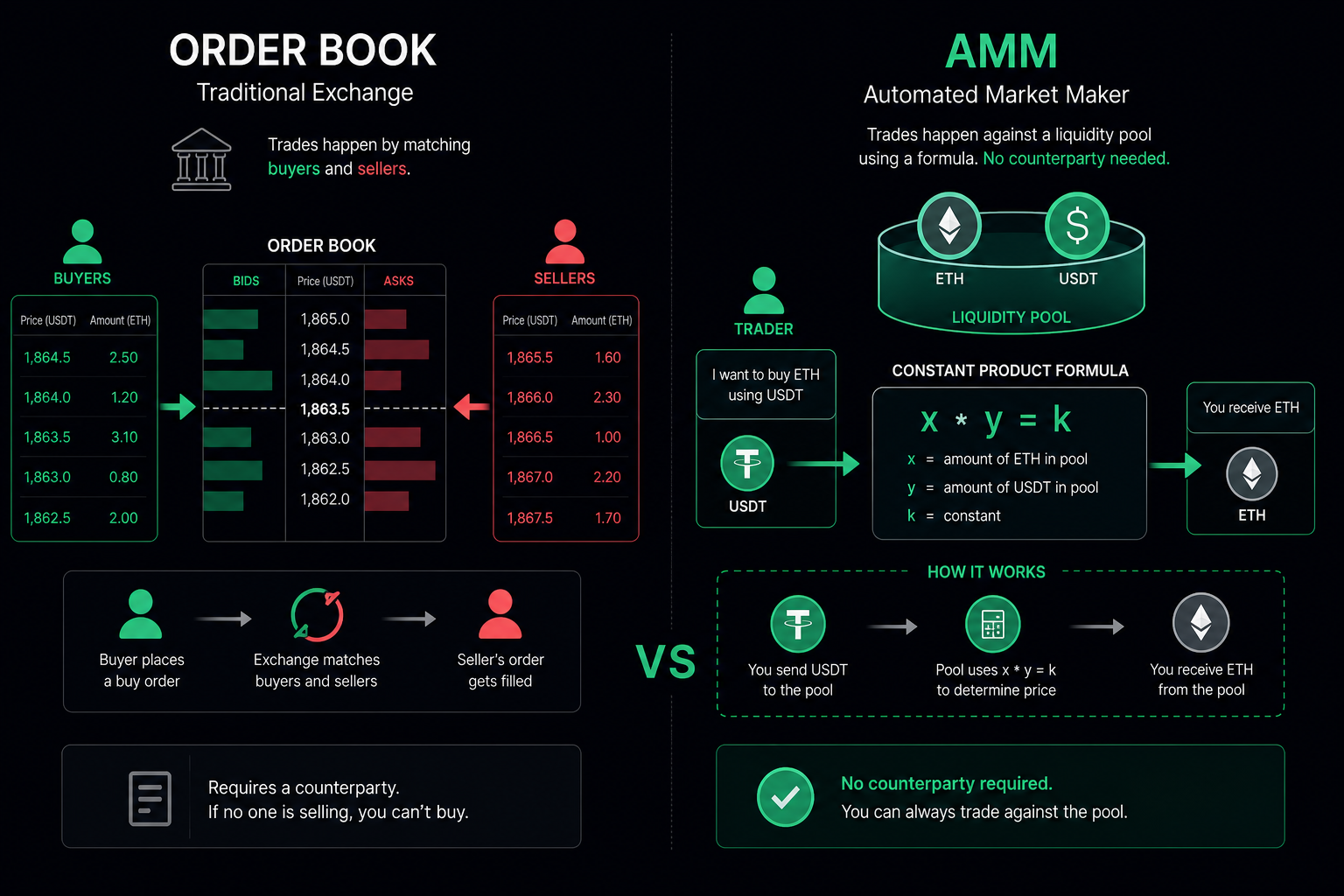
An automated market maker (AMM) is an autonomous protocol that decentralized exchanges (DEXs) use to facilitate trades on a blockchain. Instead of trading with a counterparty matched through an order book, AMMs let you trade against liquidity stored in smart contracts — the liquidity pools.
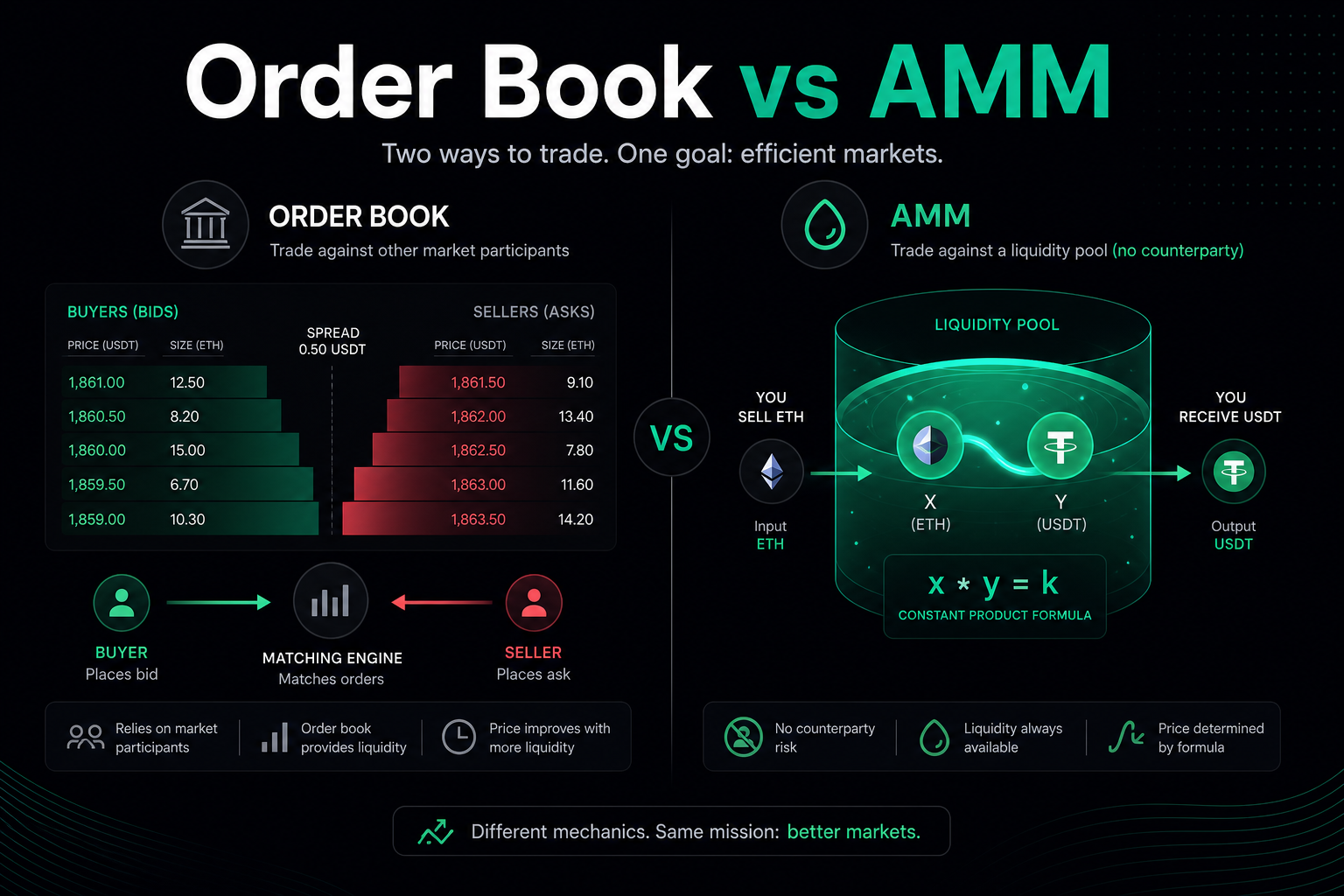
To understand AMMs, contrast them with traditional exchanges. A centralized exchange uses an order book: a list of buy orders (bids) and sell orders (asks), with the exchange matching a buyer to a seller at an agreed price. This needs active participants on both sides and works well in centralized environments but faces challenges on blockchains (thin liquidity, latency, cost).
AMMs replace this entirely. They use liquidity pools (reserves of tokens locked in smart contracts) plus mathematical formulas to price and execute trades automatically. The two fundamental changes: traders don't wait for a counterparty (they trade against the pool), and pricing is algorithmic (set by formula, not human quotes).
This innovation made permissionless, 24/7 trading possible without intermediaries, KYC, or custodial risk. Today, AMMs underpin the majority of on-chain trading across Ethereum, Solana, BNB Chain, Base, Arbitrum, and other major blockchains.
How Does an AMM Work?
An AMM operates through three core components working together: liquidity pools, a pricing algorithm, and liquidity providers.
Liquidity pools hold the token reserves. A pool typically contains two tokens (e.g., SOL and USDC) deposited by liquidity providers. These reserves are what you trade against.
The pricing algorithm sets prices based on the ratio of tokens in the pool — not from external markets or human judgment. When you trade, the algorithm calculates your price from the current reserves and recalculates after your trade changes them.
Liquidity providers (LPs) fund the pools by depositing token pairs. They earn a share of trading fees in return, serving the economic role of market makers without actively managing positions.
The flow when you trade: you open a DEX or terminal, connect your wallet, select tokens to swap, and the AMM quotes a price from the pool's reserves. You confirm, and the smart contract executes — adding one token to the pool and removing the other. Because your trade alters the reserves, the price moves slightly, and arbitrageurs help realign the pool with broader markets afterward.
The Constant Product Formula (x × y = k)
The heart of most AMMs is a deceptively simple formula. Understanding it explains why your trades behave the way they do.
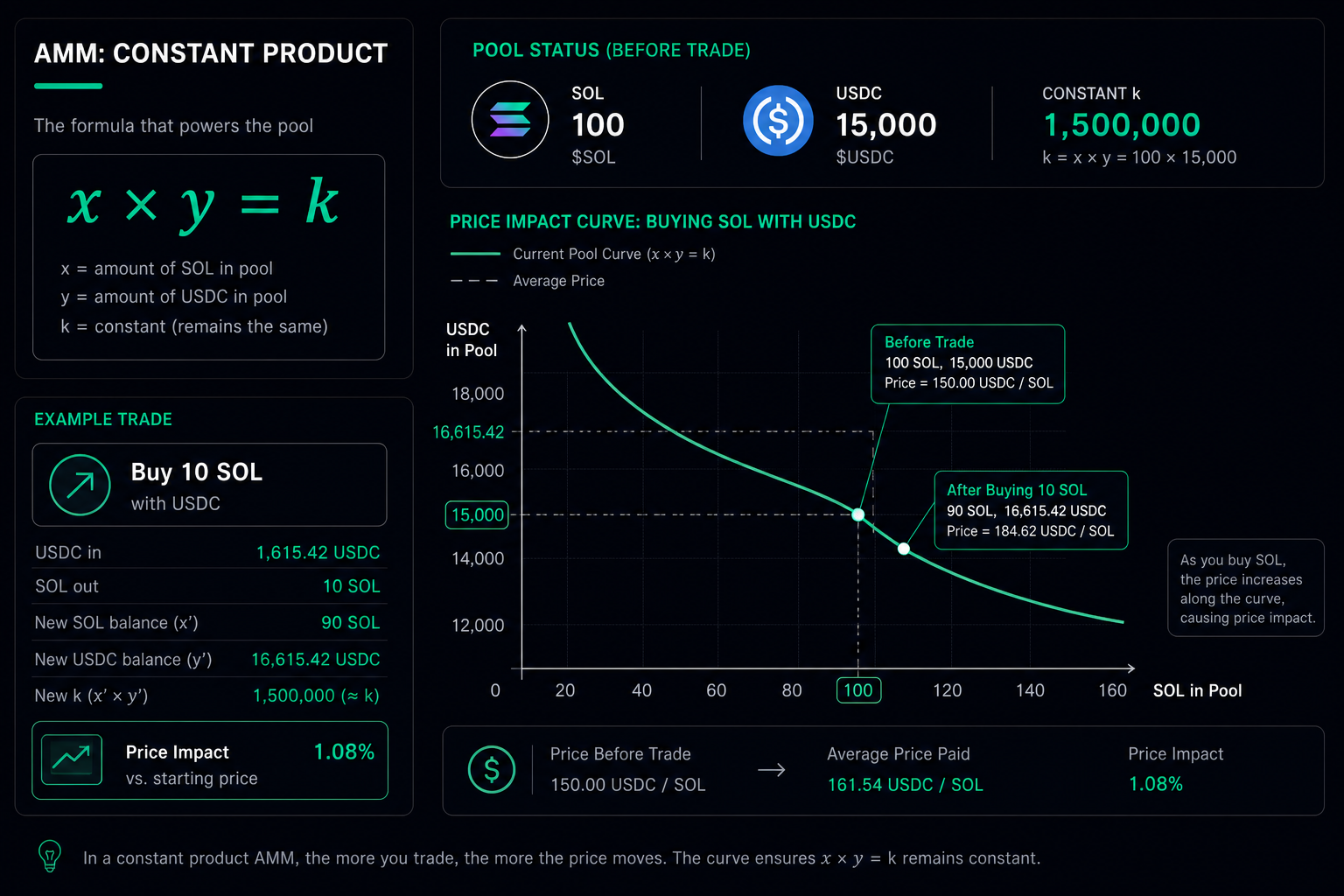
The most widely used AMM model is the constant product formula: x × y = k, where:
- x = the reserve of token A in the pool
- y = the reserve of token B in the pool
- k = a constant that must stay the same
Here's the key insight: the product of the two reserves must remain constant. When you buy token A (removing some x from the pool), you must add token B (increasing y) so that x × y still equals k. As x decreases, the price of token A rises — because there's now less of it relative to B.
A simple example: Imagine a pool with 100 SOL (x) and 15,000 USDC (y), so k = 1,500,000. If you buy 10 SOL, the pool now has 90 SOL. To keep k constant, USDC must rise to 1,500,000 ÷ 90 = 16,667 — meaning you paid about 1,667 USDC for 10 SOL, an average of ~167 per SOL (higher than the starting 150, because your purchase moved the price).
This mechanism guarantees liquidity at any price level — there's always some price at which a trade can execute. But it also means larger trades move the price more (price impact / slippage), and the smaller the pool, the bigger the impact.
Different AMMs use different formulas for different purposes — but all share the core principle that price is a function of relative supply in the pool.
Why Your Trades Have Price Impact
The constant product formula explains a concept every DEX trader encounters: price impact.
Because the AMM prices trades from the reserve ratio, every trade moves the price. When you buy, you reduce the supply of that token in the pool, pushing its price up — so you pay progressively more as your trade size grows. This is price impact, and it's distinct from (but related to) slippage.
The size of price impact depends on your trade relative to pool depth:
- Large trade in a shallow pool = big price impact (you move the price significantly against yourself)
- Small trade in a deep pool = minimal price impact
This is why deep liquidity matters so much for traders, and why large trades are often split into smaller pieces or routed across multiple pools. It's also why thin-liquidity tokens (common in the memecoin space) are so volatile — even modest trades swing the price dramatically.
DEX aggregators help by routing your trade across multiple pools to minimize total price impact, finding the most efficient path. This is one reason trading through a smart-routing terminal often gets better execution than swapping directly in a single small pool.
Get smart routing across Solana pools on GraphDex
Types of AMMs and Leading Protocols
The AMM landscape has matured significantly, with different designs optimized for different purposes.
Constant product AMMs (Uniswap-style). The classic x × y = k model, used for general token pairs. Uniswap V3 introduced concentrated liquidity (LPs allocate capital within specific price ranges for greater capital efficiency), and V4 added "hooks" — programmable extensions enabling dynamic fees, on-chain limit orders, and custom pool logic.
Stablecoin-optimized AMMs (Curve-style). Curve uses a StableSwap invariant optimized for trading between assets that hold similar prices — primarily stablecoins (USDC, USDT) and wrapped tokens (WBTC, stETH). This enables extremely low slippage on these trades, making Curve a backbone of DeFi liquidity.
Multi-asset AMMs (Balancer-style). Balancer extends the model to pools with up to eight assets in custom weightings, functioning like self-balancing portfolios.
Solana AMMs. On Solana, leading AMM DEXs include Raydium, Orca, and Meteora, plus PumpSwap (where Pump.fun tokens graduate). Solana's speed and low fees make AMM trading cheap and near-instant.
For most traders, the practical takeaway is that when you swap on any DEX, you're interacting with an AMM — the specific protocol affects fees, slippage, and features, but the core mechanic (trading against a formula-priced pool) is shared.
Benefits and Drawbacks of AMMs
AMMs reshaped trading, but they involve trade-offs worth understanding.
Benefits:
- No counterparty needed — trade instantly against the pool, 24/7
- Permissionless — anyone can trade or provide liquidity, no KYC or account
- Accessible liquidity provision — anyone can earn fees as an LP
- No central intermediary — non-custodial, no exchange controlling your funds
- Always available — solves thin liquidity and limited trading hours of early crypto venues
Drawbacks:
- Price impact / slippage — larger trades move the price, especially in shallow pools
- Impermanent loss — LPs can lose value versus holding when prices diverge
- Smart contract risk — bugs or exploits can drain pools
- MEV exposure — public transactions can be sandwiched by bots
- Capital inefficiency (in basic models) — addressed partly by concentrated liquidity
The AMM model has proven durable across multiple market cycles and continues to underpin the most active parts of DeFi in 2026. For traders, the benefits (instant, permissionless, always-on trading) generally outweigh the drawbacks — which can be managed with smart routing, MEV protection, and trading deep-liquidity pools.
How GraphDex Works With AMMs
When you trade on GraphDex, you're executing against Solana's AMMs (Raydium, Orca, Meteora, PumpSwap) — and GraphDex optimizes that interaction:
- Smart routing across Solana's AMM pools finds the best price and minimizes price impact
- MEV protection shields your AMM trades from sandwich bots that exploit price impact
- Bubble Maps help you avoid thin-liquidity pools with dangerous slippage and rug risk
- Pulse feed surfaces new tokens as their AMM pools launch
Understanding AMMs clarifies why these features matter: since AMM pricing creates price impact and public trades invite MEV, smart routing and protection directly improve your execution. GraphDex handles this automatically, so you trade efficiently against Solana's AMMs without manually optimizing routes — within a terminal that also offers copytrading, prediction markets, and staking up to 17% APY.
Trade Solana AMMs efficiently on GraphDex
Frequently Asked Questions
What is an automated market maker in simple terms? An AMM is an algorithm that prices and executes your trades against a pool of tokens, instead of matching you with another trader through an order book. A formula (commonly x × y = k) sets the price based on how much of each token is in the pool. It enables instant, 24/7, permissionless trading on DEXs.
How does the AMM formula work? The most common formula is constant product: x × y = k, where x and y are the two token reserves and k stays constant. When you buy one token (reducing its reserve), the other must increase to keep k constant, which raises the bought token's price. This guarantees liquidity at any price but causes price impact on large trades.
What is the difference between an AMM and a liquidity pool? A liquidity pool is the smart contract holding the token reserves. An AMM is the pricing algorithm that determines trade prices from those reserves. They work together — the pool holds the assets, the AMM prices trades against them. AMM-based trading isn't possible without a pool to trade against.
Why do my trades move the price on a DEX? Because AMMs price trades from the pool's reserve ratio. When you buy a token, you reduce its supply in the pool, pushing its price up — so you pay more as your trade grows. This is price impact, and it's larger for big trades in shallow pools. Deep liquidity and smart routing minimize it.
What are the best AMMs in 2026? Leading AMMs include Uniswap (Ethereum, with V3 concentrated liquidity and V4 hooks), Curve (stablecoin-optimized, low slippage), and Balancer (multi-asset pools). On Solana, Raydium, Orca, and Meteora are the major AMM DEXs, plus PumpSwap. The best depends on the chain and tokens you trade.
Are AMMs safe to use? Trading on established, audited AMMs is generally safe, but risks exist: smart contract vulnerabilities, MEV (sandwich attacks), price impact on large trades, and scam pools with new tokens. Using reputable protocols, MEV protection, and avoiding suspicious pools reduces risk. For LPs, impermanent loss is an additional consideration.
Do all DEXs use AMMs? Most do, but not all. AMMs are the dominant model, but some DEXs use on-chain order books (like certain Solana DEXs) or hybrid routing combining both. When you trade on a typical DEX or terminal like GraphDex, you're most often trading against AMM liquidity pools.
About This Guide
This guide is published by the GraphDex Research team — analysts and traders building the infrastructure for digital asset trading on Solana. Our content is based on current DeFi mechanics, live platform data, and hands-on experience.
Sources & data: Mechanics, formulas, and protocol details reflect publicly available information as of 2026 and may change. Trading and providing liquidity carry risk. This guide is educational and not financial advice — always do your own research.
GraphDex is the infrastructure for digital asset trading — trade, predict, and earn in one place. Learn more at graphdex.io.
Last reviewed: May 2026 · GraphDex Research
The infrastructure for digital asset trading. Trade, predict, stake, repeat. graphdex.io