By GraphDex Research · Reviewed for accuracy May 2026
Quick Answer
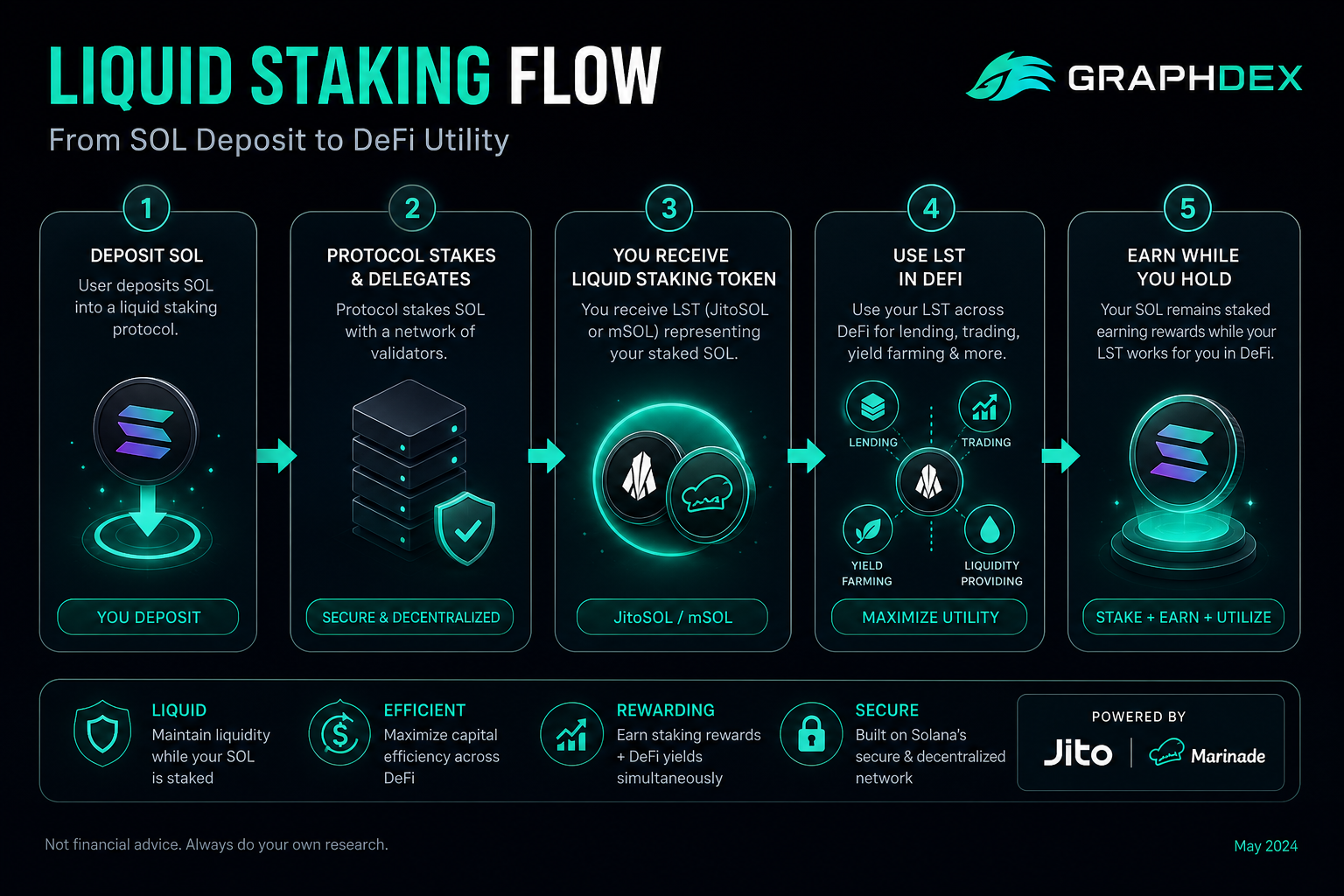
Liquid staking lets you stake tokens to earn network rewards while receiving a tradeable derivative token (LST) that represents your staked position — so your capital earns yield AND remains usable in DeFi. Key facts:
- How it works: Deposit SOL or ETH into a liquid staking protocol → receive an LST (JitoSOL, mSOL, stETH) → earn staking rewards while using the LST as collateral, in trading, or in yield farming
- Market size: Over $66 billion in liquid staking TVL; $86+ billion LST market cap
- Top Solana LSTs: JitoSOL (~5.80% APY + MEV rewards), mSOL (Marinade), JupSOL, Sanctum LSTs
- Top Ethereum LSTs: Lido's stETH (de facto standard), Rocket Pool's rETH
- Major 2026 milestone: Joint SEC/CFTC ruling in March 2026 cleared liquid staking as non-securities; Nasdaq filed VanEck JitoSOL ETF
- Trade-off: Liquid staking adds smart contract risk and slightly lower yield versus pure native staking, in exchange for capital flexibility
Earn fee-based yield up to 17% APY on GraphDex
Key Takeaways
- Liquid staking earns staking rewards via a tradeable LST that stays usable across DeFi.
- Over $66B is liquid-staked globally; on Solana, $3.3B+ across Jito, Marinade, Sanctum.
- The March 2026 joint SEC/CFTC ruling cleared liquid staking as non-securities activity.
- Risks: smart contract bugs, validator slashing, LST depeg risk, governance concentration.
What Is Liquid Staking?
Liquid staking is a way to participate in Proof-of-Stake (PoS) consensus — earning network rewards by securing the blockchain — without locking up your capital and losing access to it.
In traditional (native) staking, you delegate your tokens (SOL, ETH) to a validator, earn rewards (typically 5-8% APY), and your tokens are locked. You can't trade them, use them as collateral, or deploy them elsewhere while staked. If you need liquidity, you have to unstake — which on some networks takes days or weeks.
In liquid staking, you deposit tokens into a liquid staking protocol (Jito, Marinade, Lido, etc.), which delegates them to validators for you, and issues you a Liquid Staking Token (LST) representing your staked balance plus accrued rewards. The LST is fully tradeable, usable as collateral in DeFi, swappable, transferable — anything you can do with a normal token — even though your underlying SOL or ETH is staked.
The result: your capital earns staking rewards AND remains liquid for other strategies. You can simultaneously stake your SOL (earning ~6-7% APY) and use the resulting JitoSOL as collateral on a lending protocol (earning additional borrowing yield), or in a DEX pool (earning trading fees), or in another DeFi strategy.
This capital efficiency is why liquid staking has grown explosively — over $66 billion in TVL across protocols, with the LST market cap exceeding $86 billion globally.
How Liquid Staking Works
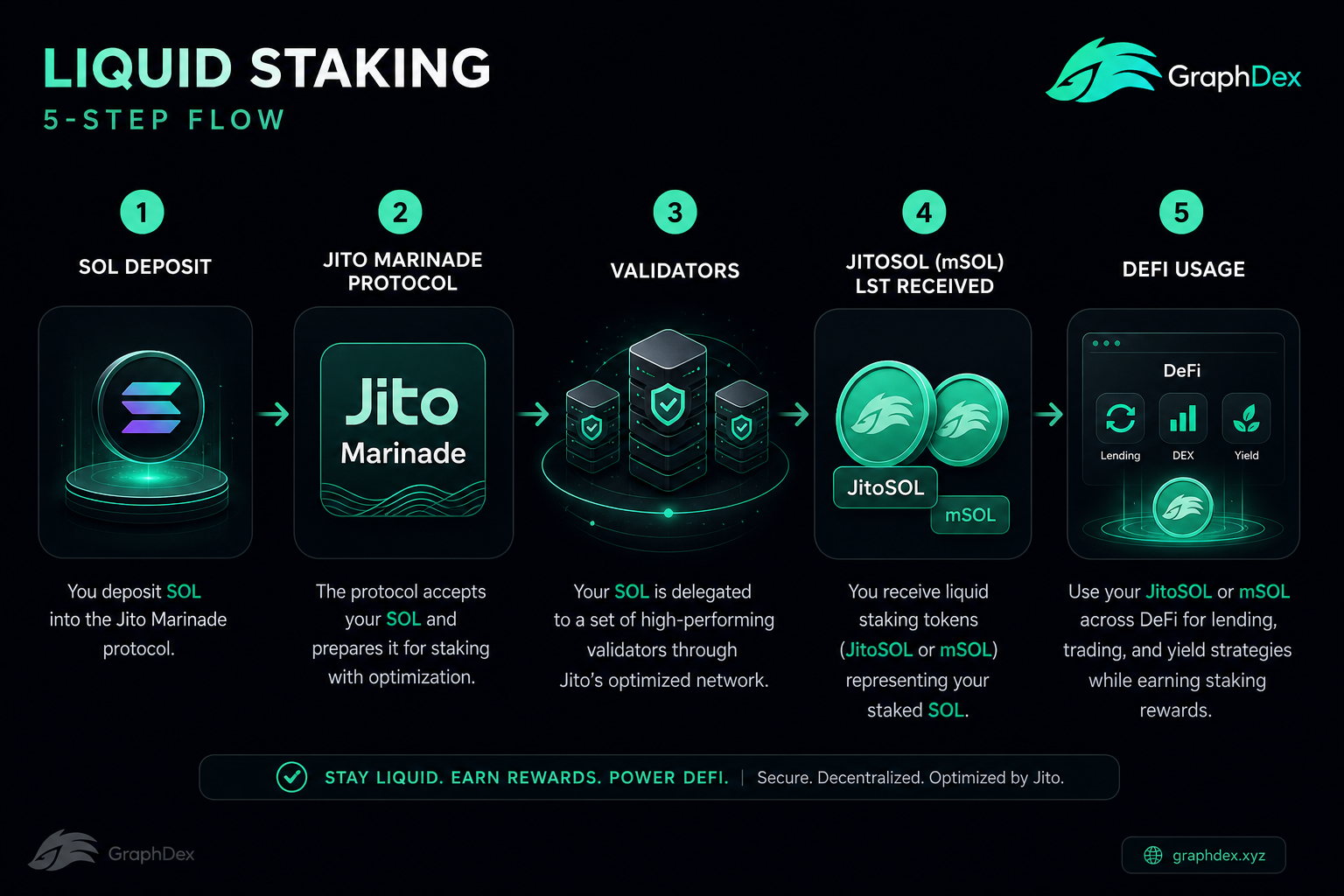
The mechanics are elegant once you see them. The flow has five steps.
1. Deposit. You send SOL, ETH, or another stakeable token to a liquid staking protocol's smart contract (Jito for Solana, Lido for Ethereum, etc.).
2. Validator delegation. The protocol delegates your tokens to a set of validators on the underlying network (some protocols delegate to many validators for decentralization; others to a curated set).
3. LST issuance. You receive a Liquid Staking Token representing your staked position. Common examples: JitoSOL (Jito's Solana LST), mSOL (Marinade's Solana LST), stETH (Lido's Ethereum LST), rETH (Rocket Pool's Ethereum LST). The LST grows in value (or quantity) as staking rewards accrue.
4. Use the LST in DeFi. The LST sits in your wallet and can be used like any other token — traded on DEXs, deposited as collateral on lending protocols, paired with other tokens in liquidity pools, or held passively as it accrues yield.
5. Unstake when ready. Return the LST to the protocol to redeem your underlying tokens plus rewards. Some protocols offer instant swaps (via liquidity pools); others have a delayed unstaking period (typically 2-10 days).
The key innovation is the LST. Without it, your staked tokens are locked. With it, you have a tradeable claim that represents your staked position — preserving liquidity while earning network yield.
How LSTs Accrue Value
There are two main models for how LSTs grow with staking rewards.
Rebasing tokens (stETH model). The LST quantity in your wallet increases over time as rewards accrue. If you hold 1 stETH today and earn 5% APY, you'll hold about 1.05 stETH in a year (without any action). The token rebases — its supply grows to reflect rewards.
Value-accruing tokens (JitoSOL, mSOL model). The LST quantity stays the same, but each token represents more underlying SOL over time. If you deposit 1 SOL and receive 1 JitoSOL, after a year your 1 JitoSOL might redeem for ~1.06 SOL. The exchange rate between LST and underlying token grows.
The economics are similar — both designs accrue rewards — but they behave differently in DeFi (some protocols handle one style better than the other). For most users, the practical difference doesn't matter; the rewards accrue either way.
The Top Liquid Staking Protocols in 2026
The liquid staking landscape has matured significantly. Here are the major players.
Solana Liquid Staking
Jito (JitoSOL). The leading Solana LST. Issues JitoSOL representing staked SOL plus MEV (Maximal Extractable Value) rewards — Jito's validators capture MEV opportunities and share returns with stakers, producing yields around 5.80% APY (slightly above native staking). The deepest DeFi integrations on Solana, near-instant secondary-market liquidity.
Marinade (mSOL). Solana's first liquid staking protocol (founded March 2021). Issues mSOL backed by a stake pool delegated to 100+ validators for decentralization. Yields are competitive, and Marinade also offers "Marinade Native" — automated delegation without smart contract risk for users wanting more conservative staking.
Jupiter (JupSOL). From the Jupiter aggregator team, JupSOL has become a major Solana LST with strong DeFi integration via Jupiter's ecosystem.
Sanctum. A flexible framework for validator-specific liquid staking — each validator can issue its own LSTs, giving users direct exposure to specific validator performance.
Phantom Staked SOL (PSOL), MoonPay Staked SOL (mpSOL). Wallet-issued LSTs that simplify staking for end users — sign in with familiar wallets and stake/unstake with built-in UX.
As of early 2026, over $3.3 billion in SOL is liquid-staked across these protocols — representing 10-15% of all staked SOL.
Ethereum Liquid Staking
Lido (stETH). The dominant Ethereum LST and largest liquid staking protocol overall by TVL. stETH is the de facto standard, accepted as collateral on more DeFi protocols than any alternative. Some concern exists about governance concentration (Lido controls a meaningful share of ETH staking).
Rocket Pool (rETH). Decentralized alternative emphasizing node operator accessibility — anyone can run a validator with 8 ETH (versus 32 ETH for direct ETH staking). Lower DeFi integration depth than stETH but more decentralized.
Ether.fi (weETH). Restaking-focused LST that auto-restakes on EigenLayer, capturing additional yields from AVS (Actively Validated Services) at the cost of additional risk complexity.
Frax (frxETH/sfrxETH), Coinbase (cbETH). Other significant Ethereum LSTs with different trade-offs.
For 2026 ETH stakers, the practical decision is often Lido (maximum DeFi composability) vs Rocket Pool (greater decentralization) vs restaking LSTs (higher yield with additional risk).
The 2026 Regulatory Breakthrough
Liquid staking's biggest regulatory milestone came in March 2026 — and it materially shifted the institutional landscape.
The SEC/CFTC joint ruling (March 17, 2026). A formal joint interpretation cleared all four staking models — including liquid staking — as non-securities activities. This removed a major barrier that had blocked institutional LST exposure pending regulatory clarity.
Earlier signals (August 2025). The SEC had issued earlier guidance clarifying that certain liquid staking activities and receipt tokens didn't constitute securities offerings, opening the door for the March 2026 joint ruling.
Institutional adoption following the ruling:
- Nasdaq filed a proposal in February 2026 to list the VanEck JitoSOL Solana Liquid Staking ETF — the first attempt to offer a regulated product tied directly to an LST
- Galaxy Digital launched institutional SOL staking in March 2026
- Hex Trust integrated JitoSOL for custodial staking, signaling traditional custodians treating LSTs as standard yield products
This regulatory clarity is genuinely transformative. Institutional capital that had been waiting on the sidelines can now participate, and LSTs are increasingly recognized as standard yield infrastructure — not just retail DeFi experiments.
The Benefits of Liquid Staking
Liquid staking's advantages over native staking come down to capital efficiency.
Capital efficiency. Your tokens earn staking rewards AND remain usable. You're not forced to choose between yield and liquidity.
DeFi composability. LSTs work as collateral on lending protocols, in liquidity pools, in yield farming strategies. You can stack yields: stake → earn ~6%; use LST as collateral → borrow → reinvest → earn additional yield. Sophisticated users layer multiple strategies.
Instant liquidity. Unlike native staking that requires waiting through an unstaking period (days on most chains), LSTs trade on DEXs with deep liquidity. Need to exit your staking position? Swap your LST for SOL or ETH immediately on Jupiter or Uniswap.
No minimum thresholds. Native ETH staking requires 32 ETH (~$80,000+); native validation requires running infrastructure. Liquid staking has no minimums — you can stake $10 of SOL or 0.01 ETH and participate.
Diversified validator exposure. Most LST protocols delegate across many validators, spreading risk and avoiding concentration with any single validator.
MEV capture (some LSTs). JitoSOL specifically shares MEV revenue with stakers — extra yield beyond standard staking.
The Risks of Liquid Staking
For balance, liquid staking introduces specific risks worth understanding.
Smart contract risk. Your tokens are deposited in a liquid staking protocol's smart contract. Any bug or exploit could affect funds. Even well-audited protocols carry this risk.
LST depeg risk. LSTs trade against their underlying token (e.g., JitoSOL vs SOL). In stress events, the LST can temporarily trade below the implied value of underlying assets. stETH famously traded at a discount during the 2022 stress events.
Validator slashing. If a validator misbehaves (offline, double-signing), they face slashing — partial loss of staked tokens. Pool-based liquid staking spreads this risk across many validators but doesn't eliminate it.
Protocol governance risk. Major LST protocols have governance tokens and concentration concerns. Lido controls a meaningful share of ETH staking, raising decentralization questions.
Yield compression. As more capital enters liquid staking, validator commission and protocol fees can compress net yields. Always compare current net yield to native staking.
Regulatory evolution. While the March 2026 ruling cleared liquid staking federally, rules continue evolving. State-level or international regulations may differ.
Tax complexity. LSTs may generate taxable events on rebasing or rewards accrual depending on jurisdiction. The treatment is unsettled in many places. Consult a tax professional.
The honest takeaway: liquid staking offers genuine capital-efficiency gains for users who understand the trade-offs. For users who don't need DeFi composability, native staking is simpler and avoids smart contract risk. For users who actively use DeFi, the flexibility usually justifies the additional risk.
Liquid Staking vs Native Staking vs Restaking
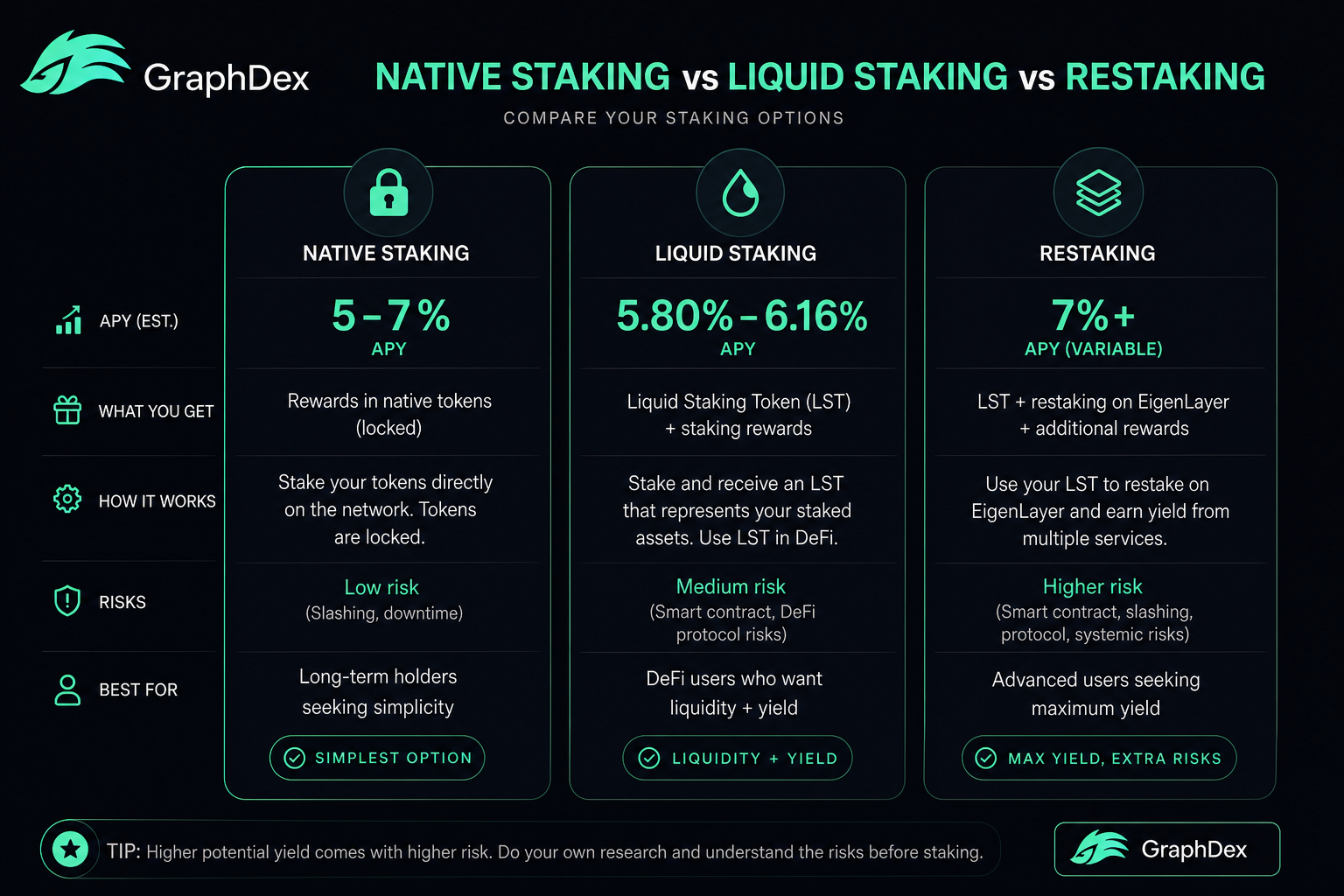
Three related concepts often get conflated. Here's how they differ:
| Model | What You Do | What You Get | Trade-off |
|---|---|---|---|
| Native staking | Delegate to validators directly | Native staking rewards (5-7% APY) | Locked capital; no DeFi use |
| Liquid staking | Deposit in LST protocol | LST + rewards (~5.80-6.5%) | Smart contract risk; full DeFi composability |
| Restaking | Use LST in restaking protocols (EigenLayer) | LST + restaking rewards | Additional risk; higher yield potential |
Native staking is simplest and lowest-risk — you delegate, you earn, you wait when you want to unstake.
Liquid staking adds capital efficiency at the cost of smart contract risk — usually worth it for active DeFi users.
Restaking stacks an additional risk layer for additional yield — appropriate for sophisticated users who price in the complexity, but the yield increment over LSTs has been modest relative to the qualitative risk increase.
For most retail users, the practical choice is between native staking (passive holders) and liquid staking (active DeFi users). Restaking is a niche for risk-tolerant sophisticated users.
Explore yield options on Solana via GraphDex
How GraphDex Approaches Staking Yield
GraphDex offers up to 17% APY on stablecoins and SOL — substantially higher than typical liquid staking yields (5-8% APY). The structure is different from liquid staking:
Fee-based yield model. GraphDex's yield comes from platform trading fees (real revenue from actual trading activity), not from PoS network rewards or token emissions. This addresses the "where does the yield come from?" question with a clear answer — fees paid by traders using the platform.
No LST required. You earn yield on your stablecoins or SOL directly within the GraphDex non-custodial environment via Privy — no separate LST to manage.
Integrated with broader activity. Your capital earns yield while you trade, prediction markets, use Pulse feed for discovery, and Bubble Maps for safety. Capital earns between actions rather than sitting idle.
This is fundamentally complementary to liquid staking, not a replacement. Many sophisticated users hold JitoSOL or mSOL for liquid staking exposure AND use GraphDex for fee-based stablecoin yield. The structures address different yield sources — network rewards versus platform trading fees — and stacking them is reasonable for diversification.
For users prioritizing sustainable, fee-based yield without managing LSTs or PoS mechanics, GraphDex's fee-based 17% APY is among the most competitive yields in 2026 DeFi.
Earn fee-based yield up to 17% APY on GraphDex
Frequently Asked Questions
What is liquid staking in simple terms? Liquid staking lets you stake tokens (SOL, ETH) to earn network rewards while receiving a tradeable derivative token (an LST like JitoSOL or stETH) that represents your staked position. The LST stays usable in DeFi — you can trade it, use it as collateral, or earn additional yield, while your underlying tokens remain staked.
How does liquid staking differ from regular staking? Regular (native) staking locks your tokens — you can't use them while staked. Liquid staking issues an LST that remains usable across DeFi, so your capital earns staking rewards AND stays liquid for other strategies. The trade-off is added smart contract risk and slightly lower yield.
What are the best liquid staking protocols on Solana in 2026? Jito (JitoSOL, ~5.80% APY plus MEV rewards) is the leading Solana LST with the deepest DeFi integration. Marinade (mSOL) is the original protocol with strong decentralization across 100+ validators. Jupiter (JupSOL), Sanctum (validator-specific LSTs), and Phantom/MoonPay's wallet-issued LSTs are also significant options.
What are the best liquid staking protocols on Ethereum in 2026? Lido (stETH) is the dominant Ethereum LST and accepted as collateral on the most DeFi protocols. Rocket Pool (rETH) emphasizes decentralization. Ether.fi (weETH) auto-restakes for higher yield with added complexity. Frax (frxETH/sfrxETH) and Coinbase (cbETH) are other significant options.
Is liquid staking legal in 2026? Yes, in the US. The joint SEC/CFTC ruling in March 2026 formally cleared all four staking models — including liquid staking — as non-securities activities. This removed a major regulatory barrier. Nasdaq filed for a VanEck JitoSOL ETF in February 2026, and institutional adoption is accelerating. Rules may vary in other jurisdictions.
What are the risks of liquid staking? Main risks: smart contract bugs (the protocol's contract could be exploited), LST depeg (LST trading below underlying token value during stress), validator slashing (validators losing tokens for misbehavior), governance concentration concerns, and tax complexity. The March 2026 SEC/CFTC ruling reduced regulatory risk but didn't eliminate all risk.
Can I lose money in liquid staking? Yes. Smart contract exploits, LST depeg, validator slashing, or LST price decline can all cause loss. However, established protocols (Jito, Lido, Marinade) have strong audit history and have weathered multiple market cycles. For most users, the risks are manageable with diversification and using established protocols, but never invest more than you can afford to lose.
About This Guide
This guide is published by the GraphDex Research team — analysts and traders building the infrastructure for digital asset trading on Solana. Our content is based on live protocol data, current regulatory developments, and hands-on experience.
Sources & data: TVL figures, APY rates, and regulatory details reflect publicly available information as of 2026 and change continuously. Liquid staking carries real risks. This guide is educational and not financial advice — always do your own research.
GraphDex is the infrastructure for digital asset trading — trade, predict, and earn in one place. Learn more at graphdex.io.
Last reviewed: May 2026 · GraphDex Research
The infrastructure for digital asset trading. Trade, predict, stake, repeat. graphdex.io