By GraphDex Research · Reviewed for accuracy May 2026
Quick Answer
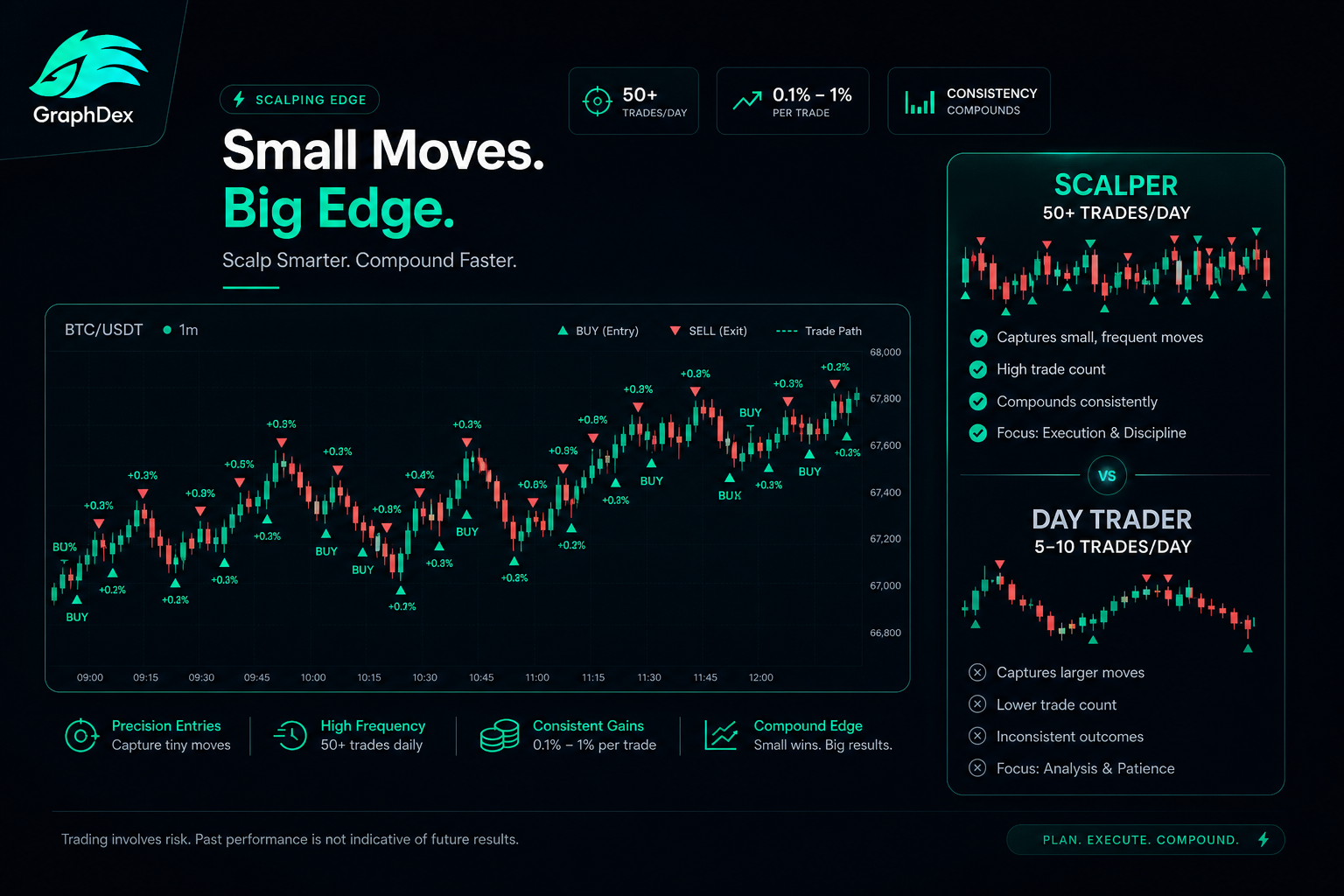
Scalping is a high-frequency trading style where traders open and close positions within seconds to minutes, aiming to capture small price movements (typically 0.1-1% per trade) repeatedly throughout the day. Key facts:
- Trade frequency: 20-200+ trades per day
- Profit per trade: 0.1-1% (very small individually, but accumulates)
- Timeframes used: 1-minute and tick charts primarily
- Capital requirements: $5,000+ recommended for meaningful position sizes
- Best on: Solana (sub-cent fees), L2s, or major derivatives platforms
- Reality check: 80-90% of retail scalpers lose money — fees, slippage, and emotional fatigue destroy most
The honest truth: Successful scalping requires exceptional focus, fast execution infrastructure, low fees, and emotional discipline that most traders simply don't have. It's the highest-skill ceiling style.
Scalp Solana with sub-cent fees on GraphDex
Key Takeaways
- Scalping captures many tiny profits per day rather than chasing large moves.
- Requires low-fee venues (Solana, fast derivatives platforms) — fees eat scalpers alive on Ethereum L1.
- 80-90% of retail scalpers lose money; the few who succeed typically use algorithmic tools.
- Best for traders with hours of daily focus, fast execution access, and ironclad discipline.
What Is Scalping?
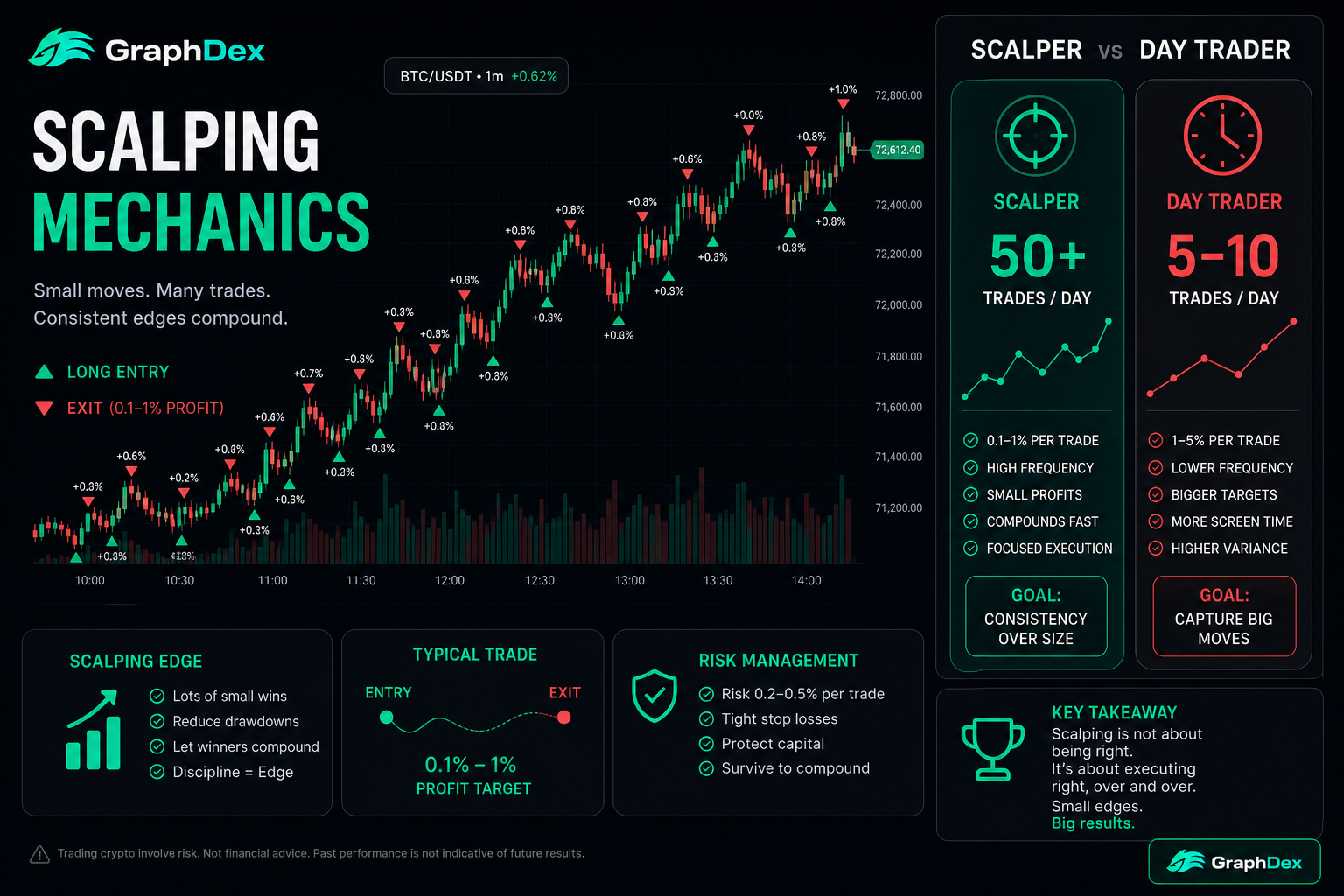
Scalping is the fastest form of active trading. Where day traders hold positions for hours and swing traders hold for days, scalpers operate on a timescale of seconds to minutes — opening and closing positions repeatedly throughout the day to capture small price movements.
The term comes from "scalping" small profits — taking a "thin slice" off the top of price movements rather than catching entire moves.
A typical scalper's day:
- Opens 50-200 trades from morning to evening
- Holds positions for 30 seconds to 10 minutes
- Targets 0.1-1% profit per trade
- Uses tight stop losses (often 0.2-0.5%)
- Watches charts continuously during trading hours
- Relies on speed of execution above everything
Why scalp?
- High trade frequency means many opportunities daily
- Avoids overnight risk completely
- Small position sizes per trade limit individual losses
- Profits compound quickly when successful
- Doesn't require predicting major market direction
The economics: A scalper making 50 trades per day at 0.3% average profit per trade (with 60% win rate) can earn 5-10% per week — extraordinary returns when sustainable. But sustaining requires near-perfect execution and discipline.
The Scalping Process: How It Actually Works
Scalping isn't about random fast trading — it's a systematic approach to capturing edge from market microstructure.
Setup Identification
Scalpers look for specific high-probability setups:
1. Momentum bursts: Brief surges of buying or selling pressure that often continue for a few minutes before reverting.
2. Liquidity grabs: Price brief dips below support or pops above resistance to trigger stop losses, then snaps back. Profit from the reversion.
3. Order book imbalances: Large bid or ask walls suggest immediate directional pressure.
4. News reactions: Brief price spikes on news that often partially revert within minutes.
5. Range bounces: In sideways markets, repeated bounces between support and resistance create consistent scalping opportunities.
Entry Execution
Speed matters enormously. Scalpers enter via:
Market orders: Immediate execution at current price. Used when speed > price improvement. Pays the spread.
Limit orders at support/resistance: Pre-placed orders at key levels. Captures spreads but may not fill in fast markets.
Stop-limit orders: Triggers on level breaks. Used for breakout scalps.
Exit Strategy
Scalping exits are extremely tight:
Take profit: Pre-defined at 0.2-1% above entry (for longs). Usually executed via limit orders.
Stop loss: Pre-defined at 0.1-0.5% below entry. Non-negotiable — moving stops kills scalpers.
Time-based exit: If price hasn't moved within a defined window (say, 5-10 minutes), exit regardless. Capital efficiency matters when running 50+ trades daily.
The Mathematical Edge
Profitable scalping requires positive expectancy across many trades:
Example: 60% win rate, +0.4% average win, -0.3% average loss
- Expected value per trade: (0.6 × 0.4%) + (0.4 × -0.3%) = +0.12%
- Over 50 trades/day: +6% daily before fees/slippage
This sounds excellent — until you subtract fees, slippage, and the emotional cost of focus. Many scalpers achieve good win rates but lose to execution costs.
Why Solana Makes Scalping Viable
Trading economics matter more in scalping than any other style. Solana's structure changed scalping fundamentally.
The Fee Math
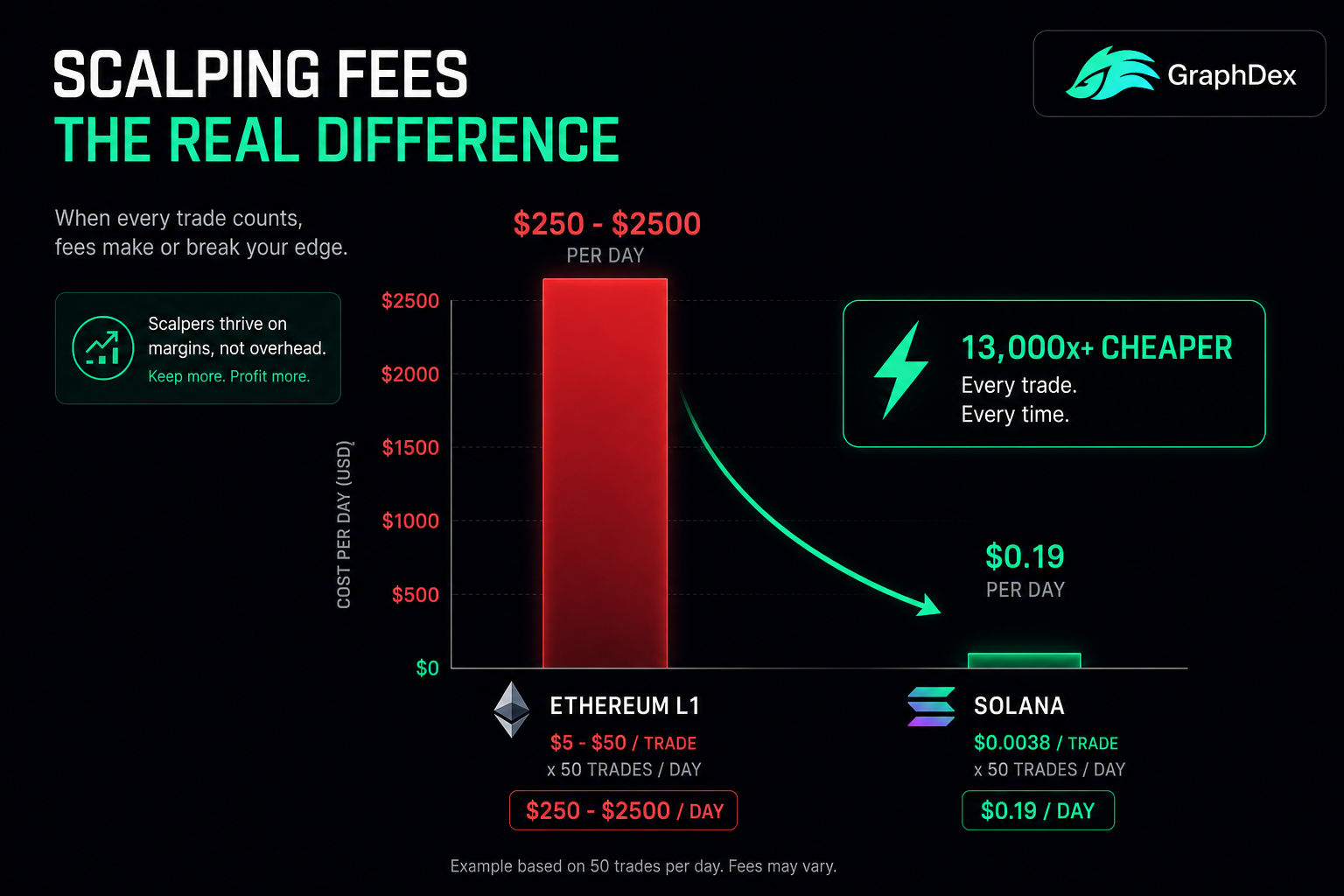
On Ethereum L1:
- Average swap: $5-50 in gas
- Scalper making 50 trades/day: $250-2,500 daily fees
- To net positive with 0.5% target profit: position sizes must be enormous ($50,000+ per trade)
- Result: scalping retail-feasible only on derivatives platforms, not on-chain DEXs
On Solana:
- Median fee: $0.0038
- Scalper making 50 trades/day: $0.19 daily fees
- Position sizes can be $500-5,000 and still net positive
- Result: scalping economically viable for retail traders for the first time
This single factor transformed Solana into the dominant retail scalping ecosystem in 2024-2026.
Other Solana Advantages
400ms finality: Transactions confirm in under half a second. Critical when holding positions for 30 seconds.
High throughput: 1,000-4,000 real TPS supports the volume scalpers generate.
Deep liquidity on majors: $650B+ stablecoin volume on Solana in February 2026. Tight spreads on SOL/USDC and major pairs.
MEV protection available: Built into platforms like GraphDex. Scalpers are prime targets for sandwich attacks — protection is essential.
Scalping Strategies That Actually Work
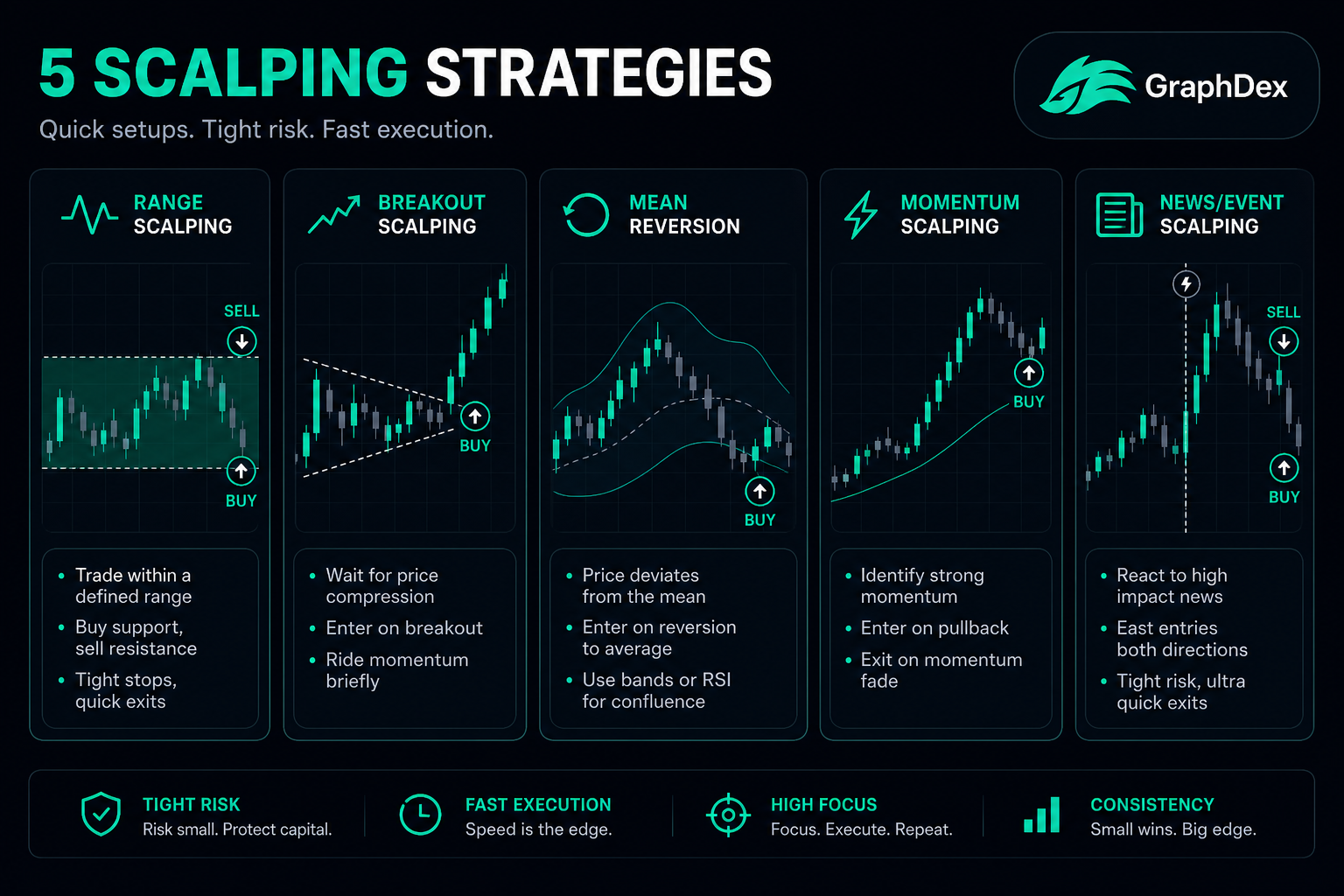
The most common profitable scalping strategies in 2026:
Range Scalping
The setup: Asset trading in a defined range (clear support and resistance).
The execution: Buy near support with tight stops; sell near resistance with tight stops. Repeat indefinitely while the range holds.
When it works: Quiet markets, post-trend consolidation periods, weekend low-volume sessions.
When it fails: When the range breaks. Discipline to exit when structure changes is critical.
Breakout Scalping
The setup: Price compressing in a tight consolidation with declining volume.
The execution: Enter on breakout with volume confirmation. Exit quickly — many breakouts are short-lived.
When it works: Major news catalysts, after long consolidations, around key technical levels.
When it fails: False breakouts (especially on low volume). Discipline to take quick losses essential.
Mean Reversion Scalping
The setup: Price extends significantly from a moving average (typically 20-50 EMA on short timeframes).
The execution: Enter against the extension, targeting return to the mean.
When it works: Range-bound markets, after exhaustion candles.
When it fails: Strong trending markets where "overextended" can stay overextended.
Momentum Scalping
The setup: Strong directional move with volume.
The execution: Enter in direction of momentum, ride to the next minor resistance/support, exit quickly.
When it works: Trending markets with clear momentum signals.
When it fails: Late entries after exhaustion. Discipline to enter early or skip is critical.
News/Event Scalping
The setup: Scheduled news or catalyst about to release.
The execution: Position before, react to actual outcome, exit within minutes.
When it works: Major economic releases, project announcements, earnings.
When it fails: Surprise outcomes that move price violently against position. High-risk style.
The Tools Scalpers Need
Scalping without proper tools is essentially impossible.
Essential Infrastructure
1. Fast execution platform. GraphDex (Solana), professional derivatives platforms (Bybit, OKX), or institutional terminals. Slow execution kills scalpers.
2. Low fees. Sub-cent on Solana, or maker rebates on derivatives. Fee structure determines profitability.
3. Multi-timeframe charts. 1-minute, 5-minute, 15-minute simultaneously. Decisions span microseconds to minutes.
4. Hot keys / instant order entry. Buy/sell with single keystrokes. Speed advantage matters.
5. Level 2 / order book visibility. See actual buy/sell orders, not just price. Critical for short-term timing.
6. Multi-monitor setup. Different timeframes, different assets, news feed, order book — too much for one screen.
Recommended Indicators
Minimal indicator stack for scalping:
- 20 EMA (short-term trend)
- VWAP (institutional reference)
- Volume bars
- Maybe one momentum indicator (RSI on shorter periods)
More indicators slow decision-making and create conflicting signals. Scalpers need clarity, not analysis paralysis.
Risk Management Tools
Position size calculator: Always know your risk per trade before entry.
Hard daily loss limits: When you hit a maximum loss (often 2-3% of capital), stop trading for the day. No exceptions.
Trade journaling software: Document every trade for review. Skipping this guarantees stagnation.
Realistic Expectations for Scalping
For honesty, what scalpers actually experience:
Year 1: Almost certain losses. Fees, slippage, and emotional fatigue destroy most beginners. Treat as tuition.
Year 2: Possible breakeven if you've developed discipline and selective setups. Many quit during this phase.
Year 3+: Some consistency possible for the dedicated subset. Returns of 50-150% annually are excellent for active scalpers — comparable to top hedge fund returns but achievable with much smaller capital.
The 5-10% who succeed long-term share:
- Hours of daily focus during market hours
- Multi-monitor professional setup
- Sub-second execution infrastructure
- Detailed trade journaling
- Strict daily loss limits
- Capital they can afford to lose
- Often algorithmic assistance for execution
What doesn't work in scalping:
- Mobile-only setups
- High-fee venues (Ethereum L1, expensive CEXs)
- Trading on emotion or impulse
- Trading while distracted
- Random "feel" trading without systems
- Trying to scalp from a day job
Scalping is full-time intensity. Part-time scalping rarely works.
Common Scalping Mistakes
For balance, what destroys scalpers:
1. Overtrading. Forcing trades when no setups exist. Best scalpers wait for high-probability setups, not constant activity.
2. Moving stops. "Just a little more room" turns 0.3% losses into 3% losses. Disciplined stops are non-negotiable.
3. Revenge trading. Doubling down after losses. Amplifies losses, never recovers them.
4. Holding losers. Scalp positions held longer than planned become unintended swing trades — usually losing ones.
5. Cutting winners short. Fear-driven exits on profitable trades destroy expectancy. Trust the system.
6. High-fee venues. Scalping is fee-sensitive. Trading on Ethereum L1 without volume to support it = guaranteed losses.
7. No daily loss limit. Letting bad days become catastrophic days. Always have a maximum daily loss that ends trading.
8. Multitasking. Scalping requires undivided focus. Mixing with other work guarantees mistakes.
9. Trading during low liquidity. Weekend overnight Asian hours often have thin liquidity, wide spreads, manipulation. Scalp during high-liquidity periods.
10. No journaling. Without documenting trades, improvement is impossible. The successful traders journal religiously.
Scalp Solana with low fees and MEV protection on GraphDex
Is Scalping Right for You?
Honest self-assessment matters before committing to scalping.
Scalping Suits You If:
- You can dedicate 4-8 hours of focused screen time daily
- You're emotionally stable under pressure
- You enjoy chess-like rapid decision-making
- You have $5,000+ capital you can afford to lose
- You can invest in proper infrastructure (multi-monitor, fast platforms)
- You have proper risk management discipline
- You don't have a day job during market hours (or trading specific market hours that suit you)
Scalping Is NOT for You If:
- You can only trade for 1-2 hours daily sporadically
- You panic during fast price movements
- You can't tolerate frequent small losses
- You have less than $1,000 in trading capital
- You only have mobile access
- You're seeking passive income (scalping is anything but passive)
For most traders, swing trading or position trading achieves comparable returns with vastly less stress and time commitment. Scalping is for a specific personality and situation.
Start scalping Solana with sub-cent fees on GraphDex
How GraphDex Supports Scalping
For Solana scalpers specifically, GraphDex provides:
- Sub-cent fees on every trade (the foundational requirement for retail scalping)
- Sub-second execution via Solana's 400ms finality
- MEV protection preventing sandwich attacks (scalpers are prime targets)
- Multi-timeframe live charts for setup identification
- Volume integration confirming momentum setups
- Pulse feed surfacing new tokens for high-volatility scalping
- AI signals identifying high-probability setups
- Bubble Maps for instant safety assessment (critical for memecoin scalping)
- Non-custodial Privy wallet — sign in with Twitter, email, or Telegram, no seed phrase
- Fee-based 17% APY on idle capital between sessions
The integrated approach means you can scan, analyze, execute, and protect — all without switching between five different platforms. For scalpers where every second matters, this consolidation is essential.
Frequently Asked Questions
What is scalping in crypto trading? Scalping is a high-frequency trading style where traders open and close positions within seconds to minutes, aiming to capture small price movements (0.1-1% per trade) repeatedly throughout the day. Scalpers typically make 20-200+ trades daily, prioritizing speed and execution over individual trade size.
Is scalping profitable in crypto? It can be — but only for a small minority. 80-90% of retail scalpers lose money due to fees, slippage, emotional fatigue, or poor risk management. The successful 10-20% typically have proper infrastructure (sub-cent fees, multi-monitor setups), strict discipline, and often algorithmic assistance. Annual returns of 50-150% are achievable but require professional-level dedication.
How much money do you need to scalp crypto? Minimum $1,000 to start learning, but realistic capital for sustainable scalping is $5,000-$25,000+. Smaller capital makes meaningful position sizes impossible due to minimum position requirements and fee impact. With $1,000 and 0.3% target profit per trade, profits are only $3 — easily eroded by fees on most platforms.
What's the difference between scalping and day trading? Both close positions within the same day, but timeframes differ dramatically. Scalpers hold positions for seconds to minutes (often 30 seconds to 10 minutes) and make 20-200+ trades daily. Day traders hold positions for minutes to hours and make 1-20 trades daily. Day trading is more accessible; scalping requires faster execution and more focus.
Can I scalp crypto on Ethereum? Generally no, due to gas fees. Ethereum L1 gas costs $5-50 per transaction — at 50 trades per day, that's $250-2,500 in fees, requiring enormous position sizes to be profitable. Layer 2s (Arbitrum, Base, Optimism) and Solana are far more viable. Solana's sub-cent fees make retail scalping economically practical.
What's the best timeframe for scalping? Primary scalping happens on 1-minute and 5-minute charts. Many scalpers also use 15-second or tick charts for entry timing, with 15-minute and 1-hour charts for broader context. The key principle: confirm higher timeframe trend, then scalp lower timeframes within that direction.
How do I avoid losing money scalping? The honest answer: most beginners can't. To improve your odds: start with proper capital ($5K+), use low-fee venues (Solana), develop systematic setups (don't trade randomly), maintain strict stop losses, set hard daily loss limits, journal every trade, focus during sessions (no multitasking), and accept that the first year is tuition. Even with all that, 80%+ still lose money.
About This Guide
This guide is published by the GraphDex Research team — analysts and traders building the infrastructure for digital asset trading on Solana. Our content is based on direct trading experience, current market data, and observation of successful scalping practices.
Sources & data: Trading style descriptions reflect typical scalping practices in 2026. Scalping carries substantial risk including total loss of capital, and is unsuitable for most retail traders. This guide is educational and not financial advice.
GraphDex is the infrastructure for digital asset trading — trade, predict, and earn in one place. Learn more at graphdex.io.
Last reviewed: May 2026 · GraphDex Research
The infrastructure for digital asset trading. Trade, predict, stake, repeat. graphdex.io