By GraphDex Research · Reviewed for accuracy May 2026
Quick Answer
Web3 is the third generation of the internet — a decentralized version built on blockchains where users own their data, digital assets, and online identities without relying on Big Tech intermediaries. Key facts:
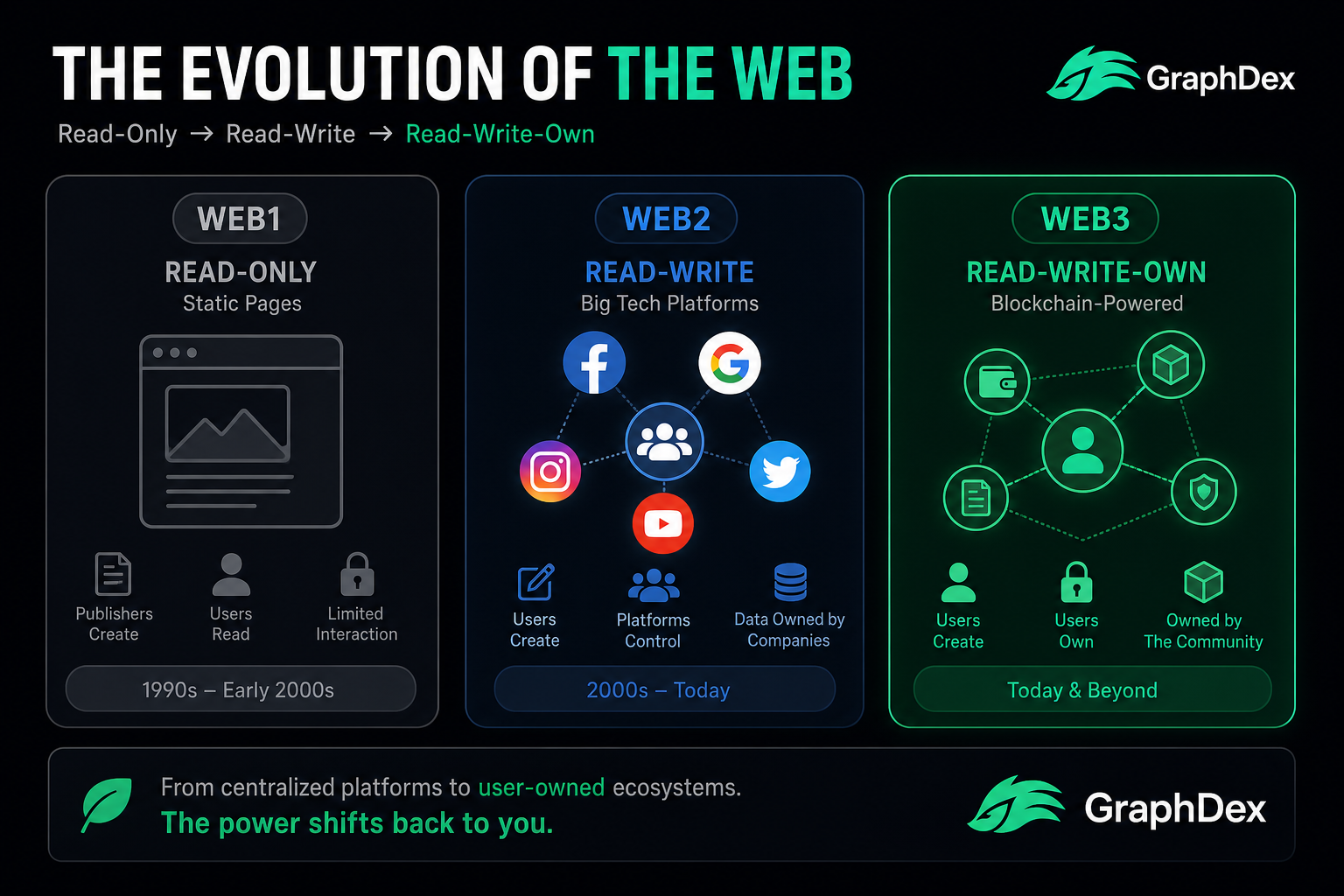
- Web1 (1990s): Read-only — static pages, no interaction
- Web2 (2000s+): Read-write — interactive but centralized (Google, Facebook, Twitter)
- Web3 (2020s+): Read-write-own — interactive AND user-owned via blockchain
- Core principles: Decentralization, permissionless access, native payments, trustless execution
- Key technologies: Blockchains, smart contracts, wallets, decentralized apps (dApps), tokens
- Major use cases: DeFi ($153B TVL), NFTs, DAOs, gaming, payments, digital identity
In Web2 you're the product (your data is monetized); in Web3 you're the owner.
Try Web3 trading on Solana via GraphDex
Key Takeaways
- Web3 is a user-owned internet built on blockchains — you control your data and digital assets directly.
- It replaces Big Tech intermediaries with smart contracts and decentralized networks.
- Core principles: decentralization, permissionless access, native payments, trustless execution.
- Major Web3 sectors include DeFi, NFTs, DAOs, gaming, and digital identity.
Web1 vs Web2 vs Web3
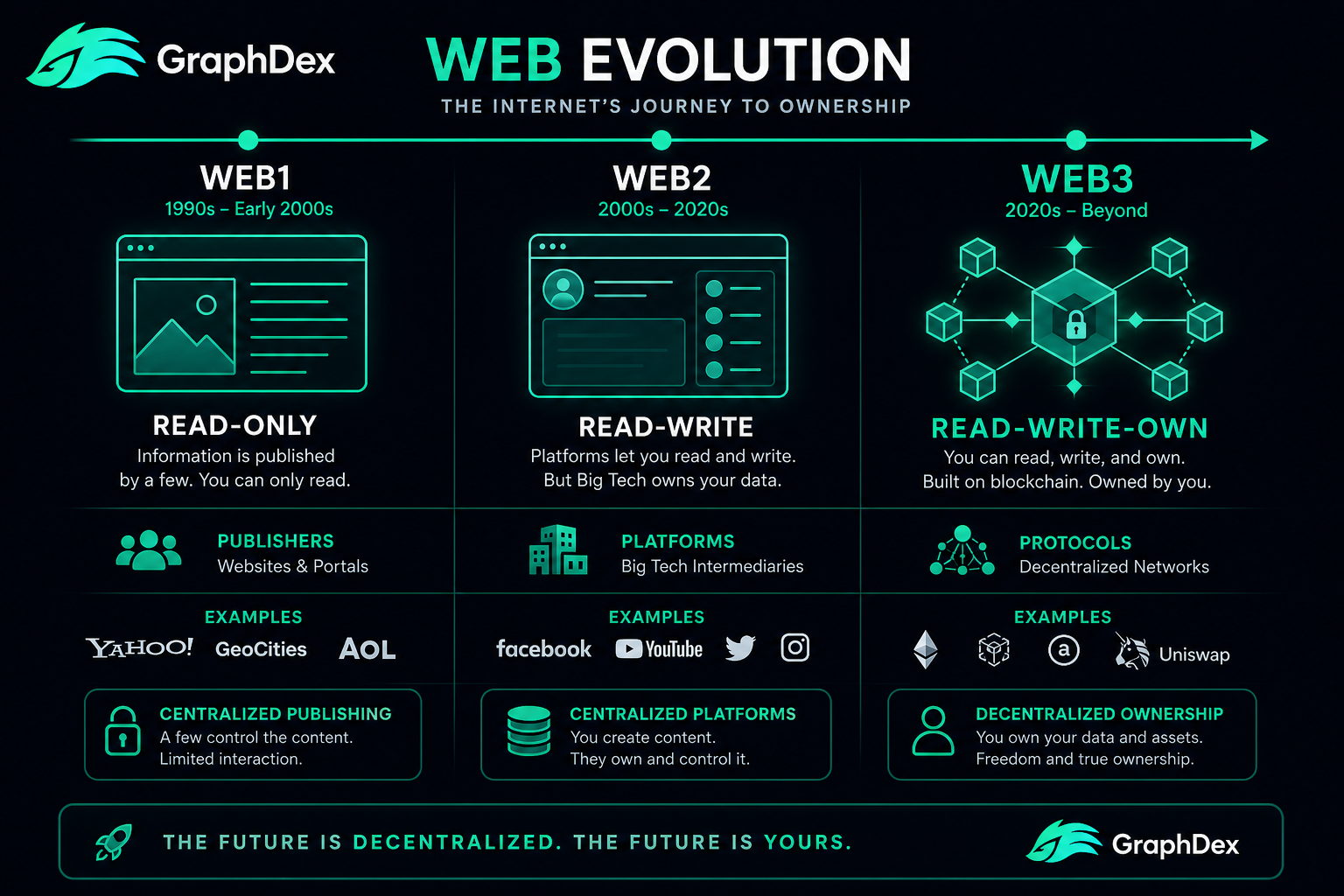
The internet has gone through three distinct phases, each fundamentally changing how we interact online. Understanding the evolution makes Web3 clearer.
Web1 (~1990s-early 2000s): Read-Only Internet. The original web was a collection of static pages. You could read information but rarely interact. There were no logins, no comments, no user-generated content at scale. The web was a digital encyclopedia — informational but one-way.
Web2 (~2004-present): Read-Write Internet. The "social web" introduced interactivity. Users created content (blogs, videos, social posts), interacted with each other, and built profiles. But interactivity came with a trade-off: a handful of large platforms (Google, Facebook, Twitter, Amazon) became the central infrastructure. They host your content, control your account, monetize your data, and can shut you down at will. In Web2, you're the product — your attention and data are sold to advertisers.
Web3 (2020s-present): Read-Write-Own Internet. Web3 keeps the interactivity of Web2 but adds ownership. You control your data, your digital assets, and your online identity through cryptography and blockchains — not corporate platforms. Applications run on shared decentralized infrastructure rather than corporate servers. You're the owner, not the product.
| Era | Period | Model | Power | Example |
|---|---|---|---|---|
| Web1 | 1990s | Read-only | Publishers | Static websites |
| Web2 | 2000s+ | Read-write | Platforms | Facebook, YouTube, Twitter |
| Web3 | 2020s+ | Read-write-own | Users | Uniswap, ENS, decentralized social |
This isn't a wholesale replacement — Web2 and Web3 coexist. But for use cases where ownership, censorship resistance, or trustless interaction matter, Web3 offers something Web2 fundamentally can't.
The Four Core Principles of Web3
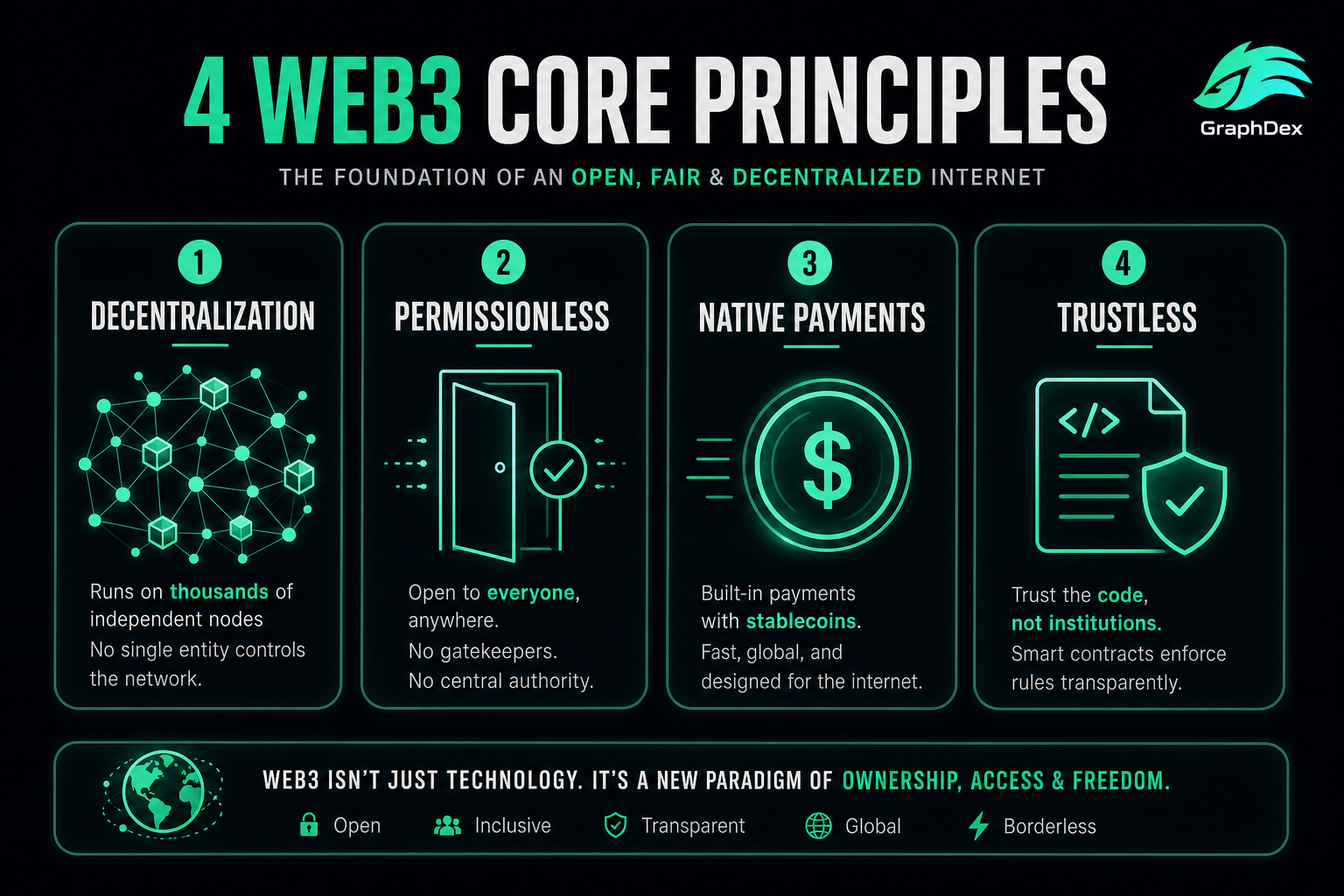
Web3 isn't just one technology — it's a set of principles that distinguish it from prior internet eras.
1. Decentralization. No single company or server controls Web3 applications. Data spreads across thousands of independent nodes worldwide. When you post content or make a transaction, multiple independent validators verify and store the information. This prevents any one entity from censoring content, freezing accounts, or manipulating records. If one node goes offline, thousands remain operational.
2. Permissionless access. Anyone can participate in Web3 — no signups, no KYC for many applications, no gatekeeper deciding who's allowed in. A 17-year-old in Lagos can use Uniswap or Solana DEXs on the same terms as a hedge fund. This contrasts sharply with traditional finance and Web2 platforms where access depends on geography, age, banking relationships, and corporate approval.
3. Native payments. Web3 has cryptocurrency built in. Money moves through the same rails as everything else — wallets, smart contracts, on-chain transactions. No payment processors, no chargebacks, no 2-3% fees to Visa or Mastercard. Settlement is final, fast, and global. Visa itself now settles USDC on Solana.
4. Trustless execution. Smart contracts execute automatically based on code — not trust in a counterparty or institution. You don't need to trust a bank to honor a deposit or an exchange to fulfill a trade. The code is the agreement, and it runs verifiably on the blockchain. This shifts trust from institutions to math.
These four principles together enable use cases impossible in Web2: permissionless global finance, censorship-resistant communication, digital assets users actually own, and self-sovereign identity.
How Web3 Actually Works
The mechanics of Web3 follow a clear sequence — once you understand wallets, blockchains, and smart contracts, the rest follows.
1. The blockchain layer. Public blockchains (Ethereum, Solana, Bitcoin, and others) are the underlying infrastructure — distributed networks of computers that maintain a shared, tamper-resistant ledger. Transactions are grouped into blocks and chained together. No central authority controls them; thousands of independent nodes verify and store the data.
2. Your wallet. A crypto wallet (Phantom for Solana, MetaMask for Ethereum, hardware wallets like Ledger) holds the private keys that prove you own your digital assets. Your wallet is your account on Web3 — your identity, your bank, your inventory of digital assets. You don't sign up with email and password; you sign with your wallet.
3. Smart contracts. These are self-executing programs deployed on blockchains. When predefined conditions are met, they automatically perform actions: swap tokens on a DEX, transfer NFTs, pay out an insurance claim, distribute DAO funds. They're the building blocks of Web3 applications.
4. dApps (decentralized applications). Frontends that interact with smart contracts. You connect your wallet to a dApp, click a button (swap, mint, vote, deposit), and the dApp constructs a transaction. Your wallet signs and broadcasts it. The smart contract executes. The blockchain records the result.
5. Tokens. Web3 has two main token types. Coins like SOL or ETH are native to their blockchains and used for fees and network value. Tokens are built on top of blockchains — stablecoins (USDC), governance tokens, NFTs, memecoins, and many more. They enable everything from peer-to-peer payments to community ownership.
The result: applications that run on public infrastructure, where users control their own data, assets, and interactions — directly, without intermediaries.
What Are the Major Web3 Sectors?
Web3 spans many use cases. The most active categories in 2026:
DeFi (Decentralized Finance). Smart contract protocols for lending, borrowing, trading, staking, and earning. Total value locked exceeded $153 billion in early 2026. Major protocols include Uniswap, Aave, Lido, Curve, Raydium, and Jito.
NFTs (Non-Fungible Tokens). Digital ownership of unique items — art, collectibles, in-game assets, music, identity tokens. Following the speculative peak in 2021-2022, NFTs have matured into use cases beyond profile pictures: gaming items, ticketing, identity, and provenance.
DAOs (Decentralized Autonomous Organizations). Smart-contract-governed organizations where token holders vote on decisions. Used for managing protocol treasuries, funding development, governing communities, and coordinating without traditional corporate structure.
Stablecoins and payments. Dollar-pegged tokens (USDC, USDT) move billions daily on blockchain rails. USDC alone surpassed $20 trillion in cumulative transactions by end-2024. Visa now settles USDC on Solana 7 days a week.
Gaming and metaverse. Players own in-game assets as NFTs, trade them peer-to-peer, and carry them between games. The vision: assets that don't disappear when a game shuts down.
Identity (DID — Decentralized Identifiers). Wallet-based identity that you control — proving credentials, signing into apps, verifying actions without handing data to a central authority. Services like ENS (Ethereum Name Service) give you a human-readable identity tied to your wallet.
RWA (Real-World Assets). A breakout 2026 category — tokenizing US Treasuries, real estate, commodities, and other off-chain assets onto blockchain. Brings TradFi yields and assets into Web3 infrastructure.
AI x Crypto. Another breakout 2026 category — integrating AI agents with on-chain economies, token-incentivized AI training, and AI-powered trading.
Each sector replaces a traditional intermediary with code that executes automatically — banks, brokers, marketplaces, governance bodies — turning institutional functions into open infrastructure.
Try active Web3 trading on Solana via GraphDex
Which Blockchains Power Web3?
Web3 isn't built on a single blockchain. Multiple networks compete and coexist, each with different strengths.
Ethereum. The original smart contract platform, launched 2015. Largest ecosystem by TVL (~$54.5B), most developers, most mature tooling. Layer 2 networks (Arbitrum, Base, Optimism, zkSync) scale Ethereum to lower fees while inheriting its security.
Solana. High-performance blockchain emphasizing speed and low fees. Real-world 1,000-4,000+ TPS, sub-cent fees, fast finality. Home to active trading, memecoins, payments, and high-velocity DeFi. Solana cleared $650 billion in stablecoin volume in February 2026 — the highest of any chain.
Bitcoin. The original cryptocurrency and largest by market cap. Primarily store-of-value rather than programmable Web3 infrastructure — though Layer 2 networks (Lightning, Stacks) build smart contracts and DeFi on top of Bitcoin.
Layer 2s (Arbitrum, Base, Optimism). Networks that scale Ethereum off-chain, reducing fees 10-100x while inheriting Ethereum security. Base (Coinbase's L2) is the largest with ~$4.15B TVL.
Others. BNB Chain (Binance's chain), Avalanche, Polygon, Sui, Aptos — all with distinct ecosystems and use cases.
For most users, the practical landscape is Ethereum + Solana for active Web3 use, with L2s as the cost-efficient Ethereum path. Different applications live on different chains; many users use multiple.
How Does Web2 Compare to Web3 in Practice?
Comparing how the same activity works in each illustrates the difference:
| Activity | Web2 Approach | Web3 Approach |
|---|---|---|
| Identity | Email + password per platform | One wallet across all apps |
| Payments | Visa/Mastercard, 2-3% fees, days to settle | Stablecoins, near-zero fees, seconds |
| Social | Facebook/Twitter owns your followers | You own your social graph |
| Gaming | Items locked to a single game | NFT items portable across games |
| Finance | Banks, brokers, 9-5 hours | DeFi protocols, 24/7, permissionless |
| Voting / governance | Trust the platform's rules | DAO with on-chain voting |
| Data | Platforms harvest and monetize | You control what's shared |
The Web3 column isn't always better — Web2 wins on user experience polish, customer support, and regulatory clarity. But for use cases where ownership, censorship resistance, or trustless interaction matter, Web3 offers fundamentally different capabilities.
What Are the Limitations of Web3?
Web3 has real potential, but it's not without challenges. Honest assessment matters.
User experience. Wallets, gas fees, transactions reverting, seed phrases — Web3 UX has lagged Web2. Seedless wallets (Privy, Phantom social login) are closing this gap, but Web3 still demands more from users than Web2.
Security responsibility. With self-custody comes full responsibility. Lose your seed phrase, and your funds are gone. There's no customer service. Phishing, scams, and malicious contracts are persistent threats.
Scalability and fees. Ethereum mainnet still has high gas fees during congestion. L2s and Solana solve this in different ways, but no single chain has fully solved scalability without trade-offs.
Regulation. Web3 regulation is evolving fast. MiCA in Europe, GENIUS Act in the US, and varying state-level rules create uncertainty. Some innovations may be restricted by regulation.
Speculation vs utility. A lot of Web3 activity is speculative trading and memecoin trading rather than fundamental adoption. The signal-to-noise ratio can be poor for newcomers.
Concentration risks. Some "decentralized" protocols are more centralized than they appear — large token holders, multisig admins, or upgrade keys. Decentralization is a spectrum, not binary.
Environmental concerns. Proof-of-Work blockchains (Bitcoin) consume significant energy. Proof-of-Stake (Ethereum, Solana) addresses this — but the conversation matters.
The 2026 reality: Web3 has made real progress on UX, infrastructure, and adoption, but it's not the seamless user-owned utopia some marketing implies. It's working infrastructure for specific use cases, growing steadily, with genuine improvements yearly.
How to Get Started With Web3
For beginners wanting to explore Web3:
Step 1: Get a wallet. Phantom for Solana (recommended for newcomers — fast, low fees, friendly interface). MetaMask for Ethereum and L2s. Optionally a hardware wallet (Ledger, Trezor) for larger holdings.
Step 2: Acquire some crypto. Buy from a centralized exchange (Coinbase, Kraken, Binance) and withdraw to your wallet. Start small while learning — what you can afford to lose entirely.
Step 3: Try a simple Web3 action. A token swap on a DEX is a great first step — connect your wallet, swap one token for another, see the transaction on a block explorer. You'll understand the mechanics in 5 minutes.
Step 4: Explore a few sectors. Try lending stablecoins on Aave or Kamino for yield. Mint an NFT. Vote in a DAO. Each sector teaches you something different about Web3 capabilities.
Step 5: Be cautious with new dApps and tokens. The Web3 frontier has many scams and rugs alongside legitimate innovation. Use established protocols, check on-chain safety (Bubble Maps reveal bundled wallets), and never invest more than you can afford to lose.
Step 6: Learn continuously. Web3 evolves fast. The smart approach is to build understanding gradually rather than going all-in early.
For Solana-focused users, GraphDex consolidates several Web3 activities — DEX trading, prediction markets, staking up to 17% APY, AI signals — in one non-custodial terminal. Sign in with Twitter, email, or Telegram via Privy; no seed phrase required. It's a Web3-native way to participate in active trading, earning, and prediction markets without juggling multiple tools.
Start with integrated Web3 on Solana via GraphDex
Frequently Asked Questions
What is Web3 in simple terms? Web3 is the next generation of the internet — a decentralized version built on blockchains where users own their data, digital assets, and online identities. Instead of Big Tech companies (Facebook, Google, Twitter) controlling your accounts and monetizing your data, blockchain-based applications let you control your information directly through cryptography and smart contracts.
What's the difference between Web2 and Web3? Web2 is the current internet of social media and centralized platforms — you create content, but platforms own the infrastructure, your data, and your account. Web3 keeps interactivity but adds user ownership: your wallet is your identity, smart contracts replace platform rules, and you control your data and digital assets directly. In Web2 you're the product; in Web3 you're the owner.
Is Web3 the same as cryptocurrency? Cryptocurrency is a part of Web3, not the whole. Crypto (Bitcoin, Ethereum, Solana, stablecoins) is the native payment and value layer that makes Web3 work — but Web3 also encompasses identity, social, gaming, governance (DAOs), and storage layers. Crypto enables Web3 economic activity but isn't its only feature.
What can I do in Web3? Major activities include: trading and earning on DEXs (Uniswap, Raydium), lending and borrowing (Aave, Kamino), staking for yield (Lido, Jito), buying NFTs (digital art, gaming items), voting in DAOs, using decentralized social platforms, owning a Web3 domain (ENS), and using stablecoins for fast global payments. Most active users do a mix.
What's the best blockchain for Web3 beginners? Solana is often recommended for newcomers due to low fees (sub-cent), fast finality, and an active ecosystem. Ethereum has the largest TVL and most mature tooling but mainnet fees can be high; Ethereum L2s (Base, Arbitrum) offer a middle ground. Many active Web3 users use both Solana and Ethereum/L2s.
Is Web3 safe? Web3 carries real risks: smart contract bugs, scams, phishing, lost seed phrases (irrecoverable), and volatility. Using established protocols, learning to recognize phishing, securing your seed phrase or using seedless wallets, and starting small all reduce risk significantly. There's no customer service for self-custodial mistakes, so caution and gradual learning matter.
How do I make money in Web3? Common income paths include: staking tokens for network rewards (5-8% APY on SOL/ETH), providing liquidity to DEXs (variable APY), lending stablecoins for interest (2-8%), trading tokens, NFTs, creator earnings on Web3 platforms, and earning protocol governance tokens. Yields can be attractive but reflect real risks — never invest more than you can afford to lose.
About This Guide
This guide is published by the GraphDex Research team — analysts and traders building the infrastructure for digital asset trading on Solana. Our content is based on live Web3 data, current market figures, and hands-on experience.
Sources & data: Web3 statistics, TVL figures, and use case examples reflect publicly available information as of 2026 and may change. Web3 activities carry risks including total loss. This guide is educational and not financial advice — always do your own research.
GraphDex is the infrastructure for digital asset trading — trade, predict, and earn in one place. Learn more at graphdex.io.
Last reviewed: May 2026 · GraphDex Research
The infrastructure for digital asset trading. Trade, predict, stake, repeat. graphdex.io