By GraphDex Research · Reviewed for accuracy May 2026
Quick Answer
Yield farming is the practice of deploying crypto assets into DeFi protocols to earn returns — through trading fees, lending interest, staking rewards, or token incentives. Key facts in 2026:
- Main strategies: liquidity provision, lending, staking, and auto-compounding vaults
- Realistic yields: 3-5% on stablecoin lending; 8-25% on advanced strategies (Pendle, concentrated liquidity)
- The 2020 era is over: triple-digit APYs were mostly token emissions; 2026 focuses on sustainable, fee-based yield
- Key insight: "If you don't know where the yield comes from, you are the yield" (CoinGecko)
- Main risks: impermanent loss, smart contract bugs, token price drops, rug pulls
Yield farming can outperform any savings account, but requires understanding what's actually generating the return.
Earn fee-based yield up to 17% APY on GraphDex
Key Takeaways
- Yield farming deploys crypto into DeFi protocols to earn fees, interest, or token rewards.
- The 1000%+ APYs of "DeFi Summer 2020" were unsustainable; 2026 focuses on real, fee-based yields.
- Sustainable yields come from trading fees, borrowing interest, and protocol revenue — not token emissions.
- Risks include impermanent loss, smart contract bugs, rug pulls, and leverage liquidation.
What Is Yield Farming?
Yield farming is a DeFi strategy where users deposit crypto assets into decentralized protocols to earn returns. Instead of leaving crypto idle in a wallet, you put it to work — providing liquidity, lending it out, or staking it — and earn rewards in the form of trading fees, interest, token emissions, or all three.
The name "yield farming" comes from the agricultural metaphor: you "plant" your capital in a protocol and "harvest" yield over time. The activity is also called "liquidity mining" when the reward includes the protocol's native governance token.
Yield farming emerged in 2020 during what the crypto community calls "DeFi Summer" — a period when new protocols offered 1000%+ APYs as they competed to bootstrap liquidity. Those returns were spectacular but mostly unsustainable, fueled by token emissions rather than real protocol revenue. Many of those farms collapsed as token prices fell.
In 2026, the landscape has matured significantly. Yield farming has shifted from chasing the highest APY to engineered, risk-adjusted income — sustainable returns from real fees, borrowing demand, and protocol revenue. The DeFi market sits at roughly $238 billion in 2026 (projected to reach $770 billion by 2031). Realistic yields today range from 3-5% on stablecoin lending to 8-25%+ on more sophisticated strategies, with the highest sustainable returns coming from genuine value creation, not token printing.
How Yield Farming Works
The mechanics depend on the strategy, but the pattern is consistent: deposit assets, the protocol uses them to facilitate something economically valuable, you receive a share of the resulting revenue.
1. Choose a strategy. Liquidity provision on a DEX, lending on Aave, staking, or an automated vault. Each generates yield differently.
2. Deposit assets. Send tokens to the protocol's smart contract — typically a pair (for liquidity provision) or single asset (for lending or staking).
3. Receive a position token. Most protocols issue an LP token, aToken, or similar receipt representing your share of the pool.
4. Earn rewards. Yield accrues continuously — trading fees on each swap, interest from borrowers, staking emissions, or protocol token rewards.
5. Compound or withdraw. Many farmers reinvest rewards to compound returns; others harvest periodically. Auto-compounding vaults handle this automatically.
The whole flow runs through smart contracts. There's no application form, no underwriting — you deposit, the contract handles everything, you can withdraw whenever the protocol allows.
APY (Annual Percentage Yield) is the metric you'll see everywhere. It expresses the return you'd earn over a year if conditions held constant — but conditions rarely do. APY can drop quickly as more capital enters a pool, token prices fall, or incentives end. Always evaluate APY skeptically.
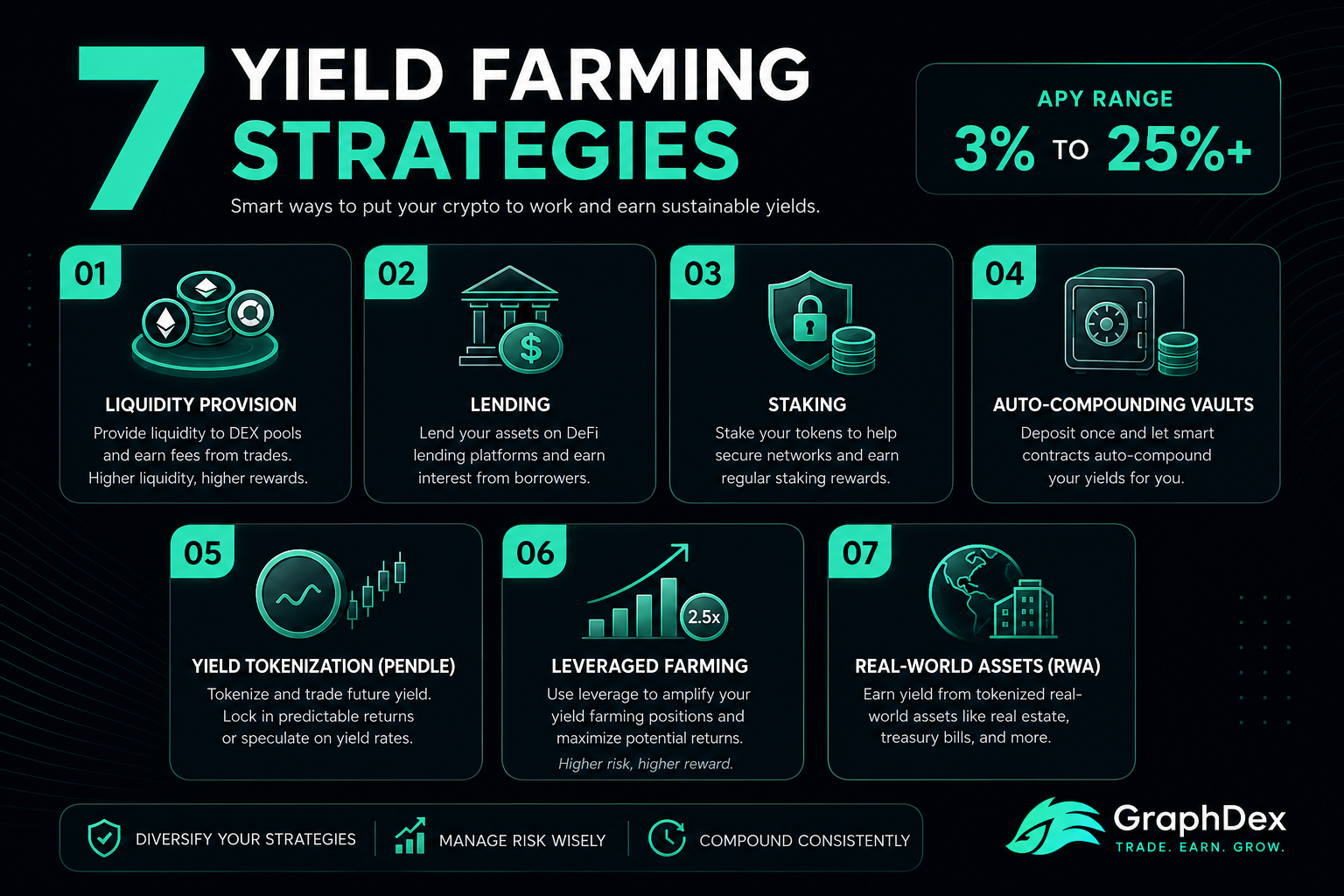
The Major Yield Farming Strategies
Yield farming has matured into several distinct approaches. Each has different risk-return profiles.
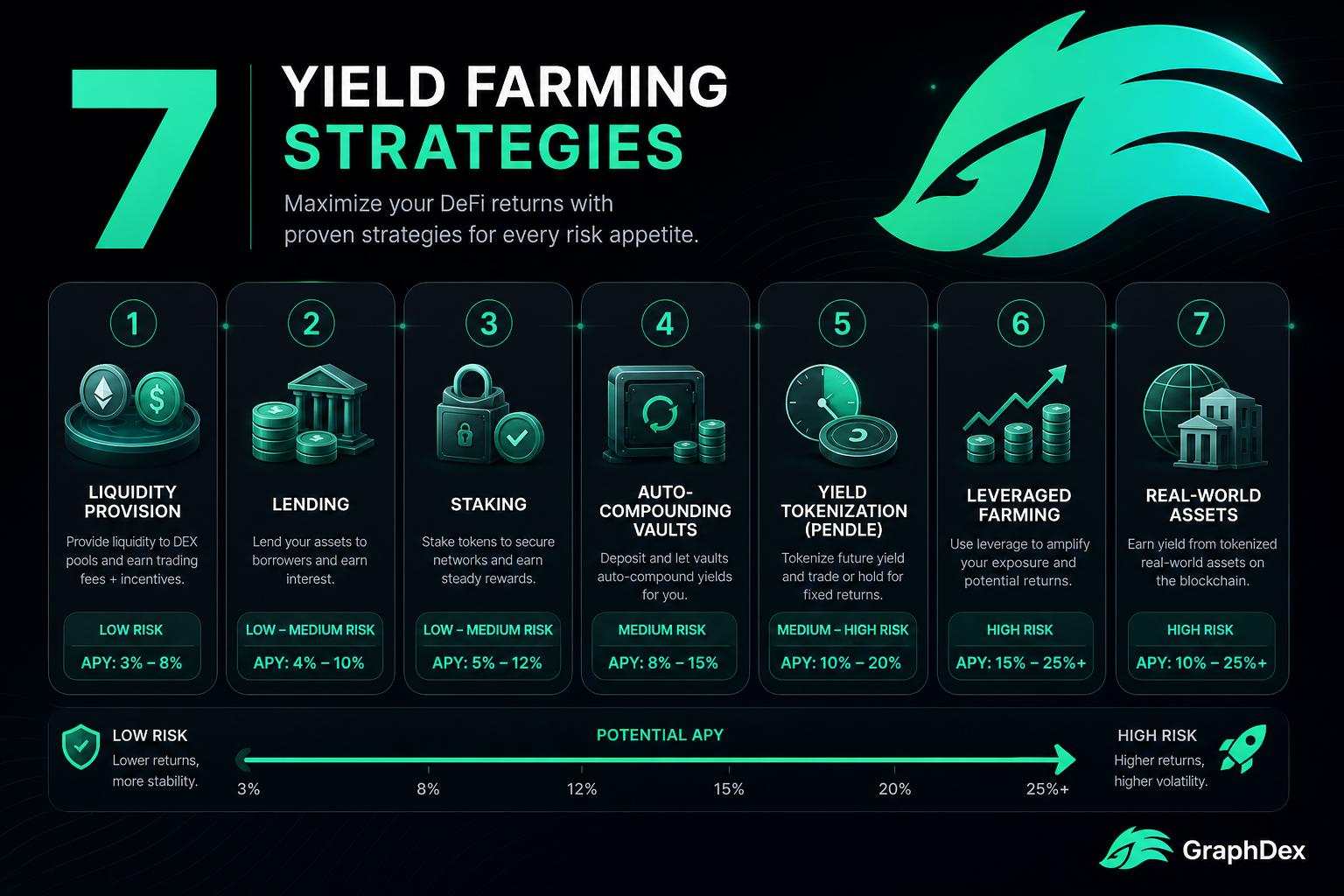
1. Liquidity Provision
Deposit token pairs (e.g., SOL/USDC, ETH/USDC) into a DEX liquidity pool and earn a share of trading fees from every swap that uses your pool. This is the foundational yield farming strategy.
- Returns: 5-25% APY on popular pairs, depending on trading volume
- Best for: Active DeFi users who understand impermanent loss
- Risks: Impermanent loss (when token prices diverge), smart contract risk
- Examples: Uniswap V3 (concentrated liquidity), Raydium, Orca, Curve
2. Lending
Supply assets to lending protocols where borrowers pay interest to use them. Lower risk than liquidity provision because no impermanent loss.
- Returns: 2-8% APY on stablecoins; sometimes higher on volatile assets
- Best for: Conservative yield seekers, especially with stablecoins
- Risks: Smart contract risk, protocol governance, occasional bad debt
- Examples: Aave, Compound, Kamino (Solana)
3. Staking
Stake tokens to secure a Proof-of-Stake network (like Solana, Ethereum) or earn protocol rewards. Liquid staking (Lido, Jito, Marinade) lets you keep liquidity via derivative tokens.
- Returns: 5-8% APY (network staking); higher on protocol-specific staking
- Best for: Long-term holders of stakeable tokens
- Risks: Slashing (validator misbehavior), token price risk
- Examples: Lido (ETH), Jito (SOL), Marinade (SOL)
4. Auto-Compounding Vaults
Vaults like Yearn Finance and Beefy automate yield strategies — moving your funds between protocols to optimize returns and automatically reinvesting rewards.
- Returns: Variable, often 5-20% on optimized strategies
- Best for: Users who want "set and forget" yield without active management
- Risks: Smart contract risk (vault + underlying protocols), strategy complexity
- Examples: Yearn Finance, Beefy
5. Yield Tokenization
Newer protocols like Pendle let you separate the principal from the yield, trading them independently. Allows fixed-income-like strategies in DeFi.
- Returns: 8-25% on creative strategies
- Best for: Sophisticated users who want structured returns
- Risks: Complexity, smart contract risk
- Examples: Pendle
6. Leveraged Farming (Advanced)
Borrow funds to increase your yield farming position — potentially 2-6x. Returns multiply, but so do risks (especially liquidation).
- Returns: Variable, potentially much higher
- Best for: Experienced traders only
- Risks: Liquidation risk on collateral drops, amplified smart contract exposure
- Warning: Liquidation can wipe out positions quickly
7. Real-World Assets (RWA)
Some protocols now offer yield at 5-8% APY on tokenized US Treasuries and other real-world assets. A bridge between TradFi and DeFi.
- Returns: 5-8% APY (T-bill equivalent)
- Best for: Conservative users wanting TradFi-comparable yields onchain
- Risks: Legal/custodial structure, smart contract risk
Realistic Yield Expectations in 2026
The "100% APY" era is over. Here's what to actually expect across strategies:
| Strategy | Realistic APY | Risk Level |
|---|---|---|
| Stablecoin lending (Aave, Kamino) | 2-8% | Low-moderate |
| Tokenized Treasuries (RWA) | 5-8% | Low |
| Liquid staking (SOL/ETH) | 5-8% | Low-moderate |
| Stablecoin liquidity (Curve) | 3-5% | Low (low IL) |
| Concentrated liquidity (Uniswap V3) | 8-25% | Moderate (IL risk) |
| Yield tokenization (Pendle) | 8-25% | Moderate |
| Auto-compounding vaults | 5-20% | Varies |
| Fee-based platform yield | Up to 17% (on competitive platforms) | Moderate |
| Leveraged farming | Variable, 20-100%+ | High |
| Memecoin/new protocol farms | "1000% APY" claims | Extreme |
The pattern: legitimate, sustainable yields cluster in the 3-15% range. Anything dramatically higher either carries significant additional risk, depends on emissions of a token that will eventually decline in price, or is fundamentally extractive (a clever way to drain new participants).
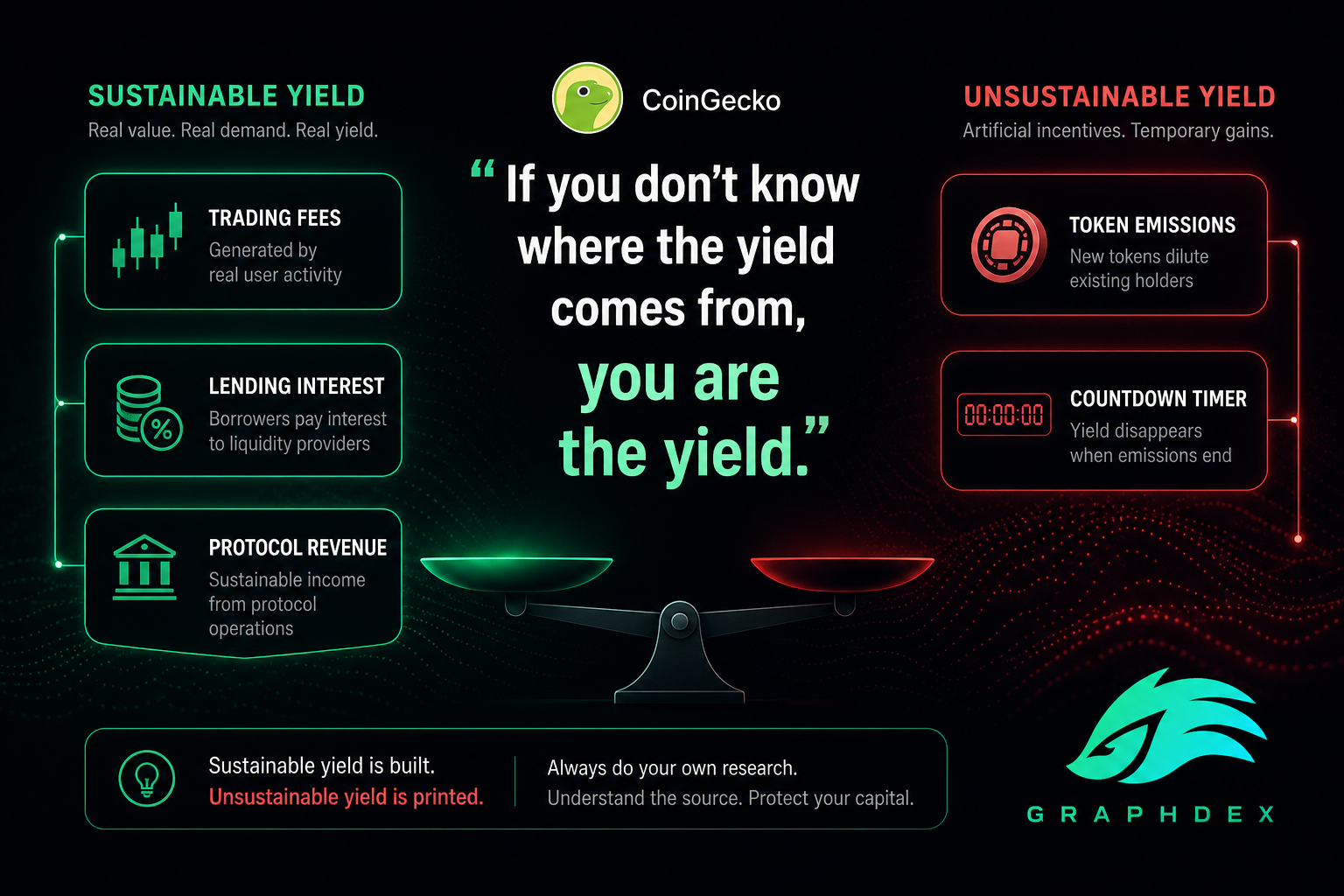
The Critical Question: Where Does the Yield Actually Come From?
CoinGecko summarized the most important question in yield farming: "If you don't know where the yield comes from, you are the yield."
Real, sustainable yield comes from genuine economic activity:
- Trading fees that traders pay to swap tokens (real revenue, scales with volume)
- Borrowing interest that real borrowers pay to use leverage (real revenue, demand-driven)
- Protocol fees that the platform earns from its services (real revenue)
- Network staking rewards that secure Proof-of-Stake networks (real economic role)
Unsustainable yield often comes from token emissions:
- Native token rewards printed from thin air to attract liquidity
- High APYs that exist only because the token's price hasn't crashed yet
- Pyramid-style mechanics where new entrants fund payouts to earlier participants
When a pool pays you in a token that was printed yesterday with no real revenue behind it, that yield is a countdown timer. The token dumps, and your "100% APY" becomes a 50% loss.
The 2026 lesson: prioritize protocols where yield is generated from real economic activity. Check protocol revenue (DefiLlama tracks this), trading volume, and borrower demand. If the yield depends entirely on token emissions, you're not earning yield — you're being paid in tokens someone else will eventually have to buy.
The Risks of Yield Farming
Yield farming has cost real money. Understanding the risks is essential.
Impermanent loss. The #1 risk for liquidity providers. When the prices of pooled tokens diverge, the AMM rebalancing leaves you with less value than if you'd held the tokens. Volatile pairs have higher IL; stablecoin pairs have minimal IL.
Smart contract bugs. Any DeFi protocol you use could be exploited. Established, audited protocols reduce but don't eliminate risk. Major hacks have drained hundreds of millions across DeFi history.
Rug pulls. New protocols can be malicious — developers drain funds, exit liquidity, or have hidden backdoors. Stick to established protocols with audit history and significant TVL.
Token reward volatility. Yields paid in native tokens depend on those tokens holding value. A protocol paying 50% APY in its native token might net you 0% (or losses) if the token price drops 70%.
Leverage liquidation. Leveraged farming positions can be liquidated quickly when collateral drops. Markets move fast; liquidation can happen mid-sleep.
Cross-protocol risk. Stacked strategies (one protocol's tokens deposited in another, then leveraged...) inherit the risks of every layer. A bug anywhere in the stack can cascade.
Regulatory risk. DeFi regulation continues evolving. Some yield strategies may face new restrictions in specific jurisdictions.
Tax complexity. Yield farming creates many taxable events (rewards received, swaps, liquidations). Keep records and consult a tax professional.
Gas fees. Active strategies require frequent transactions. On Ethereum mainnet, gas can eat returns; on Solana, fees are negligible.
The honest takeaway: yield farming can pay more than any savings account, but requires evaluating risks carefully. Diversify, use established protocols, never invest more than you can afford to lose, and prioritize understanding over chasing the highest APY.
Yield Farming on Solana vs Ethereum
Different chains offer different yield farming experiences.
Solana advantages for yield farming:
- Near-zero fees mean frequent harvesting, compounding, and rebalancing don't erode returns
- Fast finality enables responsive strategies
- Active DEX ecosystem (Raydium, Orca, Meteora, Kamino) with diverse pools
- Lower entry costs make small capital viable for active strategies
Ethereum advantages for yield farming:
- Largest DeFi ecosystem with deepest liquidity
- Most mature protocols (Aave, Curve, Uniswap V3) with longest audit history
- Largest range of structured products and complex strategies
- Higher absolute yields possible on niche/sophisticated strategies
For active yield farmers in 2026, many use both: Ethereum (or L2s) for blue-chip protocols and large positions, Solana for active management and lower-cost strategies. Solana's economics make some strategies viable that simply aren't on Ethereum L1 due to gas costs.
Explore Solana yield strategies on GraphDex
How GraphDex Approaches Yield
GraphDex offers yield up to 17% APY on stablecoins and SOL — but with a specific architecture worth understanding.
Fee-based, not emissions-based. GraphDex's yield comes from platform trading fees (real revenue from actual trading activity), not from printing native tokens. This addresses the "where does the yield come from?" question with a sustainable answer: it comes from fees paid by traders using the platform.
Non-custodial via Privy. Your funds stay in your non-custodial wallet — no seed phrase, no centralized custodian. You earn yield while maintaining self-custody.
Integrated with broader activity. Yield-earning coexists with DEX trading, prediction markets, the Pulse feed, and Bubble Maps. Capital earns between trades rather than sitting idle.
This is fundamentally different from emission-based farms that pay you in newly printed tokens. The yield isn't subsidized by token printing that will eventually need a buyer — it comes from real trading volume on the platform. For users prioritizing sustainable yield without surrendering custody, this structure is among the most competitive in 2026 DeFi.
Earn fee-based yield up to 17% APY on GraphDex
Frequently Asked Questions
What is yield farming in simple terms? Yield farming is depositing crypto into DeFi protocols to earn returns — like a savings account but on the blockchain. You provide liquidity to a DEX, lend tokens, or stake assets, and earn fees, interest, or token rewards in return. Realistic 2026 yields are 3-30% depending on strategy and risk.
Is yield farming still profitable in 2026? Yes, but differently from 2020. The "DeFi Summer" 1000%+ APYs were unsustainable token emissions. In 2026, sustainable yields cluster at 3-15% with real revenue backing them. Some sophisticated strategies (yield tokenization, concentrated liquidity) reach 8-25%. Profitability depends on choosing strategies whose yield comes from real economic activity, not emissions.
What's the safest yield farming strategy? The lowest-risk options are stablecoin lending on major audited platforms (Aave, Kamino) at 2-8% APY and tokenized Treasury products at 5-8% APY. Stablecoin liquidity pools (Curve stablepools) avoid impermanent loss because pooled tokens don't diverge. These options can't match high-APY claims but are far more predictable.
What is impermanent loss? When you provide liquidity to a pool with two tokens, divergent price movements between them leave you with less value than if you'd just held the tokens. It's "impermanent" because it reverses if prices return to the original ratio — but it becomes permanent if you withdraw while diverged. Volatile pairs have higher impermanent loss; stablecoin pairs have minimal.
How is yield farming different from staking? Staking is a subset of yield farming — depositing tokens to secure a network (PoS staking) or earn protocol rewards. Yield farming is broader: liquidity provision, lending, staking, vaults, and various other strategies all count. All staking is yield farming, but not all yield farming is staking.
What does APY mean in yield farming? APY (Annual Percentage Yield) is the return you'd earn over a year if conditions held constant. It includes compounding effects. The catch: APY rarely stays constant. As more capital enters a pool, APY drops. If token rewards constitute the yield, declining token prices reduce real return. Always evaluate APY skeptically and look at historical sustainability.
Where does the yield in DeFi actually come from? Sustainable yields come from real activity: trading fees on DEXs, borrowing interest from lending protocols, protocol revenue from services, or network staking rewards securing PoS chains. Unsustainable yields come from token emissions printed to attract liquidity — these create the highest APY claims but typically erode quickly. As CoinGecko notes: "If you don't know where the yield comes from, you are the yield."
About This Guide
This guide is published by the GraphDex Research team — analysts and traders building the infrastructure for digital asset trading on Solana. Our content is based on live DeFi data, current yield protocols, and hands-on experience.
Sources & data: Yield figures and protocol details reflect publicly available information as of 2026 and change continuously. Yield farming carries significant risks including total loss. This guide is educational and not financial advice — always do your own research.
GraphDex is the infrastructure for digital asset trading — trade, predict, and earn in one place. Learn more at graphdex.io.
Last reviewed: May 2026 · GraphDex Research
The infrastructure for digital asset trading. Trade, predict, stake, repeat. graphdex.io