By GraphPay Research · Reviewed for accuracy May 2026
Quick Answer
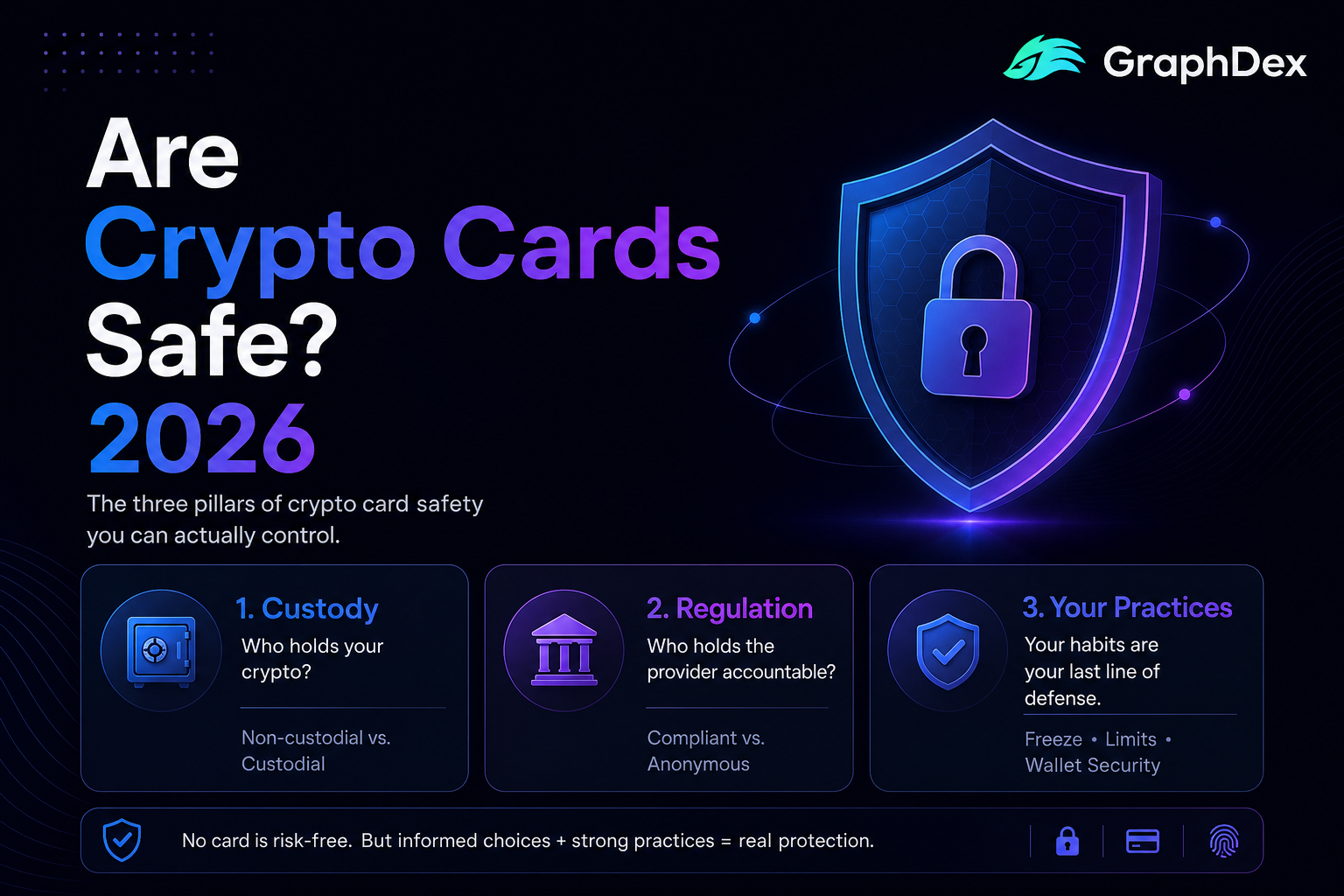
Crypto card safety depends on three main factors:
- Custody model: Non-custodial cards (funds in your wallet) are safer than custodial ones (issuer holds funds, adding solvency and hack risk)
- Regulatory standing: Regulated, compliant cards (tiered KYC, MiCA-aligned) are safer than unregulated "anonymous" cards, which have a history of sudden shutdowns and frozen funds
- Your practices: Using freeze controls, spending limits, dedicated funds, and strong wallet security
The safest profile: A non-custodial card (your crypto stays in your wallet) that's regulated and compliant (tiered KYC), on major networks (Visa/Mastercard), with security controls (freeze, limits).
The riskiest: Unregulated "anonymous" cards (documented shutdowns and frozen funds) and custodial cards where issuer failure means your loss.
The bottom line: Crypto cards can be very safe when you choose a non-custodial, regulated card and follow good security practices. They can be risky when you choose unregulated or custodial cards. Safety is largely in your control through the choices you make.
Get a safe, non-custodial GraphPay card
Key Takeaways
- Crypto card safety depends on custody model, regulatory standing, and your own practices.
- Non-custodial cards (funds in your wallet) are safer than custodial ones (issuer holds funds).
- Regulated, compliant cards are safer than unregulated "anonymous" cards, which often shut down suddenly.
- You control much of your safety through card choice and security practices.
Are Crypto Cards Safe? The Honest Answer
Crypto cards can be very safe or quite risky — the difference lies in the card you choose and how you use it. There's no single answer because "crypto card" spans everything from regulated, non-custodial cards to unregulated, anonymous schemes with a history of collapse.
The factors that determine safety:
- Custody model — Do your funds stay in your wallet (non-custodial, safer) or with the issuer (custodial, riskier)?
- Regulatory standing — Is the card regulated and compliant (safer) or an unregulated grey-area scheme (riskier)?
- Network — Is it on major networks (Visa/Mastercard, which require AML standards) or something obscure?
- Your practices — Do you use security controls, dedicated funds, and good wallet hygiene?
The reassuring reality: Much of crypto card safety is within your control. By choosing a non-custodial, regulated card on major networks and following good practices, you can achieve a strong security profile. The risks largely come from poor choices (unregulated or custodial cards) rather than crypto cards being inherently unsafe.
The honest caution: Not all crypto cards are safe. Unregulated "anonymous" cards have a documented history of sudden shutdowns, frozen funds, and disappearing operators. The key is distinguishing safe cards from risky ones — which this guide explains.
Factor 1: Custody — The Biggest Safety Factor
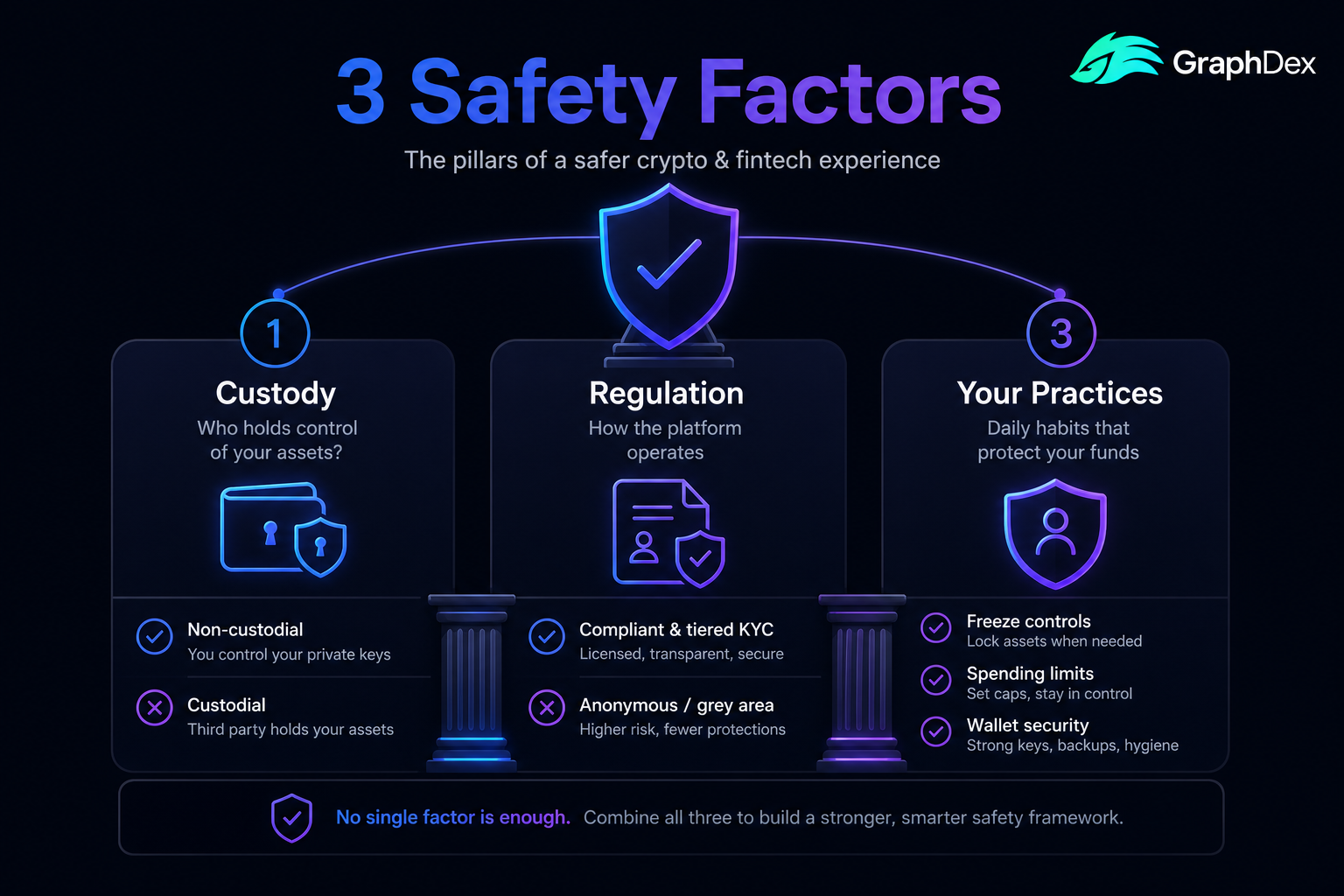
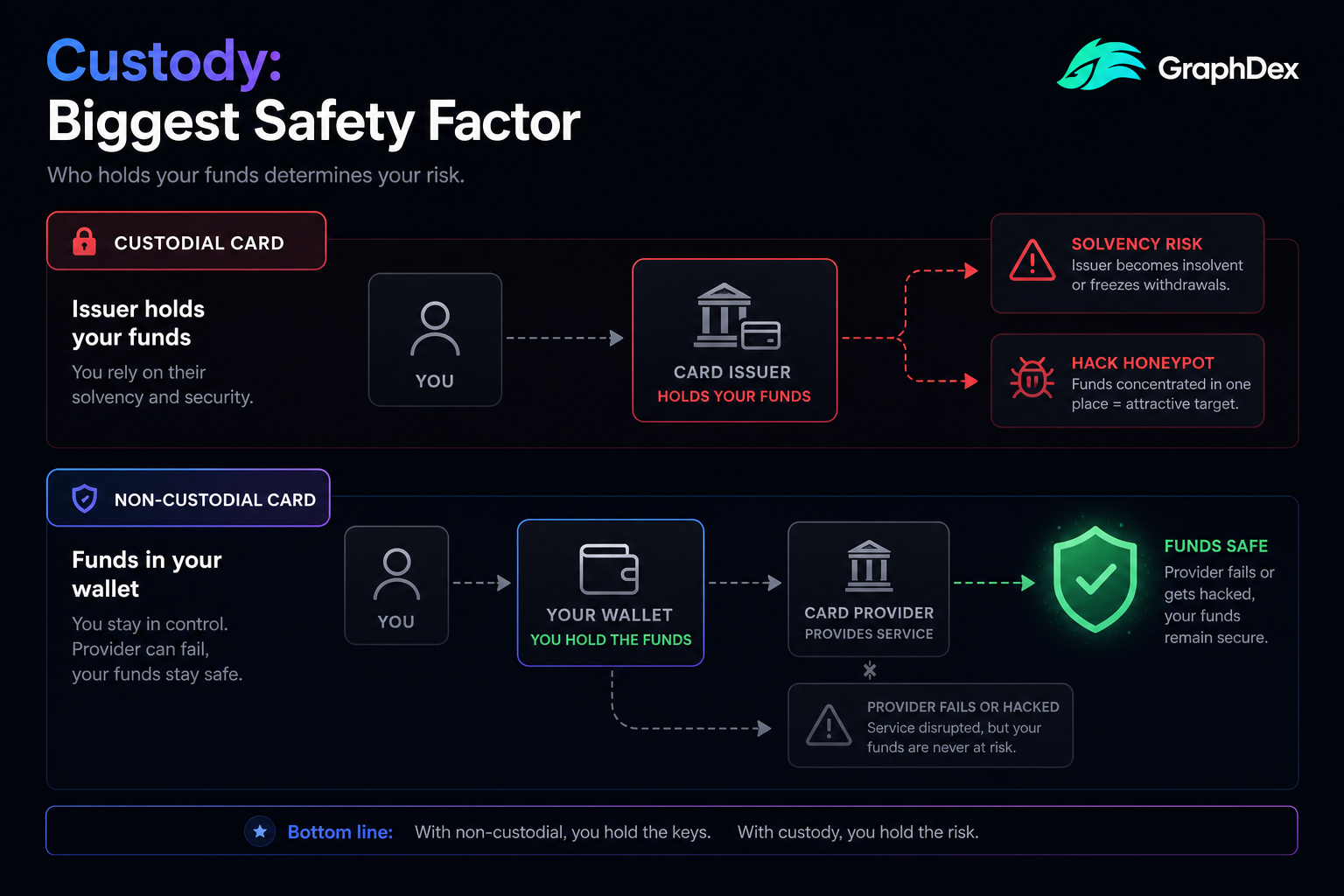
The single most important safety consideration: who holds your funds.
Custodial Cards (Riskier)
The issuer holds your crypto. This creates two risks:
- Solvency risk: If the issuer fails, goes bankrupt, or freezes accounts, your funds may be inaccessible or lost. The crypto industry has a documented history of custodial platforms failing.
- Security risk: Custodial platforms pool many users' funds, making them concentrated, high-value targets for hackers. A single breach can affect thousands.
Non-Custodial Cards (Safer)
Your crypto stays in your own wallet; the card converts only when you spend. This means:
- No issuer solvency risk: If the card provider has problems, your funds are in your wallet, unaffected
- No central honeypot: There's no pool of user funds for hackers to target
- You control your funds: Your assets stay under your control at all times
Why custody is the biggest factor: With a non-custodial card, even if the provider fails or is hacked, your funds are safe — they were never in the provider's custody. This single design choice eliminates the entire class of risk that has caused the most crypto card (and crypto platform) losses.
The takeaway: For safety, choose non-custodial cards where your funds stay in your wallet. This is the most impactful safety decision you can make.
Factor 2: Regulation — Avoiding the Grey Area
The second major safety factor: regulatory standing.
Regulated, Compliant Cards (Safer)
Cards that operate within regulatory frameworks (tiered KYC, MiCA-aligned, on Visa/Mastercard) offer:
- Accountability: They've met regulatory standards and can be held accountable
- Sustainability: Built to operate long-term within the rules
- Consumer protections: Regulatory frameworks include user safeguards
- Network backing: Visa/Mastercard require AML compliance, adding a layer of standards
Unregulated "Anonymous" Cards (Riskier)
Cards marketed as fully anonymous or KYC-free operate in a grey area with serious risks:
- Sudden shutdowns: A documented history of disappearing without warning
- Frozen funds: Users' funds locked or lost when operators vanish
- No recourse: No regulatory protection or accountability
- Compliance crackdowns: Increasingly targeted by regulators (especially with MiCA mandatory by July 1, 2026)
Why regulation matters for safety: Regulated cards are built to last and accountable to standards. Unregulated anonymous cards have repeatedly harmed users through shutdowns and frozen funds. The tiered KYC model (Level 1/2/3) of compliant cards isn't a downside — it's part of a sustainable, safer framework.
The takeaway: Choose regulated, compliant cards with tiered KYC. Avoid unregulated "anonymous" cards despite their marketing appeal — the risks (shutdowns, frozen funds) far outweigh any perceived privacy benefit.
Factor 3: Your Own Security Practices
The third factor — within your direct control.
Best practices for crypto card safety:
Use a dedicated wallet/funds. For non-custodial cards, consider using a wallet funded with spending money rather than your entire holdings. This limits exposure if anything goes wrong.
Enable freeze/unfreeze controls. The best cards let you instantly freeze a lost or compromised card. Know how to do this.
Set spending limits. Limit per-transaction, daily, or monthly amounts to cap potential exposure.
Protect your wallet. For non-custodial cards, your wallet security is paramount — secure your keys/recovery, use strong authentication, and never share credentials.
Watch for phishing. Never share private keys, seed phrases, or card details in response to unsolicited requests. No legitimate provider asks for these.
Use virtual cards for online. Virtual cards limit exposure for online purchases, and some can be frozen or regenerated easily.
Monitor transactions. Regularly review your card activity to catch any unauthorized use quickly.
Keep a backup. Have a backup payment method, especially when traveling.
The takeaway: Even with a safe card, your practices matter. Good security hygiene — dedicated funds, freeze controls, limits, wallet protection, and phishing awareness — significantly strengthens your safety.
Crypto Card Safety Checklist
| Safety Factor | Safer Choice | Riskier Choice |
|---|---|---|
| Custody | Non-custodial (your wallet) | Custodial (issuer holds) |
| Regulation | Regulated, tiered KYC | Unregulated "anonymous" |
| Network | Visa/Mastercard | Obscure/unclear |
| Transparency | Clear fees & terms | Hidden/unclear |
| Security controls | Freeze, limits, virtual cards | None |
| Your practices | Dedicated funds, wallet security | Main holdings, poor hygiene |
The safest profile combines every "safer choice" column entry.
Red Flags to Avoid
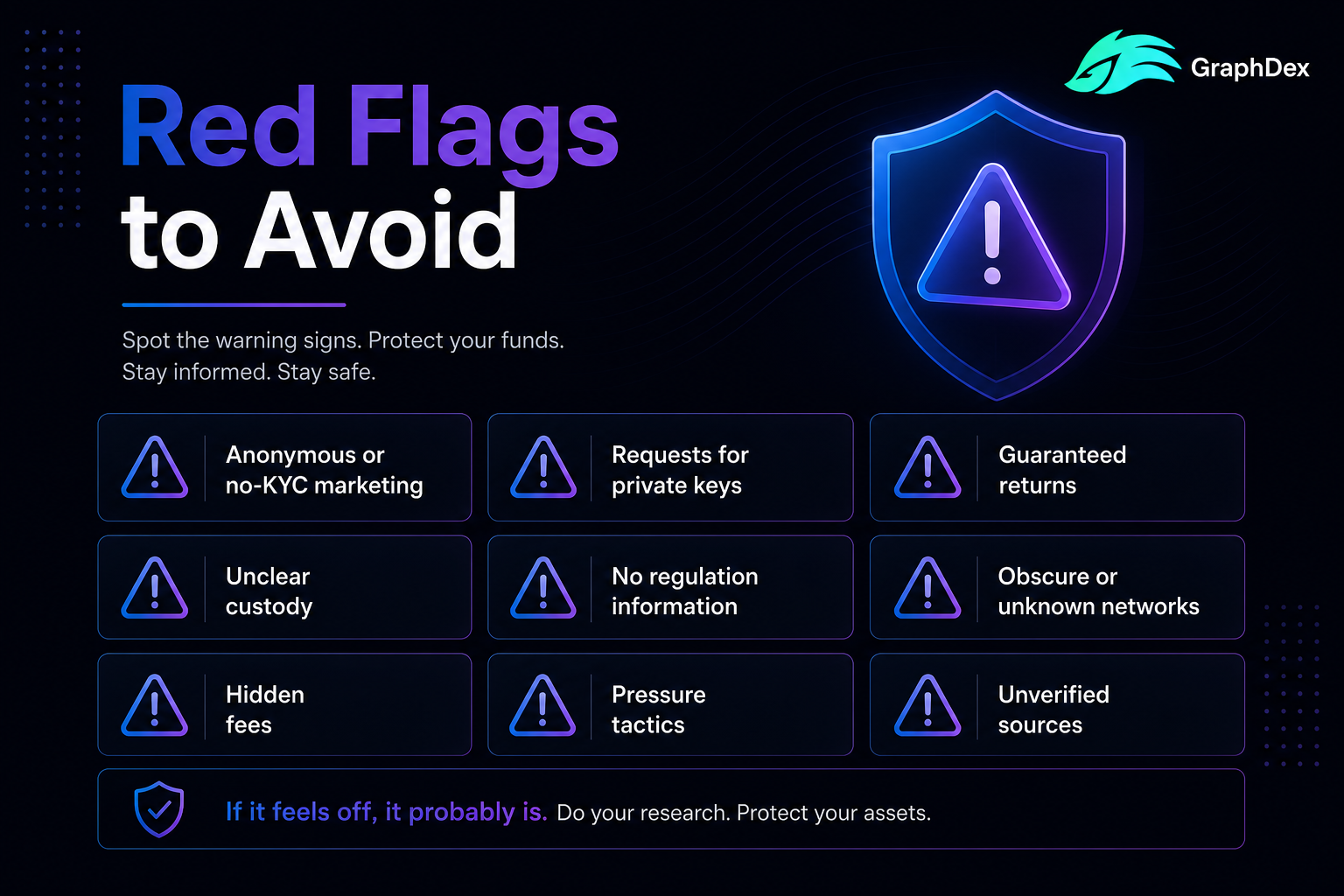
Warning signs of an unsafe crypto card:
"Anonymous" or "no-KYC" marketing. These operate in a grey area with a history of shutdowns and frozen funds. Legitimate, sustainable cards use tiered KYC.
Requests for private keys or seed phrases. No legitimate card needs these. Any request is a scam.
Guaranteed high returns or rewards. Unrealistic promises signal a scam or unsustainable model.
Unclear custody. If you can't determine whether funds are custodial or non-custodial, assume custodial and proceed cautiously — or avoid.
No regulatory information. Legitimate cards are transparent about their compliance and standing.
Obscure networks. Cards not on Visa/Mastercard may lack the AML standards these networks require.
Hidden fees and terms. Opacity about fees (especially the exchange-rate spread) signals a provider to be cautious about.
Pressure tactics. "Limited spots," urgency to deposit — classic scam signals.
No freeze/security controls. A card without basic security features is riskier.
Unverified sources. Only use official links from verified channels. Fake versions of cards and apps are common.
How to Choose a Safe Crypto Card
Putting it together — the safe-card selection process:
1. Prioritize non-custodial. Choose cards where your funds stay in your wallet. This is the biggest safety factor.
2. Verify regulation. Choose regulated, compliant cards with tiered KYC (Level 1/2/3), ideally MiCA-aligned.
3. Confirm major networks. Visa/Mastercard indicate AML compliance and broad acceptance.
4. Check transparency. Clear fees (including the exchange-rate spread), terms, and custody model.
5. Look for security controls. Freeze/unfreeze, spending limits, virtual cards.
6. Verify the source. Use only official links from verified channels.
7. Apply good practices. Dedicated funds, wallet security, phishing awareness, transaction monitoring.
The safest choice: A non-custodial, regulated card with tiered KYC on Visa/Mastercard, with transparent terms and security controls — used with good personal security practices. This combination achieves a strong safety profile.
Choose a non-custodial GraphPay card
How GraphPay Prioritizes Safety
GraphPay is built around the safety factors that matter most — non-custodial architecture, regulatory compliance, and security controls.
GraphPay's safety foundation:
- Non-custodial: Your crypto stays in your own wallet — the biggest safety factor. If anything happens to the provider, your funds are safe in your wallet, never in third-party custody.
- Regulated & compliant: Tiered KYC (Level 1/2/3), MiCA-aligned for the compliant, sustainable model — not an unregulated "anonymous" scheme.
- Major networks: Visa and Mastercard rails, meeting AML standards.
- Transparent: Clear pricing and terms, no hidden-spread tricks.
- Multi-chain: Load from BNB Chain, Ethereum, or TRON with USDT/USDC.
Why this is a safe profile: GraphPay combines every "safer choice" — non-custodial (funds in your wallet), regulated (tiered KYC, MiCA-aligned), major networks (Visa/Mastercard), and transparency. This addresses the biggest risks (custodial failure, regulatory grey areas) by design.
Your part: Even with a safe card, apply good practices — protect your wallet, use freeze controls and limits, watch for phishing, and use official sources. Together, GraphPay's safe design and your good practices create a strong security profile.
The safest crypto cards combine non-custodial architecture, regulatory compliance, and user security controls. That's what GraphPay is built on.
Get a safe, non-custodial GraphPay card
Related Guides
- Best Non-Custodial Crypto Cards in 2026: Keep Your Keys, Spend Anywhere
- MiCA & Crypto Cards in 2026: What Changes by July and What It Means for You
- How to Get a Crypto Card in 2026: Step-by-Step Guide by KYC Level
Frequently Asked Questions
Are crypto cards safe to use? They can be very safe or quite risky, depending on the card. Safe crypto cards are non-custodial (funds stay in your wallet), regulated (tiered KYC, MiCA-aligned), and on major networks (Visa/Mastercard). Risky ones are custodial (issuer holds funds, can fail) or unregulated "anonymous" cards (documented shutdowns and frozen funds). Much of the safety is in your control through card choice and practices.
What makes a crypto card safe? Three main factors: (1) Custody — non-custodial cards keep funds in your wallet, eliminating issuer failure risk; (2) Regulation — compliant, tiered-KYC cards are accountable and sustainable, unlike unregulated "anonymous" cards; (3) Your practices — freeze controls, spending limits, dedicated funds, and wallet security. The safest cards combine non-custodial architecture, regulation, and major networks.
Are non-custodial crypto cards safer than custodial ones? Yes, generally. With non-custodial cards, your crypto stays in your own wallet — if the provider fails or is hacked, your funds are safe (they were never in custody). Custodial cards hold your funds, adding solvency risk (issuer failure) and security risk (concentrated hacker target). Custody is the single biggest safety factor, and non-custodial is the safer choice.
Are "anonymous" or no-KYC crypto cards safe? No — these carry serious risks. Unregulated "anonymous" cards have a documented history of sudden shutdowns, frozen funds, and disappearing operators, with no regulatory recourse. They're increasingly targeted by regulators (especially with MiCA mandatory by July 1, 2026). Regulated cards with tiered KYC (Level 1/2/3) are far safer and more sustainable. Avoid anonymous cards despite their marketing appeal.
Can I lose my money with a crypto card? Yes, in certain situations: using custodial cards where the issuer fails, using unregulated "anonymous" cards that shut down, falling for phishing (sharing keys/details), or poor wallet security (non-custodial cards). You minimize these risks by choosing non-custodial, regulated cards, protecting your wallet, using security controls, watching for phishing, and using official sources only.
How do I keep my crypto card safe? Best practices: choose a non-custodial, regulated card; use a dedicated wallet/funds (not your entire holdings); enable freeze/unfreeze controls; set spending limits; protect your wallet keys; never share private keys, seed phrases, or card details; watch for phishing; use virtual cards for online; monitor transactions; and use only official sources. Good practices significantly strengthen your safety.
Is my crypto safe if I lose my crypto card? With a non-custodial card, yes — your crypto stays in your wallet, not in the card itself. If you lose the card, freeze it immediately (the best cards offer instant freeze), and your crypto remains safe in your wallet. This is a key advantage of non-custodial cards: the physical card being lost doesn't mean losing funds, because the funds were never in the card.
About This Guide
This guide is published by the GraphPay Research team — building non-custodial crypto payment infrastructure. Our content is based on current card industry practices, security considerations, and 2026 market data.
Sources & data: Safety factors, risks, and practices reflect publicly available information as of 2026 and may change. Specific protections vary by provider and jurisdiction. This guide is educational and not financial or security advice — always verify a provider's safety, do your own research, and follow good security practices.
GraphPay is non-custodial crypto payment infrastructure — your crypto, your pay. Learn more at graphpay.io.
Last reviewed: May 2026 · GraphPay Research