By GraphDex Research · Reviewed for accuracy May 2026
Quick Answer
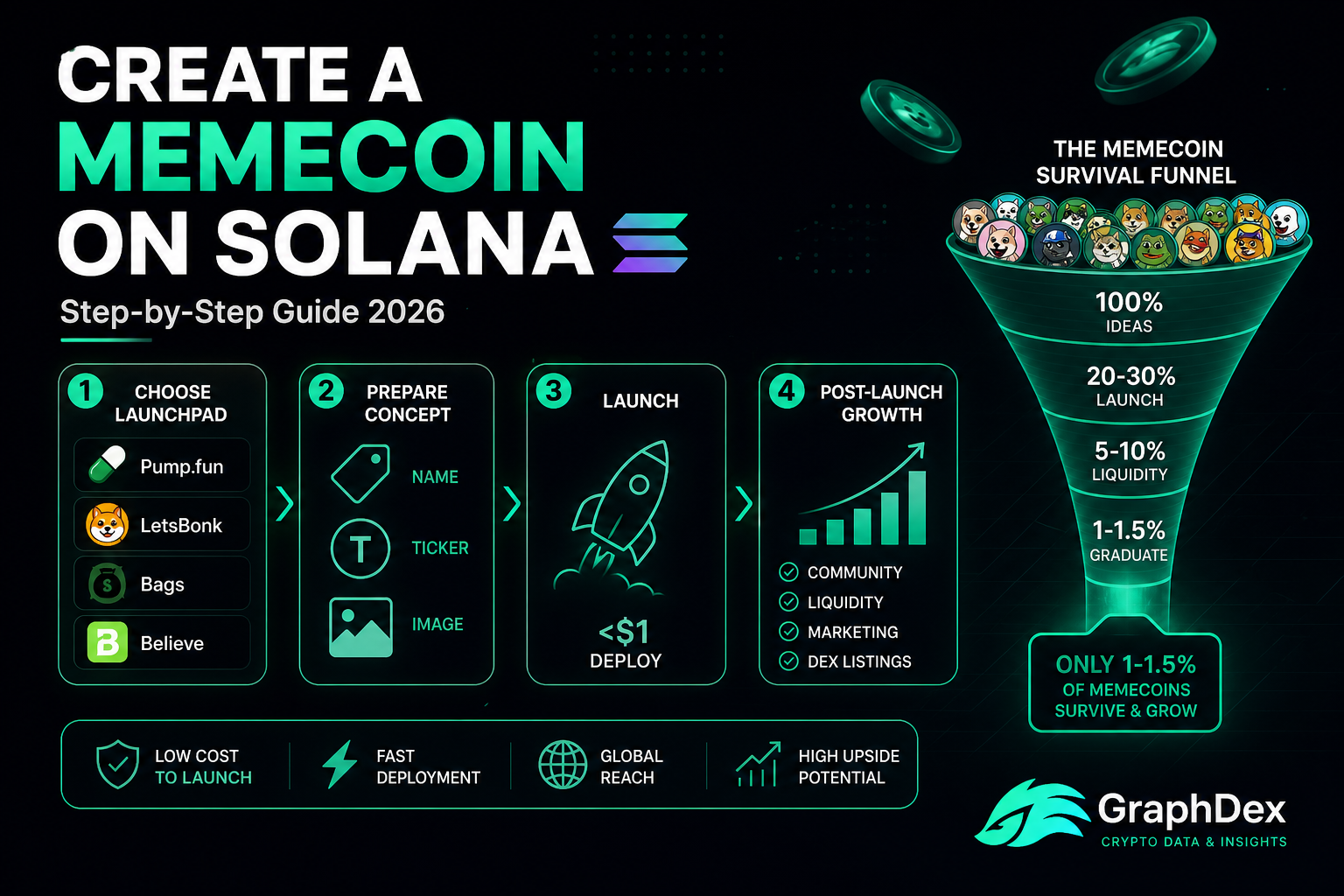
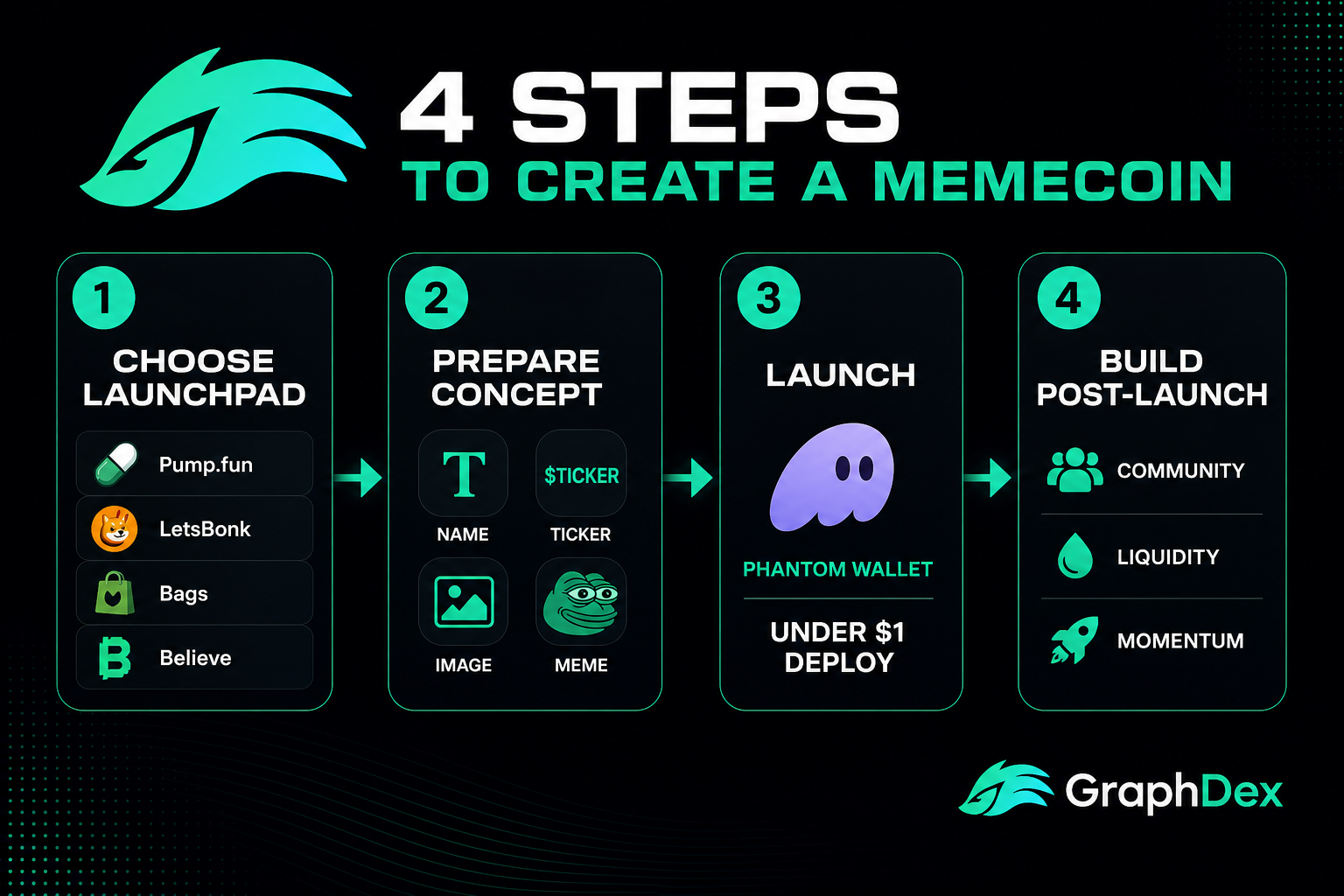
Creating a memecoin on Solana in 2026 takes four core steps:
- Choose a launchpad — Pump.fun (largest), LetsBonk/Bonk.fun (dev-friendly revenue), Bags (mobile, Apple Pay), Believe (SocialFi via X), or others
- Prepare your concept — name, ticker, image, and a meme concept with viral potential (this matters more than any technical detail)
- Launch — connect a Phantom or Solflare wallet with a small amount of SOL, fill in details, deploy (costs under $1)
- Build post-launch — community (Twitter/Telegram), liquidity, and momentum are what actually determine survival
The honest truth: Creating the token is trivial (under 10 minutes, under $1). Only ~1-1.5% of tokens graduate; the rest die within hours. Success is 5% technical creation and 95% community building, marketing, and momentum. Most projects fail not at creation but at survival.
Trade and track memecoins on GraphDex
Key Takeaways
- Creating a memecoin on Solana takes under 10 minutes and costs under $1 — the technical part is trivial.
- Choose a launchpad based on economics, audience, and features (Pump.fun, LetsBonk, Bags, Believe, others).
- Only ~1-1.5% of tokens graduate; success depends on community and momentum, not creation.
- The concept and post-launch community building matter far more than technical setup.
What Should You Know Before Creating a Memecoin?
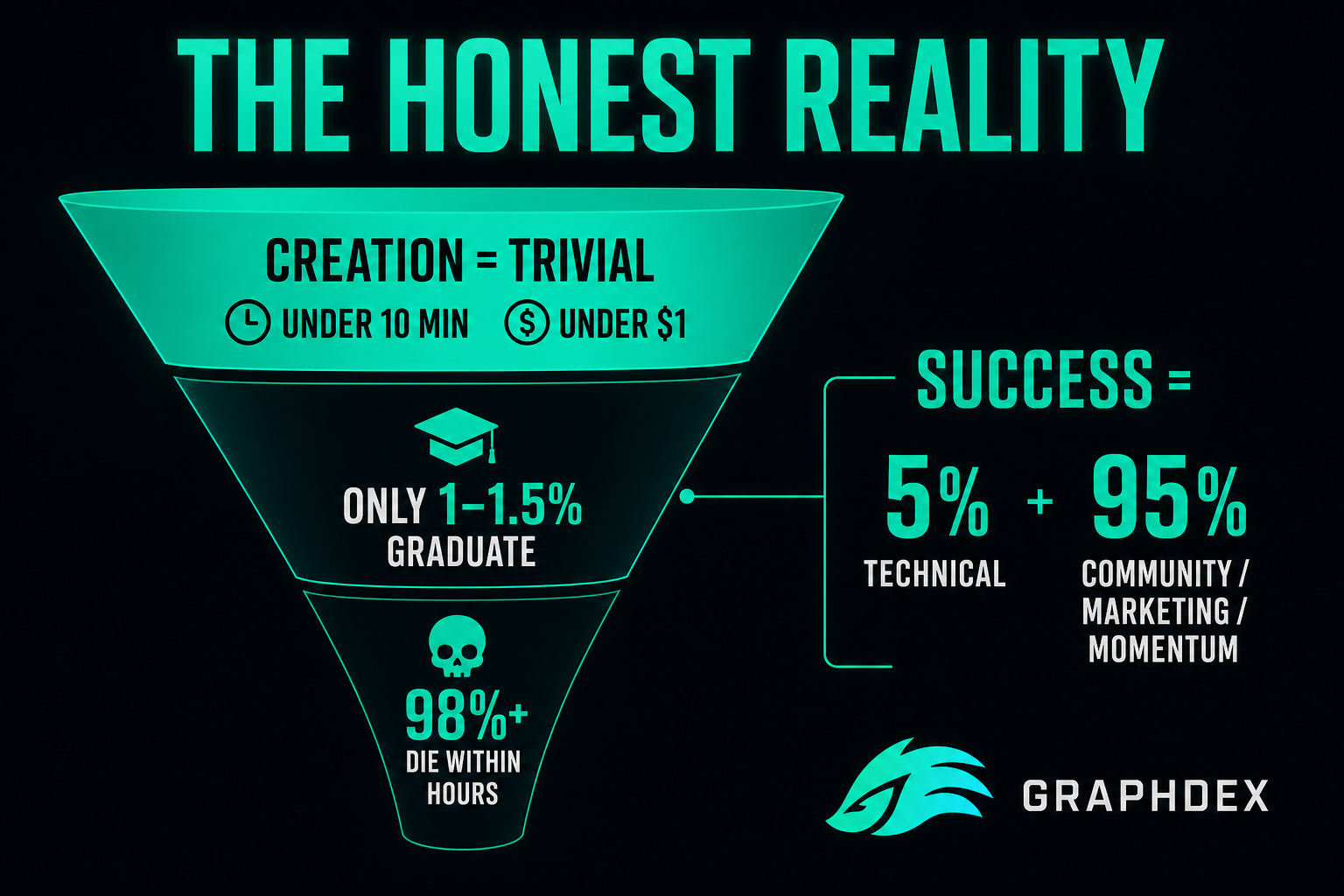
Before the how-to, an honest framing that most guides skip: creating a memecoin is easy; making it succeed is extremely hard.
The numbers:
- Tens of thousands of tokens launch daily across Solana launchpads
- Only about 1-1.5% ever "graduate" to a DEX
- The vast majority become worthless within hours
- Most launches are bots — top accounts launch a new token every few minutes
What this means:
- Creating a token is trivial (under 10 minutes, under $1)
- The technical setup is NOT where projects fail
- Success depends almost entirely on what happens after launch: community, marketing, momentum, and liquidity
- A great concept with strong community beats a technically perfect token with no audience
The realistic expectation: If you're creating a memecoin, understand that the odds of meaningful success are low, and success requires far more than launching. This guide covers the technical steps, but the honest emphasis is on the post-launch work that actually determines outcomes.
A note on ethics: Create memecoins responsibly. Rug pulls, honeypots, and deceptive launches harm people and are increasingly tracked and prosecuted. This guide is for legitimate token creation, not scams. Build something real, be transparent, and don't deceive buyers.
Step 1: Choose Your Launchpad
The launchpad you choose affects economics, audience, and features.
The main options in 2026:
Pump.fun — The largest and most established. Bonding-curve fair launches, deep ecosystem, DEXScreener dominance, Glass Full Foundation liquidity support. Best for reach and established infrastructure.
LetsBonk (Bonk.fun) — BONK community launchpad on Raydium rails. Dev-friendlier revenue sharing (higher creator fees), BONK buyback-and-burn. Best for creator economics and BONK community.
Bags — Mobile-first with Apple Pay deposits and creator royalties. Best for mobile-native creators and accessibility.
Believe — SocialFi: launch tokens by replying to X posts, no initial wallet setup. Best for social-driven, viral concepts.
LaunchLab (Raydium) — Customizable parameters (supply, distribution, vesting). Best for creators wanting control.
Jup Studio — Jupiter's launchpad with strong ecosystem integration. Best for Jupiter distribution.
How to choose:
- For maximum reach: Pump.fun (largest audience)
- For creator revenue: LetsBonk (dev-friendly economics)
- For mobile/accessibility: Bags (Apple Pay)
- For social virality: Believe (X-native launches)
- For control: LaunchLab (customizable)
Since launchpad leadership swings rapidly, consider where your target audience is and which economics suit you — but recognize the platform matters less than your concept and community.
Step 2: Prepare Your Concept
The single most important factor — more than any technical detail.
Why concept matters most: In 2026, with tens of thousands of tokens launching daily, what makes a token stand out is its concept — the meme, story, or narrative that makes people care and share. Technical perfection means nothing without a compelling concept.
Elements of a strong concept:
The meme/narrative. Winning themes in 2026 include animal memes (dogs, cats, frogs), celebrity parodies, current viral events, internet culture references, and AI-themed concepts. The concept should be instantly understandable and shareable.
The name and ticker. Memorable, on-theme, and ideally searchable. The ticker should be clean and relevant.
The image/branding. Visual identity matters enormously for memecoins. A strong, distinctive image drives shares and recognition.
The story. Why does this token exist? What's the narrative? Even memecoins benefit from a coherent story that gives the community something to rally around.
Timing and relevance. Concepts tied to current events, trends, or cultural moments can capture attention — but timing is everything.
The community angle. The best memecoins build communities around shared identity or cause. Consider what community your concept could galvanize.
The honest truth: A brilliant concept with viral potential and a rallying community beats a technically flawless token with no story. Spend more time on concept than on technical setup.
Step 3: Launch Your Token
The technical creation — the easy part.
What you need:
- A Phantom or Solflare wallet (install the browser extension or mobile app, back up your seed phrase securely)
- A small amount of SOL (at least 0.5-1 SOL to cover creation and an initial buy)
The launch process (using a launchpad):
- Connect your wallet to your chosen launchpad
- Fill in token details: name, ticker, description, image, and social links
- Set your initial buy amount (some creators buy a small amount to seed early activity)
- Deploy — your token is immediately tradeable on the bonding curve
Cost: Under $1 on most launchpads (versus $50-200+ in gas on Ethereum). Creating a token on a launchpad costs under 0.1 SOL (~$15 including a starter buy); the deployment itself is minimal.
For creators wanting full control (manual SPL token):
- Manual SPL token creation with Raydium liquidity requires more SOL (~0.8 SOL+)
- Configure authorities: consider revoking freeze authority (prevents freezing wallets) and mint authority (prevents minting new tokens) — these improve community trust
- More complex but offers full customization
Best practice for trust: Whether via launchpad or manual, revoking mint and freeze authorities signals to buyers that you can't rug them by minting or freezing. This builds trust — essential for legitimate projects.
Step 4: The Hard Part — Post-Launch Growth
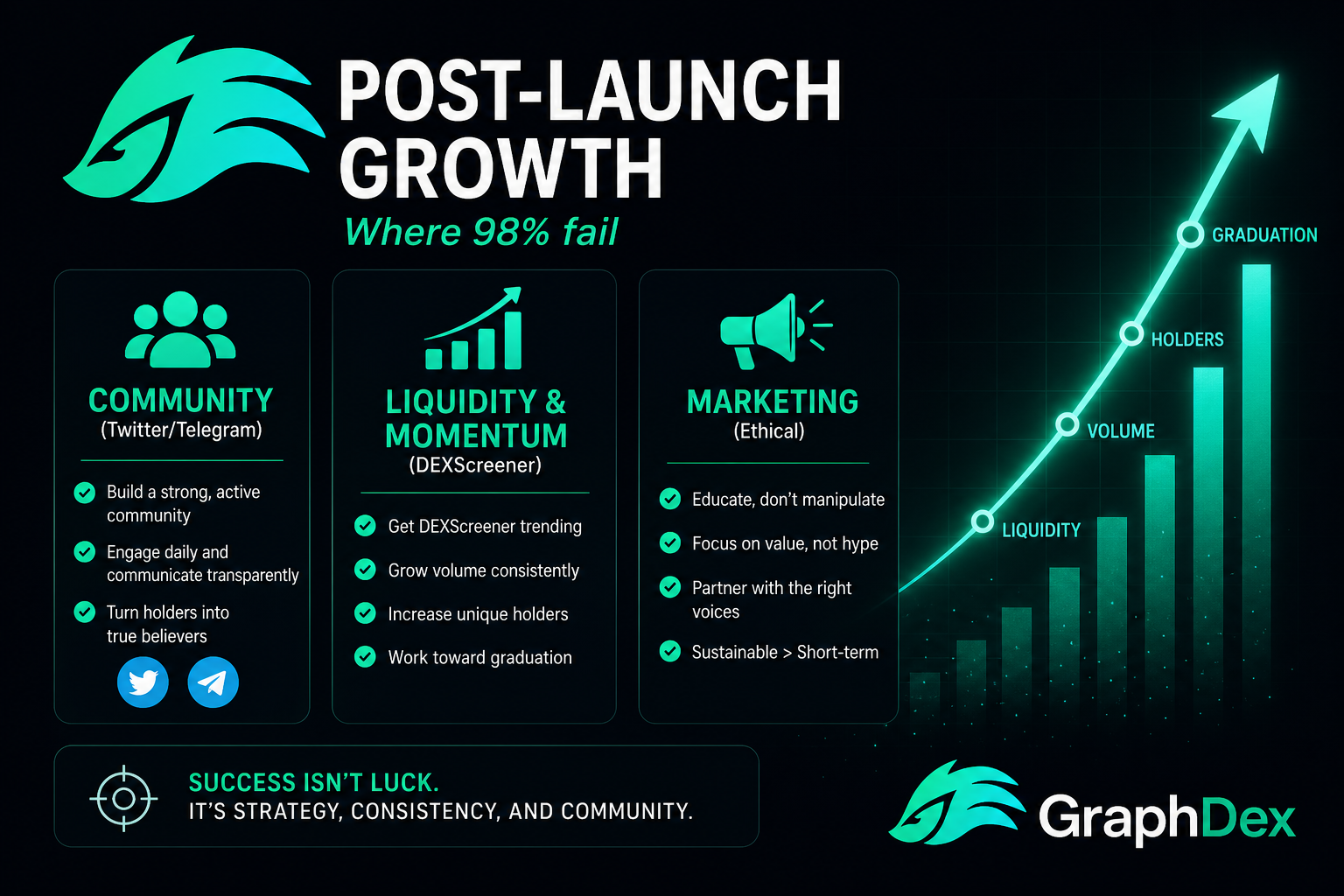
Where 98%+ of tokens fail. This is what actually determines success.
Community building:
- Twitter/X presence: Active, engaging account building narrative and community
- Telegram/Discord: A community hub where holders gather, discuss, and rally
- Consistent engagement: Memecoins live and die by community energy
- Authentic growth: Real community, not bots or manufactured hype
Liquidity and momentum:
- DEXScreener trending: Getting on trending drives discovery (requires volume and holder growth)
- Volume generation: Genuine trading activity attracts more traders
- Holder growth: Growing, distributed holders signal organic traction
- Graduation: Reaching the ~$69K threshold to graduate to a DEX is a key milestone
Marketing (ethically):
- Build genuine interest through the concept and community
- Engage authentically rather than relying on paid pumps
- Recognize that manufactured hype (paid influencers, coordinated pumps) often backfires and harms buyers
The success factors: The tokens that survive share traits: compelling concept, authentic and active community, genuine momentum, transparent creators, and often a cultural moment or narrative that gives people a reason to care. These are built post-launch, not at creation.
The failure mode: Most tokens die because creators think launching is the hard part. They deploy, then do nothing to build community or momentum. The token gets no traction and dies within hours. Creation without post-launch work is why 98%+ fail.
How Do Traders Interact With New Tokens?
Understanding how traders discover and evaluate your token helps you build for success.
How traders find new tokens:
- Real-time launchpad monitoring (Pulse feeds)
- Smart money tracking (following proven wallets)
- DEXScreener trending and new pairs
- Social signals (with skepticism)
How traders evaluate tokens (safety):
- Holder concentration (Bubble Maps) — they avoid tokens where top holders own too much
- Liquidity checks — they verify sufficient, ideally locked liquidity
- Contract safety — they check for malicious functions
- Volume authenticity — they distinguish genuine volume from wash trading
What this means for creators: Traders use safety tools to filter tokens. To attract legitimate traders, your token should pass these checks: distributed holders (not concentrated in your wallets), adequate liquidity, revoked authorities (mint/freeze), and genuine activity. Tokens that fail safety checks get filtered out by serious traders.
The transparency advantage: Building a token that passes safety analysis — distributed holders, locked liquidity, revoked authorities, transparent creators — attracts the serious traders who use tools like Bubble Maps. Deceptive tokens get flagged and avoided.
Track how tokens perform with GraphDex tools
How GraphDex Fits Into the Memecoin Ecosystem
While GraphDex is a trading terminal (not a launchpad), it's central to how the memecoin ecosystem works — for both traders and creators understanding their market.
For traders (your token's potential buyers):
- Pulse feed — discovers new launches across all launchpads
- Bubble Maps — analyzes holder concentration (creators should ensure they pass)
- MEV protection — protects traders' entries
- Multi-DEX routing — trades tokens from any launchpad
- Wallet/social tracking — follows smart money
Why creators should understand this: The traders you want to attract use tools like GraphDex to discover and vet tokens. Understanding what these tools check (holder distribution, liquidity, safety) helps you build a token that passes muster and attracts legitimate trading interest rather than getting filtered out.
For your own trading: If you trade memecoins (including studying successful launches to inform your own), GraphDex consolidates discovery, safety analysis, and execution across all launchpads — plus prediction-market copytrading, Solana DEX trading, and up to 17% APY staking on idle capital.
Explore the memecoin ecosystem on GraphDex
Common Memecoin Creation Mistakes
For balance, what causes memecoin projects to fail:
1. Thinking launch is the hard part. Creation is trivial; survival is everything. Most creators do nothing post-launch and fail.
2. Weak concept. A forgettable meme with no viral potential or community angle. Concept matters most.
3. No community building. No Twitter, no Telegram, no engagement. Memecoins live on community energy.
4. Not revoking authorities. Keeping mint/freeze authority signals rug risk to traders, who avoid it.
5. Concentrated holdings. Holding too much supply in your own wallets fails safety checks and signals rug risk.
6. Manufactured hype. Paid pumps and coordinated dumps backfire, harm buyers, and are increasingly tracked.
7. Deceptive practices. Rugs and honeypots harm people and are prosecuted. Build legitimately.
8. Ignoring how traders vet. Not understanding that traders use safety tools — building tokens that get filtered out.
Frequently Asked Questions
How do I create a memecoin on Solana? Four steps: (1) Choose a launchpad (Pump.fun, LetsBonk, Bags, Believe, or others); (2) Prepare your concept (name, ticker, image, meme narrative — this matters most); (3) Launch by connecting a Phantom or Solflare wallet with a small amount of SOL, filling in details, and deploying (under $1, under 10 minutes); (4) Build post-launch community, liquidity, and momentum — which actually determine success.
How much does it cost to create a memecoin on Solana? Under $1 for the deployment on most launchpads (versus $50-200+ in gas on Ethereum). Including a small starter buy, creating a token on a launchpad costs under 0.1 SOL (~$15). Manual SPL token creation with Raydium liquidity requires more (~0.8 SOL+). You'll want at least 0.5-1 SOL in your wallet to cover creation and initial activity.
How long does it take to create a memecoin? Under 10 minutes for the technical creation on a launchpad — connect wallet, fill in details, deploy. The token is immediately tradeable. However, this is the trivial part. Building the community, liquidity, and momentum that determine whether the token survives takes ongoing effort — and is where 98%+ of projects fail.
Which launchpad should I use to create a memecoin? Depends on your priorities: Pump.fun for maximum reach (largest audience), LetsBonk for creator revenue (dev-friendly economics), Bags for mobile/accessibility (Apple Pay), Believe for social virality (launch via X), LaunchLab for control (customizable). Since launchpad leadership swings rapidly, consider your audience and economics — but the platform matters less than your concept and community.
Do most memecoins succeed? No — only about 1-1.5% of tokens launched on Solana launchpads ever graduate to a DEX. The vast majority become worthless within hours. Success depends almost entirely on post-launch work: community building, marketing, momentum, and liquidity. Creating the token is trivial; making it survive is extremely hard. Have realistic expectations.
How do I make my memecoin successful? Focus on what actually matters: a compelling concept with viral potential, authentic and active community building (Twitter/Telegram), genuine momentum and liquidity, transparency (revoke mint/freeze authorities, distributed holdings), and passing the safety checks traders use. Success is 5% technical creation and 95% community, marketing, and momentum. Most projects fail by neglecting the post-launch work.
Should I revoke mint and freeze authority? Yes, for legitimate projects. Revoking mint authority (prevents you from minting new tokens) and freeze authority (prevents freezing wallets) signals to traders that you can't rug them these ways. This builds trust — essential since traders use safety tools to filter tokens. Tokens that retain these authorities are flagged as risky and avoided by serious traders.
About This Guide
This guide is published by the GraphDex Research team — analysts and traders building the infrastructure for digital asset trading on Solana. Our content is based on direct experience, onchain data, and 2026 market developments.
Sources & data: Creation costs, launchpad features, and graduation rates reflect publicly available information as of 2026 and may change. This guide is for legitimate token creation, not scams — rug pulls and deceptive launches harm people and are increasingly prosecuted. Creating and trading memecoins carries extreme risk. This guide is educational and not financial advice.
GraphDex is the infrastructure for digital asset trading — trade, predict, and earn in one place. Learn more at graphdex.io.
Last reviewed: May 2026 · GraphDex Research
The infrastructure for digital asset trading. Trade, predict, stake, repeat. graphdex.io