By GraphPay Research · Reviewed for accuracy May 2026
Quick Answer
The best crypto cards in 2026, organized by verification level:
Best for flexible tiers (Level 1 → 3):
- GraphPay — Non-custodial, tiered KYC (start at Level 1, upgrade to Level 3), multi-chain (BNB/Ethereum/TRON), Visa & Mastercard
Best at Level 1 (Simplified):
- GraphPay Level 1 — Virtual card, minimal verification, funds stay in your wallet
- RedotPay Tier 0 — Email-only entry on Visa rails
Best at Level 3 (Full KYC):
- GraphPay Level 3 — Physical card, highest limits, non-custodial
- Bleap — Non-custodial MPC, 0% FX, strong rewards
- Gnosis Pay — On-chain wallet identity, EU/UK focus
The honest truth: The best card isn't the one with the least KYC — it's the one that lets you start light (Level 1) and upgrade as needed (Level 3), while keeping your funds in your own wallet. Non-custodial tiered cards offer both flexibility and security.
Key Takeaways
- The best crypto card matches verification level to your needs — not the one with the least KYC.
- Level 1 cards suit testing and small payments; Level 3 unlocks physical cards and high limits.
- Non-custodial cards (GraphPay, Bleap, Gnosis Pay) keep your funds in your wallet at every level.
- A flexible card lets you start at Level 1 and upgrade to Level 3 as your usage grows.
How to Think About Crypto Cards in 2026
The crypto card landscape changed fundamentally by 2026. The "anonymous card" era is over — global regulations (FATF, MiCA, Visa/Mastercard requirements) made truly verification-free cards unsustainable. What replaced them is better: tiered verification, where you choose how much to verify based on what you need.
The key insight: Don't optimize for the least verification. Optimize for the best value at the verification level that fits your usage. A card that verifies you quickly and unlocks great features and limits beats a card that stays "light" but caps you at tiny limits with high fees.
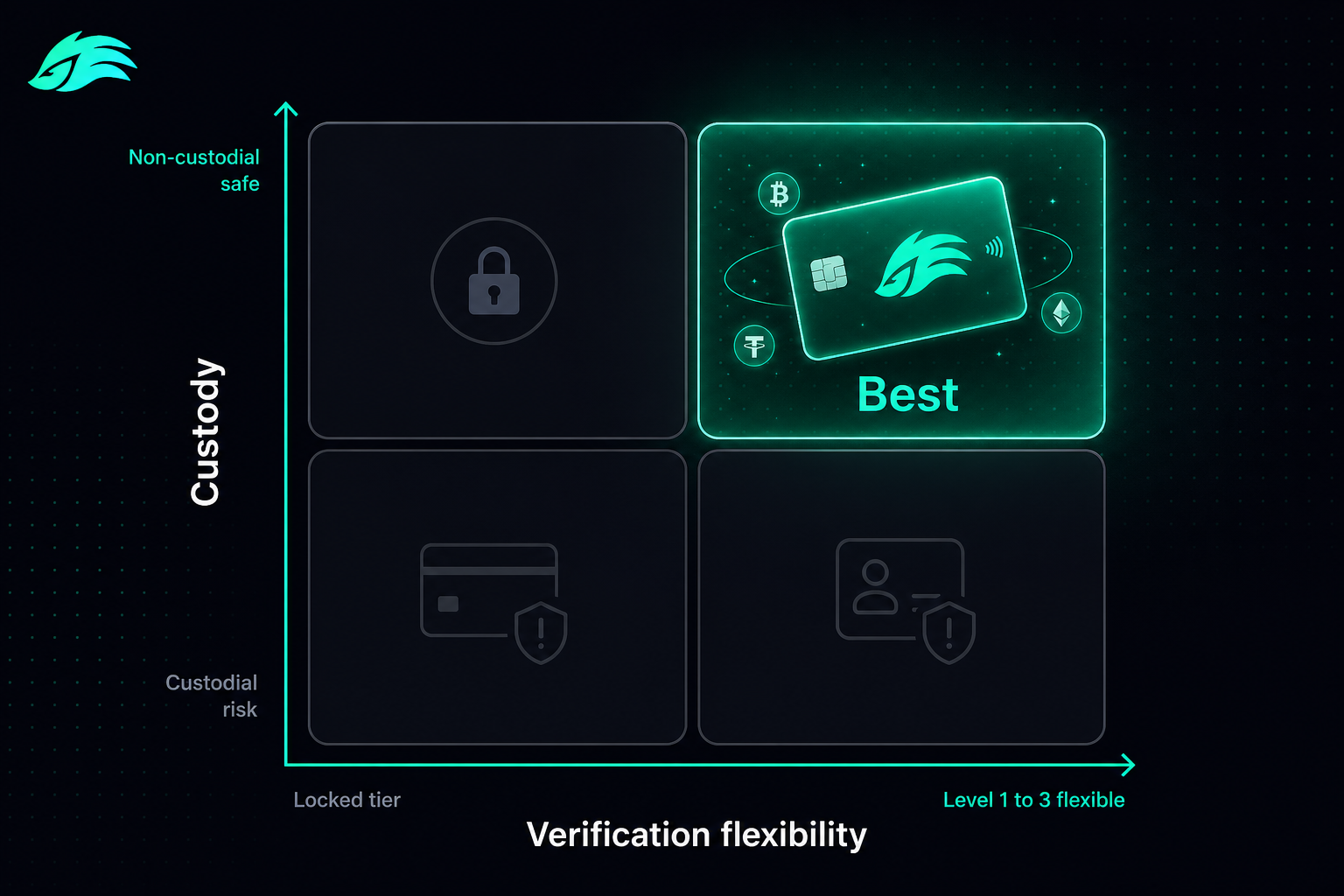
The two factors that matter most:
-
Verification flexibility — Can you start light (Level 1) and upgrade (Level 3) as needed? Or are you locked into one tier?
-
Custody model — Does the card hold your funds (custodial, adding risk), or do your funds stay in your wallet (non-custodial, safer)?
The best cards in 2026 score well on both: flexible tiers plus non-custodial architecture. This combination gives you fast initial access, room to grow, and the security of self-custody.
How we ranked these cards: We weigh verification flexibility, custody model (non-custodial preferred), fees, limits, global availability, and feature set across all three KYC levels — rather than ranking purely by "least KYC."
The Three Verification Levels Recap
Before the rankings, a quick recap of what each level means:
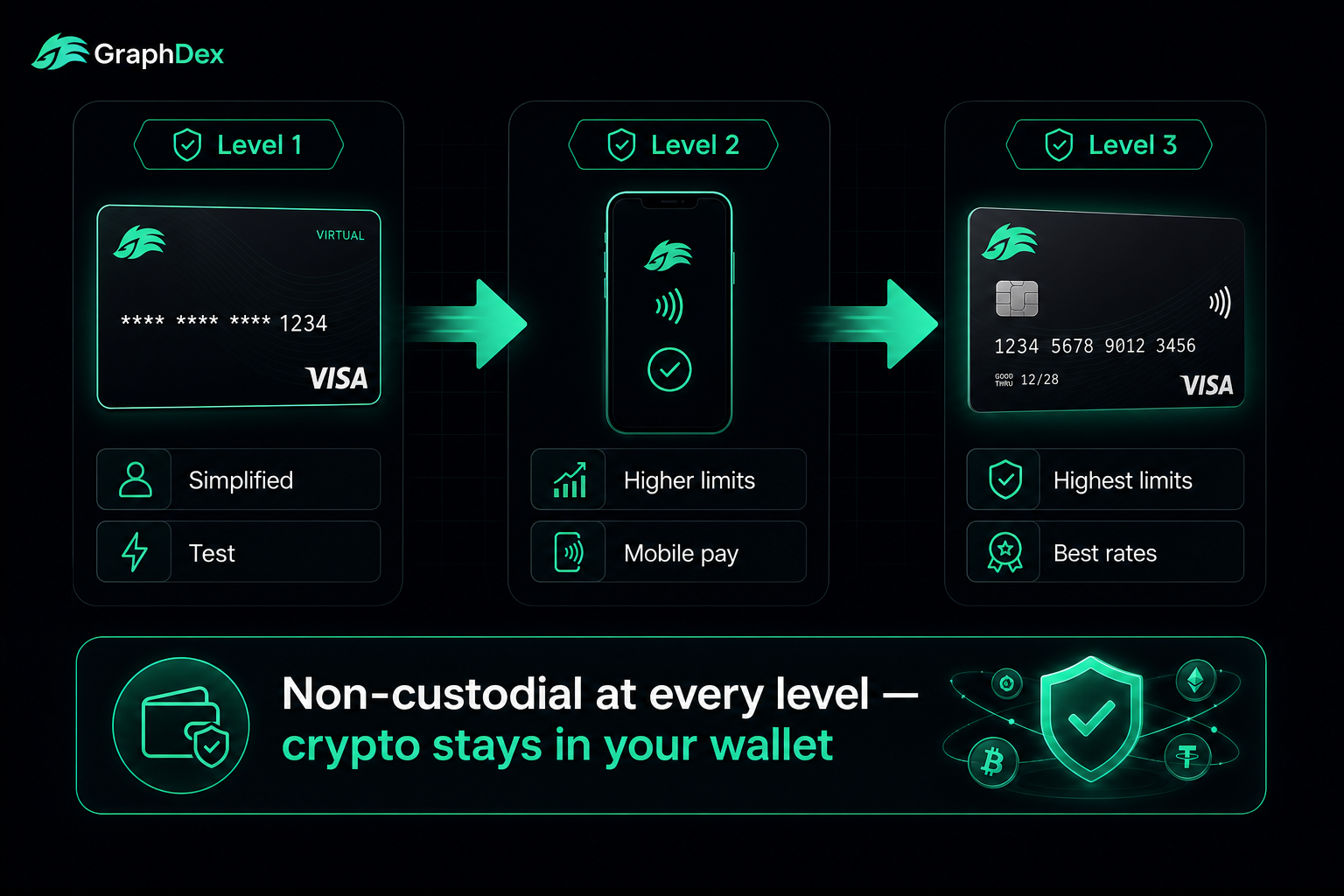
KYC Level 1 (Simplified): Minimal verification — typically email, sometimes phone. Lowest limits, fastest setup, usually virtual-only. Best for testing or small online payments.
KYC Level 2 (Standard): Phone plus basic details. Moderate limits, often unlocks mobile pay. Best for regular online spending.
KYC Level 3 (Full): Government ID, selfie, proof of address. Highest limits, physical cards, best economics. Best for everyday primary use.
The best cards let you move through these levels as your needs grow — starting light and upgrading when you want more.
#1: GraphPay — Best Flexible Tiered Card
Custody: Non-custodial Levels: 1, 2, and 3 (full flexibility) Networks: Visa & Mastercard Best for: Users who want to start light and upgrade as needed, with funds staying in their wallet
GraphPay ranks #1 for combining the two factors that matter most: flexible KYC tiers AND non-custodial architecture. You start at Level 1 with a virtual card and minimal verification, then upgrade toward Level 3 (physical card, highest limits) only when you need to — all while your crypto stays in your own wallet.
How GraphPay works across levels:
- Level 1: Virtual card, simplified verification, fast setup — test the card with small payments
- Level 2: Standard verification unlocks higher limits and more features
- Level 3: Full verification unlocks physical cards, highest limits, and best economics
Core features:
- Non-custodial: Your crypto stays in your own wallet (Web3 infrastructure). The card authorizes conversion only when you spend — your funds are never held by a third party.
- Multi-chain: Load from BNB Chain, Ethereum, or TRON using USDT or USDC.
- Major networks: Visa and Mastercard rails for global merchant acceptance.
- MiCA-aligned: Built for the compliant, self-custodial model regulators recommend ahead of the July 1, 2026 deadline.
Where it wins: The combination of tiered flexibility and non-custodial security. Start light, upgrade as needed, funds always yours. Where competitors win: Some EU-specific cards (Gnosis Pay, Bleap) offer specialized features for European DeFi users.
#2: Bleap — Best Non-Custodial Full-KYC Card
Custody: Non-custodial (MPC) Levels: Full KYC (Level 3) Networks: Mastercard Best for: EU users wanting non-custodial security with strong rewards
Bleap is a non-custodial card using MPC (multi-party computation) — your assets stay in your wallet. It requires full KYC in line with EU AML and MiCA, but offers strong value: 0% FX fees, meaningful cashback, and fee-free trading.
Where it wins: Non-custodial MPC architecture, 0% FX, strong rewards, MiCA-compliant. Where it falls short: Full KYC only (no lighter entry tier); EU-focused.
#3: Gnosis Pay — Best On-Chain Identity Card
Custody: Non-custodial (on-chain wallet) Levels: Tiered (wallet-based entry) Networks: Visa Best for: European DeFi users wanting wallet-based identity
Gnosis Pay connects directly to your on-chain wallet — your identity is your wallet address for basic tiers. EU/UK-focused Visa with stablecoin support, 0% FX fees, and variable token rewards.
Where it wins: On-chain wallet-based identity, minimal custodial data collection, DeFi-native. Where it falls short: EU/UK focus; higher tiers still require verification.
#4: RedotPay — Best Tiered Entry
Custody: Varies Levels: Three-tier system (Tier 0 entry) Networks: Visa Best for: Users wanting a clear tiered upgrade path
RedotPay operates a clear three-tier verification system. Tier 0 lets you start with minimal verification (email) and spend at 130M+ Visa merchants, then unlock higher limits by verifying further.
Where it wins: Clear three-tier structure, large merchant acceptance, frictionless entry. Where it falls short: Lower tiers have restricted limits; verify custody model.
#5: Oobit — Best Minimal-Data Global Card
Custody: Self-custodial Levels: Low entry requirements Networks: Visa Best for: Global users prioritizing minimal data exposure
Oobit uses a self-custodial model — it never holds your assets; you connect your own wallet. Available in 150+ countries with minimal basic-account requirements and zero fees.
Where it wins: Self-custodial, 150+ countries, zero fees, minimal data exposure. Where it falls short: No cashback rewards; verify current tier requirements.
#6: KAST — Best Fast Full-KYC Value
Custody: Varies Levels: Standard KYC (fast) Networks: Visa Best for: Users wanting fast verification with good rewards
KAST emphasizes fast verification (faster than traditional banks) combined with USD cashback (1.5% on the first $2,000/month) and competitive FX. A global stablecoin Visa.
Where it wins: Fast verification, USD cashback, good value at full KYC. Where it falls short: Full KYC required for full access; cashback has timelock conditions.
#7: Ready Card — Best Rewards at Lower KYC
Custody: Self-custody Levels: Minimal requirements Networks: Visa Best for: Reward seekers wanting lower verification
Ready Card is a self-custody Visa offering 3% STRK (Starknet token) cashback with minimal identity requirements compared to traditional cards. Available in EU and US.
Where it wins: 3% cashback at lower KYC, self-custody, EU and US. Where it falls short: STRK token carries price risk; newer program.
Comparison Table
| Card | Custody | KYC Flexibility | Networks | Best For |
|---|---|---|---|---|
| GraphPay | Non-custodial | Level 1→2→3 | Visa & Mastercard | Flexible tiers + self-custody |
| Bleap | Non-custodial (MPC) | Full KYC | Mastercard | EU non-custodial + rewards |
| Gnosis Pay | Non-custodial | Wallet-based | Visa | EU DeFi users |
| RedotPay | Varies | 3-tier (Tier 0 entry) | Visa | Clear upgrade path |
| Oobit | Self-custodial | Low entry | Visa | Global, minimal data |
| KAST | Varies | Fast full KYC | Visa | Fast verification + value |
| Ready Card | Self-custody | Minimal | Visa | Rewards at lower KYC |
How to Choose the Right Card for Your Verification Level
Match the card to your needs and preferred verification level:
If you want flexibility to start light and upgrade: GraphPay — the only card here offering full Level 1 → 2 → 3 progression with non-custodial security throughout.
If you want non-custodial with full KYC and rewards: Bleap (EU, MPC, 0% FX) or KAST (fast verification, cashback).
If you're a European DeFi user: Gnosis Pay (on-chain identity) or Bleap.
If you want a clear tiered entry: RedotPay (three-tier system).
If you prioritize minimal data globally: Oobit (self-custodial, 150+ countries).
If you want rewards at lower verification: Ready Card (3% STRK).
The practical reality: Most users benefit from a card that grows with them. Starting at Level 1 to test, then upgrading to Level 3 for full features, avoids both over-verification and frustrating limits. A non-custodial card like GraphPay makes this progression seamless while keeping your funds in your wallet at every step.
Why Custody Matters as Much as KYC Level
When choosing a crypto card, custody is as important as verification level — and often overlooked.
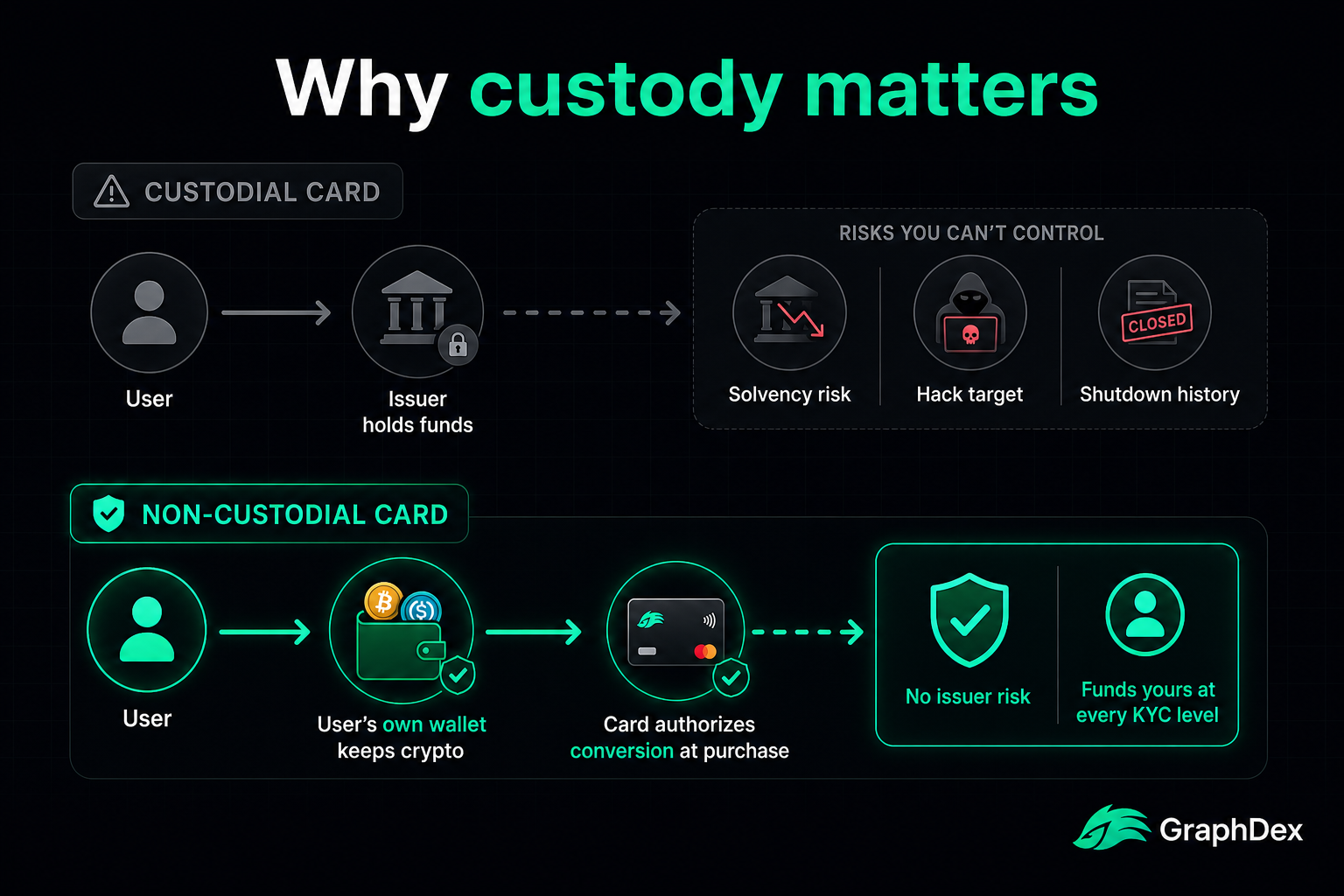
The risk with custodial cards: When the issuer holds your funds, you face two risks. First, solvency risk — if the issuer fails or freezes accounts, your funds may be inaccessible. Second, security risk — custodial platforms are concentrated targets for hackers. Unregulated "anonymous" card schemes have a documented history of shutting down without warning, taking user funds with them.
The non-custodial advantage: With a non-custodial card, your crypto stays in your own wallet. The card authorizes conversion only at the moment you spend. This means:
- No issuer solvency risk to your held funds
- Reduced data exposure (the issuer manages less of your money)
- Your assets remain under your control at every KYC level
- Alignment with what regulators recommend under MiCA
The combined ideal: Tiered KYC (verify only as much as you need) plus non-custodial architecture (funds stay yours). This is the model GraphPay is built on — and increasingly the model regulators favor as the sustainable future of crypto cards.
A card's KYC level determines your limits and features. Its custody model determines whether your funds are truly yours. The best cards optimize both.
How GraphPay Combines Flexible KYC and Self-Custody
GraphPay is built around the two factors that matter most in 2026: flexible verification tiers and non-custodial security.
Flexible KYC tiers:
- Level 1: Virtual card, simplified verification — test with small payments
- Level 2: Standard verification — higher limits, more features
- Level 3: Full verification — physical card, highest limits, best economics
Non-custodial throughout:
- Your crypto stays in your own wallet at every level
- The card authorizes conversion only when you spend
- No third party holds your funds
- Built on Web3 infrastructure
Plus:
- Multi-chain: BNB Chain, Ethereum, TRON (USDT, USDC)
- Visa and Mastercard for global acceptance
- MiCA-aligned for the compliant, self-custodial future
The result: start light, grow as needed, and keep your funds yours throughout. You get regulatory compliance (tiered KYC) and self-custody (non-custodial) — the combination regulators favor and users deserve.
Related Guides
- Crypto Card KYC Levels Explained in 2026: Level 1 vs Level 2 vs Level 3
- Crypto Card Limits by KYC Level in 2026: What Each Tier Unlocks
- How to Get a Crypto Card in 2026: Step-by-Step Guide by KYC Level
Frequently Asked Questions
What's the best crypto card in 2026? The best card matches your verification needs while keeping funds secure. For flexibility across all tiers with self-custody: GraphPay (Level 1 → 3, non-custodial, Visa & Mastercard). For non-custodial full-KYC with rewards: Bleap. For European DeFi: Gnosis Pay. The "best" depends on your needs — but flexible tiers plus non-custodial architecture serves most users best.
Should I get a card with the least KYC? Not necessarily. The smart approach isn't minimizing verification — it's matching it to your needs. Lower KYC means lower limits and often higher fees. A card that verifies you quickly and unlocks good features and limits usually beats one that stays "light" but caps you at tiny limits. Choose flexibility: start at Level 1, upgrade as needed.
What's the difference between custodial and non-custodial crypto cards? Custodial cards hold your funds (adding solvency and security risk). Non-custodial cards (GraphPay, Bleap, Gnosis Pay, Oobit) keep your crypto in your own wallet, authorizing conversion only when you spend. Non-custodial is safer — your funds stay under your control and aren't exposed to issuer failure or hacks. Regulators increasingly recommend self-custodial models.
Can I start with low verification and upgrade later? Yes, with cards that offer tiered KYC. GraphPay, RedotPay, and others let you start at a lower level and upgrade as needed. You typically start with a virtual card and simplified verification, then upgrade to unlock higher limits, physical cards, or mobile pay. This is the recommended approach — start light, grow as your usage requires.
Which crypto cards work with Apple Pay and Google Pay? Mobile pay support varies by card and verification level — it often requires at least Level 2 verification. Cards like KAST and several others support mobile pay at appropriate tiers. With GraphPay, mobile pay availability scales with your verification level. Always check the specific tier requirements for mobile pay on any card.
Are crypto cards safe? Safety depends on custody and provider legitimacy. Non-custodial cards (funds in your wallet) are inherently safer than custodial ones (issuer holds funds). Regulated, compliant cards on Visa/Mastercard rails are safer than unregulated "anonymous" schemes, which have a history of sudden shutdowns and frozen funds. Choose non-custodial, regulated, tiered-KYC cards for the best safety profile.
Do crypto cards report to tax authorities? This varies by jurisdiction and provider. Importantly, non-custodial and tiered-KYC cards reduce issuer data collection — but they don't change your tax obligations. Spending crypto can be a taxable event in many jurisdictions regardless of the card you use. Always consult a tax professional about your obligations; card choice affects data exposure, not tax liability.
About This Guide
This guide is published by the GraphPay Research team — building non-custodial crypto payment infrastructure. Our content is based on current regulatory frameworks, live card comparisons, and 2026 market data.
Sources & data: Card features, custody models, and verification structures reflect publicly available information as of 2026 and may change. Specific limits, fees, and availability vary by provider and jurisdiction. This guide is educational and not financial or legal advice — always verify current terms and consult local regulations.
GraphPay is non-custodial crypto payment infrastructure — your crypto, your pay. Learn more at graphpay.io.
Last reviewed: May 2026 · GraphPay Research