By GraphDex Research · Reviewed for accuracy May 2026
Quick Answer
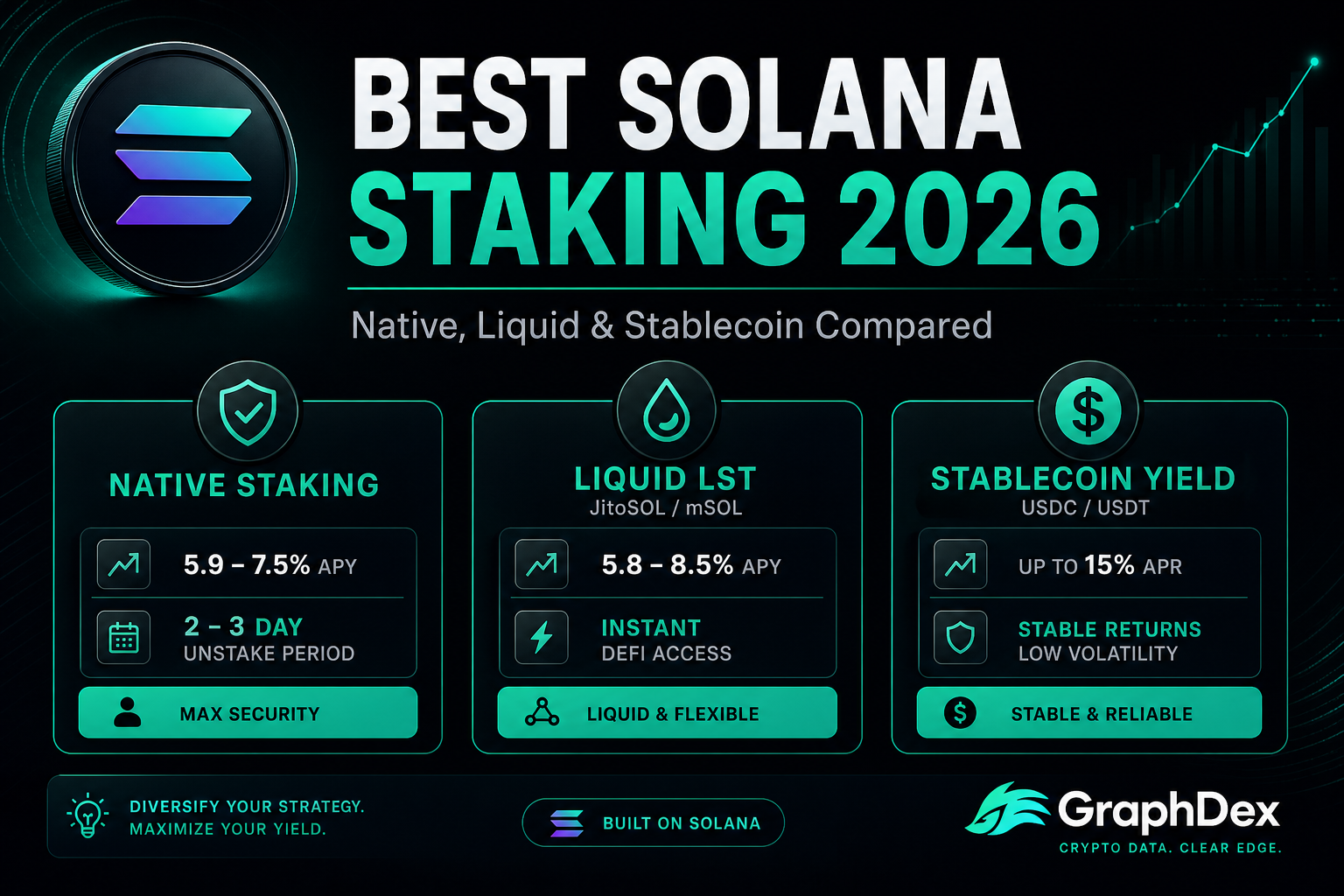
The best Solana staking options in 2026, by category:
- Native staking: Delegate SOL directly to validators. ~5.9-7.5% APY. Full self-custody, 2-3 day unstaking. Best for simplicity and decentralization.
- Liquid staking (LSTs): Stake and receive a tradeable token (JitoSOL, mSOL, INF). ~5.8-8.5% APY. Keeps liquidity, DeFi-usable. Best for flexibility.
- Stablecoin yield: Earn on USDC/USDT without SOL price exposure. Up to ~15% APR on some platforms. Best for avoiding volatility.
Key 2026 trends:
- Yield compression: Solana's inflation schedule cuts ~15% annually, gradually lowering base staking rewards
- LST growth: Liquid staking now represents ~13-14% of all staked SOL and rising
- MEV matters: MEV rewards (via Jito) differentiate top LSTs
The verdict: Choose native for simplicity and decentralization, LSTs for liquidity and DeFi, and stablecoin yield to avoid volatility. Non-custodial options keep your keys throughout.
Earn up to 17% APY on idle capital with GraphDex
Key Takeaways
- Solana staking splits into native (validator delegation), liquid (LSTs), and stablecoin yield.
- Native SOL yields ~5.9-7.5%; top LSTs ~5.8-8.5%; stablecoin yield up to ~15% APR on some platforms.
- Yield is compressing as Solana's inflation schedule cuts ~15% annually.
- Non-custodial options (native, LSTs) keep your keys; choose based on liquidity and volatility preferences.
How Solana Staking Works in 2026
Solana staking is the process of committing SOL to help secure the network's Proof-of-Stake consensus, earning rewards in return. But in 2026, "staking" spans several distinct approaches with very different characteristics.
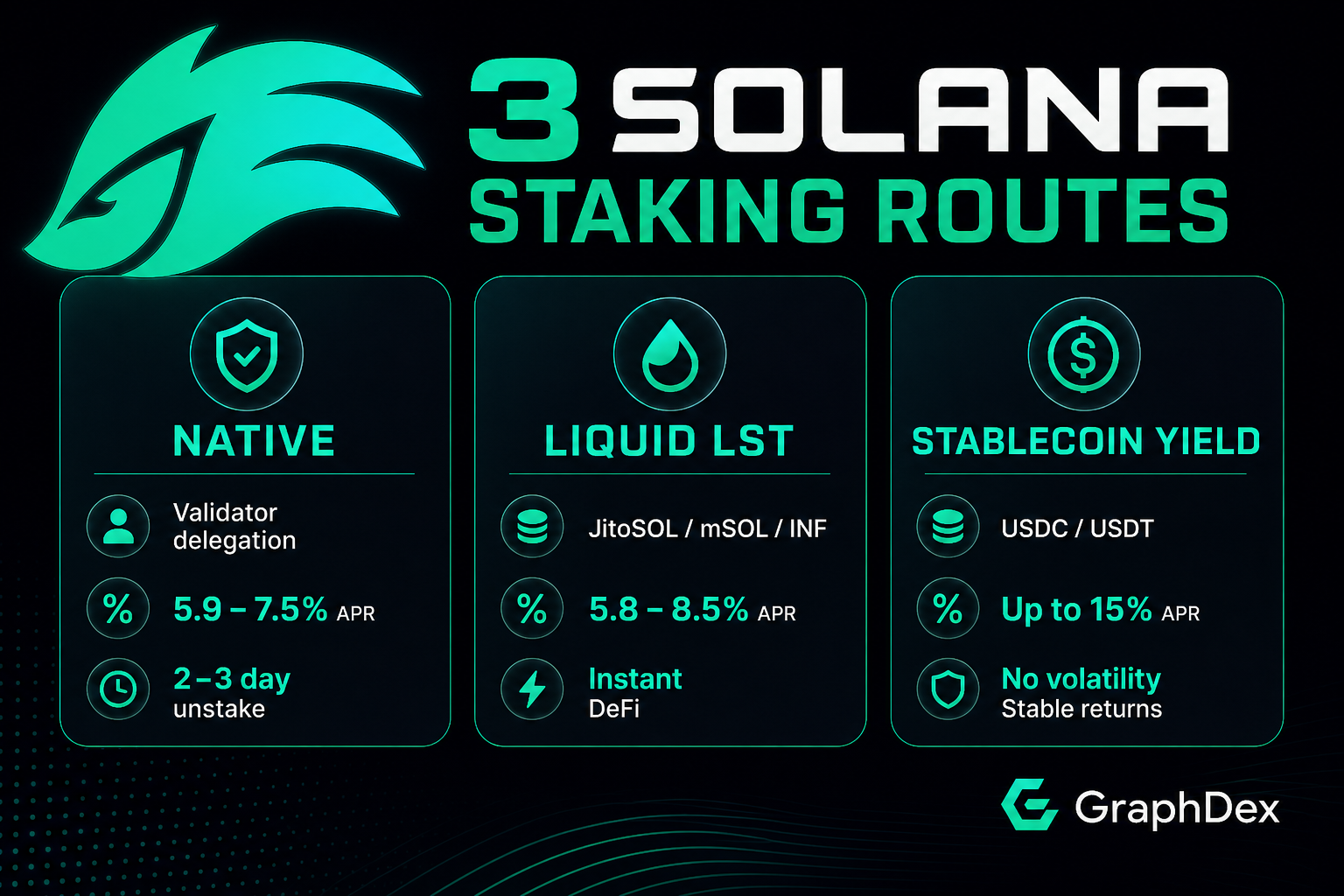
The three main routes:
Native staking. You delegate SOL directly to a validator. Your SOL stays yours (self-custody), you earn base rewards plus a share of MEV, and unstaking takes 2-3 days (a full epoch). This is the simplest, most decentralized route.
Liquid staking. You deposit SOL into a protocol and receive a liquid staking token (LST) like JitoSOL or mSOL. The LST accrues value as rewards accumulate, and — crucially — remains tradeable and usable across DeFi. You keep liquidity while earning.
Stablecoin yield. Rather than staking SOL, you earn yield on stablecoins (USDC, USDT), avoiding SOL price exposure entirely. Rates vary widely by platform.
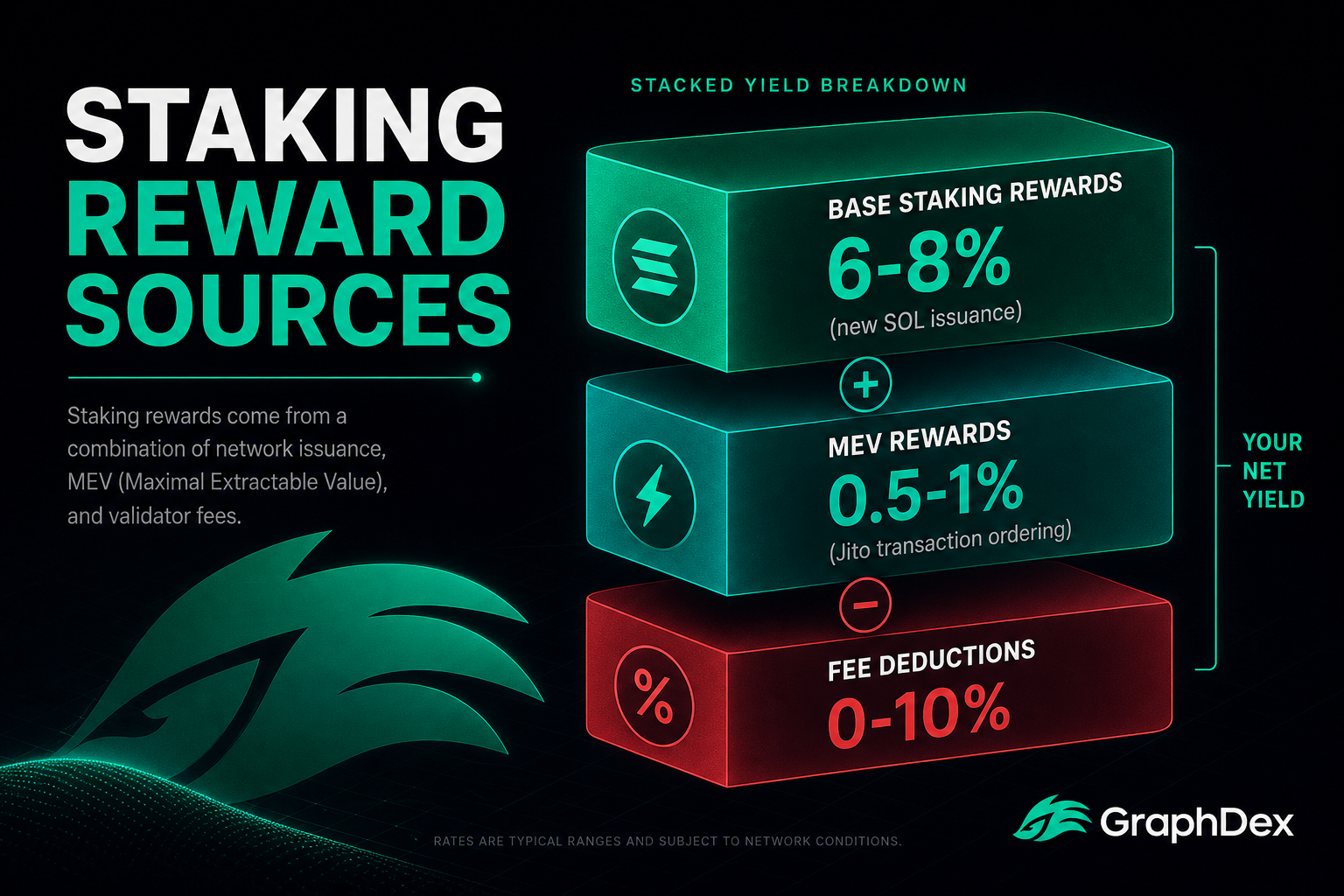
The reward sources:
- Base staking rewards: Currently 6-8% for native Solana staking, from newly issued SOL
- MEV rewards: An additional 0.5-1% from transaction ordering (Jito-enabled)
- Fee deductions: Platform fees typically range 0-10% of rewards
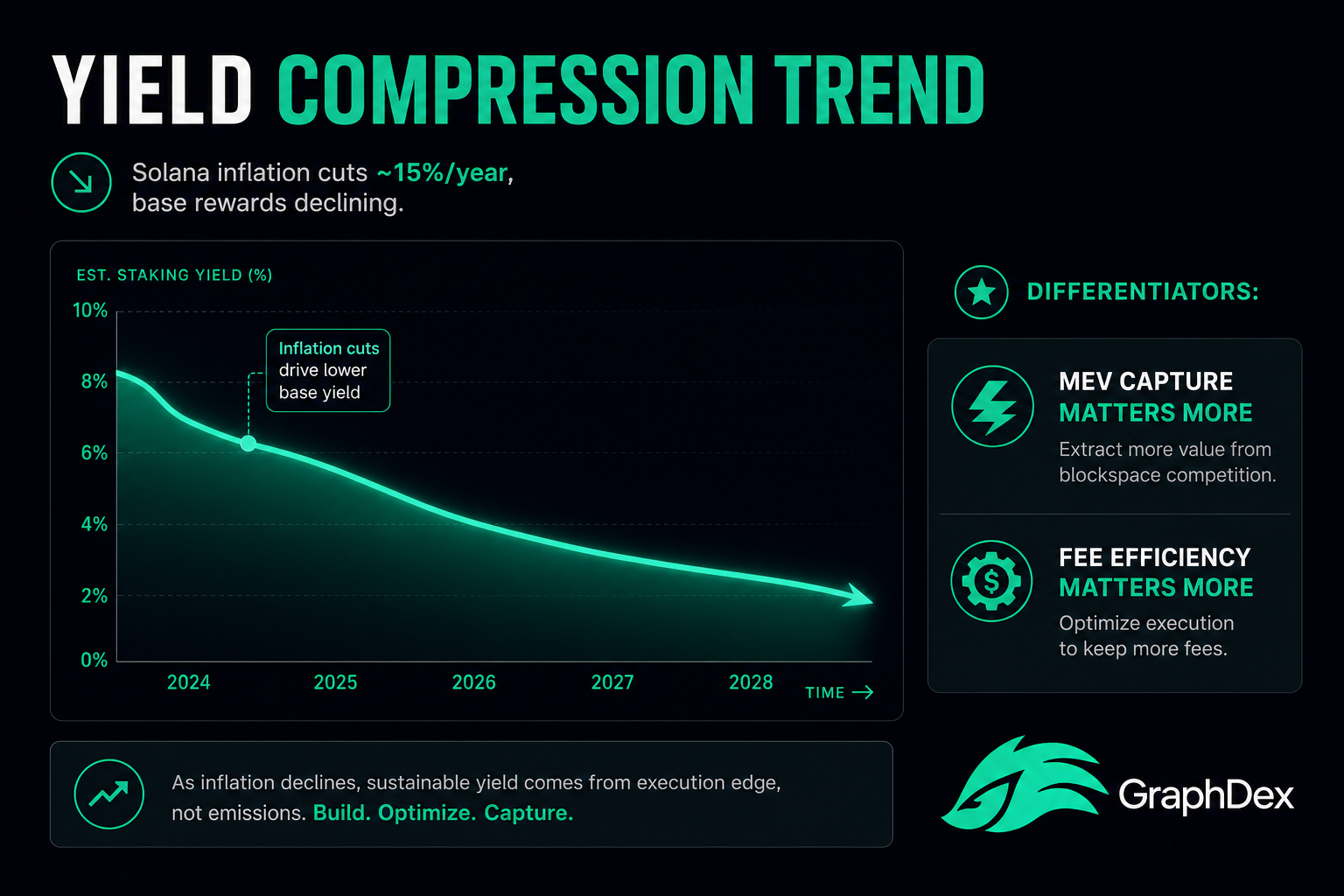
The key 2026 dynamic — yield compression: Solana's inflation schedule reduces by ~15% annually, gradually pulling base validator rewards lower. This means MEV capture and fee efficiency increasingly differentiate platforms, and yields trend downward over time. Understanding this helps you choose options that maximize returns as base rates compress.
Native Staking: Simple & Decentralized
The most straightforward route — delegate directly to a validator.
How it works:
- Stake SOL through a wallet (Phantom, Solflare, Ledger) or platform
- Your SOL is delegated to a validator who processes transactions
- You earn base rewards plus MEV, minus the validator's commission
- Unstaking takes 2-3 days (one epoch) for deactivation
Yield: ~5.9-7.5% APY, depending on the validator's commission and MEV capture.
Pros:
- Full self-custody (your keys, your SOL)
- No smart contract risk (direct delegation)
- Supports network decentralization
- Simple to understand
Cons:
- 2-3 day unstaking period (illiquid during this window)
- You select the validator (validator downtime reduces rewards)
- SOL sits outside DeFi (can't be used as collateral while staked)
Best for: Holders who want simplicity, full custody, and decentralization, and who don't need instant liquidity or DeFi use of their staked SOL.
Validator selection matters: Choosing a reliable validator with good uptime and reasonable commission (many offer 0% commission) maximizes rewards. Validator downtime directly reduces your returns.
Liquid Staking (LSTs): Flexibility & DeFi
The dominant category — stake while keeping liquidity.
How it works:
- Deposit SOL into a liquid staking protocol
- Receive a liquid staking token (LST): JitoSOL, mSOL, INF, JupSOL, and others
- The LST accrues value as rewards accumulate (the exchange rate vs SOL rises)
- The LST remains tradeable and usable across DeFi (lending, collateral, liquidity)
- Unstake by swapping the LST back to SOL (often instant via pools) or direct unstaking
Yield: ~5.8-8.5% APY depending on the LST, with MEV-enhanced options (JitoSOL) at the higher end.
Pros:
- Keeps liquidity (LST is tradeable anytime)
- DeFi-usable (collateral, lending, liquidity provision — "stacked yield")
- Often instant unstaking via liquidity pools
- MEV rewards on top-tier LSTs
Cons:
- Smart contract risk (the protocol's code)
- LST liquidity risk (exit quality depends on pool depth during stress)
- Slightly more complex than native
- Some LSTs charge management fees
Best for: Holders who want flexibility, plan to use staked value in DeFi, or want instant liquidity without the 2-3 day native unstaking wait.
The growth trend: Liquid staking now represents ~13-14% of all staked SOL and is rising, as holders increasingly prefer keeping liquidity over locking SOL natively.
Stablecoin Yield: Avoiding Volatility
For those who want yield without SOL price exposure.
How it works:
- Rather than staking volatile SOL, you earn yield on stablecoins (USDC, USDT)
- Yield sources vary: lending protocols, fee-based platforms, or structured products
- Your principal stays in stable value (1 USDC ≈ $1), avoiding crypto volatility
Yield: Varies widely — some platforms offer up to ~15% APR on stablecoins, though rates and risk profiles differ significantly.
Pros:
- No SOL price volatility (principal stays stable)
- Predictable value
- Often flexible (no lock periods on some platforms)
- Ideal for capital you don't want exposed to crypto swings
Cons:
- Yield sources carry their own risks (platform risk, smart contract risk)
- High advertised rates may carry higher risk — scrutinize the source
- Some high rates require native token holdings or have conditions
Best for: Holders who want yield without volatility exposure — for example, capital held for spending, trading reserves, or risk-averse allocations.
The caution: High stablecoin yields warrant scrutiny. Understand where the yield comes from — sustainable fee-based or lending yield differs from unsustainable token-subsidized rates. If a rate seems too high, understand the risk before committing.
Comparison Table
| Route | Yield (2026) | Custody | Liquidity | Best For |
|---|---|---|---|---|
| Native staking | ~5.9-7.5% | Self-custody | 2-3 day unstake | Simplicity, decentralization |
| Liquid staking (LSTs) | ~5.8-8.5% | Self-custody (smart contract) | Instant via pools | Flexibility, DeFi |
| Stablecoin yield | Up to ~15% APR | Varies | Often flexible | Avoiding volatility |
Yields reflect 2026 ranges and compress over time as Solana's inflation schedule reduces. Higher yields often carry higher risk.
How to Choose Your Staking Route
Match the route to how you hold and use your assets:
Choose native staking if you:
- Want maximum simplicity and full self-custody
- Prioritize network decentralization
- Don't need instant liquidity or DeFi use
- Prefer no smart contract risk
Choose liquid staking (LSTs) if you:
- Want to keep liquidity while earning
- Plan to use staked value in DeFi (collateral, lending)
- Want instant unstaking via pools
- Are comfortable with smart contract risk for added flexibility
Choose stablecoin yield if you:
- Want yield without SOL price volatility
- Hold capital for spending, trading, or risk-averse allocation
- Prefer predictable stable value
- Understand and accept the yield source's risks
Use a mix if you:
- Want to balance growth (SOL staking) with stability (stablecoin yield)
- Hold different capital for different purposes
The practical reality: Many holders use a mix — native or LST staking for SOL they hold long-term, and stablecoin yield for capital they want stable. The right route depends on your custody preferences, liquidity needs, DeFi usage, and volatility tolerance.
Earn up to 17% APY on idle capital with GraphDex
The Yield Compression Trend: What It Means
A critical 2026 dynamic every staker should understand.
What's happening: Solana's inflation schedule reduces by ~15% annually. Since base staking rewards come from newly issued SOL, this steadily lowers base yields over time. The trend is clear: staking yields are compressing.
What this means for stakers:
- Base rewards trend downward year over year
- MEV capture increasingly differentiates platforms (Jito-enabled LSTs capture MEV that boosts yield)
- Fee efficiency matters more (a platform taking 10% of rewards vs 0% makes a bigger relative difference as base rates fall)
- The gap between optimized and unoptimized staking widens
How to respond:
- Choose validators/LSTs with strong MEV capture
- Minimize fees (0% commission validators, low-fee LSTs)
- Consider stablecoin yield for capital where SOL exposure isn't the goal
- Recognize that maximizing yield requires more attention as base rates compress
The bigger picture: Yield compression doesn't make staking unattractive — 5.9-8.5% remains strong versus traditional finance. But it does mean platform choice, MEV capture, and fee efficiency matter more than ever for maximizing returns.
How GraphDex Fits Into Your Yield Strategy
GraphDex integrates yield into a broader trading terminal — letting you earn on idle capital between trades without moving to a separate platform.
The GraphDex yield approach:
- Up to 17% APY on idle capital (SOL and stablecoins) between trades
- Integrated — earn yield in the same terminal where you trade Solana tokens and prediction markets
- Non-custodial — your funds stay in your own wallet (Privy), sign in with Twitter, email, or Telegram
- No idle capital — capital between memecoin trades or prediction opportunities earns yield rather than sitting dormant
Why integration matters: Traditionally, earning yield means moving capital to a separate staking platform, then moving it back to trade — friction that leaves capital idle or discourages yield entirely. GraphDex integrates yield into the trading terminal, so your trading reserves earn automatically between opportunities.
The complete picture: For active traders, GraphDex consolidates memecoin trading (across all launchpads), prediction-market copytrading, and yield on idle capital — all non-custodial, in one terminal. Your capital works whether you're actively trading or waiting for the next opportunity.
Earn on idle capital while you trade on GraphDex
Related Guides
- Stablecoin Yield 2026: Best USDC/USDT APY (3–17%) Compared
- Best Stablecoin Staking Rates in 2026: Where to Earn the Highest APY
- JitoSOL vs mSOL vs INF in 2026: Solana Liquid Staking Tokens Compared
- How to Stake USDC in 2026: Best Platforms and Highest APY Compared
Frequently Asked Questions
What is the best Solana staking option in 2026? It depends on your priorities. Native staking (~5.9-7.5% APY) is best for simplicity and full self-custody. Liquid staking with LSTs like JitoSOL (~5.8-8.5%) is best for keeping liquidity and DeFi use. Stablecoin yield (up to ~15% APR) is best for avoiding SOL volatility. Many holders use a mix based on custody preferences, liquidity needs, and volatility tolerance.
What is the current Solana staking APY? In 2026, native SOL staking yields roughly 5.9-7.5% APY. Top liquid staking tokens (LSTs) range ~5.8-8.5%, with MEV-enhanced options like JitoSOL at the higher end. Stablecoin yield reaches up to ~15% APR on some platforms (with varying risk). Yields are compressing as Solana's inflation schedule reduces ~15% annually.
What's the difference between native and liquid staking? Native staking delegates SOL directly to a validator — full self-custody, no smart contract risk, but a 2-3 day unstaking period and SOL locked out of DeFi. Liquid staking gives you a tradeable token (LST) representing your staked SOL — keeps liquidity, usable in DeFi, often instant unstaking, but adds smart contract risk. Native is simpler; liquid is more flexible.
Is liquid staking safe on Solana? Liquid staking is widely used but carries risks native staking doesn't: smart contract risk (the protocol's code), LST liquidity risk (exit quality depends on pool depth during market stress), and collateral risk if used in DeFi. Established LSTs (JitoSOL, mSOL) have strong track records and audits, but these risks are real. Native staking avoids smart contract risk entirely.
Why are Solana staking yields going down? Solana's inflation schedule reduces by ~15% annually. Since base staking rewards come from newly issued SOL, this steadily lowers base yields — a trend called yield compression. As base rates fall, MEV capture (via Jito) and fee efficiency increasingly differentiate platforms. Yields remain strong (5.9-8.5%) versus traditional finance, but platform choice matters more.
Can I earn yield on stablecoins instead of SOL? Yes — stablecoin yield lets you earn on USDC/USDT without SOL price exposure. Rates reach up to ~15% APR on some platforms, though they vary widely and higher rates often carry higher risk. It's ideal for capital you want kept stable (spending reserves, trading capital, risk-averse allocations). Always understand where the yield comes from before committing.
Do I keep custody of my funds when staking? With native staking and non-custodial LSTs, yes — your keys stay yours. Native staking is direct delegation (full self-custody). Non-custodial LSTs keep your keys while a smart contract handles validator operations. Custodial staking (some exchanges) holds your keys — adding solvency risk. For self-custody, choose native staking or non-custodial LSTs. GraphDex's yield is non-custodial (funds in your wallet).
About This Guide
This guide is published by the GraphDex Research team — analysts and traders building the infrastructure for digital asset trading on Solana. Our content is based on direct experience, current market data, and 2026 staking developments.
Sources & data: Yield figures, rates, and trends reflect publicly available information as of 2026 and may change. Staking carries risks including smart contract risk, validator risk, slashing (where applicable), and platform risk. Higher yields often carry higher risk. This guide is educational and not financial advice — always do your own research.
GraphDex is the infrastructure for digital asset trading — trade, predict, and earn in one place. Learn more at graphdex.io.
Last reviewed: May 2026 · GraphDex Research
The infrastructure for digital asset trading. Trade, predict, stake, repeat. graphdex.io