Quick Answer
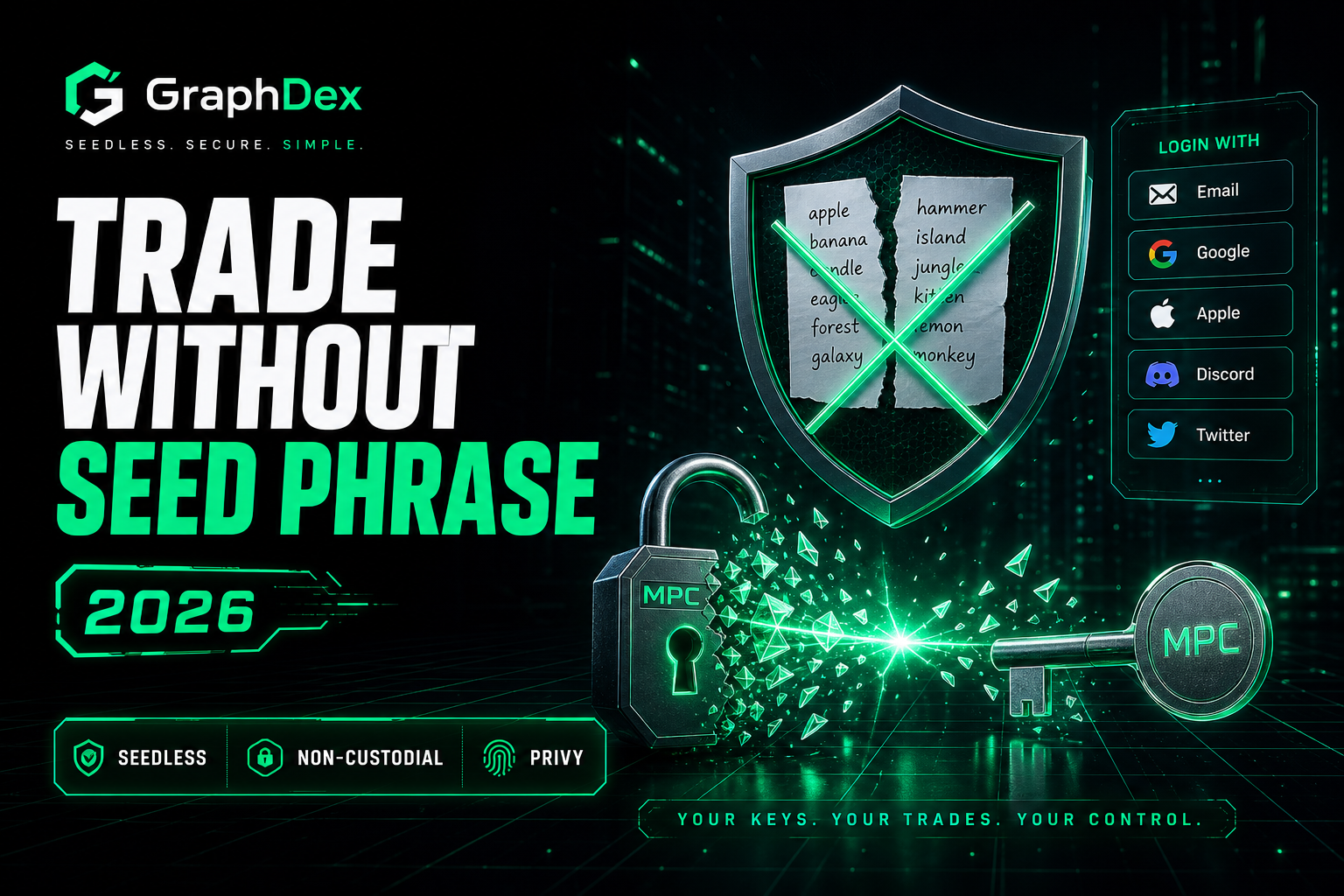
You can now trade crypto without a seed phrase using embedded wallets built on MPC (Multi-Party Computation) technology. These wallets:
- Require no 12 or 24-word seed phrase
- Require no browser extension
- Remain fully non-custodial — you control your funds
- Let you sign in with email, Google, or social accounts
GraphDex uses Privy's seedless architecture. You register with Twitter, email, or Telegram, and your non-custodial Solana wallet is created automatically.
Start trading Solana with no seed phrase on GraphDex
Key Takeaways
- MPC seedless wallets remove the 12/24-word phrase while keeping funds non-custodial.
- Sign in with email or social; no browser extension required for basic trading flows.
- Lost seed phrases account for billions in permanently lost crypto — seedless design targets that failure mode.
- GraphDex uses Privy so users trade Solana without managing a mnemonic.
The Problem With Seed Phrases
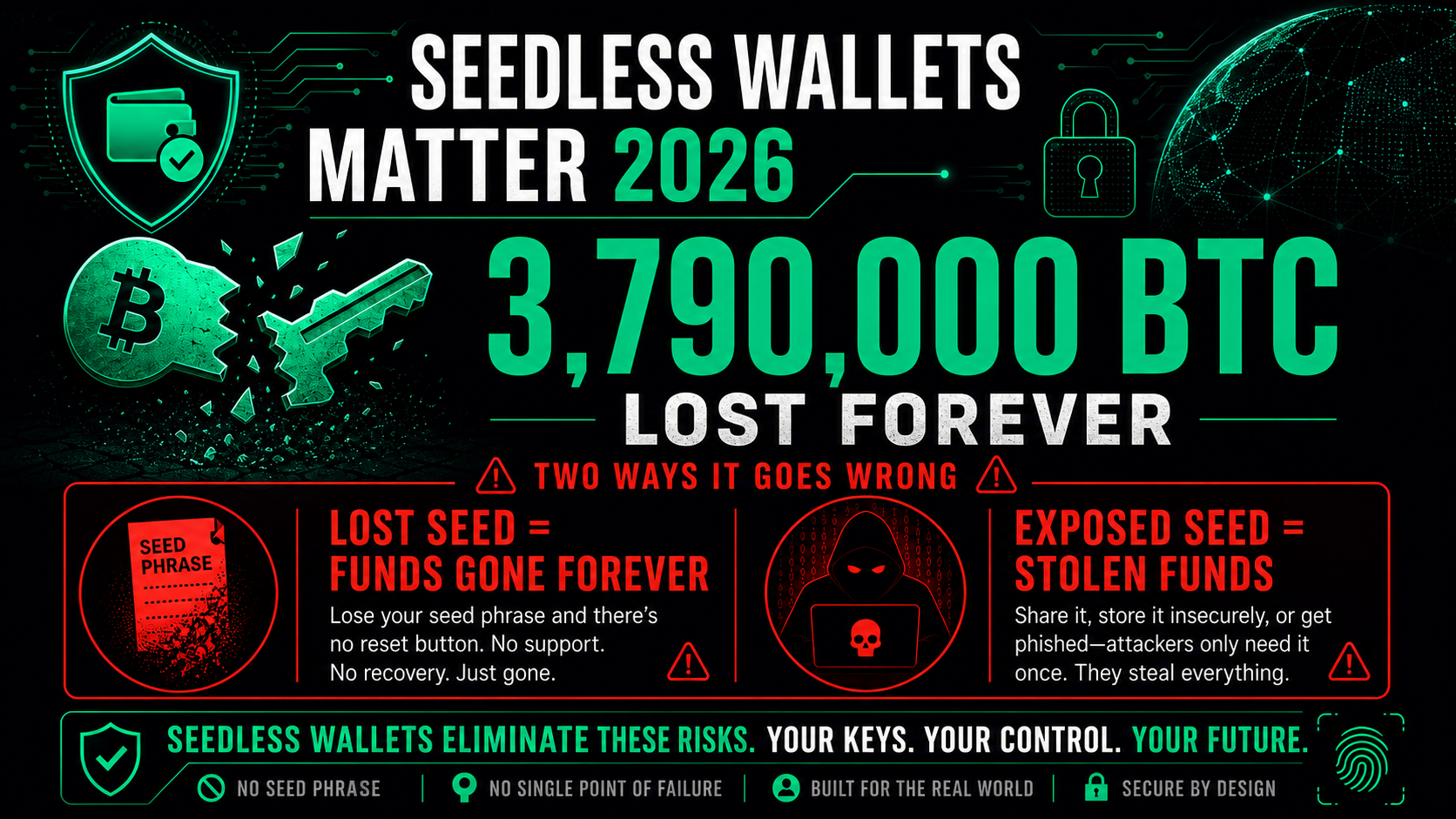
For most of crypto's history, self-custody meant managing a 12 or 24-word seed phrase. This created two opposite failure modes:
Lose it, lose everything. An estimated 3.79 million Bitcoin are lost forever due to forgotten or lost seed phrases. If you lose the phrase, recovery is impossible — the funds are gone permanently.
Expose it, lose everything. If anyone obtains your seed phrase — through a phishing site, malware, or a photo in your cloud backup — they have complete access to your wallet. There is no second factor, no reversal.
Most traditional wallets depend on a single mnemonic phrase that represents the full private key. If lost, recovery becomes impossible. If exposed, anyone can access the wallet. This is both a user experience problem and a security problem.
Seed phrases also create friction that keeps people out of crypto entirely. The instruction to "write down these 24 words and never lose them or you lose all your money" is genuinely intimidating to newcomers — and it should be, because the stakes are exactly that high.
What Is a Seedless Wallet?
A seedless wallet — also called an embedded wallet — lets you create and use a crypto wallet entirely within an app, without installing an extension, managing a seed phrase, or understanding how blockchain works behind the scenes.
The key insight: seedless does not mean custodial. Modern seedless wallets use cryptography to eliminate the single seed phrase while keeping you in control of your funds. The provider cannot access your assets.
This is made possible by two technologies: MPC (Multi-Party Computation) and Shamir's Secret Sharing combined with secure enclaves (TEEs).
How Seedless Wallets Actually Work
This is the part that matters: seedless wallets are secure because of how they handle the private key, not because they hide it.
Key Splitting
Instead of one seed phrase representing one complete private key, a seedless wallet splits the key into multiple shares. A threshold of shares is required to sign a transaction. No single party ever holds the complete key.
MPC (Multi-Party Computation)
MPC is a technique where multiple parties jointly compute a cryptographic operation — like signing a transaction — without any single party ever holding the complete private key. Each party holds a key share and contributes to signing independently. The full key is never reconstructed in any single location.
The advantage: there is no single point of compromise. An attacker would need to compromise a threshold of separate share-holders simultaneously — exponentially harder than stealing one seed phrase.
How Privy Does It (GraphDex's Architecture)
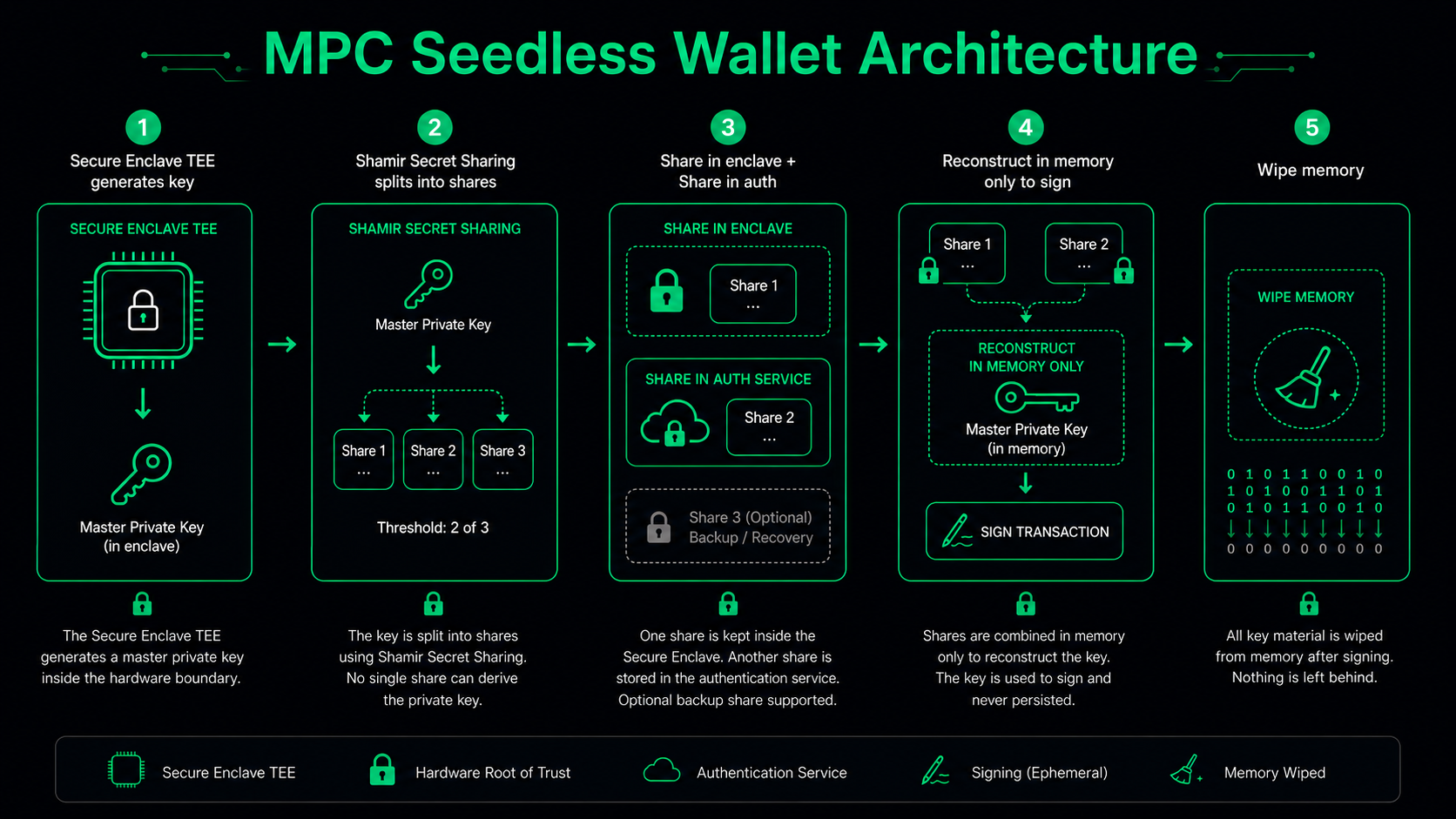
GraphDex is built on Privy. Privy combines key sharding via Shamir's Secret Sharing and a Trusted Execution Environment (TEE) implementation.
Here is what happens:
- Your private key is generated inside a secure hardware enclave — an isolated environment with no persistent storage
- The key is immediately split into shares via Shamir's Secret Sharing
- One share is encrypted in the enclave infrastructure, one share is tied to your authentication
- The complete key is never stored anywhere
- It is only temporarily reconstructed in memory to sign a transaction, then wiped
The result: Privy, the app, and the cloud host each individually cannot access your complete key. You retain control, but you never have to manage — or risk — a seed phrase.
Trade with seedless security on GraphDex
Seedless Is Not Custodial: The Critical Distinction
The most common misconception is that seedless means the company holds your funds. It does not.
| Custodial | Seedless Non-Custodial | Traditional Seed Phrase | |
|---|---|---|---|
| Who controls funds | The company | You | You |
| Seed phrase required | No | No | Yes |
| Single point of failure | Company hack | None (key split) | The seed phrase |
| Recovery if you lose access | Company resets | Authentication-based | Impossible |
| Can the provider take funds | Yes | No | No |
With a custodial wallet (like a centralized exchange), the company holds your private key and can move your funds. With a seedless non-custodial wallet, the key is split so no single party — including the provider — can access it. You get the convenience of custodial-style login with the control of self-custody.
This is why seedless wallets are sometimes called "Non-Custodial 2.0" — they preserve self-custody while eliminating the seed phrase that made self-custody so dangerous.
How to Trade Solana Without a Seed Phrase on GraphDex
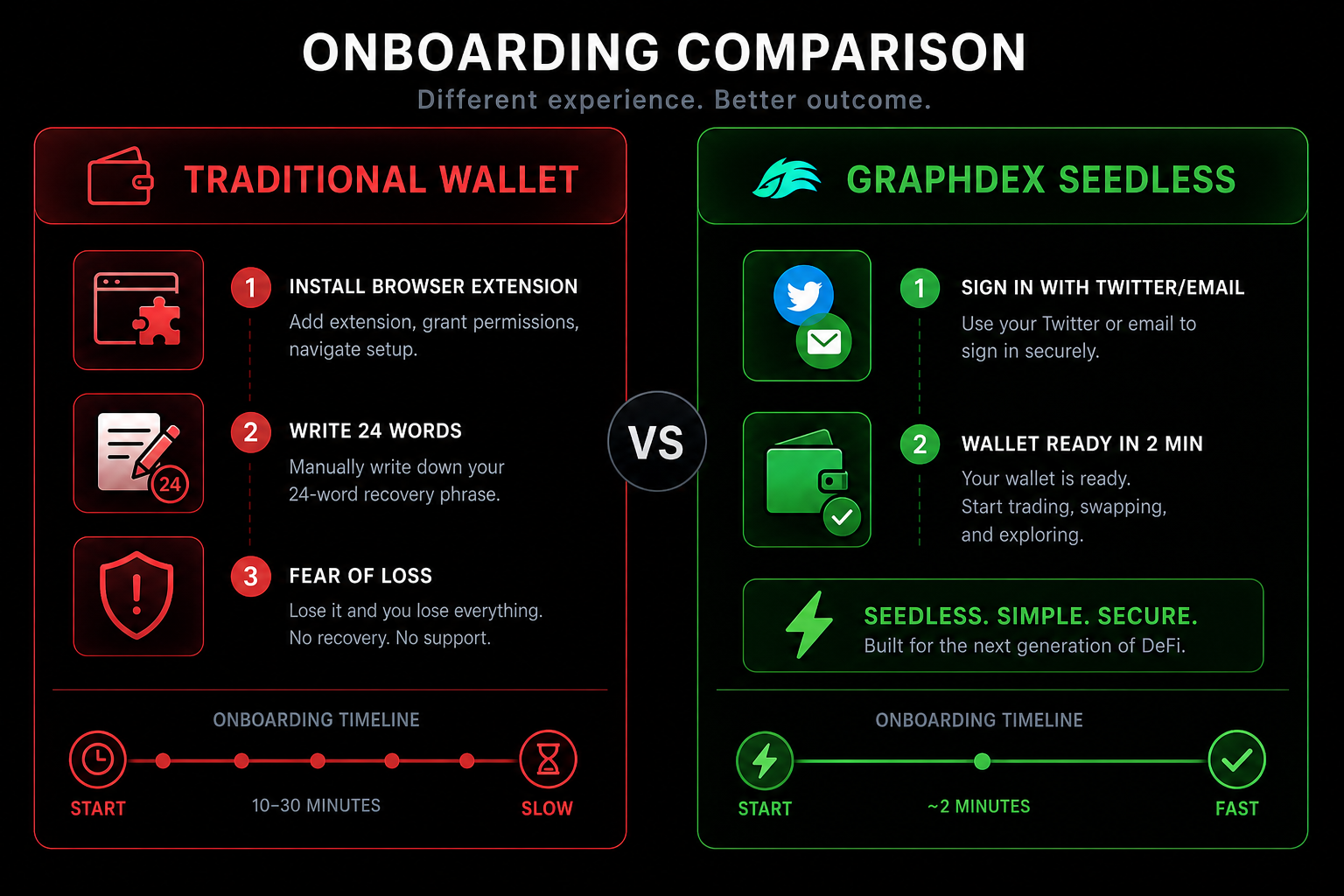
Step 1: Register Go to graphdex.io and sign in with Twitter, email, or Telegram. No seed phrase to write down, no extension to install.
Step 2: Your wallet is created automatically Privy generates your non-custodial Solana wallet instantly using the MPC architecture described above. Your key is split and secured — you never see or manage a seed phrase.
Step 3: Fund your wallet Send SOL, USDT, or USDC to your wallet address from any exchange or wallet.
Step 4: Trade Access Solana DEX trading, the Pulse feed, prediction markets, staking, and more. Every transaction is signed via the MPC process — the key is reconstructed in memory only for signing, then wiped.
Step 5: Export anytime (optional) If you ever want to move to a traditional self-custody setup, you can export your private key from Settings. You are never locked in.
The entire onboarding takes under two minutes — the same experience as signing into any modern fintech app, but fully non-custodial.
Get started on GraphDex with no seed phrase
Benefits of Trading Without a Seed Phrase
No catastrophic loss risk You cannot lose funds by misplacing a piece of paper. Recovery is tied to your authentication, not a single fragile string of words.
No phishing target There is no seed phrase for a phishing site to steal. The most common crypto attack vector simply does not apply.
Faster onboarding Sign in and trade in under two minutes. No extension installation, no seed phrase ceremony, no friction that drives newcomers away.
Reduced attack surface No browser extension means one fewer piece of software that can be compromised or spoofed.
Self-custody preserved You keep full control. The provider cannot access or move your funds. You can export your key anytime.
Are Seedless Wallets Safe?
Seedless wallets built on MPC are, for most users, safer than traditional seed phrase wallets — not less safe. Here is why.
The biggest risk to most crypto users is not a sophisticated cryptographic attack. It is losing their seed phrase, or having it phished or stolen. Seedless wallets eliminate both of these — the most common ways people actually lose funds.
MPC architecture removes the single point of failure. With a traditional wallet, one leaked seed phrase means total loss. With MPC, an attacker needs to compromise a threshold of separate share-holders simultaneously, which is exponentially more difficult.
That said, no system is risk-free. Seedless wallets depend on the security of the authentication method and the provider's infrastructure. Choose providers with proven architecture — Privy is used by major DeFi protocols and consumer apps specifically because its TEE plus Shamir's Secret Sharing model is well-regarded.
Seedless Wallet Providers in 2026
| Provider | Architecture | Used by |
|---|---|---|
| Privy | TEE + Shamir's Secret Sharing | GraphDex, major DeFi protocols |
| Web3Auth | MPC | Binance Web3 Wallet |
| Dynamic | MPC | Enterprise apps |
| ZenGo | MPC | 1.5M users, consumer wallet |
GraphDex chose Privy for its combination of strong security architecture and seamless user experience. The same infrastructure that powers major DeFi protocols secures every GraphDex wallet.
Who Should Use a Seedless Wallet?
Newcomers to crypto: If the seed phrase ceremony has kept you out of self-custody, seedless wallets remove that barrier entirely. You get the security of self-custody with the simplicity of a fintech app login.
Active traders: Speed matters. Seedless onboarding means you can act on an opportunity in minutes rather than going through extension setup and seed phrase backup. On GraphDex, this means signal to execution without wallet friction.
Anyone burned by seed phrase loss or phishing: If you have lost funds — or know someone who has — to a misplaced seed phrase or a phishing attack, seedless architecture eliminates those specific failure modes.
Mobile-first users: Seedless wallets work seamlessly on mobile without juggling extensions across devices. GraphDex's Telegram Mini App brings seedless trading directly into Telegram.
Who might prefer traditional self-custody: Users holding very large amounts long-term may still prefer hardware wallets with traditional seed phrases for cold storage. Seedless wallets are optimized for active use, not decade-long cold storage. The good news: GraphDex lets you export your key anytime, so you can use seedless for active trading and move to cold storage when needed.
The Bigger Picture: Removing Friction Without Removing Control
The history of crypto self-custody has been a trade-off between security and usability. Hardware wallets are secure but inconvenient. Hot wallets with seed phrases are convenient but fragile. Custodial exchanges are easy but reintroduce the exact counterparty risk that crypto was built to eliminate — as FTX demonstrated.
Seedless MPC wallets break this trade-off. They deliver the usability of a custodial app — sign in, start trading — with the control of self-custody. No single party holds your key. No seed phrase to lose or leak. No company that can freeze or seize your funds.
This is why seedless architecture is becoming the standard for consumer crypto applications in 2026. It is not a compromise on security — for most users, it is an improvement on both security and usability simultaneously.
GraphDex built on this foundation from day one. Every wallet is seedless, non-custodial, and created automatically at registration — so the first thing a new trader experiences is how easy self-custody can be.
Experience seedless trading on GraphDex
Related Guides
- Non-Custodial Wallets Without a Seed Phrase in 2026: How Social Login Works
- What Is a Crypto Wallet in 2026? Custodial vs Non-Custodial Explained
- How to Avoid Rug Pulls on Solana in 2026: 8 Red Flags Every Trader Must Check
- Best Solana Trading Terminal in 2026: GraphDex vs Axiom vs GMGN vs Trojan vs BullX
Frequently Asked Questions
Can I trade crypto without a seed phrase in 2026? Yes. Seedless embedded wallets built on MPC technology let you trade without a seed phrase. GraphDex uses Privy's seedless architecture — register with Twitter, email, or Telegram and your non-custodial Solana wallet is created automatically.
Is a wallet without a seed phrase safe? For most users, yes — often safer than traditional wallets. Seedless MPC wallets eliminate the two most common ways people lose funds: losing the seed phrase and having it phished. The key is split so no single party can access it.
Does seedless mean the company controls my funds? No. Seedless non-custodial wallets split your key so no single party — including the provider — can access your funds. This is different from custodial wallets (like exchanges) where the company holds your key.
How does GraphDex secure my wallet without a seed phrase? GraphDex uses Privy, which combines Shamir's Secret Sharing with a Trusted Execution Environment. Your key is generated in a secure enclave, split into shares, and only briefly reconstructed in memory to sign transactions — then wiped. No party holds the complete key.
Can I export my private key from GraphDex? Yes. You can export your private key anytime from Settings if you want to move to a traditional self-custody setup. You are never locked in.
What happens if I lose access to my email or social login? Seedless wallets use authentication-based recovery. The exact recovery process depends on the provider's design, but unlike a lost seed phrase — which means permanent loss — seedless wallets offer recovery paths tied to your authentication.
What is MPC in crypto wallets? MPC (Multi-Party Computation) is a cryptographic technique where multiple parties jointly sign a transaction without any single party holding the complete private key. It eliminates the single point of failure that a seed phrase represents.
The infrastructure for digital asset trading. Trade, predict, stake, repeat. graphdex.io