By GraphDex Research · Reviewed for accuracy May 2026
Quick Answer
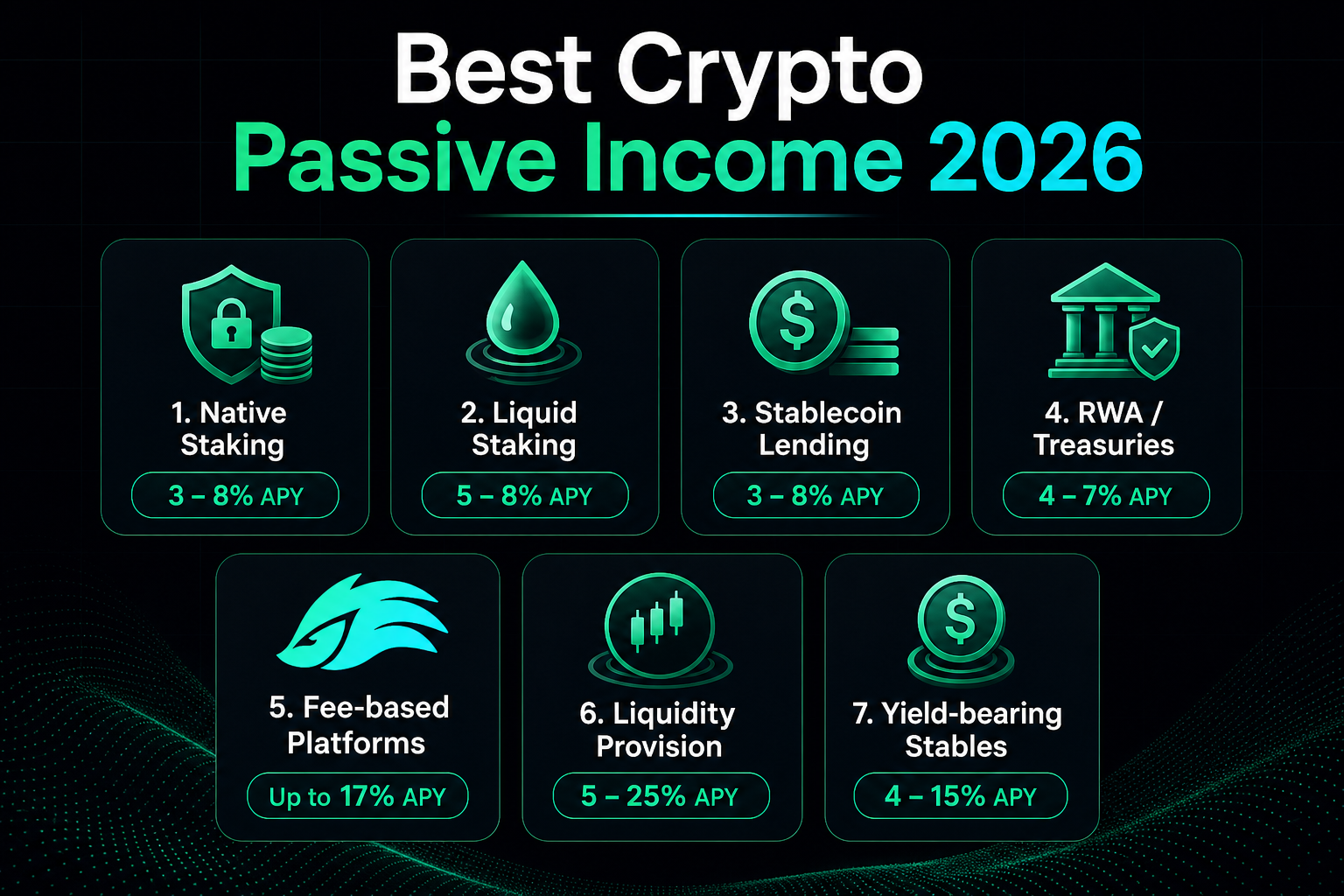
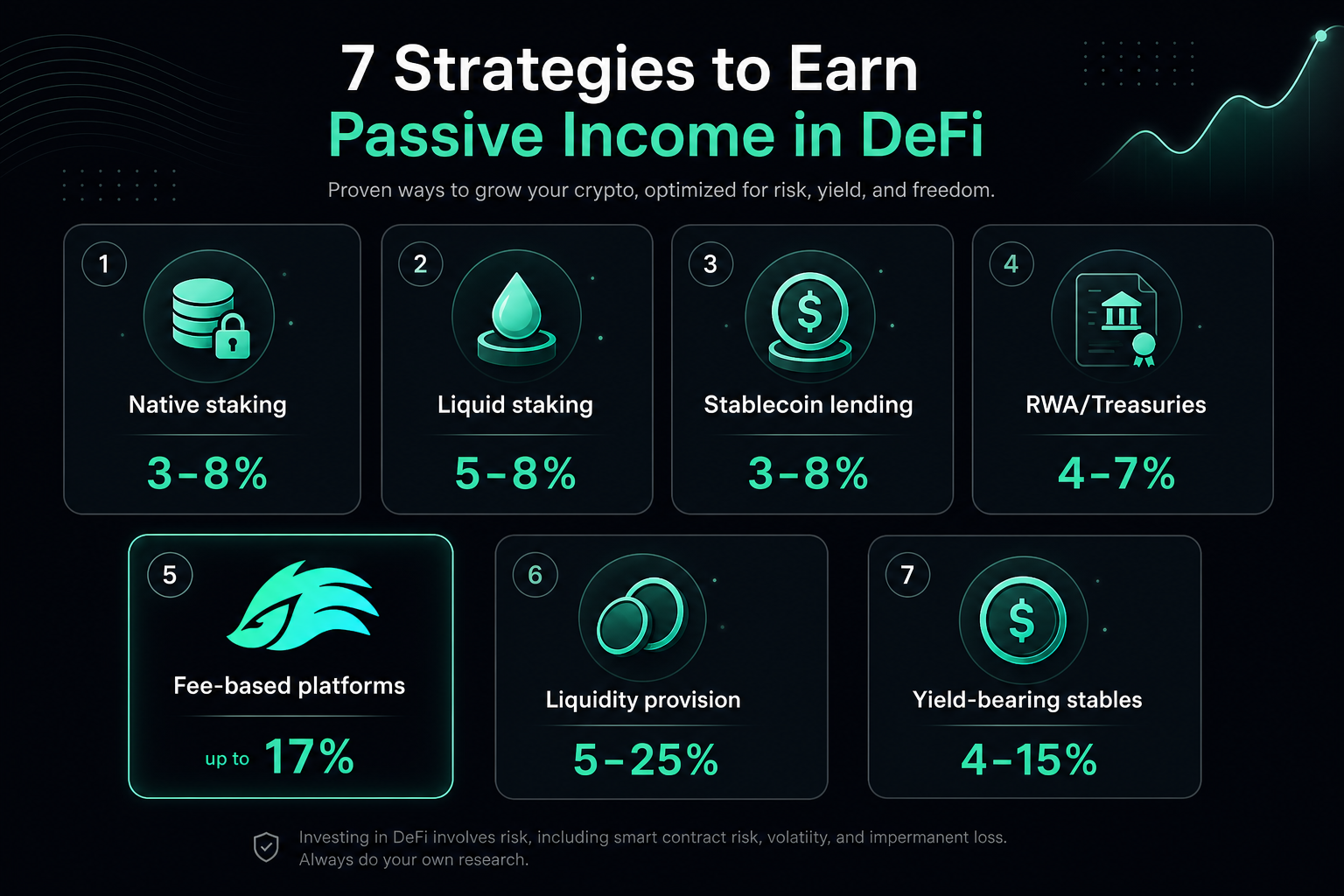
The best crypto passive income strategies in 2026 fall into seven main categories — most users combine 2-3 for diversified yield:
- Staking native tokens (3-8% APY): ETH, SOL, ATOM for proof-of-stake rewards
- Liquid staking (5-8% APY): JitoSOL, mSOL, stETH — earn while keeping liquidity
- Lending stablecoins (3-8% APY): Aave, Compound, Kamino for borrower interest
- Tokenized Treasuries / RWAs (4-7%): BlackRock BUIDL, Ondo USDY — TradFi yield on-chain
- Fee-based platform yields (up to 17%): GraphDex — from real trading fees
- Liquidity provision (5-25%+): Provide LP tokens on DEXs for fee income
- Yield-bearing stablecoins (4-15%): USDS, USDe, sUSDe — passive yield in stablecoin form
The rule: Real passive income comes from real economic activity. If you can't explain the yield source, don't trust it.
Earn fee-based 17% APY on GraphDex
Key Takeaways
- 2026 crypto passive income ranges from 3-5% (safest) to 15-17% (active platforms).
- The smart approach combines 3-4 strategies across staking, lending, RWA, and fee-based yields.
- Avoid emission-based yields without real revenue backing — they collapse predictably.
- Tax obligations apply to most crypto income — keep records and consult professionals.
Why Crypto Passive Income in 2026
Traditional passive income options have limitations. Bank savings pay 0.5%; high-yield savings 4-5%; dividend stocks 2-4% with volatility; rental real estate requires significant capital and active management. Crypto offers genuinely different passive income opportunities:
The advantages:
- Higher yields: 5-17% on stablecoins versus 0.5-5% in traditional finance
- 24/7 settlement: Income accrues continuously, withdrawable instantly
- No minimums on most strategies: Start with $10 or $100,000
- Global access: Available worldwide via crypto wallets
- Composability: Combine multiple yield sources on the same capital
The trade-offs:
- No FDIC equivalent: Smart contract bugs, hacks, depegs can cause losses
- Tax complexity: Most crypto income generates taxable events
- Volatility risk: Non-stablecoin yields fluctuate with asset prices
- Regulatory uncertainty: Rules evolve; some strategies may face restrictions
- Operational responsibility: Self-custody requires security discipline
In 2026, the realistic frame is: crypto passive income is meaningfully higher than TradFi alternatives, but carries different risks that require understanding. The right approach combines multiple strategies for diversified yield.
Strategy 1: Native Token Staking
Stake your tokens directly to a proof-of-stake network and earn network rewards.
How It Works
You "delegate" your tokens to a validator running the network's consensus software. The network pays you rewards (in the same token) for helping secure the chain. Your stake remains yours but is "locked" — unstaking has a delay (varies by network).
Top Native Staking Options
Ethereum (ETH): ~3.5-5% APY. Requires 32 ETH to run a validator yourself, or you can delegate to staking pools and services. Network of 900,000+ validators makes Ethereum staking decentralized.
Solana (SOL): ~7-8% APY. Delegate to any of 1,400+ validators via wallets like Phantom or Solflare. Stake account model with epoch-based unstaking (~2-3 days).
Cosmos (ATOM): ~10-15% APY (higher inflation reflects more aggressive issuance). 21-day unbonding period — longest among major chains.
Cardano (ADA), Polkadot (DOT), Avalanche (AVAX), Algorand (ALGO): Each offers native staking with yields varying by network economics.
Pros and Cons
Pros: Simple, network-level security, no smart contract risk beyond the protocol itself, real yield from network rewards (not emissions).
Cons: Locked capital (can't use elsewhere during stake), unstaking delays, validator slashing risk if you pick a bad operator, yields paid in volatile native tokens.
Best for: Long-term holders of major PoS tokens who don't need active liquidity.
Strategy 2: Liquid Staking
Stake your tokens and receive a tradeable derivative token (LST) that remains usable in DeFi.
How It Works
Deposit SOL, ETH, or other stakeable tokens into a liquid staking protocol (Jito, Marinade, Lido). Receive an LST (JitoSOL, mSOL, stETH) representing your staked position. Earn staking rewards (typically 5-8% APY) while using the LST as collateral, liquidity, or in other DeFi strategies.
Top Liquid Staking Protocols
Solana: Jito (JitoSOL ~5.80% APY + MEV rewards), Marinade (mSOL ~6.4%), Jupiter (JupSOL), Sanctum, Phantom Staked SOL.
Ethereum: Lido (stETH, largest by TVL), Rocket Pool (rETH, more decentralized), Ether.fi (eETH, restaking-integrated), Frax (frxETH), Coinbase (cbETH).
Pros and Cons
Pros: Capital efficiency (earn AND remain liquid), instant secondary-market exit via DEX swap, no validator selection required, composability across DeFi.
Cons: Added smart contract risk (LST protocol layer), occasional LST depeg during stress, governance concentration concerns at some protocols.
Best for: Active DeFi users who want staking yield while keeping capital deployable in DeFi.
Strategy 3: Stablecoin Lending
Deposit stablecoins into lending protocols and earn interest from real borrowers.
How It Works
Lend USDC, USDT, or DAI to a protocol's smart contract. Borrowers post crypto collateral and pay interest to borrow your stablecoins. The protocol distributes most of that interest to lenders.
Top Lending Protocols
Aave ($38.6B+ TVL, USDC ~4-6%): The largest DeFi lending protocol, multi-chain, strong audit history.
Compound: Established protocol with V3 single-asset markets, comparable yields.
Morpho Blue: Curated vault architecture with 50-150bps premium over Aave (5-8%), trade-off is curator trust.
Kamino (Solana): Solana's leading lender, 5-8% APY on stablecoins, integrated yield strategies.
Spark (Sky): DAI/USDS lending with rates from governance, stable 5-6%.
Pros and Cons
Pros: Predictable income, no impermanent loss, easy to enter and exit, established protocols with track records.
Cons: Smart contract risk (mitigated by established protocols), utilization spikes can delay withdrawals temporarily, variable rates.
Best for: Stable, low-effort passive income with manageable risk.
Strategy 4: Tokenized Real-World Assets (RWAs)
Hold tokens representing US Treasuries, money market funds, or other traditional yield-bearing assets.
How It Works
Major asset managers (BlackRock, Franklin Templeton, Ondo) acquire Treasury bonds and issue blockchain tokens representing fractional ownership. Token holders earn yield from the underlying assets.
Top RWA Yield Tokens
BlackRock BUIDL: $2.4B+ AUM, 3.5-4% APY from Treasury holdings, multi-chain (Ethereum, Solana, others), institutional credibility.
Ondo OUSG: Retail-accessible Treasury exposure, 3.5-4% APY, frequently used as collateral in DeFi.
Ondo USDY: Yield-bearing token with 4-5% APY, broad availability.
Franklin Templeton BENJI: Tokenized money market fund.
Circle USYC: Tokenized money market fund from Circle.
Pros and Cons
Pros: TradFi-grade safety (Treasury yields), regulated asset managers, 24/7 access, on-chain composability.
Cons: Lower yields than DeFi/active strategies (3-5%), often requires KYC, custodial trust in issuer.
Best for: Conservative crypto users wanting TradFi-comparable yields with blockchain efficiency.
Strategy 5: Fee-Based Platform Yields
Earn yield from trading platforms that share fee revenue with depositors.
How It Works
Trading platforms collect fees from users. Instead of keeping all as profit, fee-sharing platforms distribute substantial portions to depositors as yield. Yield is sustainable as long as trading volume continues.
Leading Example
GraphDex offers up to 17% APY on stablecoins and SOL, funded entirely by platform trading fees. Non-custodial via Privy — funds stay in your wallet. Yield is fundamentally different from emission-based yields because it comes from real revenue, not token printing.
Why this matters: When you can identify "the yield comes from this specific trading activity," you have a transparency advantage over speculative yields. Among the most competitive yield offerings on Solana in 2026.
Pros and Cons
Pros: High yields from real revenue, non-custodial (with Privy), integrated with trading and prediction markets.
Cons: Yield depends on continued platform volume, newer than legacy DeFi protocols, single-platform risk.
Best for: Users wanting high yields with revenue-backed transparency — particularly active Solana traders who'd use the platform anyway.
Earn fee-based 17% APY on GraphDex
Strategy 6: Liquidity Provision (LP)
Provide token pairs to DEX liquidity pools and earn trading fees.
How It Works
Deposit two tokens in equal value (e.g., $5,000 SOL + $5,000 USDC) into a DEX pool. Earn a share of trading fees from every swap that uses your pool.
Top LP Opportunities
Solana: Orca Whirlpools, Raydium concentrated liquidity, Meteora dynamic pools — 5-25% APY depending on volume and concentration.
Ethereum/L2s: Uniswap V3 concentrated liquidity (5-30% on active pairs), Curve stablecoin pools (3-5% with minimal IL risk).
Stablecoin pools (lowest risk): Curve stableswaps, Uniswap stablecoin pools — minimal impermanent loss because pooled assets don't diverge.
Volatile pairs (higher risk/reward): SOL-USDC, ETH-USDC concentrated pools — higher fees but impermanent loss exposure.
Pros and Cons
Pros: Higher yields than lending, scalable to active management strategies, multiple yield types (fees + incentives).
Cons: Impermanent loss when pooled token prices diverge, requires understanding LP mechanics, gas/transaction overhead for active management.
Best for: Users comfortable with active position management who understand impermanent loss.
Strategy 7: Yield-Bearing Stablecoins
Hold stablecoins that have yield built in automatically.
How It Works
Specialized stablecoins generate yield through internal mechanisms (Treasury holdings, derivative strategies, protocol fees). You earn yield just by holding the token.
Top Yield-Bearing Stablecoins
USDS / DAI Savings Rate: 5-8% APY from Sky's protocol revenue (stability fees + RWA yields).
Ethena USDe / sUSDe: 5-15% APY from delta-hedged strategies (synthetic dollar with high yields but more complex risk).
Ondo USDY: 4-5% APY from Treasury holdings.
Pros and Cons
Pros: Truly passive — just hold the token, no active management. Some can be used as collateral elsewhere.
Cons: Smart contract and strategy risk, occasional depeg risk (especially synthetic ones), regulatory uncertainty.
Best for: Set-and-forget users who want stablecoin exposure with built-in yield.
The Sensible Passive Income Stack
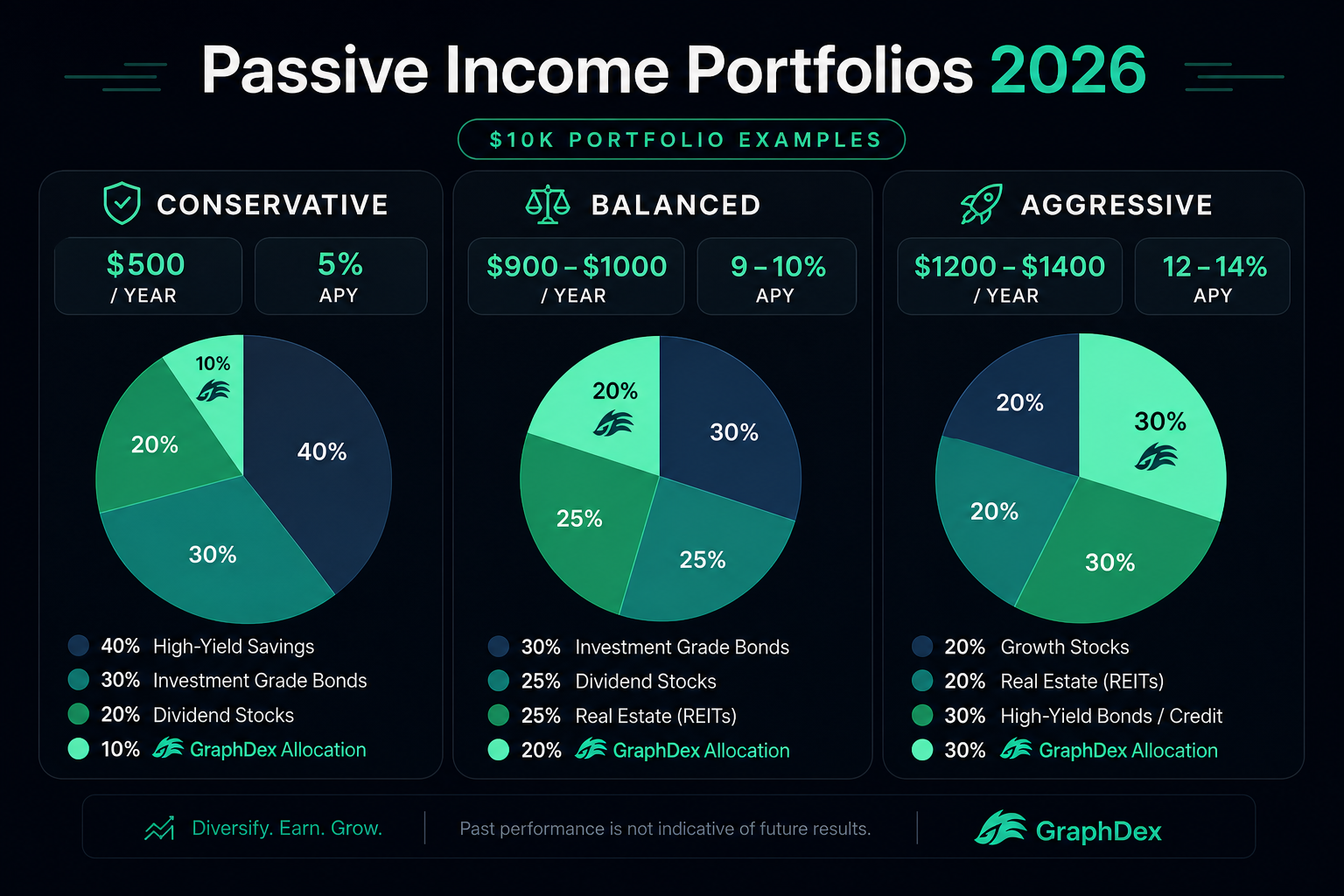
For most users, a diversified approach makes sense. Sample allocations:
Conservative ($10,000 portfolio):
- $4,000 — Liquid staking (Jito/Lido) ~6% APY
- $3,000 — Stablecoin lending (Aave/Kamino) ~5% APY
- $2,000 — Tokenized Treasuries (BUIDL/OUSG) ~4% APY
- $1,000 — Native SOL/ETH for opportunities
Estimated blended yield: ~5% APY = $500/year on $10k
Balanced ($10,000 portfolio):
- $3,000 — Liquid staking
- $2,000 — Stablecoin lending
- $2,500 — Fee-based platform (GraphDex up to 17%)
- $1,500 — LP provision (Orca SOL-USDC concentrated)
- $1,000 — Active opportunities
Estimated blended yield: ~9-10% APY = $900-1,000/year
Aggressive ($10,000 portfolio):
- $2,000 — Liquid staking
- $3,500 — Fee-based platform (GraphDex)
- $2,000 — LP provision (concentrated, active management)
- $1,500 — Yield-bearing stablecoins (USDe, USDS)
- $1,000 — High-conviction active positions
Estimated blended yield: ~12-14% APY = $1,200-1,400/year
The discipline: diversify across yield sources, understand each source, rebalance as rates change, take taxes seriously.
Build a passive income stack on GraphDex
Frequently Asked Questions
What's the safest crypto passive income? Tokenized US Treasuries (BlackRock BUIDL, Ondo OUSG) offer Treasury-grade yield (~4% APY) with blockchain efficiency — among the safest options. Stablecoin lending on established protocols (Aave, Compound) offers ~5% with manageable smart contract risk. FDIC-insured high-yield savings accounts (traditional banks) offer ~4-5% with government insurance for the most conservative.
What's the highest yield crypto passive income? Fee-based platforms like GraphDex offer up to 17% APY from real trading fees. Looped restaking strategies can reach 15-20% with serious risk. Liquidity provision on volatile pairs can pay 20%+ but with impermanent loss risk. Beware: 30%+ APYs typically reflect emission-based yields that collapse predictably.
Are crypto passive income strategies safe? Different strategies carry different risks. Tokenized Treasuries and FDIC savings are safest. Established lending protocols (Aave, Kamino) and liquid staking (Jito, Lido) are well-tested. Newer or higher-yield strategies (restaking, looped strategies) carry more risk. Always diversify, use established protocols, and never invest more than you can afford to lose.
Can I lose money in crypto passive income? Yes. Smart contract exploits (Kelp DAO lost $300M in April 2026), stablecoin depegs (UST collapsed in 2022), validator slashing, impermanent loss, and platform failures all create loss risk. Even tokenized Treasuries depend on custodian solvency. Diversification across yield sources and using audited protocols substantially reduces but doesn't eliminate risk.
How are crypto passive income earnings taxed? In most jurisdictions, crypto income is taxed as ordinary income at fair market value when received. Staking rewards, lending interest, and yield from LPs all generate taxable events. When you later sell, additional capital gains/losses apply. Keep detailed records and consult a crypto-specialist tax professional for your specific situation.
How much money do I need to start? Most strategies work with small amounts. Stablecoin lending and liquid staking accept $10-100 minimums. LP provision usually wants $500+ for gas efficiency. Native ETH staking requires 32 ETH to run a validator (but staking pools accept any amount). Start small to learn mechanics before deploying larger capital.
What's the difference between staking and yield farming? Staking specifically refers to delegating tokens to secure a PoS network for rewards. Yield farming is broader — encompassing staking, lending, LP provision, vaults, and various other strategies. All staking is a form of yield farming, but not all yield farming is staking.
About This Guide
This guide is published by the GraphDex Research team — analysts and traders building the infrastructure for digital asset trading on Solana. Our content is based on live DeFi data, current platform yields, and hands-on experience.
Sources & data: Yield figures and platform details reflect publicly available information as of 2026 and change continuously. Crypto passive income carries real risks. This guide is educational and not financial or tax advice — always do your own research.
GraphDex is the infrastructure for digital asset trading — trade, predict, and earn in one place. Learn more at graphdex.io.
Last reviewed: May 2026 · GraphDex Research
The infrastructure for digital asset trading. Trade, predict, stake, repeat. graphdex.io