By GraphPay Research · Reviewed for accuracy May 2026
Quick Answer
Crypto card cashback and rewards let you earn a percentage back on purchases, but the details matter:
- How it works: You earn a percentage of each purchase back — in crypto, stablecoins, a native token, or fiat, depending on the card
- Typical rates: Range from around 1% to higher tiers, though the highest rates often come with conditions
- The catches: Many high rewards require staking a native token (exposing you to its price risk), have spending caps, or are offset by fees (top-up, FX spread)
- Token reward risk: Rewards paid in a volatile token can lose value; rewards in stablecoins or fiat are more predictable
The honest bottom line: Evaluate rewards by total economics — the reward rate minus all fees (top-up, FX spread) and accounting for any staking requirement or token price risk. A card with modest rewards and low fees can beat one with high rewards and high fees. Don't chase the headline rate.
Explore GraphPay's transparent card economics
Key Takeaways
- Crypto card rewards let you earn a percentage back on purchases, in crypto, stablecoins, or fiat.
- Headline rates can mislead — high rewards often require staking a token or come with caps/fees.
- Rewards in a volatile token carry price risk; stablecoin/fiat rewards are more predictable.
- Evaluate by total economics: reward rate minus all fees, accounting for token risk.
How Crypto Card Rewards Work
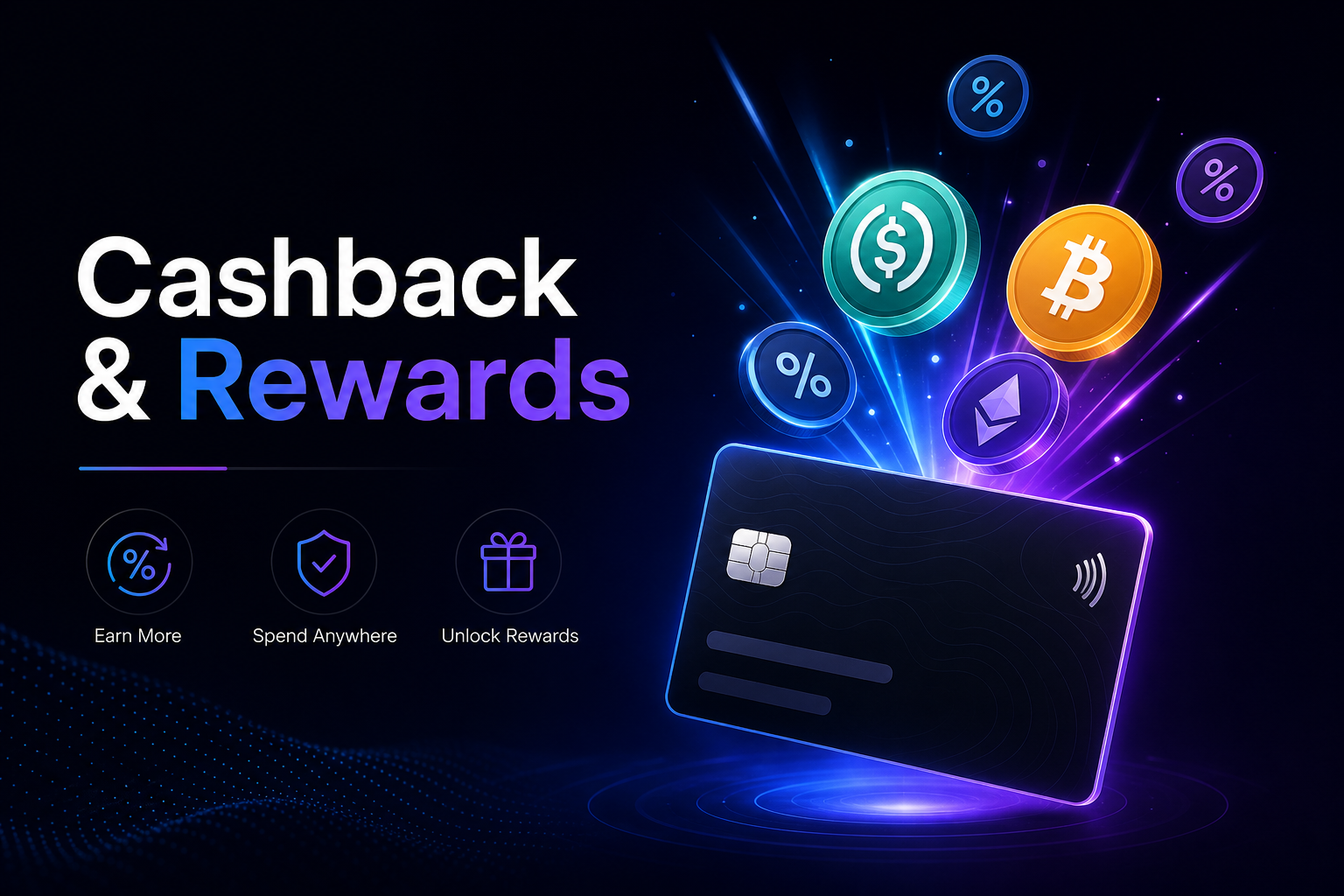
Crypto card rewards give you a percentage of your spending back — similar to traditional credit card cashback, but often paid in crypto. They're a major reason people choose crypto cards.
The basic mechanic:
- You make a purchase with your crypto card
- The card credits you a percentage back as a reward
- The reward is paid in crypto, stablecoins, a native token, or occasionally fiat, depending on the card
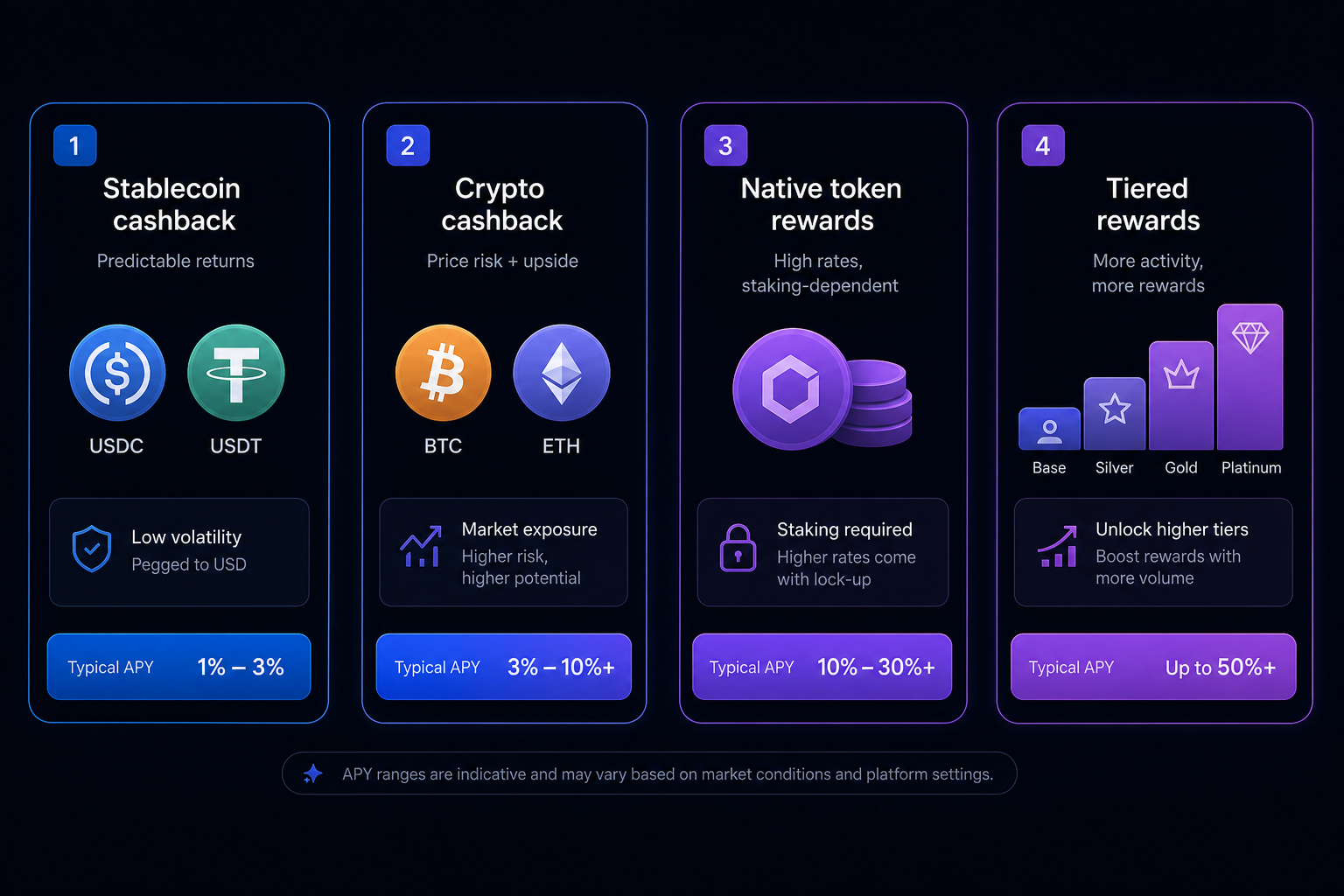
Types of rewards:
Cashback in stablecoins. Some cards pay rewards in stablecoins (USDC, USDT) — predictable value, no volatility risk. This is often the most straightforward reward type.
Cashback in crypto. Some pay in a major crypto (BTC, ETH) — you earn crypto on your spending, with that crypto's price risk (and upside).
Cashback in a native token. Many cards pay rewards in their own native token. Higher advertised rates often require holding or staking this token — and the reward's value depends on the token's price.
Tiered rewards. Rewards often scale with tiers — higher rewards for staking more of a native token, or for higher spending volumes.
Why cards offer rewards: Rewards attract and retain users, and (for cards with native tokens) drive demand for the token. Understanding the card's motivation helps you evaluate whether the rewards are sustainable and genuinely valuable to you.
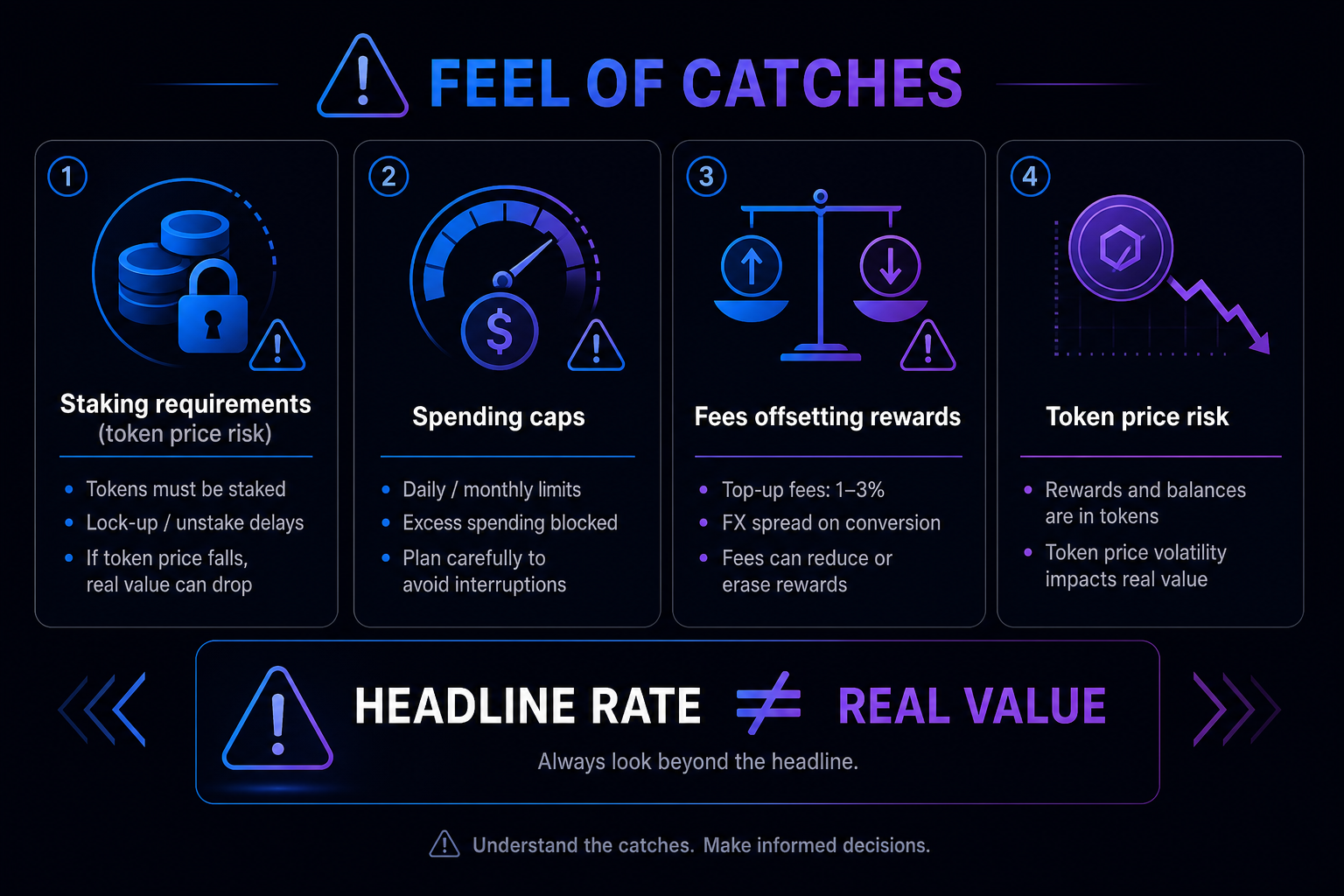
The Catches: What to Watch For
Crypto card rewards often come with conditions that reduce their real value. Understanding these prevents disappointment.
Staking Requirements
The biggest catch: many high reward rates require staking (locking) a native token.
How it works: To earn the headline rate (say, a high percentage), you may need to stake a significant amount of the card's native token. Lower staking = lower rewards.
The risk: Staking a native token exposes you to its price risk. If the token drops, your staked value falls — potentially offsetting or exceeding your rewards. The "high reward rate" assumes you've taken on this token exposure.
Spending Caps
Many rewards have caps — you earn the advertised rate only up to a monthly spending limit, with lower or no rewards above it.
What to check: The reward cap. A high rate capped at a low monthly spend is worth less than a modest rate with no cap, for higher spenders.
Fees That Offset Rewards
Rewards can be offset by fees:
- Top-up fees (1-3% when loading) can exceed modest rewards
- FX spreads (0.5-1.5% hidden in conversion) eat into rewards
- Monthly fees on premium tiers reduce net value
The key insight: A card offering 2% rewards but charging a 3% top-up fee has negative net economics. Always subtract all fees from rewards to find the real value.
Token Price Risk
Rewards paid in a volatile token can lose value between earning and using them. A "5% reward" in a token that drops 20% is worth less than it appeared.
The honest takeaway: The headline reward rate is rarely the real value. Staking requirements (token risk), spending caps, offsetting fees, and token price risk all reduce it. Evaluate the total economics, not the advertised percentage.
How to Evaluate Crypto Card Rewards Honestly
A framework for finding the real value.
Step 1: Identify the reward type. Is it paid in stablecoins (predictable), major crypto (price risk + upside), or a native token (price risk, often staking-dependent)? Stablecoin/fiat rewards are the most predictable.
Step 2: Check the requirements. Does the headline rate require staking a native token? How much? Factor in the token price risk of that staking.
Step 3: Check the caps. Is there a monthly spending cap on rewards? Calculate your realistic rewards based on your actual spending.
Step 4: Subtract all fees. Top-up fees, FX spread, monthly fees — subtract these from your rewards. This reveals net economics.
Step 5: Calculate real value for your usage. Using your actual spending pattern:
- Rewards earned (rate × spending, up to caps)
- Minus fees (top-up, FX spread, monthly)
- Adjusted for token risk (if rewards or staking involve a volatile token)
Step 6: Compare cards on net value. The card with the best net economics for your usage wins — not necessarily the highest headline rate.
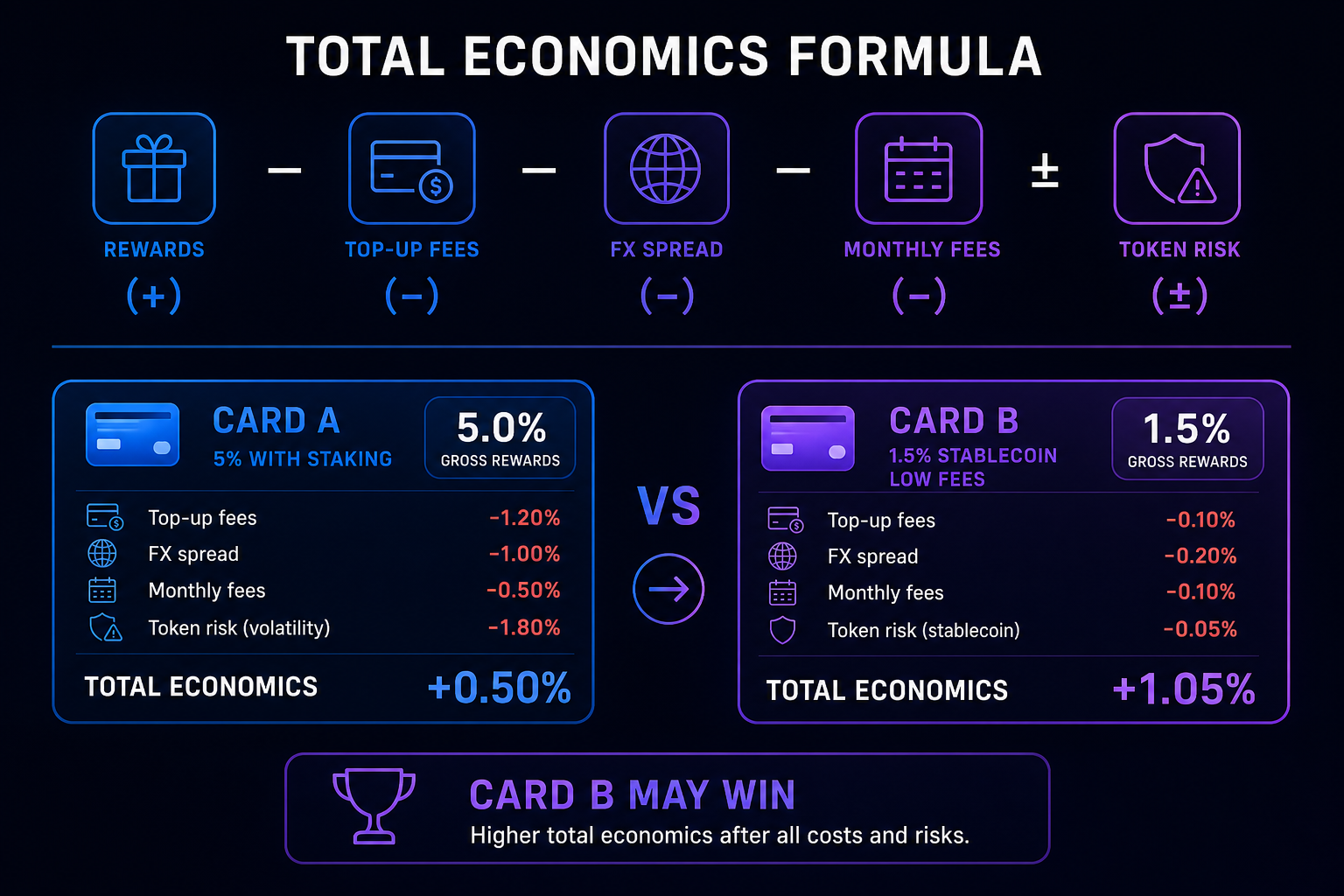
A worked example:
- Card A: 5% rewards (requires staking $2,000 of native token), 2% top-up fee, 1% FX spread
- Card B: 1.5% rewards in stablecoins, 0% top-up, tight spread
For a modest spender, Card B's predictable 1.5% (net of low fees) may beat Card A's 5% (offset by fees, requiring risky token staking). The headline favors A; the real value may favor B.
Compare real card economics with GraphPay
The principle: Don't chase headline reward rates. Calculate net value (rewards minus fees, adjusted for token risk) for your actual usage. Transparency about fees and requirements is itself a positive sign.
Rewards vs Total Economics: The Bigger Picture
The most important insight: rewards are just one part of a card's total economics.
The full economic picture:
- Rewards: What you earn back (+)
- Top-up fees: What you pay to load (−)
- FX spread: Hidden conversion cost (−)
- Monthly fees: Recurring cost (−)
- Token risk: If rewards/staking involve a volatile token (variable)
Why total economics matter more than rewards alone: A card marketed on high rewards can have worse total economics than a card with modest rewards and low fees. The rewards are visible and advertised; the fees (especially the FX spread) are often hidden. Focusing only on rewards misses the full cost.
The transparent-card advantage: Cards that transparently disclose all costs (rewards AND fees, including the FX spread) let you calculate real value. Cards that emphasize rewards while hiding fees make honest comparison hard — a red flag.
The practical approach: Rather than "which card has the highest rewards," ask "which card has the best total economics for my spending." This accounts for rewards, all fees, and token risk together — revealing the genuinely best value.
How GraphPay Approaches Card Economics
GraphPay focuses on transparent, non-custodial card economics — so you can see the real value clearly.
The GraphPay approach:
- Transparent pricing — clear disclosure of costs, no hidden-spread tricks
- Non-custodial — your crypto stays in your own wallet, converting only when you spend
- Stablecoin-friendly — spend USDT or USDC for predictable value
- Multi-chain — fund from BNB Chain, Ethereum, or TRON efficiently
- Tiered KYC — Level 3 typically unlocks the best economics
Why transparency matters for rewards: The crypto card market is full of cards marketed on high rewards that are offset by hidden fees (especially the FX spread). GraphPay's transparent approach means you can see the real economics — rather than being drawn in by a headline reward rate that hidden fees erode.
The honest positioning: Rather than luring you with an unsustainable headline reward rate offset by hidden costs, GraphPay focuses on transparent economics and non-custodial security. When evaluating any card's rewards, calculate the total economics (rewards minus all fees, adjusted for token risk) — and favor transparency. That's how you find genuine value.
For those who value clear, honest card economics over headline reward rates masking hidden fees, GraphPay's transparent, non-custodial approach is built for that.
See GraphPay's transparent card economics
Frequently Asked Questions
How does crypto card cashback work? Crypto card cashback gives you a percentage of your spending back, similar to credit card cashback but often paid in crypto. You make a purchase, and the card credits you a percentage back — in stablecoins (predictable), major crypto (price risk + upside), a native token (often staking-dependent), or occasionally fiat. Rates typically range from around 1% to higher tiers, though the highest rates usually come with conditions.
Are crypto card rewards worth it? They can be, but the headline rate rarely tells the full story. High rewards often require staking a native token (exposing you to its price risk), have spending caps, or are offset by fees (top-up, FX spread). A card with modest rewards and low fees can beat one with high rewards and high fees. Calculate total economics — rewards minus all fees, adjusted for token risk — for your actual spending to find the real value.
Why do high crypto card rewards require staking a token? Because cards with native tokens use staking requirements to drive demand for their token — higher rewards for staking more. The catch: staking exposes you to the token's price risk. If the token drops, your staked value falls, potentially offsetting your rewards. The "high reward rate" assumes you've taken on this token exposure. Factor the token risk into whether the rewards are genuinely worth it.
What's the catch with crypto card cashback? Several common catches: staking requirements (high rates need you to stake a native token, adding price risk), spending caps (the rate applies only up to a monthly limit), offsetting fees (top-up fees and FX spreads can exceed modest rewards), and token price risk (rewards in a volatile token can lose value). Always subtract all fees from rewards and account for token risk to find the real value.
Are rewards paid in crypto or cash? It depends on the card. Rewards may be paid in stablecoins (USDC/USDT — predictable value), major crypto (BTC/ETH — price risk and upside), a native token (often the highest advertised rates, with price risk), or occasionally fiat. Stablecoin and fiat rewards are the most predictable; volatile token rewards can gain or lose value. Check what a card pays rewards in before assuming the rate's value.
How do I compare crypto card rewards? Don't just compare headline rates. Identify the reward type (stablecoin vs volatile token), check requirements (staking?), check caps (monthly limits?), subtract all fees (top-up, FX spread, monthly), and calculate net value for your actual spending. Compare cards on net economics — rewards minus fees, adjusted for token risk — not the advertised percentage. Transparency about fees is itself a positive sign.
Can rewards be offset by fees? Yes — this is a common trap. A card offering 2% rewards but charging a 3% top-up fee has negative net economics. FX spreads (0.5-1.5% hidden in conversion) and monthly fees also offset rewards. Always subtract all fees from your rewards to find the real value. A card marketed on high rewards can have worse total economics than one with modest rewards and low, transparent fees.
About This Guide
This guide is published by the GraphPay Research team — building non-custodial crypto payment infrastructure. Our content is based on current card industry practices, reward structures, and 2026 market data.
Sources & data: Reward types and ranges reflect publicly available information as of 2026 and may change. Specific rewards, requirements, and fees vary by provider. Rewards in volatile tokens carry price risk; staking requirements add exposure. This guide is educational and not financial advice — always evaluate total economics and verify current terms with your provider.
GraphPay is non-custodial crypto payment infrastructure — your crypto, your pay. Learn more at graphpay.io.
Last reviewed: May 2026 · GraphPay Research