By GraphDex Research · Reviewed for accuracy July 2026
Quick Answer
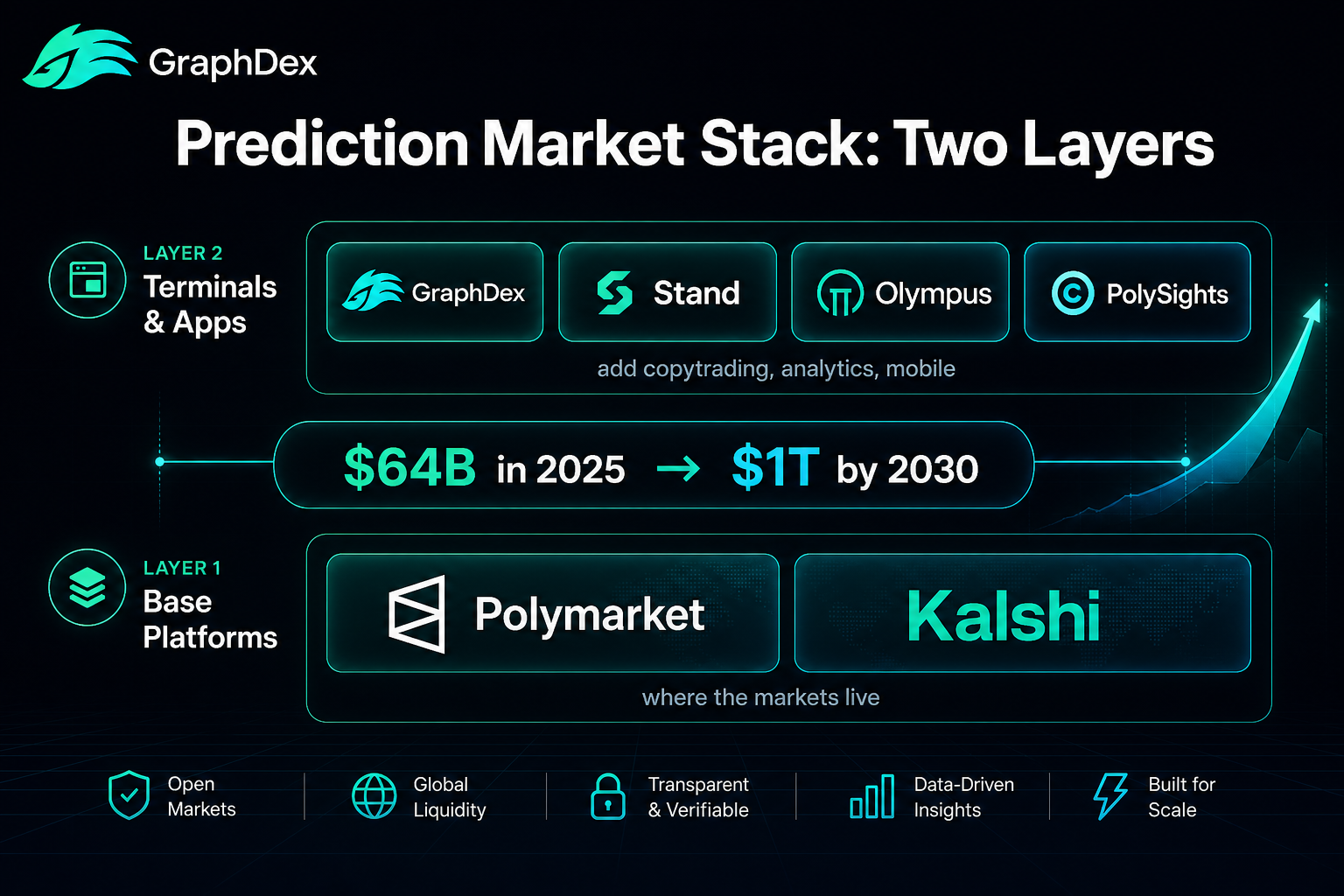
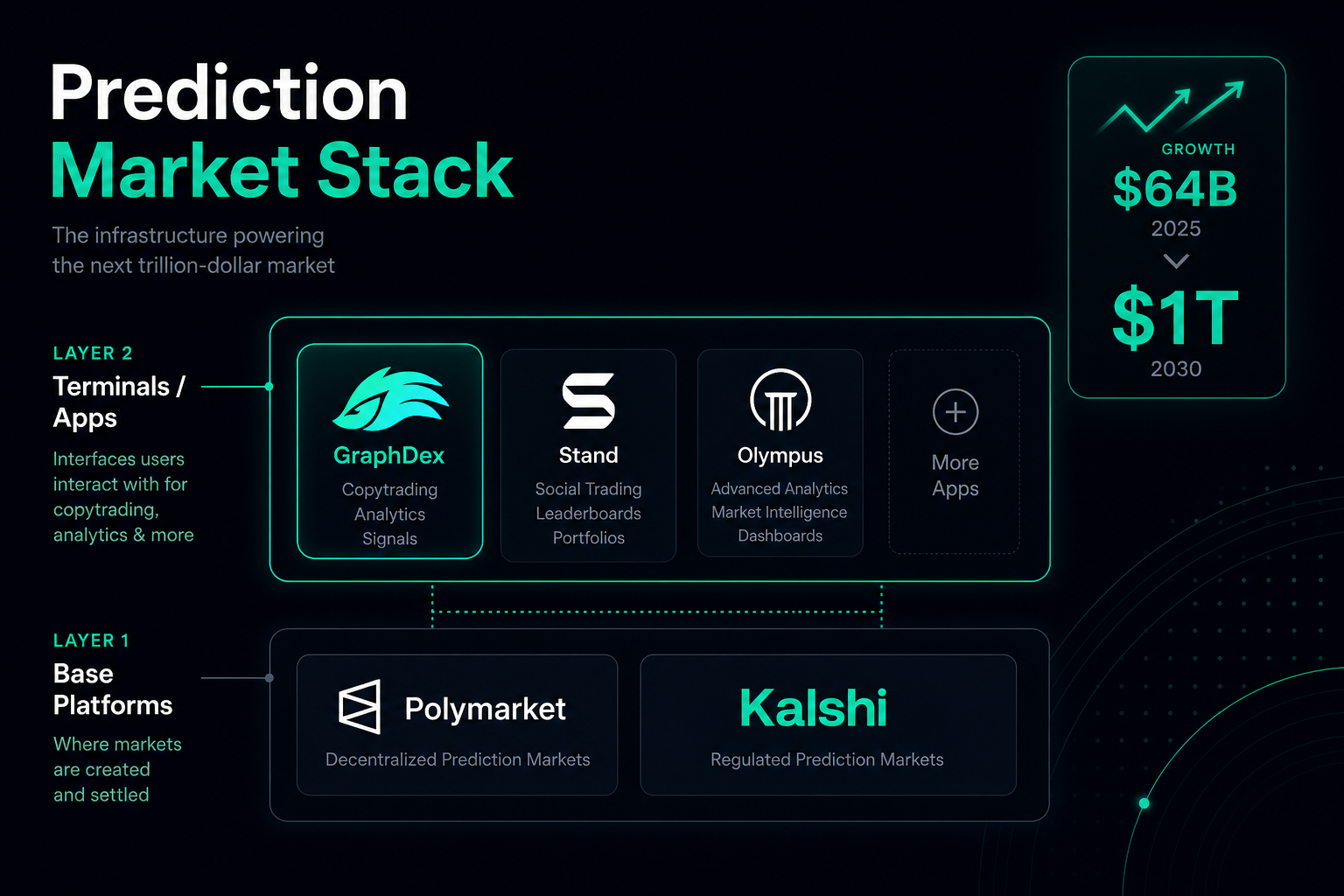
The best prediction market apps and terminals in 2026 fall into two groups — base platforms and the tools built on top of them:
Base platforms (where markets live):
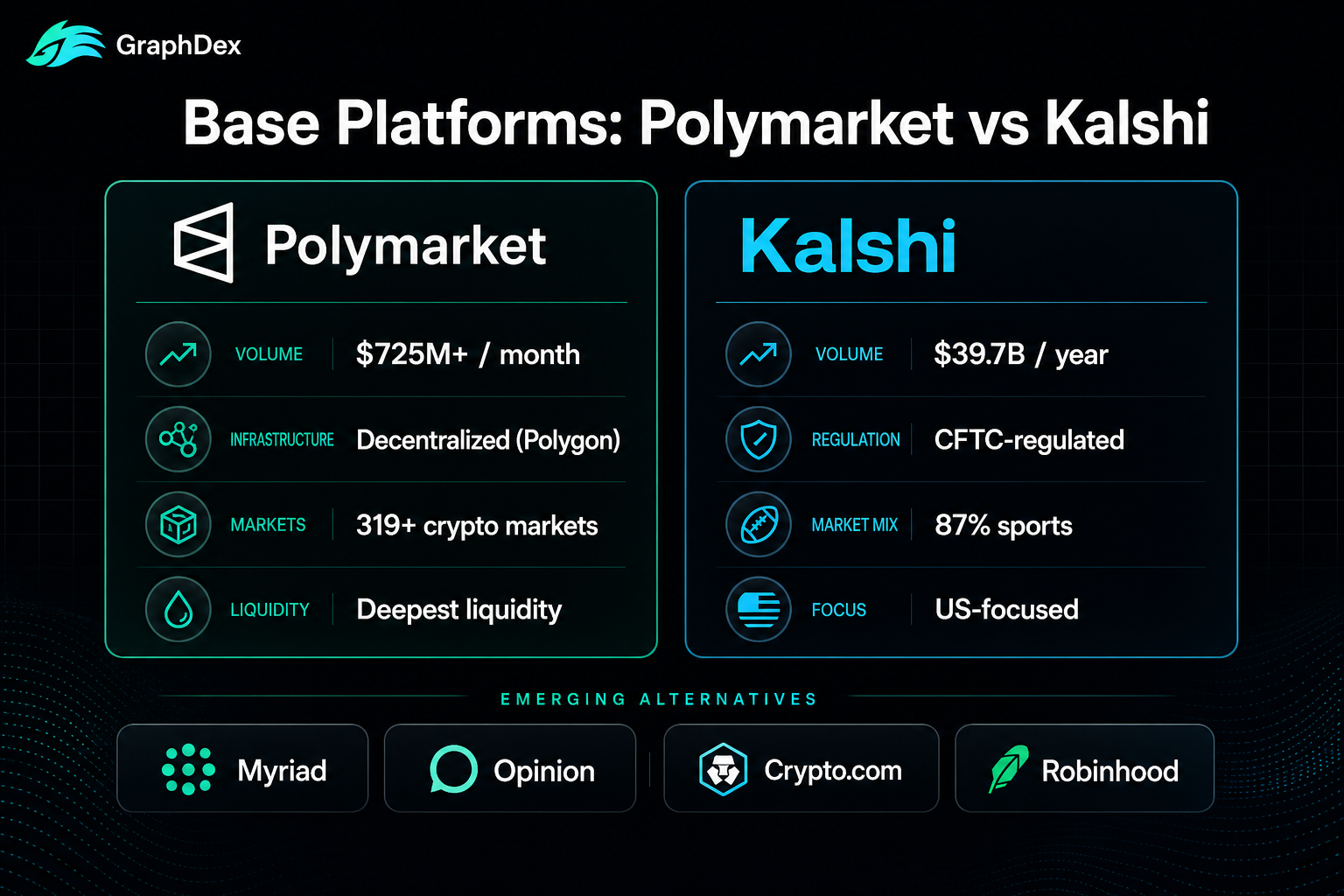
- Polymarket — Largest decentralized prediction market ($725M+ monthly volume, 319+ crypto markets)
- Kalshi — Largest regulated US platform ($39.7B/year, 87% sports)
- Myriad, Opinion, Crypto.com, Robinhood — Emerging alternatives
Terminals & apps (built on top):
- GraphDex — Best integrated terminal (copytrading + Solana trading + AI signals, non-custodial)
- Stand — Best multi-venue aggregator (Polymarket + Kalshi)
- Olympus — Best dedicated copytrading
- PolySights — Best analytics and whale tracking
- PolyCule / PolyBot — Best Telegram trading
The honest truth: The base platforms (Polymarket, Kalshi) are where you trade; terminals add the copytrading, analytics, and mobile-friendly execution that turn casual betting into systematic trading.
Trade prediction markets on GraphDex
Key Takeaways
- Prediction markets split into base platforms (Polymarket, Kalshi) and terminals built on top.
- The sector hit $64B+ in 2025, projected to reach $1 trillion by 2030.
- Terminals add copytrading, analytics, and mobile access that base platforms lack.
- For systematic trading, an integrated terminal beats juggling the base platform plus separate tools.
The Prediction Market Landscape in 2026
Prediction markets let people trade on the outcomes of future events — elections, sports, economic data, crypto prices, cultural moments. Prices reflect the crowd's probability estimate, often more accurately than polls or pundits.
The explosive growth:
- Sector exceeded $64 billion in volume in 2025
- Projected to reach $1 trillion by 2030
- Polymarket and Kalshi combined process $3.8 billion per week
- An arXiv study (March 2026) confirmed prediction markets outperform polls
Why the tooling layer emerged: The base platforms (Polymarket, Kalshi) are excellent for placing trades but limited for systematic trading. They lack native copytrading, advanced analytics, mobile-optimized terminals, and multi-venue aggregation. A layer of apps and terminals filled these gaps — and that's where serious traders now operate.
The two-layer structure:
- Base platforms host the actual markets and liquidity
- Terminals/apps add copytrading, analytics, execution tools, and mobile access on top
Understanding this structure is key to choosing the right tools.
Base Platforms: Where Markets Live
Polymarket — The Decentralized Leader
Volume: $725M+ monthly Markets: 319+ crypto markets, thousands of political/sports/event contracts Structure: Decentralized, Polygon-based, Central Limit Order Book (CLOB) Regulation: CFTC oversight in US via QCX LLC (on CFTC DCM list)
Polymarket is the world's largest decentralized prediction market. It's the deepest liquidity for most political, macroeconomic, and cultural events. Its APIs (Gamma for market discovery, CLOB for order book depth) power most third-party terminals.
Best for: Crypto-native traders, political/macro markets, deepest liquidity.
Kalshi — The Regulated US Leader
Volume: $39.7B/year Markets: 87% sports, plus economics, politics, weather Structure: CFTC-regulated exchange (DCM) Regulation: Fully regulated US platform
Kalshi is the largest fully-regulated US prediction market. After the CFTC reversed its position in January 2025, Kalshi expanded aggressively, especially into sports (87% of volume).
Best for: US users wanting regulatory clarity, sports markets.
Emerging Alternatives
Myriad — Growing decentralized alternative. Opinion — Newer prediction platform. Crypto.com / Robinhood — Major apps adding prediction market features. DraftKings — Sports-betting giant entering prediction markets. Manifold — Play-money markets (good for learning). PredictIt — Long-established political markets.
The base-platform landscape is consolidating around Polymarket (decentralized) and Kalshi (regulated), with others competing for niches.
Terminals & Apps: Where Serious Traders Operate
GraphDex — Best Integrated Terminal
Category: Integrated trading terminal Custody: Non-custodial (Privy) Best for: Traders wanting prediction markets + crypto trading in one place
GraphDex integrates Polymarket prediction markets — including the world's first prediction-market copytrading — into a broader Solana trading terminal.
Prediction-market features:
- Copytrading on Polymarket (mirror successful predictors)
- Direct prediction-market access
- Bubble Maps visual screener for prediction markets
- AI signals for opportunity discovery
Beyond prediction markets:
- Solana DEX trading (Raydium, Orca, Meteora)
- Up to 17% APY staking on idle capital between predictions
- Pulse feed, MEV protection
- Non-custodial Privy wallet (Twitter/email/Telegram login)
Where it wins: Consolidation. Prediction markets + crypto trading + copytrading + yield in one non-custodial terminal. Where competitors win: Pure-play specialists offer deeper niche features.
Try GraphDex prediction market terminal
Stand — Best Multi-Venue Aggregator
Aggregates Polymarket + Kalshi with live trade feeds, PnL filtering, whale tracking, and a unique counter-trading feature (copy the inverse of losing wallets). Started as a Discord whale tracker, evolved into a full terminal.
Best for: Traders covering multiple venues simultaneously.
Olympus / PolyFollow — Best Copytrading
Dedicated copytrading platform. 10,000+ traders, $50M+ volume, three-phase execution with retry logic, copy ratios 0.1×-1×. Non-custodial, web-based.
Best for: Pure copytrading focus.
PolySights / HashDive — Best Analytics
Aggregates Polymarket API data for whale tracking, insider trade flagging, and probability-shift alerts in political and macro markets.
Best for: Research-driven traders (pair with a separate execution tool).
PolyCule / PolyBot — Best Telegram
Telegram-native bots for trading Polymarket from chat with simple commands. PolyBot is non-custodial.
Best for: Telegram-first traders wanting low-friction execution.
Alphascope — Best AI Signals
AI-driven signal service with 10,000+ traders and a free tier. Sentiment analysis to identify unusual activity before mainstream awareness.
Best for: Traders wanting AI opportunity detection.
Comparison Table
| Tool | Type | Custody | Best For |
|---|---|---|---|
| Polymarket | Base platform | Non-custodial | Decentralized markets, deep liquidity |
| Kalshi | Base platform | Regulated | US users, sports markets |
| GraphDex | Terminal | Non-custodial | Integrated trading + copytrading |
| Stand | Aggregator | Varies | Multi-venue coverage |
| Olympus | Copytrading | Non-custodial | Dedicated copytrading |
| PolySights | Analytics | N/A | Whale tracking, research |
| PolyCule | Telegram bot | Varies | Telegram trading |
| Alphascope | AI signals | N/A | AI opportunity detection |
How to Choose Your Prediction Market Stack
The right combination depends on your approach:
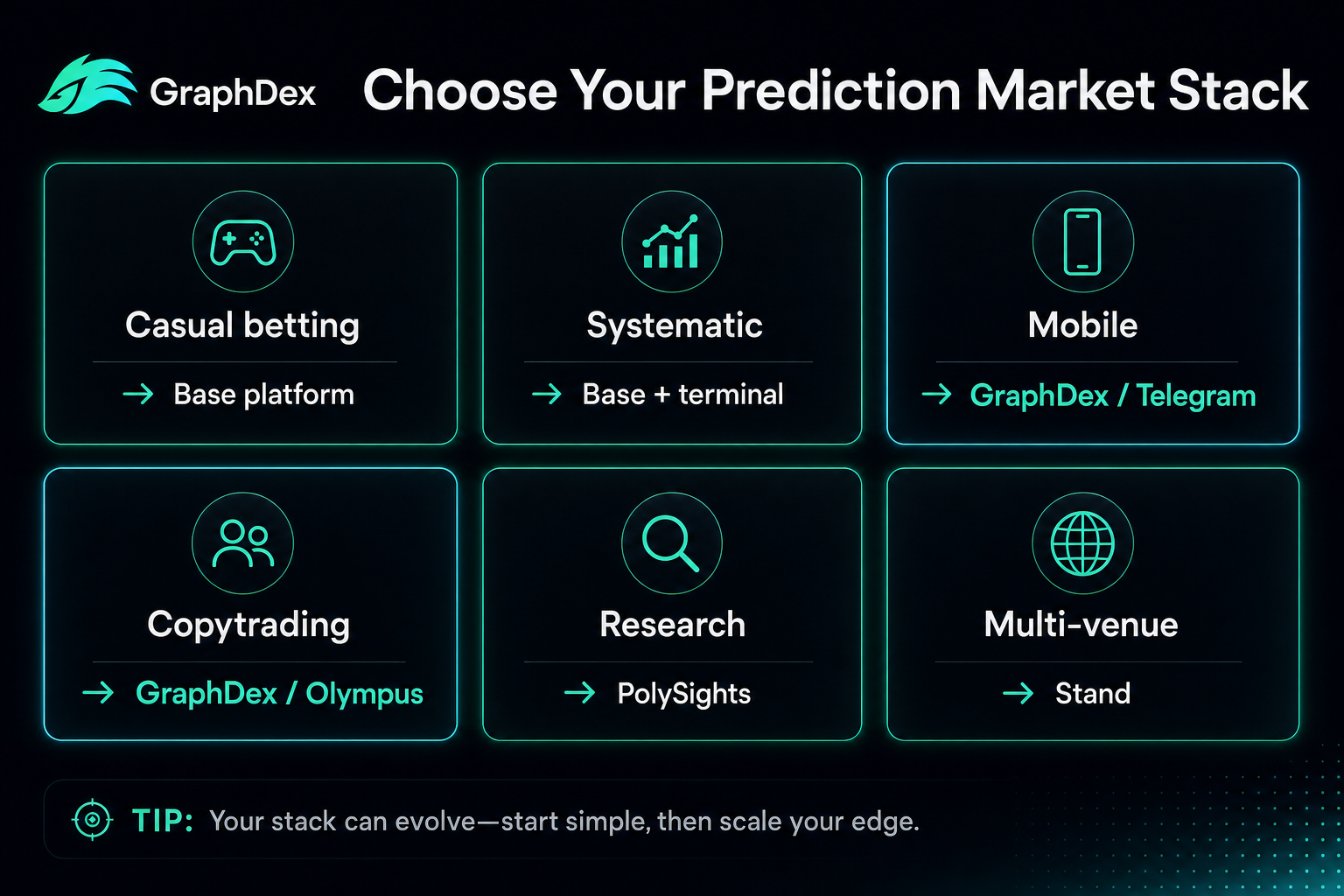
For casual betting: Just use a base platform — Polymarket (decentralized) or Kalshi (regulated US). No terminal needed.
For systematic trading: Base platform + terminal. The terminal adds copytrading, analytics, and better execution.
For mobile-first trading: GraphDex (integrated mobile-friendly terminal) or Telegram bots (PolyCule, PolyBot).
For copytrading: GraphDex (integrated) or Olympus (dedicated).
For research-heavy trading: PolySights for analytics + execution tool.
For multi-venue coverage: Stand (Polymarket + Kalshi).
For crypto traders adding prediction markets: GraphDex — consolidates prediction markets with your existing Solana trading.
The practical reality: Casual users need only a base platform. Serious traders combine a base platform with terminals. An integrated terminal like GraphDex reduces the number of tools by consolidating execution, copytrading, and analytics — plus broader crypto trading and yield on idle capital.
Build your prediction market stack with GraphDex
Are Prediction Markets Legal?
A critical consideration before choosing platforms.
United States: The CFTC has exclusive federal jurisdiction over prediction markets. Polymarket operates via QCX LLC (on the CFTC DCM list); Kalshi is a fully regulated CFTC DCM. The CFTC reversed its restrictive stance in January 2025. However, 13 states have enforcement actions, and the CFTC has sued several states over jurisdiction. A 3rd Circuit ruling (April 2026) favored Kalshi vs New Jersey.
Sports markets specifically: A Schiff+Curtis bill proposes banning sports from CFTC prediction markets — an evolving legal question.
International: Regulations vary widely by country. Some allow prediction markets freely; others restrict them.
The practical takeaway: In the US, federally-regulated platforms (Kalshi, Polymarket via QCX) are on the clearest legal footing, though state-level enforcement varies. Always verify the legal status in your specific jurisdiction. This is not legal advice — consult a qualified attorney for your situation.
How GraphDex Fits the Prediction Market Stack
GraphDex addresses the core inefficiency of the prediction-market tooling landscape: fragmentation.
Most serious prediction-market traders juggle a base platform (Polymarket), a copytrading bot (Olympus), an analytics tool (PolySights), a wallet, and a separate crypto trading platform. GraphDex consolidates:
- Prediction markets — direct Polymarket access
- Copytrading — world's first integrated prediction-market copytrading
- Bubble Maps — visual screener for prediction markets
- AI signals — opportunity discovery
- Broader trading — Solana DEX trading in the same terminal
- Yield — up to 17% APY on idle capital between predictions
- Non-custodial — Privy wallet, sign in with Twitter/email/Telegram
For traders who participate in both prediction markets and crypto, this consolidation is the central value — one terminal instead of five tools.
The 2026 Prediction Market Terminal Landscape
The case for a prediction market terminal grew stronger through 2026, as the underlying markets exploded in size and fragmented across venues.
The market scale. Combined monthly volume across the two largest prediction platforms (Kalshi and Polymarket) reached approximately $44.8 billion in June 2026, driven by historic World Cup trading — more than triple the average monthly handle of all legal US sportsbooks in 2025. Industry analysts project prediction market annual volume could reach $1 trillion by 2030.
The fragmentation problem a terminal solves. As of mid-2026, volume split across Kalshi (majority share, sports-dominant), Polymarket (crypto-native, politics and world-event depth), and a growing set of new entrants including Robinhood, Interactive Brokers, and CME Group. With markets, liquidity, and traders spread across venues, a terminal that aggregates discovery, analytics, copytrading, and execution in one place addresses real fragmentation — you don't have to juggle multiple platforms and tools.
Why copytrading and analytics matter more now. With thousands of markets across venues and record volume, no individual can monitor it all or have expertise in every category. This is exactly what a terminal adds on top of the base platforms: copytrading (mirror proven traders), whale tracking (follow smart money), and analytics (surface opportunities) — turning overwhelming market breadth into actionable signals.
The on-chain verification edge. For copytrading specifically, prediction markets like Polymarket are on-chain, so a trader's real track record is verifiable from blockchain data — unlike forex/stock copytrading where performance can be faked. A terminal that surfaces on-chain-verified traders makes copytrading more trustworthy than in traditional markets.
Related Guides
- What Is a Prediction Market Terminal?
- Best Polymarket Copytrading Platforms
- Prediction Market Copy Trading: The Complete Guide
- Best Polymarket Alternatives 2026
- What Is GraphDex?
Frequently Asked Questions
What is the best prediction market app in 2026? For base platforms: Polymarket (decentralized, deepest liquidity) or Kalshi (regulated US, sports). For terminals adding copytrading and analytics: GraphDex (integrated with crypto trading), Stand (multi-venue aggregation), or Olympus (dedicated copytrading). Casual users need only a base platform; serious traders combine a base platform with terminals.
What's the difference between Polymarket and a prediction market terminal? Polymarket is a base platform — it hosts the actual markets and liquidity. A terminal (like GraphDex or Stand) is built on top, adding features Polymarket lacks: copytrading, advanced analytics, multi-venue aggregation, mobile-optimized execution, and integration with broader trading. You trade Polymarket's markets through the terminal's enhanced interface.
Is Polymarket or Kalshi better? Different strengths. Polymarket is decentralized, has the deepest liquidity for political/macro/crypto markets, and is crypto-native ($725M+ monthly volume). Kalshi is fully CFTC-regulated, US-focused, and dominant in sports (87% of its $39.7B annual volume). Choose Polymarket for crypto-native decentralized trading; Kalshi for regulated US access and sports.
Can I trade prediction markets on mobile? Yes. GraphDex offers a mobile-friendly integrated terminal. Telegram bots (PolyCule, PolyBot) enable mobile trading via chat. The base platforms (Polymarket, Kalshi) also have apps. For systematic mobile trading with copytrading and analytics, integrated terminals offer more than the base platform apps alone.
Are prediction markets legal in the US? Federally, yes — under CFTC jurisdiction. Polymarket (via QCX LLC) and Kalshi are on the CFTC's regulated platform lists. The CFTC reversed its restrictive stance in January 2025. However, 13 states have enforcement actions, and legal questions remain (especially around sports markets). Verify the status in your specific state. This isn't legal advice.
How big is the prediction market sector? The sector exceeded $64 billion in volume in 2025 and is projected to reach $1 trillion by 2030. Polymarket and Kalshi combined process $3.8 billion per week. An arXiv study in March 2026 confirmed prediction markets outperform traditional polls for forecasting. The sector is one of crypto's fastest-growing categories.
Do prediction market terminals cost money? Varies. Some terminals charge subscriptions (Stand, some copytrading bots); others charge transaction fees; some offer free tiers (Alphascope). GraphDex's prediction-market features are part of its integrated terminal. Base platforms (Polymarket, Kalshi) charge their own fees. Compare total costs (subscription + transaction fees) for your expected trading volume.
About This Guide
This guide is published by the GraphDex Research team — analysts and traders building the infrastructure for digital asset trading on Solana. Our content is based on direct experience, live platform comparisons, and 2026 market data.
Sources & data: Platform volumes, market counts, and sector projections reflect publicly available information as of 2026 and may change. Prediction market legality varies by jurisdiction. This guide is educational and not financial or legal advice — always do your own research.
GraphDex is the infrastructure for digital asset trading — trade, predict, and earn in one place. Learn more at graphdex.io.
Last reviewed: July 2026 · GraphDex Research
The infrastructure for digital asset trading. Trade, predict, stake, repeat. graphdex.io