By GraphDex Research · Reviewed for accuracy May 2026
Quick Answer
The top Solana DeFi protocols in 2026 lead distinct categories — best to combine 2-3 of them for a full DeFi stack:
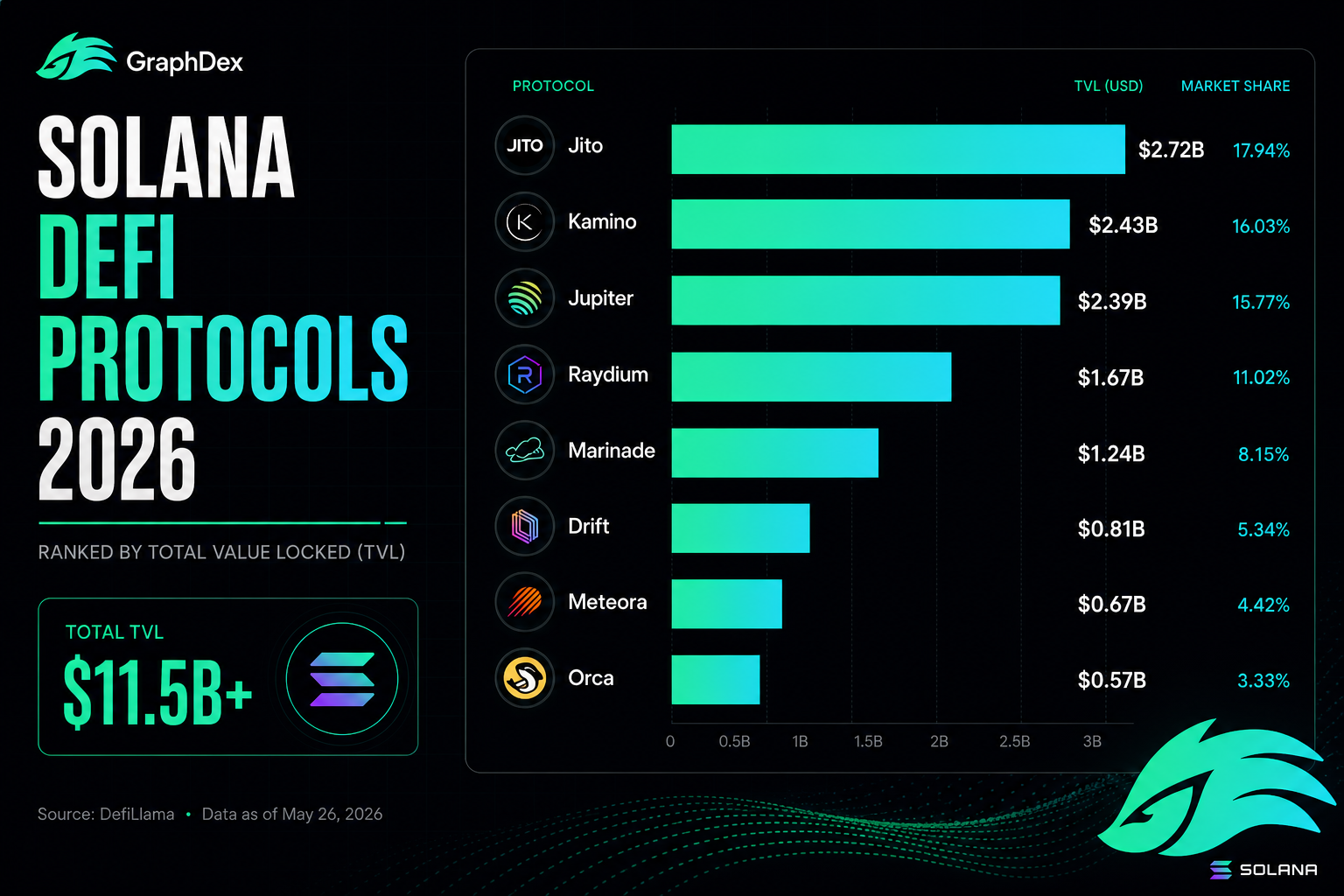
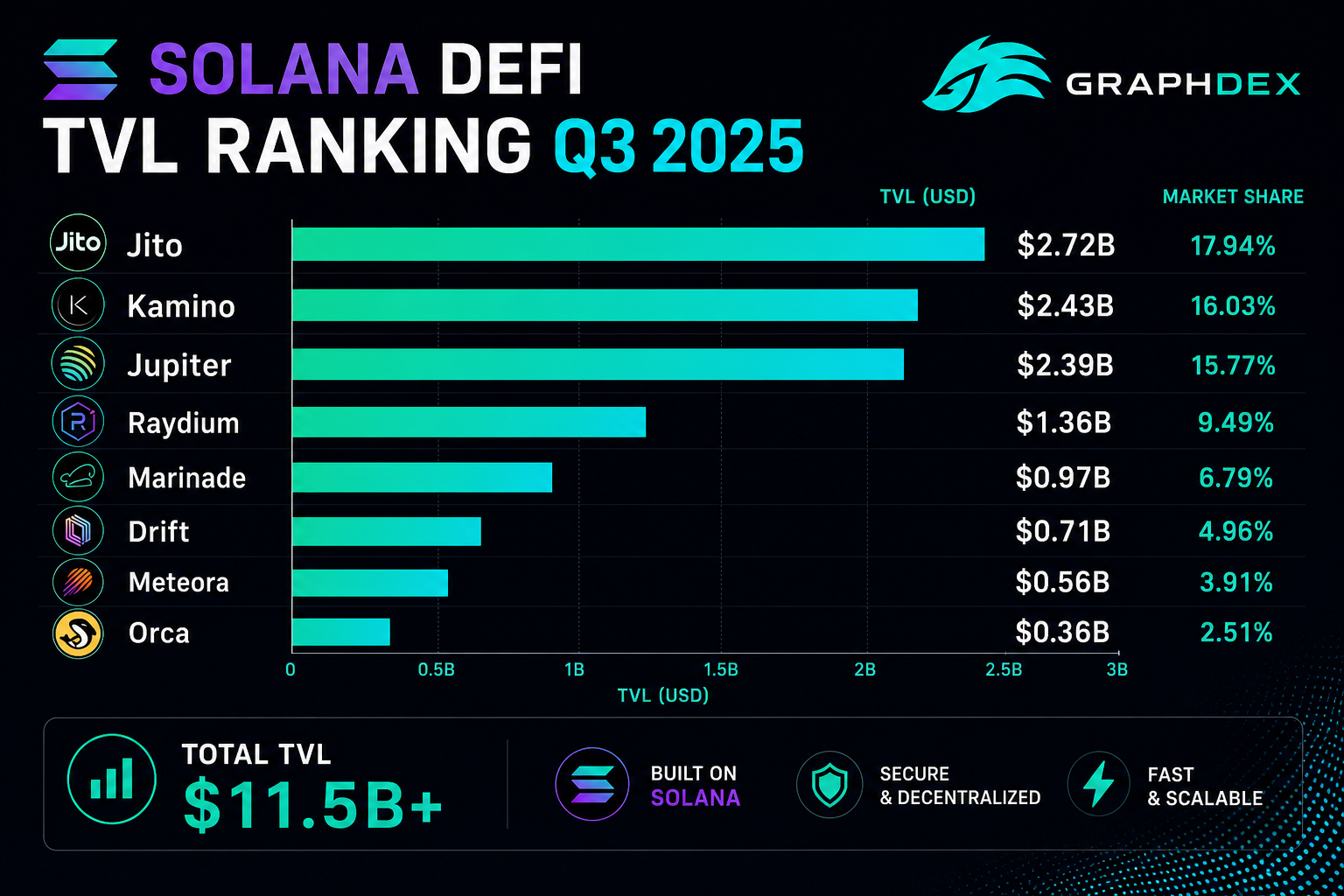
- Best DEX aggregator: Jupiter ($2.39B+ TVL) — best execution across all Solana DEXs
- Best lending protocol: Kamino Finance ($2.43B+ TVL) — institutional-grade risk management
- Best liquid staking: Jito ($2.72B+ TVL) — captures MEV for ~5.80% APY (above standard staking)
- Best AMM/DEX: Raydium — concentrated liquidity and launchpad integration
- Best derivatives: Drift Protocol — sub-400ms perpetual futures
- Best alternative liquid staking: Marinade — original Solana LST, 100+ validator decentralization
- Best trading terminal: GraphDex — DEX + prediction markets + 17% APY staking in one
- Best oracles: Pyth Network — Solana's primary price oracle infrastructure
- Best launchpad: Pump.fun — 71%+ of all Solana tokens minted
Total Solana DeFi TVL: $11.5B+ (Q3 2025). Network handled 100% uptime through 2025.
Trade Solana DeFi natively with GraphDex
Key Takeaways
- Solana DeFi has matured into production infrastructure with ~$11.5B TVL across 50+ protocols.
- Top three (Jito, Kamino, Jupiter) each manage $2+ billion and dominate their categories.
- Solana's 400ms finality and sub-cent fees enable use cases impractical on Ethereum L1.
- Best practice: combine 2-3 protocols across staking, lending, and trading for a diversified DeFi stack.
Why Solana DeFi Matters in 2026
Solana's DeFi ecosystem has reached genuine maturity. The numbers tell the story:
- TVL: $11.5 billion across all protocols (Q3 2025 figure)
- Lending markets: $3.6 billion grown by December 2025
- Network performance: 400ms block times, fees under $0.001, 100% uptime through 2025
- Stablecoin volume: $650 billion processed on Solana in February 2026 — the highest of any chain
- DEX volume: Leading weekly DEX volume globally in 2026
The architectural advantage: sub-cent transaction fees and sub-second finality enable use cases that are simply uneconomical on Ethereum L1. Active trading, memecoin participation, frequent yield strategies, prediction markets — all become viable when each interaction costs $0.001 instead of $5-50.
By 2026, the top Solana DeFi protocols have grown into the kind of established, audited, production-grade infrastructure that supports billions in capital. Choice is less about "which one to trust" (most blue-chips are battle-tested) and more about which protocols match your specific use case.
What's the Best Solana DEX Aggregator?
Jupiter is Solana's most comprehensive DEX aggregator and has evolved into what many call Solana's "DeFi operating system."
What Jupiter does: Routes trades across every Solana DEX (Raydium, Orca, Meteora, Phoenix, others) to find best execution. When you swap on Jupiter, it splits your order across multiple pools and routes for the best overall price.
Key facts (2026):
- $2.39 billion TVL (~15.77% of Solana DeFi)
- Best execution for nearly any Solana token swap
- Expanding into perpetuals (Jupiter Perps), lending (Jupiter Lend), and DAO governance
- Native JUP token with active governance
- January 2024 airdrop paid $200-$2,000+ per active wallet
Strengths: Best-in-class swap execution, deep liquidity routing, expanding product suite, strong reputation.
Weaknesses: Specialized in swaps (less optimal for lending or staking-first users), broader product suite still being refined.
Best for: Any Solana user making token swaps. Default choice for execution quality.
Which Is the Best Solana Lending Protocol?
Kamino has emerged as Solana's leading lending protocol with institutional-grade risk management.
Key facts (2026):
- $2.43 billion TVL (~16.03% of Solana DeFi)
- Largest Solana lending protocol by TVL
- Supports major stablecoins (USDC, USDT) and crypto (SOL, mSOL, JitoSOL, others)
- Automated vault strategies for passive yield
- Strong audit history
Strengths: Institutional-grade infrastructure, deep liquidity, automated strategies for passive users, strong yield generation.
Weaknesses: Higher capital threshold for some advanced strategies, complex vault structures can be intimidating for beginners.
Best for: Lending stablecoins for yield (5-8% APY on USDC), borrowing against crypto collateral, automated yield strategies.
What's the Best Solana Liquid Staking Protocol?
Jito is the dominant Solana liquid staking protocol and the largest by TVL.
Key facts (2026):
- $2.72 billion TVL (~17.94% of Solana DeFi — the largest single protocol)
- JitoSOL captures MEV rewards on top of standard staking yield
- ~5.80% APY (slightly above native staking of 6-7% due to MEV capture)
- JitoSOL accepted as collateral on Kamino, Marginfi, Save, Drift, and as LP asset on Orca and Raydium
- Nasdaq filed VanEck JitoSOL ETF in February 2026
Strengths: Highest yields among Solana LSTs due to MEV capture, deepest DeFi integration, institutional path via ETF filing, strong track record.
Weaknesses: Some validator concentration concerns, governance still maturing.
Best for: Maximizing SOL staking yield while maintaining DeFi liquidity. Default LST choice for active Solana DeFi users.
Marinade — The Alternative LST
Marinade Finance is the original Solana liquid staking protocol (launched March 2021). mSOL is delegated across 100+ validators for greater decentralization. ~6.4% APY (94% of native staking yield, after 6% protocol fee). Strong principles around validator decentralization. Best for users prioritizing decentralization over maximum yield.
Which Solana DEX Has the Deepest Liquidity?
Raydium is Solana's foundational AMM with deep liquidity and launchpad integration.
Key facts (2026):
- ~$1+ billion in protocol value
- Original Solana AMM, pioneered concentrated liquidity on Solana
- Integration with Pump.fun (graduated memecoins migrate to Raydium/PumpSwap)
- Strong launchpad for new Solana projects
- Native RAY token
Strengths: Deep liquidity for established tokens, launchpad integration, concentrated liquidity pools, established Solana brand.
Weaknesses: Pure swap aggregators like Jupiter typically offer better routing for individual trades.
Best for: Liquidity provision in established pools, launching tokens, providing concentrated liquidity for fee income.
Orca — The DEX Alternative
Orca is the most user-friendly Solana DEX with strong concentrated liquidity pools (Whirlpools). Particularly popular for stablecoin and major-pair liquidity provision. Cleaner UX than Raydium for new users.
Meteora — The Yield-Focused DEX
Meteora focuses on dynamic liquidity pools and high-yield LP strategies. DLMM (Dynamic Liquidity Market Maker) pools generate trading fee yield on volatile pairs.
What's the Best Solana Derivatives Platform?
Drift is the leading Solana perpetuals exchange with order-book efficiency.
Key facts (2026):
- Sub-400ms execution leveraging Solana's speed
- Order book + AMM hybrid model
- Cross-margin perpetuals trading
- Native DRIFT token
- Suffered $285 million exploit in 2025 but recovered with stronger security
Strengths: Fastest execution among Solana derivatives platforms, professional trading UX, deep markets in major pairs, full-featured perpetuals platform.
Weaknesses: The 2025 exploit reminded users of smart contract risk; complex for beginners.
Best for: Sophisticated traders wanting on-chain perpetuals on Solana with serious execution.
Jupiter Perpetuals — The Alternative
Jupiter Perps offers integrated perpetuals trading within Jupiter's broader ecosystem. Smoother integration with Jupiter swap users, growing market share.
Best Solana Trading Terminal: GraphDex
GraphDex consolidates several Solana DeFi activities into one non-custodial terminal — for active users wanting integrated trading, prediction markets, and yield.
What GraphDex does:
- DEX trading across Solana AMMs (Raydium, Orca, Meteora, PumpSwap) with smart routing
- Pulse feed for real-time new token discovery
- Bubble Maps for safety analysis (visualizing holder concentration before buying)
- Up to 17% APY on stablecoins and SOL (fee-based yield)
- Prediction market integration via Polymarket with copytrading
- AI signals for opportunity discovery
- Non-custodial via Privy: sign in with Twitter, email, or Telegram; no seed phrase
Strengths: Integrated experience that consolidates multiple separate tools (DEX + prediction markets + staking + discovery + safety), competitive yield from real platform fees, non-custodial security via Privy.
Weaknesses: Newer than legacy protocols, broader DeFi requires direct access to specific lending or derivatives protocols.
Best for: Active Solana traders wanting one terminal for trading, earning, and prediction markets without juggling multiple separate tools.
Try integrated Solana DeFi on GraphDex
Best Solana Oracle: Pyth Network
Pyth provides real-time price oracles for Solana DeFi and has expanded across multiple chains.
Key facts:
- Solana-native price oracle infrastructure
- Real-time price feeds from major institutional data providers (Jane Street, CBOE, Binance, others)
- Powers most Solana DeFi pricing (Drift, Kamino, others)
- Cross-chain expansion to 70+ blockchains
- Native PYTH token
Why Pyth matters: Oracles are critical DeFi infrastructure — they bring off-chain data on-chain. Without reliable oracles, lending protocols can't price collateral, derivatives can't settle, and DeFi breaks down.
Best for: Mostly an infrastructure choice — you use Pyth indirectly through other protocols.
Best Solana Launchpad: Pump.fun
Pump.fun has accounted for over 71% of all Solana token mints since launching in January 2024.
Key facts (2026):
- 11.9+ million tokens launched since inception
- Up to 67% of total Solana DEX transactions in some periods
- $800+ million in protocol revenue
- Bonding curve pricing with graduation at ~$69k market cap
- Token launches in 60 seconds for ~$2
Strengths: Easiest token creation in crypto, viral memecoin ecosystem, integrated graduation to PumpSwap, USDC pairing since May 2026.
Weaknesses: ~99% of tokens fail; high-risk speculation environment; saturated with low-quality launches.
Best for: Trading new memecoins (with appropriate safety tools like Bubble Maps), launching project tokens with built-in audience access.
How to Build a Solana DeFi Stack
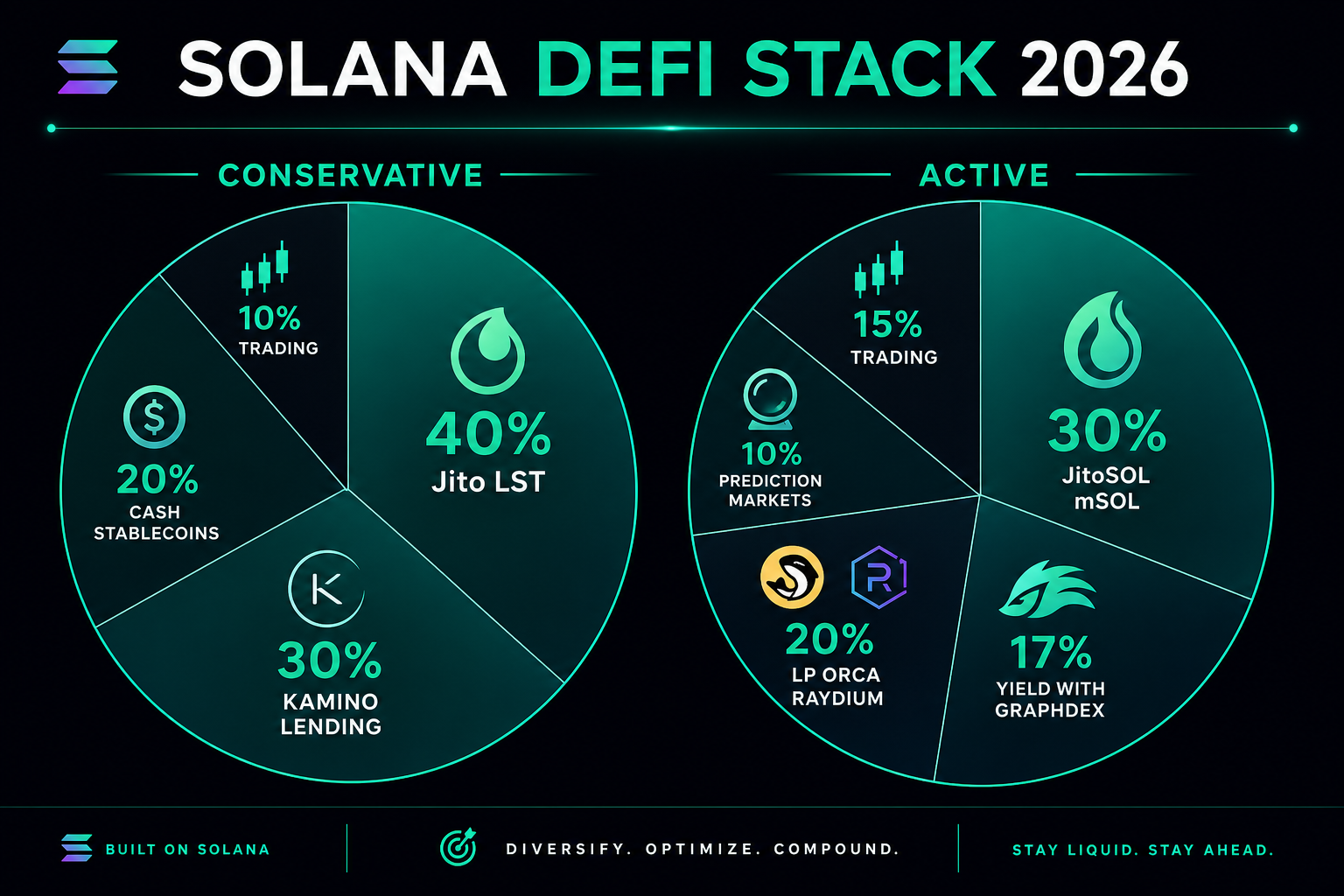
For users wanting comprehensive Solana DeFi exposure, a sensible allocation:
The Conservative Stack (lowest risk):
- 40% liquid staking via Jito (JitoSOL) for ~5.80% APY
- 30% stablecoin lending via Kamino for 5-8% APY
- 20% cash position in stablecoins for opportunities
- 10% in active trading positions
The Active Stack:
- 30% JitoSOL or mSOL for liquid staking yield
- 25% stablecoin lending (Kamino) or fee-based yield (GraphDex up to 17%)
- 20% LP provision (Orca/Raydium SOL-USDC concentrated pools)
- 15% active trading positions
- 10% prediction markets (via GraphDex + Polymarket)
The Memecoin/High-Risk Stack:
- 50% in stable yields (Kamino lending, JitoSOL)
- 30% in established Solana DeFi tokens (JUP, KMNO, JTO)
- 20% in memecoin speculation with strict position sizing — using Bubble Maps and Pulse feed for discovery and safety
The red flags to watch:
- TVL drops >30% in a week
- Governance proposals to change fee structures without notice
- Repeated oracle failures
- Sustained LST depeg >2%
- Protocol pausing withdrawals (exit immediately)
Trade Solana DeFi safely on GraphDex
Frequently Asked Questions
What's the best Solana DeFi protocol in 2026? There's no single best — top protocols lead distinct categories. Jupiter (DEX aggregation, $2.39B TVL), Kamino (lending, $2.43B TVL), Jito (liquid staking, $2.72B TVL), Raydium (AMM), Drift (perpetuals). Most active users combine 2-3 protocols across different categories.
What is Solana DeFi TVL? Solana DeFi TVL (Total Value Locked) reached $11.5 billion in Q3 2025, with major protocols managing $2+ billion each. Total has grown significantly with Solana's ecosystem maturation. Up-to-date TVL is tracked on DefiLlama and similar analytics platforms.
Is Solana DeFi safer than Ethereum DeFi? Different risk profiles. Solana has fewer validators (~1,400 vs Ethereum's 900,000+) but lower fees making active management economical. Both have suffered smart contract exploits — Drift lost $285M in 2025, Kelp DAO lost $300M on Ethereum-side restaking in April 2026. Use audited blue-chip protocols on either chain.
How do I earn yield in Solana DeFi? Multiple paths: liquid staking (Jito for ~5.80% APY), stablecoin lending (Kamino 5-8%), LP provision (Orca/Raydium 8-25% with impermanent loss risk), fee-based platform yield (GraphDex up to 17%). Most users combine multiple approaches for diversified yield.
What's the difference between Jito and Marinade? Both are Solana liquid staking. Jito (JitoSOL) captures MEV rewards on top of base staking yield — ~5.80% APY, deepest DeFi integration. Marinade (mSOL) is the original Solana LST, delegated to 100+ validators for greater decentralization — ~6.4% APY. Jito for maximum yield + integration; Marinade for maximum decentralization.
Can I use Solana DeFi without technical experience? Yes — Solana has the friendliest DeFi UX in crypto thanks to low fees enabling rapid learning. Start with simple actions (swap on Jupiter, stake with Jito, deposit to Kamino). Use a quality wallet (Phantom) and terminal (GraphDex for integrated experience). Avoid leverage and complex strategies until you understand the basics.
Are Solana DeFi yields sustainable? The major established protocols (Jito, Kamino, Jupiter, Raydium) generate yields from real economic activity — network staking rewards, borrower interest, trading fees, MEV capture. These are fundamentally sustainable as long as the underlying activities continue. Avoid emission-based "yields" from new untested protocols, which typically collapse when emissions decline.
About This Guide
This guide is published by the GraphDex Research team — analysts and traders building the infrastructure for digital asset trading on Solana. Our content is based on live protocol data, current market figures, and direct experience.
Sources & data: TVL figures, yields, and protocol details reflect publicly available information as of 2026 and may change continuously. Solana DeFi carries real risks including total loss. This guide is educational and not financial advice — always do your own research.
GraphDex is the infrastructure for digital asset trading — trade, predict, and earn in one place. Learn more at graphdex.io.
Last reviewed: May 2026 · GraphDex Research
The infrastructure for digital asset trading. Trade, predict, stake, repeat. graphdex.io