By GraphDex Research · Reviewed for accuracy May 2026
Quick Answer
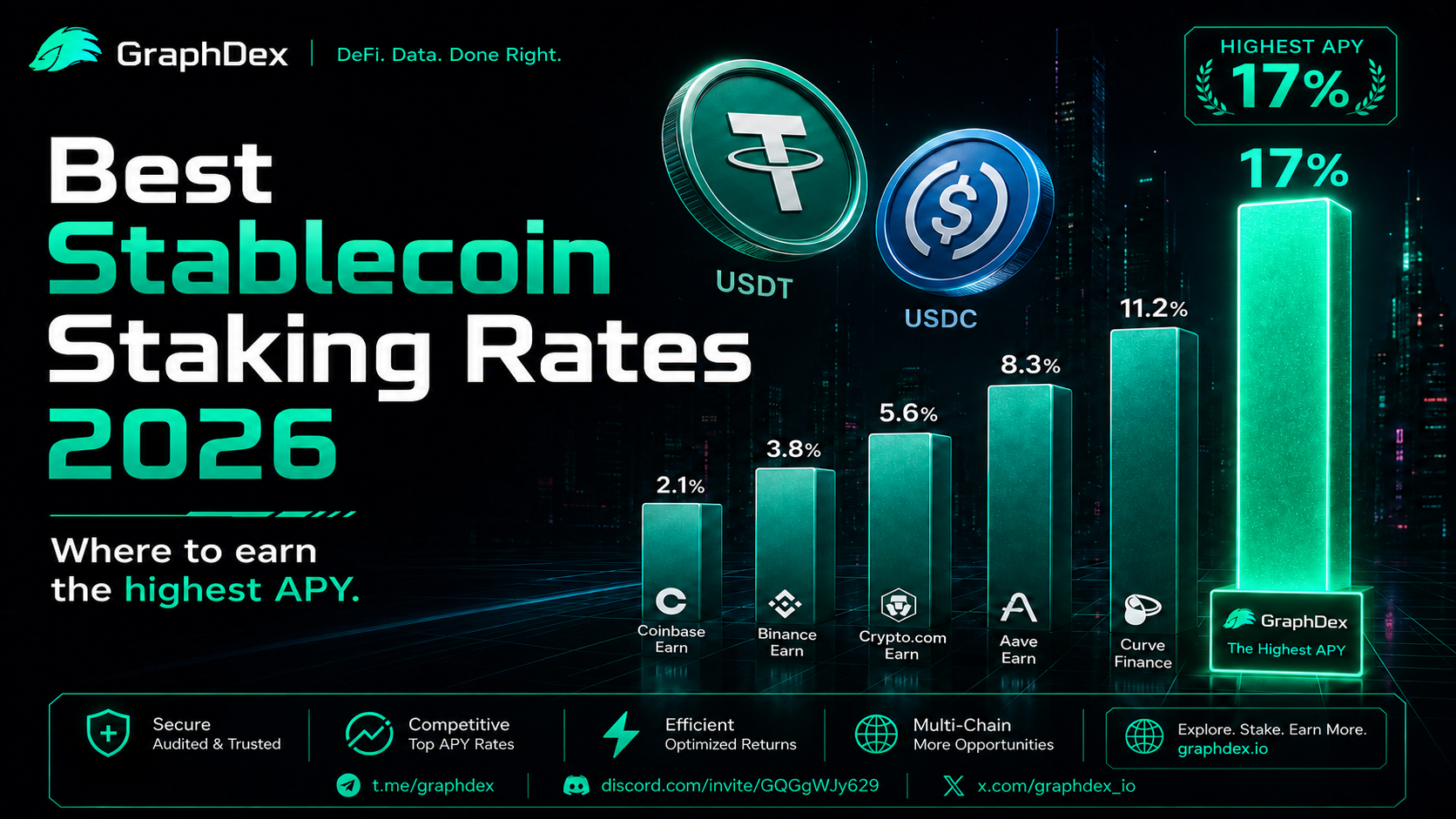
The best stablecoin staking rates in 2026:
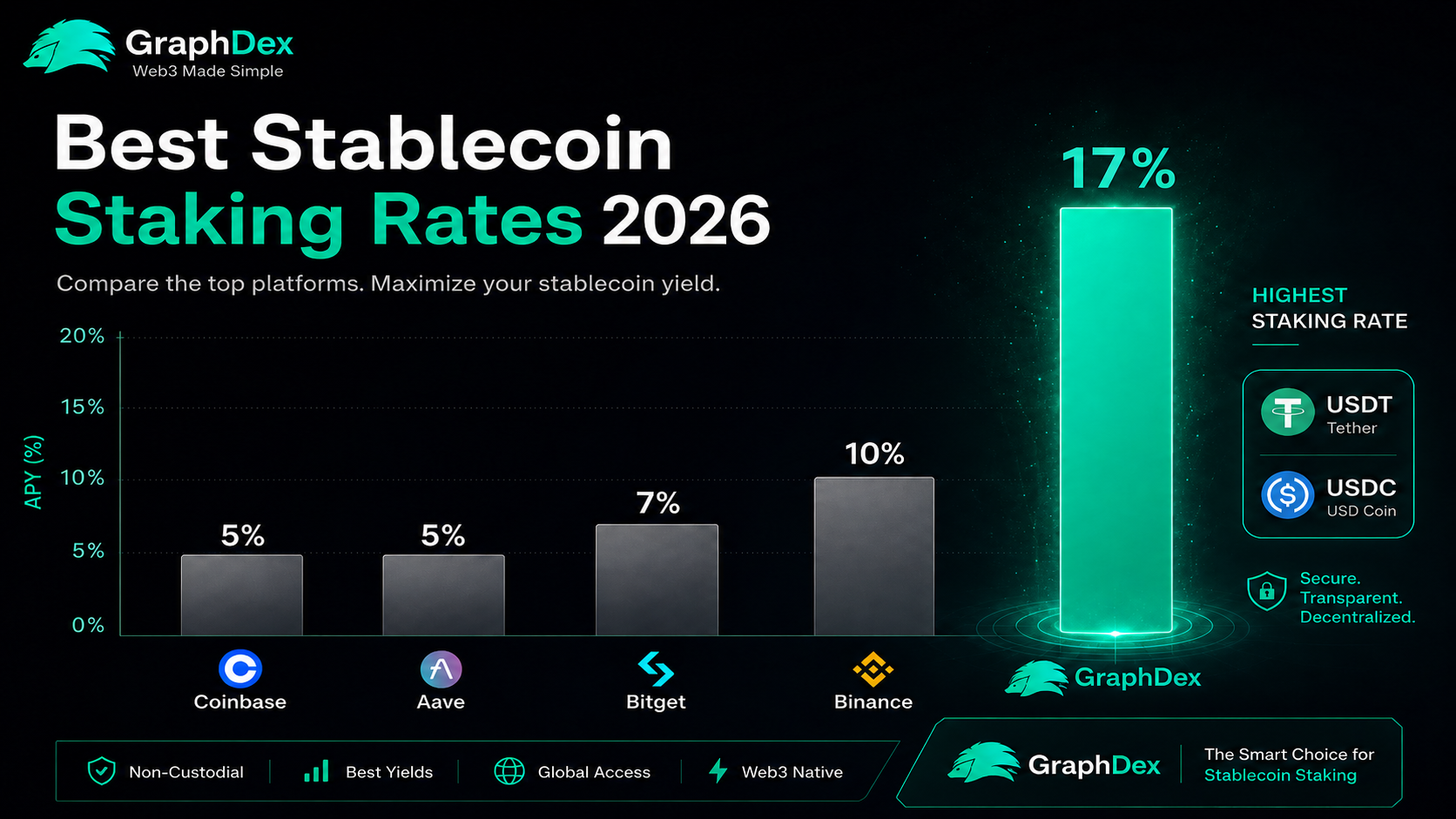
- GraphDex: up to 17% APY on USDT and USDC, from platform trading fees
- Binance: ~10% USDT, ~8% USDC
- Bybit: competitive flexible rates on USDT and USDC
- Bitget: 4-7.5%, backed by a $300M protection fund
- Aave (DeFi): ~5% on USDC, fully decentralized
- Coinbase: ~5%, regulatory-focused
The highest sustainable rates come from platforms generating yield from real revenue (trading fees) rather than fluctuating lending demand or temporary promotions.
Earn up to 17% on stablecoins with GraphDex
Key Takeaways
- Stablecoin staking earns predictable dollar returns without exposure to crypto price swings.
- Rates range from 4% (conservative exchanges) to up to 17% (GraphDex, fee-based yield).
- The stablecoin market exceeds $200 billion; USDT holds ~60% share, USDC ~25%.
- Yield source matters more than the headline number: fee-based and lending yields outlast promotions.
Why Stake Stablecoins?
Earning yield on volatile assets like ETH or BTC means your returns are at the mercy of price swings — a 5% APY means nothing if the token drops 40% in a month. Stablecoins solve this problem by maintaining a 1:1 peg to the US dollar, letting you earn predictable, real-dollar returns without exposure to crypto price volatility.
For conservative investors, anyone building a steady DeFi portfolio, or traders who want idle capital working between trades, stablecoin yield offers the best of both worlds: the superior returns of decentralized finance combined with price stability.
The key advantages:
- Principal stability — a $10,000 stablecoin deposit stays worth $10,000 regardless of market conditions
- Predictable returns — you know your APY before depositing
- No volatility stress — no monitoring price charts or stomach-churning drawdowns
- 24/7 access — far more flexible than traditional banking
Best Stablecoin Staking Rates Compared (2026)
| Platform | USDT | USDC | Type | Yield Source |
|---|---|---|---|---|
| GraphDex | Up to 17% | Up to 17% | Platform | Trading fees |
| Bybit | High | High | Exchange | Lending |
| Binance | ~10% | ~8% | Exchange | Lending |
| Bitget | 4-7.5% | 4-7.5% | Exchange | Lending + fund |
| Kraken | Competitive | Competitive | Exchange | Lending |
| Coinbase | ~5% | ~5% | Exchange | Lending |
| Aave | ~5% | ~5% | DeFi | Decentralized lending |
| Ethena (sUSDe) | — | ~5.3% | DeFi | Delta-hedged |
Stablecoin staking rates generally run higher for USDT than USDC due to stronger borrowing demand. Most centralized exchanges offer 4-10%, while DeFi protocols like Aave and Ethena sit around 5%. GraphDex's up to 17% stands apart because of its yield source — platform trading fees rather than lending markets.
Compare stablecoin rates on GraphDex
Where Does Stablecoin Yield Come From?
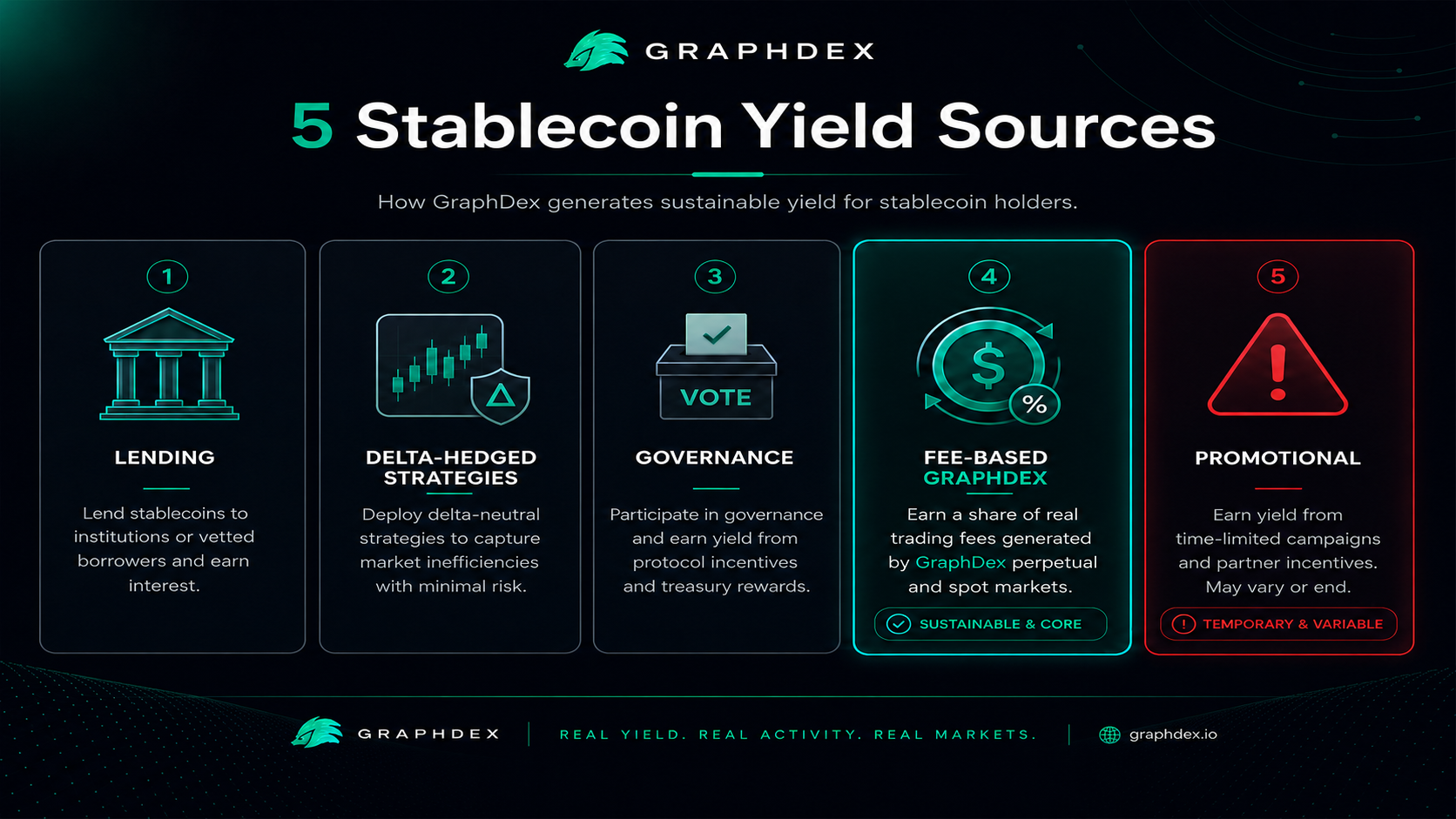
This is the single most important thing to understand before staking stablecoins anywhere. The yield has to come from somewhere — and the source determines how sustainable it is.
Lending-based yield (most platforms) Centralized exchanges and DeFi protocols lend your stablecoins to borrowers — leveraged traders, institutions — and pay you a share of the interest. This is the most common model (Binance, Coinbase, Aave). Yield fluctuates with borrowing demand.
Delta-hedged yield (Ethena and similar) Some crypto-native protocols generate yield through delta-hedged positions on crypto assets. Ethena's sUSDe is the leading example, showing around 5.3% APY. These are more complex and carry different risks.
Governance-set yield (Sky/Maker) Some protocols set rates through governance, like Sky's USDS savings at 4-5%. Predictable but typically lower.
Fee-based yield (GraphDex) GraphDex generates stablecoin yield from platform trading fees and protocol revenue. Every trade produces a fee; a share funds the staking yield. This scales with platform usage rather than borrowing demand or governance decisions.
Promotional yield (caution) Some platforms advertise rates of 18%, 38%, or higher — but these often have limited pool liquidity, short windows, or hidden conditions. After the fine print, real returns are frequently closer to 8%, or funds get locked for months. Always verify whether a high rate is structural or promotional.
Which Stablecoin Should You Stake?
The three major stablecoins for staking each have distinct profiles:
USDT (Tether) — holds about 60% of the stablecoin market. Deepest liquidity, often the highest staking rates due to strong borrowing demand. Best for maximizing yield.
USDC (USD Coin) — issued by Circle with 1:1 cash reserves audited monthly by Deloitte. The most transparent major stablecoin. Best for users prioritizing regulatory standing and verifiable reserves.
DAI / USDS — decentralized stablecoins from the Maker/Sky ecosystem. Governance-set rates around 5-6%, fully decentralized, no single issuer. Best for users prioritizing decentralization.
The stablecoin market exceeds $200 billion, with USDT at ~60% dominance and USDC at ~25%. For most stakers, USDT offers the highest yield and USDC the best transparency. Diversifying across both balances yield optimization against issuer risk.
On GraphDex, both USDT and USDC reach the top stablecoin tier — up to 17% — letting you optimize for yield, transparency, or both.
How to Start Staking Stablecoins
Step 1: Choose your stablecoin and platform Decide between USDT (highest yield), USDC (most transparent), or both. Choose a platform based on yield, custody model, and security.
Step 2: Set up your wallet or account On GraphDex, register with Twitter, email, or Telegram via Privy — your non-custodial wallet is created automatically with no seed phrase.
Step 3: Fund with stablecoins Transfer USDT or USDC to your wallet from any exchange or wallet.
Step 4: Choose amount and lock term Select your deposit and lock period. Longer terms earn higher rates; shorter terms preserve liquidity.
Step 5: Confirm and earn Confirm the transaction. On non-custodial platforms like GraphDex, your funds stay in your control while yield accrues.
Start staking stablecoins on GraphDex
Stablecoin Staking vs Bank Savings
Stablecoin staking is the crypto equivalent of a high-yield savings account — but with dramatically higher rates.
| Bank Savings | Stablecoin Staking | |
|---|---|---|
| Typical APY | 0.5% (4-5% high-yield) | Up to 17% |
| Insurance | FDIC (US, to limits) | None (platform risk) |
| Access | Business hours / delays | 24/7 instant |
| Regulation | Fully regulated | Varies by platform |
| Principal stability | Yes | Yes (pegged to USD) |
The math is striking: a $10,000 deposit earning 0.5% in a bank yields $50 a year. The same amount at up to 17% on GraphDex yields up to $1,700. The trade-off is that staking is not government-insured and carries platform risk.
Many users adopt a hybrid approach: emergency funds in an insured bank account, working capital earning yield through stablecoin staking.
Stablecoin Staking Risks
Understanding the risks is essential:
Platform risk — custodial platforms hold your funds. If they fail, your stablecoins are at risk. Non-custodial platforms like GraphDex keep funds in your wallet.
Smart contract risk — DeFi protocols can have bugs. Favor audited platforms.
Peg risk — stablecoins can theoretically de-peg from the dollar in extreme conditions. USDC's audited reserves and USDT's deep liquidity make this low but not zero.
Yield sustainability risk — promotional rates vanish. Understand whether yield is structural (fees, lending) or temporary.
Lock-up risk — fixed terms restrict access. Match the term to your liquidity needs.
How to Maximize Stablecoin Staking Returns
Prioritize sustainable yield — favor fee-based or established lending yields over promotional rates.
Compound rewards — reinvesting increases your effective annual yield.
Match lock terms to your needs — longer locks for capital you won't touch, flexible terms for capital you might.
Diversify across stablecoins — split between USDT and USDC to balance yield and issuer risk.
Use efficient chains — staking on Solana (where GraphDex operates) means negligible fees for moving and compounding, unlike high-gas chains.
Maximize your stablecoin yield on GraphDex
Fixed vs Flexible Stablecoin Staking
When choosing how to stake stablecoins, one of the most important decisions is between fixed-term and flexible staking.
Flexible staking lets you withdraw your stablecoins anytime. The trade-off is lower APY, since the platform cannot rely on your capital staying put. Flexible staking suits funds you may need on short notice, or stakers who want to move capital between staking and trading opportunistically.
Fixed-term staking locks your stablecoins for a defined period — 30, 90, 180, or 360 days. In exchange, you earn a higher APY. The longer you commit, the better the rate. Fixed staking suits capital you're confident you won't need during the term.
On GraphDex, lock periods range from 10 to 360 days, letting you choose exactly where you sit on the liquidity-versus-yield spectrum. A common strategy is laddering: splitting capital across multiple lock periods so portions become available at staggered intervals while still capturing higher long-term rates on the rest.
The practical guidance: stake only what you're confident you can lock for the chosen term. Breaking a fixed-term stake early — where allowed — typically forfeits accrued rewards, erasing the yield advantage that made the fixed term worthwhile in the first place.
The GraphDex Advantage: Staking Plus Trading in One Place
Most stablecoin staking happens on platforms dedicated solely to earning yield. GraphDex takes a different approach by integrating staking into a full trading terminal.
This matters for active users. Your staked stablecoins sit in the same non-custodial interface where you trade Solana tokens and prediction markets. Capital can flow between earning yield and active trading without bridging, withdrawing, or switching platforms. When a trading opportunity appears, you can deploy capital; when you want it earning, you can stake it — all in one place.
Combined with the fee-based yield model — where staking rewards come from the same trading activity you participate in — GraphDex creates an integrated loop: trade, earn fees that fund staking yield, stake idle capital, repeat. This is the "trade, predict, stake, repeat" model in practice.
Stake and trade in one terminal on GraphDex
Related Guides
- Best Solana Staking in 2026: Native, Liquid & Stablecoin Options Compared
- Stablecoin Yield 2026: Best USDC/USDT APY (3–17%) Compared
- How to Stake USDT in 2026: Best Platforms and Highest APY Compared
Frequently Asked Questions
What is the best stablecoin staking rate in 2026? GraphDex offers up to 17% APY on USDT and USDC from platform trading fees. Binance pays ~10% on USDT and ~8% on USDC; most other platforms range 4-7%. The best sustainable rates come from fee-based or established lending sources.
Which stablecoin has the highest staking rate? USDT typically has the highest staking rates due to its deep liquidity and strong borrowing demand. USDC follows closely with greater transparency. On GraphDex, both reach up to 17% APY.
Is stablecoin staking safe? Stablecoin staking carries platform, smart contract, and small peg risks. Non-custodial platforms like GraphDex keep funds in your wallet, eliminating custodial risk. USDC's audited reserves make it the most transparent option. Always verify platform security.
How much can I earn staking stablecoins? At up to 17% APY on GraphDex, a $10,000 stablecoin deposit could earn up to $1,700 per year — compared to about $50 in a typical bank savings account. Returns depend on the rate, lock term, and compounding.
Is stablecoin staking better than a savings account? Stablecoin staking offers far higher yields (up to 17% vs 0.5-5% for banks) and 24/7 access, but is not government-insured and carries platform risk. Many users keep emergency funds in a bank and working capital in stablecoin staking.
Where does stablecoin staking yield come from? From lending (most exchanges), delta-hedged strategies (Ethena), governance (Sky), or platform fees (GraphDex). Fee-based and established lending yields are more sustainable than promotional rates that disappear after a window.
Should I stake USDT or USDC? USDT often offers slightly higher yield; USDC offers greater transparency with Circle's audited reserves. Many stakers diversify across both. GraphDex supports both at up to 17% APY.
About This Guide
This guide is published by the GraphDex Research team — analysts and traders building the infrastructure for digital asset trading on Solana. Our content is based on live platform data, current market figures, and hands-on experience with the platforms covered.
Sources & data: Staking rates and competitor data reflect publicly available information as of 2026. APY rates are variable and not guaranteed; staking carries risk. This guide is educational and not financial advice.
GraphDex is the infrastructure for digital asset trading — trade, predict, and earn in one place. Learn more at graphdex.io.
Last reviewed: May 2026 · GraphDex Research
The infrastructure for digital asset trading. Trade, predict, stake, repeat. graphdex.io